Category Archives: Law

An open letter to the President of India: G. Ananthapadmanabhan

Sri Pranab Mukherjee
President of India
Rashtrapati Bhavan
New Delhi – 110 004.
India

12 December 2012

Subject: Open letter regarding the resumption of executions in India

Dear President,

I am writing on behalf of Amnesty International regarding the recent resumption of executions in India after eight years, to urge the Indian authorities to immediately establish a moratorium on executions with a view to abolishing the death penalty. Continue reading An open letter to the President of India: G. Ananthapadmanabhan

Free the innocent undertrials and Jharkhand’s jails won’t be overcrowded: Stan Swamy

Guest post by STAN SWAMY

A Controller and Auditor General (CAG) report tabled recently in Jharkhand  Assembly says most of Jharkhand  jails are housing prisoners beyond their capacity by the end of 2010. Significantly, the most crowded jails are in Garwa, Latehar and Simdega districts where anti-naxalite operations by police and para-military forces are on. The basic question to ask is: are Jharkhandi adivasis & moolvasis increasingly taking to crimes or is the society labeling them criminals.
There are three basis on which young rural adivasi men & women are arrested: Continue reading Free the innocent undertrials and Jharkhand’s jails won’t be overcrowded: Stan Swamy

Full report: Alleged Perpetrators – Stories of Impunity in Jammu & Kashmir

Given below is a report put out this morning by the Srinagar-based INTERNATIONAL PEOPLES’ TRIBUNAL ON HUMAN RIGHTS AND JUSTICE IN INDIAN-ADMINISTERED KASHMIR [IPTK] and ASSOCIATION OF PARENTS OF DISAPPEARED PERSONS [APDP].

Given below is a press release and the executive summary of the report.

Continue reading Full report: Alleged Perpetrators – Stories of Impunity in Jammu & Kashmir

Reject amendments to UAPA – An appeal to members of the Rajya Sabha: JTSA

This release was put out by the JAMIA TEACHERS’ SOLIDARITY ASSOCIATION on 3 December 2012. Full list of signatories at the end.

It is saddening and surprising that at a time when more and more evidence is surfacing about the extensive abuse of anti-terror laws in targeting minorities, tribals, deprived sections as well as political activists, the government has chosen to move amendments in the present UAPA 2008. These amendments will make the law even more draconian and amenable to human rights violations.

 You will remember that the amendments in the Unlawful Activities Prevention Act 1967 were passed in December 2008 without any thoroughgoing debate in the aftermath of the horrendous carnage in Mumbai. The Bill was not referred to any Parliamentary committee despite calls by several members for such a scrutiny and consultative process. Whilst the widespread sense of shock and reprehension at the Mumbai killings may have been weighing on the minds of the Hon’ble Members of Parliament then, four years later, surely, there is no reason to push through the amendments without a wider debate.   Continue reading Reject amendments to UAPA – An appeal to members of the Rajya Sabha: JTSA

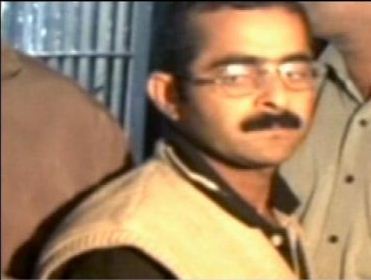
Can the Love of Justice be Assassinated?: Arvind Narrain and Saumya Uma remember Shahid Azmi

Guest post by ARVIND NARRAIN and SAUMYA UMA

Progressive lawyers, social activists and academics have invested much time in trying to puzzle out what is the progressive potential of law. Sometimes, answers to deep philosophical questions emerge from a single life. Shahid Azmi’s life   (1977-2010) exemplifies one answer to this perennial question. It was a life which took to the legal profession with the objective of using  law as a shield and tool in the quest for justice. It was also a life which was tragically cut short, when Shahid Azmi was assassinated  at the  age of thirty three.

Continue reading Can the Love of Justice be Assassinated?: Arvind Narrain and Saumya Uma remember Shahid Azmi

Abolition of Death Penalty – A Time for National Reflection: PUCL

This release was put out yesterday by the PEOPLE’S UNION FOR CIVIL LIBERTIES

The secretive and stealthy hanging of Ajmal Kasab in Pune’s Yerwada Prison yesterday, 21st November, 2012, brings to an end the legal process involved in trying Kasab for the brutal assault by trained terrorists from across the border on Mumbai, the commercial capital of India which left 166 persons dead.

The Mumbai carnage of November 2008, more popularly abbreviated to a single term `26/11,’ constitutes one of the most heinous and deliberate attempts in recent years to cause mass mayhem and terror in India. Kasab was the only member of the terrorist team sent from Pakistan apprehended alive; he was caught on film diabolically using his modern automatic weapon in a cold blooded fashion, killing numerous people. The hanging, and the trial and legal proceedings which preceded it,  admittedly  complied with existing laws which permit death penalty, and cannot be faulted as such.  While it may be argued, as many do  that the hanging will help in an `emotional closure’ to the families of victims of 26/11, there are others who point out that other key issues still remain to be addressed.  Families of victims in specific, as also other concerned citizens, have pointed out that Kasab was only a foot soldier and not the mastermind, who still remain at large. Continue reading Abolition of Death Penalty – A Time for National Reflection: PUCL

Why I was saddened by Kasab’s execution

Rejoice, fellow Indians. Ajmal Kasab has been hanged. But please excuse me, I am not joining you. Your cheering and hooting and hurrahs feel like a medieval lynch mob celebrating the death of the sinner and not the sin. Barbaric is the word that comes to mind.

This isn’t merely about the morality or aesthetic of capital punishment. I want to ask you: what did we just achieve? Ten terrorists had come to kill and be killed, to cause maximum damage of the sort that they surely knew they’d be killed. Nine of them were killed in direct encounter. Did we hail their deaths? Do we say their deaths were justice? So if we killed Ajmal Kasab four years later- “with due process” – what exactly have we achieved? Continue reading Why I was saddened by Kasab’s execution

Satyameva Jayate? On the impending execution of Afzal Guru

Someday, we will count how many minutes it took for television in India to start baying for Afzal Guru’s blood (once again) after Ajmal Kasab was buried in Yerwada Central Jail in Pune.

A man called Mohammad Afzal Guru, son of Habibullah Guru, currently resident in Ward Number 6 of Jail Number 1 in Tihar Central Prison in Delhi will hang to satisfy the bloodlust of the Indian Republic, unless the President of India decides otherwise. This text is an attempt to make us think about this decision and its ramifications carefully.

Continue reading Satyameva Jayate? On the impending execution of Afzal Guru

The Power of Mercy: Yug Mohit Chaudhry on the execution of Ajmal Kasab

Guest post by YUG MOHIT CHAUDHRY

Under Article 72 of the Constitution of India, the President’s power to grant mercy comes into play only after the judicial system has confirmed the death sentence. Therefore, the confirmation of the death sentence by the highest court is a condition precedent to the grant of mercy. Judicial confirmation of the death sentence does not put the convict beyond the pale or disqualifies him from mercy; in fact it renders him eligible for mercy. Arguments that Kasab deserved no mercy once the Supreme Court confirmed his death sentence are misconceived.

It is only the rarest of rare crimes that shock the collective conscience of society and are truly unpardonable that are given the death sentence. In our constitutional scheme, it is therefore only persons committing such crimes that are eligible for mercy and pardon. If they are to be excluded from the ambit of mercy by the mere fact of having committed truly unpardonable crimes, the President’s power of mercy has no meaning. Paradoxically, the very fact that Kasab had indeed committed an unpardonable crime is what renders him eligible for mercy. Continue reading The Power of Mercy: Yug Mohit Chaudhry on the execution of Ajmal Kasab

Kerala Police arrest one more for hurting some feelings: Sajan Venniyoor

This just in from our Thiruvananthapuram correspondent SAJAN VENNIYOOR

Trivandrum, 21 Nov: An unnamed youth from Thiruvananthapuram was arrested by the Kerala Police cyber-crime squad for allegedly ‘liking’ a Facebook post written by a complete stranger. The Facebook account in the name of ‘Indian Patroit Who Fuking Hates Everybody’ – believed to be an alias – carried a comment that was allegedly critical of something reportedly concerning a recently deceased non-Malayali. The Facebook comment was also withdrawn soon after the arrest of the Thiruvananthapuram native under sections 505 of IPC (“promoting ill-will among groups with different imaginary friends”) and 66A of the IT Act (“causing annoyance while belonging to a minority group”).

It is not known what the offensive post said, but police sources confirm that while the comment “did not actually hurt religious sentiments in the proper sense of the word”, it jolly well hurt the feelings of people who knew someone who had some kind of  sentiments that may well have been hurt had he been alive.

In his defence, the unnamed youth submitted before the Judicial Magistrate First Class, Vanchiyoor, that he had clicked on the Facebook button only because he violently disagreed with the post, thinking it said “Yikes”.

His lawyer confirmed later that the youth, who was let off on bail, was either dyslexic or from Ulloor.

(Clarification: Some Of Us Are Actually Dyslexic and/or From Ulloor. Any offence caused is therefore to us.)

A dangerous idea

For easy sharing, you can find this image on Twitter and Facebook.

Social Media Regulation vs. Suppression of Freedom of Speech: Pranesh Prakash

Guest post by PRANESH PRAKASH

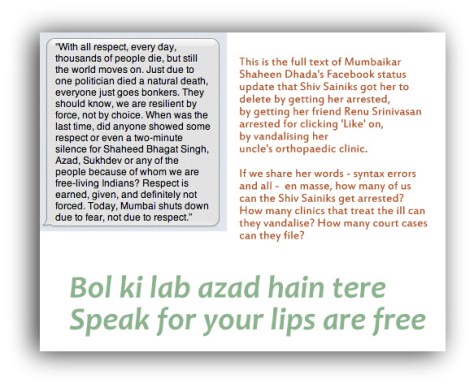
This morning, there was a short report in the Mumbai Mirror about two girls having been arrested for comments one of them made, and the other ‘liked’, on Facebook about Bal Thackeray:

Police on Sunday arrested a 21-year-old girl for questioning the total shutdown in the city for Bal Thackeray’s funeral on her Facebook account. Another girl who ‘liked’ the comment was also arrested.

The duo were booked under Section 295 (a) of the IPC (for hurting religious sentiments) and Section 64 (a) of the Information Technology Act, 2000. Though the girl withdrew her comment and apologised, a mob of some 2,000 Shiv Sena workers attacked and ransacked her uncle’s orthopaedic clinic at Palghar.

“Her comment said people like Thackeray are born and die daily and one should not observe a bandh for that,” said PI Uttam Sonawane.

What provisions of law were used?

There’s a small mistake in Mumbai Mirror‘s reportage as there is no section “64(a)”1 in the Information Technology (IT) Act, nor a section “295(a)” in the Indian Penal Code (IPC). They must have meant section 295A of the IPC (“outraging religious feelings of any class”) and section 66A of the IT Act (“sending offensive messages through communication service, etc.”). The Wall Street Journal’s Shreya Shah has confirmed that the second provision was section 66A of the IT Act.

Section 295A of the IPC is cognizable and non-bailable, and hence the police have the powers to arrest a person accused of this without a warrant.2 Section 66A of the IT Act is cognizable and bailable. Some news sources claim that section 505(2) of the IPC (“Statements creating or promoting enmity, hatred or ill-will between classes”) has also been invoked.

This is clearly a case of misapplication of s.295A of the IPC.3 This provision has been frivolously used numerous times in Maharashtra. Even the banning of James Laine’s book Shivaji: Hindu King in Islamic India happened under s.295A, and the ban was subsequently held to have been unlawful by both the Bombay High Court as well as the Supreme Court. Indeed, s.295A has not been applied in cases where it is more apparent, making this seem like a parody news report. Continue reading Social Media Regulation vs. Suppression of Freedom of Speech: Pranesh Prakash

The Uttar Pradesh administration has a prominent role in the burning of Bhadarsa: Rihai Manch

This release was put out by the RIHAI MANCH on 9 November

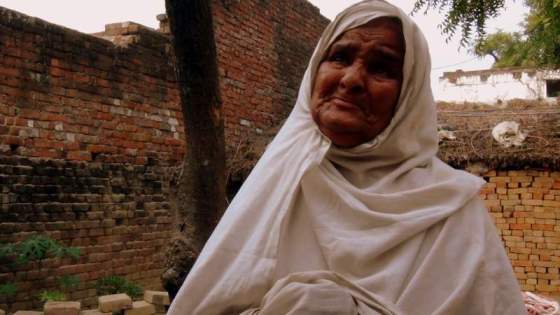
Jannatunisa, a victim of violence in Bhadarsa

Faizabad 9 November 2012: An investigation team of Rihai Manch visited the Bhadarsa village which was affected by communal violence during Dussehra celebrations. The team found out that the violence was well planned and was executed by communal elements in connivance with the administration. The role of the media in this incident is also suspicious. The team also found that the administration is forcing the affected families to erase any evidence of the incident and they have not even been compensated. No FIR has yet been registered yet. The team has also requested the Sheetla Singh Investigation Commission (constituted by the Press Council of India) to visit the area. Continue reading The Uttar Pradesh administration has a prominent role in the burning of Bhadarsa: Rihai Manch

Why is the media not asking hard questions on the deportation of Fasih Mehmood?: JTSA

This statement comes from the JAMIA TEACHERS’ SOLIDARITY ASSOCIATION

In September, we brought out a report, Framed, Damned, Acquitted documenting 16 cases where trials of terror accused had resulted in acquittals for not only lack of evidence but obviously concocted evidence. Each of these cases was accompanied by a section on how media had publicly tried and ‘executed’ these unfortunate men when they were first arrested—to abandon them or bury their stories in the inside pages when they were later acquitted. The release of the report had generated a genuine interest in the media—and one may dare say, an introspection of the media’s own role as the handmaiden of the investigative agencies. Continue reading Why is the media not asking hard questions on the deportation of Fasih Mehmood?: JTSA

Delhi University Restrained for Alleged Admission of Infringement: True Lies? Amlan Mohanty

Cross posting an intervention  by Amlan Mohanty from SpicyIP since it provides us with a very insightful analysis of the recent injunction obtained in the DU photocopy case. It also refers to  an anonymous link to communication which indicates what the real intent behind the case is.

Delhi University Restrained for Alleged Admission of Infringement: True Lies?

This afternoon, in response to my post announcing a petition relating to the OUP-Delhi University copyright dispute, we received a comment informing us that an order had already been passed against Delhi University a few days ago.
There was also a link to an e-mail allegedly sent to various publishers informing them of this order. The e-mail appears to have been sent from the lawyers representing the publishers. Unfortunately, this was posted anonymously in our comments section so we are unable to verify its authenticity. However, if it is in fact genuine, it raises an entire gamut of interesting questions that the future of this case will hinge upon.

Bootlegging Education – Four Strategies for Fighting Back

Yes, this is what we must do now on a large scale – bootleg education.

Thanks to the conjunction of new heights of intellectual bankruptcy with new regimes of intellectual property, a large scale attack on equitable access to education is upon us. A longer discussion on  ‘Intellectual property’ is required, but the immediate provocation for this post is of course the Delhi University photocopying case. Elsewhere on Kafila, there is a post that links to a petition by authors and academics on this issue. The case, very simply is this: three big corporate publishers, namely Oxford University Press, Cambridge University Press and Taylor and Francis have filed a petition in the Delhi High Court, claiming infringement of copyright with regard to course packs used by students. The offender against these giant publishers is a small photocopy shop in Delhi School of Economics. As many legal experts on intellectual property and the Indian copyright law have stated, this kind of photocopying is well within the framework of the law (See some of the discussion here and here).

At the moment, however, I am not concerned with the pure legality of the issue. The question of ‘course packs’ concerns the vital interests of our society as a whole. For there was a time when teaching at the college and university level was  conducted largely through substandard kunjis, or guidebooks – honourable exceptions apart, of course.  Even today we have at least one of the corporate giants (that happens to be among those suing the little Rameshwari photocopier), producing slightly upmarket versions of such guidebooks. University professors willing to write a substandard book a month that fits into some course or the other, are also published by  publishers like these now, euphemistically called ‘textbooks’. In an earlier time, such books of barely passable scholarship (largely plagiarized cut-and-paste jobs) would be published only by dubious publishers.

Continue reading Bootlegging Education – Four Strategies for Fighting Back

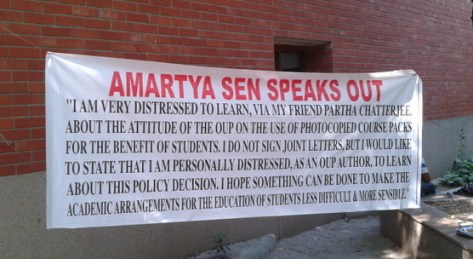
Authors and academics for equitable access to learning material

Three large academic publishers – Oxford University Press, Cambridge University Press and Taylor & Francis – have filed a petition in the Delhi High Court claiming copyright infringement with regard to the course packs used by students of Delhi University in a number of disciplines.  It is clear from DU’s stance in court that they are  distancing themselves from the  photocopier, thus clearing the way for the Court to pass an injunction staying the sale of course packs. It is absolutely critical now  for academics and authors to step up our campaign in support of our students’ access to learning materials:

Please sign the on-line petition at the link below:

“…As authors and educators, we would like to place on record our distress at this act of the publishers, as we recognize the fact that in a country like India marked by sharp economic inequalities, it is often not possible for every student to obtain a personal copy of a book. In that situation the next best thing would have been for multiple copies of the book to be available in the library so that students are able to access these books without any difficulty. But given the constraints that libraries in India work with, they may only have a single copy of a book and in many instances, none at all. The reason we make course packs is to ensure that students have access to the most relevant portions of the book without which we would be seriously compromising their education….”

Kazmi Solidarity Committee welcomes SC order to grant bail to Syed Kazmi

This release comes from the KAZMI SOLIDARITY COMMITTEE

The Kazmi Solidarity Committee welcomes the Supreme Court order granting bail to Syed Mohammad Ahmad Kazmi after seven months in custody on charges of involvement in the bomb attack on an Israeli diplomatic vehicle.

The committee deplores the obstructive attitude of the prosecution and the Special Cell of the Delhi Police, which have been perversely attempting to keep Mr. Kazmi in prison despite their inability to file a chargesheet within the extended time granted under the Unlawful Activities Prevention Act. Not only did the prosecution seek an extension of 90 days after the mandated period of judicial custody was over, it also used its inefficiency as an alibi, pleading that it needed more time to send out letters rogatory seeking international judicial assistance. While Mr. Kazmi was in custody, the Special Cell left no stone unturned in orchestrating a media trial to establish his guilt, planting malicious stories of his “confession” (while disavowing responsibility for these in court hearings).

Continue reading Kazmi Solidarity Committee welcomes SC order to grant bail to Syed Kazmi

A statement on the arrest of 13 political activists in Tamil Nadu

Tamil Nadu has always had a very high handed police, infamous for extrajudicial killings, torture and arbitrary arrest of political dissidents of all hues. In recent times, thanks to the popular Koodankulam agitation the authoritarian ways of the state police seems to have acquired a ‘nuclear’ edge.

On 6 October 2012, as 13 senior members of the Peoples Democratic Republic Party met at a school in Kundrathur near Chennai city they were all arrested by the ‘Q Branch’, as the local intelligence bureau is called in Tamil Nadu. The arrested members and supporters of the party have been since remanded to judicial custody in Vellore central prison and a case under section Cr. L.A 17 (1) registered against them. Continue reading A statement on the arrest of 13 political activists in Tamil Nadu

An appeal to release three Pakistani fishermen imprisoned in India since 1999: Jatin Desai

Given below is the text of a letter sent yesterday by JATIN DESAI to the Indian foreign secretary

Shri Ranjan Mathai,
Foreign Secretary,
Ministry for External Affairs,
Government of India,
New Delhi -110001

Shri Ranjan Mathai ji,

Greetings from Pakistan-India Peoples’ Forum for Peace & Democracy (PIPFPD).

This is in regarding three Pakistani fishermen arrested in 1999 when their boat was destroyed in a cyclone and they strayed into Indian water. The Indian Coast Guard arrested few Pakistani fishermen including Nawaz Ali Jat, Usman Sachu son of Haji Ibrahim Jat, Zaman Jat son of Haji Jat and Usman Jat son of Ali Mohammad Jat.

Nawaz Ali passed away on September 8 2012 in Civil Hospital, Ahmedabad and his body was sent to Karachi, Pakistan on October 1 2012 by PIA’s Mumbai-Karachi flight. We believe, remaining 3 arrested Pakistani fishermen are in some prison of Gujarat and most probably in Rajkot as Nawaz was taken to Civil Hospital, Ahmedabad from Rajkot Prison. Continue reading An appeal to release three Pakistani fishermen imprisoned in India since 1999: Jatin Desai

How not to handle online hate speech in India

The first amendment to the Indian Constitution, passed in 1951, allows the government to impose “reasonable restrictions” on a citizen’s right to freedom of speech and expression, in order to protect “the interests of the sovereignty and integrity of India, the security of the State, friendly relations with foreign States, public order, decency or morality or in relation to contempt of court, defamation or incitement to an offence”.

The means to impose these “reasonable restrictions” are described in several sections of the Indian Penal Code (IPC) and the Code of Criminal Procedure (CrPc). Section 298 of the IPC makes punishable words uttered “with the deliberate intent of wounding religious feelings”; section 504 addresses “intentional insult with intent to provoke breach of peace”; section 153 makes punishable speech acts that lead or could have led to rioting; section 295A could land you in jail for three years over “deliberate and malicious acts, intended to outrage religious feelings”; section 153B permits the punishment of speech acts that question any social, religious or linguistic group’s allegiance to the Constitution of India or that such a group be denied Constitutional rights. Read more…