Category Archives: Left watch

We agree passionately: one world, one struggle, education is not for sale!

Dangerous Vandals, Goths and Visigoths: Students Demanding the Impossible at #OccupyUGC

The Occupy UGC movement looks irrelevant or ridiculous to the middle and upper classes in India because it can be made to appear so by the media. Not surprisingly, television channels and leading dailies either ignored the protests altogether, or worse, focused on the apparently far more *critical* issue of the “vandalism” and “disfigurement” of the ITO metro station by the protesting students. Times of India said they were “brazening it out” after their acts of vandalism, and on social media including Kafila, these student vandals have been additionally belittled by some as misguided pawns in the hands of an apparent conglomerate of ambitious lefty professors from JNU! Basically, anything but a legitimate set of demands, some of which this poster from the movement tries to explain…

Dekh Bhai UGC
Translation: Look here UGC, if you don’t give us the scholarship, I will face marriage pressure, but you will have to face the pressure of the entire student population!!

(Incidentally, it was this image that was painted on the walls of the ITO metro station. Personally I found it cheerful).

Anyway, as Camalita Naicker reminded us in her excellent article on South Africa here on Kafila, student protests against rising student fees and shrinking scholarships and fellowships are no flash in the pan but a burgeoning worldwide phenomenon cutting across political affiliations. This is because you don’t need to be a leftist to understand that in contemporary conditions, pursuing a higher education is both the only guarantee to economic security, and the one thing that may be denied to you if you are from the wrong side of the tracks. 

We post below statements from #OccupyUGC and #Occupy SOAS in support of each other. These have been sent to us by Akash Bhattacharya, research scholar in history at JNU.

Continue reading We agree passionately: one world, one struggle, education is not for sale!

What Communal Attacks And Our Own Blindness have Cost Us: Thoughts for Malayalees on the Eve of Panchayat Elections

On the eve of the panchayat elections in Kerala, I can’t help noticing how different it has been this time. Every time, the build-up to voting day includes heated debates about the state of the local bodies and discussions on the promises made by political parties. Not that it was completely absent this time, but somehow it appeared that such questions were hardly on people’s minds. The coming of decentralized governance in the mid-1990s divided the political field in Kerala into two:  ‘local governance’ and ‘high politics’ involved very different conceptions of power, authority, and agency. Welfarism, now also reimagined in terms of self-help, was moved into the former, while the latter remained the more decisive arena of political activity and authority. However, given that the space on local governance was crucial to the poor in that welfare entitlements flowed through it, it remained a key area of public concern. Over the years, from Plachimada to Vilappilsala, the local bodies even seemed to form sites around which resistance to top-down destructive ‘development’ could take shape. Each election was an opportunity to take stock of this large network of institutions which despite all the flaws remained quite decisively important to the lives of the poor in Kerala. In fact, it is worth noting that the elections were the occasions in which the better-off sections paid relatively more attention to local bodies and even set aside their cynicism and reluctance to engage. Not so, this time, I can’t help feeling. Continue reading What Communal Attacks And Our Own Blindness have Cost Us: Thoughts for Malayalees on the Eve of Panchayat Elections

Workers right to unionize being trampled upon in yet another factory in Manesar: Report

Report on the protest by automobile workers in Manesar by BIGUL MAZDOOR DASTA AND AUTOMOBILE INDUSTRY CONTRACT WORKERS UNION


IMG-20150921-WA0005

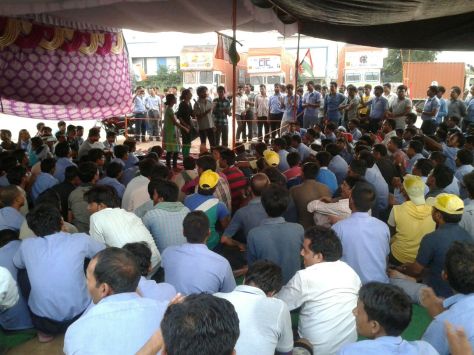
On the morning of 18 September 2015 when the workers employed in the Bridgestone company reached their factory gates they were met with Police officers and hired bouncers at the gate. When the workers tried to enter the factory premises they were resisted by the uniformed and the non-uniformed goons of the Factory Management. The Police beat up the workers and prevented them from entering the premises of the factory in spite of having a court order for tool down and without any prior notice the workers were sacked by the company. More than 400 workers employed in Bridgestone Factory in Manesar have been unlawfully sacked by the Company authorities after the workers demanded to get their Union registered. The workers are currently protesting outside the factory and have gathered there to raise their voice against the injustice and oppression that they are facing at the hands of the factory management.

Continue reading Workers right to unionize being trampled upon in yet another factory in Manesar: Report

Comrade Chintamani: Faridabad Mazdoor Samachar

This is a guest post from Faridabad Mazdoor Samachar (FMS), a monthly workers’ newspaper published from Majdoor Library

This appeared in Hindi in August 2015, New Series 326 and has been translated into English  by Pratik Ali and Sheena Jain.

In the early hours of 31st July, Comrade Chintamani passed away.

Saathi Chintamani was born in the village Mustafabad Saraiyya of Kadipur tehsil, Sultanpur district in eastern Uttar Pradesh. He studied till class 12th. Rejected tempting offers for converting to another religion, he joined as an impounding official in the Department of Agriculture, Uttar Pradesh government. While he was on duty once, realizing dues, he thrashed some people for insulting him over his caste. To avoid upper-caste backlash, he left his permanent job and moved to some relatives at Faridabad. After working for a month or two each at Bata, Goodyear, Dabur, Escorts, etc., he became a permanent worker in Gedore Tools. Together with the job, he was active in politics of caste of the Ambedkarite current. Long conversations with Com. Vijay Shankar of neighboring Babripur village strengthened his grip upon the new reality of having become, and of being, a wage-worker.

In 1977 wage-worker stirrings intensified greatly in Faridabad, and Saathi Chintamani was very active in them. He lent special support to the militant workers of Usha Spinning and Weaving Mill and the Bharatiya Electric Steel Factories. He was among those who left eighty unions to form Majdoor Sangharsh Samiti (Workers’ Struggle Committee). In 1979, many workers were killed in police firing in Faridabad. After internal emergency was lifted in 1977, Com. Vijay Shankar was dismissed from his job for his role in the Delhi Faridabad Textile (DFT) strikes. Wage-workers from Bata, Gedore, Poritts & Spencer, Electricity Board, Handa Steel, East India Cotton Mills, Orient Steel, Leatherite, etc. got together with Com. Vijay Shankar at Azad Nagar jhuggi (shanties) and Mujesar for collective study of Karl Marx’s book, ‘Capital’. Saathi Chintamani was among them.

Continue reading Comrade Chintamani: Faridabad Mazdoor Samachar

Praful Bidwai Is No More

Praful Bidwai is no more. He died in Amsterdam on Tuesday evening due to a cardiac arrest, With his death we have lost the ‘best left-wing journalist’ in this part of South Asia whose articles appeared in many newspapers and magazines in the subcontinent and in the middle east and was frequently published by The Guardian, Le Monde Diplomatique as well. Praful will be missed by thousands and thousands of his readers (this pen pusher included) who were ‘groomed’ by him in a career spanning more than four decades. For them he was one such voice who remained uncompromising in his strident criticism of communal fundamentalisms of various kinds and the crony capitalism which is having a field day these days. He was a leading voice for nuclear disarmament and peace as well and had written extensively on it. It was a strange coincidence that we met last in the capital when a memorial meeting was organised by Communist Party of India to remember the legendary Comrade Govind Pansare who was assassinated few days back. He was to speak in the meeting. The meeting was yet to start and I could steal some time to talk to him. He told he is working on a book – which was near completion – on the left movement in the country and had interviewed many activists associated with the movement to listen to their understanding of challenges before the left. And in that connection he had long meeting with Com Pansare – once in Kolhapur and one possibly in Mumbai. He shared his fascination about the energies he still had at that age for ‘the cause’. Few days after the meeting, there was a call from him asking for a phone number of a dalit activist which incidentally I did not have. Yes, that was the last time I spoke to him.

Continue reading Praful Bidwai Is No More

Remembering People’s Historian Amalendu Guha (1924-2015): Bonojit Hussain and Mayur Chetia

Guest post by BONOJIT HUSSAIN and MAYUR CHETIA

A Tribute and a Bibliography

স্বৰ্গত ৰুচি নাই, যাওঁ মই ভাটিখানালৈ

জুৱাৰী-মদপী-বেশ্যা-সিহঁতকো মেলত গোটাই

মনৰ চিতাৰ ছাই উৰুৱাই গাওঁ আশাবৰী :

আকাশত উৰা মাৰে জাকে জাকে ফিনিক্স চৰাই !

Amalendu Guha
Amalendu Guha

I have no desire for heaven,

Instead I go to the brewhouse,

Gamblers, drunkards, prostitutes – bringing them together

I sing of hope, sprinkling ashes from my soul’s pyre:

In flocks the phoenix flies to the sky.

  • “মোৰ কবিতা / My Poetry” Amalendu Guha 1960

Continue reading Remembering People’s Historian Amalendu Guha (1924-2015): Bonojit Hussain and Mayur Chetia

CPI(M)’s 21st Congress – A Schizophrenic Outcome: Prasenjit Bose

Guest post by PRASENJIT BOSE

Lost on the high seas?,
Lost on the high seas? Image courtesy CPI(M) 21st Congress site

Far from transparently and decisively resolving the issues which plague the Party and the Left movement in India, the twenty first Congress of the CPI(M) has yielded a schizophrenic outcome. The purported ‘political line’ adopted by the Party Congress and the ‘unanimous’ choice of the new general secretary are quite contradictory, which will only perpetuate the ideological-political incoherence that has gripped the CPI(M) and may further contribute to its organizational disarray.

When the central committee of the CPI(M) met in October 2014 to discuss a medium term ‘review of the political tactical line’ (PTL) in the light of the electoral reverses suffered by the Party, a politbureau (PB) member had moved a dissent note on the document presented by the PB. That note had argued against the very need to review the PTL and had instead held faulty implementation of the political line driven by ‘subjectivism’ of the leadership mainly responsible for the setbacks suffered by the CPI(M), alongside persistent organizational deficiencies. The elevation of the dissident voice within the outgoing politbureau as the new general secretary of the party raises the question whether the ‘review of the political tactical line’ and ‘political resolution’ adopted in the Congress have the support of the majority within the party? Or will the ‘political line’ adopted in the Party Congress give way over time to political opportunism in the name of ‘flexible tactics’, with the CPI(M) joining hands with the discredited, anti-people Congress in the name of fighting the communal, big corporate-backed, reactionary Modi regime? Continue reading CPI(M)’s 21st Congress – A Schizophrenic Outcome: Prasenjit Bose

Whatever happened to 15-M Movement? Atharva Pandit

Guest post by ATHARVA PANDIT

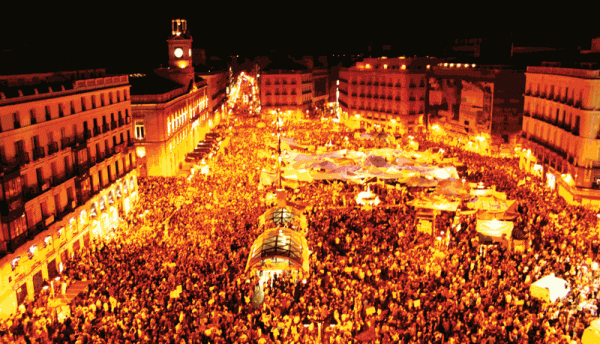
[Against the background of Spain’s recent criminalizing of public protests and the first ever hologram demonstration (see Kafila post by Geeta Seshu) against it, this article revisits the major eruption in 2011, that eventually laid the ground for the emergence of a new political force in Spanish politics]

15M, image courtesy El Tecolote

Spain, seems to be a country that is still shaping itself. Somewhat like a nation that wants to come to terms with its past, unlike many other countries that have gone through a traumatic history and have finally emerged through the political passions – admittedly misdirected – of their distant past. Spain seems like it is yet to come to terms with a civil war that forged its legacy in millions of Spanish minds and the future generations of the country. The fascist forces that staged a coup, and consequently, went on to purge about 150,000 of its citizens in summary executions, far surpassed some of the worst dictatorships that the world has witnessed, including that of Pinochet’s in Chile and of Videla’s in Argentina.

Continue reading Whatever happened to 15-M Movement? Atharva Pandit

An Interview on the Continuing Relevance of Marx

The following is an interview with PRADIP BAKSI, an independent Marx scholar based in Kolkata. He has translated and edited some of the notes and manuscripts of Karl Marx on mathematics and on the history of land relations in India. He has also written on Marx’s study of some of the natural sciences and technologies of his time. The interview was conducted by SANKAR RAY, a senior journalist based in Kolkata.

Sankar Ray [SR]: What are your views on the relevance of Marx for India today, in the context of the financial crisis continuing since 2008, a certain renewal of interest in Marx’s Capital and, of late in Piketty’s Capital for the 21st Century?

Pradip Baksi [PB]: Despite the echo of the title of Marx’s famous book in the title of Piketty’s bestseller, the latter is an exercise within one of the currently fashionable strands of Marx-innocent political economy. In contrast Marx’s Capital is a part of an unfinished and incomplete program of critique of political economy, proposing a continuous reconstruction of it as a science.

While marshalling a very large and interesting dataset on growing inequality within contemporary capitalism, Piketty proposes to make that inequality bearable through taxation within future capitalism, and thereby holds a brief for that very capitalism. Marx, it is true, left his critique of political economy incomplete and unfinished, but he never held any brief for capitalism.

The ongoing financial crisis has triggered some interest in these two books in some quarters. This financial crisis and this interest may or may not last long. I do not wish to speculate about that. The questions of relevance or otherwise of Marx for India, and for the rest of the world, however, are questions of a different order. Continue reading An Interview on the Continuing Relevance of Marx

The Sin and the Error : Ravi Sinha

Guest Post by RAVI SINHA

…it takes an error to father a sin. ─ J. Robert Oppenheimer[1]

Future historians of India may well describe the past year as a year of political sin. This was the year in which the man who had earlier presided over the Gujarat Carnage was awarded the ultimate prize. The year saw an election that touched a new low marked by shallowness, vulgarities and lies – in no small measure by the labors of the man himself. Equally appalling have been the exertions of a large class of literati and glitterati to portray philistinism and inanities spouted by the most powerful mouth as wisdom of a visionary leader.

An entire country seems to have gone blind – unable to see that the emperor has no clothes. In this age of incessant television it should be obvious to anyone that the supreme leader does not carry conviction even when enunciating relatively higher banalities. He is at his natural best only when he mocks someone as a shehzada or slanders and vilifies an entire community through phrases such as ame paanch, amara pachees. It is an irony of history that the republic which had Nehru as its first prime minister has one now for whom even common mythology is too cerebral. He must vulgarize Pushpak Viman and Ganesha and reduce them to quackeries of aviation and surgery.

Misfortune of the nation goes beyond the man. Forces of the diabolic housed in the hydra-headed Parivaar can now accomplish the impossible. They can now occupy the political center stage without leaving off the lunatic fringe. They can adopt Gandhi without renouncing Godse; erect world’s tallest statue of a leader who had punished their forefathers for assassinating Gandhi; even co-opt Bhagat Singh without batting an eyelid about what he stood for and what he had to say about ideologies like theirs. They can further refine the art of doublespeak. Their “statesmen” can pave the way for corporate plunder and call it sab ka vikas (development for all). Their “ideologues” can advocate sab ka saath (inclusion of all) by exhorting Hindu women to give birth to a minimum of four children each, lest Hindus are reduced to a minority “in their own country”. Continue reading The Sin and the Error : Ravi Sinha

While “Exposing 300 days of Modi’s Rule”, Let us not fall into the Trappings of Old Congress Style Politics: Nayan Jyoti

Guest Post by Nayan Jyoti

SOME QUESTIONS IN THE CONTEXT OF MASS ORGANISATIONS OF CPI(ML)LIBERATION, CPI, CPI(M) & OTHERS INVITING CONGRESS, RJD, JD(U) TO DEFEND ‘SECULARISM, INDIAN CONSTITUTION, INDIAN NATIONALISM’

Janta Dal (United) leader Ali Anwar, in an ‘united’ program in Jantar Mantar on 19th March had a frank admission to make in the first 15 minutes of his speech: “Elections ki hi baat se shuru kare, to haan, hum sab milkar Modi ko harayenge” (“If we begin with the question of elections, yes, we will unite to defeat Modi together”). He was indicating a plain and simple ‘unity’ of convenience for elections, of a converging pole in Indian politics. He indicated: “Bihar assembly elections are waiting to happen.” He of course, remembered the theme of ‘secularism’ for the event and said, “now I will say a few ideological things” and did utter a few lines against the BJP-RSS.

Delhi’s Jantar Mantar on 19th March thus saw a (not very?) strange unity. Various “civil society and secular political parties, victims, artists, intellectuals” came together to organize an Exposing 300 days of Modi’s Rule program. Many of the organizers included mass organisations of the Left like AISA, AICCTU, AIPWA connected with CPI(ML)Liberation, and SFI, AIDWA, CITU, DYFI, AILU connected with CPI(M), and AITUC, NFIW, PWA related to CPI, among others. In these dark times of achhe din, where unity and collaboration of various left, democratic and progressive forces has come up with renewed necessity to fight the present regime, it becomes important for us to interrogate such attempts without any sectarianism. An important question that requires asking here is the basis of these ‘Unities’ and Forums being variously attempted. ‘Unity’ is definitely required in these times of combined attack of brutal neoliberal and communal attack, but standing on what ground, and in what direction? Continue reading While “Exposing 300 days of Modi’s Rule”, Let us not fall into the Trappings of Old Congress Style Politics: Nayan Jyoti

Remembering Nishith Bhattacharya, unsung revolutionary hero: Basu Acharya

Guest pots by BASU ACHARYA

The morning of February 15th this year was exceptionally grim. The sun looked pale, its rays mangled, as if somebody had scratched its face with a scalpel blade of tempered steel. Ramakrishna Naskar lane, an obscure by-lane in Beleghata area of Kolkata, was suddenly bustling with unusual activity. A number of people, quite a few in fact, irrespective of the nature of the red flags they carry, had gathered before a modest dwelling; assembled to bid adieu (with clenched fists and the ‘Internationale’ on their lips) to an old man, an octogenarian, wrapped in a crimson cloth with a crossed hammer and sickle in white. Prof. NB, our very own Nishith-da, Comrade Nishith Bhattacharya was no more. Leaving his mortal remains for the pyre to consume and his comrades to weep over, he had left for the final voyage—journey ‘to the undiscovered country from whose bourn no traveller returns’.

My association with Nishith-da dates back to the early years of the past decade when India, like many other ‘developing countries’ of the world, was passing through the initial days of the second information revolution. I, then an activist of a tiny student-youth organisation, met him on the book-fair ground at Maidan and asked scores of questions about Naxalbari and related topics. Most surprisingly, he, without a slightest mark of impatience on his face, answered each question with brutal accuracy and won my heart. From then onwards I was his admirer, also his disciple, who could even dispose of his own thumb—if asked. There are so many fond memories such as this, and as I scribble this piece, old thoughts crowd my mind and the panorama of our decade-long association appear before my eyes. But honestly speaking, it will be absolutely criminal if we limit a man of Nishith-da’s stature to any personal reminiscence. Rather, it is better to tell the story of his life and time in considerable length and as dispassionately as possible, for history should be impartial nay objective.

Continue reading Remembering Nishith Bhattacharya, unsung revolutionary hero: Basu Acharya

Bread and Roses in Kerala today – the Kalyan Sarees Women Workers’ Struggle, and an Appeal on Women’s Day-Eve: Malavika Narayan

This is a Guest post by MALAVIKA NARAYAN

Drive through any road in Kerala, one sees enormous showrooms of silks and jewellery, glittering with all the riches they contain.

Who says that the Kerala model of development is slow on growth and only high on human indicators? The most literate ‘progressive’ state is evidently doing well enough in business and investment too it would seem. We are also an expanding consumer market now, willing to finally shed some of that humility and simplicity once perceived to be characteristic of us. We have what claims to be Asia’s biggest mall, and other international chains setting shop here. In Maveli’s land, there really appear to be no poor or oppressed who would destroy this image of perfection. Continue reading Bread and Roses in Kerala today – the Kalyan Sarees Women Workers’ Struggle, and an Appeal on Women’s Day-Eve: Malavika Narayan

Condemn Communal Violence in Kozhikode Village: Concerned Citizens

We  strongly condemn the unprecedented communal violence at the end of January 2015, in Tuneri, Vellur and Kodanjeri villages, Nadapuram in Kozhikode, Kerala, in which more than a hundred Muslim families and homes were singled out, attacked, and crores worth of property destroyed. We are utterly horrified and outraged that violence of this extent has received scant attention from the media — electronic, print or even social.

On 22 January 2015, a local murder was instantly transformed into a communal conflict. Shibin Bhaskaran, a 19-year-old DYFI activist, resident of Vellur, a village dominated by the Communist Party of India (Marxist) — CPI(M) — was stabbed to death by an Indian Union Muslim League (IUML) activist Teyyampadi Ismayil. Ismayil, who openly claimed responsibility for the murder on that very night, is known to have criminal antecedents and was once jailed for six months in accordance with the Kerala Anti-Social Activities (Prevention) Act, 34/2007. The aftermath of this cold-blooded murder, a personal settling of scores between two individuals, was instantly communalised, and in a manner that is reminiscent of communal violence in other parts of the country, especially in Muzaffarnagar 2013.

Read more at   : http://www.epw.in/letters/communal-violence-kozhikode-village.html 

G Arunima, P K Yasser Arafath, K Satchidanandan, Kavita Krishnan, Jairus Banaji, G Haragopal, Shabnam Hashmi, J Devika, Trupti Shah, Jyotirmay Sharma, Upinder Singh, B Rajeevan, C R Neelakandan, Kumkum Roy,
A K Ramakrishnan, Ajay Gudavarthi and others

An Election of Hope Versus Fear

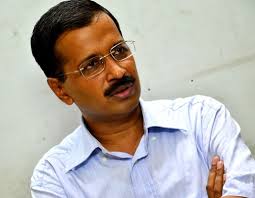
Yes it’s a simplistic dichotomy, but there is really no better way to describe the current Delhi elections. On the one hand, a little ragtag army of Davids behind “Mufflerman”, as his faithful supporters affectionately call him, a person in baggy sweater and sneakers, one you wouldn’t look at twice if you passed him on the road.

Mufflerman Business Standard

  Kejriwal

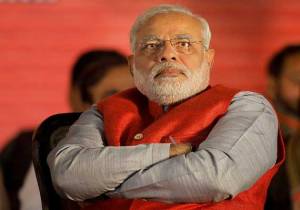
On the other hand, a massively funded, aggressively confident Goliath, openly backed by the corporate bodies and full-page ads, riding a  national “Wave” higher than most Tsunamis, topped by the 56-inch chest of “Modiman”, even if recently modestly covered by a 12-lakh rupee vest.

56-inch Modi78c0d4d3-be9e-4afb-b034-1247529df720wallpaper1

On the one hand, a fearful and awed media establishment donating PR for free to the seemingly invincible King of Gujarat, and on the other, an aam aadmi, a volunteer-cadre run campaign and a palpable vibe of trust and openness on the ground. I know I know, some will say it’s all ‘perception management’ and PR, but barring the googly of the 2 crores party donation thrown at the opportune moment, if Mufflerman’s party was any cleaner, it could have given Lalita ji’s Surf a run for its money. Whatever the result on the 10th (and there is reason to be hawk-eyed about the possibility of tampering as Nivedita Menon’s post has urged), how does anybody not get what a miracle this alone is, in a political economy with a black economy of a size that is higher than the GDPs of most smaller countries? Perhaps this is in fact about hope and fear after all, however clichéd that sounds.

Continue reading An Election of Hope Versus Fear

The Success of Nilppu Samaram: The Victory of Democracy

This is a guest post by ASWATHY SENAN
The Nilppu Samaram (Standing Strike) by the Adivasis demanding their land rights started on 9-7-12 under the leadership of Adivasi Gothra Maha Sabha (AGMS). The protesters stood for 162 days in front of the Secretariat, Thiruvananthapuram. This protest saw the support and intervention of people from all age group from various caste and religious communities (not under the banner of any particular political party or religious organisation) most of whom came to the protest space and stood with them to mark their solidarity. The government had to budge at the end under the pressure of the non-violent democratic protest of the adivasis backed by the civil society and on the 163rd day the ended their standing after the Government of Kerala agreed to all their demands on paper.

Continue reading The Success of Nilppu Samaram: The Victory of Democracy

Last Opportunity for CPI(M): Prasenjit Bose

Guest post by PRASENJIT BOSE

The CPI(M) is going to have its party congress next year in the backdrop of its worst ever electoral performance in the general elections. A four day meeting of its central committee held recently to discuss the review report and political resolution for the party congress, however, ended without adopting any worthwhile political decision. The only decision was to have another central committee meeting in January next year. When meetings of the topmost committee of a national political party end only with fixing the next meeting, something must be going wrong somewhere. It reflects lack of political direction and disarray at the top.

At the heart of the dilemma faced by the CPI(M) today is the political-tactical line to be adopted in the backdrop of BJP’s ascendancy across the country and the rightwing offensive unleashed by the Modi regime at the centre alongside the threat of political marginalization faced by the CPI(M) in what was once its citadel, West Bengal. The options apparently being debated within the CPI(M) – either align with the Congress against BJP or maintain the status quo – are both inadequate for its own revival or to take on the resurgent rightwing in India. Unless the Left mobilizes forces from below and seeks to build alliances based on struggles with like-minded progressive and democratic forces, the “political line” debate will be fruitless, abstract and of no yield. Continue reading Last Opportunity for CPI(M): Prasenjit Bose

A Reply to Ranabir Samaddar on Jadavpur: Uditi Sen

Guest Post by UDITI SEN

Prof. Ranabir Samaddar of the Calcutta Research Group has recently published a screed (in the DNA Newspaper) against the #Hokkolorob movement  initiated by the students of Jadavpur University which has found resonance with students and young people all over West Bengal and elsewhere in India. Samaddar, who seems to have lost the ability to recognize the many intersections of solidarity between students, young people in metropolitan as well as non-metropolitan contexts, women, young workers, accuses the movement of what he calls ‘elitism’ and a disconnect with realities on the ground.

Uditi Sen responds.

It is settled then. With this latest denunciation (by Ranabir Samaddar, in DNA, see link above) of the student movement at Jadavpur, we finally have a verdict we can trust. Student politics is not what it used to be. The glory days of the 60s are long gone and the protesting young today fail to live up to the authentic radicalism of their elders. Those were the days, indeed. Those were the days when student politics, organised under the banner of the organised left took up real issues, such as those of the peasants and workers and did not distract themselves with inequities closer to home. Such as, why women ‘comrades’ were expected to cook and clean and provide for their men, who led the vanguard. Such as why even the most progressive politics, when speaking of the rights of peasants, meant the rights of male peasants. Those indeed were the days of glory, which we should remember and seek to emulate, when the leaders, usually dadas, had no answers when a peasant woman asked, ‘“Why should my comrade beat me at home?” (See Samita Sen’s Toward a Feminist Politics: The Indian Women’s Movement in Historical Perspective)

Continue reading A Reply to Ranabir Samaddar on Jadavpur: Uditi Sen

A civil-war is on the doorstep of India: Interview with Kancha Ilaiah by Mahmood Kooria

This is a guest post by Mahmood Kooria

We are publishing an English translation of an important interview of the intellectual and academic Kancha Ilaiah, conducted by Mahmood Kooria for the Malayalam weekly Mathrubhumi. While what I see as Professor Ilaiah’s underestimation and perhaps misreading of the historic role of the Communists in Indian politics leaves me severely uncomfortable, especially when he exonerates the right from commensurate charges of elitism, his framing of Hindustva and Modi’s appeal within the great stream of caste in the subcontinent is brilliant and thought-provoking, as always. 

Kooria conducted the interview as well as translated it in to English. His introduction is as follows, “At a time when there was no any such discussion, in 2002 Professor Kancha Ilaiah predicted that Narendra Modi will be the prime-ministerial candidate of Baratiya Janata Party. It has come true and now Modi is in the office. At this point, I talked with him at Moulana Azad Urdu University Hyderabad where he chairs the Centre for the Study of Social Exclusion and Inclusive Policy. In the conversation, he talked about the future of Modi government and he predicted that a civil war is going to break out in India if Modi does not cater the needs of backward classes. A Malayalam-version of this interview was published in the Mathrubhumi Illustrated Weekly (August 24, 2014).”

Mahmood Kooria: Ten years ago you wrote that Modi will be the prime ministerial candidate of BJP. What would be your response as your prediction has come true?

Kancha Ilaiah: Well, at that time I was predicting that based on the Left parties’ indifference to understand the caste question. The caste question is not been seriously taken by the Left parties. And, after Mandal, the BJP and the RSS wings started looking at caste-question seriously because when Babari Masjid was demolished they mobilized a lot of backward classes. Though they oppose Mandal reservation, they wanted the backward classes to be part of the Hindu religion. Around 1994, a non-Brahmin called Rajju Bhaiya became the Sarsanghchalak of the RSS. Then he recruited a large number of backward classes, large number of youth, and he promoted the people like Narendra Modi, Uma Bharati at that time. Earlier, the first backward-class chief minister of Uttar Pradesh was a BJP man: Kalyan Sing. He was the chief minister in 1992 when the Babri Masjid was demolished.

The Sangh Pariwar was responding to the backward class demands more. But the Left or the Congress was not responding to the OBCs. The Congress was responding to the Dalits and Muslims. There was upper caste all the time on the top. So, when Narendra Modi became the chief minister and this whole atmosphere was created, I was writing a column in The Hindu. I thought that this seems to be cause/course of India, since the Hindu religion is surviving because of the backward classes. It is inevitable for the Hindutva organizations that they will have to project an OBC for the prime-ministership. But there was resistance from within itself. It is not that the Brahmins have given up the principle of varna-dharma. After that article came and of course after my writing Why I am not a Hindu itself, the backward classes even within RSS seemed to use that material for their advantage. The communists did not use or recognize it. The question of labour and caste which I have been consistently raising, which was also part of their theory, they did not care about. So the Communist Party remained tightly under the control of upper castes.

Continue reading A civil-war is on the doorstep of India: Interview with Kancha Ilaiah by Mahmood Kooria

Reflections on Solidarity for Palestine in India: Urvashi Sarkar

Guest post by URVASHI SARKAR

Some sections of Indian civil society have reacted to Israel’s most recent brutalities in Gaza with outrage, and rightly so. In its pounding of Gaza which lasted over a month, Israel destroyed essential services and infrastructure, razed houses to debris and wiped out entire families.  Over 2000 Palestinians were killed, many of them civilians, and of which over 400 were children. On the Israeli side, sixty-four soldiers and four civilians died. A shaky ceasefire between Israel and Hamas, announced in early August, did not last, with hostilities resuming almost immediately.

It is not uncommon to hear Indian voices supporting Palestine even at a time when right wing forces hold sway in the country; yet there is more to this support than meets the eye. There are internal differences on the matter of Kashmir for instance, regarding the extent to which parallels can be drawn between the Palestine and Kashmir conflicts.  The actualization of both conflicts dates back to the 1940s.  Both regions are heavily militarized; its people suffer routine human rights violations and both are undergoing prolonged self-determination struggles. Each year, Kashmir joins different parts of the world to observe Al-Quds day, held on the last Friday of Ramzan, to observe solidarity with the Palestinian struggle.  Popular anti-India protest sites in Kashmir, such as Ramban Chowk and Maisuma, are referred to as ‘Gaza’ in local parlance.  A Kashmiri teenager lost his life during firing by security forces, in an anti-Israel protest in South Kashmir in July this year. Continue reading Reflections on Solidarity for Palestine in India: Urvashi Sarkar

Creeping Dictatorship: Concerns from Kerala

Guest post by THUSHAR NIRMAL SARATHY

 Are we living in a democratic dictatorship? ‘Democratic dictatorship’ is a much debated concept in Kerala.  I am referring not to that here but to the dictatorship of the executive led by democratically-elected politicians. Recent incidents seem to indicate that this is now an ever-growing tendency in our democracy.

A few months back, a notice with the photos of well-known public figures, which identified them as Maoists, appeared in the Mananthavady police station at Wayanad.  These were pictures of senior, very well-known activists who have fought battles for democracy in Kerala.  Following widespread protests, the police was forced to remove the notice. On 28th July this year, Jonathan Baud, a Swiss citizen was arrested by Valappad police for attending a commemoration meeting of a Maoist leader, Sinoj, who died in an accidental explosion at the forested Kerala- Karnataka border. Mr Baud was in India on a tourist visa. His arrest was big news in the media which had happily swallowed policespeak, and so he was also projected as a Maoist. The reports claimed that he had come here with the express purpose of attending the meeting, and that he delivered a solidarity speech there. Later, when the Commemoration Committee made public its own version of events, the police sensationalism was refuted and had to be withdrawn. The charge against Mr Baud are apparently limited to violation of visa conditions and it was admitted that he had no Maoist links. Continue reading Creeping Dictatorship: Concerns from Kerala