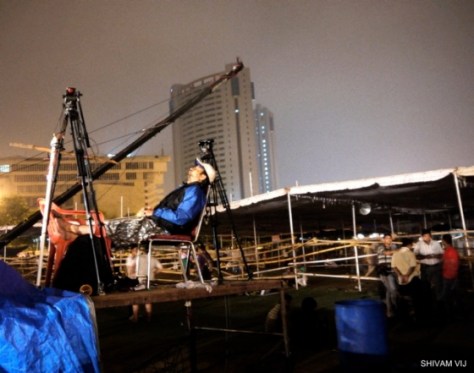
Taken in August 2011 at around 2 am one morning at Ramlila Maidan, this photo shows a news TV cameraperson taking sleeping on his chair.
Anna Hazare has returned with his protests and fasting. Should the media, particularly news TV, be more circumspect this time?
Is it time for the media to learn from the Ramlila Maidan experience in August, or should news channels stick to their earlier editorial line of broadcasting the Anna movement in great detail? Back in August, news TV broadcasted Anna’s “satyagrah” allegedly at the expense of the government. The stage is set again, the jury is out. Continue reading News TV – Caught Between an Anna and a Hard Place: Abhishek Upadhyay→
The Delhi media celebrated on 11 December the above event, which took place on 11 December 1911. The Delhi media will celebrate anything that is worth celebrating, and everything that is not worth celebrating. Someone just has to set the alarm bells and hours of programming, reams of newsprint will be dedicated to an orgy of unthinking celebration. The only thing other than Celebration that sells is Outrage.
Sohail Hashmi has written on Kafila about why 11 December could not be the centennial of “New Delhi” but only the Delhi Durbar. That was only one problem with the Celebrations; here are some more.
Amidst the cacophony of celebrating 100 years of Delhi, several details seem to have escaped the attention of our ever vigilant media, both print and electronic. This post is to draw your attention to a few of these ‘details’ in an attempt to place the celebrations in what appears to this author to be the correct perspective.
The 12th of December, 2011, can not by any stretch of imagination be described the centenary of Delhi, because there were at least 7 Dehlis before New Delhi came up, in fact 9 Dehlis if one were to add Kilokhri and Kotla Mubarakpurpur, Dehlis in their own right, to the generally accepted list of Qila Rai Pithora, Siri, Tughlaqabad, Jahan Panah, Firozeshah Kotla, Din Panah or Sher Garh or Purana Qila and Shahjahanabad. All of these came up at different times from the 11th century to the 17th century and all of these were more than a 100 years ago.
All that the 12th of December 2011 can claim to be the centenary of, therefore, is New Delhi. Let us look at even that claim a little more closely. What exactly transpired on the 12th of December 1911 that is causing so much excitement a 100 years later?Continue reading From Dehli to New Delhi, it wasn’t 1911→
This press release has been issued by thePARVEENA AHANGAR-ledASSOCIATION OF PARENTS FOR DISAPPEARED PERSONS
Srinagar, December 10, 2011: On this ‘International Human Rights Day’, December 10, 2011, the APDP (Association of Parents of Disappeared Persons), Srinagar, wishes to state that there is something obscene and perverse in the manner the CNN-IBN has nominated our organization for the ‘Indian of the Year 2011’ award. Sometimes, human rights can be violated by merely mocking those who struggle for human rights. Continue reading Parveena Ahangar rejects CNN-IBN’s nomination for ‘Indian of the Year 2011’→
A few days ago a friend asked me if I knew someone who had the ability and inclination to help out a certain department of the central government with using social media. My friend did not name who the prospective employer was, but clearly, with even Digvijay Singh on Twitter, the Congress party is worried about social media. No surprise that this should happen in a year when the UPA government’s popularity has taken a nose-dive.
The New York Times revealed on 5 December that Kapil Sibal summoned Facebook officials and showed them a Facebook page that allegedly maligned Congress president Sonia Gandhi and said that this was unacceptable. While HRD officials refused to reveal much in that NYT copy, they must have realised that shit has hit the fan, because the next morning’s Indian Express the spin doctoring was clear: there was now a mention of allegedly derogatory pictures of Prophet Mohammed along with the Prime Minister and the Congress President (who are no doubt as sacred in his books as Prophet Mohammed).By the time he held his press conference yesterday, it became about things that Hurt Our Religious Sentiments. On the 19th anniversary of the Babri Masjid demolition, it is very interesting to see a Congress minister using religion to cover up power politics. Continue reading What Kapil Sibal does not understand: the internet→
(ये लेख स्रोत-चिंतन जैसा है, जिसे पीयूष दईया के कहने पर मैंने लोकमत समाचार, दीवाली विशेषांक, 2011 के लिए लिखा था। अपनी आलोचनात्मक टिप्पणियों से नवाज़ेंगे तो अच्छा लगेगा।)
This slideshow requires JavaScript.
बहुतेरे लोगों को याद होगा कि टाइम्स ऑफ़ इंडिया समूह की फ़िल्म पत्रिका माधुरी हिन्दी में निकलने वाली अपने क़िस्म की अनूठी लोकप्रिय पत्रिका थी, जिसने इतना लंबा और स्वस्थ जीवन जिया। पिछली सदी के सातवें दशक के मध्य में अरविंद कुमार के संपादन में सुचित्रा नाम से बंबई से शुरू हुई इस पत्रिका के कई नामकरण हुए, वक़्त के साथ संपादक भी बदले, तेवर–कलेवर, रूप–रंग, साज–सज्जा, मियाद व सामग्री बदली तो लेखक–पाठक भी बदले, और जब नवें दशक में इसका छपना बंद हुआ तो एक पूरा युग बदल चुका था। [1] इसका मुकम्मल सफ़रनामा लिखने के लिए तो एक भरी–पूरी किताब की दरकार होगी, लिहाजा इस लेख में मैं सिर्फ़ अरविंद कुमार जी के संपादन में निकली माधुरी तक महदूद रहकर चंद मोटी–मोटी बातें ही कह पाऊँगा। यूँ भी उसके अपने इतिहास में यही दौर सबसे रचनात्मक और संपन्न साबित होता है। Continue reading हिन्दी फ़िल्म अध्ययन: ‘माधुरी’ का राष्ट्रीय राजमार्ग→
Suhel Seth, adman, actor, lobbyist, news TV pundit and god knows what else (the Facebook page for his book describes him as that know-all of our age, “marketing guru”), has published a self-help book that Mihir Sharma set out to review for The Caravan magazine. It is not Mr Sharma’s fault that this review became a profile of Seth, because he found that in the garb of a self-help book Seth had written an autobiography!
Mr Sharma notes:
Seth says his most important rule is: “Don’t make clients out of friends. But make friends out of clients.” Yet Suhel is friends with “almost everyone there is to know in the country”, or so the book’s jacket informs us. This may finally provide the explanation for why Get to the Top exists: he’s made friends at such a phenomenal rate that he must be running out of clients. [Must read – the full review.] Continue reading Everything you wanted to know about Suhel Seth but didn’t know who to ask→
AP photo by Yasin Dar: Local Kashmiri photographers Yawar Nazir, left, and Showket Shafi wait for treatment after they said they were assaulted by police and paramilitary forces during a protest in Srinagar, India, on Nov. 25. At least four journalists said they were assaulted by police and paramilitary forces Friday as they covered a protest in Indian-controlled Kashmir.
All freedoms enshrined in the Constitution of India are being violated or altogether thrown away by the Jammu and Kashmir Police. One could substantiate that with any number of examples. We were not the first pressmen to be thrashed by the police while covering the stone-hurling protests in the Kashmir. On Friday, 25 November 2011, without any rhyme or reason policemen along with the Central Reserve Police Force (CRPF) thrashed four of us, including me, and snatched away our expensive cameras. They did not even hesitate to bundle us into police vehicles while taking us to the Khanyar police station.
This guest post byALIA ALLANA is a despatch from Cairo for Kafila, the ninth in a series of ground reports from the Arab Spring. Photographs by Alia Allana
This slideshow requires JavaScript.
The police lobbed another tear gas canister and soon the feeling of suffocation would take over. But he didn’t move, instead he stood in the center; he continued to wave the Egyptian flag. The sound of rubber bullets being fired drowned under the sound of the drum. The drum was the harbinger of doom: when it was sounded by protestors, when the cacophony cut through the air, the message was simple – run, run as fast as you can because the police would begin their attack, again.
Over at the Indian media blog Sans Serif, Pritam Sengupta counts the number of advertisements by the Government of India on the holy occassion of the late Prime Minister Indira Gandhi’s birth anniversary, and discovers a statistical oddity:
While it is natural that ToI and HT should garner so many ads given their large circulations in the national capital, the second place for the Express group is revealing considering it sells less than five per cent of market-leaders ToI and HT in the Delhi market, which both sell in excess of 5 lakh copies.
The tabloid Mail Today, which has the third highest circulation among the Delhi newspapers, too gets fewer ads than the Indian Express. [Read the full post]
This press release was put out byKAVITA SRIVASTAVA on behalf of various women’s organisations in Rajasthan, on 11 November 2011. For a background to the case, see “A CD and a missing health worker“.
RAJASTHAN CONGRESS, STOP MISUSING AND EXPLOITING WOMEN IN POLITICS!
ARREST MAHILPAL MADERNA AND OTHER POLITICIANS INVOLVED IN THE DISAPPEARANCE BHANWARI DEVI!
ASHOK GEHLOT, PRODUCE BHANWRI DEVI DEAD OR ALIVE, OR ELSE RESIGN!
BJP WHERE ARE YOUR TEARS FOR BHANWRI DEVI!! STOP PLAYING THE CASTE CARD!
MAMTA SHARMA, NCW Chairperson, WHY THE SILENCE ON BHANWRI DEVI!
Raising the above slogans, Women, Dalit and Human Rights Organisation under the leadership of Dr. Pawan Surana ex-chairperson of the state women’s commission, protested today 11 November, 2011 condemning the Ashok Gehlot Government for the disappearance of one the workers of his Government ANM Bhanwri Devi and an aspirant of the Congress party. Continue reading Bring Justice to ANM Bhanwri Devi: Women’s organisations protest in Jaipur→
There are some of us in Goa who will know in about 20 days or so, thanks to two RTIs filed, whether Tarun Tejpal did in fact get all the necessary permissions and clearances needed to add to the lovely property he now owns in the village of Moira… or, as he more pointedly said of the village when he called me up in the Pune, “I mean, look at Moira man, it’s a dying Goan village” …emphasis on ‘dying’, and the implication being one suspects, that the Tejpals of the world can and will breathe life into it. I wonder if he remembers and can parse what I said to him in reply. Continue reading An open letter to Tarun Tejpal: Hartman de Souza→
Bad things only happen so that columnists may write Op-eds about them. Before the advent of newspapers there were no terrorists, no sectarian divide, nothing was on the brink, nobody was at a crossroads; the insidious Op-ed writers have invented all these things to scare us under our beds, like parents who tell their children ghost stories because they don’t want them wandering around in the dark lest they flip the light switch at an inappropriate time. [Read the full post by Haseeb Asif]
Bhutan’s shift to plural politics remains carefully calibrated, but the emergence of a relatively free press and democratic institutions are important achievements. An account from Thimpu
Political changes in Bhutan over the past five years — the introduction of a ‘democratic constitution,’ the retreat by the fourth King and the coronation of his son, elections to Parliament which now has both a ruling and an opposition party, and governance being the prerogative of the elected government — have triggered two opposite reactions generally. One school has hailed the vision of the Bhutanese monarchy and its act of ‘renunciation,’ and has declared the ‘democracy story’ to be a success. Many others dismiss the transition as being a ‘farce,’ claiming that the King still calls the shots and that Bhutan remains a tight autocracy. Continue reading Bhutan’s cautious tryst with democracy→
Goa-based journalist MAYABHUSHAN NAGVENKAR posed as a politician planning to contest the Goa assembly elections 2012, and called up a marketing executive of the Goa newspaper, Herald, asking for an interview to be published in the newspaper, for a price, as editorial content rather than advertisement. He has posted online four conversations he had with the executive, one of which you can hear below.
Of all the things about my last workplace, being summoned by one of our editors to her cabin was one that I did not particularly like. The problem was that, unlike other parts of the office, in her cabin I could not even pretend to seem interested in what she had to say. My eyes would involuntarily travel to the soft-board above her desk and get fixated on a slightly hazy colour photograph of Gujarat Chief Minister Narendra Modi. And if I shifted focus a bit towards the left, then I could also see another familiar figure standing next to Mr. Modi. That of the cabin’s proud occupant.
Now, it is not a hidden secret that the Indian business news community admires Mr. Modi. His biennial Vibrant Gujarat Summits, desi version of international pseudo-events like the Davos World Economic Forum, are a definite hit among business news hacks. How can you not be at a place where deals upwards of $452 billion get signed over just a couple of days?
Last weekend, I attended a wonderful rally by the Adivasi Mahasabha in Raipur – some 10-15 busloads of people came from Dantewada and Bastar alone, while large numbers came from other parts of Chhattisgarh and even other states like Maharashtra, Orissa and West Bengal. The procession was flagged off by Dhurwa dancers while the rear end was brought up by Marias with their large dhols and bison horns. In between were thousands of militant marchers shouting slogans against militarization, demanding peace talks, the release of their arrested leaders, the implementation of the Supreme Court judgement on Salwa Judum, and all their constitutional rights with respect to land, forest and water. These were men and women who had lost everything to arson and loot by Salwa Judum, who had been interned in camps but managed to return home and pick up their ploughs again, who face the daily threat of arrests, beatings and encounters by the security forces, who have to negotiate with the Maoists everytime they wanted to access panchayat funds, who live a life on the razor edge of survival. And yet here they were, laughing, cheering and vowing to fight till the last breath, fight for their constitutional rights and in a constitutional way.
This remarkable struggle has been waged, not just over one weekend, but over years. Indeed, the Salwa Judum leaders themselves credit the CPI with the destruction of their movement – both through mass actions and through legal means.
It is not yet dawn, and I am wondering what is happening inside the Maruti Suzuki Factories in Manesar. How exactly is the Haryana Police, armed, along with its usual ordnance, with a High Court order, and the Haryana Labour Department’s ‘go ahead’, going about its stated business of ‘escorting’ a few thousand unwilling workers out of their factories under cover of darkness? Apparently, the factory fence has been layered with tent cloth. No light gets in, no light gets out. The Maruti Factories in Manesar have become black holes.They are producing more darkness than cars in Manesar tonight.
There is no way of knowing just what is going on inside. And yet, a few hundred surveillance cameras must be recording what the management, police, administration and ‘security personnel’ are doing to ‘convince’ the workers to leave. Someday, this archive, every inch of video footage, should be played and rewound repeatedly, in order to arrive at a clearer understanding of the evolution of class relations in the industrial belt around the National Capital Region in the second decade of the twenty first century in India. Unfortunately, I have a strong feeling that tonight’s footage is going to go where all inconvenient truths go – to the limbo of unsolicited erasure.



 Over at the Indian media blog Sans Serif, Pritam Sengupta counts the number of advertisements by the Government of India on the holy occassion of the late Prime Minister Indira Gandhi’s birth anniversary, and discovers a statistical oddity: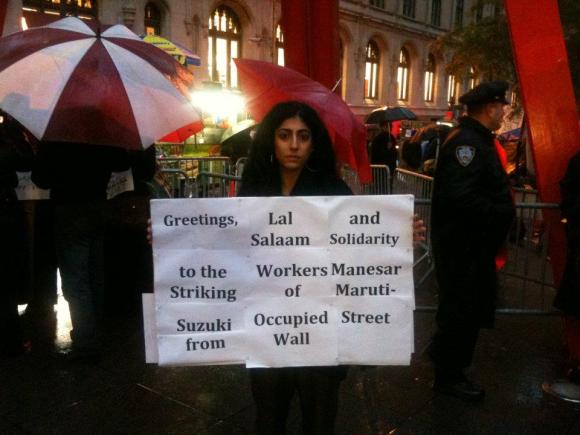
 KAFILA - COLLECTIVE EXPLORATIONS SINCE 2006