Category Archives: Media politics

The Twitter Gherao of Mamidala90 on the 10th Day of Najeeb Ahmed’s Disappearance from JNU: Shehla Rashid

Guest Post by Shehla Rashid

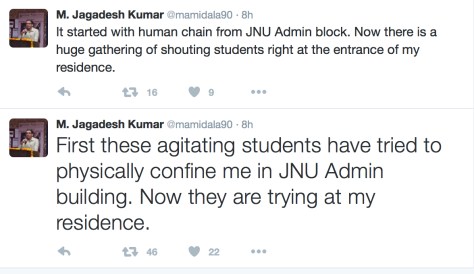
[ Between the 9th and 1oth day of the disappearance of Najeeb Ahmed from the JNU campus, the JNU Vice Chancellor, Mamidala Jagadesh Kumar decided to salvage his reputation on twitter, even as he squandered it on the grounds of the campus of the university he presides over. And so he let forth a volley of tweets, while sitting inside his office and his residence, even as he refused to meet or listen to the JNU students who have grown increasingly concerned and anxious at the university administrations callous laxity about the fate of Najeeb Ahmed, the missing students.

While students marched down the campus, forming a human chain that culminated at the gates of the VC’s residence near the university’s east gate, Mamidala90 (the handle with which the VC distinguishes himself in twitsville) began getting extremely active. While the students were peacefully assembled at the gates of the VC’s residence, very much not in ‘gherao’ or ‘blockade’ mode, Mamidala90 whined about being ‘blockaded’.

A Sample of Mamidala90's tweets while students gathered peacefully outside his residence. Is this what it felt like to hear Nero fiddle while Rome burnt?
A Sample of Mamidala90’s tweets while students gathered peacefully outside his residence. Is this what it felt like to hear Nero fiddle while Rome burnt?

Continue reading The Twitter Gherao of Mamidala90 on the 10th Day of Najeeb Ahmed’s Disappearance from JNU: Shehla Rashid

Press Club of India Elections 2016 – Prescription for a better soup: The Dissenters

[As the Press Club of India, Delhi, goes for its election today, with two left panels on offer, here is a note from THE DISSENTERS. We publish this as we think it raises some very important issues of larger importance.]

How to vote amidst false claims from Left, Right and Others

Journalism means expressing dissent and speaking truth to power. Alas! The Press Club Of India has lost this very essence. In the lust for power, all ethics and morality, even professional wisdom is being negotiated with in the current elections for PCI, New Delhi.

The recent move by one brave journalist to dissociate himself from his panel at the last moment exposes grave corruption embedded in the the moral sphere of scribes who have formed convenient rainbow coalitions, convenienty called panels, to grab the small power centre that operates from 1, Raisina Road, New Delhi. This election however was a farce from the very beginning. Let us take some time to read this before we go to vote on October 1st, 2016.

The outgoing panel was supposed to go out of office after completion of its one-year term and remain as a caretaker till the current elections. This never happened. There are many arguments for and against this immoral act but what has conspired in the meantime needs to be recalled.

The defining moment for this panel, named Nadeem panel after PCI outgoing Secretary-General, came in the Ali Javed episode. Let’s not forget that Ali Javed only booked the PCI hall  in his capacity as a member where the Kashmir-centric program was held and allegedly “anti-national” slogans were raised. Despite, this management committee involved Delhi Police instead of initiating a preliminary internal inquiry. A complaint was lodged in the midnight by PCI against Javed and others that led to prolonged harassment of this senior member who teaches in DU and is himself the General Secretary of Progressive Writers Association, the oldest organisation of writers in this country associated with the Communist Party of India (CPI).

A signature campaign was initiated against PCI’s move the very next day in favour of Javed that immediately tested the waters. The “official” panel (Gautam-Vinay panel) supported by outgoing GS Nadeem Kazmi is backed by so-called CPI-CPM affiliated journalists. These scribes not only refused to sign the petition rather disapproved of running any such campaign because “right-wing will benefit” from it. Later Javed was reinstated but when he arrived one fine evening in the club, he was forced to leave and even abused as “Pakistani agent” by some management committee members as well as others.  Continue reading Press Club of India Elections 2016 – Prescription for a better soup: The Dissenters

The Orphaning of ‘Women’s Collective Interests’ in Kerala


There is considerable outrage in Kerala about how the accused in the murder of the young woman worker Soumya in 2011 has slipped the noose at the Supreme Court. There is considerable doubt remaining on how the murder of the young dalit woman student Jisha was handled by the present government. In both cases, the accused are not men who would earn the sympathy of the Malayali middle-class – in one case, a tamil homeless man, and in the other, a Muslim migrant worker. Not surprisingly, the cry for their blood has been particularly shrill. Outrage at the Supreme Court’s refusal to endorse the lower court’s judgment in the first case is particularly striking – not only because of its loudness, but also because one is unable to forget the Suryanelli case. The difference between the present cases and the Suryanelli case is that in the latter, the victim has been condemned to living death, though she has persistently fought to be heard as a survivor of the most horrific violence. Yet her pleas that the powerful Malayali politician P J Kurien be also tried never roused the kind of outrage was have heard recently. It appears that the Malayali public is kinder to dead violated women than women who survive violation; it also seems harsher towards abjected males than to .powerful males who occupy the pedestal of elite masculinity. Continue reading The Orphaning of ‘Women’s Collective Interests’ in Kerala

Aam Aadmi Mohalla Clinics Set to Shut Thanks to L-G and BJP Controlled Municipal Bodies: Jyoti Punwani

[The Superintendent of Tihar Jail, went a joke recently circulating on WhatsApp, had staked his claim for the Chief Ministership of Delhi, because he had the requisite number of MLAs! The mainstream (Big) media has had a field day, reporting with great ‘earnestness’, what even the ordinary person on the street can see is an orchestrated move to harass and discredit the AAP. A leading paper even did a status report on all the cases against AAP MLAs a couple of days ago, as if it was simply ‘reporting’ (with a straight face). Some day, hopefully we will be able to come out with a more detailed analysis of the ways in which sections of the big media have – even in the person/s of their most benign representatives and columnists – played footsie with the regime at the Centre. This dispensation and its utterly unprincipled and unethical ways are truly unprecedented and this phase of our history has emerged as the dirtiest chapter of parliamentary democracy in India. In the meantime, online news forums have kept the tradition of actual reportage and fairness alive. Here are some extracts from a report by JYOTI PUNWANI, courtesy The Hoot (linked below), on the mohalla clinics and the strange politics of the media that surrounds reportage around such measures undertaken by the Delhi government.]

The AAP’s mohalla clinic experiment drew the attention of The Washington Post. Its article (`What New Delhi’s free clinics can teach America’, March 11, 2016) was also carried by the Chicago Tribune. A University of Southern California delegation came to study mohalla clinics  in July.

But our print media didn’t think this important experiment was anything special. Not all covered it; of those that did, some didn’t carry the report in all their editions….

The Indian Express carried a long report in April, after the second batch of clinics opened, in its Delhi edition (“In rented rooms across Delhi, part 2 of ‘mohalla’ clinic project takes off’’).  Livemint hada detailed report last month, after more than 100 clinics had opened (`Mohalla clinic: AAP offers affordable healthcare model at doorstep’); and earlier this week, The Hindu evaluated their performance in its Delhi edition (`A thousand promises of prompt health care’).

Among news websites, Newslaundry did a lively report immediately after the first clinic opened (`Mohalla clinics come to town’). In January, Catch News did a report  (`#MohallaClinics: AAP has diagnosed Delhi’s health problem. Can it cure it?’), and a follow-up in April after the second batch opened (`AAP Mohalla clinics: rented homes turn clinics, private docs appointed’).

A two-part article appeared in Scroll.in in May (`The clinic at your doorstep: How the Delhi government is rethinking primary healthcare…) Indeed, news websites, rather than newspapers, seem to have given the new experiment the space it deserves.

Going through the reports on mohalla clinics, it became clear that the possible removal of some of them was only the latest move against them. A few days before the NDMC issued this order, the Lieutenant General (LG) of Delhi had got into the act. Consider the sequence of events:

On August 5, the Delhi High Court ruled that the LG was the administrative head of the capital. After the judgment, Deputy CM Manish Sisodia specially requested Najeeb Jung not to transfer the Health and Education secretaries as these two bureaucrats were essential for the AAP’s new initiatives in these sectors. Continue reading Aam Aadmi Mohalla Clinics Set to Shut Thanks to L-G and BJP Controlled Municipal Bodies: Jyoti Punwani

No Country for Free Speech : Shiv Inder Singh

Guest Post by Shiv Inder Singh

freedom of expression के लिए चित्र परिणाम

(Photo courtesy : humanrightshouse.org)

In an open letter, Mr Shiv Inder Singh, an independent overseas journalist from Punjab, claims that he lost his job owing to his criticism of PM Modi’s government. 

Dear Sir/ Madam,

I am an independent journalist based in Punjab, India. I have been associated with the media industry for the past fifteen years. My work experience includes the time period of five years as an overseas’ contributor for Canada-based radio stations in Ontario, Alberta and British Columbia. In that capacity I have been giving daily news updates and political commentary on India at these radio channels.

I want to bring to your knowledge that the Vancouver-based Radio Red (93.1) FM for which I have been working since October 2014 has arbitrarily suspended my services due to political interference which amounts to trampling of freedom of expression. Continue reading No Country for Free Speech : Shiv Inder Singh

What exactly happened in Jamia Millia Islamia on 13th August? Jamia Millia Islamia Students

Guest Post by Jamia Millia Islamia Students

What exactly happened in Jamia Millia Islamia on 13th August?

The sequence of events:

Just two days before Independence Day, all the hostel residents were informed personally by the administrative authorities to be careful as there may be some raid by IB or CBI or Delhi Police. Students were instructed not to keep any non-resident student in the hostel.

While it is okay to instruct students not to keep any non-resident student in the hostel, what is problematic is the atmosphere of fear that was created among students. Many of the students were told to be careful regarding ‘KASHMIRI STUDENTS’ in particular.

The hostel authorities repeatedly instructed the students not to come out of their rooms and to be careful.

On the 13th of August, at around 3 p.m., two police constables in uniform and around 15-20 officials in plain clothes were seen sitting just outside the hostel gate. Two constables came inside the gate and started having conversation with the guards while around 10 officials were sitting in their cars inside the hostel campus.
Continue reading What exactly happened in Jamia Millia Islamia on 13th August? Jamia Millia Islamia Students

The Mahmood Farooqui Rape Conviction – A Landmark Verdict: J Devika & Nivedita Menon

This post is jointly written by J DEVIKA and NIVEDITA MENON

Bitter arguments rage within the community that we may term as broadly secular, leftist, even feminist, around the Farooqui judgement – in many ways, this judgement and the case itself, may be to Left politics in India with regard to sexual violence, what “Nandigram” was with regard to the question of land, agriculture and environmental costs of industrialization. That is, the dismantling of an older framework of ethics and politics and the painful emergence of what one hopes will be a new consensus on what constitutes rape, but more importantly, on what the harm of rape and sexual violence is.

The authors of this post have read the judgement and followed the case closely, and that is the basis of our analysis here.

We believe that the judgement and verdict in the Mahmood Farooqui rape case indicates an unmistakeable and important shift in the way in which rape is viewed in a courtroom.

“She was bitter against the accused for committing a sin and taking what was most precious to her i.e her control over her sexuality.”

Judgement in the Mahmood Farooqui rape case

This is a radical break from the dominant discourse on rape. It does not focus on loss of honour or physical hurt as the most deeply felt loss by a rape survivor. It recognises, instead, that “sin” of rape is that it robs a woman of what is most precious to her: control over her own sexuality. Continue reading The Mahmood Farooqui Rape Conviction – A Landmark Verdict: J Devika & Nivedita Menon

An Example of the Liberal Media Defending Powerful Neoliberal Elites: Aditya Velivelli

Guest post by ADITYA VELIVELLI

A wife’s career taking a backseat due to her husband’s work is no trivial issue. However, Outlook magazine used this issue to defend a powerful couple who had giant conflicts of interest among them.

In the recent cabinet reshuffle, Minister of State for Finance, Jayant Sinha, was shifted out of the finance ministry. A few news articles came out speculating that Sinha’s transfer was due to his wife Punita Sinha’s conflicts of interest and because a Tea party organised by Jayant Sinha involved schmoozing between Corporates and bank officers. Jayant Sinha was in the process of organising a bailout fund for the bad corporate loans at that time. This bailout fund would be paid for by the tax payers.  Continue reading An Example of the Liberal Media Defending Powerful Neoliberal Elites: Aditya Velivelli

Police in Kashmir Raid Newspaper Bureaus, Detain Employees, Seize Copies: Prabodh Jamwal

Guest Post by Prabodh Jamwal

Two of Kashmir’s leading newspapers, Kashmir Times and Rising Kashmir said that Jammu and Kashmir police raided their office on Saturday night, seized their printed copies and arrested their employees – a clear act of choking and gagging media in crisis-hit Kashmir valley. Copies of other newspapers, including Kashmir Reader and Kashmir Observer were also seized and their circulation prevented.

Continue reading Police in Kashmir Raid Newspaper Bureaus, Detain Employees, Seize Copies: Prabodh Jamwal

Statement On the Unfolding Situation in Kashmir : NSI Delhi Chapter

Guest Post by New Socialist Initiative, Delhi Chapter

The valley of Kashmir is on the boil again. Forsaking the so-called normal routines of their lives, people are on the streets. Not just young men, but even children and women are out, challenging the military might of the Indian state. Any fear of the police and army appears to have been discarded. Police stations and even CRPF camps have been attacked. A popular upsurge, it is energised by mass fury. Forty people have lost their lives in one week at the hands of the Indian security establishment. Hundreds of others have suffered serious eye and other injuries from presumedly ‘non-lethal’ pellets used by the police. While people are out confronting the police, para-military and army, the other organs of the Indian state in Kashmir, the elected government and its bureaucracy, elected members of the legislature, panchayats, etc. are in a rathole, fearing public appearance. It is just the people of Kashmir valley versus the institutions of organised violence of the Indian state.

While the immediate cause of popular anger is the killing of Hizbul Mujahideen militant Burhan Wani, reasons for this anger go much deeper and have a longer history. The stifling and repression of the Kashmiri people’s right to self-determination stands at the root of this conflict. This repression has taken on extreme violent forms. For twenty five years now, the Kashmir valley has been among the most militarised places in the world. More than half a million troops of Indian army and para-military forces have been stationed in the state and its border with Pakistan. Rashtriya Rifles and CRPF camps dot the land scape. Highway checkpoints and random searches are part of everyday life. Thousands of men have disappeared, been picked up by security forces, thrown in the black hole of interrogation camps, often ending up in unmarked graves. The hated AFSPA gives Indian security forces legal cover to assault basic rights of Kashmiris to live a life of elementary dignity. If an average valley resident is alienated from the normal practices of the Indian state such as elections and its administrative initiatives, s/he harbours deep resentment against the presence of Indian security forces in their homeland. This resentment has erupted in mass protests again and again.

Continue reading Statement On the Unfolding Situation in Kashmir : NSI Delhi Chapter

Moral Police-Police!


The Kerala police has once more revealed how utterly unreconstructed it is since colonial times, in their brutal attack on transgender people in the city of Kochi. Stuck in 19th century Victorian morality on the one hand, and in the unabashed sense of power that only colonial authority can bequeath, these policemen thought it perfectly alright to use violence to correct what they perceive as a ‘moral problem’, sex work and that too, by transgendered persons. Continue reading Moral Police-Police!

Teacher Killings Ignite Calls for Revolution in Mexico

The violent police crackdown on teachers’ union protests recently have spurred widespread condemnation of the government’s privatization drive, backed by repression. The following is extracted from two reports by Lauren McCauley, staff writer, Common Dreams (commondreams.org)

Oaxaca protests, Mexico
Oaxaca protests- teachers block highway, Mexico, (Photo: Luis Alberto Hernandez/ AP)

An initial report in Common Dreams, on 20 June 2016 reported: ‘A Mexican teacher protest against neoliberal education policies turned deadly on Sunday, with nine people killed, after police unleashed gunfire on the demonstrators’ road blockade.

According to TeleSUR, teachers from the dissident union, Coordinadora Nacional de Trabajadores de la Educación (CNTE), “had set up the blockade as part of protests over an education reform implemented by President Enrique Peña Nieto and the arrest of several of the unions’ leaders over the past week,” which they said, were politically motivated.


Continue reading Teacher Killings Ignite Calls for Revolution in Mexico

Stop Trying to Portray Us as Extremists: Dalit Human Rights Movement

The police investigation about the bomb blast at the Kollam Collectorate on 15 June 2016 has now turned against us. Neither the organization nor its activists have any involvement in this incident. The accusation against us is just a ploy to use draconian laws such as the UAPA to destroy dalit-adivasi resistance.

The demeaning and enslaving social norms in Kerala have, since centuries, denied dalit people the most basic human rights such as the right to education, the right to decently clothe one’s body, the right to travel on public roads, and express one’s views. But India became a democracy that aimed for social democratisation, and Dr B R Ambedkar raised the possibility of social equality and reservations for the underprivileged groups through the Indian Constitution. Yet, sixty-five years later, the classes fundamental to this society have made no social, economic, or cultural progress and they continue to endure caste slavery and and exploitation in all areas of public life. The mainstream political parties who surfaced as the protectors of these classes have never offered them complete protection at any time. Though they have been faithful followers and workers of these parties, members of the disadvantaged groups have had little economic security; they have lacked social education; they have had to cry out for tiny parcels of land. Continue reading Stop Trying to Portray Us as Extremists: Dalit Human Rights Movement

Crushing Dignity, Force-feeding Honour: The CPM is Back in Form Again!

The hunt, it seems, is on again. The CPM in power has begun to show its fangs again, and shamefully, they seem to threaten only dalit people who refuse and criticise their disciplinary/welfarist embrace.  In north Kerala, two dalit women were arrested for having allegedly attacked a DYFI leader who abused them in casteist terms. In the south, the persecution of the Buddhist Dalit Human Rights Movement (DHRM)seems to have begun afresh, with the police and the press foisting on them responsibility for the recent bomb blast at the premises of the Kollam Collectorate. The two women mentioned belong to the Congress party; as for the DHRM, the CPM has had a long-standing grouse against them, carried forward now from their last term in power. I am not sure, but the recent ouster of Laha Gopalan, the leader of the Chengara land struggle in the wake of the CPM’s return to power, could be part of this story too. I have no love lost for that man, who evoked the name of Ambedkar but ran the village set up by the landless in Chengara like a crude caste headman. But the timing of his expulsion and the way the village seems to be under the thumb of the police arouses discomfort. Continue reading Crushing Dignity, Force-feeding Honour: The CPM is Back in Form Again!

On the Need for Obscene and Offensive Humour: Rohit Revi

This is a guest post by ROHIT REVI

Tanmay Bhat, popular Stand Up Comic, recently released a video on the popular social networking platform SnapChat, imitating Sachin Tendulkar, the popular cricketer, and Lata Mangeshkar, the popular Musician. He called it ‘Sachin vs Lata Civil War’, where the two figures argue over who the better cricketer is, Tendulkar or Kohli. It was almost immediately picked by right-winged political groups, such as the BJP and the MNS, and over the course of the day, the few seconds long video became about ‘Tanmay vs Indian Culture’, ‘Comedians vs The Nation’ and so on. Mumbai Police consulted legal experts, in the meanwhile asking YouTube and Facebook to take the video down. The mainstream media, held hour long debates in relation to the video, and those who tuned in heard about ‘drawing lines’ and ‘crossing boundaries’, amidst drowning shrieks on, again, what ‘our’ culture is and what it is not. As customary, MNS Leader Ameya Kopkar, issued a quick threat to assault him, if he ever appeared in public. Sunil Pal, the comedian, called the young brand of comedians of which Tanmay is a part, a group “filled with lesbians and gays”. An effigy was burnt.

This article is not about whether the video was funny or not. It is about a certain brand of offensive humour and the need for it. Continue reading On the Need for Obscene and Offensive Humour: Rohit Revi

Three Photographs, Six Bodies: The Politics of Lynching in Twos: Megha Anwer

This is a guest post by MEGHA ANWER


file-19-1458409803749044900
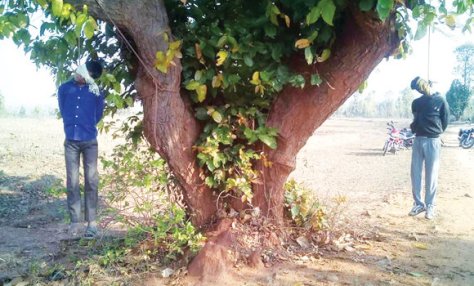
Mazlum Ansari and Imteyaz Khan, Jharkhand 2016.


The recent spate of vigilante attacks in India has lent a new, nearly domestic familiarity to the word “lynching”. This, though, is more than just a shift in language: the nation’s visual archive itself seems be shifting, towards instatement of a new normal. Inside just a year the “lynching photograph” has moved center-stage, filling mainstream news reportage and social media newsfeeds. The imagistic vocabulary of lynching has thus taken on a touch of mundane inevitability in caste and communal violence.

It began in March 2015, with the lynching of Syed Arif Khan in Dimapur, Nagaland. A couple of months later two teenage Dalit girls were raped, strangled and left hanging from a mango tree in Katra village in Uttar Pradesh. Then, on 28 September 2015, Mohammad Akhlaq was bludgeoned to death by a mob in his home near Dadri in what went on to gain spurious notoriety as a “beef-eating incident”. The following March, continuing with the logical rhythm of a scheduled sequel, the cattle herder Mazlum Ansari and his 14-year-old nephew Imteyaz Khan were lynched and hanged from a tree in Jharkhand. Most recently (on May 22) M. T. Oliva, a Congolese citizen, was beaten to death in the national capital of Delhi. This is an incomplete list: it includes only those incidents that resulted in fatalities. In the same timeframe there have been at least a dozen other cases in which the victims somehow survived the end-stage public shaming, torment and lurid physical violence, in short the ordeal of a completed lynching.

There is no lynching without its spectators. Continue reading Three Photographs, Six Bodies: The Politics of Lynching in Twos: Megha Anwer

But She was a Law Student …


In a way that is perhaps unprecedented, today, a very large number of Malayalis feel connected to each other by a veritable tsunami of pain. No wonder perhaps, because the veils of our complacency have been ripped off too thoroughly. The immediate context is the gruesome murder of a young Dalit student in central Kerala, in the tiny, rickety squatter-shack that was her home, in full daylight.

At a single stroke, the incident fully exposed the dimensions of social exclusion in contemporary Kerala. Hers was an all-woman family among families deemed ‘properly gendered’, they were lower caste people trapped and isolated among upper and middle caste families, they were the working-class poor without property in an area full of propertied domestic-oriented bourgeois and petty-bourgeois families. Oppressed in all these ways, they were invisible to the state and the political parties. They possessed no form of capital that would have allowed them upward mobility. Yet, the young woman struggled on and reached the law college.

‘But she went to college’, some ask, ‘how could she have been so helpless?’

Read the rest of the article here 


Media figures call for Release of Himal Editor Kanak Mani Dixit

New Delhi, April 23 — Editors and media figures as well as intellectuals and scholars from India, Nepal, Bangladesh, UK, US, Australia and Sri Lanka have called for the release of Himal editor and prominent Nepali journalist Kanak Mani Dixit who was arrested yesterday in Katmandu by anti-graft officials.

The following is the text of the statement:

It is with deep concern that we have learned of the arrest today of Kanak Mani Dixit, the widely respected founder-editor of Himal Media and a courageous voice for transparency, freedom of expression and democratic rights in Nepal and across South Asia. The charges are related to alleged corruption but Kanak Dixit says it is part of a vendetta pursued against him by people in Government.

We have known Kanak Dixit as a true professional, human rights defender and energetic journalist whose credentials are built on robust research and tremendous courage. Himal Media, a pioneer in South Asia journalism, has published Himal South Asia, Nepali Times and Himal Khabar Patrika (in the Nepali language). He has written extensively for international media including leading newspapers in India and is chairman of Sajha Yatayat, a state run transportation company, which he has been turning around from a loss-making entity. Continue reading Media figures call for Release of Himal Editor Kanak Mani Dixit

Responding to the Challenges of Blue and Red – Reminiscences of a JNU-HCU Alumna: Shipra Nigam

This is a guest post by SHIPRA NIGAM

That the past few months have been cataclysmic is an understatement. Personal tragedies and political catastrophes have exploded within our most cherished spaces, and brought a churning in them.  What was truly transformative was the experience of both the emergence of broad solidarities against right-wing fascism, and of the reminders of multiple registers and contexts within them. These underline the need for multiple conversations to understand both our common struggles, as well as the contradictions within, and to renew a resolve for introspection through them as we move towards real ‘azaadi’.

There is of course an ongoing debate on this, and here I felt that some binaries being invoked in it are not very convincing, while others brought home stark truths that pose challenges to a patriarchal, majoritarian caste hindu ordering of society, within which we are all located at different levels of hierarchy, complicity, and engagement.

I have been part of both public universities under fire right now, and the present brings home the urgency of the dual task of defending the public university as a space for pushing the boundaries of critical thought, and confronting the very hierarchies and complicities with power that shape it. This is necessary even as processes of democratisation and affirmative action take root in public institutions . So these are some reminiscences from an alumna of both these public universities who has been wrestling with articulations and complexities which lie beyond institutional labels or binaries. Continue reading Responding to the Challenges of Blue and Red – Reminiscences of a JNU-HCU Alumna: Shipra Nigam

Fifty Shades of Grey – Without the Thrills

[This is a response to Shourajenda Nath Mukherjee’s open letter on Kafila by Prof Makarand Paranjape]

Mr. Shourjendra Nath Mukherjee’s “Open Letter” of April 5, 2016 makes only one substantive point, concerning the agency of students, which needs attention. The rest of it, as the Dormouse said to Alice, is “much of a muchness” – confusion, rigmarole, and thumb-twiddling over precious little, which scarcely need be dignified by serious confutation. Continue reading Fifty Shades of Grey – Without the Thrills

Shoot to Kill: Standard Operating Procedure in Kashmir

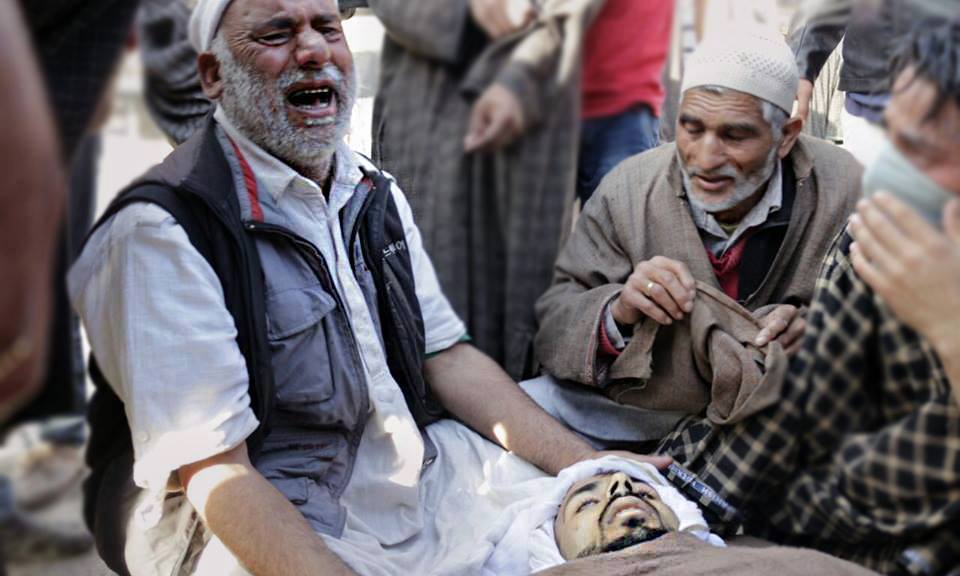
Nothing unusual has happened in Handwara. The Indian state has once again proved to be a killer  in Kashmir. Three people have lost their lives because the Indian armed forces and the J&K Police decided to defend themselves against people protesting against what they perceived to be a soldier’s harassment and molestation a Kashmiri woman.

Blood on the streets of Handwara
Blood on the streets of Handwara, Kashmir

The troops that defend India’s honour, unity and integrity and other such stuff have been trained to shoot to kill rather than answer a town’s questions about the sense of impunity that the Armed Forces Special Powers Act and the entire apparatus of a de-facto military occupation gives to Indian soldiers in the Kashmir valley. Lets stop pretending this is an exceptional situation, an excess, an anomaly, or even an instance of troopers going rogue. Whatever be the facts of the case, if the name the village of Kunan Poshpora, or of two women called Nilofar and Asiya mean anything to you, you will know that a predatory sexual profile is part of the operational signature of the Indian armed forces and local police in Kashmir.

Continue reading Shoot to Kill: Standard Operating Procedure in Kashmir