Category Archives: Mirror Worlds

On the Harud Literary Festival, setting the record straight

It is sad that a literature festival that was to be held in Srinagar later this month has been indefinitely postponed. What is even sadder is that while announcing its postponement on HarudLitFest.org, the organisers of the Harud Literature Festival (the same team that puts up the acclaimed Jaipur Literature Festival) have sought to blame those who signed an “open letter” expressing a set of concerns about the festival. The statement reads, “A few people who began the movement to boycott the festival have no qualms in speaking on and about Kashmir across international forums, but have refused to allow other voices, including writers, poets and theatre people from the Valley and across India to enjoy the right to express themselves at the Harud festival.”

As one of the over two hundred signatories of the open letter posted on Kafila.org, I am dismayed at the deliberate and disingenuous misrepresentation of the open letter as a “movement to boycott” What does such deliberate misrepresentation of dissent by the organisers of a literature festival say about them, their honesty and intent?

Two news reports appeared on 28 July 2011. One, by Agence France-Presse, quoted organiser Namita Gokhale as saying, “it will be an apolitical dialogue concerning literature”. The other report, by Randeep Singh Nandal in The Times of India, datelined Srinagar, did not quote anyone, and claimed: “There is speculation that Salman Rushdie might drop by…”

The term “apolitical” offended Kashmiris, who were seen objecting to it widely on Facebook and Twitter. Some of these were also aghast with the idea of Salman Rushdie, who they consider a blasphemer against Islam, sitting on a stage in Srinagar. Even though some of those named in these and subsequent news reports had told the festival organisers even before the news was in the papers that they would not be able to attend, their names were falsely put out in the media. They were thus forced to publicly state they would not attend a lit-fest termed “apolitical”.

Kashmir is a place where people live under the shadow of the gun, their political grievances against the Indian state silenced with draconian laws, criminalisation of dissent and heavy militarisation. You can get two years in jail without charge for a Facebook status update, a pamphlet, a mass gathering, a call for strike. Around the time the Harud controversy was gaining momentum, the Jammu and Kashmir Police beat up over several hours a photojournalist, allegedly because they didn’t like his work on the Al-Jazeera website.

Now, a group of people from the Indian capital decide to go to the place described above, to hold a literary festival, and announce that the festival would be “apolitical”. Were Kashmiri writers and journalists, including some acclaimed ones, wrong in feeling offended?

On 12 August 2011, Namita Gokhale was quoted as saying in the London-based newspaper The Guardian (no relation to this publication), “There was perhaps some misinterpretation of my use of the word ‘apolitical’.” She chose not to withdraw the word. If by apolitical she meant non-partisan, the choice of venues, Delhi Public School’s Srinagar franchise and the Kashmir University, was not seen as non-partisan in Srinagar. If your intent is to be neutral in a conflict zone, surely, you must attempt to be seen to be neutral?

he open letter, signed initially by fourteen people, including me, was published on 25 August. It said, “Our concerns are also heightened by reports that the festival is sought to be denoted as being an ‘apolitical’ event, that, yet, people will be free to speak what they want and that no one has the right to deny Kashmiris a chance to listen to writers. Beyond the absurdity of asserting that art and literature has nothing to do with politics, our issue is precisely that people are not allowed to speak their minds in Kashmir.” The open letter did not use the word boycott, did not urge anyone to not attend it, did not ask for it to be cancelled. It did say, “We would firmly support the idea of a literary/artistic festival in Kashmir if we were convinced that its organising was wholly free from state interference and designs, and was not meant to give legitimacy to a brutal, repressive regime.”

Two days later, their response on Kafila.org said, “We wish to categorically state that the Harud literature festival is not government sponsored.” It did not withdraw the word ‘apolitical’. An expanded version of this 27 July release, sent to the media, mentioned false rumours spread by a Facebook group about Rushdie coming to attend. Why did it put the blame of the Rushdie rumour on Kashmiris and not on The Times of India, and on themselves for choosing to not deny the rumour for a whole month?

Then, suddenly, on 29 August they announced indefinite postponement of the festival, in a dishonest release that blamed the signatories of the open letter for being against free speech! It also cited security threats emanating from that Facebook page with nearly 5,000 ordinary Kashmiris supporting the boycott call on account of Rushdie’s rumoured attendance.

Given that so many Kashmiris have expressed reservations about the festival’s intent, including many Kashmiri writers and journalists, even young, aspiring, as yet-unpublished ones, it is surprising that we are hearing patronising comments about how Kashmiris have been ‘denied an opportunity’. It is high time Kashmiris started their own literary festival, something they have tried to do before but were not allowed to by the state government. They should do it in Delhi or Jaipur, giving Indian writers an opportunity to learn what it means to be political.

(First published in The Sunday Guardian, Delhi, and The Friday Times, Lahore.)

From Kafila archives:


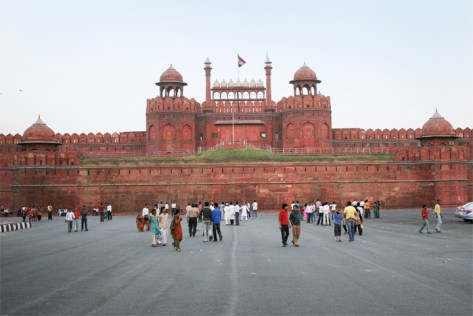
Of Seven Cities and New Delhi

Historically, Delhi was a place that all its conquerors made their home, but for the British it was a city that only glorified the power of Imperialism. Photos: Sohail Hashmi/Himanshu Joshi

Red Fort

Continue reading Of Seven Cities and New Delhi

Hypocrisy in Any Season: Mridu Rai responds to Rahul Pandita on the Harud Literature Festival

Guest post by MRIDU RAI

Rahul Pandita has written a misleading piece—in the tone of high dudgeon and ethical outrage no less—in the ‘essays’ section of the 3 September 2011 issue of Open magazine titled “The Autumn of Hypocrisy”. I think it is a piece that, nevertheless, requires some examination mostly because it makes several assertions in ways that queer any possibility of debate around the important question of what a literary festival held in Kashmir today might mean. Whether or not it was the author’s intention to do so, its effect is also to discredit, off-hand, several literary and artistic voices whose greatest sin would appear to be to have disagreed with the kind of literary festival in Kashmir Rahul Pandita and his fellow organizers had in mind. Of course, it is also troubling to hear from Mr. Pandita on this question since he is both an aggrieved party, deprived of his right to express himself at the festival, and also, as the credit at the bottom of his piece elaborates, a former “member of the advisory committee for the Harud literary festival”. I wonder if this conflict of interest bothers anyone other than me. Continue reading Hypocrisy in Any Season: Mridu Rai responds to Rahul Pandita on the Harud Literature Festival

Ten lessons of the fortnight that was: Jay Mazoomdar

Guest post by JAY MAZOOMDAAR

The 13-day blockbuster— peddled as the second freedom struggle, panned as irresponsible blackmailing, and a lot in between — is over. Anna Hazare accepted honeyed coconut water from two little girls, introduced to the crowd as a dalit and a Muslim, and went on to recuperate in one of India’s most expensive hospitals, one branded after Hindu spiritual literature at that.

News TV is still fighting the vacuum by flogging the debate – so much so that seasoned correspondents are chasing a rather dismissive Dr Naresh Trehan to unravel the mystery of Anna’s endurance. Biker gangs have gone into a sulk and roads at India Gate are looking safer for traffic and women (which is not saying much in Delhi). What is more, India has started taking note that too many Indians have meanwhile drowned in floods. Continue reading Ten lessons of the fortnight that was: Jay Mazoomdar

The North-South Question in Punjab: Umair Javed

click to enlarge

‘Sayeen, ham nay toh kabhee 5,000 banday kaa jaloos bhi nahee nikaala. Siyaasat kay liyay aik laash kya, aik zakham bhi nahee hay hamaray paas toh. Aur aaj lag aisay raha hay kay hamaari dheemi dheemi baaton ko sun kar yay Punjab kay tukray karnay lagain hain’  (Sayeen, we’ve never taken out a rally with 5,000 people. Forget martyrs, we don’t even have a bruise to flaunt for political mileage. And today, it seems they’ve heard our whispers and taken them to heart. Today, they’re talking about splitting Punjab.)

While talking to a few last month, I realized that most independent Seraiki activists privately acknowledge that the issue of a new province, or at the very least, a wholesale recognition of Seraiki grievances, was a cause that could only be made actionable when the People’s Party thought it to be worthwhile – and 9 times out of ten, a cause’s worth for a national level party is determined by its weight in the electoral matrix.  Continue reading The North-South Question in Punjab: Umair Javed

A fax about Anna: Dilip D’Souza

Guest post by DILIP D’SOUZA

Of course everyone has their own take on the movement that’s got us all talking. It raises passions, it polarizes, it shakes the powerful, on and on. I have immense admiration for what Anna Hazare has achieved: the outrage against corruption where we had indifference before, the outlet for such outrage, the renewed hope where we had cynicism before, the way his movement has shamed brazen politicians and forced an entire government to listen.

Yet the movement sometimes reminds me, of all things, of fax machines. Continue reading A fax about Anna: Dilip D’Souza

Hazare, Khwahishein Aisi: Desiring a new politics, after Anna Hazare and beyond corruption

Hazare, khwahishein aisi, ke har khwahish pe dam nikle
bahut nikle armaan, lekin, phir bhi kam nikle

Hazare, so many desires, that every desire takes our breath away
so many hopes, and yet so few

(with due apologies, for liberties taken, to Mirza Asadullah Khan Ghalib, sometime poet and native of Delhi)

On the ninth of april, this year,  I wrote a posting on Kafila titled – ‘At the Risk of Heresy : Why I am not Celebrating with Anna Hazare Tonight‘. A little more than four months later, I have to say I have not yet found reasons to celebrate. But I am not in mourning either. What follows is my attempt to think this through, in all its contradictory character. For once, I am not even trying to be consistent. If my argument occasionally faces two directions at once, it is probably because I feel the needs to be double faced in order to understand a double-faced moment. When all the talk is only of the need for honesty, one might want to stake a claim to being double-faced, if only for the sake of breaking the moral monotony.

Continue reading Hazare, Khwahishein Aisi: Desiring a new politics, after Anna Hazare and beyond corruption

The Lokpal debate from a Dalit-Bahujan perspective

The video above shows a protest in Delhi demanding a Bahujan Lokpal Bill, and protesting against Anna Hazare. This was hardly given any coverage in the media. The video was made and uploaded by KHALID ANIS ANSARI, who writes at the Round Table India:

A supra-parliamentary Jan Lokpal and a very interventionist and unaccountable judiciary are a horror for the dalit-bahujan masses. All said and done the legislature is most respectful of social diversity as far as the three organs of government are concerned. The executive is bad and the judiciary is the worst in this regard. So I am presently in favor of taking the ‘political’ route than the civil society one which is in any way a club of the chattering classes. [Read the full post]

Given below is a note expressing a Dalit-Bahujan perspective on the Lokpal debate. The note has been put out by DINESH MAURYA: Continue reading The Lokpal debate from a Dalit-Bahujan perspective

A Response from the Harud Literature Festival

In response to the open letter expressing a set of concerns about the forthcoming Harud Literature Festival, the festival organisers have responded:

We wish to categorically state that the Harud literature festival is not government sponsored. It has been conceived with the intent of creating a platform for free and open debate, discussion and dialogue through contemporary narratives, literary fiction and poetry.

The festival seeks to showcase writing in urdu, kashmiri, dogri and english from the region and other Indian writers. We seek support for the spirit of the festival which is plural, inclusive and supports freedom of speech and expression. [Link]

Some Thoughts from Ramlila Maidan

This slideshow requires JavaScript.

The People

Not enough people are asking what is motivating people to go to Ramlila Maidan in such large numbers. People like Ghazala Jamil and Anish Ahluwalia are not asking this question because for them the whole thing is an elite, middle-class conspiracy that is anti-Dalit, anti-OBC, anti-Muslim, anti-justice, anti-equality, anti-peace, anti-love and anti-sex.

These saviours of the marginalised, the poor and the vulnerable make the point that Anna Hazare’s means are showing contempt for the people by not letting people’s chosen representatives delay anti-corruption measures. They are making the point that unless Anna Hazare’s movements takes up issues of land reforms and justice for Gujarat’s Muslims, he should not be supported.  Continue reading The People

Three Questions to Friends

I have been taking my time to reflect on the positions that have emerged in the fairly polarised debate on the on-going anti-corruption struggle in Delhi. I take very seriously the questions raised by critics on the right-wing inclinations evident in the movement’s leadershi, but I think it is both a strategic mistake and a disawoval of responsibility on the part of those of us on the left of the political spectrum to stay out of it. We should engage with the movement from the inside, strategically and persistently, and this means thinking afresh on the means by which we may support the larger binding issue with clear awareness of the risks involved. In this connection, I want to raise three questions:

First, when did we start to be so reluctant to acknowledge the fact that any civil social movement is bound to be contaminated by regressive positions and ideologies and so we cannot avoid thinking of ways of participating in them guided by awareness of the risks? I have recently been trying to collect narratives remembering the fourth national conference of the Indian women’s movement held at Kozhikode, Kerala, in 1990. The participants who spoke to me often pointed to a contrast between the dominant left parties who opposed the conference from the outside, and many, many groups who participated in the conference fully, but raised sharp criticisms which were quite like those of the former. They remarked that these critics were listened to with considerable respect because they were inside, unlike the dominant left.The participant who mentioned this, a well-known radical activist here, still remembers their arguments vividly. Another participant remembered sharp disagreements between urban feminists and rural participants on the question of justice to rape victims. While the former were opposed to the ‘solution’ of marrying the victim off to the rapist, a senior participant from a rural area who spoke up approved of it. This was shocking and unexpected to the urban feminists, but then purity of positions wasn’t, apparently, an overwhelming concern then — and at that place.

Continue reading Three Questions to Friends

जोश मलीहाबादी की एक नज़्म – आज के नाम

जोश मलीहाबादी की नज़्म ‘रिश्वत’ के कुछ टुकड़े, इस स्वाधीनता दिवस के नाम.

[Apologies for some missing nuqtas, despite my best efforts.]

लोग हमसे रोज कहते हैं ये आदत छोडिये
ये तिजारत है खिलाफे-आदमियत छोडिये
इससे बदतर लत नहीं है कोई, ये लत छोडिये
रोज अखबारों में छपता है की रिश्वत छोडिये

भूल कर भी जो कोई लेता है रिश्वत, चोर है
आज कौमी पागलों में रात-दिन ये शोर है. Continue reading जोश मलीहाबादी की एक नज़्म – आज के नाम

What caste do you think the Financial Times is?

See update below.

So… I get a phone call yesterday. It’s a reporter from the Financial Times who wants to know what I feel about the recent ban on the movie Aarakshan in certain states, and also what do I feel about caste-based reservations in general, whether caste is still relevant in the India of today, the theory that quotas just increase inequality etc.. I tell her I haven’t seen the movie, and if she still wants to know what I feel about caste-based reservations we could talk for a bit. She says she absolutely wants to know. So I say fine, and we have a 45-minute conversation. Allow me to reproduce a very simplified version of that conversation (in Q&A forrmat):

1. Q: Do you believe movies like Aarakshan can be provocative or controversial; as in, are certain groups justified in taking offence and asking for a ban? Continue reading What caste do you think the Financial Times is?

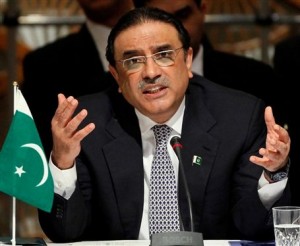
In Defence of Asif Ali Zardari: Abdullah Zaidi

Guest post by ABDULLAH ZAIDI

What comes to your mind with the mention of Asif Ali Zardari? “A cunning, vile, and corrupt man,” said my 19 year old cousin. This was a good summation of what the urban middle-class thinks of him. The more I hear people talking about him the more I am convinced of the power of propaganda. “Give the dog a bad name and hang him,” Zardai once said about himself. That is what is at work here.

Despite what has been said about him, Zardari did have a political background. His father Hakim Ali Zardari entered politics well before Partition and was a member of the Khaksaar Tehreek in 1931. He was first elected to the National Assembly in 1970s. All this talk of Zardari as a political orphan who hogged the Bhutto dynasty upon marriage with Benazir, is a non-starter. In Benazir’s husband, the Bhutto family wanted someone who would remain loyal to her. That is exactly what they got in him. For Zardari, family would always come first. This was the case at the time of Benazir’s death, when he kept the family together. Benazir would often tell close aides that despite his failings, Zardari always remained loyal to the family. Continue reading In Defence of Asif Ali Zardari: Abdullah Zaidi

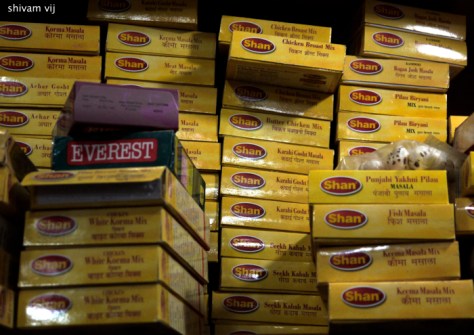
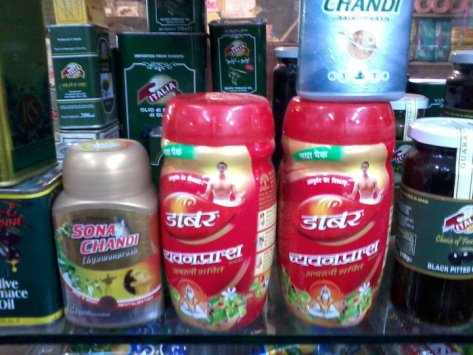
India and Pakistan: A Matter of Taste

Imported from Karachi, Shan masalas are a hit in Delhi. They make sure anyone can make good Biryani or Korma. Photo taken at a grocery store in south Delhi by Shivam Vij
Dabur Chawanprash at a grocery store in Lahore. The Devnagiri script on the pack would be a rarity in Pakistan! Photo credit: Shiraz Hassan

Tagore in film


That is a clip from The Postmaster (the first story in Teen Kanya, directed by Satyajit Ray).

Trisha Gupta on Tagore’s characters, seen better in films than in English translation:

In film after film, we see events through the eyes of the educated Bengali man trying to deal with a world that has either changed too much—or too little. The protagonist is often a young man from the city who arrives at a small provincial outpost, armed with a modern Western education and little else, his head full of glimpses of another world that seem only to succeed in cutting him off from everything around him. Continue reading Tagore in film

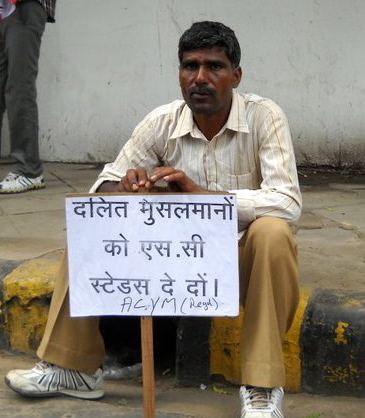
The Unending Struggle of Dalit Christians and Dalit Muslims for Equality: S. Japhet and Y. Moses

On the sidelines of a protest at Delhi's Jantar Mantar today

Guest post by S. JAPHET and Y. MOSES

Religious minorities, both Christians and Muslims from different parts of the country have converged in Delhi to demand reservations for Dalit Christians and Dalit Muslims. This is part of a long standing struggle demanding the Government to introduce a bill to amend the constitution to include Dalit Christians and Dalit Muslims in the scheduled Castes list. The Christian community has been agitating since the promulgation of the Presidential Order Government of India 1950 that effectively prevents those professing religions other than Hinduism from being considered as Scheduled Castes. It has been argued that the 1950 Order violates Article 15 that prohibits discrimination on grounds of religion, race or caste and Article 25 that gives the right to all citizens to profess and practise any religion according to his or her choice. The demand is that affirmative action or positive discrimination of dalits, providing reservations in government jobs, educational institutions and representation in Parliament and state legislatures should be extended to all dalits irrespective of whatever religion they may profess and practise. Continue reading The Unending Struggle of Dalit Christians and Dalit Muslims for Equality: S. Japhet and Y. Moses

Few Hearts to Live for

This slideshow requires JavaScript.

Photographs by Amruta Mehta

Just when Shantuben held her meditative poise at a Vipassana camp at Igatpuri on the morning of January 26, 2001, her dream turned to rubble back home in Bhuj. When she reached home, her labour of love of the last 5 years was gone, razed to the ground. It all had to start afresh. Continue reading Few Hearts to Live for

Solidarity letter to anti-POSCO movement from Korean jail: Sung-Hee Choi

Madhumita Dutta has sent us this powerful letter in solidarity with the people of Jagatsinghpur opposing the POSCO project, written by a South Korean activist SUNG-HEE CHOI, in prison for opposing a naval base.

Dear residents in Jagatsinghpur,

I am a woman and activist living in South Korea, the country of the POSCO you oppose. I am currently being jailed in the Jeju prison, under the charge of ‘interruption of business’, because of my resistance against the enforcement of the naval base construction in the Jeju Island located in the south of South Korea. As of today, July 3, I met 46th day since my arrest and 44th day since my being restrained.

I accidently happened to see two of your struggle photos and a photo in the Korean Times, June 13, 2011 had a  caption underneath it:
‘Anti POSCO action in India: A village sprays water to relieve children lying with other villages along the entry point to prevent policemen and officials from entering their area at Jagatsinghpur district, about 140 kilometers(87 miles) east of eastern Bhubareshwary India, Saturday. The villagers have been protesting against turning their farmland into an industrial developed area for a $12 billion steal plant of South Korean conglomerate POSCO (AP-Yonhap).’

Continue reading Solidarity letter to anti-POSCO movement from Korean jail: Sung-Hee Choi

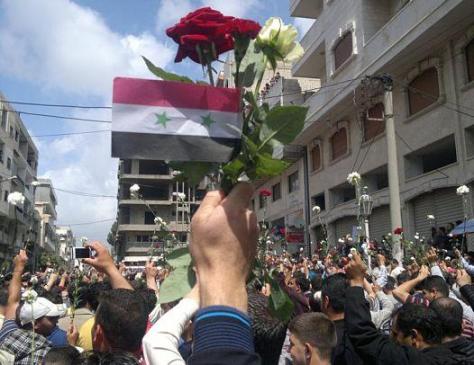
‘Ask Brazil, South Africa and India to help stop the bloodshed in Syria’

AMNESTY INTERNATIONAL wants you to sign the statement below

It has been over four months since the beginning of largely peaceful protests in Syria calling for political reform and for the Syrian President to step down. The Syrian authorities’ response to their people’s demands has so far been brutal to say the least.  Continue reading ‘Ask Brazil, South Africa and India to help stop the bloodshed in Syria’