
We the citizens of India and Pakistan strongly condemn the inhuman and dastardly serial blasts in Mumbai on 13 July 2011 in which 21 innocent people were killed and over 140 injured. We offer our heartfelt condolences and sympathies to the bereaved families and pray for quick and complete recovery of all those injured. It is clear that these blasts are a well orchestrated heinous conspiracy to derail the resumption of the dialogue and peace process between India and Pakistan that was stalled following the terrorist attack in Mumbai in 2008. Continue reading Indian and Pakistani Citizens Condemn Serial Blasts in Mumbai
Category Archives: Mirror Worlds
Martyrs’ Days: Memorializing 13 July 1931 in Kashmir: Mridu Rai
Guest post by Mridu Rai
It is widely believed that the Kashmir conflict has its roots in the Partition of India in August 1947. This view perpetuates the understanding of the conflict as one between India and Pakistan. However, recognising that the roots of the conflict lie in an earlier history – indeed, that there was a history before August 1947 – changes our understanding of the ‘intractable’ conflict in Kashmir. This guest post by MRIDU RAI, author of the book, Hindu Rulers, Muslim Subjects: Islam, Rights and the History of Kashmir (2004), discusses the salience of the events in Srinagar on this day, exactly 80 years ago.

Continue reading Martyrs’ Days: Memorializing 13 July 1931 in Kashmir: Mridu Rai
#AgainstIndianCulture
Twitter hash-tag doing the rounds, becoming a meme with thousands of tweets. Small selection for you only:
‘Can someone be a Brahmin and not be acting as a Brahmin?’
 Over at the excellent India Site, Rahul Pandita asks a thought-provoking question:
As a Brahmin, does it make me less sensitive to the plight of the poor or the marginalised? Why is it such a big deal that I can wear my Janeu, recite my Hanuman Chalisa, and yet go to Bant Singh’s house in Bhurj Jabbar, thirstily gulp down a few glasses of water, and tell his story? Where is the contradiction? [‘A Brahmin Heart’]
 And the ever-sharp Kufr has the best answers there can be to that question:
when rahul pandita says he’s a brahmin, he’s making a claim on a lot of indian history. when bant singh rebels against his present, he is also rejecting pandita’s history, his claim on privilege. if pandita doesn’t see that, he shouldn’t have undertaken the trip to bant singh’s home. [why bant singh can’t go to rahul pandita]
“Report the news. It is not news that there are poor people in India.”
In the morning today The Independent‘s Asia correspondent, Andrew Buncombe, blogged his disagreement with Arundhati Roy’s statement that foreign journalists in India have been asked not to report bad news. As a foreign journalist in Delhi he had faced no such censorship from his editors or the government here.
Buncombe made his case strongly: Continue reading “Report the news. It is not news that there are poor people in India.”
Coke Studio India – the first six songs
So the unanimous verdict is that Coke Studio India (first aired on the Friday that went by) is no match for Coke Studio Pakistan [Wikipedia]. For some it’s been like an India-Pakistan match – I’ve seen Indian congratulate Pakistanis on Twitter for the ‘Coke Studio victory’ and others ask Indian musicians and singers to listen to Pakistani singers and hang themselves. For most, this was not surprising – Coke Studio Pakistan has showcased some of the best music you’ve heard in recent times and it raised the bar too high for Coke Studio India. There’s also the problem of Bollywoodisation of music in India, of dumbing down, producing music aimed at the marriage market and livening up the moods of those stuck in traffic. A celebrity culture has taken the passion out of music in India – it does not seem to come from deep within. New popular music in India leaves you with the kind of feeling that a mall does. Loud and empty.
Dr Khaleel Chishty will finally be free
This note comes from KAVITA SRIVASTAVA of the People’s Union for Civil Liberties

Dr. Khaleel Chishty, the 78 year old a renowned Virologist from Pakistan, will now go home very soon. A process that began on the 20th of April, 2011 will finally conclude at the Rajasthan end two months later precisely on the 20th of June, with the Governor signing the mercy petition that will let him go, once the MEA give their stamp. Continue reading Dr Khaleel Chishty will finally be free
Birds, tea, ghosts and the Indian National Congress: Sumana Roy
Guest post by SUMANA ROY
A few years ago, I took my students to the cemetery in Darjeeling. I lived in an apartment just above the Happy Valley Tea Estate, from where I saw the prettiest of sunsets, had a colleague point out the ranges of Sandakphu to me quite often, and from whose long narrow balcony I imagined shadows of, as the lingo among Bengalis in Darjeeling went, “Sahib Ghosts”. Apart from the weather, perfect and monstrous in turns, what kept Darjeeling alive to “professors from the plains”, as we were called, was the mythology of “biliti” (“foreign”) ghosts waiting for the appropriate moment to reclaim what they had created – tea-gardens, the schools and colleges, the architecture, the cookies and cakes, the “style”, a word in which we tried to condense the British legacy. We spoke about planchettes, about ghosts we wanted to invite for tea, while history professors debated with political science researchers whether that meeting would be a post-postcolonial one or an anti-postcolonial moment. Continue reading Birds, tea, ghosts and the Indian National Congress: Sumana Roy
Caste in Urdu Prose Literature: Ajmal Kamal

Guest post by AJMAL KAMAL
The historical division of society in South Asia on caste lines is now an acknowledged sociological, political and economic fact. However, caste as a literary or social discourse does not, for several reasons, form a part of the predominantly Muslim culture of Urdu. Nor has there been much academic exploration of the role caste plays in the life of South Asian Muslim communities as against others. As far as the Urdu literary writing is concerned, it has traditionally focused exclusively on the lives and concerns of conquerors, their cohorts and their descendants, who typically prided themselves on their real or perceived foreign origins. Even after modern, socially committed writing began in Urdu around the 1930s, caste as a variable for social exploration was largely ignored in favour of economic class. Continue reading Caste in Urdu Prose Literature: Ajmal Kamal
Corruption, the New Caste: Thomas Crowley
Guest post by THOMAS CROWLEY
In the mainstream coverage of the Ramdev hullabaloo, there has been, unsurprisingly, little substantive discussion about corruption itself: its fundamental causes; its widespread effects; the viability of different plans to combat it. Who would want a dry, intellectual discussion of the root causes of corruption when we can stare uneasily at pictures of Baba Ramdev holding a sword and wait with bated breath for his holy army to congregate?
But let’s – for the moment – take seriously Ramdev’s proposal that the death sentence be meted out to India’s corrupt. If the press is to be believed – especially the foreign press – this may just mean killing every Indian. For, implicit in many media reports is the assertion that corruption is part of the Indian psyche, an essential component of what it means to be Indian. In this sense, corruption serves the same conceptual role as caste: it essentializes an ever-changing historical phenomenon, freezing it in time and obscuring its economic and political roots. Much as the British taught Indians and foreigners alike to understand India predominantly in terms of caste, modern commentators are encouraging both desis and firangis to conceptualize India as the land of unending corruption. (Of course corruption has not replaced caste as a mode of understanding India; the fascination with caste still runs deep.)
Six Dead Villagers and a Lost Road: This did not happen at Baba Ramdev’s ‘Yoga Camp’ at Ramlila Ground in Delhi
Sometimes, thankfully, one does not need to write an over-long post to make a point.
Everybody knows how the entire television media has been giving enormous airtime to BJP and its allies giving vent to their outrage on the condemnable police action on Baba Ramdev’s ‘Yoga Camp’ in the Ramlila Maidan in New Delhi. One woman, named, Rajbala is still seriously injured. No casualties have been reported so far.
Though it must be said that Acharya Balkrishna, Baba Ramdev’s right hand man, seems to have had the pitch of his voice transposed a few octaves higher, giving his heartfelt statements at press-conferences the timbre of a dulcet castrati. I suppose, depending on how you look at the fate of Acharya Balkrishna’s vocal cords and other organs, that is a casualty. Continue reading Six Dead Villagers and a Lost Road: This did not happen at Baba Ramdev’s ‘Yoga Camp’ at Ramlila Ground in Delhi
The Power of Crowdsourcing
Old Left is Dying! Long Live the Left!
[Following the publication of the previous post – the statement on the future of the Left, we have received some important comments that seek to take the debate forward, alongside those predictable, invective laden rants that we know only too well by now. We need to keep the debate on the future of the Left in India going, irrespective of these comments that seek to derail any meaningful discussion. We must continue to assert that ‘the Left’ far exceeds the decadent and decrepit lot that now goes by the name of Left parties in this country. This post is a slightly modified and longer version of an article that appeared in Bengali yesterday in Ekdin.]
In a recent newspaper article, former Left Front finance minister Ashok Mitra, observed: “The Left Front, led by the Communist Party of India (Marxist), has not merely lost the poll in West Bengal, it has been made mincemeat of.” He was underlining the obvious, catastrophic significance of the results – at least from the Left Front’s perspective. The signs are there for everybody to see, especially when all important leaders of the LF government have faced resounding defeat and the overall vote share of the LF has declined by almost 9 percent since the last assembly election. Mitra’s reference is important as much was being made of the fact that he signed in support of the LF in the course of the election campaign.
But such was the state of drunkenness in power, that only a Biman Bose could say, when virtually everyone knew what was coming, that the LF would still gain a comfortable majority and those who were predicting their decline would have to “swallow their own spit.” More incredibly, even after the elections, indeed after the results came in, both Bose and Prakash Karat in Delhi focused on the fact that their votes had increased by 11 lakh votes in absolute terms. Of course, the minor detail they mentioned in passing was that the TMC alliance had increased its votes much more. The even more minor point that there had been as many as 4.8 million more votes polled this time as compared to 2009 was, of course, beside the point.
‘The situation in Ngaba is getting worse’: An interview with Tsewang Rigzin of the Tibetan Youth Congress
Guest post by T RIYAS BABU

It all started on March 16 this year when a Tibetan monk named Phuntsok set himself ablaze in protest against China marking exactly three years since the bloody crackdown by Chinese troops on the people of Ngaba County of Tibet in 2008. Chinese government tightened security and its stronghold on Ngaba in general and Kirti monastery in particular. Tibetans allege the authorities even blocked food supplies to the monastery in an attempt to starve around 2,500 monks. They say many have been arrested and a large number are missing. Continue reading ‘The situation in Ngaba is getting worse’: An interview with Tsewang Rigzin of the Tibetan Youth Congress
पीर पराई जानै कौन?: कुलदीप कुमार
Guest post by KULDEEP KUMAR
अज्ञेय की प्रसिद्द कविता-पंक्तियाँ हैं:
“दुःख सबको मांजता है/
स्वयं चाहे मुक्ति देना वह न जाने/
किन्तु जिनको मांजता है/
उन्हें यह सीख देता है/
कि सबको मुक्त रखें.”
लेकिन दुःख की इस सीख पर क्या कोई अमल भी करता है? पुराना या आज का इतिहास तो इसकी गवाही नहीं देता. बल्कि देखने में तो यह आता है कि दुःख के भी खाने बन जाते हैं. हमें केवल अपना या अपनों का दुःख ही दुःख लगता है. पराई पीर जानने वाले वैष्णव हम नहीं हैं.
जबसे सुना है कि ओसामा बिन लादेन की ह्त्या उसकी दस-बारह साल की बेटी की आँखों के सामने हुई, तभी से विचलित हूँ. मुझे मालूम है कि आज जिस तरह की फिजा बन गयी है, उसमें यह कहना भी जोखिम से खाली नहीं है. मुझे ओसामा बिन लादेन के प्रति सहानुभूति रखने वाला घोषित किया जा सकता है. उसकी बेटी को तो पता भी नहीं होगा कि उसका बाप वाकई में क्या था. क्या उस बच्ची का दुःख इसलिए कम हो जाता है क्योंकि वह ओसामा की बेटी है? हम लोगों ने अपने लिए जिस तरह के तर्क गढ़ लिए हैं, उनके अनुसार तो इस बच्ची के दुःख के बारे में सोचना और बात करना भी आतंकवाद के प्रति सहानुभूति दिखाना होगा.
Who Killed Jugni? Shiraz Hassan
Guest post by SHIRAZ HASSAN
It was many summers ago. I was visiting my village on the banks of the Jhelum. I saw the people of my village go towards the Eidgah, across the chappaD, or the pond. When I asked my grandfather about them, he said. “Ajj mela ay putter!” [Son, today is a fair!] The mela ground was bustling with makeshift shops and people thronging them. At one end of the mela a circus had come up. The mithai stalls were packed with customers and curious on-lookers, some of them were buying and eating. And that’s when I heard the sound of their music. There they were, surrounded by a circle of spectators. A couple of local artists sang a song I had not heard before. I couldn’t understand a word, other than ‘O mereya Jugni, O mereya Jugni’ – which they chorused, over and over again.
That was my introduction to Jugni. I had no idea who Jugni was, and for I long time I didn’t care. Continue reading Who Killed Jugni? Shiraz Hassan
The Death of Merit: A short film series by the Insight Foundation
From here.
This documentary is first in the series of our efforts to document caste-based discrimination prevalent in Indian higher education system resulting in large number of suicides of Dalit students in Indian campuses.
It is based on the testimonies of parents and family members. In next few days, we are coming up with few more documentaries to expose the kind of caste-based hostility and harassment Dalit and Adivasi students have to suffer from the faculties, fellow students and administration in some of the country’s premier educational institutions. These documentaries are part of our efforts to make Indian educational system inclusive in real sense and free from caste-discrimination.
Here’s more on The Death of Merit.
Brilliant Tutorials: Trisha Gupta reviews Siddharth Chowdhury’s “Day Scholar”
 Guest post by TRISHA GUPTA
On the face of it, Siddharth Chowdhury’s Day Scholar, is a coming of age novel. The book’s own inside cover actually describes it as a “crazed and profane coming of age tale”, whose plot is ostensibly about how Patna boy Hriday Thakur (“who hopes to be a writer some day”) is first “trapped… by a series of misjudgements” and later “saved from a terrible end”. But much like Chowdhury’s previous offering, Patna Roughcut (also billed as “a story of love, idealism and sexual awakening” that takes us to “the heart of an aching, throbbing youth”), Day Scholar – despite a self-referential moment when its protagonist is asked by his father about how his Bildugsroman is coming along – is not a book that seems containable within the neat boundaries of the coming-of-age genre. Continue reading Brilliant Tutorials: Trisha Gupta reviews Siddharth Chowdhury’s “Day Scholar”
In Memory of the Unknown Worker, this May Day
Nations build memorials to the Unknown Soldier. A militarized imagination in which the glory of the Nation is embodied in a nameless and faceless figure who courts death. This faceless Unknown Soldier must die so that the myth of the nation can live, and a mythical National Interest devastate the everyday lives of the powerless.
This May Day, let us sing to the memory of the Unknown Worker – celebrated by no one, not even in abstraction! The faceless figure on whom rest our lives of luxury, our ‘growth’ and the profits of the bourgeois. I borrow the the term ‘unknown worker’ from Susie Madrak.
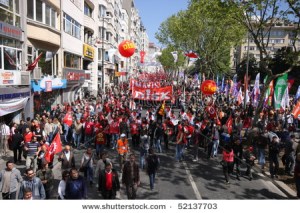
Let us, we who have no nation – antinationals, postnationals, aliens, refugees, immigrants, undocumented workers, development refugees – sing the strains of the Internationale. Let us recall the days when the poetry of the International truly belonged to the ‘wretched of the earth’, the time when the Internationale was not yet taken over and made into the official anthem of nations, parties and governments. The long winter of party-state-nation appropriations of the voices of struggle, that set in more than a century ago, and once again imprisoned them, may be nearing its end.
Continue reading In Memory of the Unknown Worker, this May Day
A Few Lessons on Marxism and Politics
“At a certain point in their historical lives, social classes become detached from their traditional parties. In other words, the traditional parties in that particular organizational form, with the particular men who constitute, represent and lead them, are no longer recognized by their class (or fraction of a class) as its expression” – Antonio Gramsci, Prison Noteboooks, International Publishers, New York, 1971, p. 210. Emphasis added)
This is how Gramsci, sitting inside Mussolini’s fascist prison, began his now celebrated discussion of the ‘crisis of hegemony’. I cite this here apropos of the discussion that has gone on some of the previous posts by Monobina Gupta, Sankar Ray and myself on the CPM/Left in West Bengal, in the course of which, I have been accused of ‘coming out’ as a supporter of the Trinamool Congress, which some have also termed as a fascist or even ‘super-fascist’ organization! Clearly, these gentlemen neither know the history of fascism nor indeed of Marxism. Fed on pamphlets of a certain marxist catechism, they have learnt only one thing: the division of the world into two camps where ostensibly, battle lines are permanently drawn between parties that apparently have a ‘mandate from heaven’ of bearing a particular class character, either bourgeois or working class. I hope none of those who have learnt their ‘dialectics’ or their ‘historical materialism’ from marxism-made-easy pamphlets of Emile Burns, Maurice Cornforth and Stalin will jump to pronounce Gramsci a postmodernist who denies this supposed ‘class essence’ of parties . (I am told though that these too are passe now; ‘cadres’ these days are not meant to read beyond party resolutions and ‘theoretical’ essays of Prabhat Patnaik, whose own world has stopped with Michal Kalecki).
Did You Say ‘US Imperialism’, Prakash Karat? Sankar Ray
Guest post by SANKAR RAY
The CPI(M) general secretary Prakash Karat and the Left Front chairman Biman Bose deserve thanks for referring to the WikiLeaks revelation about the US enthusiasm in seeing a change of guard at the Writers’ Buildings, the seat of the Government of West Bengal.
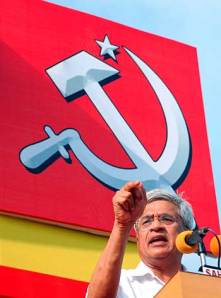
Quoting the cable no 230353 10/20/2009, Mr Karat conveyed the gist of it as follows: “Since the May 2009 parliamentary elections elevated West Bengal’s regional party, All India Trinamool Congress, from obscurity to the second largest constituent party in the United Progressive Alliance, its leader, Mamata Banerjee, has conscientiously sought to re-brand herself as West Bengal’s Chief Minister-in-Waiting. She is using the considerable administrative resources at her disposal as Railway’s Minister, political resources as leader of the state opposition party, and personal resources to initiate this transformation. Supporters and critics acknowledge the new image, but question whether it is indeed a new product, or simply new packaging. Backed by a large parliamentary constituency and allied with the ruling Congress party, Banerjee’s Trinamool is well placed to win the 2011 state assembly elections if she can continue along her current path of self-restraint and avoid making any mistakes along the way.” For details, the reader has to visit http://pragoti.org, even though it’s unabashedly pro-CPI(M).
The CPI(M) supremo observed that the AITC brass “is very much within private outreach. I’m in no position unfortunately to investigate and tell you what they are doing to fulfill this general direction they’ve given in the cable”.
Continue reading Did You Say ‘US Imperialism’, Prakash Karat? Sankar Ray
 KAFILA - COLLECTIVE EXPLORATIONS SINCE 2006