
- Share on X (Opens in new window) X
- Print (Opens in new window) Print
- Share on Facebook (Opens in new window) Facebook
- Email a link to a friend (Opens in new window) Email
- Share on Reddit (Opens in new window) Reddit
- Share on LinkedIn (Opens in new window) LinkedIn
- Share on Pinterest (Opens in new window) Pinterest
- Share on Tumblr (Opens in new window) Tumblr
Category Archives: Movements
‘How Leaving the Internet Fueled Our Revolution’
 For those who worry themselves sick about laptop radicalism, this is essential reading:
The web is in many ways a more modern, much larger version of the kinds of public spaces and forums that have made citizenship possible throughout history. Losing it for a week didn’t stop Egyptians from protesting or airing their frustrations; we still know how to use physical public spaces, after all. But it did remind us that a forum for the open exchange of words and ideas is central to any sustainable democracy; alternatively, we end up in a perilous cycle of control and chaos. Instead of expressing pent-up opinions with fists and bullets, as is happening now in the streets of Cairo, people who can express them freely in conversation, even in a virtual one, have a chance to hear one another and deliberate together about the future. Never mind the vacant symbolism of “Twitter revolutions” and Youtube activism: losing the Internet at the hand of our own government simply offers us a powerful reminder of why we actually want the Internet to begin with, and why we’re doing any of this. [Read the full article by Haisam Abu-Samra]
Excellent as the al-Jazeera coverage is, if you’re tired of it, see videos from Egypt on YouTube, created and uploaded by the people whose revolution it is. It will give you the closest possible feel of what it’s like to be there. Not even al-Jazeera can manage that!
And if you’ve been watching the events in the Arab world and consoling yourself that it’s not that bad in India, consider this: India recently gave Hosni Mubarak an award in Nehru’s name for ‘international understanding’ and Vice President Hamid Ansari addressed him thus:
Your support for regional and international efforts to promote and maintain peace in the West Asian region is eloquent testimony to your commitment to the promotion of international peace and goodwill. I feel deeply privileged to convey my warmest greetings to you. [Press Information Bureau]
Tahrir at Midan Tahrir
These six photos come to Kafila from an art collective in Cairo. Photographs by artist HR and other members. They do not want their identities revealed for their safety. Note how that gas canister says Made in USA!
Also see this video doing the rounds, perhaps its not the only effort that brought about the 25 January uprising in Egypt but may still be an important one.
Previously on Kafila: A Phone Call From Alexandria
More photos from the Free Binayak Sen rally, Delhi, 30 January 2011
Photographs by Koyel Lahiri, Antara Rai Chowdhury, Anil Tharayath, Joe Athialy and Amrita.
Some photographs post here, earlier.
Niyamgiri, You Are Still Alive
This 17 minutes long film won the Vasudha, Environment Award at the International Film Festival of India in Goa, 2010.
Release Binayak Sen! Repeal Section 124 A!
Pictures of the rally in Delhi yesterday, January 30th, by PRASHANT TALWAR
Egypt today: A first hand account.
Transcript of a land line phone conversation between my friend NAHED MANCYP (based in Toronto) and her mother a (a blogger herself) and grandmother (both currently in Alexandria). Her mother will write a piece soon which can get to Nahed only after the ban on the internet is lifted in Egypt. Thank you Nahed.
My mom:
We arrived in Alexandria from Cairo right after Friday prayers. The streets where completely empty. I actually made a bet with dad. Dad said, I don’t think anything is going to happen. I said, no something will. Half an hour later I began feeling really embarrassed because it looked like nothing would happen. The streets where deserted, there were no officers or cars. Continue reading Egypt today: A first hand account.
The Republic of Exploitation
On this Republic Day, while armoured tanks muscle across Rajpath in New Delhi, little ossified museums of culture called tableaux charm the assembled pass-holding citizenry and the Prime Minister sits like a barely-sentient caricature of himself behind a bullet-proof screen, it may do well to think about the other republic that remains hidden within the bosom of Superpower India – the republic of unfree labour.
This is a world where the laws of the upside world are inverted – where the more you work, the less you are paid, the more your company profits, the poorer you end up and if you find yourself the victim of an injustice and god forbid complain about it, the police put your family in jail. It’s a great irony of our times that we believe the choice before us is between loving the Nation and loving the Corporation, not realising that most of the time its the same person wearing two grotesque masks. All those who believe that the world begins with their newspapers and television sets and ends at their white picket fences (and all those who don’t), please take a minute to go through the excellent documentation of the war that is raging for workers in this country, put together by the Gurgaon Workers’ Solidarity Group, the Faridabad Mazdoor Sangathan and several other exemplary organisations.
Sumangala Damodaran on IPTA’s protest music
See also: Singing of Defiance
KG Kannabiran (1929-2010)
Guest post by ANANT MARINGANTI

I was on my way to the Basheerbagh Press Club at 5.45 pm Thursday, December 30 when my mobile rang.
“Have you heard the news ?” I knew what that ominous question meant. But who was it?
The friend who called was one of the listed speakers at the Free Binayak Sen meeting at the Press Club where I was going. It had to be someone both of us knew intimately. “Kannabiran. I am on my way. I can pick you up,” he said quickly. Continue reading KG Kannabiran (1929-2010)
Why is it so difficult to free India of manual scavenging?
Guest post by BEZWADA WILSON

- Safai karamcharis from across India declared their liberation at a function in Delhi on 20 December
Over the years, there have been many changes in the Safai Karamchari Andolan movement. The biggest change we have seen has been in the safai karamchari community’s outlook. There was a time when safai karamcharis were ashamed to admit they did manual scavenging. It was not uncommon for even family members to be unaware that someone was involved in the practice of manual scavenging.
Continue reading Why is it so difficult to free India of manual scavenging?
25,000 Maheshwar dam oustees march in Madleshwar: Narmada Bachao Andolan

Thousands demand revoking of clearance and scrapping of dam
Press note from NBA
The Mandleshwar town resounded with the voices of 20,000 to 25,000 people (over 50% of them women) affected by the Maheshwar dam who marched through the town today, in defence of their rights despite the heavy rain, asking for rehabilitation and land, or scrapping of the dam. After marching through the main roads of Mandleshwar town, the oustees reached the Narmada River and after affirming and renewing their resolve to struggle against all odds, the people congregated in a huge public meeting at the local “Krishi Upaj mandi” in Mandleshwar. Continue reading 25,000 Maheshwar dam oustees march in Madleshwar: Narmada Bachao Andolan
Bhagwan Das (1927-2010)
Bhagwan Das (23 April 1927–18 November 2010) legendary Ambedkarite and historian of the dalit movement passed away on 18 November 2010 at the age of 83. Continue reading Bhagwan Das (1927-2010)
dissenting dialogues – New Social Justice Magazine on Sri Lanka
dissenting dialogues, a new social justice magazine on Sri Lanka was just launched. The introduction and the list of articles in the first issue are listed below. The entire magazine can also be downloaded
Introducing dissenting dialogues
Debates on the causes and consequences of the 30-year war in Sri Lanka, and its end in May 2009, continue to evoke heated exchanges in some quarters and a disempowered silence in others. A year and a half later, it is time to engage in an open discussion that is truly reflective. While there are both continuities and discontinuities from before, during and after the war, there is clearly a renewed need for dissent and dialogue to broaden and transform the debate. Continue reading dissenting dialogues – New Social Justice Magazine on Sri Lanka
This Chhath Puja, Ram ke naam: Mahtab Alam
Guest post by MAHTAB ALAM
Last week, after a gap of almost 12 years, when I was asked by my family members to accompany them to see Chhatth Puja, an ancient Hindu festival dedicated to Surya, the Sun God, I could not resist myself and readily agreed to join them. As a school going boy, I had always enjoyed watching the festival and devotees performing the rituals observed for the Puja in my hometown Supaul, a district of Bihar, which borders the Tarai region of Nepal. In the last 12 years, I couldn’t get a chance to do so due to the mobile nature of work I am involved in. The Puja, most elaborately observed in Bihar, Jharkhand and the Terai regions of Nepal in modern times, and those areas where migrants from these regions have a presence. Chhath, usually observed six days after Diwali, was observed on 12 November this year. Continue reading This Chhath Puja, Ram ke naam: Mahtab Alam
“Nobody Can Stop The Revolution”
Over the weekend, a number of journalists received the following statement from Ganapathy; General Secretary of the Communist Party of India (Maoist). In the text, Ganapathy clarifies the Maoist stance on a broad range of topics – particularly Kashmir, the Commonwealth Games, the Ayodhya Verdict, Mamta Bannerjee in Bengal, Obama and the North East.
However, the fact that the questions are posed by an obviously sympathetic “interviewer” and our inability to send any follow-up questions means that, I personally, treat this as a policy document rather than an “interview”. To get a quick newsy sum-up, you could read my report for The Hindu.
I felt it would be interesting for our readers to go through this text to get a sense of “What Maoists Want”. As a reporter, I am only too aware of how Maoist politics is severely under-reported as opposed to their military tactics.
As neither the Maoists, nor Mr Ganapathy are currently in a position to defend their views on Kafila; I have disabled comments on this post. Afzal’s acerbic (and spot on) comment has changed my mind. Have allowed comments on this piece.Hopefully, this document shall serve as a reference point for further discussions on the Maoist movement.
Greed-Kerala Express, Anyone?
The panchayat elections in Kerala are over and the dust has settled in the battle-field. In the past weeks, I have been repeatedly asked, why aren’t you writing something on the elections? Well, I told them, I have many failings but I do not suffer from Schadenfreude.
Kashmir: A “No-Peace” Political Initiative
Guest post by ANGANA CHATTERJI
The 8-point Plan, New Delhi’s political initiative to address the crises in Kashmir, attests to the parallel and incommensurate realities of the sovereign and the subjugated, the Indian state and the Kashmiris.
The 8-point Plan renders obvious New Delhi’s limited comfort zone. The Plan is not an overture to healing the reality of suffering and outrage inside Kashmir. Rethinking militarization and military governance is not the priority. The ambition is to manage Kashmiris and to keep the disarray concealed from the international gaze.
New Delhi announced its 8-point Plan on September 25, 2010, following the visit to India-ruled Kashmir of a 39-member All Party Delegation from New Delhi led by Union Home Minister Palaniappan Chidambaram, and parallel to the 65th Session of the United Nations General Assembly meetings in New York City. That Defence Minister Arackaparambil Kurian Antony did not accompany the All Party Delegation was indicative of New Delhi’s mood.
Sri Lanka’s 18th Amendment: A Charter for Dictatorship: Rohini Hensman
Guest post by ROHINI HENSMAN


Different sections of Sri Lankans protest against the 18th Amendment
Sri Lanka’s claim to be a democracy has been tenuous for years, but the passing of the Eighteenth Amendment to the Constitution by parliament on 8 September 2010 dealt it a fatal blow. It changed Sri Lanka into a de facto dictatorship like Zimbabwe and Myanmar, where it is abundantly clear that elections alone cannot unseat Mugabe or Than Shwe.
Continue reading Sri Lanka’s 18th Amendment: A Charter for Dictatorship: Rohini Hensman
The Second Demolition: Ayodhya Judgement September 30, 2010
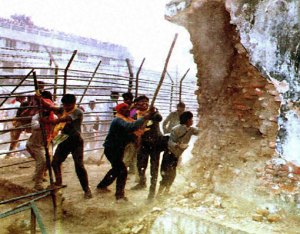
December 6, 1992
A shameful and shocking judgement.
I am shattered by what it does, by its implications for democracy, and by the statement it makes about what we can expect for the future.
My rage is growing with every statesman-like pronouncement from one pompous man after the other in the media, gravely holding forth on the maturity of the compromise that has been reached.
Continue reading The Second Demolition: Ayodhya Judgement September 30, 2010
Kashmir: A Time for Freedom
Guest post by ANGANA CHATTERJI
First published on 25 September 2010 in Greater Kashmir
“Freedom” represents many things across rural and urban spaces in India-ruled Kashmir. These divergent meanings are steadfastly united in that freedom always signifies an end to India’s authoritarian governance.
In the administration of brutality, India, the postcolony, has proven itself coequal to its former colonial masters. Kashmir is not about “Kashmir.” Governing Kashmir is about India’s coming of age as a power, its ability to disburse violence, to manipulate and dominate. Kashmir is about nostalgia, about resources, and buffer zones. The possession of Kashmir by India renders an imaginary past real, emblematic of India’s triumphant unification as a nation-state. Controlling Kashmir requires that Kashmiri demands for justice be depicted as threatening to India’s integrity. India’s contrived enemy in Kashmir is a plausible one – the Muslim “Other,” India’s historically manufactured nemesis. Continue reading Kashmir: A Time for Freedom
 KAFILA - COLLECTIVE EXPLORATIONS SINCE 2006