
- Share on X (Opens in new window) X
- Print (Opens in new window) Print
- Share on Facebook (Opens in new window) Facebook
- Email a link to a friend (Opens in new window) Email
- Share on Reddit (Opens in new window) Reddit
- Share on LinkedIn (Opens in new window) LinkedIn
- Share on Pinterest (Opens in new window) Pinterest
- Share on Tumblr (Opens in new window) Tumblr
Category Archives: Movements
Requiem for a Movement
Current media discussions about Lalgarh seem to miss out one crucial fact: Till less than a month ago, it was not a Maoist fortress, but a place where a fascinating experiment with a new kind of democratic politics was being undertaken. Maoists were certainly present, but they were constrained to go along with the mood inside Lalgarh, as earlier posts on Kafila have pointed out. This mood was certainly not one of forming ‘dalams’ or squads of roving Maoist guerillas. In fact, as People’s Committee Against Police Atrocities (PCPA) leader Chhatradhar Mahato told Times of India a couple of days ago, ‘if the state government had done even 10 percent of what we have done, the situation would have been very different.’ Continue reading Requiem for a Movement
Where there is no police: Kumar Rana
This is a guest post by KUMAR RANA
Where there is no police – what a wonderful state that would be. It’s a place that many have dreamt of, at least at some point of time if not all through the life. What a wonderful land that would be where one can eat or fast, sleep or remain awake, work or rest, move in or move out completely freely, where her wishes would not be monitored by the police. So the episodes in Khejuri in East Medinipur and Lalgarh, in West Bengal, had apparently made some of the citizens happy: what a relief, there is no police.
But, alas, it was only a dream. Because there was the state and a state without police is as alive as a dead animal, the khaki was quickly replaced by lungi or jeans, and the gun by perhaps more lethal AK47 and its sort.
Continue reading Where there is no police: Kumar Rana
Maoist Violence in Lalgarh, West Bengal, Must be Condemned
The inevitable has happened. As soon as the election results came out and the wall of fear collapsed and mass anger against the ruling CPM became evident, the Maoists waiting in the wings have come out into the open. However, what is happening today in Lalgarh and other parts of West Bengal cannot be justified by pointing at the CPM’s totalitarian terror in the Bengal countryside.
According to reports, the violence, killings of CPM activists and members, especially in Lalgarh, has now acquired unprecedented proportions. CPM members are being driven out of their homes or killed. The offices of the party have been targeted on a large scale, not just in Lalgarh but elsewhere in West Bengal.
Continue reading Maoist Violence in Lalgarh, West Bengal, Must be Condemned
Don’t do unto others, what they do to you
Do I sound like a liberal simpleton when I criticize or condemn the violence that has been unleashed in Khejuri by the ‘people’ led by the Trinzmul Congress?
Offices belonging to the CPM have been razed to ground, burnt down and vandalized. Photographs of people tearing away grills from the windows of these offices and carrying them as ‘booty’ with smiling faces tell you that the same old story is being repeated. The plot remains the same; only the hunted have turned into hunters and the hunters of the past are now running for cover.
Roads to Khejuri are blocked, ministers and leaders of the CPM turned away, again by ‘the people’. The police as usual stands mute witness as they have been trained in this state not to go against the ‘will of the people’. How does it matter to them that now these people do not belong to the CPM, masters for last three decades? They have learnt to follow, not the law, but the party. And these days in Nandigram Trinamul is ‘The Party’. And the enemy territory of Khejuri has also been annexed. Victory is complete. Continue reading Don’t do unto others, what they do to you
Chinese memories
Suddenly the other day, on the 3 of June 2009, in a bizarre flash of memory I went back two decades ago, June 3 1989. As is well known, hundreds of students in Beijing had begun a protest a few months ago with wide-ranging critiques of the regime – more democracy, end to corruption and workers rights. They were joined by workers, office goers, Beijing residents, local party officials, just about everyone else. Soon the protests had spread all over China, there were demonstrations everywhere. A Chinese friend of mine was in Tiananmen Square, the main centre of the protests. He later told me – “we were all giddy, everyone traveled free in trains to Beijing, people helped us with food and water on the streets, we sang the Internationale and all the old revolutionary songs, suddenly they felt real not false…” All went to Beijing.
For many on the left in India, China occupies a peculiar, proximate place. The events of 1956 in Hungary and 1968 in Czechoslovakia, when Soviet tanks crushed uprisings, did not cause the storms they did in the European left. But China was different – it was in Asia, a large peasant society with an old civilization, and the site of one of the great revolutionary transformations that had begun in the nineteenth century. China had to be different. When the Naxalite militants scribbled ‘China’s path is our path’ or ‘Listen to Radio Beijing’ on the walls of Calcutta in 1969, they were probably out of their mind, but only just.
Continue reading Chinese memories
Naagbanton, Binayak Sen and Kampala Declaration
Patrick Barigbalo Naagbanton is a well-known human rights activist. Born in Rivers State, Nigeria, he trained as a journalist before working as a trade unionist at the Port Harcourt factory of the Union Dicon Salt PLC, where he was elected chairman of the workers union, Maritime Workers Union of Nigeria (MWUN). He was eventually fired for campaigning for improvement in working conditions. Naagbanton recruited many workers to join human rights/pro-democracy groups like the Civil Liberties Organisation (CLO), Campaign for Democracy (CD), and Committee for the Defence of Human Rights (CDHR). Naagbanton served as a board member of Civil Liberties Organisation (CLO), representing the Niger Delta region of Nigeria. He also worked with the Environmental Rights Action (ERA) and Friends of the Earth Nigeria (FOEN), documenting, researching and campaigning against human rights and environmental degradation in Nigeria. In recognition of his role in promoting and defending victims of rights abuse in Nigeria, Naagbanton received the Indianapolis University Human Rights Award in 2001; and in 2002, the Rivers State branch of the CLO conferred on him the Saro-Wiwa Award for human and environmental rights defender.
Continue reading Naagbanton, Binayak Sen and Kampala Declaration
Sri Lanka: A Tragedy Foretold – Rohini Hensman
guest post by ROHINI HENSMAN
Once a forest fire is raging, putting it out is difficult, and an enormous amount of destruction is inevitable. The same is true of the war in Sri Lanka. Even over the past fifteen years, there were several chances to prevent this tragedy, but only a tiny minority of those who are now grieving over the dead and injured were arguing then that a failure to take these chances would lead to a bloodbath. Continue reading Sri Lanka: A Tragedy Foretold – Rohini Hensman
Anatomy of a prejudice
The BSP’s politics may trouble the popular conception of Indianness, among English speaking middle classes, who understand India as one whole, where the ‘Indian’ identity dominates and the rest, which reflect real India (inequality and conflicts) are hushed up. On the other hand, the BSP’s politics reiterates that India is a country of various minorities (castes, religions, regions) who may be victimised by fellow Indians in different contexts. Emphasising the BSP or Mayawati’s Dalitness ignores the complexity of caste society and associated politics. Kanshiram in the past and Mayawati now raise issues of caste not to sustain inequality but to challenge them. What Mayawati and BSP’s growth represents is the deepening of democracy in India. [Suryakant Waghmore]
Balraj Sahni’s Convocation Address at Jawaharlal Nehru University, 1972
About twenty years ago, the Calcutta Film Journalists’ Association decided to honour the late Bimal Roy, the maker of Do Bigha Zameen and us, his colleagues. It was a simple but tasteful ceremony. Many good speeches were made, but the listeners were waiting anxiously to hear Bimal Roy. We were all sitting on the floor, and I was next to Bimal Da. I could see that as his turn approached he became increasingly nervous and restless. And when his turn came he got up, folded his hands and said, “Whatever I have to my I say it in my films. I have nothing more to say,” and sat down.
There is a lot in what Bimal Da did, and at this moment my greatest temptation is to follow his example. The fact that I am not doing so is due solely to the profound regard I have for the name which this august institution bears; and the regard I have for yet another person, Shri P.C. Joshi, who is associated with your university. I owe to him some of the greatest moments of my life, a debt which I can never repay. That is why when I received an invitation to speak on this occasion, I found it impossible to refuse. If you had invited me to sweep your doorstep I would have felt equally happy and honoured. Perhaps that service would have been more equal to my merit.
Please do not misunderstand me. I am not trying to be modest. Whatever I said was from my heart and whatever I shall say further on will also be from my heart, whether you find it agreeable and in accordance with the tradition and spirit of such occasions or otherwise. As you may know, I have been out of touch with the academic world for more than a quarter of a century. I have never addressed a University Convocation before. Continue reading Balraj Sahni’s Convocation Address at Jawaharlal Nehru University, 1972
Lalgarh, Media and the Maoists: Monobina Gupta
Guest Post by MONOBINA GUPTA
[As this report is filed, reports have come in that the CPI-M has finally managed to enter Lalgarh and hold its first public meeting since 2 November 2008, when the police first arrested seven young students from Lalgarh, sparking off a revolt. No machine guns were fired, no mines were blasted – even though we are supposed to believe that the area is a ‘liberated area’ of the Maoists. See our earlier report, written soon after the revolt began. Even as we post this, more reports – mostly from West Bengal government and police sources, are being suddenly being published of ‘unrest’ spreading to ‘more Maoist areas’, and an atmosphere is sought to be created for an eventual justification of government and party sponsored violence.]
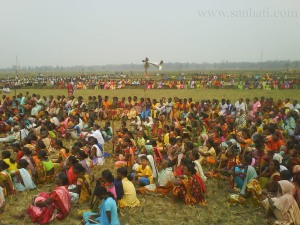
- Assembly in Lalgarh – Armed Maoists? Photo: courtesy sanhati.com
For five months now Lalgarh has been practicing a unique form of democratic politics. To the ruling CPI-M in West Bengal and the big media however, it has been nothing but a Maoist-sponsored agitation with portents of Maoist style violence. Except Bengal media, national print and television, have by and large kept Lalgarh out of their ambit of coverage. If at all news has trickled in, it has come tagged with ‘Maoists’ and ‘violence’; as if tribals in this forgotten part of Medinipur, the past five months, have been stocking up arms and laying ambushes to wage a war against the state.
A front-page article in the Times of India (TOI) today (April 22, 2009) sticks to this format describing Lalgarh as “Nandigram II, a liberated zone” where an explosive situation is building up with elections scheduled for April 30 and the Pulishi Santrash Birodhi Janashadharaner Committee (People’s Committee against Police Atrocities) refusing to allow the police to enter Lalgarh. “The police can’t enter here. Nor are other government officials welcome. This has been the situation for the last six months.”
Continue reading Lalgarh, Media and the Maoists: Monobina Gupta
The Tragedy of Politics in Sri Lanka
I am posting below an article that I wrote with Cenan Pirani. The shorter version of this article is in Combat Law. The longer version below delves into the history of left politics in Sri Lanka and attempts at a political solution. Another article by me reflecting some of these concerns and raising questions of solidarity titled ‘The Challenges of Solidarity’ was published in Red Pepper.
The Tragedy of Politics in Sri Lanka
By AHILAN KADIRGAMAR and CENAN PIRANI
In the last few months, the Sri Lankan security forces have managed to ruthlessly push the LTTE into a 40 square km strip of land in the North of the island, and along with the LTTE leadership and its cadres, a sizable civilian population, anywhere from seventy thousand to one hundred and fifty thousand, have also been cordoned off in this area. As the security forces continue their offensives purporting to rid Sri Lanka of the LTTE, they also claim the lives of these civilians daily. Continue reading The Tragedy of Politics in Sri Lanka
Tens of Thousands Protest G20 Summit
‘They hoped for ten thousand, but in the end more than three times that number turned out on London’s streets today for the biggest mass demonstration since the beginning of the economic crisis’, writes a report in the Guardian.

According to another report: Tens of thousands of people marched across central London Saturday to demand jobs, economic justice and environmental accountability, kicking off six days of protest and action planned in the run-up to the G20 summit next week.
More than 150 groups threw their backing behind the “Put People First” march. Police said around 35,000 attended the demonstration, but there were large gaps in the line of protesters snaking its way across the city toward Speaker’s Corner in Hyde Park.
Read the full report here.
What is significant about the protests this time round, is that ordinary people are not ready any more to be the sacrifiical lambs while the big corporations are bailed out. ‘Capitalists, you are the crisis’ and ‘We won’t pay for their crisis’ are in fact some of the important and key slogans of the current round of protests.
‘Lahoris woke up and joined their son’

What a moment it is, what a moment it must be. Ordinary people on the streets of Lahore on Sunday, countless thousands of them, have forced the Pakistani government to re-instate the deposed Chief Justice of the Supreme Court. What a moment of hope in a country the rest of the world believes is about to ‘implode’. What a resurrection of yourself, Mian Sa’ab, who will now remember how unpopular you were when Mush had ousted you!
Here’s an extremely illuminating account of what happened in Lahore, an anonymous account circulating on some mailing lists. This is apart from some excellent citizen reportage on Twitter by Pakistanis.
The Army, the Presidency, the Americans and the Prime Minister, were all ready to throw peanuts at Nawaz Sharif. The assessment was that 500 will reach constitution avenue (read Salman Taseer). In Pindi, we had halwa puri at a friends house today. A PPP friend who knew my passion for the CJ, at 11-00 am said, looking at me, “Yar Imran, there is a bigger long march in my house than in Lahore.” A PML N friend told me from Lahore, “Punjabis dont get out in the face of danda. The long march will fail.” Continue reading ‘Lahoris woke up and joined their son’
Re-booting Communism Or Slavoj Zizek and the End of Philosophy – I
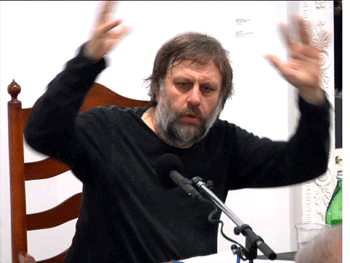
Today, 13 March, a whole galaxy of philosophers and theorists got together for a three-day conference “On The Idea of Communism” under the auspices of the Birkbeck Institute for the Humanities, London University. The Conference opened to a jam-packed hall where all tickets had sold out (no jokes, this was a ticketed show where the likes of Alain Badiou, Slavoj Zizek, Jean Luc-Nancy, Toni Negri, Jacques Ranciere, Terry Eagleton and many many others are to perform on the ‘idea of communism’). The huge Logan hall with a capacity of about 800-900 was so packed that the organizers had made arrangements for video streaming in another neighbouring hall – and that too was half full! Very encouraging in these bleak days.
The conference began in the afternoon with brief opening remarks by Alain Badiou and Slavoj Zizek. Badiou made his general point (see below) about the continuing relevance of the ‘communist hypothesis’. Staid and philosopherly. Continue reading Re-booting Communism Or Slavoj Zizek and the End of Philosophy – I
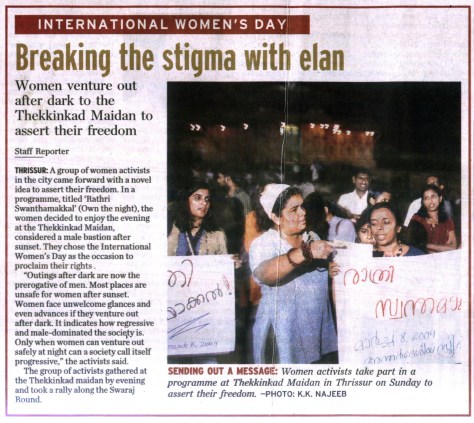
Women’s Day 2009, Thrissur
Silencing Social Activists
An escalating wave of attacks on social activists has been sweeping the country. Several recent incidents indicate an increase in the number of cases alleging grave human rights abuses against social activists, and a shift from low-level targeting, such as intimidation and harassment, to more serious violations, such as detention, prosecution, imprisonment and threats to their physical integrity. The authorities are also trying to silence them through unfair trial, denial of bail and long prison terms. There is excessive use of force, torture and other ill-treatment by the police. Women social activists are facing further violations, as women and as human rights defenders, including sexist verbal abuse and derogatory accusations. Continue reading Silencing Social Activists
Bloggers and Defamation
Justice Balakrishnan, in refusing to quash criminal proceedings against a nineteen year old blogger, says that any blogger posting material on the web should be aware of the reach of the internet and hence also be willing to face the consequences of such action. This sounds fair enough, and it would seem that if bloggers are exercising their right to freedom of speech and expression, then they should be subject to the same norms as a newspaper or magazine would, including the possibility of legal action being taken against them.
This sentiment reminds me of Anatole France’s famous statement that the law, in its majestic equality, forbids the rich as well as the poor to sleep under bridges, to beg in the streets, and to steal bread. The quick equation of an individual blogger with the might of a newspaper or a magazine is a little troubling. Individuals do not have the same kind of power, money or reach to be able to defend themselves in the way that newspapers may be capable of. Continue reading Bloggers and Defamation
A Fragile Peace in Nepal
In the six months that Maoist chairman Pushpa Kamal Dahal ‘Prachanda’ has been Prime Minister, he has realised that running a state is more complex than waging a war.
Since mid-August when he took charge, the PM has had to deal with multiple challenges – an intense ideological debate within his party; a deadlock in the peace process; breakdown of consensus with the G P Koirala led Nepali Congress (NC); acrimony between the defence ministry and Nepal Army (NA); opposition from sections of civil society suspicious of Maoist commitment to democratic norms; rampant lawlessness in the eastern Tarai and ethnic assertion in eastern hills; the collapse of basic services with 16 hour power cuts; and the impact of the global meltdown with remittances dipping. Continue reading A Fragile Peace in Nepal
Valentine’s day and protest in Bangalore, 2009
A friend said that last week in Bangalore and the drama(s) around Valentine’s Day would make a wonderful PhD thesis if one had the time and the distance. Two things are of relevance here.
One, the spread of communal politics that is inherently violent and divisive is not new to our country. Moral policing forming a major part of it and translating primarily into the control of the everyday lives of women, control over the institutions that could keep the regressive ideas around religion and caste in place such as marriage have been the standard points of attack in many parts of the world and in India. To maintain the notion of the ‘other’ that these divisive forces base their politics and everyday activities, we should never meet or get to know the ‘other’. And thus the attacks on young people who had friends across communities. It is these incidents that have sometimes spiraled into well-planned, thoroughly executed, state-sponsored carnage of people from certain communities, namely the imaginary ‘other’. Continue reading Valentine’s day and protest in Bangalore, 2009
Caste/gender in a poem by Varavara Rao
I’m posting below a poem by Varavara Rao and a response to it by Rochelle Pinto. Comments and debate welcome, but trolls will strictly not be allowed regardless of caste and gender! Comments are regulated here by a disclaimer to maintain sanity. Not repeating your position ad nauseum helps, unless you desperately want to have the last word.
Merit
by VARAVARA RAO
Lucky
You are born rich
To say in your language
“Born with silver spoon in the mouth”
Your agitation sounds creative
Our agony looks violent
Continue reading Caste/gender in a poem by Varavara Rao
 KAFILA - COLLECTIVE EXPLORATIONS SINCE 2006