Category Archives: Movements

Lalgarh, Media and the Maoists: Monobina Gupta

Guest Post by MONOBINA GUPTA

[As this report is filed, reports have come in that the CPI-M has finally managed to enter Lalgarh and hold its first public meeting since 2 November 2008, when the police first arrested seven young students from Lalgarh, sparking off a revolt. No machine guns were fired, no mines were blasted – even though we are supposed to believe that the area is a ‘liberated area’ of the Maoists. See our earlier report, written soon after the revolt began. Even as we post this, more reports – mostly from West Bengal government and police sources, are being suddenly being published of ‘unrest’ spreading to ‘more Maoist areas’, and an atmosphere is sought to be created for an eventual justification of government and party sponsored violence.]

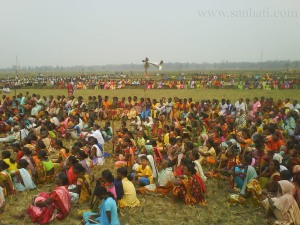
Assembly in Lalgarh - Armed Maoists? Photo, courtesy sanhati.com
Assembly in Lalgarh – Armed Maoists? Photo: courtesy sanhati.com

For five months now Lalgarh has been practicing a unique form of democratic politics. To the ruling CPI-M in West Bengal and the big media however, it has been nothing but a Maoist-sponsored agitation with portents of Maoist style violence. Except Bengal media, national print and television, have by and large kept Lalgarh out of their ambit of coverage. If at all news has trickled in, it has come tagged with ‘Maoists’ and ‘violence’; as if tribals in this forgotten part of Medinipur, the past five months, have been stocking up arms and laying ambushes to wage a war against the state.

A front-page article in the Times of India (TOI) today (April 22, 2009) sticks to this format describing Lalgarh as “Nandigram II, a liberated zone” where an explosive situation is building up with elections scheduled for April 30 and the Pulishi Santrash Birodhi Janashadharaner Committee (People’s Committee against Police Atrocities) refusing to allow the police to enter Lalgarh. “The police can’t enter here. Nor are other government officials welcome. This has been the situation for the last six months.”

Continue reading Lalgarh, Media and the Maoists: Monobina Gupta

The Tragedy of Politics in Sri Lanka

I am posting below an article that I wrote with Cenan Pirani.  The shorter version of this article is in Combat Law. The longer version below delves into the history of left politics in Sri Lanka and attempts at a political solution.  Another article by me reflecting some of these concerns and raising questions of solidarity titled ‘The Challenges of Solidarity’ was published in Red Pepper.

The Tragedy of Politics in Sri Lanka

By AHILAN KADIRGAMAR and CENAN PIRANI

In the last few months, the Sri Lankan security forces have managed to ruthlessly push the LTTE into a 40 square km strip of land in the North of the island, and along with the LTTE leadership and its cadres, a sizable civilian population, anywhere from seventy thousand to one hundred and fifty thousand, have also been cordoned off in this area.  As the security forces continue their offensives purporting to rid Sri Lanka of the LTTE, they also claim the lives of these civilians daily. Continue reading The Tragedy of Politics in Sri Lanka

Tens of Thousands Protest G20 Summit

‘They hoped for ten thousand, but in the end more than three times that number turned out on London’s streets today for the biggest mass demonstration since the beginning of the economic crisis’, writes a report in the Guardian.
London march, courtesy Associated Press

According to another report: Tens of thousands of people marched across central London Saturday to demand jobs, economic justice and environmental accountability, kicking off six days of protest and action planned in the run-up to the G20 summit next week.

More than 150 groups threw their backing behind the “Put People First” march. Police said around 35,000 attended the demonstration, but there were large gaps in the line of protesters snaking its way across the city toward Speaker’s Corner in Hyde Park.

Read the full report here.

What is significant about the protests this time round, is that ordinary people are not ready any more to be the sacrifiical lambs while the big corporations are bailed out. ‘Capitalists, you are the crisis’ and ‘We won’t pay for their crisis’ are in fact some of the important and key slogans of the current round of protests.

‘Lahoris woke up and joined their son’

What a moment it is, what a moment it must be. Ordinary people on the streets of Lahore on Sunday, countless thousands of them, have forced the Pakistani government to re-instate the deposed Chief Justice of the Supreme Court. What a moment of hope in a country the rest of the world believes is about to ‘implode’. What a resurrection of yourself, Mian Sa’ab, who will now remember how unpopular you were when Mush had ousted you!

Here’s an extremely illuminating account of what happened in Lahore, an anonymous account circulating on some mailing lists. This is apart from some excellent citizen reportage on Twitter by Pakistanis.

The Army, the Presidency, the Americans and the Prime Minister, were all ready to throw peanuts at Nawaz Sharif. The assessment was that 500 will reach constitution avenue (read Salman Taseer). In Pindi, we had halwa puri at a friends house today. A PPP friend who knew my passion for the CJ, at 11-00 am said, looking at me, “Yar Imran, there is a bigger long march in my house than in Lahore.” A PML N friend told me from Lahore, “Punjabis dont get out in the face of danda. The long march will fail.” Continue reading ‘Lahoris woke up and joined their son’

Re-booting Communism Or Slavoj Zizek and the End of Philosophy – I

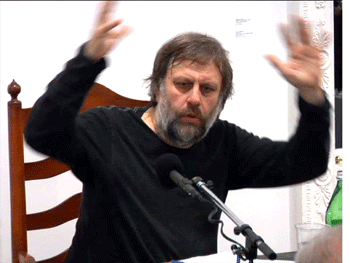
Zizek - the postmodern Lenin?

Today, 13 March, a whole galaxy of philosophers and theorists got together for a three-day conference “On The Idea of Communism” under the auspices of the Birkbeck Institute for the Humanities, London University. The Conference opened to a jam-packed hall where all tickets had sold out (no jokes, this was a ticketed show where the likes of Alain Badiou, Slavoj Zizek, Jean Luc-Nancy, Toni Negri, Jacques Ranciere, Terry Eagleton and many many others are to perform on the ‘idea of communism’). The huge Logan hall with a capacity of about 800-900 was so packed that the organizers had made arrangements for video streaming in another neighbouring hall – and that too was half full! Very encouraging in these bleak days.

The conference began in the afternoon with brief opening remarks by Alain Badiou and Slavoj Zizek. Badiou made his general point (see below) about the continuing relevance of the ‘communist hypothesis’. Staid and philosopherly. Continue reading Re-booting Communism Or Slavoj Zizek and the End of Philosophy – I

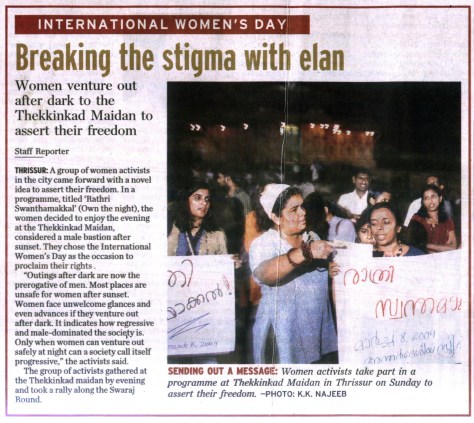
Women’s Day 2009, Thrissur

securedownload

Silencing Social Activists

An escalating wave of attacks on social activists has been sweeping the country. Several recent incidents indicate an increase in the number of cases alleging grave human rights abuses against social activists, and a shift from low-level targeting, such as intimidation and harassment, to more serious violations, such as detention, prosecution, imprisonment and threats to their physical integrity. The authorities are also trying to silence them through unfair trial, denial of bail and long prison terms. There is excessive use of force, torture and other ill-treatment by the police. Women social activists are facing further violations, as women and as human rights defenders, including sexist verbal abuse and derogatory accusations. Continue reading Silencing Social Activists

Bloggers and Defamation

Justice Balakrishnan, in refusing to quash criminal proceedings against a nineteen year old blogger, says that any blogger posting material on the web should be aware of the reach of the internet and hence also be willing to face the consequences of such action. This sounds fair enough, and it would seem that if bloggers are exercising their right to freedom of speech and expression, then they should be subject to the same norms as a newspaper or magazine would, including the possibility of legal action being taken against them.

This sentiment reminds me of Anatole France’s famous statement that the law, in its majestic equality, forbids the rich as well as the poor to sleep under bridges, to beg in the streets, and to steal bread. The quick equation of an individual blogger with the might of a newspaper or a magazine is a little troubling. Individuals do not have the same kind of power, money or reach to be able to defend themselves in the way that newspapers may be capable of. Continue reading Bloggers and Defamation

A Fragile Peace in Nepal

In the six months that Maoist chairman Pushpa Kamal Dahal ‘Prachanda’ has been Prime Minister, he has realised that running a state is more complex than waging a war.

Since mid-August when he took charge, the PM has had to deal with multiple challenges – an intense ideological debate within his party; a deadlock in the peace process; breakdown of consensus with the G P Koirala led Nepali Congress (NC); acrimony between the defence ministry and Nepal Army (NA); opposition from sections of civil society suspicious of Maoist commitment to democratic norms; rampant lawlessness in the eastern Tarai and ethnic assertion in eastern hills; the collapse of basic services with 16 hour power cuts; and the impact of the global meltdown with remittances dipping. Continue reading A Fragile Peace in Nepal

Valentine’s day and protest in Bangalore, 2009

A friend said that last week in Bangalore and the drama(s) around Valentine’s Day would make a wonderful PhD thesis if one had the time and the distance. Two things are of relevance here.

One, the spread of communal politics that is inherently violent and divisive is not new to our country. Moral policing forming a major part of it and translating primarily into the control of the everyday lives of women, control over the institutions that could keep the regressive ideas around religion and caste in place such as marriage have been the standard points of attack in many parts of the world and in India. To maintain the notion of the ‘other’ that these divisive forces base their politics and everyday activities, we should never meet or get to know the ‘other’. And thus the attacks on young people who had friends across communities. It is these incidents that have sometimes spiraled into well-planned, thoroughly executed, state-sponsored carnage of people from certain communities, namely the imaginary ‘other’. Continue reading Valentine’s day and protest in Bangalore, 2009

Caste/gender in a poem by Varavara Rao

I’m posting below a poem by Varavara Rao and a response to it by Rochelle Pinto. Comments and debate welcome, but trolls will strictly not be allowed regardless of caste and gender! Comments are regulated here by a disclaimer to maintain sanity. Not repeating your position ad nauseum helps, unless you desperately want to have the last word.

Merit

by VARAVARA RAO

Lucky
You are born rich
To say in your language
“Born with silver spoon in the mouth”

Your agitation sounds creative
Our agony looks violent
Continue reading Caste/gender in a poem by Varavara Rao

Interview with Ragavan on Tamil Militancy (Early Years)

As the Tamil community in Lanka is at the crossroads with twenty five years of war nearing an end with the increasing marginalization of the LTTE, I would like to do a series of interviews on the social, economic and political conditions that led to the emergence of armed politics and militarization of the Tamil community.  Returning to those years in the seventies and early eighties then is an attempt to also think about ways forward out of the militarized and armed politics of the last few decades.  I intend to do a series of interviews to capture that important political period for Lankan Tamils.  This important shift in Lankan politics and the decades of war that followed it did irreparable damage to the Lankan Tamil community and all the peoples of Lanka.

I begin with an interview of Ragavan, a founding member of the LTTE, who left the movement in 1984 and has since moved to London where he lives in exile.  In this first interview, Ragavan speaks about his background and early years of militancy.

This is an interview by Ahilan Kadirgamar of Ragavan at his London home on 25 January 2009. Continue reading Interview with Ragavan on Tamil Militancy (Early Years)

The meaning of “Obama” and the history of a friendship

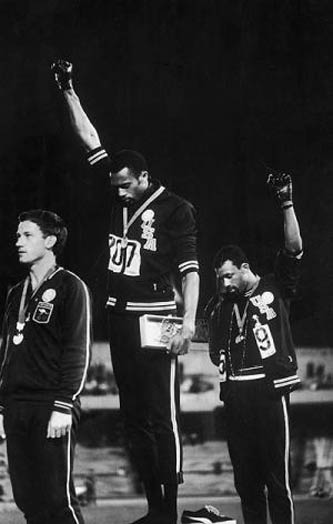
At the Mexico Olympics in 1968, this photograph of American athletes Tommie Smith and John Carlos standing on the victory podium with heads bowed and black-gloved fists raised in a Black Power salute in protest at racism in the USA, became the iconic image of the age.

1968_salute

In the fraught years since 1968, the weight of living through the aftermath put a heavy burden on the friendship of Carlos and Smith. In separate interviews with the Los Angeles Times it was revealed that they have barely spoken to each other since the early 1990s, despite living just a short drive apart in southern California. Smith described their relationship as “strained”. Carlos would call his former team-mate only “Mister Smith”.

Continue reading The meaning of “Obama” and the history of a friendship

Beyond violence and non-violence – K Balagopal

Via Jamal Kidwai

[We are posting this piece by K Balagopal, hoping to continue our reflections on violence and non-violence in political movements. – AN]

The public arena is witness to dispirited discussion of the ineffectiveness of people’s movements, which are at the most able to slow down things, and nothing more. The discussion often turns around violence and non-violence, not as moral alternatives but as strategic options. Those who are sick of sitting on dharna after dharna to no effect are looking with some envy at violent options,
while many who have come out of armed groups find the Narmada Bachao Andolan (NBA) fascinating.

It is good that there is some openness in the matter now, for dogmatic attitudes have done considerable harm. To say that one should not be dogmatic about violence may be morally a little unsettling but it is a defensible position even without adopting a relativistic attitude towards the preciousness of life or a casual attitude towards one’s moral responsibility for injury caused in the course of a struggle. More of that in the right context. But the
discussion will unavoidably be based on assessments  of the effectiveness of the alternatives, and a distant view is likely to colour the reality with hopes and assumptions, even illusions. A realistic assessment of what each strategy has been able to achieve would better inform the debate.

The plain and stark fact is that while all strategies have been effective in curbing some injustice, none has succeeded in forcing the government to take back a single major policy in any sphere. And none has been able to reverse the trends inherent in the structures of society and economy. Yet no serious political movement or social struggle we know of is only for softening oppression or improving relief. The general understanding is that governance of the country – and may be the systemic infrastructure of society – is fundamentally wrong and needs remedying, maybe overturning. Do we know of any
effective strategy for that? I am not talking of political strategies,
but strategies of struggle that will successfully put pressure upon the State and the polity to stop them in their tracks. The struggle may be built around class or caste or any other social combination. It may in the end seek reform or the upturning of the polity. It may operate mainly or in part within the polity or keep out of it altogether. Whichever it is, the common problem is this: the experience of this country is that governments do not stop doing some thing merely because it has been demonstrated to be bad. Or even contrary to constitutional directives and goals. They stop only if going along is made difficult to the point of near impossibility. No democratic dispensation should be thus, but Indian democracy is thus. Short of that, you demonstrate the truth of your critique till you are blue in the face or shout till you are hoarse in the throat, it is all the same.

Continue reading Beyond violence and non-violence – K Balagopal

Let Us Not Forget – South Asia Solidarity Initiative

Statement by the South Asia Solidarity Initiative (SASI) at ‘After Mumbai, Which Way Forward? A Public Dialogue’, City University of New York Graduate Center, New York, December 15th, 2008. Co-sponsored by The Center for Place, Culture and Politics, The Brecht Forum and SALAAM Theatre.

Let Us Not Forget

Like many in South Asia, we watched with anguish as nearly 180 people of different castes, classes, religions and nationalities lost their lives in the events in Mumbai that unfolded over several days. We mourn their loss in this large tragedy and condemn the perpetration of such terrible violence. We also express solidarity with those intrepid groups and individuals who have tirelessly sought to build deep-roots of social, political, economic and cultural understanding for peace and justice in South Asia.  At this moment, we call for reflection on recent histories of South Asia and the world.  Hence lessons may be drawn, collective action contemplated and spaces of hope created from the debris of despondency. Continue reading Let Us Not Forget – South Asia Solidarity Initiative

More reflections as Southasians on Mumbai

Anjum Altaf has sent us two posts on The South Asian Idea that reflect on the terrorism in Mumbai and discuss how best we can respond as Southasian citizens:
 

Ecstatic Archaisms of Aurobindo Ghose – Prasanta Chakravarty

Guest post by PRASANTA CHAKRAVARTY

In Reflections on Revolutionary Violence Aditya Nigam makes some nuanced points about the nature of Maoist violence and by contrast, comments on the bedrock character of democracy itself. Can we trace the sublime cult of blood and gore further down, to the founding principles of Forward Bloc, for instance? Or espy it in the millennial longings of a few Gita wielding swadeshis, for that matter? One may begin to see a pattern.

Continue reading Ecstatic Archaisms of Aurobindo Ghose – Prasanta Chakravarty

Reflections on Revolutionary Violence

In the last one year, I have often found myself going back to a conversation I had had with a Maoist ideologue. As it happened, it was he who started interrogating me about my stand on violence. ‘So, you have become a Gandhian?’ he demanded. I must confess I was a bit taken aback, not quite able to figure out the context of this poser. ‘What do you mean by Gandhian’, I kind of mumbled. Pat came his reply: ‘Well you have been making some noises lately about Maoist violence, haven’t you?’ Suddenly it all became clear. Through this ridicule, he was trying to appeal to that part of me that still remained marxist – presumably now buried in some remote past – and to resurrect it against my ostensible ‘non-marxist’, ‘liberal’ present (for which ‘Gandhian’ was some kind of a short hand code). I found myself at a loss of words. Does a criticism of the mindless and nihilistic violence of the Maoists make one a Gandhian? Is there no space left between these two polar positions? The conversation did not go very far that day but has kept coming back to me ever since.

Continue reading Reflections on Revolutionary Violence

The ‘Obama Moment’: Sangay Mishra and Jinee Lokaneeta

The ‘Obama Moment’ and Conversations on Race
Guest post by SANGAY MISHRA and JINEE LOKANEETA

[The ‘Obama moment’ is much more than the man. Elementary, one would have thought. But maybe not. For, it has been intriguing to watch and listen to people – radical and nonradical liberal alike – mock this moment in a cynical, ‘we-know-it-all’ and ‘what-do-you-expect?’ mode. Intriguing, because, somewhere the insinuation is that those who celebrate are just being carried away by an ephemeral event. Maybe. It seems however, and the authors argue below, that this persona we now know as ‘Obama’ was not there even a year or two ago; he emerged in this present form, through a series of ‘encounters’ – with race, with his own history and with ‘blackness’. In his present form, Obama is produced by a certain African American investment in the earlier Obama (of, say, the pre-campaign Obama). – AN]

Much as the Obama victory on the 4th of November was expected and already predicted by a number of polls, the reaction to his victory both inside and outside the United States was breathtaking.

Continue reading The ‘Obama Moment’: Sangay Mishra and Jinee Lokaneeta

Bye Bye Reliance: Pen Tehsil Says No SEZ!

In our continuing concern with the strange times that seem to have befallen our cities, lets not lose sight of the historic battle underway in the countryside. In the first instance of its kind, the referendum on the Maha-Mumbai Special Economic Zone being set up by Reliance has unambiguously returned the verdict of the farmers of Raigad- no SEZ in Pen! As Sanhati notes, the Tata’s 1500 crore investment in Singur sounds like loose change when compared to the one lakh crore that Reliance is planning to sink into 10,000 hectares. 22 villages in the Pen Tehsil voted against the acquisition of their lands at the paltry sum of 10 lakhs per acre. Unsurprisingly, Reliance Industries Limited has said the referendum is “not genuine”:

Continue reading Bye Bye Reliance: Pen Tehsil Says No SEZ!

Singur, Mediotics and an NGO Called Indian Express

[Note: Television was often referred to as the the idiot-box. For very sound reasons. It produced idiocy on a regular basis. It still does. But in these days, this is no longer the monopoly of the televisual media. Newspapers too are doing pretty much the same. Let us call this specific form of media-generated idiocy, rampant among media persons, mediocy and the phenomenon, mediotics. Those affected by it will then be mediots.]

I know that someone will immediately step in to correct me to say that Indian Express is not an NGO. But if one looks at the completely illiterate use of the term made by the Indian media, then anything that is not ‘governmental’ is ‘non-governmental’ and can, hence, be called an NGO. Except that for the large mass of ignoramuses peopling the media i.e. mediots, this is a safe term to describe an animal that you cannot identify. Continue reading Singur, Mediotics and an NGO Called Indian Express