
(with inputs from Mythri Prasad Aleyamma)
I admit, this title sounds sensationalist. But one can hardly avoid resorting to it when confronted with utterly stupefying news of attacks on dalit colonies almost next door to Kerala’s capital city and nerve centre of Malayalee politics, and that too, by a minor anti-political force that has a legacy of anti-South Indian hatred — the Siva Sena. And of course when one is confronted with the hard, stony silence of almost all sections of the media about this. The mystery of the murder of an elderly, innocent morning-walker in Varkala, a town close to Thiruvananthapuram (of which I wrote in an earlier post) still remains a mystery; the police story is so full of holes that it looks like a sieve. But the Guardians of our Free Press are still lapping police versions and not conducting independent investigation. Activists who have dared to do so have been heckled and hounded, even senior and respected human rights activists like B.R.P.Bhaskar, by the Siva Sena, and their protests have been ignored. Meanwhile violence continues to be unleashed against the supporters of the group that has been accused of murder, the Dalit Human Rights Movement (DHRM).
Category Archives: Movements
Social Boycott of Dalits in MP: Uncivil Society, apathetic administration
(A Fact Finding Report issued by Nagrik Adhikar Manch and Yuva Samvad.)
(The situation in the Gadarwara Sub Division of District.Narsinghpur (MP) has been in a state of constant flux since last 3-4 months. The Dalits living in the villages adjoining Gadarwara have been condemned to a life of fear and intimidation.Their human rights and dignity are being at stake.
Obviously there is a concrete reason behind this sudden spurt in violence against them.They have refused to remain subservient to the interests of the upper/dominant castes and have decided to speak up.
Instead of taking concrete steps to guarantee the human rights of dalits granted to them under constituion, the administration has preferred to remain silent or at best supportive of the interests of the dominant castes only. One can easily see why Madhya Pradesh happens to be the state which tops the list of atrocities on tribals and stands second when it comes to cases of atrocities against dalits.)
Dist: Narsinghpur(Madhya Pradesh)
Tehsil: Gadarwara
Affected Area: Dalits (Ahirwar community) in Gadarwara and adjoining villages
Villages visited by the Fact Finding Team: Nander, Madgula, Devri and Tekapar
Date: 7th and 9th November 2009
Members of Fact Finding Team
Jai Bhim, Moolchand Ahirwar, Javed, Skand Shukla, Manoj, Satyam, Shivkumar, Nishant Kaushik
Brief Introduction to Narsinghpur District. Continue reading Social Boycott of Dalits in MP: Uncivil Society, apathetic administration
Maoist Revolution, Liberal Naivete
Responding to the call by the Home Minister and prime Minister of India to halt violence to facilitate talks, Maoist leaders ridiculed them and asked them to get their history right. According to them it was wrong to say that the ‘war’ that is now being played out in the theatre of the jungles of Chhatisgarh, Jangalmahal of Bengal, Jharkhand , Orissa and other states is of recent origin. This is only the latest phase of the “people’s war” that is being waged since 1967 and would not stop until the ultimate objective of establishing Communism is achieved. The Constitution of the CPI(Maoist) is very unambiguous, “The ultimate aim or maximum programme of the party is the establishment of communist society. This New Democratic Revolution will be carried out and completed through armed agrarian revolutionary war i.e. the Protracted People’s War with area wise seizure of power remaining as its central task.”
Area wise seizure of power is what the Maoists are busy with. They have succeeded, partially or fully in many areas of different states. What needs to be understood is that it is not development they are opposed to as is evident from the statements of their leaders. They are ready to let development activities take place, provided it is under their supervision. They are interested more in making themselves the lone political voice of the people. One should ask why do they keep abducting, harassing, threatening or killing the members and leaders of other political parties in the areas where they rule using the strength of their guns? Why do they force people to resign from other political parties? Their answer is very simple: whoever is seen to interrupt or impede the armed people’s war is either a class enemy or an agent of the class enemy represented by the state and is therefore on the other side of the war.
Continue reading Maoist Revolution, Liberal Naivete
WHOSE LAND IS IT ANYWAYS? Public Meeting organized by National Alliance of People’s Movements
An open discussion on the relevance and implications of Land Acquisition (Amendment) Bill and Rehabilitation and Resettlement Bill 2009
Saturday, November 21, Gandhi Peace Foundation, Deen Dayal Upadhyay Marg, New Delhi 2 – 6 pm.
Friends,
The current economic model of growth prevalent in India , with strong neo-liberal leanings, needs to be re-assessed in the wake of increasing alienation and dispossession of vast populations from their land and the wave of resistance, both violent and non-violent, against such activities that are being played out in many parts of the country.
In the wake of an armed operation against escalating Maoist insurgency; adivasis, particularly in Chhattisgarh, Jharkhand, West Bengal Orissa, Andhra Pradesh and Maharashtra are stiffly resisting the industrial development that threaten their traditional way of life; farmers around the country raging against acquisition of their lands in the name of growth and development – the importance of revisiting the proposed Land Acquisition (Amendment) Bill, 2009 (LAA) and Rehabilitation and Resettlement Bill 2009 (R&R) is paramount, if not imperative.
We the struggling communities from different regions of the country have resisted the government’s machinations of enacting a faulty Resettlement and Rehabilitation Act and introducing amendments to the Land Acquisition Act, promoting private and corporate interests over public good. We gathered recently in Delhi in July 2009 and our struggle gained a significant boost when the Acts could not be passed in the Budget session of the Parliament. We have been in Delhi since 18th November and held meetings at Kanjhawala, Jantar Mantar and JNU and explained our concerns on these two Bills but also on the fires raging in the country and the path of growth on which the country is being pushed today.
It is in this context that we invite you to discuss the relevance and implications of these half hearted measures for the millions of people who are struggling to retain their means of livelihood and seek meaningful rehabilitation from a system in which they no longer seem to have faith.
The panelists for this meeting are :
K B Saxena, Former Secretary, Ministry of Rural Development and Agriculture, Union of India now at Council for Social Development, New Delhi
Ramaswamy Iyer, Former Secretary, Ministry of Water resources, Union of India and Government’s nominee on the Sardar Sarovar review Committee now at Centre for Policy Research, New Delhi
Sanjay Parikh, Senior Counsel, Supreme Court of India.
Roma, Kaimur Kshetra Mahila Mazdoor Kisan Sangharsh Samiti, NFFPFW (Sonbhadra)
Gautam Bandopadhyay, Nadi Ghati Morcha , Chattisgarh
Dayamani Barla, Adivasi Mulnivasi Astitva Raksha Manch, Jharkhand, INSAF [to be confirmed]
Sandhya Devi, Kalahandi Mahila Mahasangh, Orissa
Praffula Samantray, NAPM Orissa
Medha Patkar, Narmada Bachao Andolan & NAPM
MODERATOR : Anand Mazgaonkar, Paryavaran Suraksha Samiti, NAPM Gujarat
Mass Politics, Violence and the Radical Intellectual
With the debate on Maoist violence and Operation Green Hunt hotting up, things are taking a disturbing turn. The danger really is that all spaces of radical political movements and indeed the entire space of the Left, part of it gradually vacated by the parliamentary ‘Left’ in recent decades and finally completely abandoned in the last few years, will now be virtually erased. In its place will be installed the phantom of an ‘armed struggle’ that threatens to completely swallow up the spaces once occupied by different shades of the CPI(ML) and the Naxalite movement and other Continue reading Mass Politics, Violence and the Radical Intellectual
Debating “Political Islam”
A number of activists from the South Asia Solidarity Initiative (SASI) in New York have initiated a reading group on South Asia. The notes below are the second in a series of commentaries following reading discussions that some members of the reading group are posting on Kafila. This is an attempt to broaden the discussions and in the process make it a productive dialogue to understand developments in the region and deepen our solidarity.
Debating “Political Islam”
– Svati Shah, Biju Mathew, Sumitra Rajkumar, Prachi Patankar and Ahilan Kadirgamar
The recent debate between Samir Amin and Tariq Amin-Khan on a left perspective on “political Islam” in the context of imperialism, published in Monthly Review (December 2007 and March 2009), provides an opportunity to reflect on a number of issues that have vexed the anti-war movement and the left with respect to the on-going wars in Iraq and Afghanistan. The most vexing of these issues has been the question of whom the left should target as its allies in those countries, and what position the left should take toward so-called “political Islam,” represented by Islamist groups calling for an end to foreign occupation. The definition of “political Islam” is presented below in relation to each critique. Both Amin and Amin-Khan are in agreement that both “political Islam” and imperialism have to be challenged simultaneously. There are no strategic questions here, in terms of joining one to fight the other. The defeat or withdrawal of both is desirable in the interests of a people-centred politics. In imperialism’s projection of capitalism and reactionary Islam’s comfort with capitalism (that class and gender do not trouble it) they are objective allies even if on the ground their adherents are military enemies. This initial agreement then delves into a number of nuanced questions that must be considered in order to foster the return to a people centred politics in both of these countries, and the regions as a whole.
Complicating the ‘Naxalite’ debate
(An edited version of this piece appeared as the cover story in Himal Southasian in December 2007. The report is based on travels across Andhra to Bihar in October of the same year. At a time when most of the media is pushing the same binaries we must avoid, this may help in conveying the enormous complexity of the issue. Some facts may be outdated, and Kafila readers will be more familiar with certain issues like Salwa Judum than this reporter, but the broad argument may still have some relevance. I will follow this up with posts on the Nepali process and Indian Naxalites.)
A people’s movement. The greatest internal security challenge. Struggle for the rights of the poor, tribals, Dalits, landless. Compact Revolutionary Zone with influence in almost 200 districts. A socio economic problem rooted in exploitation and idealism. A law and order threat . True people’s democracy. A criminal, authoritarian and opportunistic outfit. The revolution will smash the Indian state. The Maoists are ants and can be crushed anytime .
Neat black and white portrayals have come to characterise one of the most complex stories of our times. The Naxal as the saviour and the state as the oppressor. The state as protector and Naxal as the villain. Numbers and scale of action act as the judge of Maoist spread and activity. 1608 incidents of Naxalite violence and 677 people killed in 2005; 1509 incidents and 678 killed in 2006; 249 persons killed till June 2007. Continue reading Complicating the ‘Naxalite’ debate
Open Letter to Noam Chomsky: Nirmalangshu Mukherjee
[We publish below an open letter to Noam Chomsky, written in the wake of his endorsement of a statement against ‘Operation Green Hunt’, issued recently by a large number of intellectuals in India and in the US. Nirmalangshu’s letter is important because it raises some very serious questions that are being brushed under the carpet by sections of the radical intelligentsia. Unlike Nirmalangshu, I would not put ‘radical’ within scare quotes, since it is precisely this that highlights the immense tragedy of our times. Radical intellectuals – truly radical intellectuals – once again find themselves caught in this situation where in order to oppose state violence, they will wilfully turn a blind eye to the violence of armed nihilist gangs, simply because these claim to speak on behalf of the oppressed – a claim that Nirmalangshu’s letter exposes in all its falsity. He lays bare how the politics that goes by the name of ‘Maoism’ (i.e. CPI-Maoist) believes in violently erasing all other voices of opposition to and criticism of the state, but that of itself. This brand of politics in fact lives in symbiosis with the state – delegitimizing all forms of mass democratic politics. At this moment one deeply misses the courageous voice of the late Balagopal – recently slightingly dubbed a ‘liberal humanist’ by a spokesperson of the Maoists, at a meeting meant to salute his memory. I cannot help recalling here the feeling of immense sadness many of us were overcome by, watching and hearing speakers at this meeting (in Delhi) for Balagopal – speakers who were ungenerous, if not carping and outright dismissive of the courage of conviction that was Balagopal. AN]
Dear Prof. Chomsky,
I saw your support to the statement issued by Sanhati in the form of a letter to the prime minister— endorsed by some intellectuals from India and abroad. Three points are transparent: (a) the Indian government is planning a massive armed operation in the tribal-hilly areas in the eastern part of the country, (b) the poorest of the poor and the historically marginalised will suffer the most in terms of loss of lives, livelihood and habitat, and (c) for whatever it’s worth, an all-out campaign by democratic forces is needed to resist the armed invasion of people’s habitat by any party. To that extent, the statement does bring out the urgency of the matter.
Continue reading Open Letter to Noam Chomsky: Nirmalangshu Mukherjee
More on Murder from Kerala
These are happy days in which everyone in Kerala wants too settle the land dispute at Chengara. A happy consensus between the Left and the Right seems to be growing there, after the Congress leader of the Opposition, Oommen Chandy, decided to take on Godfathership of the land struggle. The very language of the struggle had changed – interestingly, from ‘we are landless squatters’ to ‘we are settlers’! Now, it is well-known in Kerala that these terms have had different sorts of political associations – ‘squatter’ with the Left, and ‘settler’ with (largely) the Right. Indeed, this was inevitable perhaps, given the fact that the New Left didn’t look very keen on ‘squatters’. However, it is clear that neither dalit or tribal organisations are going to be part of the negotiations towards the final package –today’s newspapers report that prominent tribal and dalit leaders have protested against the state’s reluctance to negotiate with them. It would be very convenient for both the Left and the Right to delegitimize – indeed criminalize – tribal and dalit organizations. And what luck that precisely that boon has been granted to them by the sudden eruption of a ‘lower-caste terrorist group’ (according to the police), the ‘Dalit Human Rights Movement’!
MRF United Workers’ Union Case: Ramapriya Gopalakrishnan
This guest post has been sent to us by RAMAPRIYA GOPALAKRISHNAN. She is a lawyer practising in the Madras High Court working on labour rights, environmental and human rights issues. She is one of the two lawyers who appeared for the MRF United Workers’ Union before the Madras High Court.
The MRF United Workers’ Union case – Ruling of the Madras High Court on the recognition of trade unions
The workers in the Arakonam factory of MRF Limited, a tyre major, ended their 125 day old strike on September 14, 2009 and resumed work following the pronouncement of the much awaited verdict in the case filed by the MRF United Workers’ Union before the Madras High Court concerning the recognition of the union by the management of the company.
The Arakonam factory of MRF Limited in Vellore District in Tamil Nadu is the largest of the six tyre manufacturing factories of the company. The workers in the factory are paid piece rate wages with no transparency in the process. They do not have any information on what constitutes a ‘piece’ and the rate at which they will be paid for the ‘piece.’ Moreover, the number of ‘contract workers’ engaged in the factory for direct production work is more than twice the number of direct confirmed workers engaged for doing the same work. These facts by itself would indicate the status of labour law compliance in the factory. There was thus a long felt need among the workers for an independent and effective trade union to protect their interests.
Continue reading MRF United Workers’ Union Case: Ramapriya Gopalakrishnan
The End or Future of Capitalism and Ending Obama’s War
Last night I heard a public conversation between the Marxist Geographer David Harvey and Alexander Cockburn the editor of CounterPunch and columnist with The Nation. The conversation titled, ‘The End or Future of Capitalism’ was hosted by The Center for Place, Culture & Politics. Cockburn opened the conversation by speaking about the lack of vision in the Left. Harvey argued that the capitalist system was facing tremendous stress and that a different path of economic development had to be envisioned. Harvey continued on the end of capitalism as one needing analysis in terms of how this crisis arose with the problem of accumulation and realization of surplus, and poses the question of what is to be done? Central to Harvey’s argument is that the mounting stress seen at the centre of the capitalist system in the last three decades is the culmination of the inability to sustain the two and a half percent compounded accumulation that has been a characteristic of global capital over the last couple hundred years. That the capitalist system is unable to find productive investments for the two and a half percent accumulation rate leading to repetitious and aggravating crises in the unproductive bubbles in financial assets.
I stood in line when the floor was open, but much to my disappointment the moderator had brought the conversation to an end before I could ask my question, and so I am going to ask it here. Both Harvey and Cockburn talked about the urgency of the moment and the need for provocative questions from the Left. But what is the more urgent question to ask at this moment? Is it the end or future of capitalism? Or is it the end or future of the American Empire? The two may well be related and even two sides of the same coin, but the question for me is influenced by the urgency of the situation in our region; the war in Afghanistan and Pakistan. The relatedness of the two questions also leads me to ask what would be the consequence of the tremendous stress at the centre of the capitalist system on the wars fought at the periphery of Empire? And in turn, what is the impact of the tremendous stress of the wars on the periphery for the hegemonic centre of the capitalist system?
Continue reading The End or Future of Capitalism and Ending Obama’s War
Reading Land and Reform in Pakistan
A number of activists from the South Asia Solidarity Initiative (SASI) in New York have initiated a reading group on South Asia. The notes below are the first in a series of commentaries following reading discussions that some members of the reading group hope to post on Kafila. This is an attempt to broaden the discussions and in the process make it a productive dialogue to understand developments in the region and deepen our solidarity.
Reading Land and Reform in Pakistan
— Svati Shah, Prachi Patankar and Ahilan Kadirgamar
“…any strategy to stem the tide of Taliban-Al Qaida led militancy cannot ignore the issue of land rights…. Any reforms that revalue and formally recognize the local management of common property resources, therefore, will elevate the authority of tribal leaders over religious clerics or TAQ militants.”
Haris Gazdar, ‘The Fourth Round, And Why They Fight On: An Essay on the History of Land and Reform in Pakistan’
Given the escalation of a multifaceted war in Pakistan, and given our own commitment to a peace with justice in South Asia, we have started reading and discussing issues of importance in Pakistan and South Asia more broadly. This inquiry is informed by the alarming and rapidly changing situation in Pakistan, and by an interest in interrogating the category ‘South Asia’ itself. While all are agreed that the term ‘South Asia’ is indispensable, we wonder how ‘South Asia’ could be used to describe more than a region or a set of places outlined by shared borders. We wonder how we can move beyond the limitations of finding historical unity in South Asia primarily through the lens of British colonialism? We wonder how we could describe the political unities and potential solidarities of ‘South Asia’ in this moment? We find it particularly helpful to approach these questions by seeing common issues in the region relating to labour, land and the role of the state in societies in South Asia. At the same time, we want to move away from the received notions of South Asia, whether they be the statist conceptions of SAARC, South Asia as seen by the US State Department or, for that matter, as a region defined by area studies.
Remembering Rajani and Re-Reading The Broken Palmyrah
I am posting below a much longer version of an article that is published in Himal Southasian. The Broken Palmyrah is out of print, but the entire book is on the UTHR(J) website.
Remembering Rajani and Re-Reading The Broken Palmyrah
September this year many will remember Rajani Thiranagama, a feminist, an activist, a Marxist, a scholar, a doctor and a teacher assassinated twenty years ago on September 21st, 1989. Among the reasons for her assassinations was the publication of that profoundly grounded work, The Broken Palmyrah, which she co-authored with three other academics from the Jaffna University. While we commemorate the life and work of Rajani at a time when the war has come to an end, in many ways the Palmyrah is still broken. It is in this context that I return to that inspiring work, which has much to teach us, in particular for those of us belonging to the younger generations of activists after Rajani. Inspiring, for despite the worst cruelties of war, it carried a message of hope, an analysis of possible ways forward and faith in the resilience of ordinary people. Continue reading Remembering Rajani and Re-Reading The Broken Palmyrah
Is the Naz Foundation decision the Roe v. Wade of India?
There are surprisingly few constitutional cases in India which have had the same symbolic power that cases like Roe v. Wade (affirming the right of abortion) or Brown v. Board of Education (dissolving racial segregation in schools) have had in the political history of the United States. For sure, there are a number of important constitutional cases which have contributed significantly to the democratic history of India. Kesavananda Bharati’s espousal of the basic structure doctrine, Maneka Gandhi’s introduction of due process in Art.21, but these cases seem to have an appeal largely within the legal fraternity. They are also cases where the relief sought by the petitioners have had little to do with the final outcome of the case, and it is highly doubtful whether his Holiness Kesavananda Bharati had any investment in the long term impact of the basic structure doctrine (not to mention that Kesavananda Bharati just doesn’t roll of the tongue as easily- in terms of recall value). Is it possible then that Naz Foundation v. Government of Delhi is the first equivalent of a case whose name conjures up the history of particular struggle, celebrates the victory of a particular moment and inaugurates new hopes for the future.
Continue reading Is the Naz Foundation decision the Roe v. Wade of India?
The Day After the Judgement
So now that we have one group of criminals less to deal with, I have a proposal: Criminalize English TV news channels.
-
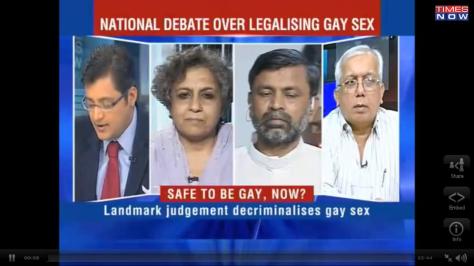
- ‘Debate,’ the Times Now way
Watching Times Now yesterday after the Delhi High Court ruling on Section 377, I was overcome by a growing sense of bewilderment. I could hear Dominic Emmanuel (Director of the Delhi Archdiocese of the Roman Catholic Church) and Kamal Farooqui (Chairman of the Delhi Minorities Commission), saying quite cearly and more than once, to my surprise, that they welcome the decriminalization of homosexuality, that homosexuals should not be treated as if they were criminals. Okay, correct that – I could barely hear these statements over the insistent, aggressive and disruptive interruptions of the anchor Arnab Goswami, who had obviously pre-set this “discussion” rigidly as a face-off between Reactionary Clerics/Minorities and Gay Rights Activists, while he himself was super hero, Anchorman. So each time they said “we welcome” etc., Anchorman would swoop in, bellowing, “So are you saying that they dont have rights, Sir, are you saying they should not have rights. Over to Anjali Gopalan (Naz) – Anjali, they say homosexuals should not have rights, what do you say?”
Iran: Inquilab Zindabad?
Once upon a time, only a hundred or so years ago, and earlier, Iranians were our neighbours. Many were friends, relatives – uncles, grandparents, ancestors, some were husbands, wives and lovers. And cities like Delhi, Lucknow, Murshidabad and Hyderabad spoke Persian better than they spoke English, or even Hindi. The distance from Tehran and Isfahan to Delhi, Lucknow and Lahore, or across the water from Bandar Abbas to Bombay or Karachi, in miles and in the imagination, seemed less than what we can even begin to understand today.
The Bengal renaissance had one of its points of origin in a Persian broadsheet called Mirat ul Akhbar published by Ram Mohan Roy in Calcutta. The first Iranian talking film and the last ‘Irani’ restaurant both have their origins in Bombay. The Sabk-e-Hindi, or the ‘Indian Style’ continued to adorn the more ornate fringes of Persian poetry in Iran. The miniatures painted in the ateliers of Delhi and Agra owed a great deal to the paints, brushes, colours and visions of visiting masters from Tabriz. The sitar and the sarod came from Iran, and stayed on. We shared jokes and stories, poets, prophets and pranksters, wine and spices, surnames (Kirmani, Rizvi, Mashadi, Yazdi) and clan histories, heresies and wisdom and a thousand other things that neighbours, friends, cousins and lovers share.
Gaon chodab nahin
Requiem for a Movement
Current media discussions about Lalgarh seem to miss out one crucial fact: Till less than a month ago, it was not a Maoist fortress, but a place where a fascinating experiment with a new kind of democratic politics was being undertaken. Maoists were certainly present, but they were constrained to go along with the mood inside Lalgarh, as earlier posts on Kafila have pointed out. This mood was certainly not one of forming ‘dalams’ or squads of roving Maoist guerillas. In fact, as People’s Committee Against Police Atrocities (PCPA) leader Chhatradhar Mahato told Times of India a couple of days ago, ‘if the state government had done even 10 percent of what we have done, the situation would have been very different.’ Continue reading Requiem for a Movement
Where there is no police: Kumar Rana
This is a guest post by KUMAR RANA
Where there is no police – what a wonderful state that would be. It’s a place that many have dreamt of, at least at some point of time if not all through the life. What a wonderful land that would be where one can eat or fast, sleep or remain awake, work or rest, move in or move out completely freely, where her wishes would not be monitored by the police. So the episodes in Khejuri in East Medinipur and Lalgarh, in West Bengal, had apparently made some of the citizens happy: what a relief, there is no police.
But, alas, it was only a dream. Because there was the state and a state without police is as alive as a dead animal, the khaki was quickly replaced by lungi or jeans, and the gun by perhaps more lethal AK47 and its sort.
Continue reading Where there is no police: Kumar Rana
Maoist Violence in Lalgarh, West Bengal, Must be Condemned
The inevitable has happened. As soon as the election results came out and the wall of fear collapsed and mass anger against the ruling CPM became evident, the Maoists waiting in the wings have come out into the open. However, what is happening today in Lalgarh and other parts of West Bengal cannot be justified by pointing at the CPM’s totalitarian terror in the Bengal countryside.
According to reports, the violence, killings of CPM activists and members, especially in Lalgarh, has now acquired unprecedented proportions. CPM members are being driven out of their homes or killed. The offices of the party have been targeted on a large scale, not just in Lalgarh but elsewhere in West Bengal.
Continue reading Maoist Violence in Lalgarh, West Bengal, Must be Condemned
Don’t do unto others, what they do to you
Do I sound like a liberal simpleton when I criticize or condemn the violence that has been unleashed in Khejuri by the ‘people’ led by the Trinzmul Congress?
Offices belonging to the CPM have been razed to ground, burnt down and vandalized. Photographs of people tearing away grills from the windows of these offices and carrying them as ‘booty’ with smiling faces tell you that the same old story is being repeated. The plot remains the same; only the hunted have turned into hunters and the hunters of the past are now running for cover.
Roads to Khejuri are blocked, ministers and leaders of the CPM turned away, again by ‘the people’. The police as usual stands mute witness as they have been trained in this state not to go against the ‘will of the people’. How does it matter to them that now these people do not belong to the CPM, masters for last three decades? They have learnt to follow, not the law, but the party. And these days in Nandigram Trinamul is ‘The Party’. And the enemy territory of Khejuri has also been annexed. Victory is complete. Continue reading Don’t do unto others, what they do to you

