Category Archives: Politics

The Modi Mandate – A Belated Response to S Varadarajan: Pradip Datta

Guest post by PRADIP KUMAR DATTA

Siddharth Varadarajan’s article raises some very important dilemmas before Modi which is really a rehearsal of the development versus welfare debate now bound to be exacerbated with the runaway capitalism that Modi promises to unleash.

But it raises another important question. Can we simply forget the past and get on with the future? Can we join the futurist chorus of Modi and his Thatcherite – Reaganite followers? Can an electoral mandate, even one as powerful as this, remove permanently the memory of 2002?

The immediate analogy comes with the anti Sikh riots followed by the 1984 verdict. 1984 returns every election to haunt the Congress even after they have made a Sikh prime minister for 10 years. Some historical memories are very stubborn and refuse to leave off the haunting of the future. It is not as if there have not been many riots. But only some riots achieve a historically emblematic status that remove them from the realms of simple memory alone. Some events become symbolic rallying points and they invite an excess of documentation, of witness testimonies, of cultural representations, all of which memorialize and fix them in chronology as a rupture in time that can never quite be bridged by the stitchings or blurrings of popular oral memory alone. In such events the archive becomes memory. Continue reading The Modi Mandate – A Belated Response to S Varadarajan: Pradip Datta

Excitotoxins and MSG. (Or, the Modi Style of Governance)

download

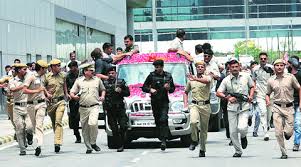
Prime Minister Elect of the world’s largest democracy arrives at the airport in New Delhi

Image Ravi Kanojia, Indian Express May 18, 2014

Circulating on Facebook for two days, and still unreported in mainstream media, is the story of overjoyed BJP workers attacking two mosques in Dakshina Kannada Lok Sabha constituency. Inebriated saffron activists, raising Hara-Hara Modi slogans, attacked two Masjids in separate places of the district on May 16th, after the poll results were announced.

The BJP activists also tried to harm the Imam of Muhiyuddin Juma Masjid, but he managed to escape from the hands of the miscreants.

Meanwhile, another group of miscreants, believed to be BJP activists, reportedly pelted stones at a Masjid in Suralpady near Kaikamba under the limits of Bajpe police station.

Today’s Hindu reports that a Muslim chicken stall owner was beaten up by a gang at Hoode village.

Mr. Ais told The Hindu that he was cooking food, for nearly 400 students at a nearby school, when seven persons came on four motorcycles asked for him with his daughter Ayesha at around 4.30 p.m. They later pushed her and came to him and asked if he was present when a victory procession [of the Bharatiya Janata Party] was taken out on May 16, to which he replied in the negative. They then beat him up.

But none of this muck sticks to the Teflon visage of Modi, ever. Continue reading Excitotoxins and MSG. (Or, the Modi Style of Governance)

The Triumph of the Will(ie): Prasannarajan Anoints Modi in the Open

The televised coronation (or should I say Rajyabhishek) of Narendrabhai Damodardas Modi has featured a supremely photogenic set (the Dasashwamedh Ghat in Benaras), a chorus line of calisthenic priests lining the riverfront of the Ganga with blazing torches, a script (being written, even as the epic is being canned, in every television studio and editorial office) talented producers and art directors, an army of happy-clappy extras, and even its own battalion of masked stunt doubles.

Modi at Dasashwamedh Ghat, Varanasi/Benaras on 17 May 2014. Courtesy, Amar Ujala website.
Amit Shah, Rajnath Singh and Narendra Modi,  at Dasashwamedh Ghat, Varanasi/Benaras on 17 May 2014. Courtesy, Amar Ujala website.

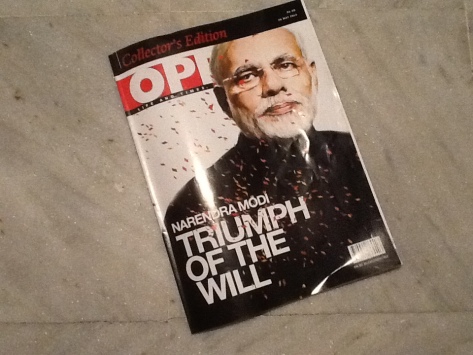
Like any good bollywood blockbuster, it cannot but be a homage to an extant cinematic classic. S. Prasannarajan, editor of the Open Magazine has even told us what that classic is. On the cover of Open, beneath a pensive, tight lipped and determined Narendrabhai looking out at the magazine’s reader through a shower of rose petals and rimless Bulgari glasses, four words spell out in bold capitals the film’s name – ‘TRIUMPH OF THE WILL’. Dejavu, anyone?

'Triumph Of the Will' Open Magazine, May 26, 2014
”Triumph Of the Will’ Open Magazine – ‘Collectors’ Issue’, May 2014

Continue reading The Triumph of the Will(ie): Prasannarajan Anoints Modi in the Open

क्या निराश हुआ जाए?

क्या निराश हुआ जाए? कल सुबह से हजारी प्रसाद द्विवेदी  का एक अन्य  प्रसंग में किया गया यह प्रश्न मन में घूम रहा है. चुनाव नतीजों के पहले ही चरण में पिता ने फोन पर कहा: “यह तुम्हारा पहला कड़ा इम्तहान है.”पिता ने, जो अब जीवन की सांध्य वेला में हैं, कहा, “हम तो किनारे पर खड़े लोग हैं, तुम सब अभी इस जिंदगी के रेले के ठीक बीचो-बीच हो, भागने का न तो कोई उपाय है और ऐसी कोई भी इच्छा कायरता होगी. इसका सामना करो और इसे समझो.” हजारीप्रसाद जी और अपने पिता को कहना चाहता हूँ, वह जो रवींद्रीय ब्रह्मांडीय उदारहृदयता का स्वप्न आप सबने दिखाया था, कामकाजी रोजमर्रापन की तेज रौशनी में खो गया जान पड़ता है. शायद हम सब अब तक सो रहे थे,अचानक जगा दिए गए हैं. निराश या हताश होने की सुविधा नहीं है. समझने की कोशिश ही शायद इस यथार्थ का सामना करने के साधन देगी! Continue reading क्या निराश हुआ जाए?

How The AAP Won Punjab: Harjeshwar Pal Singh

 This is a guest post by HARJESHWAR PAL SINGH

Amidst the unprecedented Tsunami of Modi which swept away opposition in most of the country, one result stood out as truly exceptional. AAM AADMI PARTY’s (AAP) stunning debut in Punjab. The virtually unheard of party in Punjab even 5 months before won 4 Parliamentary seats out of 13 and secured 25% of the popular vote announcing itself to be an equal of the ruling SAD/BJP combine and the opposition Congress. Two of its candidates Bhagwant Maan (Sangrur) and Prof Sadhu Singh (Faidkot ) won with a stunning margin of over 2 lakhs and 1.7 lakhs respectively. This popular groundswell of support which was ignored by most political analysts, conventional media and political parties had begun to take visible form through buzz on the street, social media and in common discourse by the election day.

What explains this massive upsurge by a fledgling political outfit lacking money, muscle, men and a local organization to humble two of the most well equipped political machines -SAD/BJP and Congress? Continue reading How The AAP Won Punjab: Harjeshwar Pal Singh

So Who Has Won the Election?

The sweep is certainly breathtaking. Way beyond what most surveys and exit polls predicted. To be sure, our commitment to the democratic spirit demands that we recognize the mandate for what it is – at least on the face of it. And on the face of it, it is a triumph of the Modi-led BJP. Behind it, of course, lies the organizational machinery of the RSS and its familial organizations.

However, it will be a mistake to think that the election was fought and won by any of these outfits. From 1998 onward, the BJP, backed by the same RSS parivar, has continuously registered a decline in vote share, irrespective of whether it was in power or out of it. From 25.6 percent in 1998, it declined to 22.2 percent in 2004 and further to 18.8 percent in 2009. The presence of younger people in RSS shakhas too has been significantly on the decline in this period and in particular, after 2004. In period of the run-up to the elections, the BJP was a ramshackle and directionless party – its top leaders like LK Advani and Jaswant Singh disgraced and then brought back; Atal Behari Vajpayee knocked out of action for quite some time by then and practically all state units riven with internal dissension. As a consequence, it was also a party therefore, with completely demoralized ranks.

How then did the change come about? As long as our eyes remain fixed on the supposedly ‘political’ domain, we are unlikely to be able to see what exactly has been going on. The fact of the matter is that Narendra Modi was neither BJP’s candidate of choice nor that of the RSS. This election was fought by the corporate sector directly, along with the Big Media – the surrogates of the corporate sector. The plan to set up Modi was put in place by these players. And in this process, the emergence of the Big Media as a full-fledged propaganda machine of Modi’s constitutes a significant moment. It is a moment that actually awaits a more detailed study of how exactly the game plan was put into operation but one thing can be said right away. What brought about this result was not just the machinery of the Sangh parivar but the mobilization of a whole range of opinion makers to serve what was to be a clearly Hindutva framed political formation. Most of these intellectuals and opinion-makers are economically right-wing (neoliberal fundamentalists) although not Hindu-communal, but while they do not seriously believe that Modi has shed his Hindutva skin, they are prepared to join the propagation of lies, lies and lies in the service of corporate capital, disguised as the ‘greater good of humanity’. Continue reading So Who Has Won the Election?

Bittersweet Gujarat: Reena Patel

This is a guest post by REENA PATEL

I looked around the room and my gaze was met with the kohl lined eyes and stares of bewilderment and distrust. My heart pounded as I listened to three Muslim women describe their latest attempt to find their father and brother after they disappeared in the riots. They were speaking to Rahidbhai* from a local NGO who was accompanying me into the Ahmedabad relief colonies for the first time. Why was I so scared? Why was my heart pounding? The eldest woman of the home disrupted my thoughts, she asked me for my name. I looked around and looked at Rahidbhai, who looked back uneasily. “Mera naam Reena hai.” I said, almost choking on the words, knowing what the next question would be. “Aap ka surname kya hai?” The room grew thick with silence. “Patel.”

As far back as I could remember, I was taught to regard Muslims differently from the rest of the general population. My parents, both from Surat, Gujarat moved and met in the United States in their twenties. They both lived in England and spent time in Gujarat, and had families that were deeply involved in the Gujarati community. My brother and I were born in Long Beach California. I went to Gujarati school on Sundays, went to every function, picnic, and cultural show put on by the Leuva Patidar Samaj in Southern California. Many of my family members were apart of the organization. In fact, my great grandfather Vallabhai Patel was one of the first Patels to land upon the shores of the United States, now estimated at a population of over 140,000. We went to religious camps that were meant to teach us about Hindu ideology, handed out saffron prayer books and modeled how to become ideal Hindu men and women for our communities.

Continue reading Bittersweet Gujarat: Reena Patel

There’s a G on my Neck (again): Simran Kaur

Guest post by SIMRAN KAUR

Shekhar Gupta is at it again: lacing an insidious agenda with just enough actual facts that even the targets of his vitriol become eager to swallow. Aspiring Indian Journos, this is how a good Sardar Joke—and while you are at it, jibe at the poor, the rural, the unemployed, the mourning—is done, while earning your paycheck yet again as an esteemed Editor-in-Chief, at best with head-in-clouds, at worst, a stake-in-oppression.

Shekhar G’s latest thesis: The rest of the country has moved on but Punjab has become a prisoner of its boisterous old stereotype. It has forgotten its entrepreneurial energy, its competitive spirit and slipped into a complacent, decadent trance of perpetual balle-balle.

His first argument for the thesis of Punjab’s decline: “the Punjabification”…of Punjab. He bemoans that signs and posts are in Punjabi, in Punjab.

The 50s and 60s saw Punjabi Hindus becoming the unique community to denounce their own mother-tongue. Upping the ante, G. ridicules Punjabis who use Gurmukhi, the script developed in the time of the Sikh Gurus. He finds tell-tale signs over Punjab (he notes his fieldwork of actually travelling on the Grand Trunk Road and flying over Punjab by helicopter recently) of the people being un-couth:  signage on Punjabi establishments, in poor English.

You will take a minute figuring out what the “burgars” and “nudles” painted on so many fast-food shops mean, or why Lily is always spelt “Lilly”, whether it be the name of a restaurant in Phagwara or a beauty parlour in Bathinda…If you haven’t figured out already that this, indeed, is Singh’s English.

Brilliant two-birds strike, Shekhar G. Continue reading There’s a G on my Neck (again): Simran Kaur

BJP’s Campaign of Intimidation – A Report from Banaras: Monobina Gupta

Guest post by MONOBINA GUPTA

The narrow streets of Goduliya Chowk were bursting at the seams yesterday. It was the time of the famous Varanasi aarti at the ghats of the Ganga, a time when the crowd multiplies by several hundreds of people. Narendra Modi was preparing to head out on his triumphant road show through this area, choc-a-bloc full. The BJP’s activists were in a frenzied trance – waving saffron flags, flaunting Modi caps (a tawdry imitation of the original AAP trademark), dancing and chanting: Modi, Modi. As a person with no love lost for Modi, I responded to the exultant mood with some apprehension. My thoughts were straying to the nukkad sabha of the AAP that I attended last evening when a group of 20 young and old AAP volunteers had gone around campaigning for Medha Patkar’s meeting. I found myself thinking about the evening a couple of days ago when I stood with Anand Patwardhan and some activists who were distributing leaflets right there at Goduliya Chowk, and a group of BJP men came surrounded us. I thought about another night spent at Kabir Math Chowk after watching the Dastangoi performance – when a group of young men from Bangalore and Maharashtra were confronted by BJP supporters. I was worried about their safety standing amidst a crowd which appeared dangerous in its swaggering triumph. Yesterday, with Modi’s cavalcade approaching, frictions were reaching fever pitch – encounters one could not possibly see on the images on TV at home.

Standing there amidst the crowd, I spotted an elderly Sikh gentleman walking through the throng of people wearing his AAP topi. Suddenly a roar went up, as Modi sympathisers lunged after him shouting ‘pagal, pagal’ (mad/mad). A little distance ahead I saw another man wearing the AAP cap. The crowd spotted him too, and ran after them both, gesticulating, heckling. As I start walking quickly towards the men I saw them, seemingly unperturbed, walk right through the charging hoard, not a sign of nervousness about their gait. They were walking the confident walk of men who know no fear. Continue reading BJP’s Campaign of Intimidation – A Report from Banaras: Monobina Gupta

The curious case of Reliance Industries Ltd’s gravity defying stock price – Or, how you should learn to stop worrying about gas prices and buy RIL stock now: Vineeth Sukrithan

This is a guest post by VINEETH SUKRITHAN

The stark contrast between RIL’s latest march quarter performance and the almost- three-year highs that its stock price is perched on top, merits a deeper analysis. On April 18th, 2014, RIL released its quarterly data showing disappointing results that were entirely in line with industry expectations. Petrochemical business revenues fell 3.7%, while oil and gas turnover dropped 18.2% q-o-q. Net profit growth in its January-March quarter (Q4FY14) was at Rs 5,631 crore – only 0.7 per cent higher than Rs 5,589 crore it earned a year ago. The petrochemicals business’s Ebit was lower than in the December quarter and the company’s outstanding debt over shot its cash and equivalents. (Rs 89,968 crore against cash, and equivalents of Rs 88,190 crore.)

Yet, for a company that has always been known to be reticent about taking on high levels of debt, RIL has gone on what can only be called a remarkable splurge in capital expenditure. Its capital expenditure during the year was the highest ever. The company reported net addition to fixed assets of Rs 35,210 crore in FY14. In FY09, when the company commissioned its second refinery and K-G basin gas production, its capex was only Rs 24,907 crore. So, on all accounts, RIL’s actions and stock price seem counter to the predicaments of its current financial health, which begs the question, where does Reliance derive this level of confidence in its future profitability to be willing to take on tremendous amounts of debt?

Continue reading The curious case of Reliance Industries Ltd’s gravity defying stock price – Or, how you should learn to stop worrying about gas prices and buy RIL stock now: Vineeth Sukrithan

Some Reflections on the neutrality of political institutions and the project of making Modi more palatable: Moiz Tundawala

Guest Post by MOIZ TUNDAWALA

“ … . however good a Constitution may be, it is sure to turn out bad because those who are called to work it, happen to be a bad lot. However bad a Constitution may be, it may turn out to be good if those who are called to work it, happen to be a good lot. The working of a Constitution does not depend wholly upon the nature of the Constitution. The Constitution can provide only the organs of State such as the Legislature, the Executive and the Judiciary. The factors on which the working of those organs of the State depend are the people and the political parties they will set up as their instruments to carry out their wishes and their politics.”

[Dr. Bhimrao Amdedkar]

These observations of Babasaheb Ambedkar, made on the 25th of November, 1949, one day before the Constitution was finally adopted after three years worth of labour, should suffice for anyone who dismisses Modi skeptics as excessive scare mongers. As a second year law student in 2006-07, I couldn’t quite understand why our revered constitutional law teacher Prof. M.P. Singh would keep reiterating these sentiments in class, something which I thought was so axiomatic it did not need emphases. With only a few days left for the outcome of what is being called an election for the soul of India, I now realize the wisdom underlying those constant reminders, especially in a law school converted by the culture and priorities of its students into a factory churning out smart but unreflective products for the corporate sector. I think those of us who find Modi problematic, but would still vote him in for the lure of the promised economic miracle, while at the same time consoling ourselves with the talk of sufficiently robust political institutions capable of surviving any onslaught, must listen to Ambedkar carefully. The Constitution is an artefact, a human creation, constantly needing ‘good people’ at the helm to work it out. If nothing else, resistance to Modi’s rise to power is at least resistance against the enthronement of ‘bad people’, who deep down have only harboured contempt for the Constitution as a foreign document.

Continue reading Some Reflections on the neutrality of political institutions and the project of making Modi more palatable: Moiz Tundawala

Condemn the Massacre in Assam: A Statement by Civil Society Groups, Activists and Concerned Citizens

Text of a statement issued by Civil Society Groups and Concerned Citizens

5th May 2014

Condemn the Massacre in Assam, Demand immediate arrest of Pramila Rani Brahma; Ensure safety of Muslims in BTAD: A Statement by Civil Society Groups, Activists and Concerned Citizens

We, the undersigned, express our profound sense of grief and alarm over the gruesome massacre of Bengali-speaking Muslims on 2nd May. This most recent round of killings — in which 32 people, mostly women and children have lost their lives – is another link in the long and… bloody sequence of ethnic cleansing being carried out by tribal Bodo militant groups with impunity.

For years, Hindutva politics has successfully created the bogey of the ‘Bangladeshi’, rendering Muslims as suspects and targets, locked in a perpetual battle with the tribal Bodos. In his rally at Silchar, the BJP’s Prime Ministerial candidate reiterated precisely this. He said: “There are two kinds of people who came from Bangladesh to Assam: those brought as part of a political conspiracy for vote bank politics of a particular party (Muslims) and others who were harassed in the neighbouring country (Hindus). Those brought for vote bank politics and smugglers must be pushed back, while the second category must be accommodated.” (Silchar, 22nd February). Continue reading Condemn the Massacre in Assam: A Statement by Civil Society Groups, Activists and Concerned Citizens

India’s 16th Lok Sabha General Elections and Persons with Disabilities: Avinash Shahi

This is a guest post by Avinash Shahi

When the challenges and daily difficulties of approximately 70 million persons with disabilities in public life are not highlighted in political rallies and in the TV studios, it raises a serious question about an elite political class’s commitment to empower persons with disabilities. Do they consider persons with disabilities as India’s citizens to be taken seriously? Politicians of major political parties are crisscrossing India’s vast geographical terrain to address voters. But neither Narender Modi nor Rahul Gandhi have ever bothered to utter a single word about their plan for voters who are persons with disabilities in their campaigns. Continue reading India’s 16th Lok Sabha General Elections and Persons with Disabilities: Avinash Shahi

Two days with AAP in Banaras

‘Varanasi’ is only the official name. Sometimes, to make a poetic point, someone may say Kashi.   But ‘Banaras’ is how Banarasis refer to their city.

Banaras ki parampara, they say. Or hum Banaras ke musalman.

Kaal Bhairav Banaras ke kotwal hain, says the mahant of the Shitala Mata temple. Kaal Bhairav (Shiva) is the keeper of the gates of Banaras.

And of course, Banaras ki chaat khaayi hai aapne? Banaras ka paan nahin khayenge?

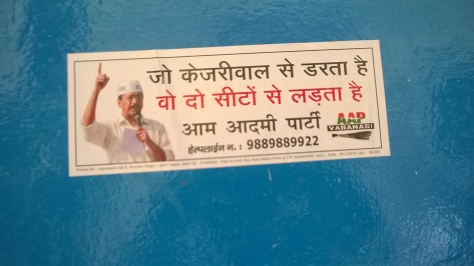
do seet

Sticker on wall of home in Rajmandir, a Hindu locality (All pictures by JAMAL KIDWAI)

My old friend and comrade Jamal Kidwai and I were in Banaras to observe the AAP campaign, being supporters of AAP (me) and of Arvind Kejriwal in Banaras (Jamal), and to hang out with the (largely young) volunteers who have landed up – from IT and advertising, from colleges and small government jobs, from Bangalore and Mumbai, from Madhya Pradesh and Arunachal Pradesh – to map Banaras with their feet. So this does not purport to be an objective account – unlike journalists’ accounts of the ‘Modi wave’, which do claim to be purely factual. As Professor Randhir Singh is fond of reminding us – in Paris in 1968, the first question the students would hurl at all speakers was always – “Where do you speak from?” Continue reading Two days with AAP in Banaras

The Carnage in Kokrajhar: Saba Sharma

Guest post by SABA SHARMA

Since the evening of the 1st of May, it has been reported that at least 23 people have been killed in Kokrajhar and Baksa districts in Assam, administered under the Bodoland Territorial Council. All the victims were from the Muslim community, and were allegedly shot by the militant Bodo group, the National Democratic Front of Bodoland (Songbijit), named after its ruthless leader Songbijit, from the Karbi Anglong area in Assam. Indefinite curfew has been imposed here and in neighbouring districts as well, as rumours of other killings and beatings filter in, impossible to separate from facts in the atmosphere of panic that currently prevails.

Polling ended in the Kokrajhar constituency in Assam on the 24th of April, ending a temporary sense of calm and normalcy. Ethnic violence between Bodos and Bengali Muslims took place in July 2012, majorly affecting Kokrajhar, Chirang and Dhubri district. Nearly 5 lakh people were displaced from their homes, and most did not return until January 2013, staying in relief camps, too afraid to return. Once the camps were formally shut down and people returned to their homes, normalcy was still a distant reality. An economic boycott imposed by Bodo leaders on the Bengali Muslim community meant that agricultural labour, a primary occupation for Bengali Muslims, was all but non-existent. In the last year, this economic boycott has slowly been relaxed in some areas, while in other areas, it prevails as strongly as ever. In most areas, markets were among the first spaces to become mixed again, an almost neutral zone where people began to interact with one another again. But in other markets, like Koila Moila bazaar in Chirang, Muslims are still ‘banned’. Continue reading The Carnage in Kokrajhar: Saba Sharma

Professors of Political Science and the Modi Phenomenon

Ashutosh Varshney has written yet another piece on the Modi phenomenon. This time he has invoked “the discipline of political science”, which he has “taught for two decades”, and underlined that it fundamentally disagrees with an “institutions-free” view of the rise of Narendra Modi. [See my response to his earlier piece here.] Before I examine Varshney’s ‘arguments’ about present politics, let me cite the following from nothing less than the American Political Science Review – a revealing chapter from the history of the discipline that he and I share:

Following World War I came the turbulence of the 1920s and 1930s. Communism and fascism rose to prominence as the world’s great powers fell to deflation and imperialism. Yet during this time of great political upheaval, political science became a study in irrelevance. Perhaps as a result of no longer sharing common theories and assumptions, the discipline fragmented and retreated inwards. Scanning the American Political Science Review from 1923 to 1936 for any sustained analysis of the great events of the day such as Mussolini’s march on Rome, Japan’s occupation of Manchuria, or even the Great Depression, one will come up empty. What one does find are, for example, reports of constitutional change in Estonia (Roucek 1936), predictions that the German administrative structure would stop Hitler becoming a dictator (Friedrich 1933), and analysis of the legal monism of Alfred Verdoross (Janzen 1935). [Mark Blythe, ‘Great Punctuations, Randomness, and the Evolution of Comparative Political Science’, APSR, Vol. 100, No. 4, November 2006. All emphasis added]

Perhaps this delusional business of waxing on the strength of institutions has been a professional pastime in the discipline but one could excuse the political scientists of the 1920s and 1930s, insofar as they were making the mistake for the first time. What do you say of someone who repeats the same error with ever greater self-righteousness, eighty/ ninety years down the line? And if this business of repeating the same error over and over again is something more than a pastime, if it is integral to political science, then all one can say is, so much the worse for political science! Continue reading Professors of Political Science and the Modi Phenomenon

What is ‘communal’? The problem of false equivalence: Sheba Tejani

Guest post by SHEBA TEJANI

Although the BJP has attempted to build a campaign around the issue of “vikas” during this election, the hate filled fumes of “communalism” keep slipping through the cracks. Last week, we heard Ramdas Kadam say that Modi would find a permanent solution for recalcitrant Muslims and ship them off to Pakistan, which he would also incidentally destroy in six months. Giriraj Singh wanted to send everyone who opposed Modi to Pakistan. A video clip showed Praveen Togadia inviting his audience in Bhavnagar to evict Muslims and forcibly occupy their homes, openly encouraging criminal activity. FIRs have been filed against Kadam and Togadia after the Election Commission took note of their speeches while Singh has been barred from campaigning.

But then some would say other candidates and parties are no better and make similarly incendiary remarks: Shazia Ilmi, AAP’s candidate from Ghaziabad recently urged a group of Muslims to be more “communal” and less “secular” in deciding whom to vote for. She urged them to defend their own interests and to vote for one of “their own”, including Arvind Kejriwal in that category. Continue reading What is ‘communal’? The problem of false equivalence: Sheba Tejani

Anatomy of a Rape and Its Immediate Aftermath – A Report from Kolkata: Kasturi

Guest post by KASTURI

Time flew fast. Over the last two days and sleepless nights. A girl I knew, a cheerful bubbly college first-year, eyes wide open with dreams, has been subjected to sexual violence. We had walked together in many marches against injustice, oppression, gender violence. I remember the day I first met her, several months back. It was opposite the Indian Coffee House on College Street. She had become an activist of the radical left students’ organization AISA by then. After that I met and chatted with her on many occasions. On the very day she was raped, she had participated in a students’ demonstration against the corporate-communal onslaught personified by Narendra Modi. She was slated to participate in another program the very next day. When night struck.

The night that rolled on to dawn
Continue reading Anatomy of a Rape and Its Immediate Aftermath – A Report from Kolkata: Kasturi

Modi Thugs on the Rampage – Where is the EC?

UPDATE on yesterday’s news

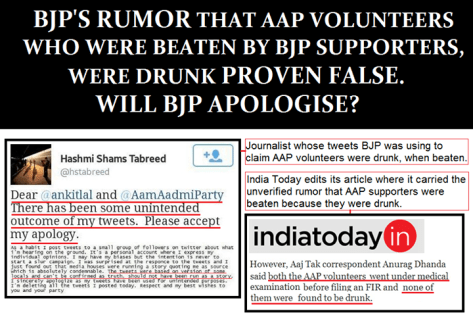
BJP's lie exposed

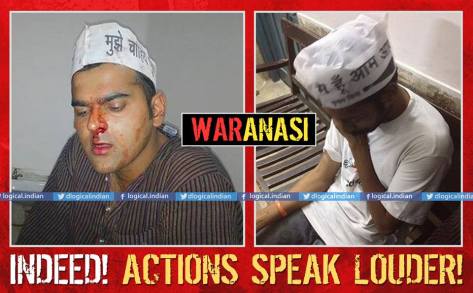
Reports of Modi Thugs on the rampage in Benaras: Over the last few days, as the days of the election appraoch, Modi supporters have become more and more desperate and violent. This is just one in a long series of disruptions of meetings and attacks that has been meted out by the goon squad to AAP volunteers.

जिन्हें नाज़ है हिन्द पर वो कहाँ हैं? उन्हें  ये गलियाँ, ये कूचे, ये मंज़र दिखाओ…

AAp activists attacked by Modi Thugs

Continue reading Modi Thugs on the Rampage – Where is the EC?

पार्टी विहीन गठबंधन का दिल्ली फतह ! संजीव कुमार

Guest post by SANJEEV KUMAR
अभी अभी सत्तरहवीं लोकसभा (2019) के चुनाव परिणाम आये है, देश की कोई भी पार्टी खाता भी नहीं खोल पाई है, जनता ने सभी सीटों पर निर्दलीय उम्मीदवार को चुनकर संसद का रास्ता दिखाया है। हमारे राष्ट्रपति महोदय सरकार बनाने के लिए आमंत्रित करें तो किसे करें? देश को इस संवैधानिक और क़ानूनी संकट से बाहर निकालने के लिए राष्ट्रपति ने सर्वोच्च न्यायलय के न्यायधीश को ख़त लिखा और दोनों ने मिलकर ये फैसला लिया कि सभी नव-निर्वाचित सांसदों को दिल्ली बुलाया जाय और उन्हें समग्र रूप से अगली सरकार बनाने का आग्रह किया जाय।

इधर हमारे सभी नव-निर्वाचित सांसदगन कन्फ्यूज्ड भी है पर दिल्ली के लिए अपना बोरिया बिस्तरा भी बाँध रहे है, आखिर महामहिम का आदेश जो है। दिल्ली पहुँचाने पर सभी सांसद जब राष्ट्रपति भवन में पहुंचे तो राष्ट्रपति ने सदन के दोनों सभाओ के संयुक्त बैठक को संबोधित कर सरकार बनाने की प्रक्रिया का ढांचा प्रस्तुत किया जिसमे सबसे पहले सभी नव-निर्वाचित सांसदों को एक एक कर देश की समस्याओं और उसके समाधान के उपाय पर बोलने की अनुमति दी जाएगी और उसके बाद उन सांसदों को प्रधान मंत्री बनाने का दावा पेश करने के लिए सामने आने को कहा जायेगा जिनको कम से कम 60 सांसदों का समर्थन प्राप्त हो। 60 सांसदों का समर्थन जुटाने के लिए उन्हें एक हफ्ते का समय दिया जायेगा और फिर उसके बाद संसद में प्रधानमंत्री पद के लिए अनुपातिक मतदान पद्धति से चुनाव होगा और हमारे प्रधान मंत्री को चुना जायेगा। उसके बाद ठीक इसी प्रकार से देश के अन्य मंत्रालयों के मंत्रियों का भी चुनाव होगा। सभी सांसदों को सभी मंत्रालयों को चलाने की क्षमता को संसद में सांसदों के सामने प्रकट करने का सामान अधिकार होगा। Continue reading पार्टी विहीन गठबंधन का दिल्ली फतह ! संजीव कुमार

A letter to Father Frazer Mascarenhas SJ

Endorsed by academics, activists and educationists across India.

Dear Father,
In these troubling times, when the mightiest are being bought over, lured, seduced, or silenced, we salute you for your courage and moral clarity in asking your students to choose wisely. By drawing the attention of your students (who would have voted for the first time) to the seamy underbelly of a ‘model’ that is being promoted unabashedly by the corporate media as the panacea of all that which ails India, we believe you acted responsibly and ethically. The purpose of education is to inculcate critical thinking, to provide
tools of analysis, and to make students sensitive to social realities – no matter how unpleasant they may be. Far from abusing your position, as the BJP is alleging, we think that your advice is the appropriate way for a teacher, and head of an academic institution, to act. Continue reading A letter to Father Frazer Mascarenhas SJ