Category Archives: Politics

Condemn the Massacre in Assam: A Statement by Civil Society Groups, Activists and Concerned Citizens

Text of a statement issued by Civil Society Groups and Concerned Citizens

5th May 2014

Condemn the Massacre in Assam, Demand immediate arrest of Pramila Rani Brahma; Ensure safety of Muslims in BTAD: A Statement by Civil Society Groups, Activists and Concerned Citizens

We, the undersigned, express our profound sense of grief and alarm over the gruesome massacre of Bengali-speaking Muslims on 2nd May. This most recent round of killings — in which 32 people, mostly women and children have lost their lives – is another link in the long and… bloody sequence of ethnic cleansing being carried out by tribal Bodo militant groups with impunity.

For years, Hindutva politics has successfully created the bogey of the ‘Bangladeshi’, rendering Muslims as suspects and targets, locked in a perpetual battle with the tribal Bodos. In his rally at Silchar, the BJP’s Prime Ministerial candidate reiterated precisely this. He said: “There are two kinds of people who came from Bangladesh to Assam: those brought as part of a political conspiracy for vote bank politics of a particular party (Muslims) and others who were harassed in the neighbouring country (Hindus). Those brought for vote bank politics and smugglers must be pushed back, while the second category must be accommodated.” (Silchar, 22nd February). Continue reading Condemn the Massacre in Assam: A Statement by Civil Society Groups, Activists and Concerned Citizens

India’s 16th Lok Sabha General Elections and Persons with Disabilities: Avinash Shahi

This is a guest post by Avinash Shahi

When the challenges and daily difficulties of approximately 70 million persons with disabilities in public life are not highlighted in political rallies and in the TV studios, it raises a serious question about an elite political class’s commitment to empower persons with disabilities. Do they consider persons with disabilities as India’s citizens to be taken seriously? Politicians of major political parties are crisscrossing India’s vast geographical terrain to address voters. But neither Narender Modi nor Rahul Gandhi have ever bothered to utter a single word about their plan for voters who are persons with disabilities in their campaigns. Continue reading India’s 16th Lok Sabha General Elections and Persons with Disabilities: Avinash Shahi

Two days with AAP in Banaras

‘Varanasi’ is only the official name. Sometimes, to make a poetic point, someone may say Kashi.   But ‘Banaras’ is how Banarasis refer to their city.

Banaras ki parampara, they say. Or hum Banaras ke musalman.

Kaal Bhairav Banaras ke kotwal hain, says the mahant of the Shitala Mata temple. Kaal Bhairav (Shiva) is the keeper of the gates of Banaras.

And of course, Banaras ki chaat khaayi hai aapne? Banaras ka paan nahin khayenge?

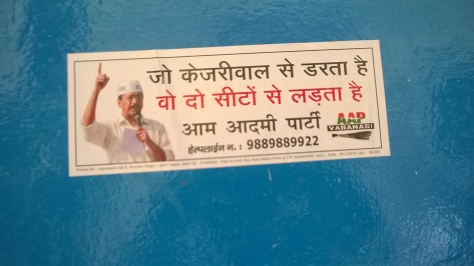
do seet

Sticker on wall of home in Rajmandir, a Hindu locality (All pictures by JAMAL KIDWAI)

My old friend and comrade Jamal Kidwai and I were in Banaras to observe the AAP campaign, being supporters of AAP (me) and of Arvind Kejriwal in Banaras (Jamal), and to hang out with the (largely young) volunteers who have landed up – from IT and advertising, from colleges and small government jobs, from Bangalore and Mumbai, from Madhya Pradesh and Arunachal Pradesh – to map Banaras with their feet. So this does not purport to be an objective account – unlike journalists’ accounts of the ‘Modi wave’, which do claim to be purely factual. As Professor Randhir Singh is fond of reminding us – in Paris in 1968, the first question the students would hurl at all speakers was always – “Where do you speak from?” Continue reading Two days with AAP in Banaras

The Carnage in Kokrajhar: Saba Sharma

Guest post by SABA SHARMA

Since the evening of the 1st of May, it has been reported that at least 23 people have been killed in Kokrajhar and Baksa districts in Assam, administered under the Bodoland Territorial Council. All the victims were from the Muslim community, and were allegedly shot by the militant Bodo group, the National Democratic Front of Bodoland (Songbijit), named after its ruthless leader Songbijit, from the Karbi Anglong area in Assam. Indefinite curfew has been imposed here and in neighbouring districts as well, as rumours of other killings and beatings filter in, impossible to separate from facts in the atmosphere of panic that currently prevails.

Polling ended in the Kokrajhar constituency in Assam on the 24th of April, ending a temporary sense of calm and normalcy. Ethnic violence between Bodos and Bengali Muslims took place in July 2012, majorly affecting Kokrajhar, Chirang and Dhubri district. Nearly 5 lakh people were displaced from their homes, and most did not return until January 2013, staying in relief camps, too afraid to return. Once the camps were formally shut down and people returned to their homes, normalcy was still a distant reality. An economic boycott imposed by Bodo leaders on the Bengali Muslim community meant that agricultural labour, a primary occupation for Bengali Muslims, was all but non-existent. In the last year, this economic boycott has slowly been relaxed in some areas, while in other areas, it prevails as strongly as ever. In most areas, markets were among the first spaces to become mixed again, an almost neutral zone where people began to interact with one another again. But in other markets, like Koila Moila bazaar in Chirang, Muslims are still ‘banned’. Continue reading The Carnage in Kokrajhar: Saba Sharma

Professors of Political Science and the Modi Phenomenon

Ashutosh Varshney has written yet another piece on the Modi phenomenon. This time he has invoked “the discipline of political science”, which he has “taught for two decades”, and underlined that it fundamentally disagrees with an “institutions-free” view of the rise of Narendra Modi. [See my response to his earlier piece here.] Before I examine Varshney’s ‘arguments’ about present politics, let me cite the following from nothing less than the American Political Science Review – a revealing chapter from the history of the discipline that he and I share:

Following World War I came the turbulence of the 1920s and 1930s. Communism and fascism rose to prominence as the world’s great powers fell to deflation and imperialism. Yet during this time of great political upheaval, political science became a study in irrelevance. Perhaps as a result of no longer sharing common theories and assumptions, the discipline fragmented and retreated inwards. Scanning the American Political Science Review from 1923 to 1936 for any sustained analysis of the great events of the day such as Mussolini’s march on Rome, Japan’s occupation of Manchuria, or even the Great Depression, one will come up empty. What one does find are, for example, reports of constitutional change in Estonia (Roucek 1936), predictions that the German administrative structure would stop Hitler becoming a dictator (Friedrich 1933), and analysis of the legal monism of Alfred Verdoross (Janzen 1935). [Mark Blythe, ‘Great Punctuations, Randomness, and the Evolution of Comparative Political Science’, APSR, Vol. 100, No. 4, November 2006. All emphasis added]

Perhaps this delusional business of waxing on the strength of institutions has been a professional pastime in the discipline but one could excuse the political scientists of the 1920s and 1930s, insofar as they were making the mistake for the first time. What do you say of someone who repeats the same error with ever greater self-righteousness, eighty/ ninety years down the line? And if this business of repeating the same error over and over again is something more than a pastime, if it is integral to political science, then all one can say is, so much the worse for political science! Continue reading Professors of Political Science and the Modi Phenomenon

What is ‘communal’? The problem of false equivalence: Sheba Tejani

Guest post by SHEBA TEJANI

Although the BJP has attempted to build a campaign around the issue of “vikas” during this election, the hate filled fumes of “communalism” keep slipping through the cracks. Last week, we heard Ramdas Kadam say that Modi would find a permanent solution for recalcitrant Muslims and ship them off to Pakistan, which he would also incidentally destroy in six months. Giriraj Singh wanted to send everyone who opposed Modi to Pakistan. A video clip showed Praveen Togadia inviting his audience in Bhavnagar to evict Muslims and forcibly occupy their homes, openly encouraging criminal activity. FIRs have been filed against Kadam and Togadia after the Election Commission took note of their speeches while Singh has been barred from campaigning.

But then some would say other candidates and parties are no better and make similarly incendiary remarks: Shazia Ilmi, AAP’s candidate from Ghaziabad recently urged a group of Muslims to be more “communal” and less “secular” in deciding whom to vote for. She urged them to defend their own interests and to vote for one of “their own”, including Arvind Kejriwal in that category. Continue reading What is ‘communal’? The problem of false equivalence: Sheba Tejani

Anatomy of a Rape and Its Immediate Aftermath – A Report from Kolkata: Kasturi

Guest post by KASTURI

Time flew fast. Over the last two days and sleepless nights. A girl I knew, a cheerful bubbly college first-year, eyes wide open with dreams, has been subjected to sexual violence. We had walked together in many marches against injustice, oppression, gender violence. I remember the day I first met her, several months back. It was opposite the Indian Coffee House on College Street. She had become an activist of the radical left students’ organization AISA by then. After that I met and chatted with her on many occasions. On the very day she was raped, she had participated in a students’ demonstration against the corporate-communal onslaught personified by Narendra Modi. She was slated to participate in another program the very next day. When night struck.

The night that rolled on to dawn
Continue reading Anatomy of a Rape and Its Immediate Aftermath – A Report from Kolkata: Kasturi

Modi Thugs on the Rampage – Where is the EC?

UPDATE on yesterday’s news

BJP's lie exposed

Reports of Modi Thugs on the rampage in Benaras: Over the last few days, as the days of the election appraoch, Modi supporters have become more and more desperate and violent. This is just one in a long series of disruptions of meetings and attacks that has been meted out by the goon squad to AAP volunteers.

जिन्हें नाज़ है हिन्द पर वो कहाँ हैं? उन्हें  ये गलियाँ, ये कूचे, ये मंज़र दिखाओ…

AAp activists attacked by Modi Thugs

Continue reading Modi Thugs on the Rampage – Where is the EC?

पार्टी विहीन गठबंधन का दिल्ली फतह ! संजीव कुमार

Guest post by SANJEEV KUMAR
अभी अभी सत्तरहवीं लोकसभा (2019) के चुनाव परिणाम आये है, देश की कोई भी पार्टी खाता भी नहीं खोल पाई है, जनता ने सभी सीटों पर निर्दलीय उम्मीदवार को चुनकर संसद का रास्ता दिखाया है। हमारे राष्ट्रपति महोदय सरकार बनाने के लिए आमंत्रित करें तो किसे करें? देश को इस संवैधानिक और क़ानूनी संकट से बाहर निकालने के लिए राष्ट्रपति ने सर्वोच्च न्यायलय के न्यायधीश को ख़त लिखा और दोनों ने मिलकर ये फैसला लिया कि सभी नव-निर्वाचित सांसदों को दिल्ली बुलाया जाय और उन्हें समग्र रूप से अगली सरकार बनाने का आग्रह किया जाय।

इधर हमारे सभी नव-निर्वाचित सांसदगन कन्फ्यूज्ड भी है पर दिल्ली के लिए अपना बोरिया बिस्तरा भी बाँध रहे है, आखिर महामहिम का आदेश जो है। दिल्ली पहुँचाने पर सभी सांसद जब राष्ट्रपति भवन में पहुंचे तो राष्ट्रपति ने सदन के दोनों सभाओ के संयुक्त बैठक को संबोधित कर सरकार बनाने की प्रक्रिया का ढांचा प्रस्तुत किया जिसमे सबसे पहले सभी नव-निर्वाचित सांसदों को एक एक कर देश की समस्याओं और उसके समाधान के उपाय पर बोलने की अनुमति दी जाएगी और उसके बाद उन सांसदों को प्रधान मंत्री बनाने का दावा पेश करने के लिए सामने आने को कहा जायेगा जिनको कम से कम 60 सांसदों का समर्थन प्राप्त हो। 60 सांसदों का समर्थन जुटाने के लिए उन्हें एक हफ्ते का समय दिया जायेगा और फिर उसके बाद संसद में प्रधानमंत्री पद के लिए अनुपातिक मतदान पद्धति से चुनाव होगा और हमारे प्रधान मंत्री को चुना जायेगा। उसके बाद ठीक इसी प्रकार से देश के अन्य मंत्रालयों के मंत्रियों का भी चुनाव होगा। सभी सांसदों को सभी मंत्रालयों को चलाने की क्षमता को संसद में सांसदों के सामने प्रकट करने का सामान अधिकार होगा। Continue reading पार्टी विहीन गठबंधन का दिल्ली फतह ! संजीव कुमार

A letter to Father Frazer Mascarenhas SJ

Endorsed by academics, activists and educationists across India.

Dear Father,
In these troubling times, when the mightiest are being bought over, lured, seduced, or silenced, we salute you for your courage and moral clarity in asking your students to choose wisely. By drawing the attention of your students (who would have voted for the first time) to the seamy underbelly of a ‘model’ that is being promoted unabashedly by the corporate media as the panacea of all that which ails India, we believe you acted responsibly and ethically. The purpose of education is to inculcate critical thinking, to provide
tools of analysis, and to make students sensitive to social realities – no matter how unpleasant they may be. Far from abusing your position, as the BJP is alleging, we think that your advice is the appropriate way for a teacher, and head of an academic institution, to act. Continue reading A letter to Father Frazer Mascarenhas SJ

Speak to us, not for us: students respond to media coverage of the St Xavier’s letter

On April 21st, 2014, Dr. Frazer Mascarenhas, S.J., Principal of St Xavier’s College, Mumbai, posted a letter on the college’s official website. In it, Fr. Mascarenhas, who also teaches a course in Anthropology of Development, dissected the “Gujarat model of development”. He warned against the dangers posed by an “alliance of corporate capital and communal forces coming to power”, and stressing the importance of a strong welfare state, ended by informing students to “choose well.”

The Bharatiya Janta Party (BJP) has lodged a complaint with the Election Commission, claiming this was “an attempt to influence the minds of students”, and that it “violated the Model Code of Conduct.” A simultaneous campaign on electronic and social media alleged Fr. Mascarenhas had overstepped his authority. Unfortunately, all this is being said on behalf of students of St Xavier’s, without considering their views on the same.

While we as alumni and students might not agree unanimously with Fr. Mascarenhas’ statement, or the method he chose to disseminate it, we strongly oppose the biased media reports and falsehoods propagated on social media, which are twisting this case beyond merit. Thus, we, students and alumni of St. Xavier’s College, Mumbai, wish to strongly bring home a few points: Continue reading Speak to us, not for us: students respond to media coverage of the St Xavier’s letter

In the Background of Elections – The Development Debate: Frazer Mascarenhas

This is the post by FRAZER MASCARENHAS, SJ that came under attack from the Moditva Brigade, aided ably by the ‘propaganda machine’ that the media has become, and which has since been taken down from the St Xavier’s College website. We have Fr Mascarenhas’ permission to reproduce it here. As any committed teacher would certify, it is our privilege and responsibility to place before our students a range of views, including our own, provided we make clear what our own views are, and do not cloak these as truth or the only valid view. I believe in this piece Fr Mascarenhas has adhered to this ethical principle.

It is also not a coincidence that the Moditva  Brigade frontally attacks particularly people from minority communities when they express their views fearlessly, whether it be Shazia Ilmi labelled as communal for asking Muslims to vote for their “own” – Arvind Kejriwal, mind you, not a Muslim, thus redefining the very idea of community as has been pointed out here – or Fr Mascarenhas placing his views before his students.

Of course, the fear of the Modi Masks is that “minorities” are communities that are “led” by their own.

The truth that they dare not confront is that Fr Mascarenhas and Shazia Ilmi belong to another community altogether – our community of Indians who believe in a strongly democratic society, a society that secures to its citizens justice, equality and dignity. As the two statements endorsing Fr Mascarenhas (that will shortly go up here on Kafila) show – one from the St Xavier’s academic community and the other from a wider set of people –  “We the People” will never ever fit neatly into the hateful divisions the Hindutvavaadis try so hard – and keep failing – to propagate.

The approaching elections have brought an interesting discussion to the public forum on what constitutes human development and how it is to be achieved. The Gujarat model has been highlighted for our consideration. That is very apt because it puts in stark contrast two current views. Is the growth of big business, the making of huge profits, the achievement of high production – what we seek? Or is it the quality of life for the majority in terms of affordable basic goods and services and the freedom to take forward the cultural aspirations of our plural social groups that make up India? Continue reading In the Background of Elections – The Development Debate: Frazer Mascarenhas

Unbroken History of Broken Promises – Adivasis and Election Manifestos: Kamal Nayan Choubey

Guest Post by KAMAL NAYAN CHOUBEY

Election manifestos of political parties have a distinct and vital role in the parliamentary elections. Parties present their policies on crucial issues of the country and their programmes to address the problems of the country. These elections, however, have seen minimal discussions on the contents of the manifestos of different parties because perhaps these elections are less policy centric and more individual centric. That is why the principal opposition party in the Parliament, BJP had not released its manifesto till the first day of polling. Election manifestos of all parties explain their policy and programme for the each and every section of society. It would be useful to consider that what kind of policies and programmes are promised for adivasis in the manifestos of prominent political parties. This is also necessary because these people have paid the price of the ‘development’ based on the extraction of natural resources and the use of corporate capital for this purpose. (Here I want to clarify that I will not focus on the issue of adivasis of North East India, because their problems are very different from the adivasis of the rest of India and one cannot do full justice by analyzing them as one unit).

In last twenty years this expropriation of resources has increased in the forest areas of the country. In each tribal dominated state, State Governments have signed hundreds of Memoranda of Understanding (MoUs) with many national, international and multinational companies. These are the areas where Maoists have strong influence as the ‘biggest internal security threat’ of the country. So, it is important to ask what the policies of various political parties for adivasis are and is there any continuation in their policies and their actual performance as the ruling party in the Centre or in the States? Can adivasis expect, on the basis of these policies and programmes, that next government would follow more sensitive approach towards their problems? Continue reading Unbroken History of Broken Promises – Adivasis and Election Manifestos: Kamal Nayan Choubey

Modi-Fascism and the Rise of the Propaganda Machine

Almost every day, Modi takes off from Ahmedabad airport in an EMB-135BJ, an Embraer aircraft, for his rallies. The jet is owned by Karnavati Aviation, a group company of the Adani Group. “We record two movements of Modi’s aircraft daily. No matter where he goes to address rallies, he always comes back home,” said an air traffic control official.

Recently, Modi’s aircraft was denied permission to fly by DGCA in Delhi for over two hours, following which he lashed out at the central government for stalling his movement. Ever since, Modi has increased the use of choppers to cover smaller distances. “Mostly, politicians use chopper to reach places where bigger aircraft can’t reach,” said an ATC official.

Over the past few days, Modi flew in an Augusta AW-139 chopper, owned by the DLF Group, for his rallies in north India, especially in Uttar Pradesh and Bihar. ‘Fleet of 3 aircrafts ensures Modi is home every night after day’s campaigning’, Times of India, April 22, 2014

The Political Culture of Fascism

In an earlier post, I had joined issue with a section of liberal intellectuals, whose ‘liberalism’ was either rendering them too gullible or simply complicit in the formation of the Narendra Modi phenomenon – which I have no hesitation in referring to as the Indian edition of fascism. The gullibility or complicity of many of these intellectuals also manifests itself in the myopia that grips them when the talk about the impending challenge before democratic politics in India – a brief glimpse of which is provided in the quote above, that indicates the alliance, the power bloc that will rule, were Modi to come to power.

The Modi-formation is ‘fascism’, in the sense that it takes direct inspiration from the particular history that goes by that name, especially its Nazi episode and knows that even though it cannot replicate the conditions of its existence in India, it can nevertheless use its cardinal ideas. The exaltation of the Nation/ nation-state, the manic obsession with ‘national security’ to the extent of the destruction of democratic rights, identification and suppression of scapegoats – the Other (the Jew, the Muslim, the homosexual, and all kinds of ‘wayward’ sexualities – often, all rolled into one) and of course, the intellectuals, artistes and human rights activists. A key aspect of this political culture is the combination of violence with mass frenzy that is sought to be continuously whipped up and directed against the imagined enemies of the ‘Nation’. Continue reading Modi-Fascism and the Rise of the Propaganda Machine

Pogrom Politics from 1984 to 2002: Sanjay Kumar

Guest post by SANJAY KUMAR

Delhi 1984 and Gujarat 2002 are among the darkest spots in India’s post independence history. Like all other communal killings in the country, they too were similar in the mechanics of their violence. Connivance of the top state authorities, active role of elected politicians, police and bureaucratic indifference, a cornered and hapless minority, and participation of ordinary folks in violence and looting, all elements of the process of communal killings almost reached the  point of perfection in these two pogroms. So much so, that they indeed were not contained, but played themselves out fully, till the time killers and looters got tired, or when nobody was left to be killed, and nothing remained to be burnt and looted. All those who talk, think, write or make claims about civilisation in India, should take a few moments off to come to terms with these two events. Victims of these pogroms too, like of other communal killings in the country, continue to wait for justice. Collusion of investigative agencies, protective shadow of state power and judicial lethargy has meant that prime movers behind these killings have remained beyond the arm of justice. In fact, particularly in these two cases, the political fortunes of parties involved in killings witnessed an unprecedented boom. Congress party under Rajiv Gandhi in 1984 returned with the largest ever national mandate to Lok Sabha; and the BJP under Narendra Modi has successfully decimated all political opposition in Gujarat, and is now eyeing central power under his leadership. Continue reading Pogrom Politics from 1984 to 2002: Sanjay Kumar

फेंके जा, फेंके जा – ये तीन सौ टॉफी भी गुजरात मॉडल की देन हैं!

चला मुरारी हीरो बनने. मगर इत्ती जल्दी काहे की – टॉफी और ट्रॉफी का फ़र्क तो जान ले पहले. भक्तों और भक्तिनों से ही पूछ लिया होता तो वो भी बता देते. मगर इत्ता भी सब्र किसे जब सामने कुर्सी दिखाई दे रही हो. वो भी परधान मंत्री की. और जब सारे मुनादी करने वाले, बैंड बाजे वाले चुगलिया, फुगलिया, शर्मा, गुप्ता, कंवल, फंवल में बादशाह के नए लिबास की तारीफ़ों के पुल बांधने की होड़ लगी हो, तो कौन है सुसरा जो हमारे सामने बोल सके है? अब मुरारी बोलता है और बैंड बाजे वाले दाद देते हैं. लीजिये समाअत  फरमाइए उन्हीं की ज़ुबानी और आनंद लीजिये:

Muslims Will Consider Supporting AAP, if it Offers Concrete Programme for Them: Jamaat-e-Islami

An Interview with the Jamaat-e-Islami Hind Amir (National President) MAULANA JALALUDDIN OMARI conducted by MISHAB  IRIKKUR, MOHAMMAD RAGHIB and ABHAY KUMAR

Amid the talk of communal forces emerging stronger, India is going to polls. The fear of BJP’s prime ministerial candidate Narendra Modi is perhaps more felt by the Muslim minority than anyone else. The “secular” Congress—charged with corruption and misrule—does not seem much energetic and confident at this moment. At this crucial juncture what strategy should the largest religious minority community of the country adopt in the upcoming General and assembly elections? What are the options available for them? To learn about this and more, Mishab Irikkur, Mohammad Raghib and Abhay Kumar interacted with Maulana Jalaluddin Omari, the Amir (national president) of Jamaat-e-Islami Hind (JIH) last week at its New Delhi headquarter. The seventy-nine year old Amir–who is an Islamic scholar and author of dozens of books–spoke on a host of issues such as elections, politics, the social and economic problems of Muslims, reservation, framing of innocent Muslim youth on terror charges etc. The JIH—which came into existence soon after the Jamaat-e-Islami had split into two separate organisations at Partition–is one of the most influential Islamic organizations among Muslims that mainly does “intellectual” work and carries out welfare activities as well. The excerpts are as follows.

Amir_JIH_Omari
Amir_JIH_Omari

What are the major concerns of Muslims ahead of the upcoming elections?

Omari: Our Constitution does not discriminate any citizen on the basis of caste, colour, religion, region, sex etc. It has also given minorities some special rights related to their personal laws and culture. Muslims, therefore, should vote to power those forces, which are committed to upholding democracy, secularism and the principles of Indian Constitution. At the same time we should defeat the parties which are opposed to diversity. The very language of cultural assimilation is a threat to the spirit of our Constitution and interests of people. Continue reading Muslims Will Consider Supporting AAP, if it Offers Concrete Programme for Them: Jamaat-e-Islami

De-recognize the BJP!

The BJP has been clamouring for the de-recognition of AAP for its ‘anarchism’ and its lack of faith in institutions put in place by the Constitution, but faced with the sting by Cobrapost on its own responsibility for the Babri Masjid demolition, its only response is that  the Election Commission should stop its broadcast in view of the elections. In its characteristic fashion, the BJP leaders went on to accuse the sting operation of being ‘Congress sponsored’ – looks like this party has even lost the capacity to make a reasonable argument about anything. Meanwhile, all of yesterday the major channels were  dancing tango with the BJP in expressing suspicion about the ‘timing’ of the release. Not one of the channels had anything to say about the content of the sting.

Who is setting the terms of ‘debate’ here?

And why does the BJP want the EC to stop the broadcast? Because now it is clear that even as top BJP leaders and the Kalyan Singh government gave their commitment to the Supreme Court of India that nothing would happen to the mosque, the leaders were planning its demolition. That is what the sting operation shows. It shows, in the words of the actual dramatis personae, how the young recruits were trained by retired military personnel, without  being told what their mission was. The training was conducted in strict secrecy and with the full knowledge of at least some of the BJP bigwigs, the RSS and the Shiv Sena. Continue reading De-recognize the BJP!

56 इंच का सीना और बोलती बंद?

सरकती जाए है रुख़ से नक़ाब, अहिस्ता, अहिस्ता….

इसे कहते हैं ५६ इंच की छाती

बहुत दहाड़ते हैं फेकू महाराज. गुजरात के शेर. 56 इंच के सीने वाले. यकीन न हो तो यह देख लीजिये बाएँ बाज़ू पर छपी तस्वीर. गरजते हुए शेर के कम लग रहे हैं? ऐसा दहाड़ना, ऐसा गरजना की अच्छे अच्छों की रूह कांप जाए. और क्यों न हो? कौन भूल सकता वो दिन – जिसे आज मीडिया की धुआंदार बमबारी भुला देने पर अमादा है. अंग्रेजी में एक शब्द है इस तरह की बमबारी के लिए – carpet bombing, यानि कालीन कि माफ़िक बम से ज़मीन को ढक देना. पिछले कुछ वक़्त से हमारी इन्द्रियों पर जो हमला हो रहा, कुछ इसी किस्म का है. मगर वो लाख चाहे कि इन महाशय की सारी करतूतें भुला दी जाएँ, ऐसा कैसे हो सकता है? जब जब यह शक्ल सामने आती है तब तब नाखूनों में खून दिखाई दे जाता है. वैसे भूलने भुलाने वाले भी अजीब मिट्टी के बने होते हैं. अब देखिये न जी, हिन्दुओं से कहते हैं की चार सौ साल पुरानी मस्जिद भी मत भूलना – बाबर का बदला लेना है और मुसलमानों से कहते हैं इतनी पुरानी बात – 2002 का रोना अब भी रोये जा रहे हो? इसे कहते हैं “चित भी मेरी, पट भी मेरी – और अंटा मेरे बाप का”. खैर जिन्हें बदला लेना था उन्होंने ले लिया. किस का बदला किससे – कौन जाने? क्या फ़र्क पड़ता है आखिर? वैसे गनीमत है कि पब्लिक सब जानती है – इसलिए ज्यादातर हिन्दू भी इनकी नहीं सुनते. इसी लिए इन्हें हर चुनाव से पहले आग लगानी होती है. खैर, ये तो ठहरे मर्जी के बादशाह – मगर उन मीडिया वालों की क्या कहिये, या उन नए नवेले भक्तों और भक्तिनों की जो सब जान कर अनजान बने हैं?

मज़े की बात यह है कि जैसे की यह शेर अकेले में धर लिया जाता है – जहाँ खुले मैदान में दहाड़ना क़ाफ़ी नहीं, जहाँ सवाल का जवाब देना ही होता है, जहाँ चालाकी से किसी को भी “पाकिस्तानी एजेंट” वगैरह कहा नहीं जा सकता है – वहीँ फेकूराम बगलें झाँकने लगते हैं. घूँट भरते हैं, पानी मांगते हैं और फिर मौन व्रत. एक बार तो स्टूडियो से ही उठ कर चल दिए थे. अभी हाल में हेलिकोप्टर में फँस ही गए तो चेहरा फीका पड़ गया (देखिये नीचे दूसरा वीडियो).

Continue reading 56 इंच का सीना और बोलती बंद?

Revenge is the Only Motive of the Vindictive Modi government – A Statement in Support of Teesta and Others

The following is a Statement issued by SAHMAT in Support of Teesta Setalvad and others

We are shocked and outraged by the continuing attempt of the highly vindictive Modi government and the Gujarat police to somehow implicate activists Teesta Setalvad and Javed Anand, along with three victim-survivors of the state-sponsored Gujarat carnage in 2002 on patently trumped-up charges.

This is nothing but a desperate bid to delay or derail the justice process, in particular Zakia Jafri’s appeal which is now before the Gujarat High Court. Mrs. Jafri has accused Gujarat chief minister and home minister, Narendra Modi along with 59 other top politicians, police officers and civil servants of conspiracy for mass murder and other serious criminal offences.

It is significant that the Supreme Court appointed amicus curiae in the case, Mr. Raju Ramachandran, has told the apex court there was enough prima facie evidence to prosecute Modi. Continue reading Revenge is the Only Motive of the Vindictive Modi government – A Statement in Support of Teesta and Others

Narendra Modi’s Plans for India if He Becomes PM!


Narendra Modi’s Plans for India
For a detailed explanation of how Mr. Narendra Modi plans to run the country if elected Prime Minister, Click here.