Category Archives: Politics

Three questions for Madhu Kishwar: Dilip D’Souza

Guest post by DILIP D’SOUZA

Dear Madhu,

20+ years ago, I picked you up at the airport in Austin and you stayed at my home there for a few days. You had come there to deliver a lecture, as I’m sure you remember. We developed a friendship based on a degree of mutual respect and liking. I think you’ll agree? Several years after that I remember a stimulating afternoon sitting with you in Panchgani, catching up on many things and discussing various issues threadbare.

We haven’t met in some years now, but I’m going to call on the privilege of our 20+ years of friendship as I write these lines.

I have no problem at all with your desire to learn about Gujarat and Narendra Modi for yourself. Nor with your desire to see beyond what you’ve called the “targeting” of Modi. Nor with your speaking in support of Modi: if there are people who criticize Modi, I understand and accept that there are those who support him — it’s a democracy we live in after all. Nor with your speaking your mind: you have always done so and it’s the least I expect from you. (In turn, it’s the least you should expect from me). Continue reading Three questions for Madhu Kishwar: Dilip D’Souza

Welcome the Two-Year Under Undergraduate Programme at Delhi University

Harish Kumar Trivedi’s article on the proposed four-year undergraduate programme at Delhi University, “Is Delhi University Dying?” (TOI May 29th 2013), for all its rhetorical flourishes, makes in fact a single point – the need for change. He is not alone in this belief; who could possibly be against reform? Who would want to stick their necks out in these breathless times and say, “Stop, why so fast?”

Many, many right-thinking people, actually, as the absolute barrage of criticism against the FYUP has shown. From the ordinary undergraduate teacher to academic and executive councils, committees of courses, and internationally renowned scholars, writers and academics. Now, there can be two responses to the range and variety of criticism that has been expressed. One would be to engage with it, based on the reasonable assumption that so many people involved with a profession cannot be entirely wrong. The other response is of the kind Professor Trivedi makes – to make an a priori argument for “change”. I say a priori because in fact there is only one, short paragraph in the article that discusses the possible advantages of the new system. One, that the new system ends the distinction between pass and honours courses. Two, that even if students exit after two years, they will still earn a “university qualification”. Three, it allows college teachers to frame a course in the fourth year.

Continue reading Welcome the Two-Year Under Undergraduate Programme at Delhi University

Disinformation and Journalistic Ethics: A Letter from Harsh Mander

We are publishing below a communication received from Harsh Mander, a former member of the National Advisory Council, regarding misrepresentation of his position and his politics by no less a person than the editor-in-chief of the Indian Express. The misrepresentation could easily have been corrected, had the mistake been really a mistake but by not publishing the letter or even an editorial correction, newspaper and the editor seem to be acknowledging that the error was in fact, intended. In the language of the Cold War, acts such as these were called ‘disinformation’. 
Response to Mr Shekhar Gupta’s article ‘The Bleeding Heartless’ in the Indian Express, June 1 2013
 

In response to an article by Mr Shekhar Gupta ‘The Bleeding Heartless’ in the Indian Express, June 1 2013, I sent the letter reproduced below on 3 June 2013, which has not yet been carried by Indian Express. I try not to respond polemically to articles which disagree with my views on public policy or other issues, as these differences are perfectly legitimate in a democracy. And who is to be sure that I am right, and my critics are wrong? But this was different, because it utterly falsely described my ideological position on Maoism as sympathetic, whereas I have always been passionately and publicly opposed to all forms of violence, including Maoist violence. Moreover it linked this to my membership in the NAC, and through that by implication to the many pro-poor agendas I sought to bring into and support within the NAC in the two years that I was a member. Finally Indian Express did not check with me the full facts reported in the opinion piece. I therefore felt I should respond formally to the report. But since this response has not been carried, and on the other hand it is being publicly referred to by others as well, I felt it would be best to place this reply in the public domain. – Harsh Mander Continue reading Disinformation and Journalistic Ethics: A Letter from Harsh Mander

Pakistan beyond liberal and conservative: Ayesha Siddiqa

Guest post by AYESHA SIDDIQA

As Pakistan battles with militancy, part of the war is also being fought in the arena of ideas.

In order to fight militancy, some argue, Pakistani society has to win hearts and minds back from extremists. It is the ‘fundamentalist’ thinking in our midst that prevents us from confronting militants wholeheartedly. On the other side of the talking divide stand those who feel that ‘liberals’ are forcing the state to declare a war on its own people under the guise of fighting militancy.

There is, however, at least one way in which both camps are similar. Regardless of who is right or wrong, the two sides view each other as being incompatible binaries with nothing in common. This is a flawed approach. No society, and especially not one as complex as Pakistan, can be divided so cleanly into two groups that do not overlap. Continue reading Pakistan beyond liberal and conservative: Ayesha Siddiqa

The Jamhuriyat Road to Taksim Square: Shilpi Suneja

Guest post by SHILPI SUNEJA

Istanbul, 4 June

istanbul11

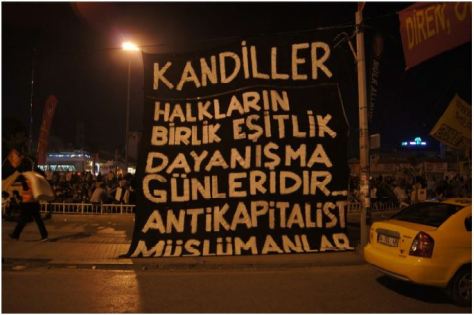
The evening of 3 June, 2013 was the first time I’d experienced the sting of pepper spray. I was walking on Cumhuriyet Caddesi near Taksim Square in central Istanbul, where, for the past five days, civilians and the Turkish police have been clashing over what the international media has called “a matter of a few trees”. Certainly, the spark of what is now a huge mass protest spanning multiple cities with over 1,000 injured, was the issue over Gezi Park, an area in central Istanbul where the Prime Minister, Tayyip Erdogan has proposed to build a shopping complex. The plan was to graze the green space and create a shopping complex. This in an area that already boasts of a Hyatt, a Hilton, a Swiss hotel and shopping centers with national and international brands. “There’s already so many shopping malls here,” said a Turkish friend speaking about the government’s decision. “Why build another?” The grazing of the park was supposed to start on Thursday, May 30th. By that time, hundreds of people gathered and occupied the park, bringing tents, books, and children. The police, in response, burned their tents and dispersed the protesters using pepper spray and tear gas. Continue reading The Jamhuriyat Road to Taksim Square: Shilpi Suneja

PUCL statement condemning the Maoist massacre in Darbha Valley

This statement was put outby the PEOPLE’S UNION FOR CIVIL LIBERTIES on 26 May, and the one below it on 25 May by PUCL’s Chhattisgarh unit

PUCL Condemns Killings of Congress Party leaders, their PSOs and Ordinary Villagers by Maoists in Dharba Ghati of Sukma District, Chhattisgarh

The PUCL strongly condemns the ambush of a Congress party election cavalcade by the dalam of the CPI(Maoist) party at Dharba Ghati area in Sukma district of Chhattisgarh on Saturday, 25th May, 2013, resulting in the death of 28 people including Congress party leaders, their personal security officers and ordinary villagers of the area. PUCL denounces as totally unacceptable, the abduction, kidnapping and subsequent killing in cold blood of the Congress party President of Chhattisgarh, NK Patel, and his son Dinesh. The Maoists also killed Mahendra Karma, the founder of the dreaded Salwa Judum, and his security guards. Continue reading PUCL statement condemning the Maoist massacre in Darbha Valley

Manifesto of a New Initiative: Statement by New Path

This guest post is a statement by NEW PATHa collective of people, mostly from backgrounds in social movements and mass organisations, who have been discussing how the work of people’s struggle and revolutionary transformation can be taken forward in the Indian context. Those discussions led to the decision to found a new organisation, tentatively called “New Path”.

Below is the draft manifesto, sent to us by friends associated with the initiative. It is being circulated for comments, criticism, suggestions and observations. New Path does not aim to be a traditional revolutionary party. Rather, it seeks to be a political formation that seeks out opportunities, through struggle, to weaken bourgeois hegemony in this country.
Continue reading Manifesto of a New Initiative: Statement by New Path

End of Postcolonialism and the Challenge for ‘Non-European’ Thought

A lively debate has been going on lately in Al Jazeera, following the question posed by Hamid Dabashi in an article provocatively titled “Can Non-Europeans Think“? Dabashi’s piece, published earlier in January this year was a response to an article by Santiago Zabala, Research Professor of Philosophy at the University of Barcelona. Zabala’s article, entitled “Slavoj Zizek and the Role of the Philosopher”, was actually on an entirely different issue, as will be evident from the title. Zabala attempts, in this article, to read in Zizek’s persona and oeuvre, the possible implications for the philosopher as such. He dwells on Zizek as a figure who is at once a philosopher and a public intellectual – a role not very easily available, according to him, to academic philosophers.

If most significant philosophers become points of reference within the philosophical community, he says, “few have managed to overcome its boundaries and become public intellectuals intensely engaged in our cultural and political life as did Hannah Arendt (with the Eichmann trial), Jean-Paul Sartre (in the protests of May 1968) and Michel Foucault (with the Iranian revolution).” Zabala explains this rare ability/ possibility by invoking Edward Said on the ‘outsider’ status of the intellectual and by underlining the direct engagement of the thought of such philosophers with contemporary events. He says:

These philosophers became public intellectuals not simply because of their original philosophical projects or the exceptional political events of their epochs, but rather because their thoughts were drawn by these events. But how can an intellectual respond to the events of his epoch in order to contribute in a productive manner?

In order to respond, as Edward Said once said, the intellectual has to be “an outsider, living in self-imposed exile, and on the margins of society”, that is, free from academic, religious and political establishments; otherwise, he or she will simply submit to the inevitability of events.

Read the full essay here at Critical Encounters.

India needs a third imagination

In a brilliant column in the The Indian Express, Pratap Bhanu Mehta (with whom I have much to disagree about reservations) calls the bluff of the “national” parties who want Indian voters to be wary of the ‘instability’ and impossibility of a third front coalition government. This argument, strangely posing itself in a nationalist tone, is unfortunately also bought by too many left-liberal intellectuals and activists who don’t want us to get out the non-choice of the BJP-Congress binary. Mehta writes:

Sometimes an ordered instability can be more productive than a comatose stability. It is said that a third front leadership is unlikely to have a national perspective. But the cringingly desperate way in which the leadership of the national parties have put their own survival above any principle makes you wonder what the charge of not having a national perspective is all about. The third front will make foreign policy hostage to regional interests. In a way, it already is. But the source of the problem is deeper. Even a supposedly national party like the BJP cannot get its act together on the enclaves agreement with Bangladesh. Why blame regional parties? The third front will be fiscally irresponsible. It is a risk, but no more than a risk with any political party. The Congress squandered the best of economic opportunities in a fiscally irresponsible way. It is something of an irony that the only Chidambaram budget described as a “dream budget” came under Deve Gowda. And many states have shown innovation in a kind of pro-business entrepreneurial capitalism and in social sector schemes. Many of the regional leaders who would make up the third front are autocrats. Indeed, many of them are. But that autocracy is more visible because the national parties can use the state structure in a very sophisticated way to further their ends. But they are articulate and engage with their constituents. In short, the constituents of the third front are as much India and Indian interests as anyone else. [Full article]

India needs a third imagination, and by constantly being told that it is not possible we are told not to imagine it. This is the argument of, as Mehta puts it, the ‘entrenched elites’, to save their privileges. The fear of the third front, of the ‘regional’, needs to be fought and defeated. We see this poverty of imagination thrown at us whether we’re talking of Nitish Kumar or Arvind Kejriwal or Mayawati by people who will do not think it necessary to subject the Congress and the BJP to similar scrutiny. This bias against the “regional” is remarkably shared amongst a lot of people across the ideological spectrum. Their bluff needs to be called.

Of Education and Democracy in India: Preeti Chauhan

This is a guest post by Preeti Chauhan Now that the cat is out of the bag and the four year undergraduate programme(FYUP) is being criticized and thereby being discussed threadbare by some of the leading scholars of the country, one needs to also think of its relationship with the current state of democracy in India. The manner in which FYUP is being pushed through crushes the very idea of a university and with it the ideals and ideas of democracy.

Even if one assumes and believes that the “Academic Congress” held last year in the University gave a go ahead to change the existing three year undergraduate programme to FYUP and frame courses accordingly, then also the way the University administration has functioned goes against the very values that the University of Delhi or for that matter any university is supposed to promote. Continue reading Of Education and Democracy in India: Preeti Chauhan

The Political Parties of Pakistan: Saim Saeed

A Pakistani soldier loads ballot boxes into a van in Rawalpindi. Authorities hope the app, combined with a fully revised voter list and an unprecedented level of public scrutiny, will help ensure the election will be the cleanest ever. Photograph: Farooq Naeem/AFP/Getty Images

Guest post by SAIM SAEED: Democracy in South Asia is its own animal, and has little resemblance with its counterparts in the United States and elsewhere. Gone are any kind of faultlines between liberals and conservatives, ideologies and the like; “Social Democrats” means little, and Greens, Communists and Freedom, even less.

A widely held view is that political parties in Pakistan (and India) are based on ethnic lines. And there is good reason to believe that view. The PML-N, run by Punjabis, controls northern Punjab. The PPP, run by Sindhis, controls Sindh and parts of Southern Punjab. The ANP, run by Pushtuns, controls the Pushtun-dominated Khyber Pukhtunkhwa province in the North-West, and represents a few Pashtun-heavy neighborhoods in Karachi. Smaller parties run similarly. The MQM, a party founded as a Muhajir – immigrant – party, runs Karachi, the city with the largest Muhajir constituency. The BNP, founded as a Baloch pro-independence party is the most popular party in Balochistan. At various points, parties have tried to fashion themselves nationally, reflecting their larger ambitions. PPP’s official rhetoric talks of a national narrative. The MQM, originally short for Muhajir Quami Movement – National Immigrant Movement – changed to become the Muttahida Quami Movement (without any change to its initials), Muttahida meaning United. These changes have been cosmetic, however, and each party’s constituency remains more or less the same.

This view, however, is incomplete.

Continue reading The Political Parties of Pakistan: Saim Saeed

Naya Pakistan, an old fable: Ayesha Siddiqa

pakvotes-election-symbols

Guest post by AYESHA SIDDIQA: The renowned television anchor Quatrina Hosain was in tears. A day after the incident of her being sexually assaulted at a Pakistan Tehreek-e-Insaaf (PTI) jalsa by party workers in Wah Cantonement, she talked about how the bruises may heal but not her emotional scars. She was covering election rallies and got invited by a PTI candidate Mohammad Sarwar to his rally in Wah. It was a sudden plan so no one could have conspired to misbehave. This is important to note, as  many PTI workers have subsequently tried to blame the incident on Pakistan Muslim League (Nawaz)’s workers. However, when confronted with facts, PTI workers tried to hide behind the argument that women should not provoke people by coming out and mixing with them. Continue reading Naya Pakistan, an old fable: Ayesha Siddiqa

Partha Chatterjee on Subaltern Studies, Marxism and Vivek Chibber

At the recent Historical Materialism conference held in Delhi from April 3-5, a panel was organized with great fanfare – an official panel by the HM editors – around Vivek Chibber’s new book Postcolonial Theory and the Spectre of Capital. This panel was billed to be a decisive refutation of Subaltern Studies and Postcolonial theory, not only by the chief  theorists and organizers of Historical Materialism but by many other Indians – most of whom in any case have little more than a religious faith in ‘Marxism’ and understand little of Marxism and its history.  There was glee all around and one came across the hurried announcement of a Centre for Marxist Studies that was to host further events around this book against the demon that Chibber had apparently slain. After all, Chibber  was backed by the likes of Slavoj Zizek, Robert Brenner and Noam Chomsky, all of whom  had  endorsed his book as the death knell to  Subaltern Studies and Postcolonial theory. The glee was to be short-lived.

On April 28, at the New York conference of Historical Materialism, the organizers made the mistake of inviting Partha Chatterjee (a representative of a spent force, already buried at the Delhi HM Conference!) to debate the new star on their horizon. The meticulous demolition of Chibber that followed, embarrassed even his most ardent supporters, who had hoped to see the redoubtable Partha vanquished in person. And Chhibber, let our marxist brethren note, is reduced to finally accepting that he is more inclined towards contract  theory than towards Marxism!

Partha, whose years of meticulous engagement with Marxism can hardly be taken on cavalierly by any upstart on the horizon, calmly tore Chibber’s claims to shreds. Many supporters of Chibber’s book have, in social media, glumly  described the 28 April event as a great setback to their cause…

Here is Partha in debate…

Food Security Bill – MPs clueless: Ankita Aggarwal

This is guest post by ANKITA AGGARWAL: Last week a group of about fifteen of us (students who have been working on the right to food in various capacities) met Members of Parliament to discuss the amended National Food Security Bill and how it can be improved. We knocked on the doors of more than a hundred MPs, but managed to meet only about twenty of them. Most of the MPs were away from Delhi, in their constituencies or elsewhere, and a few were “too busy” or “too tired” to meet us.

Our overall experience was quite disappointing. Most MPs were quite clueless about the Bill. But instead of using our visit as an opportunity to inform themselves about the Bill and its shortcomings, most of them preferred to indulge in rhetoric, making statements like “we will raise your demands in the Parliament” or “it’s shameful that there is hunger in the country even so many years after independence”. A few MPs talked to us at length about issues ranging from the demand for Telangana to the impossibly high cut-offs in colleges, but not about how the Bill can be salvaged. Some MPs were of the opinion that there was no scope for discussion of the Bill in Parliament, and that it was pointless to discuss it with us. Continue reading Food Security Bill – MPs clueless: Ankita Aggarwal

Of Angry Young Students and Education in India – A Response to Thane Richard: Aritra Chatterjee

This is a guest post by ARITRA CHATTERJEE: In his response to the article by some students of St. Stephen’s College, Thane Richard has raised a set of questions about the college, about the students participating in the present movement, about education in India and students’ voice in shaping education. He is critical about what he calls the lack of quality education, of a system where education is primarily about rote learning and conformity to structures of authority; in such a situation the promise of a good liberal arts education remains a mere promise and students migrate to the West in search of it. He also rues the lack of students’ voice in the education system, rhetorically asking, “Do students have any right?” He welcomes the students’ fight against the oppressive regime at St. Stephen’s College but views it as a movement that is too little too late and even that in “the wrong direction”. I shall respond to his views at two levels – at the level of education in the country as a whole, and that of the present movement at St. Stephen’s College. Continue reading Of Angry Young Students and Education in India – A Response to Thane Richard: Aritra Chatterjee

Let us declare that a state of war exists

“Let us declare that the state of war does exist and shall exist so long as the Indian toiling masses and the natural resources are being exploited by a handful of parasites.” Those are not the words of a member of the Central Committee of the Communist Party of India (Maoist), though the film has that too. These words are of Bhagat Singh, revolutionary freedom fighter who has today been appropriated by everybody for their own purposes.

The most remarkable thing about Sanjay Kak’s new film Red Ant Dream is Punjab. Occupying more than a third of the film, its use of the revolutionary sentiment in today’s Punjab takes forward the debate on the Maoist and other resistance movements in India. Instead of getting into the debates around the Maoist movement in central India, the film makes for a powerful document of the how and why the revolutionary ideal lives in India 2013. Continue reading Let us declare that a state of war exists

Academic Excellence and St. Stephen’s College: A response by Thane Richard

This is a guest post by THANE RICHARD

I recently read an article in Kafila – more like an angry, reflective rant – written by some students from St. Stephen’s College in Delhi.  To quickly summarize, the piece criticized the draconian views of the Principal of St. Stephen’s College regarding curfews on women’s dormitories and his stymying of his students’ democratic ideals of discussion, protest, and open criticism.  More broadly, though, the article’s writers seemed to be speaking about the larger stagnant institution of Indian higher education, overseen by a class of rigid administrators represented by this sexist and bigoted Principal, as described by the students.  The students’ frustration was palpable in the text and their story felt to me like a perfect example of what happens when an unstoppable force meets an immovable object.  Except Indian students are not an unstoppable force.  Not even close. Continue reading Academic Excellence and St. Stephen’s College: A response by Thane Richard

Spin Doctors, Propagandists and the Modi Make-over

Elsewhere on Kafila, we have published a 7000 word long response by Madhu Kishwar to Zahir Janmohamad’s open letter to her which appeared on 15 January, followed by Zahir Janmohamad’s response. Perhaps a few things need to be stated here clearly with respect to her ‘response’. It seems to me to violate every tenet of reasoned debate and argument and is replete with name calling and stereo-typing of not just the secularist ‘other’ [who is her real other, not the Muslim] but even of the adversary she is arguing with. So if Zahir is a  Muslim, he has to be X, Y, Z and has to be believing in A, B, C. Everything starts and ends in bad faith. But then that is what distinguishes Madhu Kishwar from others. She is in her element especially in relation to those whom she disagrees with. With her there can be no disagreement – you have to be sneered and jeered at, irrespective of whether you are a Medha Patkar or an Aruna Roy. I suppose these are matters of personal style and I shall not dwell on them further.

Let me rather, turn to some of the more substantive issues raised in Madhu’s response. Zahir has answered most of them but it seems to me that a couple of vital questions still remain. Even here, though, a caveat is necessary. I have great admiration for Madhu Kishwar’s battle in defense of the rikshaw pullers in Delhi and have often said so openly to her as well as others. However, I do know that it is possible to talk to her when only we agree, which is very rare. On matters that we disagree about, I have decided that I do not want to enter into any kind of an argument with her. In any case, large parts of her ‘response’ are like Modi’s PR handouts, served to us without any sense of critical examination. Therefore, what follows below is not my reply to her but my reactions to a set of allegations she has raised about whosoever is opposed to Narendra Modi – all lumped together in a breathtaking move of reductio ad absurdum, first as secularists , who are reduced to Leftists/ NGO activists and finally to Congress-supporters (because, she says in her Modinama1, the Congress has been equally responsible for all the riots till date). I therefore, lay my cards on the table at the outset: I am an inveterate Modi-hater (and a Congress-hater as well, if that makes sense to anyone in her dichotomized universe) and Kafila is a forum with a certain, if very broad, politics that, at the minimum rules out being pro-Modi. Continue reading Spin Doctors, Propagandists and the Modi Make-over

Lethal Lottery: A study on death penalty in India, 1950-2006

Melbourne Academics in Solidarity with UPenn Professors

Statement from Melbourne Academics in Solidarity with Ania Loomba, Suvir Kaul, Toorjo Ghosh and others at the University of Pennsylvania.

24wharton1

The statement follows the brief background to the issue below:

Ashley L Cohen in The Daily Pennsylvanian

In the pages of The Daily Pennsylvanian and elsewhere, supporters of Narendra Modi have framed the issue of Modi’s disinvitation from the Wharton India Economic Forum as one of free speech. The framing is a clever one. Narendra Modi is a rather unsavory figure, and he is difficult to defend on any other terms. Continue reading Melbourne Academics in Solidarity with UPenn Professors

Gonojagoron march in Dhaka April 6, 2013

Images courtesy KALYANI MENON-SEN

1365252284-hefajat-program-attack-revealed-at-press-conference_1935474


1365426178-strike-in-dhaka-called-by-hefajateislam_1941888