Category Archives: Politics

सत्ता और हिंसा : बद्री नारायण

बद्री नारायण का यह लेख लखनऊ के एक हिंदी अख़बार को दिया गया था पर उन्होंने छापने से मना कर दिया.

शक्ति अपने संस्थागत रुप में सत्ता में तब्दील हो जाती है। सत्ता अपने मूल अर्थ में भय एवं हिंसा पर टिकी होती है। सत्ता का अभ्यांतरिकरण हो या सत्ता का प्रतिरोध, दोनों ही अर्थो में हिंसा उसके सह उत्पादक के रुप में दिखाई पड़ती है। जनतंत्र को एक ऐसी प्रक्रिया के रुप में परिकल्पित किया गया था जो सत्ता को उसके हिंसक पक्ष से मुक्त कराके सेवाभाव के एजेन्सी के रुप में सक्रिय रखे। यह माना जा रहा था कि जनतंत्र सत्ता को रेशनालाइज कर उसे सेवा-भावि प्रशासकीय स्वरुप में तब्दील कर देती है। यह काफी कुछ हुआ भी किन्तु अपने कार्य-प्रक्रिया में इस जनतांत्रिक समय में भी सत्ता हिंसा को उत्पादित करते रहने वाली शक्तिस्रोत के रुप में सामने आई है। सत्ता पहले अपने भीतर अपने ही कारणो से क्राइसिस को जन्म देती है, फिर उससे उबरने के लिए हिंसा रचती है। बंगाल, झारखण्ड, आन्ध्र के जंगलों में पहले तो बाजार शासित विकास के तहत आदिवासी जीवन के संसाधनों पर कब्जा कर उन्हे बहुराष्ट्रीय कम्पनियों को बेचना, फिर उसके विरोध में आदिवासी जनता का नक्सलवादी विचारों एवं नेतृत्व में हिंसक प्रतिरोध का बढ़ते जाना, पुनः उसे दबाने के लिए राज्य द्वारा की जाने वाली ज्यादा आक्रामक एवं खुंखार हिंसा को इसी रुप में देखा जा सकता है। Continue reading सत्ता और हिंसा : बद्री नारायण

The Many Uses of a U.P Election

I live in Noida, which is the child of an extra-legal union between Delhi and Uttar Pradesh. Noida is not-quite Delhi, not-quite U.P, not quite itself on most days. Living in a cusp has several advantages, however, the main one being that one can look either way, up at Delhi and right down over U.P’s scruffy head. I found myself doing both in the recently-concluded U.P election. Curiously it seemed, for Delhi people, U.P’s 2012 elections were flush with new meaning. For decades the favourite whipping boy of Delhi, U.P had overnight become its favourite gap-toothed angel. For Pratap Bhanu Mehta of the Delhi-based Centre for Policy Research, the U.P election was a historic battle between empowerment and patronage, the future and the past, performance and rhetoric, sincerity and cynicism, and (this is my favourite) ‘rootedness over disembodied charm’. Mehta believes that while voters ‘carefully assessed’ candidates through the ‘prism of local circumstances’, they were no longer prisoners of their identity. Most confounding is Mehta’s view of democracy, “In a democracy, where you are going should be more important than where you are coming from”. These U.P elections “redeemed that promise” according to Mehta, since they were “without a trace of community polarisation: no one felt on the edge or under siege, all could exercise options without being unduly burdened by the past.”

Continue reading The Many Uses of a U.P Election

Happy Kapil Sibal’s Day

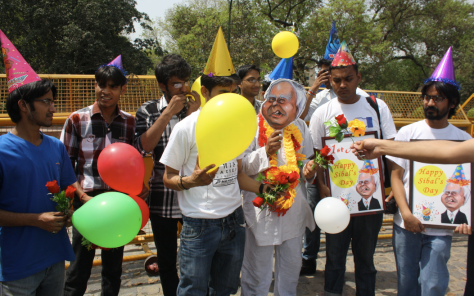
Aseem Trivedi is a cartoonist in Kanpur. Or was. He has, for some months, been a full-time activist against internet censorship in India. As 2011 was turning into 2012, the Maharashtra police got his domain registrar to suspend his domain, http://cartoonsagainstcorruption.com, which was in support of the Anna Hazare-led Lokpal movement. His website wasn’t blocked, but the domain name suspended – the equivalent of shutting down a printing press. This was done in no time, and he wasn’t given an opportunity to defend his content. This was done thanks to the IT Rules 2011, a simple FAQ about which can be found here. Today, 1 April, Trivedi celebrated “Kapil Sibal’s Day,” calling the Communications minister the fool that he is. In the image below, taken at Delhi’s Rajghat today, Trivedi is standing on the extreme right. For more on Trivedi’s campaign, see http://www.saveyourvoice.in.

Hindi Press Release:

पुलिस प्रशासन के अवरोध के बावजूद राजघाट पर मनाया गया सिब्बल्स डे, पहुचे ब्लोगर्स और सोशल एक्टिविस्ट
1 अप्रैल के दिन पर राजघाट पर सेव योर वाइस की टीम ने आईटी मिनिस्टर कपिल सिब्बल को प्री सेंसरशिप पर दिए गए उनके बयानों के लिए  मूर्ख दिवस की शुभकामनाएं दीं. राजघाट परिसर में बड़ी संख्या में पुलिस बल, आईबी, सीआईडी और सीबीआई के लोग मौजूद थे और सेव योर वाइस के सदस्यों को बापू की समाधि पर जाने से रोका गया. केवल कुछ गिने चुने लोग ही चुपचाप राजघाट पर पहुच पाए. पुलिस ने पूर्व अनुमति होने के बावजूद सिब्बल दिवस का आयोजन नहीं होने दिया. कारण पूछने पर उच्चस्तरीय आदेशों का हवाला दिया गया और कहा गया कि उन्हें पीएमओ . और आईटी मिनिस्ट्री से आदेश दिए गए हैं. काफी गहमागहमी के बाद टीम के सदस्य राजघाट के बाहर समता स्थल पर एकत्र हुए.  Continue reading Happy Kapil Sibal’s Day

Politics, ‘Political Society’ and ‘the Everyday’

Politics, ‘Political Society’ and ‘the Everyday’

 Book Review 

Lineages of Political Society, by Partha Chatterjee, Permanent Black, Ranikhet, 2011. Pages: 278, hardcover, Rs 750.


Lineages of Political Society

 Over a decade ago, political theorist Partha Chatterjee embarked on what was a novel journey in the history of political thought in India and perhaps, in the postcolonial, non-Western world. Bringing together the results of decades of his own intellectual engagement with Indian politics and the question of subalternity in particular, Chatterjee began articulating a concept that has now acquired wide currency: his concept of ‘political society’. ‘Political society’, in Chatterjee’s hands, was a way of recuperating a sphere of politics that had been a permanent source of anxiety for theorists of Indian (and postcolonial) modernity and democracy – the vast domain that existed outside the designated spheres of modern politics, where the untutored masses made claims on the state and formed their own associations and organizations, unmindful of the formal grammar of rights and citizenship. A crucial part of what defines activities in this domain is ‘illegality’, or, at any rate, non-legality, where the state itself places the law in suspension in order to recognize the claims of the governed. Thus for instance, squatting by the poor on government land that is strictly speaking, encroachment in legal terms and can never acquire the status of a ‘right’, is nevertheless allowed by governments to continue through the recognition of some kind of moral claim of the poor on governments and society at large.

Continue reading Politics, ‘Political Society’ and ‘the Everyday’

Occupy Monsanto!

Some good news for a change…

Peru Passes Monumental Ten Year Ban on Genetically Engineered Foods

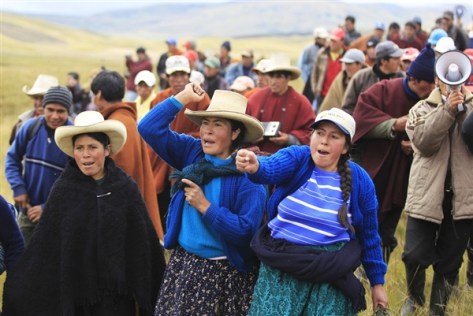
In a massive blow to multinational agribiz corporations such as Monsanto, Bayer, and Dow, Peru has officially passed a law banning genetically modified ingredients anywhere within the country for a full decade before coming up for another review. Peru’s Plenary Session of the Congress made the decision 3 years after the decree was written despite previous governmental pushes for GM legalization due largely to the pressure from farmers that together form the Parque de la Papa in Cusco, a farming community of 6,000 people that represent six communities. They worry the introduction of genetically modified organisms (GMOs) will compromise the native species of Peru, such as the giant white corn, purple corn and, of course, the famous species of Peruvian potatoes. Anibal Huerta, President of Peru’s Agrarian Commission, said the ban was needed to prevent the ”danger that can arise from the use of biotechnology.”

Read the rest of this story here.

Does democracy stop at the doorstep of the women’s hostel?

This appeal comes to us via MAYA JOHN

Friends,

Since January of 2012, residents of Delhi University’s largest postgraduate women’s hostel, University Hostel for Women (UHW) have been waging a battle against outright suppression of their democratic rights by, both, their hostel authorities and the University’s Proctorial Committee. Since the hostel’s Chairperson is also the Proctor of the University, the Proctorial Committee has been intervening in the matter, not as a neutral party, but in complete connivance with the hostel authorities. There are two issues which are central to the ongoing struggle of the women students, namely, the imposition of a union constitution by the authorities, and the existence of archaic and conservative rules in the hostel.

Continue reading Does democracy stop at the doorstep of the women’s hostel?

Jai Bhim, Comrade Patwardhan

How many murdered Dalits does it take to wake up a nation? Ten? A thousand? A hundred thousand? We’re still counting, as Anand Patwardhan shows in his path-breaking film Jai Bhim Comrade (2011). Not only are we counting, but we’re counting cynically, calculating, dissembling, worried that we may accidentally dole out more than ‘they’ deserve. So we calibrate our sympathy, our policies and our justice mechanisms just so. So that the upper caste killers of Bhaiyyalal Bhotmange’s family get life imprisonment for parading Priyanka Bhotmange naked before killing her, her brother and other members of the family in Khairlanji village in Maharashtra, but the court finds no evidence that this may be a crime of hatred – a ‘caste atrocity’ as it is termed in India. Patwardhan’s film documents the twisted tale of Khairlanji briefly before moving to a Maratha rally in Mumbai, where pumped-up youths, high on testosterone and the bloody miracle of their upper caste birth are dancing on the streets, brandishing cardboard swords and demanding job reservations (the film effectively demolishes the myth that caste consciousness and caste mobilisation are only practised by the so-called ‘lower castes’). Asked on camera about the Khairlanji murders, one Maratha manoos suspends his cheering to offer an explanation. That girl’s character was so loose, he says, that the entire village decided to teach her a lesson.

Continue reading Jai Bhim, Comrade Patwardhan

FDI In Retail – What Does the Government’s Own Data Say? Shankar Gopalakrishnan

Guest post by SHANKAR GOPALAKRISHNAN

In his budget speech, Finance Minister Pranab Mukherjee declared that the government’s “decision” to allow FDI in multi-brand retail outlets “has been held in abeyance” until there is a “broad based consensus.”  In other words, it’s already a decision, but it’s just being held back until the government feels it can go ahead safely.  The question though is: why is the government so convinced of its decision?  How does Mr. Mukherjee so firmly declare that “organised retail helps in reducing costs of intermediation… benefiting both consumers and producers”?  Has the government done the homework to justify its actions?  This note looks at the government’s own data to find out.

As far as is known, there was only one study commissioned by the government in this regard (Business Standard 2007)  This was done by ICRIER in 2007, first published as a Working Paper in 2008 (Joseph et al 2008), and subsequently converted into a book – Retail in India: A Critical Assessment – in 2009, with one chapter added by other authors.[i]

Continue reading FDI In Retail – What Does the Government’s Own Data Say? Shankar Gopalakrishnan

Thinking through UP election results with numbers: Rahul Verma

Guest post by RAHUL VERMA

Here’s a closer analysis of Uttar Pradesh 2012 election results

In an article the Times of India says the Samajwadi Party’s victory in Uttar Pradesh seems to be an even more impressive sweep than the BSP’s 2007 showing, but it’s actually a less comprehensive domination. According to the same article, the SP did not do well in western UP and Bundelkhand. They do not provide any reason for this.

My analysis of the election results data shows that average number of candidates per assembly constituency and average number of candidates per one lakh electorate in west UP and Bundelkhand, was slightly lower than other regions of the state. In west UP and Bundelkhand, the average number of candidates per one lakh electorate was approximately 8.5 and average number of candidates per assembly constituency was approximately 16. Whereas in other parts of the state average number of candidates per one lakh electors was approximately 9.5 and average number of candidates per assembly constituency was 17. This means that in other regions of the state votes were more divided and thus the SP got an edge in terms of winning seats. In the first-past-the-post (FPTP) system with multi-cornered contests, even such small gaps lead to big swings in terms of seats a party can win. Continue reading Thinking through UP election results with numbers: Rahul Verma

We, the People of Gujarat: Urvish Kothari

This guest post by URVISH KOTHARI was originally written in Gujarati and has been translated by VISTASP HODIWALA

Associated Press

Some facts are so simple and self-evident that they elude you completely at the time they happen. Digesting them takes time – 2, 3,7, maybe even 10 years. By that time, the passion and the anger has abated a bit and there is a sense of composure that pervades our beings.

Like the fact about the communal violence that gripped the State of Gujarat in 2002.

Of course, a mere mention of this is enough to get the chief minister’s fanboys roll up their sleeves, even as their opponents ready themselves to launch a counter onslaught. But with the passage of ten long years, the first question should not be about whether the Chief Minister was complicit in the crime or not. No, it cannot be.

Continue reading We, the People of Gujarat: Urvish Kothari

A Flawed Democracy – The Case for Proportional Representation in India: Srinivasan Ramani

Guest post by SRINIVASAN RAMANI

Times of India graphic

For all the chest thumping and tomtoming about the Samajwadi Party’s emphatic victory – winning 224 seats out of 403 in the UP Assembly elections – a true reflection of the mandate is to be seen in the individual vote shares of the four main (“effective”) parties in the elections (the Bahujan Samaj Party – Bhartiya Janata Party, the Samajwadi Party, and the Congress – in alliance with the Rashtriya Lok Dal). Data from the Election Commission of India website shows the following in terms of vote shares:

Continue reading A Flawed Democracy – The Case for Proportional Representation in India: Srinivasan Ramani

75 Years of Bhonsala Military School: Militarising Minds, Hindutvaising the Nation

Image

..to bring about military regeneration of the Hindus and to fit Hindu youths for undertaking the entire responsibility for the defence of their motherland.

to educate them in the ‘Sanatan Dharma’, and to train them “in the science and art of personal and national defence”

– From the aims of ‘Central Hindu Military Education Society,’ NMML, Munje Papers, subject files, n 24, 1932-36)

This training is meant for qualifying and fitting our boys for the game of killing masses of men with the ambition of winning victory with the best possible causalities (sic) of dead and wounded while causing the utmost possible to the adversary.

– Preface to the scheme of the Central Hindu Military Society and Its Military School’NMML, Munje Papers, subject files, n 25, 1935

Nashik: Expressing concern over the dominance of ‘rich and powerful people’ in politics, besides the soaring inflation rate, Rashtriya Swayamsewak Sangh (RSS) chief Mohan Bhagwat said that India’s situation was better during the British rule…Speaking at a function organized by Bhonsala Military School (BMS) to celebrate its platinum jubilee year in Nashik on Monday, Bhagwat …laid stress on the need for imparting military education to students, citing rising threat to the nation.

– ‘India was better off under British rule: Mohan Bhagwat’, Times of India, Feb 22, 2012

Continue reading 75 Years of Bhonsala Military School: Militarising Minds, Hindutvaising the Nation

Feminism and the Family – Thoughts on International Women’s Day

Excerpts from my forthcoming book Seeing Like a Feminist (Penguin India/Zubaan Books).

Have you heard of ‘nude make-up’?

This is what it is:

‘Nude makeup looks are all about your skin looking fresh and dewy, without looking like you’re even wearing any makeup. All you need is eyeliner, mascara, nude lipstick, and a highlighting blush that will give your skin a natural-looking glow.’[1]

The whole point of nude makeup clearly, is to spend hours painting your face in order to make it look like you never touched it at all.

The maintaining of social order is rather like that. It requires the faithful performance of prescribed rituals over and over again throughout one’s lifetime. Complex networks of cultural reproduction are dedicated to this sole purpose. But the ultimate goal of all this unceasing activity is to produce the effect of untouched naturalness.

When one ‘sees’ the world like a feminist though, with the gaze of a feminist, it’s rather like activating the ‘Reveal Formating’ function in Microsoft Word (what an earlier generation of WordPerfect users knew as ‘Reveal Codes’). The feminist gaze reveals the strenuous, complex formatting that goes on below the surface of what looked smooth and complete. Continue reading Feminism and the Family – Thoughts on International Women’s Day

Why Mayawati’s defeat is the BSP’s victory

Satish Chandra Mishra with Mayawati at a rally near Delhi during the Lok Sabha elections in 2009, amongst the last such appearances together

Even before the results came out, the Mayawati cabinet passed a resolution to dissolve the assembly. Never before has an incumbent shown such confidence about losing. Mayawati’s body language during the campaign was proof of the same lack of confidence. Mayawati was going to lose, the Samajwadi Party was in the air. And yet, Mayawati must be relieved right now. She knows that this defeat of hers is, ironically, a victory of the Bahujan Samaj Party and what it stands for. Here’s how.

Continue reading Why Mayawati’s defeat is the BSP’s victory

Some thoughts on the “hawa” in Indian elections

‘Public transmitter’ nahi ban sakey Mulayam aur Mayawati. (Mulayam and Mayawati could not become public transmitters.)

In the Hindi original of that line, the phrase public transmitter is in single quotes only because they are English words in a Hindi paper. The entire sentence is not in quotes. A sentence like this, if it were the title of a text, would count as an expression of opinion. And yet, it was a news headline in the Varanasi edition of UP’s largest selling daily, Dainik Jagran. In case you could not guess who it was trying to help, there was the photo of Rahul Gandhi below the headline. This was the lead story. Continue reading Some thoughts on the “hawa” in Indian elections

Why Rahul Gandhi’s Congress flopped in Uttar Pradesh

In 2008 if you had said the Congress could revive in Uttar Pradesh you would have been laughed at. No party structure or caste base, you would have been told. In 2009, Rahul Gandhi earned perhaps the first laurel of his political career by proving critics wrong. He beat conventional wisdom by saying no to allying with the Samajwadi Party and the Congress won just 22 of 406 seats. Since then, Congress revival in UP has been taken for granted in many corners. Some pundits were predicting as many as 100 seats for the Congress this election. This speculation had a good basis: Rahul Gandhi always left crowds happy. And he flew on a helicopter addressing as many as 4 rallies a day. If you spoke to the people who attended his rallies, you’d be surprised by the amount of goodwill he created for himself. The rise in vote share despite the poor seat performance is proof for the rising appreciation of the Congress’ efforts to regain relevance in state politics. But then, what went wrong? Continue reading Why Rahul Gandhi’s Congress flopped in Uttar Pradesh

Joint Statement on police atrocities and state repression on anti-POSCO struggle

See names of signatories below; please send your endorsement to asit1917 at gmail dot com

We strongly condemn the attack on and illegal abduction by the Odisha police of Umakanta Biswal, a famer belonging to Dhinkia village of Odisha, and an active member of POSCO Pratirodh Sangram Samiti (PPSS), that has been engaged over the last six years in resisting the forcible acquisition of their land by the Odisha government for handing over to the South Korean multinational corporation POSCO. This incident, which occurred on 2nd March 2012, is the latest in the series of atrocities inflicted by the Odisha government and by hired goons associated with the government and the POSCO company, on the people of these villages. Umakanta Biswal, who was engaged in agricultural activity in his paddy field at the time of his abduction, was pursued by a group of armed plainclothes policemen on a motorbike, and shot at when he tried to escape. He has reportedly been kept in Paradip prison, and has not been produced in front of a magistrate within 24 hours of his arrest, as is required under law. We have cause to fear that he is being tortured in police custody, and are gravely concerned about his safety. Continue reading Joint Statement on police atrocities and state repression on anti-POSCO struggle

Seeing UP from Phulpur

Photograph by Akif Ahmad for Fountain Ink magazine

In which I go to Phulpur, once famous as Nehru’s seat, and do walk-the-talk with village-level workers of the four main political parties in Uttar Pradesh. Here. Continue reading Seeing UP from Phulpur

Gujarat genocide – the state, law and subversion: R B Sreekumar

Guest post by R B SREEKUMAR, former Director General of Police, Gujarat, who deposed before the Nanavati Commission.

Gujarat riot victims prevented from protesting against Narendra Modi during his sadbhavna fast in September 2011.

The Gujarat genocide in 2002, resulting in killing of nearly 1,500 innocent citizens, mostly from India’s major minority community and subsequent pervasive subversion of governmental machinery to sabotage justice delivery to riot victims, has to be understood as a man-made disaster. A disaster broughtabout by lack of professionalism and lack of integrity and commitment to the letter, spirit and ethos of the Constitution of India, on the part of all officials of the state, from the Chief Minister Narendra Modi to the police constables.

An analysis of the sequence of events from the time of the gruesome killing of 59 Hindu passengers in the train burning incident on 27 February, 2002 to this day, will bring up many unambiguous facts and data on deliberate acts of omission and commission by political leaders, bureaucrats and policemen, aiming at the actualization of the anti-Muslim carnage in Gujarat in 2002, and since then, the lopsided justice delivery to riot victims.

Continue reading Gujarat genocide – the state, law and subversion: R B Sreekumar

Everything you wanted to know about the great Kingfisher Airlines scam but didn’t know who to ask

This slideshow requires JavaScript.

All your queries will be answered here.

Delhi Police Special Cell – Encounters, Frame-ups, Impunity: Manisha Sethi

Guest post by MANISHA SETHI

An RTI enquiry has revealed that Delhi Police Special Cell’s conviction rate is a paltry 30 per cent. Nearly 70 per cent of the accused it charge-sheeted over the past five years were acquitted for want of credible evidence. Do these figures tell us something? A news story in a leading English daily bemoans this trifling record and quotes a senior police officerattributing this to the fact that “police sometimes get tangled in cross evidences and it becomes tough when you rely more on circumstantial evidences”. [i] This evokes the image of a bumbling policeman, reminiscent almost of Jacques Clouseau, tripping over reams and strings of evidences, in an impossible attempt to build a watertight case against the villains. But Special Cell couldn’t be farther from this sort of cute sloppiness. Continue reading Delhi Police Special Cell – Encounters, Frame-ups, Impunity: Manisha Sethi