Category Archives: Politics

Kathmandu Siege – They Are Here

Kathmandu’s elites cannot seem to understand who these people are. But talk to the cab driver, waiter, vegetable seller, small shopkeeper, slum dweller or construction worker and you will get an idea of who may dominate the streets from Saturday.
There has been coercion in the process of mobilisation. But the Maoists have essentially tapped into the three core contradictions of Nepali society – ethnicity, class, and space (Kathmandu versus the rest). They have deployed their cadres; capitalised on the rage of those on the periphery; and channelised popular discontent against inflation, power cuts, corruption and insecurity, for which Madhav Nepal has been projected as solely responsible. Continue reading Kathmandu Siege – They Are Here

Swami & Friends: JTSA’s response to Praveen Swami

The story so far…

Jamia Teachers Solidarity Association was  formed after the so-called “encounter” at Batla House in 2008, in which two students of Jamia Millia Islamia were killed. You may remember posts on kafila at the time, questioning the credibility of police accounts of the “encounter” and criticizing the unethical nature of media coverage:

A little less melodrama, a lot more forensics;

The Jamia Nagar encounter: Curiouser and curiouser;

Shame is a revolutionary sentiment;

Some questions about the Delhi encounter.

In April this year, JTSA, which has been demanding an independent probe into the encounter, issued a statement after the post mortem reports of Atif Ameen and Md. Sajid were made public, revealing that the two boys were not  killed in cross fire as Delhi Police claimed:

Batla House ‘Encounter’: Whom is the JP Trauma Centre Shielding?

On April 25, 2010, Countercurrents published another statement by JTSA, titled Praveen Swami’s Not so Fabulous Fables, which began thus:

“If there is one infallible indicator of what the top Indian Intelligence agencies are thinking or cooking up, it is this: Praveen Swami’s articles. Each time the security establishment wishes to push a certain angle to this bomb blast or that, Swami’s articles appear magically, faithfully reflecting the Intelligence reports. After the Batla House ‘encounter’, he launched a tirade against all those who were questioning the police account of the shootout labeling them all ‘Alices in wonderland’. He went so far as to identify ‘precisely’ how Inspector Sharma was shot by claiming that “abdomen wound was inflicted with [Atif] Amin’s weapon and the shoulder hit, by Mohammad Sajid”.

And no sir, Swami’s conclusion was not based on post mortem reports of the killed, fire arm examination report or ballistic report but on this innocent fact: “the investigators believe that…” He certainly brings in a whole new meaning to ‘investigative journalism’. Swami however felt no need to pen an article when the postmortem reports of Atif and Sajid revealed that they had been shot from close range and that neither of them sustained gunshot wounds in the frontal region of the body—an impossibility in the case of a genuine encounter. Was it because the police and the Home Ministry chose to remain quiet after the revelations—hoping that the storm would quietly blow over?
Praveen Swami wrote an injured response via a letter to Annie Zaidi, which too was published on Countercurrents.
And now read on, as JTSA responds to Swami.

Continue reading Swami & Friends: JTSA’s response to Praveen Swami

Heading for a Bloodbath: Rohini Hensman

This post by ROHINI HENSMAN is an article  published on the Outlookindia.com website on April 22, 2010.

To people desperately trying to avert a bloodbath in the forest belt, the recent PUDR statement on the massacre of 76 CRPF jawans in Dantewada caused considerable consternation, and Sumanta Banerjee’s response to it even more so. According to the PUDR statement,

‘As a civil rights organization we neither condemn the killing of security force combatants nor that of the Maoists combatants, or for that matter any other combatants, when it occurs’.
Sumanta Banerjee objected to the equating of Maoist violence and state violence, saying that
‘these soldiers, by being cannon-fodders of the Indian state, however tragic it might be, suffered the fate that – I’m sorry to say – they deserved…To come back to the latest incident of the Maoist attack on the CRPF camp in Chhattisgarh…. if we accept it as a part of a civil war, such killings are inevitable (just as the CRPF killings of Maoists) in a violent system that has been institutionalized by the Indian state. The difference between the CRPF violence (involving ‘false encounters’, raping of tribal women, burning their homes, etc.) on the one hand, and the Maoist violence on the other (which means attacks on oppressive landlords and the police and para-military forces like the CRPF which come to the aid of the landlords) – has to be distinguished by civil society groups’
Both the statement and the response assume that a civil war is already in progress, and therefore the killing of combatants is not illegal.

Continue reading on outlookindia.

‘Boycott of Israel would not serve any useful tactical purpose’: Amitav Ghosh

The British Committee for the Universities of Palestine (BRICUP) and Pakistanis for Palestine amongst others have appealed to the novelist Amitav Ghosh to decline the Israeli Dan David Prize he is being given jointly with Margaret Atwood.

The BRICUP open letter to Ghosh reads:

It’s surprising to have to raise Israeli colonialism with a writer whose entire oeuvre seems to us an attempt to imagine how human beings survived the depredations of colonialism. Gosh, even the Dan David judges like the way you evoke ‘the violent dislocations of people and regimes during the nineteenth and twentieth centuries’.

Those making him this appeal have reminded him of his rejection of the Commonwealth Writers’ Prize in 2001.

Give below is Ghosh’s response to the appeal: Continue reading ‘Boycott of Israel would not serve any useful tactical purpose’: Amitav Ghosh

Batla House ‘Encounter’: Whom is the JP Trauma Centre Shielding?

Statement by Jamia Teachers’ Solidarity Association

Days after the startling revelation of the post mortem reports of Atif Ameen and Md. Sajid, which conclusively nailed the lie of the Delhi Police claims that the two boys were killed in cross fire, the security establishment has swung into damage control to ensure that no further information is made public. It is to be recalled that the post mortem reports could be made public only through the persistent efforts of RTI activist and Jamia student, Afroze Alam Sahil and the resolute resistance offered by the teachers and students of Jamia as well as other civil rights activists.

While the post mortem reports have made it amply clear that both Atif and Sajid have been shot from close range and possibly in captivity (as illustrated by the injury marks made by blunt force); the reports also raised several questions: Continue reading Batla House ‘Encounter’: Whom is the JP Trauma Centre Shielding?

An Open Letter to the Democratic and Progressive Groups and Individuals in Aligarh Muslim University and Other Universities in India to Demand Justice for Dr.Siras

To sign this statement, click here

The unforeseen death of Dr Srinivas Ramachandra Siras (Reader and Chair of Modern Indian Languages at Aligarh Muslim University) and the circumstances surrounding it have thrown us into a web of shock, despair and great concern. As an academic community, there are a number of questions that we need to ask and address.

The role of the Aligarh Muslim University authorities in this incident has been nothing short of condemnable. The invasion of Dr Siras’ privacy, the subsequent authoritarian impulse to suspend him and the complete lack of sensitivity by the administration has been outrageous. It has created anxiety about our vulnerability to the exercise of arbitrary powers. The use of such surveillance is not simply a threat to our freedom to make life choices (and sexual choices); it also leads to “self-discipline” due to fear of transgressing majoritarian norms. Continue reading An Open Letter to the Democratic and Progressive Groups and Individuals in Aligarh Muslim University and Other Universities in India to Demand Justice for Dr.Siras

Happy Ambedkar Jayanti

The Congress Party will use the occassion of Ambedkar Jayanti tommorow to reach out to UP’s Dalits. Commenting on this, NDTV  says, “Mayawati, who knows a thing or two about appropriating the Dalit legacy, is going on the offensive as well.”

Appropriating? Hello! You mean to say Rahul Gandhi is a Dalit and Mayawati a half-Italian, one-fourths Parsi and one-fourth Kashmiri Pandit, trying to pass off as an Allahbad Brahmin and collecting Dalit votes on the side?

Of course there will be other memorable celebrations, but they won’t be as ‘news-worthy’.

Peeing in Peace and the Revival of Labour Activism in Kerala

The city of Kozhikode in northern Kerala has seen many a spectacular public protest by women since the 1930s. Recently, it witnessed a truly unique protest which hopefully reveal the shape of things to come. This was over the denial of safe toilet facilities to women, especially the large numbers of underpaid and overworked women employees in the city shops.The issue was successfully raised by the action committee organized by Penkoottu,an organisation of women workers in the city–  which included many  organizations including the feminist group Anveshi,the Muslim women’s organization Nisa, some activists of the Mahila Congress, and independent activists. Continue reading Peeing in Peace and the Revival of Labour Activism in Kerala

Response to Rohini Hensman: Soumitra Ghosh

SOUMITRA GHOSH is with the National Forum of Forest Peoples and Forest Workers. This post came as a response to Rohini Hensman’s recent post Getting Indian Democracy Right

Is India a democracy? This question has to be seen in context of the complex and plural character of the present Indian state and several other state like formations(for instance the Maoist People’s Sarkar in the liberated zones, the parallel administration run by the Nagas, areas and times where and when the extreme hegemony of one or the other mainstream political party or the feudal landlords substitutes the process of law—and others). There is also the fallacy whether India is a nation-state in the way other nation-states(for instance, China, USA, England) are, and whether the concept of a monolithic Western-type at all democracy applies in the Indian context (and if so, how far?). However, the question Rohini tries to raise deals more perhaps with our ethical constructs of democratic values than the character of the Indian state. If it is the former we enter the realm of ethical a-priories, which I too share: democracy is something that as a political process tolerates pluralism and leaves some space for minority dissents against dominant majorities. To take the democracy debate further and to include the Indian state in it will mean a different discourse, in which I am not going for the time being.

Continue reading Response to Rohini Hensman: Soumitra Ghosh

Maoists issue a statement, the media plays it down

The CPI (Maoist) has issued a statement after the killing of the CRPF men in Dantewada. You would imagine that the statement should be all over the media. If you Google you will find it here and there, and if you’ve been reading the papers I won’t blame you for missing it. It’s buried in the inside pages today, and only the Hindustan Times yesterday had put it on its front page. This is not surprising considering that after the CRPF killings the media has gone into war mode. It’s war out there, they’re saying again and again. Anchors are shouting, news-magazines are declaring war and calling the Indian state impotent and the top editors are saying it’s a turning point, ab bas bahut ho gaya, now let’s just shoot ’em dead. What, no air strikes? get real guys.

Continue reading Maoists issue a statement, the media plays it down

Thai tyrants use violence to cling to power: Giles Ungpakorn

This is a guest post by Giles Ungpakorn, Thai academic and social activist, formerly Associate Professor at Faculty of Political Science, Chulalongkorn University. He fled to the UK after facing lese-majeste charges in Thailand for his book A Coup for the Rich.

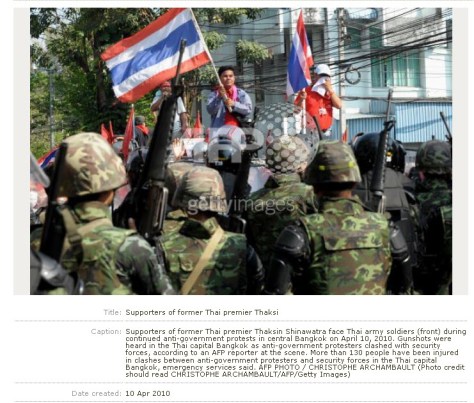
More images of Thai military crackdown on unarmed pro-democracy protesters

Abhisit’s Democrat Party, the Military and the Bureaucratic Elites, can only cling to power through violence and lies. As they use armed troops and tanks against pro-democracy demonstrators in Bangkok for the 5th time in forty years, the tyrants hope that a blanket of censorship throughout Thailand will allow them to do their dirty work in secret. But their censorship is not working and the assembled masses of pro-democracy Red Shirts are resisting. On the 10th April 2010 the army shot dead 17 unarmed Red Shirt protesters and a Japanese camera man in Bangkok in an attempt to crush a peaceful demonstration. Yet Abhisit Vejjajiva continues to lie. He claims that soldiers “only shot into the air” when they were threatened. Many reports from foreign journalists, and the deaths of 18 people, indicate that the soldiers fired live ammunition directly into the crowd.

Continue reading Thai tyrants use violence to cling to power: Giles Ungpakorn

A search that depressed me

[Thinking about recent political developments in Lanka, here is a recent poem by Mahendran Thiruvarangan, who lectures at the University of Jaffna — AK]

A search that depressed me

Searching
in those semi-arid paddy fields,
the cleavages of the silent hills, no longer luscious,
the dried up river,
the never-ending rows on the ballot sheet.

No sickles, no hammers, the sky blackened without stars,
green, blue, yellow, white, brown — all could paint our walls
with faces of new-born patriots and traitors,
the missing red,
gone with the wasted blood,
the Left,
left forever?

Bridges bombed and broken,
the tree long lost its roots,
the violent tsunamis,
patriotisms and nationalisms,
homelands and motherlands,
the ship is out of sight,
the crew all dead and missing,
sleeping in new camps,
with strange bedfellows who praise gods and demons.

The unhappy farmer of Tissamaharama,
the manacled Tamil prisoner from the thickets of the Wanni,
the withered tea-plucking woman in Talawakkele,
the homeless fisherman on the Eastern coast,
the evicted Jaffna Muslim,
the unspoken Malays, Burghers and Telugus,
disconnected,
throttling each other in battles misfought.

Cracks everywhere,
the wall crumbles.


Getting Indian Democracy Right: Rohini Hensman

Guest post by ROHINI HENSMAN

‘Far away, in that other fake democracy called India’: so said Arundhati Roy in a passing reference to India when she began her talk at the finale of the Left Forum 2010 in New York in the middle of March. Fake democracy? Yet in the same month her long essay ‘Walking With the Comrades,’ supporting the struggle of the CPI (Maoist) in the tribal areas, was published by a mainstream, corporate-controlled Indian magazine, Outlook. How would that be possible if India were just a ‘fake’ democracy? By way of a comparison, across the border in Sri Lanka, the March issue of Himal Southasian was seized by customs on account of an article of mine, despite the fact that I have always been sharply critical of the insurgencies of the LTTE and JVP, and cannot by any stretch of the imagination be described as sympathetic to terrorism or violence. Earlier editions of Himal with articles by writers critical of both the government and the LTTE have suffered the same fate. My articles have been turned down by one newspaper after another in Sri Lanka, and I do not blame their editors and owners: so many journalists, editors and owners who have been critical of the regime in power have been jailed, killed or disappeared, even if they, too, had been critical of the LTTE. Continue reading Getting Indian Democracy Right: Rohini Hensman

Violence and revolution

THIS note attempts to understand the nature of the politics behind the violent actions of the Maoists. There seems to be an agreement among human rights activists that Maoist violence is a ‘forced’ response to the extreme repression of the Indian state. The argument is that since the Indian state has been consistently ignoring or violently repressing various people’s movements, the people are left with no choice but to take recourse to the gun.

There is a fallacy in this argument. We know about people’s movements on issues of land rights or displacement which have not turned into armed insurrections, even though they have suffered major losses and have been treated in a very callous manner by the state. Apart from the Narmada Bachao Andolan there are hundreds of big and small peoples’ resistance movements in Jharkhand, Chhattisgarh, Orissa, Bengal, Tamil Nadu and other states which have not given up on the ‘parliamentary’ path of struggle.

Interestingly, we find that Maoist groups are also active in these areas and they constantly try to infiltrate and take control of such movements. We do not know of any movements organized by the Maoists which were initially ‘peaceful’ but compelled to turn to arms after all attempts at working with the state failed. I would suggest that the theory of ‘peaceful’ movements mutating into ‘violent’ insurrections appears flawed. Also that instead of using ‘Maoist’ as an adjective in a careless manner we should treat them as a political formation organized on the lines articulated in its political programme and constitution which is based on its own Marxian theory of revolution which is impossible without violence. Continue reading Violence and revolution

Arrests of Activists in Gujarat

PRESS RELEASE
Date: 22nd March 2010

“Is it a crime to work in a democratic and peaceful way for the empowerment and development of Adivasis”?
– Adivasi Mahasabha Gujarat & People’s Union for Civil Liberties, Gujarat.

Mr. Avinash Kulkarni and Mr. Bharat Pawar, activists of long-standing repute, have been working relentlessly for the rights of the Adivasis of Gujarat, over the past 15 years. Based in Ahwa, Avinash and Bharat have been actively involved on issues pertaining to the empowerment and development of Adivasis, through the Dangi Lok Adhikar Samiti and the Dangi Mazdoor Union, in Dang district. Avinash and Bharat have played a significant role in the struggle for the Forest Rights Act and for people’s rights to use, manage and control forests and forest resources as part of the leadership of Adivasi Mahasabha Gujarat, both in the advocacy and struggle that brought about the Forests Rights Act and the monitoring of its implementation across the Adivasi areas of Gujarat. It is a well known fact that they have always worked for democratic and peaceful means of securing the rights and entitlements of the Adivasis and have stood by non-violent means of working for social change.
In the afternoon of 21st March, 2010, about 2 P.M  Avinash  was picked up by Dy. S. P.  Shri Patil under the pretext of questioning and took him to an undisclosed location, without giving any information to his family members or colleagues as to where they were taking him or giving him the right of contacting his advocate. Bharat Pawar also was detained the same evening in a similar fashion by policemen from the DSP office of Ahwa, Dangs. This is a clear violation of Justice D. K. Basu Guideline of Supreme Court.
Continue reading Arrests of Activists in Gujarat

Integration of the Army and New Constitutionalism in Nepal: Menaka Guruswamy

This post comes to us from Menaka Guruswamy

Constitution-making is a process involving a contested terrain and this is reflected in Nepal’s political situation today, particularly
on the question of integration of rebel combatants into the army and its “democratisation”. It is important for Nepal’s political parties and forces to leave aside their past mistrust and come together to reach an equitable settlement while integrating combatants. Political foresight is also needed to appreciate that democratisation of all institutions, including the army, is imperative for creating the new constitutional democracy that is Nepal.

This piece originally appeared in the Economic and Political Weekly, February 2010, Vol. XLV No.9

Guruswamy EPW Nepal

The Rumour of Maoism

This essay has been published in the current issue of Seminar (No. 607, March 2010).

In his classic Elementary Aspects of Peasant Insurgency in Colonial India, Ranajit Guha outlines a certain methodological imperative for the historian who wanted to ‘get in touch with the consciousness of [peasant] insurgency’ when access to it is barred by the discourse of counter-insurgency that structures official records. How does one look beyond this discourse of the state that frames the archives in order to gain access to the voice of the rebels? Guha’s solution was relatively simple: Counter-insurgency, he argued, derives directly from insurgency and is so determined by the latter that ‘it can hardly afford a discourse that is not fully and compulsively involved with the rebel and his activities.’1

Unlike British Marxist historian E.J. Hobsbawm who had tried to track the story of ‘social bandits’ through a somewhat problematic reading of folklore,2 Guha warned that ‘folklore relating to peasant militancy can be elitist too’, for many singers and balladeers belonged to upper-caste families who had fallen on hard times and were, therefore, often suspicious of the revolt of the lower castes or tribals. Guha underlined that though the records of the colonial state and its police officials registered the voice of those hostile to the insurgents – including landlords and usurers – they could not avoid being shaped by the will of the insurgents. His conclusion therefore was that the presence of rebel consciousness could be read in the body of evidence produced by the discourse of counter-insurgency itself.

The burden of Guha’s argument was that in order to decode the language of counter-insurgency, it was often enough to simply reverse the values in the terms used by the official discourse: thus ‘badmashes’ simply meant peasant militants and not ‘bad characters’; ‘dacoit village’ would indicate an entire village involved in the resistance and ‘contagion’ would most likely refer to the solidarity generated by the uprising.

Those were happier days from the historian’s point of view. For the peasant and tribal insurgencies that Guha was discussing were organic struggles which drew their leadership from amidst the peasants or tribal communities themselves. Whether it was Sidhu Kanoo, Birsa Munda or Titu Mir – the leadership of the movements and their ‘ideologies’ derived directly from the world of the tribals. The context of colonial India was also, in a significant sense, quite clearly polarized and the possibility of written records being produced from a multiplicity of sources was simply out of the question. It may, therefore, be possible to follow Guha’s suggestion and merely reverse the values in order to get a sense of that other discourse. Continue reading The Rumour of Maoism

‘constitutional’ Realities: Priya Thangarajah

Guest post by PRIYA THANGARAJAH

The piece is unfinished, consciously so. The thought is unfinished and needs to be fleshed out and thus posting this, so that this important idea can be evolved collectively. It raises a range of questions and contributes to existing debates on constitutional law from a social change/human rights perspective. (consciously the words ‘constitution’ and ‘india’ are not capitalised. ) It contributes significantly to an understanding, not just of north east india but the realities of chattisgarh, jharkhand, bihar, kashmir to name a few. It helps us understand all the wars fought within the country – ‘constitutionally’ about which much is being said in the media and elsewhere by state and non-state actors.

The constitution, some argue, is an aspirational document. Baxi states that it is created to protect the rights of the impoverished. Created to protect the weaker sections of society and that’s how the Dworkinian trumping of rights works. Rights of the weaker parties always trumps that of the stronger. But whatever the aim of the constitution maybe, its sacrosanct. Sacred. Amendments can be made with great difficulty but the constitution per se cannot be done away with for a new one. Continue reading ‘constitutional’ Realities: Priya Thangarajah

Response to Arundhati Roy: Jairus Banaji

This is a guest post by JAIRUS BANAJI

Arundhati Roy’s essay “Walking with the Comrades” is a powerful indictment of the Indian state and its brutality but its political drawbacks are screamingly obvious.  Arundhati clearly believes that the Indian state is such a bastion of oppression and unrelieved brutality that there is no alternative to violent struggle or ‘protracted war’. In other words, democracy is a pure excrescence on a military apparatus that forms the true backbone of the Indian state. It is simply its ‘benign façade’. If all you had in India were forest communities and corporate predators, tribals and paramilitary forces, the government and the Maoists, her espousal of the Maoists might just cut ice. But where does the rest of India fit in? What categories do we have for them?  Or are we seriously supposed to believe that the extraordinary tide of insurrection will wash over the messy landscapes of urban India and over the millions of disorganised workers in our countryside without the emergence of a powerful social agency, a broad alliance of salaried and wage-earning strata, that can contest the stranglehold of capitalism?  Without mass organisations, battles for democracy, struggles for the radicalisation of culture, etc., etc.?  Does any of this matter for her?

Continue reading Response to Arundhati Roy: Jairus Banaji

Koirala’s death robs Nepali politics of its centre

Girija Prasad Koirala’s death on Saturday afternoon marks the end of an era in not only Nepali but also sub-continental politics. As a warrior for democracy over six decades, a five-time Prime Minister and architect of the ongoing peace process with the Unified Communist Party of Nepal (Maoist), Koirala was an integral part of Nepal’s modern political history. But he has passed away at a time when the task of institutionalising the democracy he fought for remains incomplete.

G.P. Koirala, or GPK, was born in Bihar in 1925, where his father, Krishna Prasad Koirala, was in exile for defying the autocratic clan-based Rana regime. His father believed that Nepal could not be free of despotic Rana rule as long as their patrons, the British, ruled India. G.P. Koirala’s elder brother, B.P. Koirala (also known as BP), was imprisoned in the Quit India Movement. In early 1947, Nepali exiles in India and Kathmandu-based dissenters formed the Nepali National Congress. Continue reading Koirala’s death robs Nepali politics of its centre

Levelling the playing field before the Commonwealth Games

Ahead of the Commonwealth games, the capital city of the country with aspirations towards being anointed First Side-Kick to the only super-power left in the world, is busy cleaning up. Beggars, protesters, poor-looking people in general, out, out, all out.

Pholpata, her child and a friend inside a mobile court in a mini-bus, caught begging and brought before a magistrate who will decide whether to jail them for a year or release them. [The Independent on Sunday]


Also, see Partha Banerjee’s post on this in his blog
The Real Slumdog Story: India’s Ghastly Commonwealth Cleanup.

Meanwhile, of course, the labourers working day and night to complete the endless amounts of construction required to host an event of this magnitude, are “working and living in highly dangerous and deplorable conditions;  earning less than the stipulated minimum wage;  with no access to basic sanitation and health facilities;  and, lacking safety equipment”, found a Committee appointed by the Delhi High Court.

Continuing the saga of national triumph, below, we have AKHIL KATYAL and SHALINI SHARMA on the forced evictions of protesters from Jantar Mantar.

The Delhi State Government and New Delhi Municipal Corporation (NDMC) seem to have a particularly limited vision of a beautiful city. In the run up to the Commonwealth Games, Delhi is seeing a massive beautification drive which is really about an intolerant attitude towards democratic dissent and towards the urban poor. It is an idea of beauty that deals with urban protest or poverty simply by excising it from view.

Continue reading Levelling the playing field before the Commonwealth Games