Category Archives: Politics

Democracy and the Communist Party: Aniket Alam

This is a guest post by ANIKET ALAM

This paper, rather preliminary note towards a full paper, attempts to look at the troubled history of democracy (both as a concept as well as a practice) and parties claiming affiliation to Marxism-Leninism. It tries to understand the historical paradox of parties and movements influenced by Marxism being among the more important contributors to democratising our world, but States ruled by parties owing allegiance to Marxism denying democratic rights to their own citizens. It then tries to identify some of the reasons for this large democratic deficit.

But before I begin, two short points about the structure of the paper may be in order. First, I have been fairly hesitant to write on this topic. I can hardly lay any claim to expertise on theoretical debates among Marxists as well as on the details of the history of countries ruled by communist parties. That apart, I am also conscious of my weakness in political theory, specially that relating to democracy and related ideas of liberty and representation. Therefore, the stress will remain more on the historical experience rather than the theoretical arguments. Second, and following from my hesitation laid out above, this paper is basically structured around three writings by two Marxists: Karl Marx himself , and Rosa Luxemburg. You may say I am merely paraphrasing them, or you may say that they are the burqa I wear during this excursion into unfamiliar territory.

Continue reading Democracy and the Communist Party: Aniket Alam

Deshbhakts at Arthur Road Jail: Susan Abraham

This is a guest post by SUSAN ABRAHAM

Shahid Azmi

It took Shahid Azmi’s cold-blooded murder on 11th February 2010 at his office near Kurla, for the world to come alive to his  importance.  Soft spoken and modest, it is the sweep of the cases he fought, challenging the State’s calculated targeting of innocent Muslims, that marked Shahid’s  remarkable achievements as a lawyer within a short span of six years in the legal profession.

One of these cases related to the brutal lathi charge in Arthur Road Jail in central Mumbai, on 28th June 2008, by the jail staff along with convicts and undertrials from the so-called `patriotic’ underworld gangs,  on a select group of undertrial-inmates. This assault was conducted under the overall supervision of the-then Jail Superintendent Swati Sathe. To the outside world, Ms Sathe was a tough no-nonsense, non corrupt woman officer who probably wished to become the next Kiran Bedi. But underneath her stiff khakhi uniform ruled a tough no-nonsense hindutva heart, no less.

Continue reading Deshbhakts at Arthur Road Jail: Susan Abraham

While we thank A.P.Shah, some reflections

The text below was written as an email on many LGBT lists in India. Followed by the text of the email are a few after thoughts on the email itself and the reaction to it.

Dear all,
It’s been interesting to watch all the reactions to A.P.Shah’s unfair retirement. This has been from various quarters including the LGBT community.
One must admit, among all the communities whose lives his judgments have attempted to change, we have been rather vocal in thanking him profusely. This is a good trend to set in general as sometimes I feel others working on various issues whose work has been vindicated rather literally by him have not taken the time out to do an analysis and express their gratitude towards the existence of a judge like him, in the otherwise difficult judiciary in this country. This might make a difference to him. He is hurt by the judiciary which he dedicated his life to which has now slighted him through opaque, undemocratic processes, thus going against all that he stands for and what the judiciary claims to stand for. So am glad we are doing this! Continue reading While we thank A.P.Shah, some reflections

An Aid to Surveillance

Guest post by USHA RAMANATHAN

The air is thick with schemes that will enable the state, and its agencies, to identify every resident, and to track what they are doing. A Home Ministry project for creating a National Population Register which will be prepared along with the 2011 Census has been propelled through its pilot stage. Now, an ambitious programme has been launched to load all the residents of the country on to a data base, providing each of us with a unique identity number. What  distinguishes this exercise from any other undertaken so far?

First of all, the intention is provide a Unique Identity Number to the whole population, including the just born.  The state is to have data on each individual literally from birth to death; and beyond, for a person’s UID is not destroyed at death, merely dis-abled. The numbers are to be so generated that it will not have to be repeated for between a hundred and two hundred years. Continue reading An Aid to Surveillance

Statement of Concerned Citizens and Feminists on the Death of W R Varadarajan

We, a group of concerned citizens and feminists wish to register our sorrow and shock at the death of W R Varadarajan, member CPI (M). We also wish to record our extreme unease at the manner in which crucial facts to do with the events and circumstances that preceded his death appear to have been deliberately ignored by the party leadership. That the party was aware of these facts is evident from a letter that the late Varadarajan addressed to CPI (M) General Secretary, Prakash Karat, and extracts from which were reproduced in the Indian Express, New Delhi edition, dated 24. 02.2010. Continue reading Statement of Concerned Citizens and Feminists on the Death of W R Varadarajan

Appeal for talks with broader section of people’s struggles in the forest and mineral belt

Aditya Nigam, Dilip Simeon, Jairus Banaji, Nivedita Menon, Rohini Hensman, Satya Sivaraman, Sumit Sarkar, Tanika Sarkar

In the light of the recent demands raised by sections of the intelligentsia urging the government to heed the CPI (Maoist) “offer of talks”, we insist that “civil society” should rather, put pressure on the government to initiate talks with representatives of all struggling popular and adivasi organizations. The CPI (Maoist) cannot be treated as the sole spokesperson of all the people in the forest and mineral belt, convenient though this may be for the state and for that party. Does the government believe that violent insurgents are the only deserving interlocutors? Continue reading Appeal for talks with broader section of people’s struggles in the forest and mineral belt

Undermining Political Reconciliation with Post-Election Repression

The following are my prepared remarks at the Global South Asia conference at New York University on 13 February 2010.  My prepared remarks on the Sri Lanka panel in titled, ‘Return of the Displaced and Political Reconciliation’ are below.  The remarks in the Sri Lanka panel which I chaired were to complement the presentations by Sharika Thiranagama, New School for Social Research titled, ‘Houses of the Future: Return and Reconciliation amongst Northern Muslims and Tamils’ and V. V. (Sugi) Ganeshananthan, University of Michigan, Lanka Solidarity, journalist and author of Love Marriage titled, ‘Dialogue in the Diaspora’.  The February 2010 issue of Himal Southasian magazine is a special issue on Jaffna, Sri Lanka and has a number of articles that address the post-war moment. The Sri Lanka Democracy Forum (SLDF) statement on 18 January 2010 titled, ‘SLDF Calls for National Attention on Demilitarization and a Political Solution’ details many of these issues in depth.

I want to begin with the end of the war, which inevitably leads to a shift in politics.  Post-war politics can not be same as war politics.

During the last couple years of the war, President Rajapaksa put together a war coalition comprised of a broad spectrum, from Sinhala nationalists to sections of the Old Left.  Despite the end of the war, the President and his government attempted to keep the war mentality alive, as we have seen through the continued suffering of the displaced as they were herded into internment camps with no freedom of movement.  It was indeed a lost opportunity for political reconciliation. Continue reading Undermining Political Reconciliation with Post-Election Repression

Bt brinjal – understanding the issues involved: Sunita Narain

In the prevailing arguments and counter arguments on the baingan gaatha, I found the following brief piece in Times of India by Sunita Narain, Director, Centre for Science and Environment, Delhi, invaluable for outlining the critical issues involvedevaluation of risks to health, control over seeds, threat to biodiversity, consumer choice and independence of research.

Jairam Ramesh, the Union minister for environment and forests, has agreed to put Bt brinjal on hold. I believe this is the right and only decision that he could have taken.

The fact is that we are not talking about a new technology of genetic modification here. We are talking about its use in a daily-use vegetable, cooked in our homes. Let us understand that Bt brinjal, if permitted would have been the world’s first genetically modified vegetable. It is therefore completely erroneous to argue that Bt brinjal should be cleared because the world is already growing genetically modified plants and believe these are safe.

Green Hunt: The Anatomy of An Operation

An operation is underway in Central India, but no one really knows what it is. Variously described as a media myth, a comprehensive hearts and minds strategy, and an all-out offensive by paramilitary forces and the state forces along the borders of Chhattisgarh, Jharkhand, Andhra Pradesh and Maharashtra, Operation Green Hunt has become a shoebox of news clippings, police reports, public demonstrations and armed encounters.

Depending on the definition, Green Hunt either began in July 2009, September 2009 or November 2009. Speaking off record, senior policemen confirmed that the intensification of “search and comb” operations in Chhattisgarh began as early as July last year. In September 2009 the press reported on the progress of “Operation Green Hunt”: a massive 3 day joint operation in which the central CoBRA force and state police battled Naxal forces in Dantewada. Continue reading Green Hunt: The Anatomy of An Operation

Uncanny parallels between Beg’s and Shah’s deaths

This is a guest post by Akhilesh Upadhyay

The gruesome murder on Sunday of media entrepreneur Jamim Shah, 47, has brought back chilling memories of June 29, 1998. On that day, Mirza Dilshad Beg, a sitting lawmaker, was gunned down outside his home in Siphal, Kathmandu. It was a dark night and the hillside neighbourhood looked darker still due to load-shedding, when we (reporters and photographers from Kantipur and The Kathmandu Post) arrived at the scene, soon after the 9.30 hit-and-run incident.

The newsroom had received a tip-off from a local who had heard what he suspected were gun-shots. It was an innocent world in many ways. Nepalis were still unfamiliar with sounds of bombs and gun-shots, the Maoist-waged “people’s war” was still in its infancy, violent deaths still shook everybody, and political assassination was unheard of. But what shocked the Nepalis most was how ugly games from powerful external forces could play out in Nepal, as it watched haplessly. The incident also gave many of us in the newsroom a first-hand lesson on forces which operate from behind the scene. Two of the theories that made the rounds then clearly pointed at the cross-border nature of the operation; the third one was that Beg’s death had to do with “family problems,” which turned out to be false. Continue reading Uncanny parallels between Beg’s and Shah’s deaths

Presidential Elections, Minorities and Political Space

The following is the write up of my talk given at the Centre for Society and Religion on January 11th, 2010.  I have articulated some of these concerns in greater depth in my recent article in the January 9th, 2010 issue of the Economic and Political Weekly titled, ‘State Power, State Patronage and Elections in Sri Lanka’.

Presidential Elections, Minorities and Political Space

First, I want to thank the organisers for inviting me to speak here at the Centre for Society and Religion (CSR), an institution that embodies a great tradition of conscious political engagement.  It is an honour to be given this privilege and I hope this series of discussions at CSR on the upcoming presidential and parliamentary elections is the beginning of many discussions and debates on important political issues facing the peoples of our country.  Indeed, the space that has opened up in recent weeks in the context of the elections should be expanded by all social institutions and social forums concerned about peace, justice and democracy.  I for one believe that the debates, the social pressures and the mobilisations in the lead up to and after elections are at times even more important than the act of electing a President or other political representatives. Continue reading Presidential Elections, Minorities and Political Space

Jyoti Basu and the Passing of an Era

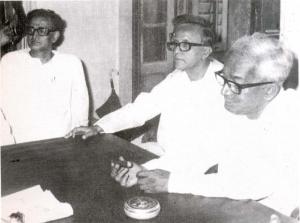
Jyoti Basu, Promode Dasgupta and Saroj Mukherjee

With the passing away of Jyoti Basu, the curtain comes down on an entire chapter of communist history in this country. Basu may have been the last of a generation that learnt its politics in the stormy days of the anticolonial struggle and who lived through the ups and downs of politics – from the underground days of the 1930s and 1940s to the initiation into the ways of parliamentary democracy. The long engagement with parliamentary democracy was to lead to Basu’s – and the communists’ – long stint in power. And Basu was one of those rare communists for whom democracy was not a mere strategic imperative but a value to be internalized.

Basu belonged to a generation of communists who worked their way from the bottom up. Trained in Law in England, Basu returned to India, determined to work in the communist movement. Muzaffar Ahmed, the then secretary of the undivided communist party sent him to work among the railway workers. It was there, working among and organizing the railway workers that Basu entered mass politics.  It was probably in this process that Basu developed his distinctive style of politics – a style that we have yet to understand fully.

Continue reading Jyoti Basu and the Passing of an Era

Remembering Jyoti Basu: Monobina Gupta

This is a Guest Post by MONOBINA GUPTA

Jyoti Basu
Jyoti Basu

While waiting endlessly at the CPI-M headquarters in Delhi, we, the Left-beat reporters, often used to say how incredibly dull the beat would be in the absence of Jyoti Basu, Indrajit Gupta, and Harkishen Singh Surjeet. With their distinctive personalities and distinct style, each one had livened up the tedious job of keeping track of the Left parties and their leaders. Indrajit Gupta would speak in a baritone voice, trotting out gruff answers; the ever-amiable Harkishen Singh Surjeet, never failed to pick up the phone, was always ready to share a laugh with us. But of these three colourful Communist stalwarts, it was Basu who used to keep us most preoccupied, with his ‘read-between-the-line’ one-liners, exasperatingly short, brusque replies, sometimes even with outright sarcasm or rudeness.

Continue reading Remembering Jyoti Basu: Monobina Gupta

Asim Butt (1978-2010)

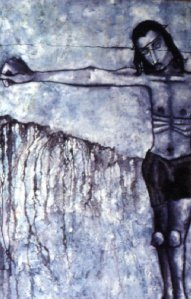
Self-portrait as Christ. 1998. Oil on board, paper, and wax palimpsest.

Karachi-basd artist Asim Butt committed suicide yesterday by hanging himself to death. He was only 31, and his work made waves. Part of the Stuckist art movement, he made figurative paintings, most notably a series of seven portraying a dog’s carcass. He was also a graffiti artist, painting red the walls of Karachi. His best known graffiti work was the eject symbol painted all over towards the end of General Musharraf’s rule.

Read this moving tribute by a journalist friend and this one with a lot of links at Stuckism.com. You can pay homage here, but most of all, see his pictures and paintings on his own Facebook profile.

As one of the tributes on Facebook reads, good people die early.

Inaugurated: The Malabar Moral Police!

The dastardly attack on the eminent writer Paul Zachariah by the DYFI in the CPM fortress of Payyanur in north Kerala on 10 January has been roundly condemned across the political spectrum in Kerala. Zacharia was heckled and abused at a literary seminar organized by a publisher for  criticizing the moral policing  practiced by the official left in Kerala. He condemned the recent DYFI-PDP joint ‘moral action’ against the Congress leader Rajmohan Unnithan and a Sewa Dal leader which, according to the the DYFI leadership, were ‘provocative’. Zacharia was accosted by a gang of men when he was about to leave Payyanur and openly threatened. He was told that such talk was not permitted in the left bastion of Payyanur; when the threat did not produce the desired reaction, they resorted to physical intimidation, and relented only after the intervention of the organizers who are CPM sympathizers, and other writers present there. The day after, prominent leaders in the CPM, including the Chief Minister and the Minister for Education, condemned the action. Continue reading Inaugurated: The Malabar Moral Police!

The Two Zizeks

Slavoj Zizek spoke on Tragedy and Farce in Delhi on January 5, 2010. He spoke for about an hour and a half, then I responded for about 18 minutes, then he came back spiritedly for about forty-five minutes. This post is in two parts. The first part is the brief intervention I made at Stein Auditorium. In the second part of this post, I expand on my critique in the light of his response. I could not of course, speak after he had spoken the second time, so I’m doing it here.

I

A jinn appeared to a man and granted him three wishes. First, said the man excitedly, I want to be Slavoj Zizek. You idiot, said the jinn. You are Slavoj Zizek.

This is one of the many stories that the internet throws up on the eminent Slovenian Lacanian whom it has been our pleasure to listen to today. His own jokes and anecdotes are of course legendary, the medium through which he makes complex theoretical points. It thus becomes the burden of every unfortunate person writing about him or commenting on his work, to tell a few jokes themselves. Often Profesor Zizek’s own.

So. It struck me that the truth of the joke with which I began is that Slavoj Zizek longs to be Slavoj Zizek. He never quite makes it, though, because Zizek keeps escaping himself. In an interview to The Guardian a couple of years ago, he was asked – What do you most dislike about your appearance? And he replied – That it makes me appear the way I really am.

Having followed Professor Zizek’s work for a while now in growing bewilderment, I understand his predicament There are at least two Zizeks in there, and whichever one manifests himself, Slavoj is taken aback and rather dissatisfied. This is me? He seems to ask.

Continue reading The Two Zizeks

Protest and Terrorism, Is there a Difference?

Sufiya Madani of the PDP has been granted conditional bail by the Ernakulam Sessions Court Judge after a tense wait following her arrest on 17 December. She was remanded to judicial custody by the first class magistrate court at Aluva which had refused her bail. Meanwhile, the mainstream media went on a speculation-spree, even publishing ‘evidence’ that she had abetted terrorism and violence — the burning of a bus owned by the Tamil Nadu Road Transport Corporation at Kalamassery in 2005 during protests against the PDP leader Abdul Nasser Madani’s (Sufiya’s husband) continued detention in the Coimbatore jail . Continue reading Protest and Terrorism, Is there a Difference?

Reflections on Biometric Attendance: Kriti Budhiraja

This is a guest post by Kriti Budhiraja

The latest in the list of efforts to “meet international standards” is the proposal to introduce biometric attendance for teachers across Delhi University. According to Vice Chancellor Deepak Pental, this new system is in keeping with the “spirit of transparency inculcated by the Right to Information Act.” But this commitment to a “spirit of transparency” becomes immediately questionable when one reflects on the undemocratic ways in which proposals such as these are being pushed through. Much like the semester system which is going to be implemented despite widespread dissent, it is rightfully feared that Deepak Pental may go ahead with this proposal while paying scant regard to teachers’ hostility towards it. Continue reading Reflections on Biometric Attendance: Kriti Budhiraja

Water…

In a tangential continuation of my last rant, a news report in the Hindu today caught my eye, because it made clear what we all know: the poor pay much much more for essential services than the rich do and therefore price of living indices as they are currently defined/calculated do not capture in any way the everyday realities of millions of Indians.

Continue reading Water…

Savarna Terror Erupts in Kerala

(with inputs from Mythri Prasad Aleyamma)
I admit, this title sounds sensationalist. But one can hardly avoid resorting to it when confronted with utterly stupefying news of attacks on dalit colonies almost next door to Kerala’s capital city and nerve centre of Malayalee politics, and that too, by a minor anti-political force that has a legacy of anti-South Indian hatred — the Siva Sena. And of course when one is confronted with the hard, stony silence of almost all sections of the media about this. The mystery of the murder of an elderly, innocent morning-walker in Varkala, a town close to Thiruvananthapuram (of which I wrote in an earlier post) still remains a mystery; the police story is so full of holes that it looks like a sieve. But the Guardians of our Free Press are still lapping police versions and not conducting independent investigation. Activists who have dared to do so have been heckled and hounded, even senior and respected human rights activists like B.R.P.Bhaskar, by the Siva Sena, and their protests have been ignored. Meanwhile violence continues to be unleashed against the supporters of the group that has been accused of murder, the Dalit Human Rights Movement (DHRM).

Continue reading Savarna Terror Erupts in Kerala

Who’s at ‘Jihad’? : ‘Love Jihad’ and the Judge in Kerala

It looked as if the controversy over ‘Love Jihad’ ( ‘jihad defined as ‘war by other means’) had  blown over with state authorities in Kerala and Karnatake denying that such a threat ever existed.The Central Government informed the Kerala High Court early this month that there was no such thing and that the term ‘love jihad’ was being used by the media.However, today, the Kerala High Court openly voiced its scepticism of police reports, claiming that the reports were inconsistent and citing various technical flaws.The Court claims that it is abiding by the secular spirit of the Indian Constitution: it agrees that the freedoms to choose one’s faith and one’s partner in marriage are fundamental rights. However, it feels that the present instances of marriage and conversions that have been brought to its attention are not the exercise of freedom by individuals — specifically, by young women, though the Court does not say it that way. It is difficult to imagine a more anti-Muslim and anti-woman position; and it is a serious matter that the muddle-headed reasoning of the judge has been uncritically circulated in the dominant media.
Continue reading Who’s at ‘Jihad’? : ‘Love Jihad’ and the Judge in Kerala