अपने नए बंद के दौरान सी.पी.आई.( माओवादी) ने छत्तीसगढ़ और बंगाल में अर्ध-सैन्य बल के सदस्यों के साथ बस में सफ़र कर रहे साधारण ग्रामीणों की हत्या करने के बाद जो बयान दिया है उससे यह साफ़ है कि अभी शायद इससे भी क्रूरतापूर्ण कार्रवाइयां देखने को मिल सकती हैं. उनके प्रवक्ता ने कहा कि उन्होंने पहले ही छतीसगढ़ के ग्रामीणों को यह बता दिया था कि उन्हें इस युद्ध की विशेष परिस्थिति में क्या करना है और क्या नहीं करना है. मसलन, पुलिस या सैन्य बल के लोगों के साथ किसी भी तरह का कारोबार या सामजिक व्यवहार प्रतिबंधित है, उनके साथ किसी सवारी गाडी में सफ़र नहीं करना है. इसके आगे उनसे यह भी कहा गया है कि उन्हें पुलिस या सैन्य बल की गतिविधियों पर नज़र रखनी है, उनके पास हथियारों का अंदाज़ करना है और इसकी खबर जनता सरकार को देते रहना है. इस दल के प्रवक्ता ने कहा कि साधारण लोगों का मारा जाना अफसोसनाक है लेकिन एक तरह से वे खुद इसके लिए जिम्मेदार थे क्योंकि उन्होंने चेतावनी का उल्लंघन किया था. Continue reading युद्ध के रूपक का जाल
Category Archives: Politics
To P Chidambaram: Response from a member of civil society, by AK Agrawal
By ARUN K AGRAWAL
Dear Shri Chidambaram,
This is in response to your repeated taunts on NDTV that the civil society must respond to the wanton killing by the Naxals. It appears that the interview was tailor made for getting the consent of the Cabinet for more firepower and airpower to combat the Maoist. The diabolic support of Arun Jaitly, be it by describing you an injured martyr, was designed to achieve his ambition through the support of the mining barons of the BJP ruled states.
As a member of society I hope I am being civil in disagreeing with you on your hard line approach against the innocent tribal. I also hope you will not find it too shocking for being accused of being largely responsible for the rise and growth of Naxalism, as the following happened on your watch as Finance minister.
Continue reading To P Chidambaram: Response from a member of civil society, by AK Agrawal
On Regret and Control
As I get ready to mail this piece, I read the news of the killing of four CRPF men who were out on a patrol in an IED blast in Begal. I know that these deaths do not qualify as deaths of the ‘people’ since all the dead were ‘combatants’. I therefore do not expect any expression of regret from the CPI( Maoist). But the sheer lack of remorse with which the CPI( Maoist) has owned the land mine blast which killed more than 40 people travelling in a bus in Chhatigarh shows that the lives of the tribal people matter little for them. Their central committee member Azad told the reporters that it could not be helped. He said that since they had informed the villagers through circulars that they should refrain from travelling with the security persons, the Maoists cannot be blamed for these deaths. They paid the price with their lives for ignoring this warning. The circular issued by the ‘Janadhan Sarkar’ very clear forbids them from mixing with Jawans or police, inviting them to village for any event , providing them food or shelter, giving any service to the security persons , or travelling with them, including the police, CRPF , SPOs or the CRPF . They have also been asked to keep track of the number of policemen in their area and also the arms they carry and report to the ‘Janadhan Sarkar’ their movement and destination. Continue reading On Regret and Control
Why RSS Wants to Forget Pracharak Sunil Joshi’s Murder?
I.
It was a murder of an old activist, which the RSS would love to forget. It is a different matter that despite the innumerable ways in which it has tried to banish the memory of the whole incident it has found it very difficult to get away with it. And with the latest exposures in the Ajmer Dargah bomb blast case the whole issue has once again returned to haunt it.
“A former RSS pracharak, who was an accused in the murder of a Congress leader and his son, was shot dead in Dewas town, about 35 kms from Indore, late on Saturday.
Sunil Joshi, 45, was strolling in Chuna Khadan locality when assailants, who used a Maruti van and a two-wheeler, shot him thrice. He was declared dead on arrival in the district hospital.”
(Indian Express, Posted: Mon Dec 31 2007, 00:00 hrs) Continue reading Why RSS Wants to Forget Pracharak Sunil Joshi’s Murder?
‘An acceptance of Israel’s legitimacy does not imply an acceptance of all that it does’: Amitav Ghosh
Given the long discussion on an earlier post on this subject, I think it is important to post here Amitav Ghosh’s long, persuasive response to the campaign that requested him not to accept the Dan David Prize. I’m taking the liberty of copying this response from here.
May 14, 2010
Dear Signatories to the letter of May 7:
I am sorry I have been slow to respond to your letter expressing disappointment in my decision to to accept the Dan David prize. I will attempt to do so now. Continue reading ‘An acceptance of Israel’s legitimacy does not imply an acceptance of all that it does’: Amitav Ghosh
From Murder Mystery to Spy Thriller: Raveena Hansa
THE CONTINUING SAGA OF THE MUMBAI TERRORIST ATTACKS
This is a guest post by RAVEENA HANSA.
Tactical Retreat?
The Maoist ‘postponement’ of the general strike has drawn diverse reactions. Ruling parties have projected it as a victory of democracy, constitutionalism, and law and a massive defeat for the Maoist ‘politics of blackmail’. Sections of the media and civil society that had urged the Maoists to pull back feel it is a result of popular pressure exerted by the peace rally on Friday morning. And while some Moist leaders and cadre are reported to be confused, demoralized, and angry at the leadership for letting go, others are hopeful that this will pave the way for an agreement on peace and constitution.
The responses are naturally shaped by one’s own location on the political spectrum. But what it ignores is that there is a complex set of factors that led to the Maoist decision. The non-Maoist euphoria also glosses over the fact that the strike was not the problem; it was only a symptom of the problem. And while the strike is off for now, those underlying issues remain unresolved.
The Maoists made four miscalculations. Continue reading Tactical Retreat?
In Search of Brahmeshwar Singh, ‘the Absconder’
The Myth of the ‘Misuse’ of Laws Meant for the Protection of Dalits and Tribals
Are the laws meant for the protection of Dalits and tribals are put to misuse?
It is a theme which recurs regularly in the discussions engaged in by the chattering classes of the country. While nobody can deny that frivolous cases are not filed under this act the manner in which the issue gets raised creates an impression that the only ‘use’ of this law is its ‘misuse.’ Neither the polity nor the articulate sections of our society seem ready to go for a reality check. In fact, as a marker of these classes’ ‘sensitivities’ towards this delicate issue, even Ms Mayawati in her earlier incarnations as Chief Minister of UP had cautioned the police about its ‘misuse’. She is also reported to have issued G.Os (government orders) to use this law only in cases of rapes and murders of the Dalits.
Continue reading In Search of Brahmeshwar Singh, ‘the Absconder’
Rahul Gandhi and the Dalit votebank in Uttar Pradesh
This article by me has appeared (.pdf) in the Economic and Political Weekly.
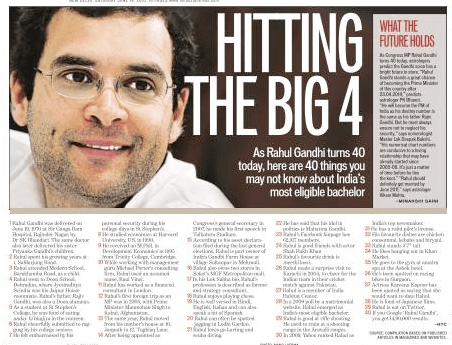
On 14 April this year party general secretary Rahul Gandhi launched the Congress’ biggest campaign to revive itself since 1989. The date was carefully chosen, Ambedkar Jayanti, because he is trying to win over dalit votes in Uttar Pradesh (UP). In 1989 the Congress’ support base in UP was made up of a rainbow coalition of brahmins, Muslims and dalits. The Congress has to woo these communities again to regain power in UP.
The brahmin community took to the now ruling Bahujan Samaj Party (BSP) in small numbers in the 2007 Vidhan Sabha election primarily because there was no strong brahmin leader after Bharatiya Janata Party (BJP) leader Atal Behari Vajpayee became politically inactive. Brahmins see in Rahul Gandhi a potential “brahmin” leader. The UP Congress president, legislative leader and Youth Congress president in the state are all from the brahmin community.
Muslim support is no longer enchained to the Samajwadi Party (SP) because their bete noire, the BJP, is powerless these days in both the centre and the state. As a result the Muslim vote is being fought for, as a three-way contest between BSP, SP and Congress. BSP head and Chief Minister Mayawati’s stratagem is to therefore change her party’s core support base constructed out of the “brahmin-dalit” alliance into a Muslim-dalit alliance.
The dalits, wooed away en masse by the Kanshi Ram-Mayawati duo of the BSP for years, would be the hardest to win back for the Congress. In fact, a year ago the very idea would have sounded ludicrous. But today, Mayawati’s angry reaction to the Congress’ bid to woo dalits is indication that the Congress may be winning over dalits. How is this happening? Continue reading Rahul Gandhi and the Dalit votebank in Uttar Pradesh
An election in Nottingham
This is a guest post by AMAN BHARTI on the elections in UK
I had nipped out during my lunch break to post my voting ballot. The route back took me past Nottingham’s speaker’s corner, where for the first time ever, I saw some speakers. They appeared to be two of the three main political party candidates.
Intrigued, I joined the small crowd for my first experience of local electioneering. A desi chap in his shalwaar-kameez (or is that only what women wear?), sleeveless jacket and one of those Ahmad Shah Masood caps (I know they are called something, but I forget what) was just about to ask a question. In broken, accented English, he talked about the Muslim community suffering due to anti-terror laws, and asked which party would bring in “transparency and accountability” in the exercise of anti-terror laws, and adhere to the European courts’ views on individual human rights?
The brown faces in the audience cheered loudly. The white faces were conspicuously (and a little worryingly) silent. Continue reading An election in Nottingham
The City Turns Red – Kathmandu on May Day
When Maoist Newa state in charge Hitman Sakya asked the assembled crowd at Khula Manch to silently honor martyrs, the moment turned somber. The leaders stood with their heads down on the stage, and on the ground, all one could see were thousands and thousands of fists raised up. There was pin-drop silence.
A bit later, members of the Maoist cultural wing sang and danced. The lyrics were deeply political, hitting out at the NC, UML and India, projecting the Maoists as the only people’s party, and wooing the security forces by showing uniformed personnel shaking hands with Maoists ‘to build a new Nepal’. The crowd was enthralled. Continue reading The City Turns Red – Kathmandu on May Day
Kathmandu Siege – They Are Here
Kathmandu’s elites cannot seem to understand who these people are. But talk to the cab driver, waiter, vegetable seller, small shopkeeper, slum dweller or construction worker and you will get an idea of who may dominate the streets from Saturday.
There has been coercion in the process of mobilisation. But the Maoists have essentially tapped into the three core contradictions of Nepali society – ethnicity, class, and space (Kathmandu versus the rest). They have deployed their cadres; capitalised on the rage of those on the periphery; and channelised popular discontent against inflation, power cuts, corruption and insecurity, for which Madhav Nepal has been projected as solely responsible. Continue reading Kathmandu Siege – They Are Here
Swami & Friends: JTSA’s response to Praveen Swami
The story so far…
Jamia Teachers Solidarity Association was formed after the so-called “encounter” at Batla House in 2008, in which two students of Jamia Millia Islamia were killed. You may remember posts on kafila at the time, questioning the credibility of police accounts of the “encounter” and criticizing the unethical nature of media coverage:
A little less melodrama, a lot more forensics;
The Jamia Nagar encounter: Curiouser and curiouser;
Shame is a revolutionary sentiment;
Some questions about the Delhi encounter.
In April this year, JTSA, which has been demanding an independent probe into the encounter, issued a statement after the post mortem reports of Atif Ameen and Md. Sajid were made public, revealing that the two boys were not killed in cross fire as Delhi Police claimed:
Batla House ‘Encounter’: Whom is the JP Trauma Centre Shielding?
“If there is one infallible indicator of what the top Indian Intelligence agencies are thinking or cooking up, it is this: Praveen Swami’s articles. Each time the security establishment wishes to push a certain angle to this bomb blast or that, Swami’s articles appear magically, faithfully reflecting the Intelligence reports. After the Batla House ‘encounter’, he launched a tirade against all those who were questioning the police account of the shootout labeling them all ‘Alices in wonderland’. He went so far as to identify ‘precisely’ how Inspector Sharma was shot by claiming that “abdomen wound was inflicted with [Atif] Amin’s weapon and the shoulder hit, by Mohammad Sajid”.
And no sir, Swami’s conclusion was not based on post mortem reports of the killed, fire arm examination report or ballistic report but on this innocent fact: “the investigators believe that…” He certainly brings in a whole new meaning to ‘investigative journalism’. Swami however felt no need to pen an article when the postmortem reports of Atif and Sajid revealed that they had been shot from close range and that neither of them sustained gunshot wounds in the frontal region of the body—an impossibility in the case of a genuine encounter. Was it because the police and the Home Ministry chose to remain quiet after the revelations—hoping that the storm would quietly blow over?“
Continue reading Swami & Friends: JTSA’s response to Praveen Swami
Heading for a Bloodbath: Rohini Hensman
This post by ROHINI HENSMAN is an article published on the Outlookindia.com website on April 22, 2010.
To people desperately trying to avert a bloodbath in the forest belt, the recent PUDR statement on the massacre of 76 CRPF jawans in Dantewada caused considerable consternation, and Sumanta Banerjee’s response to it even more so. According to the PUDR statement,
‘As a civil rights organization we neither condemn the killing of security force combatants nor that of the Maoists combatants, or for that matter any other combatants, when it occurs’.
‘these soldiers, by being cannon-fodders of the Indian state, however tragic it might be, suffered the fate that – I’m sorry to say – they deserved…To come back to the latest incident of the Maoist attack on the CRPF camp in Chhattisgarh…. if we accept it as a part of a civil war, such killings are inevitable (just as the CRPF killings of Maoists) in a violent system that has been institutionalized by the Indian state. The difference between the CRPF violence (involving ‘false encounters’, raping of tribal women, burning their homes, etc.) on the one hand, and the Maoist violence on the other (which means attacks on oppressive landlords and the police and para-military forces like the CRPF which come to the aid of the landlords) – has to be distinguished by civil society groups’
‘Boycott of Israel would not serve any useful tactical purpose’: Amitav Ghosh

The British Committee for the Universities of Palestine (BRICUP) and Pakistanis for Palestine amongst others have appealed to the novelist Amitav Ghosh to decline the Israeli Dan David Prize he is being given jointly with Margaret Atwood.
The BRICUP open letter to Ghosh reads:
It’s surprising to have to raise Israeli colonialism with a writer whose entire oeuvre seems to us an attempt to imagine how human beings survived the depredations of colonialism. Gosh, even the Dan David judges like the way you evoke ‘the violent dislocations of people and regimes during the nineteenth and twentieth centuries’.
Those making him this appeal have reminded him of his rejection of the Commonwealth Writers’ Prize in 2001.
Give below is Ghosh’s response to the appeal: Continue reading ‘Boycott of Israel would not serve any useful tactical purpose’: Amitav Ghosh
Batla House ‘Encounter’: Whom is the JP Trauma Centre Shielding?
Statement by Jamia Teachers’ Solidarity Association
Days after the startling revelation of the post mortem reports of Atif Ameen and Md. Sajid, which conclusively nailed the lie of the Delhi Police claims that the two boys were killed in cross fire, the security establishment has swung into damage control to ensure that no further information is made public. It is to be recalled that the post mortem reports could be made public only through the persistent efforts of RTI activist and Jamia student, Afroze Alam Sahil and the resolute resistance offered by the teachers and students of Jamia as well as other civil rights activists.
While the post mortem reports have made it amply clear that both Atif and Sajid have been shot from close range and possibly in captivity (as illustrated by the injury marks made by blunt force); the reports also raised several questions: Continue reading Batla House ‘Encounter’: Whom is the JP Trauma Centre Shielding?
An Open Letter to the Democratic and Progressive Groups and Individuals in Aligarh Muslim University and Other Universities in India to Demand Justice for Dr.Siras
To sign this statement, click here
The unforeseen death of Dr Srinivas Ramachandra Siras (Reader and Chair of Modern Indian Languages at Aligarh Muslim University) and the circumstances surrounding it have thrown us into a web of shock, despair and great concern. As an academic community, there are a number of questions that we need to ask and address.
The role of the Aligarh Muslim University authorities in this incident has been nothing short of condemnable. The invasion of Dr Siras’ privacy, the subsequent authoritarian impulse to suspend him and the complete lack of sensitivity by the administration has been outrageous. It has created anxiety about our vulnerability to the exercise of arbitrary powers. The use of such surveillance is not simply a threat to our freedom to make life choices (and sexual choices); it also leads to “self-discipline” due to fear of transgressing majoritarian norms. Continue reading An Open Letter to the Democratic and Progressive Groups and Individuals in Aligarh Muslim University and Other Universities in India to Demand Justice for Dr.Siras
Happy Ambedkar Jayanti

The Congress Party will use the occassion of Ambedkar Jayanti tommorow to reach out to UP’s Dalits. Commenting on this, NDTV says, “Mayawati, who knows a thing or two about appropriating the Dalit legacy, is going on the offensive as well.”
Appropriating? Hello! You mean to say Rahul Gandhi is a Dalit and Mayawati a half-Italian, one-fourths Parsi and one-fourth Kashmiri Pandit, trying to pass off as an Allahbad Brahmin and collecting Dalit votes on the side?
Of course there will be other memorable celebrations, but they won’t be as ‘news-worthy’.
Peeing in Peace and the Revival of Labour Activism in Kerala
The city of Kozhikode in northern Kerala has seen many a spectacular public protest by women since the 1930s. Recently, it witnessed a truly unique protest which hopefully reveal the shape of things to come. This was over the denial of safe toilet facilities to women, especially the large numbers of underpaid and overworked women employees in the city shops.The issue was successfully raised by the action committee organized by Penkoottu,an organisation of women workers in the city– which included many organizations including the feminist group Anveshi,the Muslim women’s organization Nisa, some activists of the Mahila Congress, and independent activists. Continue reading Peeing in Peace and the Revival of Labour Activism in Kerala
Response to Rohini Hensman: Soumitra Ghosh
SOUMITRA GHOSH is with the National Forum of Forest Peoples and Forest Workers. This post came as a response to Rohini Hensman’s recent post Getting Indian Democracy Right
Is India a democracy? This question has to be seen in context of the complex and plural character of the present Indian state and several other state like formations(for instance the Maoist People’s Sarkar in the liberated zones, the parallel administration run by the Nagas, areas and times where and when the extreme hegemony of one or the other mainstream political party or the feudal landlords substitutes the process of law—and others). There is also the fallacy whether India is a nation-state in the way other nation-states(for instance, China, USA, England) are, and whether the concept of a monolithic Western-type at all democracy applies in the Indian context (and if so, how far?). However, the question Rohini tries to raise deals more perhaps with our ethical constructs of democratic values than the character of the Indian state. If it is the former we enter the realm of ethical a-priories, which I too share: democracy is something that as a political process tolerates pluralism and leaves some space for minority dissents against dominant majorities. To take the democracy debate further and to include the Indian state in it will mean a different discourse, in which I am not going for the time being.
Maoists issue a statement, the media plays it down
The CPI (Maoist) has issued a statement after the killing of the CRPF men in Dantewada. You would imagine that the statement should be all over the media. If you Google you will find it here and there, and if you’ve been reading the papers I won’t blame you for missing it. It’s buried in the inside pages today, and only the Hindustan Times yesterday had put it on its front page. This is not surprising considering that after the CRPF killings the media has gone into war mode. It’s war out there, they’re saying again and again. Anchors are shouting, news-magazines are declaring war and calling the Indian state impotent and the top editors are saying it’s a turning point, ab bas bahut ho gaya, now let’s just shoot ’em dead. What, no air strikes? get real guys.
Continue reading Maoists issue a statement, the media plays it down