Category Archives: Politics

A Hundred Years to Valentine’s Day

The Manglore-style of violence against women is clearly not the style of the politically powerful guardians of sexual morality in Kerala. But maybe the style is more or less redundant over here: there are very few pub-going local (or local-looking) women over here. How convenient for us women of Kerala that we Malayalees live in social arrangements that insist on sexual segregation in public spaces and institutions.

This is of course related to the particular history of gender and spatiality that unfolded between the mid-19th and 20th centuries in Kerala.Spatial categories have always underwritten caste and gender exclusion in Malayalee society. Take for instance, the derogatory term chanthapennungal (‘market women’) that refers to women who get their way through loud and vociferous argument – who work for their livelihood in market-space and reject feminine modesty. The chanthapennu is the very antithesis of taravattil pirannaval (‘she who was born in an aristocratic homestead’). Thus the woman whose daily life and labours involves traversing spaces outside the domestic and the familial is forever poised at the brink — she is who may, at any instant, collapse into being chantappennu.In traditional Malayalee society, family spaces were named by caste and constructed through caste practices and gender norms. For instance, the Brahmin home was referred to as Illam or Mana; the Nair homestead as Taravadu or Idam.In other words, a generalized notion of domestic space housing the family was absent.  Indeed, the observance of spatial regulations was often taken to be crucial in shaping feminine moral qualities found characteristic of the aristocracy — and hardly vice-versa.

Continue reading A Hundred Years to Valentine’s Day

Interview with Ragavan on Tamil Militancy (Early Years)

As the Tamil community in Lanka is at the crossroads with twenty five years of war nearing an end with the increasing marginalization of the LTTE, I would like to do a series of interviews on the social, economic and political conditions that led to the emergence of armed politics and militarization of the Tamil community.  Returning to those years in the seventies and early eighties then is an attempt to also think about ways forward out of the militarized and armed politics of the last few decades.  I intend to do a series of interviews to capture that important political period for Lankan Tamils.  This important shift in Lankan politics and the decades of war that followed it did irreparable damage to the Lankan Tamil community and all the peoples of Lanka.

I begin with an interview of Ragavan, a founding member of the LTTE, who left the movement in 1984 and has since moved to London where he lives in exile.  In this first interview, Ragavan speaks about his background and early years of militancy.

This is an interview by Ahilan Kadirgamar of Ragavan at his London home on 25 January 2009. Continue reading Interview with Ragavan on Tamil Militancy (Early Years)

India’s Terror Dossier. Further Evidence of a Conspiracy: Raveena Hansa

This guest post has been sent to us by RAVEENA HANSA

On 5 January 2009, the Indian government handed a 69-page dossier of material stemming from the ongoing investigation into the Mumbai terrorist attacks of 26-29 November 2008 to the Pakistani government. This was subsequently made accessible to the public, so it is possible for us to examine it.

The most striking point about the dossier is its vague and unprofessional character. Enormous reliance is placed on the interrogation of the captured terrorist, Mohammed Amir Kasab, despite the fact that there is an abundance of other evidence – eyewitness accounts, CCTV and TV footage, forensic evidence, etc. – which could have been called upon to establish when, where, and what exactly happened during the attacks. This gives rise to the suspicion that the interrogation is being used as a substitute for real investigation because it can be influenced by intimidation or torture, whereas other sources of evidence cannot be influenced in the same way.

Continue reading India’s Terror Dossier. Further Evidence of a Conspiracy: Raveena Hansa

Jayampathy Wickramaratne on Political Solution in Sri Lanka

I am posting a longer version of an interview with Jayampathy Wickramaratne.  The February 2009 issue of Himal Southasian, a special issue on Sri Lanka, has a shorter version of this interview.  At a time when there is much concern about the ongoing humanitarian catastrophe there have also been increasing voices calling for a political solution.  On the history of displacement and humanitarian concerns with the twenty-fire year war in Sri Lanka, I recommend Rajan Hoole’s article in Himal.  This interview with Jayampathy Wickramaratne might engage those interested in past attempts at a political solution as well as the problems with the 13th Amendment (which came out of the Indo-Lanka Accord of 1987 and is currently being talked about both in Sri Lanka and India).

Ahilan Kadirgamar talked to Jayampathy Wickramaratne, who is President’s Counsel, a constitutional lawyer, a former senior advisor for the Ministry of Constitutional Affairs, and a member of the team that drafted the 2000 Constitution Bill.  Wickramartane was a member of the panel of experts to assist the All Party Representative Committee and signatory to the “Majority Report” (December 2006) that proposed extensive restructuring of the state, with extensive devolution and power sharing at the centre.   Wickramaratne is a politburo member of the Lanka Sama Samaja Party. Continue reading Jayampathy Wickramaratne on Political Solution in Sri Lanka

Viva ‘Academic Untouchability’ !

Jantar Mantar, a unique historical place in the capital, which today acts as a ‘sanctioned abode of protest’ under a liberal bourgeois regime, witnessed a protest dharna in the first week of February. Looking at the participation level, one could easily say that, it was indistinguishable from similar protest actions held on the same date. But it is incontestable that the raison detre for the dharna carried very large import which pertained to the entitlements of dalits, tribals or OBCs in higher education. It brought forth the surreptitious manner in which the Congress led UPA government is pushing a bill which would do away with reservation at faculty level in institutions of ‘national importance’.

As expected for the media managers and the pen pushers (or byte takers) employed by them the whole protest action was a non event. Question is why the articulate sections of our society, which yearn for justice, peace and progress, has joined the conspiracy of silence about this particular issue.

The return of ‘academic untouchability’ with due sanction of the parliament and the further legitimisation it would provide to the ‘merit’ versus ‘quota’ debate need to be questioned and challenged uncompromisingly. Continue reading Viva ‘Academic Untouchability’ !

Dead Hence Guilty?

“Governments have always lied. They naturally deny it, even long after it is abundantly clear that they have lied, trailing multiple red herrings, dismissing inconvenient evidence, implying that there is counter-evidence they are not free to produce. When a lie can no longer be credibly denied it is justified, usually by an appeal to the national interest. Governments of modern representative democracies are no different, even if they are more liable than dictators to be exposed.”
Colin Leys, Quoted in Socialist Register, 2006

The National Capital Region (NCR) witnessed a police encounter on the eve of the republic day. Two young men who were supposedly carrying a big cache of arms and ammunition were killed on the spot. We were told that this duo was part of a larger LeT module, which wanted to wreak havoc in the capital.
The killings of the two young men did not cause much uproar.
The police officers appeared jubilant over this episode for foiling such attempt. To blunt any possible criticism of the incident a due enquiry was also ordered by the powers that be and has even promised that it would be completed in a stipulated time.

Continue reading Dead Hence Guilty?

The meaning of “Obama” and the history of a friendship

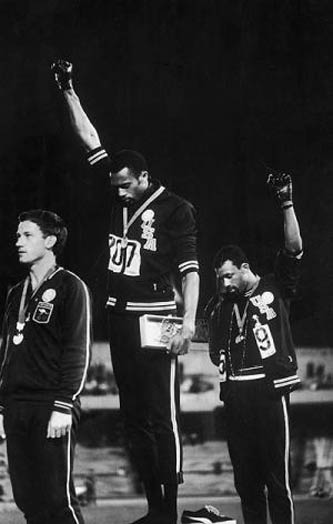
At the Mexico Olympics in 1968, this photograph of American athletes Tommie Smith and John Carlos standing on the victory podium with heads bowed and black-gloved fists raised in a Black Power salute in protest at racism in the USA, became the iconic image of the age.

1968_salute

In the fraught years since 1968, the weight of living through the aftermath put a heavy burden on the friendship of Carlos and Smith. In separate interviews with the Los Angeles Times it was revealed that they have barely spoken to each other since the early 1990s, despite living just a short drive apart in southern California. Smith described their relationship as “strained”. Carlos would call his former team-mate only “Mister Smith”.

Continue reading The meaning of “Obama” and the history of a friendship

Beyond violence and non-violence – K Balagopal

Via Jamal Kidwai

[We are posting this piece by K Balagopal, hoping to continue our reflections on violence and non-violence in political movements. – AN]

The public arena is witness to dispirited discussion of the ineffectiveness of people’s movements, which are at the most able to slow down things, and nothing more. The discussion often turns around violence and non-violence, not as moral alternatives but as strategic options. Those who are sick of sitting on dharna after dharna to no effect are looking with some envy at violent options,
while many who have come out of armed groups find the Narmada Bachao Andolan (NBA) fascinating.

It is good that there is some openness in the matter now, for dogmatic attitudes have done considerable harm. To say that one should not be dogmatic about violence may be morally a little unsettling but it is a defensible position even without adopting a relativistic attitude towards the preciousness of life or a casual attitude towards one’s moral responsibility for injury caused in the course of a struggle. More of that in the right context. But the
discussion will unavoidably be based on assessments  of the effectiveness of the alternatives, and a distant view is likely to colour the reality with hopes and assumptions, even illusions. A realistic assessment of what each strategy has been able to achieve would better inform the debate.

The plain and stark fact is that while all strategies have been effective in curbing some injustice, none has succeeded in forcing the government to take back a single major policy in any sphere. And none has been able to reverse the trends inherent in the structures of society and economy. Yet no serious political movement or social struggle we know of is only for softening oppression or improving relief. The general understanding is that governance of the country – and may be the systemic infrastructure of society – is fundamentally wrong and needs remedying, maybe overturning. Do we know of any
effective strategy for that? I am not talking of political strategies,
but strategies of struggle that will successfully put pressure upon the State and the polity to stop them in their tracks. The struggle may be built around class or caste or any other social combination. It may in the end seek reform or the upturning of the polity. It may operate mainly or in part within the polity or keep out of it altogether. Whichever it is, the common problem is this: the experience of this country is that governments do not stop doing some thing merely because it has been demonstrated to be bad. Or even contrary to constitutional directives and goals. They stop only if going along is made difficult to the point of near impossibility. No democratic dispensation should be thus, but Indian democracy is thus. Short of that, you demonstrate the truth of your critique till you are blue in the face or shout till you are hoarse in the throat, it is all the same.

Continue reading Beyond violence and non-violence – K Balagopal

Corporate Complicity and Gujarat

The 4th ‘Vibrant Gujarat Global Investors’ Summit, organized by the Gujarat government on 12-13 January 2009 in Ahmedabad, and the statements by some prominent Indian corporate leaders, have spawned protests, analysis, debates and questions about corporate accountability, complicity, responsibility and rights in Indian democracy. At this biennial event, ‘Jai Jai Garvi Gujarat’ has been showcased as an ‘ideal investment destination, both for Indian and foreign investors’, where prospective investors have ‘only Red Carpet and no Red Tape and it is where investors can sow a rupee and reap a dollar as returns’ (see Official portal of Gujarat Government).

Bringing together business leaders, investors, corporations and policy makers by a democratically-elected government, exploring business opportunities and signing memorandum of understandings are legitimate economic activities. However, the projection of the Chief Minister of the State, Narendra Modi, as the next Prime Minister of India by corporate cheerleaders is much more than mere economic activity. It is turning a blind eye to gross abuses of rule of law, and knowingly assisting a political leader and his government to continue committing them. It is becoming party to a specific political vision in a manner that incurs responsibility and blame. Such corporate leaders thus become complicit with a government and its leader in serious human rights abuses. It is negative and unacceptable.

Continue reading Corporate Complicity and Gujarat

“Why?”

(Uma Singh, a journalist with Radio Today in the southern town of Janakpur in Nepal, was killed on 11th January 2009. The Federation of Nepali Journalists has mounted a campaign asking for immediate action against Uma’a killers and a firm commitment by the government to the freedom of press. Uma’s killinng comes in the wake of attacks on different media houses in Kathmandu. Like Lasantha Wickrematunge in Sri Lanka, Uma was killed for writing and speaking fearlessly at the other end of Southasia.)

Janakpur: It was impossible to believe that Uma Singh at Ganga Sagar Ghat on Tuesday morning – an FNJ flag draped over her still body, face bandaged all across, the cuts on the head visible – was the same Uma I had met two months ago.

Uma’s looks were deceptive, for the tiny frame contained abundant energy. By the time I strolled into Radio Today’s studio at 6 am in mid-November, Uma had wrapped up her morning bulletin. She was running around the office and passing instructions in a matter-of-fact professional way

She briefed me on the format of Janakpur’s most popular Maithili political discussion show, Garma garam chai. I still remember how Uma said to both her co-anchor and me, “Please avoid English words. The programme is meant for people in villages.” I nodded, a little ashamed my Maithili was not as fluent. Continue reading “Why?”

Hindutva Terrorism in Karnataka

A Karnataka dacoit with links to a radical Hindu rightwing group has confessed to having carried out the Hubli district court bombing of May10, 2008.

The blast took place as the first phase of polling for the Karnataka Assembly elections was on – in a magistrate’s courtroom where cases against top SIMI leaders including Safdar Nagori were scheduled to be heard two days later.

(Dacoit with Hindu outfit links behind Hubli blast, Indian Express, January 13, 2009.

Does anybody remember the bomb blasts in Hubli (Karnataka, May 2008 ) courts last year when preparations were on for the coming state assembly elections? These blasts which took place on a holiday did not witness any casuality although they extensively damaged the court premises. But the most important part played by these blasts was the atmosphere it created in favour of the BJP.

As it always happens after any such mysterious sounding blasts, many innocents belonging to minority community were illegally detained and quite a few among them also were booked for their ‘role’ in the blasts. The police had promptly claimed that ‘sleeper cells belonging to LeT and SIMI’ had executed the blasts. Continue reading Hindutva Terrorism in Karnataka

The use of “Lese majeste” in Thailand against freedom of speech

Lese majeste literally means an offense or crime committed against the ruler or supreme power of a state – or, in other words, the crime of dissent. In Thailand, this provision is routinely used to silence any form of criticism of the government.

A recent case that has been brought to our attention is that of Associate Professor Giles Ji Ungpakorn, from the Faculty of Political Science, Chulalongkorn University. He is facing Lese Majeste charges for writing a book A Coup for the Rich, which criticised the 2006 military coup. He also wrote an article on the coup for Asia Sentinel. Others who have been accused of Lese Majeste are former government minister Jakrapop Penkae, who asked a question at the Foreign Correspondent’s Club in Bangkok, about exactly what kind of Monarchy they have in Thailand. There is also the case of Chotisak Oonsung, a young student who failed to stand for the King’s anthem in the cinema. Apart from this there are the cases of Da Topedo and Boonyeun Prasertying. In addition to those who opposed the coup, the BBC correspondent Jonathan Head, an Australian writer names Harry Nicolaides and social critic Sulak Sivaraksa are also facing charges. The latest person to be thrown into jail and refused bail is Suwicha Takor, who is charged with Lese Majeste for surfing the internet. The Thai Minister of Justice has called for a blanket ban on reporting these cases in the Thai media. The mainstream Thai media are obliging. Thus there is a medieval style witch hunt taking place in Thailand with secret trials in the courts.

A petition of protest in support of Giles is available here.

Chavez Expels Israel’s Ambassador, Becomes New Palestinian Hero

Via Liberation News Service

Venezuelan leader accuses Israel of being ‘murder arm’ of US, says solution to Gaza crisis is in Obama’s hand.
Report by Anna Pelegri of Middle East Online – BETHLEHEM, 12 January 2009

Demonstrators in Yemen
Portraits of Chavez carried by demonstrators in Yemen

“Venezuelan flags and portraits of President Hugo Chavez have been flying high during protests in the West Bank against Israel’s assault on the Gaza Strip”, says the report.

The report continues:

The Venezuelan president’s decision on January 6 to expel Israel’ ambassador from Caracas — the only country apart from Mauritania to take such a step — has made the left-wing South American leader a hero to Palestinians.

Hamas has welcomed Chavez’s “courageous decision,” while Hassan Nasrallah, head of Lebanon’s Hezbollah group, urged Arab states to follow the Venezuelan president’s example.

ग़ाज़ा, इस्राइल और इस्राइल बनने की मंशा

प्रणव मुखर्जी से किसी पत्रकार ने पूछा कि क्या भारत पाकिस्तान में वैसी ही कार्रवाई करेगा जैसी इस्राइल गाज़ा में कर रहा है. शुक्र है कि हमारे विदेश मंत्री ने  यह कहना ज़रूरी समझा कि इस्राइल की तरह भारत ने किसी और की ज़मीन पर कब्जा नहीं कर रखा है. इस सादे से तथ्य को कहना आजकल गनीमत है क्योंकि हमारे आदर्श बनते जा रहे अमरीका में फिलीस्तीनीयों को ही इस रूप में पेश किया जा रहा है मानो वे ही शांति से रहने वाले इस्राइलियों को चैन से नहीं रहने दे रहे. तो क्या यह मान लिया जाय कि हमारी याददाश्त भी ‘गजनी’ की तरह सिर्फ पंद्रह मिनट की रह गई है? क्या हम यह भूल गए है कि गाज़ा के उस पतली सी पट्टी में जो पिछले साठ  साल से पीसे जा रहे हैं वे एक ज़िओनवादी राज्य इस्राइल की स्थापना के लिए उनकी अपनी ज़मीन से उखाड कर फेंक दिए गए लोग हैं?

ग़ाज़ा पर इस्राइली बामबारी, सा�ार बीबीसी
ग़ाज़ा पर इस्राइली बामबारी, साभार बीबीसी

अगर हम साठ साल की बात को याद नहीं रखना चाह्ते तो क्या हम यह भी भूल गए हैं कि  अभी दो ही साल बीते हैं कि फिलीस्तीन की जनता ने हमास को चुनाव में बहुमत दिया था! क्या हमें यह भी याद दिलाना होगा कि हमास की चुनावी जीत को इस्राइल, अमरीका , युरोप और उनके पिट्ठू फतह ने मान्यता देने से इंकार कर दिया था?

एपी
बमबारी का एक और नज़ारा, तस्वीर: एपी

हमास एक आतंकवादी संगठन नहीं है, जैसा अमरीका और इस्राइल चाह्ते हैं कि उसे माना जाए, वह फिलीस्तीनी जनता का वैध प्रतिनिधि है. क्या चुनाव में उसकी जीत को मानने से इनकार  वैसा ही नहीं जैसा मुजीबुर्रहमान की जीत को मानने से तब की पकिस्तानी हुकूमत का इंकार ? उसका नतीजा था  पाकिस्तान का  विभाजन और बांग्लादेश के रूप में एक नए राष्ट्र का जन्म. यहां अंतर सिर्फ यह है कि हमास ने गाज़ा पट्टी पर संघर्ष के बाद नियंत्रण कर लिया. तब से इस्राइल के कहने पर अमरीका समेत पूरे विश्व ने हमास का बहिष्कार कर रखा है. क्या हम इसकी कल्पना कर सकते हैं कि भारत में भारतीय जनता पार्टी के चुनाव में जीतने के बाद उसकी राजनीति से असहमति रखने के कारण उसे मान्यता न दी जाए?

Continue reading ग़ाज़ा, इस्राइल और इस्राइल बनने की मंशा

Speech and silencing on the Right and Left

Lasantha Wickrematunge, the courageous editor of Sunday Leader, a weekly newspaper from Sri Lanka, was recently assasinated by the Sri Lankan state. Relentless in exposing corruption and human rights abuses, he was fully aware of the price he would have to pay. In a stunning editorial that he appears to have written for publication in the event of precisely such an eventuality, and which was published after his death, he directly accuses the government of killing him:

“It is well known that I was on two occasions brutally assaulted, while on another my house was sprayed with machine-gun fire. Despite the government’s sanctimonious assurances, there was never a serious police inquiry into the perpetrators of these attacks, and the attackers were never apprehended. In all these cases, I have reason to believe the attacks were inspired by the government. When finally I am killed, it will be the government that kills me.”

His words of farewell are defiant:

“If you remember nothing else, remember this: The Leader is there for you, be you Sinhalese, Tamil, Muslim, low-caste, homosexual, dissident or disabled. Its staff will fight on, unbowed and unafraid, with the courage to which you have become accustomed. Do not take that commitment for granted. Let there be no doubt that whatever sacrifices we journalists make, they are not made for our own glory or enrichment: they are made for you. Whether you deserve their sacrifice is another matter. As for me, God knows I tried.”

Meanwhile, in Nepal, the premises of Himal media were attacked by people identified as Maoist activists. Today the ‘bourgeois’ media, tomorrow – dissenting Left voices…?

Guantanamo and Illegal U.S. Detentions: Time for Real Change

[On the seventh anniversary of Guantanamo Bay, 11 January]

The United States detention facilities at Guantanamo Bay, Cuba – seven years old on 11 January 2009 – have become emblematic of the gross human rights abuses perpetrated by the US Government in the name of fighting terrorism. Though the U.S. President-elect Barack Obama has pledged to close down the Guantanamo Bay, there are undoubtedly substantial challenges to closing. Every day that Guantánamo is kept open is another day in which hundreds of detainees and their families are kept in the legal shadows. Distressing to the individuals concerned and destructive of the rule of law, the example it sets – of a powerful country undermining fundamental human rights principles – is dangerous to us all. It would be no less dangerous, and no less unlawful, if the USA were simply to transfer the problem it has created at Guantánamo to another locations.

Detainees at Guantanamo Bay

The detention facility at Guantánamo Bay isn’t the only prison where the United States is holding detainees from the ‘war on terror.’ At Bagram Air Force Base in Afghanistan, Camp Bucca and Camp Cropper in Iraq, and many more – some known and others secret – are used to detain those captured by the U.S. military. Camp Bucca alone has at times held 20,000 prisoners, most of whom live in groups of tents surrounded by wire. Most detainees are held unlawfully, without warrant or charge, and without recourse to challenge their detention. Even when Guantánamo is closed, the need to push for detainee human rights will continue.

Continue reading Guantanamo and Illegal U.S. Detentions: Time for Real Change

Character builders of the nation

‘Na Taala Toota na tijori, Phirbhi BJP Mukhyalaya se dhai karod chori.’
(Neither the lock was broken nor the safe, yet 2.5 crore Rs were stolen from the Party headquarters.)
– An SMS which was circulated widely in the journalist community.

What is the weight of Rs. 2.5 crore if one decides to have the whole amount packed in the denomination of Rs.1,000 notes ?

It is exactly 31 kilograms.

Please do not get surprised over my correct reply. I just wanted to share few details of the ‘theft’ at the headoffice of the main opposition party namely BJP which has appeared in different newspapers.

According to the treasurer of the party there is no cause of worry and once the ‘ankeshan” (auditing) is over then only something definite can be said about it. The latest news is that amount supposedly missing from the coffers has been reduced without any further explanation. Continue reading Character builders of the nation

In Cold Blood: Abuses by Armed Groups

India, Pakistan, Sri Lanka, Nepal, Bangladesh, Afghanistan, Iraq, Saudi Arabia, Israel and the Occupied Territories, Indonesia, Egypt, Jordan, USA, UK, Spain, the Russian Federation, to name a few, are a testimony to the cruel attacks on civilians and other human rights abuses in the recent past by non-state armed groups, including terrorist groups. They are showing utter disdain for the lives of civilians and others, continuing a pattern of serious crimes and crimes against humanity. They fail to abide by even the most basic standards of humanitarian law. The attacks and other abuses by armed groups are so frequent and the security situation so grave, that it is impossible to calculate with any confidence the true toll upon the civilian population, let alone the long term consequences that so many people inevitably suffer.

Continue reading In Cold Blood: Abuses by Armed Groups

Fight Terror – Stop Thinking

Oxford Book Store in Mumbai was visited by a cop about ten days ago, and offered a friendly caution to be “careful” about stocking books and CDs related to Pakistan, as the shop might be “targeted” after the recent terror strikes in Mumbai.

Trick question: The reason the cop dropped in was

a) to reassure the store that they would receive police protection in case such threats materialize

b) to pass on a message from Raj Thackeray

(Hint. Looks like there are two options, but there is only one)

Continue reading Fight Terror – Stop Thinking

Army wanted Abdullah, who’s surprised?

Ashish Sinha in Mail Today:

Any political decision on Kashmir — especially when the ball is in the Congress’s court — cannot afford to ignore the sentiments of lakhs of troops stationed here because, at least for now, they appear to be a more permanent fixture than any party, even the National Conference (NC). [Full text]

I told you so…

And Siddharth Varadarajan asks the right question:

But if these motives propelled the ISI to either mount or at best turn a blind eye to the Mumbai plot, why did the same agency — which essentially manages Rawalpindi’s links with militant groups active in Jammu and Kashmir — not seek to disrupt the assembly elections? [Here]

Protests in Israel against Gaza Attacks

We are all aware of the terrible toll of unarmed civilian casualties caused by the IDF (Israeli Defence Forces) air strike on Gaza a few days ago. It demonstrates yet again the willingness of those who currently hold power in Israeli to sabotage the chances of a lasting and durable peace with the Palestinian people. There is no other way to describe these air strikes other than as acts of gross state terrorism. Bombing unarmed civilians from the skies, including children is not a solution or an answer to terrorism. It is terrorism.

Of course, Hamas, (which controls the West Bank, and whose origins lie in the cultivation by Israel of an ‘Islamist Opposition’ within the Palestinian ranks in the eighties and earlier ) with its own obduracy has contributed to the ‘blowback’ that holds the peace process in Israel-Palestine hostage to a never ending cycle of competitive retribution.

Continue reading Protests in Israel against Gaza Attacks