Category Archives: Right watch

Ambedkar’s Ideology – Religious Nationalism and Indian Constitution: Ram Puniyani  

Guest Post by RAM PUNYANI

In order to gain larger legitimacy, RSS has been making claims of sorts. One of that which was made few months back was that Gandhi was impressed by functioning of RSS. Now on the heels of that comes another distortion that Ambedkar believed in Sangh ideology (Feb 15, 2015). This was stated recently by RSS Sarsanghchalak, Mohan Bhagwat. There cannot be bigger contrasts between the ideology of Ambedkar and RSS. Ambedkar was for Indian Nationalism, Secularism and social justice while the RSS ideology is based on two major pillars. One is the Brahmanic interpretation of Hinduism and second is the concept of Hindu nationalism, Hindu Rashtra.

Where does Ambedkar stand as for as ideology of Hinduism is concerned? He called Hinduism as Brahminic theology. We also understand that Brahmanism has been the dominant tendency within Hinduism. He realized that this prevalent version of Hinduism is essentially a caste system, which is the biggest tormentor of untouchables-dalits.

Continue reading Ambedkar’s Ideology – Religious Nationalism and Indian Constitution: Ram Puniyani  

हिन्दुत्व की प्रयोगशाला बनता दिल्ली विश्वविद्यालय: जीत सिंह सनवाल

Guest post by JEET SINGH SANWAL

केन्द्र में भाजपा के नेतृत्व में सरकार बनने के बाद से राष्ट्रीय स्वयं सेवक संघ का राजकीय शिक्षा नीतियों से लेकर शिक्षण संस्थाओं के क्रियाकलापों में बढ़ता हस्तक्षेप किसी से छुपा नहीं है। शिक्षा नीति में बदलाव लाने व इस बाबत मानव संसाधन विकास मंत्रालय को सुझाव व विश लिस्ट सौंपने में संघ ने काफी तत्परता दिखाई है। कई मीडिया रिपोर्टों के अनुसार संघ ने प्रत्यक्ष व अप्रत्यक्ष रूप से उनके लिए काम करने वाले तमाम लोगों की लिस्ट सरकार को भेजकर शैक्षिक व सांस्कृतिक संगठनों में उनकी नियुक्ति की मांग की। आशा के अनुरूप पिछले दस माह के भाजपा सरकार के कार्यकाल में विभिन्न संगठनों मेें कई सरकारी नियुक्तियां की गयी और संघ विचाराकों को अपेक्षा से अधिक सम्मान देकर ताजपोशी की गयी। नागपुर के एक प्रतिष्ठित संस्थान में डायरेक्टर पद पर नियुक्ति पाने के लिए तो एक व्यक्ति ने अपने संघ से जुड़े होने के प्रमाण प्रस्तुत करते हुए संबंधित मंत्री को नियुक्ति हेतु आवेदन किया। आशा के अनुरूप मंत्रालय ने भी उन्हीं की नियुक्ति की।

शैक्षिक व सांस्कृतिक संगठनों में इस प्रकार के हस्तक्षेप के पीछे संघ की बुनियादी रणनीति है। प्रख्यात मानवाधिकार कार्यकर्ता राम पुनियानी के अनुसार संघ पहले से ही प्रगतिशील शैक्षिक व सांस्कृतिक विमर्श को बदलकर अपना राजनैतिक आधार मजबूत करने में विश्वास रखता है। दिल्ली विश्वविद्यालय के प्रो0 अपूर्वानन्द के अनुसार संघ की यह रणनीति शिक्षा के अज्ञानीकरण की ओर जाता है। भा.ज.पा. को पूर्ण बहुमत मिलने व संघ के प्रचारक का प्रधानमंत्री बन जाना, उनकी इस रणनीति को आगे बढ़ाने के लिए मुफ़ीद है। विभिन्न शैक्षणिक व सांस्कृतिक संगठनों में पिछले कुछ महीनों से हो रहे इन बदलावों में दिल्ली विश्वविद्यालय का उदाहरण काफी अलग है। संघ दिल्ली विश्वविद्यालय में शोध, शिक्षण के साथ-साथ छात्रों के मोबिलाईजेशन के जरिये, अपने विवादास्पद एजेंडे को धार देने का प्रयास कर रहा है। संघ की विचारधारा व उनके कार्यक्रम पहले से ही विवादों में रहे हैं। उनके उग्र हिन्दुत्व व अल्पसंख्यकों से वैमनस्य किसी से छुपा नहीं है। ऐसे में दिल्ली विश्वविद्यालय में संघ की बढ़ती औपचारिक व अनौपचारिक सक्रियता, विश्वविद्यालय व बौद्विक जगत के लिए चिंता का विषय है।  Continue reading हिन्दुत्व की प्रयोगशाला बनता दिल्ली विश्वविद्यालय: जीत सिंह सनवाल

Land Acquisition and Delays Over Democracy: Shubham Jain, Sarangan Rajeshkumar, Dhruva Gandhi

Guest post by SHUBHAM JAIN, SARANGAN RAJESHKUMAR and DHRUVA GANDHI

The Right to Fair Compensation and Transparency in Land Acquisition, Resettlement and Rehabilitation Act, 2013 was passed with Objective to promote transparency and participative governance in the acquisition of land for industrialisation and urbanisation and to, thereby, ensure overall socio-economic development. In the pursuit of this objective, the law introduced mechanisms as Social Impact Assessment, Consent, and Rehabilitation et al.

This law, however, attracted widespread criticism from the industry on account of the supposedly time consuming barriers created for the acquisition of land. Accordingly, the Ordinance of 2015 was promulgated as a measure to hasten the process of Land Acquisition and to, thereby, contribute towards the economic development of the country. Unfortunately, most of the debate on this Ordinance has barely focussed on the problems it sought to address and, consequentially, there has been a dearth of an analysis of solutions proposed therein in the backdrop of these problems. Let us, therefore, contextualise the debate on the Ordinance and, then, examine the merits of the same. Continue reading Land Acquisition and Delays Over Democracy: Shubham Jain, Sarangan Rajeshkumar, Dhruva Gandhi

“Those Backward People” – Arun Jaitley and a Long Ugly History

Two days ago, Finance Minister Arun Jaitley sought to make a special mention of “poor, dalits, tribals, backwards, those who are landless.” The occasion was the the Land Acquisition Bill, which,

“we are bringing, as per that the industrial corridors which would be set up in the country, those backward people, the 300 million landless people would get employment opportunities,”

First, Mr Jaitley, what exactly is the mechanism your government proposes by which the “backwards” released from the land will be absorbed into industry? Is there a guarantee by the industry owners? Is there a provision for skill training in the same industrial corridors? Are there ITI institutes being set up? Forget these, is even primary or secondary education going to be expanded so that farmers’ children, at some point in the distant future can take advantage of the supposed industrial boom? Continue reading “Those Backward People” – Arun Jaitley and a Long Ugly History

Updating of “National Register of Citizens” and Recent Political Developments in Assam: Abdul Kalam Azad

Guest post by ABDUL KALAM AZAD

On 21st July, 2010 one of my close family relatives, Mydul Mullah (25) was one among the thousands of marginalized Muslims of Barpeta district who were demonstrating in front of Deputy Commissioner’s office at district headquarter demanding an error-free fresh NRC (National Register of Citizens). Eventually, police brutally cracked down on the picketers and fired upon them for the ‘crime’ of exercising their democratic right to peacefully protest. After the police firing Mydul Mullah along with his three comrades Khandakar Matleb (20), Siraj Ali (27) and Majam Ali (55) succumbed to the bullet injuries. The Tarun Gogoi led Assam government was forced to suspend the faulty NRC pilot project due to unprecedented public outrage.

The question of ‘illegal migration’ from Bangladesh has been one of the most significant and emotive topics in the political milieu of Assam for almost half a century now. .

The six-year long movement (1979-1985) against illegal immigration, popularly known as the Assam Movement, spear headed by All Assam Students Union claimed itself to be a secular and nonviolent new social movement of ‘indigenous’ people to drive out the illegal immigrants. But analyses of scholars and social scientists like Prof. Hiren Gohain, Prof. Monirul Hussain, Dr. Debabrata Sarma, Diganta Sarma etc. reveal that as soon as the Assam movement accommodated right wing RSS workers into its leadership, the whole movement turned against Muslims of Bengali origin in Assam. Heinous massacres like that of Nellie, Chaolkhuwa, Nagabandha etc. were orchestrated against Muslims of Bengali origin and in broad day light thousands of people were killed. After six years of deadlock, the movement culminated in the signing of the ‘Assam Accord’ with the Government of India in 1985. The accord says that the immigrants, who came to Assam after 25th of March, 1971 will be detected and deported from Assam. One of the mandates of the accord was to update the 1951 National Register of Citizen to facilitate identification of illegal immigrants from Bangladesh in Assam.   Continue reading Updating of “National Register of Citizens” and Recent Political Developments in Assam: Abdul Kalam Azad

Ban-man on the prowl again: Malvika Sharad

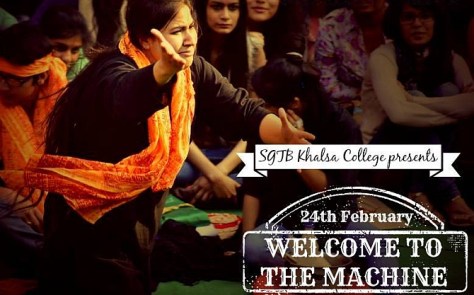
Guest Post by MALVIKA SHARAD on the recent call by Delhi University Students’ Union for a ban on the street play by Khalsa College theatre group, Ankur.

24lead6

Image courtesy rediff.com

One evening in 2013, a group of ‘street play seniors’ as we call them, visited us in the front lawns of my college, Lady Shri Ram College for Women. They were from various colleges across DU who had been actively involved in street theatre, and had been invited to give the newly formed street play team of that year, an introduction to the art form. Among those seniors was a dynamic young chap from Khalsa College, who reiterated several times that street theatre fills you with such immense courage that you end up doing things you never thought you would, for that courage comes from the sheer truth and brutal honesty that street theatre is based upon. He said that freedom of expression is taken to a whole new level when you perform amidst crowds, and state the truth looking directly into their eyes. A fire is born within you that cannot be extinguished, it burns brighter with every performance of the play. You become fearless in voicing your opinions and thoughts, so fearless that you don’t even realize how far you have pushed your own limits and emerged triumphant.

After a whole year dedicated to doing street plays in Delhi, I have learnt how right he was, that young student not much older than us. I find I have come out of my shell, shedding my inhibitions at a pace and scale I had never imagined. Torn chappals don’t bother me anymore, my sun-burned skin makes me look beautiful, I don’t flinch with embarrassment while sitting, sometimes lying, on the floor of the metro station out of sheer weariness, though co passengers stare at me with judgemental eyes, I can’t bring myself to stop romanticizing the mud and the dirt that hug me every time I wear my soiled street play kurta… But above all, I can articulate my thoughts properly now, I am not scared of speaking in public unlike the times when I was a meek docile person, cocooned in the comforts of home and parental pampering. I owe this change in my attitude and personality to street theatre, which taught me what it is to live confidently and fearlessly.

Continue reading Ban-man on the prowl again: Malvika Sharad

CPDR Statement on Maharashtra Cow Slaughter Ban

Committee for the Protection of Democratic Rights, Mumbai
THE MAHARASHTRA ANIMAL PRESERVATION (AMENDMENT) ACT, 1995
18 March 2015

As if the 1976 Maharashtra Animal Preservation Act banning the slaughter of cows, including the male and female calf of the cow, enacted by the Shankarrao Chavan-led Congress government during the Emergency was not enough, the Devendra Fadnavis-led Bharatiya Janata Party-Shiv Sena government is elated that the 1995 Maharashtra Animal Preservation (Amendment) Act, enacted by a previous BJP-Sena led by Manohar Joshi, that extends the ban to include slaughter of bulls and bullocks, has now received presidential assent. Despite the BJP’s claims justifying the ban on agro-economic grounds, among others, the driving force behind the prohibition is the ideology of Hindutva, presented as “a way of life” rooted in the central beliefs of neo-Vedantic Hinduism, of which cow slaughter and beef eating are supposedly anathema.

Continue reading CPDR Statement on Maharashtra Cow Slaughter Ban

People’s Union for Democratic Rights Condemns Bans on Cow Slaughter

Statement by People’s Union for Democratic Rights 
On March 16th 2015, the Haryana Government unanimously passed Haryana Gauvansh Sanrakshan and Gausamvardhan Bill with main opposition parties INLD and Congress supporting the Bill. The new bill passed by the Haryana Government bans cow slaughter and sale of beef and imposes a punishment of rigorous imprisonment of not less than three years extending up to 10 years and fines ranging from Rs. 30,000 to Rs. one lakh. The Haryana Government’s move comes just days after the President’s assent to Maharashtra Animal Preservation (Amendment) Bill 1995 early this month. Maharashtra Animal Preservation (Amendment) Bill 1995 not only banned beef but also extended the prohibition to slaughter of bulls and oxen. There was already a ban on slaughter of cows in Maharashtra since 1976.  The new amended act imposes a fine of Rs. 10,000 and a maximum prison term of five years for selling or even possessing beef.
What needs to be underlined here is that these bans on cow slaughter are not new; they were in existence in many of the states for many-many years. For example in Delhi, Bihar, Andhra Pradesh, slaughter of cows and calves is totally prohibited. In Goa and Andhra Pradesh, ‘cow’ is defined to include heifer, or a male or female calf of a cow under the Goa, Daman and Diu Prevention of Cow Slaughter Act 1978 and Andhra Pradesh Prohibition of Cow Slaughter and Animal Preservation Act 1977, respectively. In some states like Karnataka, Andhra Pradesh, Goa and Madhya Pradesh slaughter of bulls, bullocks and adult buffalos is permitted on ‘fit for slaughter’ certificate if the cattle is over 12 or 15 years of age, is not likely to become economical for draught, breeding or milk. Assam and West Bengal provides for slaughter of all cattle which includes bull, bullocks, calves, cows and buffalo on ‘fit for slaughter’ certificate. Meghalaya and Nagaland have no legislation to this effect.

Continue reading People’s Union for Democratic Rights Condemns Bans on Cow Slaughter

Dealing with ‘sexist pigs’? Reflections on the feminist protest against AIB’s Avish Mathew at National Law University, Delhi: A Statement

A statement from concerned students and teachers

What does one do sitting in the middle of an audience roaring with laughter at jokes that one might find downright humiliating? Laugh along, retire hurt, or ask people to stop? It’s a dilemma that many of us on the ‘wrong’ side of various lines of privilege (caste, class, gender, race) and those sensitive to these divisions often find ourselves in. Some students at the National Law University, Delhi seem to have been put in a similar situation when during their annual college fest, comedian Avish Mathew of AIB Roast fame would not stop amusing his audience with one offensive joke after another. They first decided to walk out and then came back with a placard saying, “Get out you sexist pig!”

Continue reading Dealing with ‘sexist pigs’? Reflections on the feminist protest against AIB’s Avish Mathew at National Law University, Delhi: A Statement

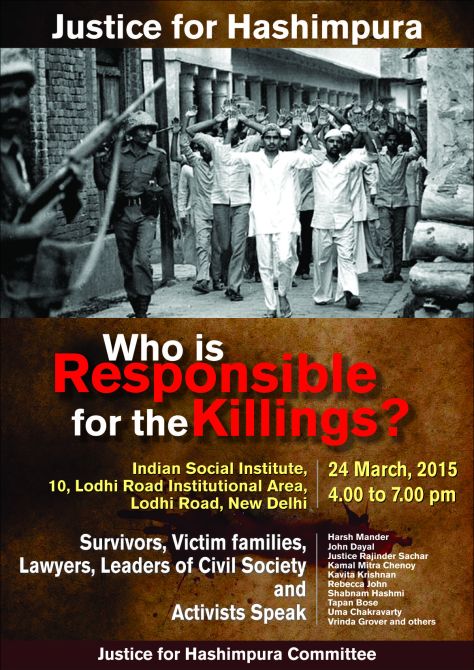
Justice for Hashimpura!

hashmipura killing Poster (1)

Widespread Protests in Dhaka Against Avijit Roy’s Killing by Muslim Extremists

Killing of Avijit Roy, image courtesy Sudin Chattopadhyay
Standing up to the killing of Avijit Roy, image courtesy Sudin Chattopadhyay


Soon after this brutal killing of the Bangladeshi-American atheist blogger, protests have begun across Dhaka. We extend our support to the struggle against the dangerous forces of religion-inspired extremism. See more detailed report in Al Jazeera here and The Guardian here.

B'desh protests against killing
B’desh protests against killing, image courtesy The Guardian

धर्म की आड़ में महिला अस्मिता पर प्रहार: जीत सिंह सनवाल

Guest post by JEET SINGH SANWAL

उन्नाव (उ.प्र.) से भारतीय जनता पार्टी के सांसद साक्षी महाराज ने पिछले माह हिन्दू धर्मावलम्बी महिलाओं को चार-चार बच्चे पैदा करने की सलाह देकर हिन्दुत्ववादी संगठनों की वर्षों पुरानी ख्वाहिश को मानो एक जीवनदान दे दिया। इस बयान के बाद तमाम हिन्दुत्ववादी संगठनों ने धर्म की दुहाई देते हुए महिलाओं को ज्यादा से ज्यादा बच्चे पैदा करने की सलाह देने के लिए मोर्चा संभाल लिया। कुछ लोगों ने तो आठ और कुछ ने दस-दस बच्चों को पैदा करने तक का आह्वान कर दिया। कई वर्षों से विश्व हिन्दू परिषद इस विषय को मुद्दा बनाये हुए है लेकिन साधारण जनमानस ने उसे कोई महत्व नहीं दिया। भाजपा के नेताओं द्वारा इस तिरस्कृत मुद्दे को उछालने के बाद इस तरह के तमाम संगठनों ने इसे हाथों-हाथ लेते हुए एक व्यापक मुद्दा बनाने का प्रयास किया।

महत्वपूर्ण बात यह है कि वी.एच.पी. से संबंधित साध्वियों को यदि छोड़ दें तो महिलाओं से संबंधित इस मुद्दे पर यह बहस पुरुषों ने शुरू की है। महिलाओं को संबोधित करने वाले ये बयान महिलाओं पर अधिकार जमाने वाले पुरूष मानसिकता का प्रतिरूप है, जिसमें महिलाओं की स्वतंत्रता, इच्छा, अधिकार, समानता व आत्मसम्मान की कोई जगह नहीं है।

इस मुद्दे की जमीनी सच्चाई तो यह है कि ऐसे  बयानों के बावजूद भारतीय महिलाओं ने प्रजनन दर को कम रखने को प्राथमिकता दी है। जनसंख्या निदेशालय के आंकड़ों के अनुसार भारत की कुल प्रजनन दर जो 1971 में 5.2 थी वह घटकर 2013 में 2.3 हो गई। धार्मिक भावनाओं केा भड़का कर इन महिला विरोधी बयानों को तूल देने की इस प्रक्रिया में चिंता इस बात की है कि इसमें धर्म के ठेकेदारों के साथ-साथ सत्ता पक्ष से जुड़े राजनेताओं ने भी मोर्चा संभाला हुआ है। छिट-पुट विरोधों के अलावा प्रगतिशील मंचों से इस तरह के बयानों की कोई खास आलोचना न होने से भी इन संगठनों व लोगों के हौसले बढे  हैं।  Continue reading धर्म की आड़ में महिला अस्मिता पर प्रहार: जीत सिंह सनवाल

A Chance for Social Change Like Never Before: Shankar Gopalakrishnan

Guest post by SHANKAR GOPALAKRISHNAN

For those who don’t like Modi-Sangh politics, February 10th was a day of joy. When this note was drafted a month ago, the provisional title was “This is No Time for Despair.” But last Tuesday has not only dented Modi’s invincible image – it has also dented the sense of being besieged. Since May 2014, almost every progressive force in the country has been on the defensive. The AAP’s politics and the popular tsunami that drove it to power have shattered this gloom.

But the key question at this point – is the eventual defeat of the NDA in an election the only goal? I argue that here that that is just the beginning. The end of this period – which, notwithstanding February 10th, is obviously some time away – will offer a space that has not existed in Indian politics in decades. Whether that space gets used or not will depend on how the struggle develops in the interim period.

The potential of this period is rooted in three basic flaws that the current ruling coalition (between big business and the Sangh) suffers from. First, its key forces are fundamentally myopic and delusionary in character. Second, it is internally contradictory – the two pillars of this formation will undercut each other in organisational (not just political or rhetorical) terms. Finally, it embodies a peculiar combination of organisational strength and political weakness. Continue reading A Chance for Social Change Like Never Before: Shankar Gopalakrishnan

Vandalism – The Perfect Solution To Communalism! Nandini Rao

Guest Post by  NANDINI RAO

Thank you, unknown-vandals-out-there.

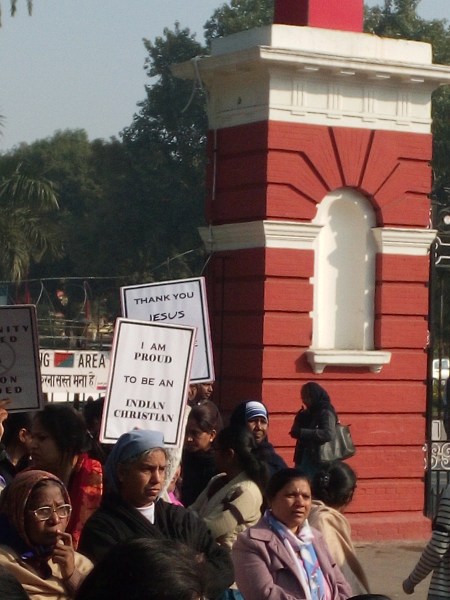
For burning church altars to ashes; for desecrating sacred objects inside houses of worship, for tossing carcasses inside religious places; for converting, de-converting, un-converting or re-converting (as the case may be); for stealing objects from churches that are more valuable to their parishioners for their emotional significance rather than monetary value. For making people ask in hushed tones when and where the next attack is going to take place and what form it will take. For making the pastor conduct midnight mass on Christmas eve outside the church in Delhi, with the faithful offering their prayers in the freezing winter night, simply because they did not have a church to go to.

But most of all, thank you for frightening communities who follow different religions and worship different gods. As for those who do not believe in god or religion, thank you for making them worried about how the social fabric of this country is being pulled apart, thread by thread, through political machinations.

IMG_20150205_094537

Because by doing all of the above, the unknown vandals (they are, needless to say, not criminals, just harmless “vandals”) have made people stop in their tracks and think. They have made communities question law enforcement agencies that brush aside fears and doubts and try to minimise the crimes taking place in their houses of worship. They are compelling them to discuss and debate about forced versus consensual conversions to religions of one’s choice. They are making people of all communities and religions realise how they are being pitted against each other and used as pawns in devious political games. They understand that, in the bargain, it is the poor and the marginalised living on daily wages who are being exploited in the worst possible way. People are realising the importance of their vote and of the very real impact they can make and the change they can bring about, with the single act of pressing a button.

Vandalism has made people come together to hold meetings and consultations to chart out a course to resolve the crises. It has made them stand outside their churches on pavements and on roads, demanding justice and accountability from a state and administration that does not seem to be heeding their voices.

And most important of all, vandalism is teaching us (more than political speeches and advertisements) how one needs to keep on asserting till our voices are heard that we are all citizens in a secular, socialist and democratic republic. That as believers and non-believers, we may worship (or not worship) in varied ways and learn from the teachings of one holy book (or a multitude of books and philosophies), but as citizens, our Holy Book is only the Constitution of India and what it has defined for us, as Indians.

Continue reading Vandalism – The Perfect Solution To Communalism! Nandini Rao

Open Letter to Hindu Mahasabha – we’ll be there on February 14th!

GET READY TO MARRY! 

To the National President, Akhil Bharat Hindu Mahasabha

Dear Chandra Prakash Ji,

It has come to our notice that  you and your self-appointed brigade of protectors of ‘Bharatiya Sanskriti’ have openly vowed to undertake a massive programme on the 14th of February where you promise to marry off anyone who openly expresses their love, whether on the streets or on Facebook. Since you have taken on this gigantic task of marrying so many people on a single day, we would like you to answer some questions that have ‘unnaturally’ crept into our heads as a result of ‘westernization’.

5d67984a9261b26c3a10a7214ddf55d3

Will you marry a boy to a boy he likes, or a girl to a girl?  Will you acknowledge their love for each other, repeal section 377? Or will you send them to jail or Baba Ramdev? Continue reading Open Letter to Hindu Mahasabha – we’ll be there on February 14th!

An Election of Hope Versus Fear

Yes it’s a simplistic dichotomy, but there is really no better way to describe the current Delhi elections. On the one hand, a little ragtag army of Davids behind “Mufflerman”, as his faithful supporters affectionately call him, a person in baggy sweater and sneakers, one you wouldn’t look at twice if you passed him on the road.

Mufflerman Business Standard

  Kejriwal

On the other hand, a massively funded, aggressively confident Goliath, openly backed by the corporate bodies and full-page ads, riding a  national “Wave” higher than most Tsunamis, topped by the 56-inch chest of “Modiman”, even if recently modestly covered by a 12-lakh rupee vest.

56-inch Modi78c0d4d3-be9e-4afb-b034-1247529df720wallpaper1

On the one hand, a fearful and awed media establishment donating PR for free to the seemingly invincible King of Gujarat, and on the other, an aam aadmi, a volunteer-cadre run campaign and a palpable vibe of trust and openness on the ground. I know I know, some will say it’s all ‘perception management’ and PR, but barring the googly of the 2 crores party donation thrown at the opportune moment, if Mufflerman’s party was any cleaner, it could have given Lalita ji’s Surf a run for its money. Whatever the result on the 10th (and there is reason to be hawk-eyed about the possibility of tampering as Nivedita Menon’s post has urged), how does anybody not get what a miracle this alone is, in a political economy with a black economy of a size that is higher than the GDPs of most smaller countries? Perhaps this is in fact about hope and fear after all, however clichéd that sounds.

Continue reading An Election of Hope Versus Fear

Statement protesting arrest of Shirin Dalvi, Editor, Awadhnama

We, members of the Mumbai based human rights group Hum Azaadiyon Ke Haq Mein  are disturbed at reports of the multiple cases lodged against Shirin Dalvi, the editor of Awadhnama, Mumbai, and her arrest by Thane district police on January 28, for publishing a news-item on the Charlie Hebdo issue and one of the covers of the magazine on January 17, 2015. We are also shocked at the reports of the continual harassment of Shirin Dalvi.

Responding to readers’ views, she issued a clarification denying any intention to hurt religious sentiments and tendered a public clarification the very next day. However, cases have been registered against her in different police stations in Mumbra and Rabodi (Thane district), Malegaon and Mumbai on charges of violating Sec 295 of the Indian Penal Code (outraging religious feelings by insulting a religion with malicious intent).

While she has sought, and obtained, anticipatory bail in one set of cases from Mumbai Additional Sessions Court judge S D Tekale on January 23, she was arrested in Mumbra, Thane district, and granted bail the same day on Jan 28.

The Mumbai based human rights group Hum Azaadiyon Ke Haq Mein is disturbed at the attempts made to defame her character. Baseless statements appeared in several Urdu newspapers that a colleague had tried to dissuade her from using the Charlie Hebdo cover but the colleague identified was actually not even in office on that day and had resigned a few days ago. Other attempts to defame her included statements that she had joined the RSS women’s wing and was a ‘follower’ of Bangladeshi writer in exile Taslima Nasreen!

Shirin Dalvi is a respected journalist with more than 20 years of experience in Urdu journalism. She is perhaps the only woman editor in Urdu journalism in India, has written on issues concerning women’s rights and politics and is well-known for her literary skill and learning.

The manner in which she is being hounded bodes ill for free debate and discussion and for peaceful resolution of controversy. Besides, the incident is also being used as a pretext to ratchet up polarized public opinion, which is a dangerous game and detrimental to freedom of speech and expression in a democratic society, besides causing immense personal harm and a threat to her life and safety.

We request those who have filed cases against her to accept her clarification in the right spirit with which it has been given and to withdraw all the cases against her.

We also demand that Shirin Dalvi be provided necessary protection forthwith.

sd/-
Hasina Khan
Dr. Ram Puniyani
Adv.Irfan Engineer – Director, Centre for Study of Society and Secularism
Javed Anand – General Secretary, Muslims for Secular Democracy
Sukla Sen
Ammu Abraham
Sameera Khan
Nasreen Fazalbhoy
Mario D’Penha
Divya Taneja
Kamayani Mahabal
Geeta Seshu
Brinelle D’souza – Tata Institute of Social Science
Teesta Setalvad, Editor, Communalism Combat
Rukmini Sen, Hillele Combat TV
Veena Gowda
Anjali Kanitkar
Saaz Shaikh
Rohini Hensman
Chhaya Datar
Susan Abraham
and members and organisations of Hum Azaadiyon ke Haq Mein

Beware BJP’s Filthy Campaign and Desperate Bid to Steal the Elections!

Avam characters

As the AVAM drama unfolds and much more detective work remains to be done, some other disturbing news has also started trickling in. A journalist friend got a mail from an official yesterday, who confided to this journalist:

Dear Sir,
We would like to bring to your notice that our volunteer Mr. XYZ (name withheld for obvious reasons) has attended the preparation of Electronic Voting Machine on 31st January & 1st February and he noticed some discripencies in the EVMs of Booth No. 26, 47A, 75 & 87.
Whichever button he was pushing the vote was being casted in favour of BJP only.
However, after his objection the EVM machines were replaced.

We of course, do not know how many such machines there are.

Meanwhile, another friend – an academic – sent this mail, which tells us something of the sense he got from a tour around Delhi areas – along with his deep suspicion that once again, through some machinations, the elections may be stolen:

This is just to tell you that I accompanied two journalist friends to go on an election tour of Delhi (targetting trader bases with BJP support) and most of the people that we talked to openly supported AAP. Attitudes to Modi ranged from indifference to criticism for blabbering away and not doing anything to plain abuse. Many have started identifying the BJP as a “syndicate” party i.e. as a party of rich businessmen. Above all people think that the 49 day government was a period they felt empowered – and they compare it to the lack of any improvements under Modi for the last 8 months!

This still does not let me lose my belief in the worst: But it gives me a warm feeling when I keep my fingers crossed!

Continue reading Beware BJP’s Filthy Campaign and Desperate Bid to Steal the Elections!

Indian Democracy and the Current Political Dispensation: Ram Puniyani

Guest Post by RAM PUNIYANI

Text of the Dr Asghar Ali Engineer Memorial Lecture

I begin this lecture paying tribute to my very dear friend, Dr. Asghar Ali Engineer, with whom I had the rare privilege of working with for close to two decades. Dr. Engineer was a unique scholar-activist, totally committed to the dream and vision of a humane society that honours the values of diversity and where human rights for all are the defining point.

In this regard, he may have been among the first persons who realized the dangers of divisive communal politics. It was he who set the trend seeking the causal factors behind communal violence, doing his own meticulous investigation after such riots. He contributed massively to reforms that took place in the Bohra community, on the issues of secularism and finally, in the interpretation of Islam. We need to learn a lot from him in order to strive for a society that values peace, amity and compassion.

Where are we standing today? What are the major threats to Indian democracy, today, even more menacing with the coming of the Modi Government?

The factors contributing to his victory have been several. The unstinted support given to him by India’s corporate; the fanatical zeal of the RSS and its lakhs of volunteers; the role of a corporate controlled media; the false projection of the ‘Gujarat model of development’; and the polarization of society along religious lines

The promise of Achhe Din – Good Times – has vanished into thin air. Despite the steep fall in the prices of crude oil in the world, the overall ‘cost of living’ continues to going up. The promise that all the black money stacked abroad will be brought back within six months or so and that we would be surprised to see 15 lakh deposited in our accounts, has been forgotten. The pattern of (good?) governance is only visible in the centralization of power around one person, Modi. Gradually the cabinet system of governance is giving way to one man’s autocratic ways, with secretaries of Government departments reporting directly to the PM.  Continue reading Indian Democracy and the Current Political Dispensation: Ram Puniyani

Modi, Barack and a once sovereign nation

The sheer misery, the excruciating embarrassment, of  watching the Prime Minister of a sovereign (but not secular or socialist) nation desperately, inappropriately, capering about to show off his imagined intimacy with an American President who steadfastly kept his distance and his dignity, is now passing. Time does heal all wounds. (And hopefully, as Groucho Marx put it, Time will also wound all heels) [1]

But the burning question remains – is Modi more shameless than he is ignorant? Much has been said about Modi’s suit that exceeds the worst excesses of the late unlamented Marie Antoinette. Vrinda Gopinath points out:

While the last world leader to don such a suit (it costs around 15,000 sterling pounds or Rs 15 lakhs today) was deposed Egyptian tyrant Hosni Mubarak, it certainly out-dazzled Obama’s working dark grey suit (to cut down on non-vital decisions, the US Prez only wears grey and blue ). However, if Modi was thinking hip-hop bling and ice accessories (his fave diamond Movado watch), it certainly got Obama to make a mention at the President’s banquet when he foxily pointed out how a newspaper back home wrote, “Move aside, Michelle Obama. The world has a new fashion icon.” It must have not passed Obama’s notice that Modi had changed his attire thrice that day.

securedownload

Continue reading Modi, Barack and a once sovereign nation

PK, satire, ramzadas: Prabhat Kumar

Guest Post by PRABHAT KUMAR

download

Commenting on a Hindi film released a month ago is a difficult enterprise, but this ‘delayed’ review of PK highlights what the film critics so far have ignored. Through intelligent crafting of its narrator-figure and its satirical narrative, I argue, this astoundingly successful Hindi film questions the ordinary and banal of Indian public life. The political vision behind PK’s satirical attack is old but relevant: Nehruvian.

Breaking the grammar of normalcy, Pee Ke!

Oye Pee Ke hai kya?” (Are you drunk?), is the dismissive riposte that PK, protagonist-narrator, of the film receives for questions he asks. For, the questions he asks are considered ‘abnormal’. But he is persistent with his ‘odd’ queries and prying gaze, like a drunken man, unmindful of the wrath he may invite from the sober and normal beings. He is tireless and gawking in his ‘weird’ interrogations, like a curious child, unaware of the risk of irreverence to mature beings. But, why does he ask such ‘strange’ questions? What makes his questions ‘unheard-of’ and his snooping eyes ‘clumsy’ in normal everyday life? Why is his ‘drunken-childish’ probing inadvertently insistent to confront the normalcy of mature world? The answer lies in the carefully crafted lead character and the political subtext that inform PK. Continue reading PK, satire, ramzadas: Prabhat Kumar