Category Archives: Sex

Why the Govt’s Ordnance is Fraud & Mockery of the Justice Verma Committe Recommendations: Bekhauf Azaadi Campaign

Guest post by BEKHAUF AZAADI CAMPAIGN

The UPA Govt, in a Cabinet meeting held on 1 February, has introduced an ordinance that it claims will address the most urgent concerns on sexual violence. In fact, the Government has been completely reluctant to acknowledge and implement the Justice Verma Committee recommendations: the PM refused to accept it from Justuce Verma, the Ministry of Home Affairs removed it from their website, the Govt never adopted any transparent process of discussion to decide the way forward on implementing the recommendations, rather they said Justice Verma ‘exceeded his brief’. Now, they claim that their ordinance has ‘implemented’ the Justice Verma recommendations. Is this true?

The fact is that the Government’s ordinance is a mockery of the letter and spirit of the Justice Verma recommendations. Why? Let us take a closer look.

Continue reading Why the Govt’s Ordnance is Fraud & Mockery of the Justice Verma Committe Recommendations: Bekhauf Azaadi Campaign

Water Cannons, Tear Gas, Ordinance: How the State Responds to Protests Against Rape and the Justice Verma Committee

20130203-075541.jpg

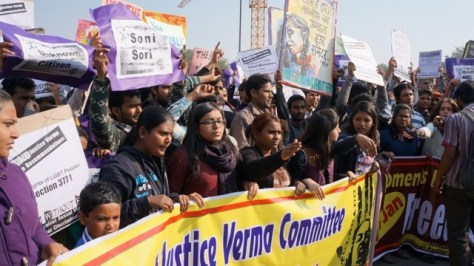
  • [ Protestors from the Bekhauf Azaadi/Freedom Without Fear Campaign Demanding Complete Implementation of the Justice Verma Committee Recommendations during the Freedom Parade to Reclaim the Republic on Republic Day, 26 January, 2012 in New Delhi. ]

So, first they come with water cannons and tear gas, and then they come with an ordnance.

Yesterday, the Union Cabinet decided to rush drafting an ordinance in response to the massive protests against rape and sexual violence that have been occurring ever since the 16th of December, 2012. According to preliminary reports, the ordnance, which will be signed into law by the President of India before Parliament even meets, flies in the face of the detailed and exhaustive list of recommendations made by the Justice Verma Committee (JVC) which had been hailed by the protesting young people and a large number of women’s organisations. In other words, the government feels no need to discuss the JVC in parliament. It feels no need to even give time and an opportunity for its recommendations to sink in, for there to be more thinking, more ideas, more awareness of the issues and questions at stake. No wonder, the government had so hastily pulled down the JVC report from its own websites after it had been released. Continue reading Water Cannons, Tear Gas, Ordinance: How the State Responds to Protests Against Rape and the Justice Verma Committee

Delhi Gang Rape – Understanding the Structure of Violence: Esha Shah

Guest post by ESHA SHAH

The social, political and legal debates that have followed the gruesome incident of gang rape in Delhi on 16 December – including the debates on the recently published report of Justice Verma Commission widely hailed for its revolutionary character – have not sufficiently engaged with the structure of violence perpetrated in the act of brutality. In forging the solidarity against the suffering, there is a popular tendency to externalise the act of barbarity causing this suffering as demonic and hence out of this world. For instance, one of the posters in the protests that followed the incident read “your suffering is my suffering” – in the same poster it was demanded that those who caused this suffering were narpishach and should be hanged. The pain of the victim is shared collective pain, but the brutality of the act is certainly not the shared collective responsibility. In the preliminary remarks below I want to argue that we need to revise the nature of power asserted in the act of brutality, and in doing so we need to not only convert the demonic caricatures as flesh and blood human beings produced by this world but also to embed their acts into deep-rooted structures of violence in our society.

Continue reading Delhi Gang Rape – Understanding the Structure of Violence: Esha Shah

The Verma Committee: Alchemizing anger to hope: Arvind Narrain

ARVIND NARRAIN has an op-ed in today’s Hindu about the Justice Verma Committee. This is a longer version of the article

The public discourse post the brutal rape of Nirbhaya has witnessed a persistent degrading of the public discourse. Having been subjected to crudely offensive remarks by members of the political establishment, right from belittling a serious movement for equality as led by  ‘painted and dented ladies’ to ostensibly sympathetic responses which belittle women who have suffered a serious violation of their bodily integrity as nothing  more than ‘zinda laash’, we finally have a document authored by a Committee set up by the state which honours Nirbhaya.

The Verma Committee Report most fundamentally alters the public discourse on crimes against women by placing these crimes within the framework of the Indian Constitution and treating these offences as nothing less than an egregious violation of the right to live with dignity of all women. What is particularly moving and inspiring about the Report is that it does so by placing the autonomy and indeed the sexual autonomy of women at the very centre of its discourse.

Continue reading The Verma Committee: Alchemizing anger to hope: Arvind Narrain

Patriarchy, Women’s Freedom and Capitalism: Kavita Krishnan

Guest post by KAVITA KRISHNAN

(This article began as a rejoinder to Hindi columnist Raj Kishor [Vaam se dakshin tak ek hi tark, (‘The same argument from Left to Right’), Rashtriya Sahara, January 13 2013], but it has also provided an occasion to address some common misconceptions about women’s freedom and capitalism.)

When women demand ‘freedom,’ why does it immediately raise the spectre of ‘licentiousness’?
Why, in other words, is women’s freedom automatically taken by many as equivalent with ‘licence,’ whereas the similar freedom on the part of men is never branded as ‘licence’?

This question arose in my mind after reading a piece by Hindi columnist Raj Kishor. Raj Kishor’s argument is that those – from Left leaders like I, to those whom he sees as representatives of the market – who are calling for women’s freedom are ‘consigning women into the fire of capitalism.’ When he hears me use the word ‘azaadi’ (freedom) he calls such freedom ‘utshrnkhalta’ (literally ‘unbridled-ness’, or licentiousness). He says and I, and the capitalist market alike, are calling for women to be free to ‘break all bounds of licentiousness’ if they so choose. Of course, Raj Kishor anticipates my criticism of his use of the word ‘utshrnkhalta’, since he says that is a word that ‘has feminists up in arms, demanding with red (infuriated) eyes the definition of ‘utshrnkhalta’.

Continue reading Patriarchy, Women’s Freedom and Capitalism: Kavita Krishnan

Remembering Laxmi Orang and the Gender Question in Assam: Mayur Chetia and Bonojit Hussain

Guest post by MAYUR CHETIA AND BONOJIT HUSSAIN

The Delhi gangrape case has led to country-wide outrage, with young women and men still pouring out on to the streets to protest against the widespread culture of sexual violence. The outrage has not just stopped at Jantar Mantar, India Gate or university campuses; it has also led to a wave of intellectual reflection on the issue. For most protesters the demand for justice has not stopped with the Delhi gang rape victim, but has led to a demand for justice for all victims of sexual violence. These protesters have forced us to remember a litany of names that get buried by the TRP driven media and a public with a notoriously short attention span of memory. It is time to remember names that we are losing to public amnesia, names like Soni Sori, Manorama, Asiya and Neelofar. It is time we remember another forgotten name – Laxmi Orang.

 In the Interest of Remembering: Who is Laxmi Orang?

On 24th November 2007, Laxmi Orang, a young adivasi woman, was forcibly stripped naked, thrashed and paraded by a violent mob of “mainstream” Assamese [1] men. This took place just 100 meters away from State Legislative assembly, in the very heart of Guwahati, in the full glare of the media and police forces. As with her fellow protesters, it was her first trip to the city, the mythical land where the modern day Swargodeo’s [2] listen to their subjects, where appeals are heard, where miracles happen, where riches and wonders thrive. She had come to the city as participant of a protest organized by the All Adivasi Students’ Association Assam (AASAA) to demand Schedule Tribes status for the Adivasi community of Assam. Continue reading Remembering Laxmi Orang and the Gender Question in Assam: Mayur Chetia and Bonojit Hussain

Against Castration: Himika Bhattacharya and Deepti Misri

Guest post by HIMIKA BHATTACHARYA and DEEPTI MISRI

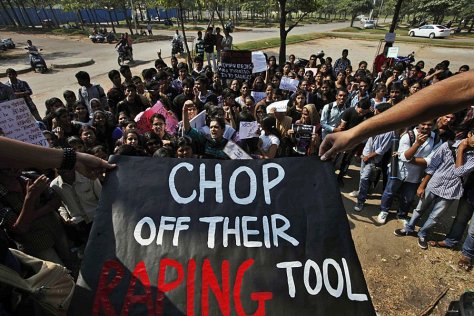
some-protestors-have-been-calling-for-rapists-to-be-castrated

The public preoccupation with both the death penalty and castration as punishment for rape continued last week, with the Pakistani activist Asma Jahangir reportedly suggesting that the rapists of the Delhi rape case be either punished with castration or else face the death penalty.[1] The consistent demand for punitive castration in India may be somewhat boosted by the Indian media reporting the following developments – last week, the South Korean court ordered Asia’s first chemical castration[2]; the Malaysian bar is pushing for castration[3] as a punishment for repeat sex offenders; and that such punishment has reportedly been long used in other countries[4]such as Germany, Denmark, and some states in the U.S. Continue reading Against Castration: Himika Bhattacharya and Deepti Misri

Notes from a bachelorette party in New India: Swathi Sukumar

Guest post by SWATHI SUKUMAR

Last week, I went to a bachelorette party. The party props were unbelievable to the point of being ridiculous—shot-glasses shaped like body parts, kinky trinkets, balloons in unmentionable shapes and sizes—and other items that would have made many women of another generation collapse in horror.

At the end of the party, everyone was slightly drunk and a good deal of time had been spent asking the bride-to-be embarrassing questions and cracking dirty jokes.  I realized that our revelry had a close parallel in the cult classic “The Hangover”, a story of four men who go to Las Vegas to celebrate a very eventful bachelor’s party. Our party shared common themes from the script of the movie, including inebriation and the obsession with bodies, both perfect and imperfect. We missed the tiger and the stripper from the movie, but I am told that strippers are a very common feature in bachelorette parties in India.

Tigers are not common, I hope. Continue reading Notes from a bachelorette party in New India: Swathi Sukumar

RSS Supremo Mohan Bhagwat’s Thoughts on Rape

The RSS supremo Mohan Bhagwat (or to call him out in the way he is referred to in the Sangh – Sarsanghchalak Param Pujya Shri Mohan-ji Bhagwat-ji) has now joined the pavilion of eminent Bharatiya moustachioed misogynists. In a breathtakingly revealing statement, he has told us that rapes happen in India, not in Bharat. What he means is that rape only occurs in urban areas where the influence of Paschatya Sanskriti (western culture) leads women astray into being raped by men unable to help or control themselves in the face of the assault of women, out and about, by day and night, defying Mohan Bhageat’s Sangh-mandated Lakshman Rekha.

When an upper-caste landlord in a village claims his ‘droit de seigneur’ (land-owner’s claim) with a Dalit woman, it is not rape, it is a yagya, a time honoured shastric ritual. When husbands persuade minor wives on their ‘suhaag raat’ with a few disciplinary measures that leave them with black eyes and sore limbs, it is not rape, it is the carrying out of an Upanishadic injunction. When swamijis, babajis, acharyas and prachaks have their way with ignorant and nabalik shishyas, it is not rape, it is the partaking of the naivedyam of a woman’s body. It is the realisation of a ‘pushp ki abhilasha’, even if the pushp gets pushed around a little bit in the process. Continue reading RSS Supremo Mohan Bhagwat’s Thoughts on Rape

Justice for Soni Sori. Gathering at Jantar Mantar, 02/01/13

Protests against Sexual Violence continue in Delhi. Earlier this morning, there was a gathering to protest against the gruesome sexual violence committed on Soni Sori while in custody in Chhattisgarh under the supervision of Ankit Garg, Superintendent of Police, Dantewada. Ankit Garg was awarded with a presidential police medal on Republic Day (January 26) in 2012.

Soni Sori’s petition at the Supreme Court is due to be heard tomorrow. Continue reading Justice for Soni Sori. Gathering at Jantar Mantar, 02/01/13

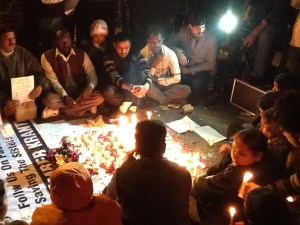
Evening at Jantar Mantar.

Candles at,Jantar Mantar
The Wake
The Wake
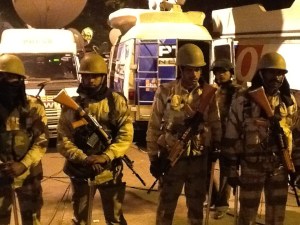
Armed, Cold, Bored
Armed, Cold, Bored

What Do Men Have To Do With It?: Rahul Roy

Guest post by RAHUL ROY

I have been sitting quietly trying to finish my new film and had promised myself that I would not get side tracked and concentrate on the task at hand. But enough is enough. I am shocked and disappointed at the way men high jacked a protest that could have been and probably still is the most significant pouring out of women who may never have thought in their wildest dreams that they would be facing water cannons and cops giving them a chase with iron tipped sticks. I am sure it is a coming of age moment for many young women of the city of Delhi.

I am aware that there has been a fair bit of cynicism about middle class women running up and down Raisina Hill and whether it adds up to anything. It damn well does. The next time they see adivasis being chased down by the police in Chattisgarh or in Orissa a penny will drop. It already is, today there is an article by a 19 year old student form Lady Sri Ram College narrating her brush with Delhi Police at the Parlaiment Street Police station and quite significantly she adds that if they are capable of behaving the way they did with a group of ‘well connected’ college students in Delhi then what must be happening in the more remote areas of non metropolitan India. Continue reading What Do Men Have To Do With It?: Rahul Roy

Armed Forces Special Powers Act provides impunity for rape: Warisha Farasat

Guest post by WARISHA FARASAT

The protests against the brutal gangrape of a young 23 year-old girl in Delhi have been unprecedented. Finally, it appears that the impunity with which crimes against women in our country are committed is causing outrage, and both men and women are demanding justice. What is encouraging is that although the protests were triggered by the recent incident of rape in Delhi, it has also forced us to reflect on the larger issue of impunity for rape and other crimes against women, particularly when it happens against women belonging to the marginalized communities. Moreover, it is also politicizing an entire generation of young people that are realizing that their voice can create ripples in the political establishment in Delhi.

Shuddhabrata Sengupta in his earlier post has lucidly articulated about how our response to sexual violence should not be selective, and our protests should recognise the brutality of crimes against women in the conflict areas of Kashmir, Manipur and Chhattisgarh. In Kashmir, accusations of rape have been repeatedly made against the security force personnel. It has been alleged that rape and assaults have occurred during crackdowns, cordon and search operations. During these operations the men were held for identification outside their houses, near mosques or in a common ground while the security forces searched their homes. During these search operations, safeguards such as inclusion of a women officer in the search teams were never followed. Continue reading Armed Forces Special Powers Act provides impunity for rape: Warisha Farasat

Stop Shielding Criminals in the Army and Security Forces in Assam: Bondita and Anjuman

This press release was issued on 23 December by BONDITA and ANJUMAN of WING and WSS, Guwahati

Aggravated sexual violence in Guwahati in July 2012 and gang rape in Delhi this month have led to public outrage and anger, compelling the media and the government to take serious note of the rampant sexual violence against women.  Even as the current attention on sexual violence on women raises several questions over laws, their enforcement and policing, there continues to be absolute silence and complete denial about sexual violence by the Army and the Central Armed Police Forces. It is high time to review and repeal laws and practices that promise complete impunity to the armed forces for sexual assault in counter insurgency conflict areas. Continue reading Stop Shielding Criminals in the Army and Security Forces in Assam: Bondita and Anjuman

Misogyny, Politics and Zombiedom: From Sonia Gandhi to Botsa Satyanarayana

After Sushma Swaraj called a rape survivor a zombie – ‘Zinda Laash’,  it is now the Congress Party’s turn to field its prime misogynists and women haters. If the stalwarts of the BJP have unleased their righteous blood-lust by calling for capital punishment (which they do routinely for many things)  how can the good men and women of the Congress party allow themselves to be left behind in the competition for civilised discourse?

The Times of India has a report which I am quoting below that spells out Andhra Pradesh Congress Chief Botsa Satyanarayana’s thoughts on women’s safety.

“Andhra Pradesh Congress chief Botsa Satyanarayana on Monday opened his mouth to put his foot right in, saying women are asking for trouble if they venture out at night. Worse, he described the assault on the physiotherapy student as a “minor incident” for which party president Sonia Gandhi had reached out to agitating people. Continue reading Misogyny, Politics and Zombiedom: From Sonia Gandhi to Botsa Satyanarayana

To the Young Women and Men of Delhi: Thinking about Rape from India Gate

Dear young women and men of Delhi,

Thank you for the courage and the honour you have brought to Rajpath, the most dishonorable street in our city. You changed Delhi yesterday, and you are changing it today. Your presence, of all twelve thousand of you, yesterday, on Rajpath, that street that climbs down from the presidential palace on Raisina Hill to India Gate, getting soiled by the excreta of the tanks and missiles on Republic Day each year, was for me a kind of purificatory ritual. It made a claim to the central vista of ‘Lutyen’s Delhi’ as a space for democratic assertion in contravention of the completely draconian, elitist and undemocratic prohibitory orders that make the heart of this republic, a zone of the death, not the life and sustenance, of democracy.

From now onwards, consider the heart of Delhi to be a space that belongs, first of all, to its citizens. Yesterday, when thousands of you gathered peacefully, intending to march up Raisina Hill to the president’s palace, you were charged with batons, tear gas and subjected to jets from water cannons. The violence began, not when protestors threw stones, but when the police started attacking people. Stones were thrown in retaliation. The television cameras that recorded what happened show us the exact chronology. The police were clearly under orders not to let people up Raisina Hill. Why? What is so sacred about Raisina Hill? Why can a group of unarmed, peaceful young people not walk to the gates of the president’s palace? So, lets be clear. Violence began when the state acted. Of course, the protest got hijacked by hooligans. But of course it had to be. When hooligans in uniform are let loose on an unarmed crowed, there can be no possibility of averting the possibility that hooligans out of uniform will respond in kind. Continue reading To the Young Women and Men of Delhi: Thinking about Rape from India Gate

A City’s Pride

This Sunday, Delhi walks in its fifth annual queer pride parade. Each year at this time the question arises again: why a pride parade? Transgender, lesbian, gay, bisexual, hijra, kothi, and intersex people still have too many answers to give. While a decision on the appeals against the 2009 Naz judgment still remains pending, stories of continuing violence on the bodies of those deemed different do not wait for the Supreme Court. Queer people continue to have no legal protections against discrimination in the workplace; to be forcibly dragged to psychologists; to be forced to lie, cheat and conceal their lives; to be victims of familial, domestic and public violence and to feel, in so many ways both in their own minds and in the eyes of many others, like lesser citizens.

What this past year has reminded us is that they are not alone. The fundamental pillars of what enables this violence – fear, prejudice, intolerance – seem to have dug themselves deeper into our cities just as the institutions and democratic safeguards meant to combat them seem to have floundered. The ranks of urban residents who have experienced that deeply queer moment of exclusion and otherness – whether or not it speaks the particular idiom of sexuality – have grown. This year, as people once again take to the streets, they must do so not just for themselves but for the cities they inhabit and, increasingly, must protect.

Continue reading A City’s Pride

Stuck Between Gandhi and Cultural Crap: Papilio Buddha Reveals Much

Sometimes a minor cut on the surface of the skin will do to reveal the rot beneath. This is precisely what the film Papilio Buddha, made by the New York-based Malayalee film-maker Jayan Cherian, which draws broadly upon contemporary caste politics in Kerala, has achieved for us. In fact, its achievement on this count is simply amazing. At a single stroke, it has brought to light several stinking sores above which Malayalees, especially many Malayalee intellectuals who  occasionally don the garb of public intellectuals, strut. Continue reading Stuck Between Gandhi and Cultural Crap: Papilio Buddha Reveals Much

Yo, Yo Honey Singh and Other Implied Learnings: Aprajita Sarcar

Guest post by APRAJITA SARCAR

Kudiye ni tere brown rang ne, munde patt te ni saare mere town de…..Hun bach bach ke, tenu rab ne husn ditta rajj rajj ke/Main keha kaali teri Gucci, te Prada tera laal/ Kithe challo oh sohneyo, sajh dajh ke ke/ Tere wargi naar ni honi, mainu munde kehnde si /Hoge ni tere charche Star News to BBC /Ho brown brown skin wali, let me tell you one thing /Rab di saunh you so sexy! Continue reading Yo, Yo Honey Singh and Other Implied Learnings: Aprajita Sarcar

Gird Your Loins

A new product ’18 Again’ has hit the Indian market. A vaginal tightening gel, the advertisement left us mildly bemused.

With her newly tautened privates, the saree-clad lady seems in remarkably good cheer, given she apparently ‘feels like a virgin’ and ‘it’ (it presumably being sex), ‘feels like the very first time’. Namely awkward, painful, inexperienced fumbling? Ah well! There’s no accounting for tastes, not least the fantasies of the Indian man.

Regardless, we think this is a step in the right direction. Virgins being a scarce commodity these days, a handy at-home converter for any sacrifices you may have planned is a thoughtfully designed product indeed. (The makers of ’18 Again’ are unclear on what to do with those of us who escaped the wastelands of virginity before 18, but there you have it. You can’t please everyone, certainly not those sluts who didn’t even wait till they were legal). The makers of 18 Again are hoping for strong revenues on the back of exponential domestic demand.

As this article details, the Indian vagina now caters to a broad spectrum of consumer taste and preference. Backed by a strong commitment to product diversification, the Indian vagina is set to enter the 21st century  with applications and appliances, room fresheners and Christmas trees. Needless to say, we are delighted; our only grouse being that the products are somewhat limited in scope and vision. And so with an eye to the future we present a small list of potential uses and a plea that we all broaden, rather than tighten, our imagination. Continue reading Gird Your Loins

The Right to Our Bodies

In a case where the “facts” are both complex and yet also the question at hand, let us start with one that should be undisputed: Pinki Pramanik says she is a woman. She has lived as one, competed as one, and identifies as one. She and no other person or institution – particularly the law or medical science – has the right to decide what her gender identity is regardless of her anatomy, her chromosomes or her hormones. As the investigations against her began, her claim to be a woman should have been accepted at face value regardless of whether narrow judgments of her appearance, manner, physicality or dress led some to believe otherwise.

To add to Nivedita’s post below and track what the Pinki Pramanik case continues to tell us, here is a link to the rest of the Times of India piece cited above that appeared on Monday. The argument I make in that piece has taken a new turn. The gender test results, as reported by the media currently, now say that Pinki is “male” because she has XY chromosome. Yet the report says at the same time that she has “female genital ducts and female external genitalia.” What indeed, then, are we to make of a “conclusive” report that finds Pink to be “male”? The terms and words of the test undo themselves and the underlying assumptions and pathways to the conclusion are far from apparent. If Pink is indeed intersex, then all of these results can stand without the conclusion the report draws of her being “male.” Worth reading are a Journal of American Medical Association article here on Gender Testing and the Olympics, Alice Dreger on sex and gender testing in sports here.

In a national daily this morning, there is a photograph of Pinki. She is taking cooking lessons with her mother in her village. The performance of her gender has begun as her sex is questioned. The only strategy open to her is to now constantly claim all that is uncontestably “woman”: a saree, a pallu over the head, in the kitchen, learning from her mother. Yet again the binaries and essentialisms of our gender identities are reproduced as Pinki tries to erase signs of the apparent “masculinity” of her appearance and behaviour that has driven much of the outrage against her thus far.