Category Archives: Violence/Conflict

Dadri Beef Rumour and Lynching – A Report from Bisara village

The following is a report on the Dadri beef rumour and lynching, prepared by a fact finding team from NEW SOCIALIST INITIATIVE, PEOPLE’S ALLIANCE for DEMOCRACY and SECULARISM, SAHELI and DELHI SOLIDARITY GROUP, released in New Delhi on 05/10/2015

 The investigation team with the following members visited the village on 3 October 2015: Bonojit Hussain (New Socialist Initiative), Deepti Sharma (Saheli), Kiran Shaheen (writer and activist), Naveen Chander (New Socialist Initiative), Sanjay Kumar (People’s Alliance for Democracy and Secularism and New Socialist Initiative) and Sanjeev Kumar (Delhi Solidarity Group)

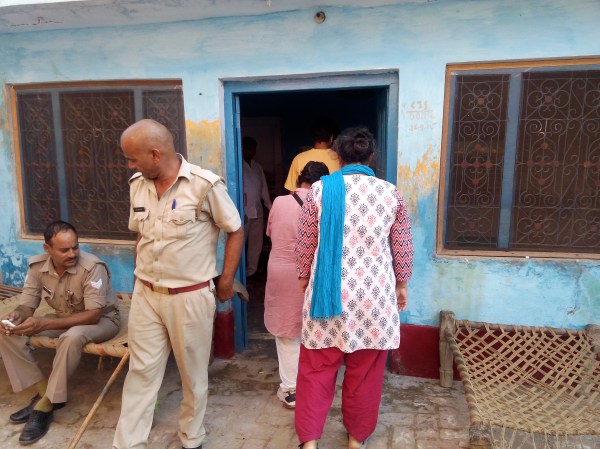
Akhlaq's house
Akhlaq’s house

On the night of 28 September, in a heinous instance of hate crime Mohammad Akhlaq a resident of Bisara village of Dadri in western Uttar Pradesh was lynched to death and his son Danish brutally assaulted by a mob of villagers over a rumour that Mr. Akhlaq and his family had slaughtered a calf and consumed its meat. Just before the lynching, an announcement was made from the local temple to spread the rumour, and within moments a mob constituted itself and attacked Mr. Akhlaq resulting in his lynching. Mr. Akhlaq’s son Danish has been in hospital since that night and despite undergoing two brain surgeries his condition is still said to be critical. Continue reading Dadri Beef Rumour and Lynching – A Report from Bisara village

बढ़ती असहिष्णुता और फासीवादी प्रवृतियां : किशोर

Guest Post by KISHORE

(Image : Courtesy – http://www.huffingtonpost.in)

अख़बारों में आई खबर के अनुसार ग्रेटर नॉएडा में भीड़ ने एक व्यक्ति को इस अफवाह के आधार पर मार दिया कि वह गौमांस के व्यापार में लगा था. यह बताने की जरूरत नहीं कि मरने वाला किस धर्म को मानने वाला था और मारने वाले किस धर्म के अनुयायी थे. अब आ रही खबरों के अनुसार यह अफवाह झूठी थी और जिस पुजारी ने इस अफवाह की शुरूआत करी. उस पुजारी को यह अफवाह उड़ाने के लिए मजबूर किया गया था. कुछ लोग यहाँ तक कह रहें हैं कि यह बर्बर हत्या किसी ग़लतफ़हमी के कारण हुई है, पर मेरे एक मित्र ने बड़ा ही प्रासंगिक प्रश्न उठाया कि हम अगर यह मान भी ले की वह व्यक्ति गौ मांस के व्यापार से जुड़ा हुआ था तो क्या उसकी हत्या को उचित ठहराया जा सकता है.

इस बात में कोई दो राय नहीं कि अगर मेरा धर्म मुझसे अपेक्षा रखता है कि मैं ये खाऊँ और ये ना खाऊँ और मैं उसमे विश्वास रखता हूँ, तो यह मेरा चयन हो सकता है कि मैं कुछ ना खाऊँ. कोई मुझे वह चीज़ खाने के लिए मजबूर नहीं कर सकताण. पर क्या यह जरूरी है कि मेरे खाने या ना खाने के चयन का पालन बाकि लोग भी करें. खाना.पीना, पहनना-ओढना और कुछ अच्छा लगना या न लगना हर किसी का निजी मामला है. क्या समाज यह तय कर सकता है कि मैं क्या खाऊँ और क्या ना खाऊँ ? और एक वर्ग की प्राथमिकताओं के हिसाब से न चलने पर उसको मौत के घाट उतारना किसी न्यायोचित समाज की निशानी है या बर्बर समाज की ? Continue reading बढ़ती असहिष्णुता और फासीवादी प्रवृतियां : किशोर

अखलाक़ की मौत उठा रही है हमारी सभ्यता और जनतंत्र पर सवाल

दिल्ली के करीब दादरी के बिसराड़ा गाँव की अस्करी गमी में है। अपने पचास साल के बेटे मोहम्मद इख़लाक़ की मौत का गम वह मना रही है।  और साथ में उसका  परिवार। बाईस साल का उसका पोता दानिश हस्पताल में मौत से जूझ रहा है।यह शोक मामूली नहीं है और न यह मौत साधारण है। यह आपको तब मालूम होता है जब आप देखते हैं कि  गम की इस  घड़ी में अस्करी के कंधे पर रखने वाला कोई पड़ोसी हाथ नहीं है।

अस्करी पूछती है, जहां कोई हमारा पुरसाहाल न हो, उसे हम अपना देस  कैसे कहें! हमारे यहाँ  गाँव को देस कहने का रिवाज है।  अस्करी का  सवाल वाजिब है: जहां गम बँटाने पड़ोसी न आएं, वह अपना देस कैसे हुआ!

Akhlaq's family, image courtesy rediff.com
Akhlaq’s family, image courtesy rediff.com
इख़लाक़ की मौत का शोक  कितना ही एकाकी क्यों न हो मौत उसकी एकाकी न थी. वह मारा गया, ऐलानिया, खुलेआम-शोर-शराबे  के बीच।
बिसाराड़ा गाँव में मोहम्मद अखलाक़ की हत्या जितनी दिल दहलाने वाली है, उसके बाद की प्रतिक्रियाएं उस ह्त्या से अधिक चिंतित करने वाली हैं। सबसे ज़्यादा मुखर भारतीय जनता पार्टी के नेता हैं। मोहम्मद अखलाक़ के घर पर हमला करके उन्हें पीट-पीटकर मार डालने और उनके बेटे को गंभीर रूप घायल करने वाली भीड़ के छह  लोगों को पुलिस ने नामजद किया है। लेकिन भाजपा के नेताओं ने इस पर गहरा ऐतराज जताया है। उनका कहना है कि यह इरादतन किया गया क़त्ल न था, इसलिए ह्त्या की धाराएँ न लगा कर गैर इरादतन ह्त्या की धारा लगानी चाहिए। तर्क यह यह है कि  अखलाक़ की ह्त्या की कोई पूर्व योजना न थी, वह तो ‘गोवध’ और ‘ गोमांस’ खाने की खबर से हिंदू ग्रामीणों की धार्मिक भावनाएं भड़क उठीं। उन्होंने कुछ कड़े रूप में  अपनी भावनाएं व्यक्त कीं, जिसके नतीजे में अलखलाक़ की मौत हो गयी। वे उलटे अखलाक़ के परिवार पर गोवध और गोमांस भक्षण के लिए आपराधिक मामला दर्ज करने की मांग आकर रहे हैं। धमकी दी जा रही है की अगर ऐसा न किया गया तो महापंचायत की जाएगी।

Continue reading अखलाक़ की मौत उठा रही है हमारी सभ्यता और जनतंत्र पर सवाल

Untitled

The thing about violence is that it is very hard and very easy to talk about. Describing it is simple, empirical, instinctive. There are facts, logistical details to hide behind. Motives to be ascribed, an “incident” to be explained. Mohammad Akhlaq. Dadri. A mob. A(nother) Muslim (dalit/trans/worker/woman’s) body. Meat that is not beef. A murder. A lynching.

Facts are useful. But they also hide things from us. They make violence about its incidence. It’s not. The act is banal. Ordinary. Expected.

Mohammad began to die a long time ago. When violence against particular bodies becomes legitimate, becomes a series of “misunderstandings,” it is not violence at all. It is the order of things. It is not prejudice but probability. Beef, property, a panchayat election, love jihad, a job, an argument, a WhatsApp message – these are not causes, they are just modes. The last circuits in a motherboard whose pattern is set in place.

Mohammad began to die at least as early in 1992. When we speak of his death in September 2015, it is already too late. The violence is not his death. The violence is that his body lost its right to be murdered because it has slowly been stripped of its life, bit by bit, for years.

Continue reading Untitled

Workers right to unionize being trampled upon in yet another factory in Manesar: Report

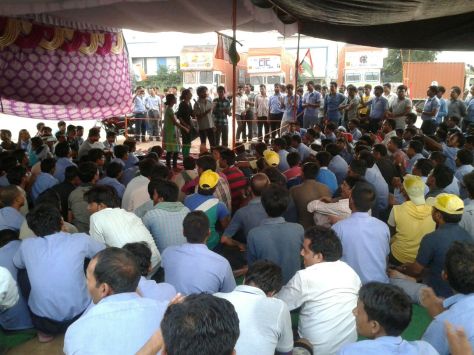
Report on the protest by automobile workers in Manesar by BIGUL MAZDOOR DASTA AND AUTOMOBILE INDUSTRY CONTRACT WORKERS UNION


IMG-20150921-WA0005

On the morning of 18 September 2015 when the workers employed in the Bridgestone company reached their factory gates they were met with Police officers and hired bouncers at the gate. When the workers tried to enter the factory premises they were resisted by the uniformed and the non-uniformed goons of the Factory Management. The Police beat up the workers and prevented them from entering the premises of the factory in spite of having a court order for tool down and without any prior notice the workers were sacked by the company. More than 400 workers employed in Bridgestone Factory in Manesar have been unlawfully sacked by the Company authorities after the workers demanded to get their Union registered. The workers are currently protesting outside the factory and have gathered there to raise their voice against the injustice and oppression that they are facing at the hands of the factory management.

Continue reading Workers right to unionize being trampled upon in yet another factory in Manesar: Report

A Contested line – Implementation of Inner Line Permit in Manipur: Deepak Naorem

This is a guest post by DEEPAK NAOREM

Violence and the accompanying disruption of everyday life in Manipur is not a recent phenomenon. This year too, the state was plunged into a spiral of violence following demands for the implementation of Inner Permit Line, a law originating in the colonial period. This demand is based on real or imagined fears that Manipur, like Sikkim and Tripura, would be overwhelmed by the ‘outsiders’ and that the ‘indigenous people’ of Manipur would become a minority in their homeland. Such demands are neither new nor surprising in this part of the world, where a nearly-unfathomable ethnic, demographic and political jigsaw puzzle was created by British colonialism; one that was deepened by even more myopic and inconsistent policy in the post-colonial years. However, this year, following the death of a young student by police firing during a student protest in Imphal, the movement demanding the Inner Line Permit (ILP) gained considerable momentum in Manipur. Subsequently, the legislature was forced to introduce three bills in the Manipur State Legislative Assembly on 28th August, 2015, ensuring the implementation of Inner Line Permit in the state. This in turn triggered another wave of violence with the ‘tribals’ and tribal organizations opposing the three bills, eventually bringing life to a standstill in the state.

Continue reading A Contested line – Implementation of Inner Line Permit in Manipur: Deepak Naorem

Muzaffarnagar Baaqi Hai – Critical Readings Online and Offline: Akash Bhattacharya and Arif Hayat Nairang

These are guest posts by Akash Bhattacharya and Arif Hayat Nairang

The film Muzaffarnagar Baaqi Hai has been in the news recently, and not always for the right reasons, having attracted disruptive and abusive protest at some screenings. Following a day of counter-protest in which the film was screened all over the country, a friend teaching in a Delhi University college suggested screening it in her college, only to be told by the student representative that it would “cause trouble” (“bawwal mach jayega ma’am!!”). She asked what that meant and if he had seen the film, and he simply said, “nahin, bhaiyya logon ne kaha hai ki woh film bahut buri hai” (No, but our elder brothers have said it’s a bad film). 

In an atmosphere where political self-censoring comes as easily to the current generation of students as scouring the net for “blocked content” we present below two readings of the reception of the film, the first ruminating on whether the film addresses the complexities of communal mobilisation adequately; and the second inquiring in the context of social media and particularly Facebook, what constitutes the ‘liking’ of an image or idea. The idea of posting these comments is as much to give space to these arguments as it is to make a larger point that the ‘sickular left’ voices that are presumably behind the film love discussion, critique and disagreement. That to my mind is the way forward, not pre-empting the always-already hurt sentiments of the bhaiyya log whosoever they may be.

Continue reading Muzaffarnagar Baaqi Hai – Critical Readings Online and Offline: Akash Bhattacharya and Arif Hayat Nairang

Hindutva: A Political Theory of Nationhood?: Aman Verma

Guest post by Aman Verma

It is disheartening to see amongst supporters of Hindutva these days a silent acquiescence and at times even active support for extra-constitutional techniques being adopted by organizations like the RSS and its offshoots towards attaining the goal of Ram Rajya. An assessment is necessary of what would ultimately entail on the social, political and economic fronts if such a policy that envisages a supposedly ‘Hindu’ cultural and linguistic hegemony over cultures and languages represented by minority communities becomes reality. However, being a student of law what disturbs me more is the absence of any socio-political entity or civil society movement rooted in values of democracy that can effectively counter the impact of Hindutva organizations on the Indian social fabric. While the BJP has its RSS, every other political party claiming to be the upholder of secularism lacks its equivalent, or at the very least an effective social protégé.

Further, my personal interactions with supporters of BJP reveals that there is some deep sense of hurt and helplessness, part valid for the sake of argument, but for the most part carefully manufactured by Hindutva propaganda, which manifests itself in questions a friend recently put to me, “What are the other ways in which the Hindus can also claim their rights and send out a message that they have been too tolerant for too long?” and another which sounded like “How else to keep our dignity and identity alive in our land?”. These questions, based upon presumptions like those of “Hindu tolerance” of acts perpetrated by other communities supposedly only against Hindus and, protection of a completely vague concept of “Hindu identity” are clearly an outcome of a campaign strategy that relies upon upping the antics on the romantic-nationalist front.

Continue reading Hindutva: A Political Theory of Nationhood?: Aman Verma

Lions, Liars and Masters of the Universe: Shrinivas Dharmadhikari

Guest Post by SHRINIVAS DHARMADHIKARI

Last month’s killing of Cecil, the 13-year-old, rare black-maned lion by American dentist Walter Palmer, was met with global outrage and condemnation. However, this foolish bravado cannot just be treated as another sign of American (or white) exceptionalism (read sickness)  because behind this is a much larger and thriving Trophy Industry.

A few facts will make the size and destructive power of this industry clear. Americans traveling to Africa make up more than 60 per cent of the foreign-participated lion trophy hunts carried out each year. This is according to John Jackson, president of the lobbying group Conservation Force. According to another scientist, Eric Jensen, a University of Warwick professor  who studies public engagement in wildlife issues, the Trophy industry caters to the human need for dominance and control of nature and provides in addition a sense of masculinity having hunted a large animal. Continue reading Lions, Liars and Masters of the Universe: Shrinivas Dharmadhikari

On keeping Open the Door that was Opened by Dr. Malleshappa Kalburgi

On Sunday morning, seventy seven year old scholar Dr. Malleshappa Kalburgi opened his door in Dharwad town in Karnataka to some people who asked for ‘sir’. They pumped bullets into ‘sir’ when he appeared in front of them. Throughout his life, Dr. Kalburgi had the habit of opening doors. His scholarship into Kannada literature opened many doors. Those who killed Kalburgi abused not just his hospitality, and his willingness to open his doors to strangers (he had asked that his security be ‘lifted’ despite threats to his life), they abused all the traditions in the world that promise kindness to strangers, and keep doors open.

Continue reading On keeping Open the Door that was Opened by Dr. Malleshappa Kalburgi

The Anthem of ‘Black Lives Matter’

MEERA NANDA has sent us this moving and militant anthem of the Black Lives Matter campaign.

janelle-getty_wide-40db75d71631e05766c321b52a99a3cee3eb15a5-s800-c85

R&B singer Janelle Monáe released a blistering 6 1/2-minute protest song on Friday called “Hell You Talmbout.” [African-American slang for “what the hell are you talking about.”] The song’s premise is simple, and that simplicity is the source of its power. The lyrics are the chanted names of black Americans killed by police and vigilantes, followed by the phrase “say his name” or “say her name.” The chorus is an anthemic, gospel-leaning repetition of the song’s title. Monáe is joined on the track by a drum line and the members of her Wondaland Arts Society collective: Jidenna, Roman GianArthur, Deep Cotton, St. Beauty and George 2.0. All of the vocals are raw, several to the point of breaking. None of the names are sung.

At the moment, Hell You Talmabout is available as a stream only. Here is the link.

And here are the lyrics. Note that some of the names are hyperlinked to tell you about the person being named.

Continue reading The Anthem of ‘Black Lives Matter’

Public Secrets Now Proven – Ranveer Sena Terrorists Caught on Camera by Cobrapost: Kavita Krishnan

Guest Post by Kavita Krishnan

The ‘Operation Black Rain’ film released by the web portal Cobrapost, based on secretly filmed boasts of the Ranveer Sena terrorists with detailed accounts of massacres of Dalit and oppressed caste labourers in the 1990s, has only confirmed public secrets that everyone in Bihar already knew.

Continue reading Public Secrets Now Proven – Ranveer Sena Terrorists Caught on Camera by Cobrapost: Kavita Krishnan

The State Playing God and Magician – Thoughts after Yakub Memon’s Death: Sharib Ali

Guest Post by Sharib Ali

With a finality that only history possesses, Yakub Abdul Razak Menon, an accused in the Bombay blast case, has transformed for many over the last few days, including me, into just Yakub. His name pronounced with a deep felt sadness that has come to characterize so many of our days. Days leading to terrible, terrible nights.
It is indeed sad, when a criminal -a sauve 20 year old looking for a way out- is, in death, turned into a rallying symbol of injustice. Flowing white beard, and a bloated body, suddenly turned around into an idea draped in flowers, garlanded, and marched on the shoulders of thousands of men through narrow streets- in complete silence. There were whispers, though, in the sweltering heat of bodies. But the pact was made. There would be no sloganeering. The state was there- to keep peace, no less. And it did what it does best: lined the streets with policemen. The policemen were out there defending a strange paradox: That it is right to kill to punish those who kill, so that others are deterred from killing. Stithi niyantran mein hai, still, they said. The rest, were silent.

Continue reading The State Playing God and Magician – Thoughts after Yakub Memon’s Death: Sharib Ali

All That Remains for Us to Consider in the Wake of the Death of Yakub Memon

Yakub Menon was murdered yesterday morning. Apparently it was his birthday. When his brother Suleman and his cousin Usman met him on Wednesday afternoon his words to them, as reported in today’s Indian Express, were – “Agar woh mujhey mere bhai ke gunahon ke liye sazaa de rahe hain, toh mujhe kabool hai. Par agar unko lagta hai ki mein gunehgaar hoon aur sazaa de rahe hain, toh yeh galat hai. Main bekasoor hoon.” (If they are punishing me for the sins of my brother, then I accept this verdict. But if they are punishing me because they think I am guilty, then it is wrong. I am innocent.)

Continue reading All That Remains for Us to Consider in the Wake of the Death of Yakub Memon

The courts of this country are on trial, not Teesta: Indira Jaising

INDIRA JAISING writes in The Times of India

The hounding of Teesta Setalvad is timed to coincide with the publicly articulated urge of the Prime Minister to get a “clean chit” from the courts in relation to the ongoing cases in Gujarat, which Teesta has been doggedly pursuing. She is the victim of the pursuit for justice.

We are being asked to roll back the clock, consign the 2002 Gujarat carnage to the dustbin of history and replace Teesta Setalvad as the villain, who hounded the then chief minister…Can the collective amnesia on the Gujarat riots, and the view that we must move on be legitimized?

All this could possibly happen if Zakia Jafri and Teesta Setalvad, who are doing everything constitutionally and legally possibe to hold the head of the then government accountable, are checkmated, preferably gagged, and put into jail.

Read the rest of this damning indictment of the Indian justice system here.

CBI Mis-reporting on Search: Teesta Setalvad

We reproduce below the full statement (partially reported in the newspapers) from Teesta Setalvad on the CBI search at her office premises regarding the continuous misreporting that was going on during the search: 

As I write this, the search is still not concluded. It is shocking that while over a dozen members of the CBI are still in our premises conducting the search, Delhi spokesperson is misleading the public and our vast supporters by a series of misinformations and official tweets.

In our view, and we repeat no laws have been broken by us. This is a continuation of the persecution and witchhunt first launched by the Gujarat police in 2014 then under the dispensation that rules Delhi. The CBI has taken the same documents that we had voluntarily on inspection given the MHA (FCRA dept). Over 25,000 pages of documentary evidence has been given to the Gujarat Police. When they could not succeed with the bizarre and desperate attempts to gain custody (February 2015), it was the Gujarat Government Home Department that wrote to the MHA and the current round of the persecutions began.

Its is shameful political vendetta. The Zakia Jafri case begins its final hearings on July 27 2015. The Naroda Patiya appeals (Kodnani and Bajrangi) are being heard in the Gujarat High Court tomorrow. This is nothing but a bid to subvert the cause of public justice and ensure that no justice happens in these cases. Continue reading CBI Mis-reporting on Search: Teesta Setalvad

Remember the Indian commitment to Palestine! Palestine Solidarity Committee in India

Personally, it’s reached a point where there isn’t one single thing done in the name of ‘India’ that doesn’t make me deeply ashamed…(NM)

Statement from Palestine Solidarity Committee in India

The Palestine Solidarity Committee, the All India Peace and Solidarity Organisation and Indian Campaign for the Cultural and Academic Boycott of Israel condemns the government of India’s abstention from a UN Human Rights Council (UNHRC) vote for adoption of a UN Inquiry Commission report on Israel’s attack on Gaza, Palestine, last year. This is a blatant reversal of India’s longstanding policy of support to the Palestinians against Israel’s occupation of the West Bank and Gaza. The vote in the 47-member Council was overwhelmingly against Israel; 41 countries vote in favor of the resolution, only one – the U.S. – voted against it; India was one of the 5 countries who abstained.

This is the first time India has abstained on such a resolution in the UNHRC. Even in July last year, New Delhi voted in favour of a UNHRC resolution criticizing Israel for the Gaza war.

Continue reading Remember the Indian commitment to Palestine! Palestine Solidarity Committee in India

#SelfieWithDaughter – Ehsan Jafri and Nishrin Jafri Hussain

350948-ehsan-n-daughter

A picture that says more than a thousand words

Read the story in DNA

Read about Ehsan Jafri here.

Recently, under increasing pressure for the growing incidents of communally targeted violence by BJP and its allied Hindutva groups, the PM Narendra Modi met Muslim leaders and assured them he would be available to address their issues even “at 12 in the night.” In the face of this blatant hypocrisy we will remember that in Gujarat in 2002, Ehsan Jafri, his house filled with Muslims seeking shelter from the murderous mobs, made several desperate phone calls, including to Modi, the Chief Minister of Gujarat at the time, and he got no response but abuses.

The Special Investigation Committee investigating the Gulbarg Society massacre concluded laughably, as we know, that Jafri’s death was caused by his “provoking a violent mob”, and predictably gave Modi and the state authorities the proverbial “clean chit”.

Are there any limits to the shamelessness of this Prime Minister, this party, this government?

June 1984 – 31 Years Later, Sikhs Are Mapping Their Stories: Ravleen Kaur

Guest post by RAVLEEN KAUR

When June 1984 comes up in conversation, the same talking points invariably arise – “it was the state’s burden to attack; they had no choice”, “Bhindranwale had to be taken down”, or “Punjab was already bleeding”.

What these oft-repeated phrases – a product of the tight PR messaging campaign on the part of the government – glide over is the scope of human suffering that occurred in June 1984 – and most glaringly, suffering that was perpetrated by those in power, by those who had been elected in a democracy to uphold the rights and dignity of the people who they killed in 1984.

Anthropologist Talal Asad has noted the “notorious tactic of political power to deny a distinct unity to populations it seeks to govern, to treat them as contingent and indeterminate.”

With the belief that every Sikhs who was alive in 1984 has a story to tell, the 1984 Living History Project is depicting the unity in trauma of a people, who, in 1984, felt attacked as a people. The 1984 Living History Project is working to give a platform to ordinary people who lived through the massacres of both June and November. The project was initiated in 2012 by Sikh millennials.  Realizing that the generation who experienced 1984 firsthand was getting older and that time was running out to capture their stories, they began a grassroots effort to capture as many stories and testimonies from Sikhs worldwide, one video narrative at a time. The first videos were their own parents and grandparents, recorded on smart phones and edited and shared rather seamlessly. The Project’s web platform allows easy Steps to make and share videos; something other Sikhs around the world have been doing through the 30th and 31st anniversary years of 1984.  Continue reading June 1984 – 31 Years Later, Sikhs Are Mapping Their Stories: Ravleen Kaur

What’s wrong with these headlines? (Answer – It’s Election time, Stupid)

Another disputed mosque sparks Ballabgarh riots” (The Hindu)

Ballabhgarh Communal tension: At heart of dispute lie a temple and half-built mosque” (The Indian Express)

ballabgarh

Muslim families at Ballabhgarh city police station on Wednesday night after fleeing riots in their village.(Express Photo by: Gajendra Yadav)

This one image should be issued as a ceremonial postage stamp to commemorate one year of Modi’s rule. We have said it many times already, but here it is, once more, with feeling – this is a bloody, violent Hindutvavaadi regime, with a cool headed, coldly vicious master-mind at its head – he of the Swarovski eye glasses, the 10 Lakh Rupee Suit, the diamond Movado watch – he of the infinite silences on All That Matters.

Continue reading What’s wrong with these headlines? (Answer – It’s Election time, Stupid)

Much Better to Run Over the Poor Than to Speak Up for Them

Yesterday, the 9th of May, one day after the court granted what must be the fastest bail and suspension of sentence in the history of India to India’s favourite Dabangg, a diminutive woman stood under the blazing Delhi sun and spoke of her husband who had been in jail for the past one year. In May 2014, lecturer in English at Ramlal Anand College, Delhi University, G. N Saibaba was returning home after evaluating answer scripts when he was abducted by unknown men, who later identified themselves as Maharashtra Police.

Professor Saibaba. Image Courtesy FRS Blog

Saibaba was not produced before a magistrate in Delhi but taken directly to Aheri, a small town in Maharashtra and then to Nagpur, to be put in solitary confinement in the famous anda cell of Nagpur jail. Let’s call this cell famous instead of the usual epithet “notorious” because all over the country, children are probably playing with each other right now saying to each other, “saale main tujhe anda cell mein daal doonga“, while their parents look on indulgently, congratulating themselves on the kid’s excellent G.K.

Continue reading Much Better to Run Over the Poor Than to Speak Up for Them