Category Archives: Violence/Conflict

Terror, Performance and Anxieties of Our Times – Reading Rustom Bharucha and Reliving Terror: Sasanka Perera

Guest Post by SASANKA PERERA

[ This post by Sasanka Perera is a review of  Terror and Performance by Rustom Bharucha (2014). Tulika Books, New Delhi. Kafila does not ordinarily post book reviews. An exception is being made for this post because we feel that the subject of terrorism, which has interested Kafila readers in the past, is an important one, and needs to be thought through with seriousness. We hope that this post initiates a debate on Kafila regarding terror, the state, performance, and the performances – serious, or otherwise – that typically attend to the discussions of terror, whether undertaken by the agents of the state or by non-state actors, commentators in the media, or by intellectual interlocutors. ]

When I started reading Rustom Bharucha’s latest book, Terror and Performance, it immediately became an intensely personal and gripping engagement. It was difficult to read in a single attempt as the mind kept wandering from one unpleasant moment in our recent annals of terror to another in some of which I had also become an unwitting part – mostly as a spectator. From the beginning, my reading was a conversation with Bharucha’s text through detours of my own experiences and an interrogation to a lesser extent. In 1986, as a young man when I went to the Colombo International Airport to pick up my father who was returning from the Middle East, I was shaken by a tremendously loud sound for which I had no immediate references. I had not heard such a sound before. People started running towards the sound. It was a bomb that had blown up an Air Lanka flight which had come from Gatwick. The Central Telegraph Office in Colombo was bombed in the same year. We learnt that everyone was running towards the sound and not away from it. Dry local political humor very soon informed us that people were trying to get inside the bombed out telegraph office hoping that they could get free phone calls to their relatives in the Middle East as they had heard phones were dangling from the walls with no operators in sight. That was long before mobile phones and call boxes. We were still young in terms of our experiences with terror. However, we soon had very viable references to what all this meant as the political narrative of Lanka unfolded with devastating consequences. But in 1986, when the kind of terror that was to follow in all its fury was still relatively new and quite unknown, we were acutely unaware of the dynamics of the actual act of terror and the structure of feeling it could unleash. This is why many of us in these initial years were naively attracted towards the epicenter of the act rather than being mindful to run away from it. But as the society grew in experience, people soon learned their lessons. Though an academic text in every conceivable way, I was reminded one could always find a few rare books of this kind which might personally and emotionally touch a reader in addition to whatever intellectual stimulation it might also usher in. Terror and Performance is clearly one such book. From the perspective of the writer, Bharucha himself recognizes this personal emotional engagement and investment early in the book. For him, “this writing demands stamina as it faces an onslaught of uncertainties and cruelties at the global level that challenges the basic assumptions of what it means to be human” (xi). It is the same kind of stamina that one also needs to read it as most of us in South Asia would be reading it squarely sitting in the midst of our own worlds of unfolding terror. This is why all those thoughts came gushing into my mind throughout the reading. I was not only reading Bharucha; I was also reading my own past.

Continue reading Terror, Performance and Anxieties of Our Times – Reading Rustom Bharucha and Reliving Terror: Sasanka Perera

#Hokkolorob – Images from a Jadavpur Solidarity Meeting in Jantar Mantar, Delhi

Here are some images from a  meeting held in solidarity with Jadavpur University Students at Jantar Mantar, New Delhi, on Thursday, September 2014. Students from Delhi University, Jawaharlal Nehru University, Jamia Millia Islamia, Indian Institute of Mass Communications, teachers and professors from different universities in Delhi, Jadavpur University Ex-Students, Workers and Professionals from the Delhi NCR Region spoke at the meeting. A signature campaign was undertaken, and the assembled people wrote their statements on to a scroll in support of their friends at Jadavpur.

All Photographs are by Akhil Kumar, Youth Ki Awaaz. 

This slideshow requires JavaScript.

Khushi Ram, a terminated worker from the Maruti Suzuki Factory at Manesar had come from Haryana to express the solidarity that the workers of the Delhi-NCR region have for the students of Jadavpur University. He read a poem at the gathering. Kafila caught up with him as the meeting was about to end. Here is a video of him reading his poem for the readers of Kafila, and a brief record of a conversation with him about solidarity between workers and students.

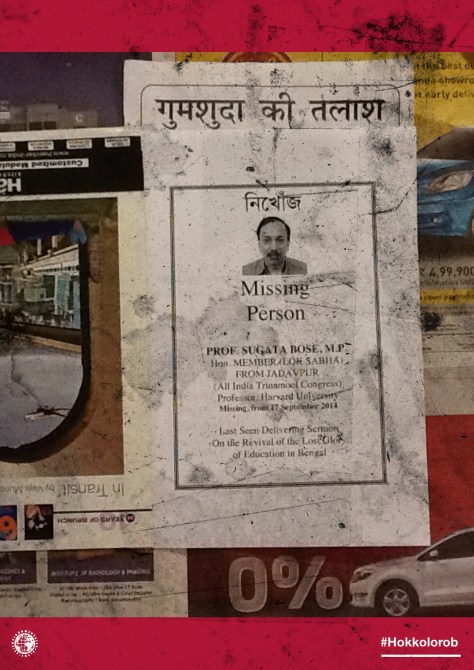
Missing Person Notice: Ben Zachariah

Guest Post by Benjamin Zachariah

Looking for Prof. Bose

It was not so long ago that Sugata Bose, now Lok Sabha Member for Jadavpur, made his way back from Harvard to serve his people. West Bengal had voted for ‘poriborton’, ‘change’, and as everybody assumed that Bengalis loved their fellow-men who had been anointed abroad, Sugata Bose returned to conquer the heights of Bengali higher education. The plan was to use a brand name within a brand name to shore up another brand name : Harvard, Netaji, Presidency. The Trinamul Congress, Bose was confident, would not interfere with his plans. Or so he said in public; his mother, Krishna Bose, had been the Trinamul Congress’s Presidential candidate, and long regarded as the force behind the attempted bhadramahilafication of Didi, apparently a prerequisite for political acceptability in West Bengal (otherwise known as Waste Bengal or Poschimbongobongo). It was therefore no surprise that his plans did not diverge from the plans of the TMC, although ‘internal differences’ were often heard of. It was also no surprise that, as the attempts to turn Presidency ‘University’ into the font of moral and intellectual legitimation for the TMC faltered, Bose took the mantle of his great-uncle upon himself and stood as a candidate for the TMC in the Lok Sabha elections, from the Jadavpur constituency. There was not even the pretence that Sugata Bose stood on his own credentials: his campaign marches were led by a child in Netaji uniform and Netaji glasses, prompting a complaint to the National Commission for Protection of Child Rights.

Now, in the Jadavpur constituency, duly won by Netaji’s heir, and not by a hair’s breadth, developments at Jadavpur University are cause for concern.

Continue reading Missing Person Notice: Ben Zachariah

Jadavpur’s Infectious Autumn Thunder Goes Viral: Kasturi

Guest post by Kasturi

One of the slogans churned out of the womb of turbulent Paris in the Maydays of 1968 was ‘Don’t trust anyone over 30’. The student uprising of May ‘68 with its audacity and exaggeration might have failed. Yet the mahamichhil (grand rally) called by students which took command over the heart and pulse of Kolkata on 20th September was a literal, vivid, living embodiment of this slogan. As I stood with a video camera on a spot on the Jawaharlal Nehru Road, with hope to capture the moments and 50,000 faces that made history with each footstep, all I could see was an ocean of people most of who had perhaps not even reached their twenty fifth year, and many of who were walking their very first rally. Those slightly older, those weathered yet young at heart paced alongside them in solidarity. ‘Such a student gathering – so huge, determined and disciplined – I have not seen in my life’, wrote poet Sankha Ghosh, ‘This really moved me. It’s very early to say if this will mark the beginning of a new era but I will reiterate this is one of the biggest student rallies I have seen in my life’.

The rally was replete with slogans reflecting basic demands of the movement, but there was a unifying chant, rather a call to action, that instantly bonded with and caught the fancy of the first timers that hit the street – Hok, Hok, Hok Kolorob (‘let there be clamour’). A call, ripped off from a popular song by Bangladeshi singer Ornob and used as hashtag on social media to mobilize – was surreal, refreshing, imaginative enough to break the deafening silence, stupor and suffocation strangling students’ aspirations for democracy, freedom of expression and association across education campuses of Bengal. The other interesting aspect of this call was that unlike regular slogans where someone leads and the rest follow, here there was no single lead but many voices all chanting the four words in unison, accompanied by clapping of hands. As a comrade observed, ‘the zeitgeist and slogan of the contemporary present is #hokkolorob’!’ (‘Kolorob’/ ‘kalrav’, roughly translated here as ‘clamour’, conveys the sense of a symphony of birdsong in many Indian languages.) Continue reading Jadavpur’s Infectious Autumn Thunder Goes Viral: Kasturi

A Letter to the Vice Chancellor of Jadavpur University, Kolkata: Ahona Panda

Guest Post by AHONA PANDA

[Ek Je Cchilo VC / Once There Was a VC – Thanks to Utsavdan, and to Manik-da of Bishop Lefroy Road]

To

The Vice Chancellor,
Jadavpur University,

and the Education System of West Bengal.

Respected Sir,

I would like to return to this university a gold medal that it awarded me, then a girl of 21, in the year 2009. I’ve never worn that medal since my convocation, and it lies in the box it was awarded in. I was a student of the English department in this university, and went on to study at Oxford and University of Chicago. Continue reading A Letter to the Vice Chancellor of Jadavpur University, Kolkata: Ahona Panda

From Jadavpur to Everywhere #Hokkolorob – Let There be Clamour

#HOKKOLOROB
#HOKKOLOROB

More then one hundred thousand students and their friends (according to Kolkata Police estimates) defied the rain to walk in protest yesterday against the assault on Jadavpur University by Kolkata Police, backed by an insensitive University Vice Chancellor and a cynical State Government. There were students, ex students, professors, students from Presidency University, and many other colleges in Kolkata and the neighborhood, there were many ordinary citizens, some who had never been university students, and many who had stopped being university students a long time ago.

Continue reading From Jadavpur to Everywhere #Hokkolorob – Let There be Clamour

Syrian Jihad spawned the Islamic State: Nauman Sadiq

Guest Post by NAUMAN SADIQ

Let me admit at the outset that Assad is an illegitimate tyrant who must abdicate his hereditary throne to the will of the people when the opportune moment arrives. But at the moment our primary concern shouldn’t be bringing democracy to Syria; at the moment our first and foremost priority should be reducing the level of violence in Syria. There are two parties to this conflict: the regime and the rebels (the majority of whom are takfiri jihadis). It is not possible for the regime to deescalate the conflict because it is holding a tiger by the tail. The regime is fighting a war of defense; and what is at stake in this war is its survival; not only its survival but the survival of its clan: the Alawite minority of 2.6 million people who comprise 12% population of Syria’s 22 million people.

The second party to the conflict is the rebels who are generously supported by the Gulf monarchies, Turkey (Sunni Muslims), Western powers and Israel. Don’t get alarmed and be dismissive of the possibility of an alliance [1] between the Sunni Muslims of Saudi Arabia, Qatar, Jordan, Turkey and the Zionists of Israel. It is realpolitik: the enemy of my enemy is my friend. In fact the Western interest in this war is partly about Israel’s regional security[2] because the Shia axis comprising Iran-Syria-Hezbollah is an existential threat to Israel; and with each passing year the nature of this threat will enhance proportionally with the increased sophistication of Iranian missile program. During the 2006 Israel-Hezbollah conflict in Lebanon, most of the rockets fired by Hezbollah into the Israeli territory missed their target; but according to some reports Iran and Hezbollah have already developed smarter missiles and with every passing year the threat of Hezbollah’s guided missiles so close to Israeli borders will keep on haunting the Israeli strategists’ dreams.  Continue reading Syrian Jihad spawned the Islamic State: Nauman Sadiq

Notes from Jadavpur: Ahona Panda

Guest Post by Ahona Panda

About eight years ago, while lounging about doing nothing much in the campus of Jadavpur University where I was a student of the English department, I came across some callously etched graffiti:

Jodi prem na dile praane
Tobe Jadavpure pathanor ki mane?
(If you haven’t given this life some love–
What is the point of sending one to Jadavpur?)

Eight years on I cannot imagine the luxury of lounging about doing nothing much. One moves on in life after graduating from Jadavpur University. Meanwhile, in home and the world, the complete freedom (some will persist in calling this anarchy) of the JU campus has made it a legend somewhat like Dirty Harry: either worship and put it in on a pedestal, or condemn it thoroughly. The reputation of JU since the infamous 1970s has been as a hub of constantly bubbling anarchism, where Naxalites are hatching their next program of action, where ignorant armies like SFI and other anti-SFI groups clash by night.

Continue reading Notes from Jadavpur: Ahona Panda

Happy to Disturb – RJ Sayan and The Jadavpur Police Station, Kolkata

The disgusting police violence and simple thuggery unleashed by the Vice Chancellor of Jadavpur University at the behest of his masters in the Trinamool Congress Party and the West Bengal Government has resulted in a counter-offensive that features rage mixed with humour, mirth, music and creativity. Nothing can be more lethal for the zombies in power than the laughter and music of the young.

Here is a brilliant radio clip – produced by RJ Sayan (Meter Down, 104 FM, Kolkata).

Thanks to Debjani Dutta for the translations and the English subtitles in the video.

From Jadavpur University, Kolkata – ‘I am, one of those survivors, who has experienced a nightmare last night’: Tanumay Naskar 


Guest Post by TANUMAY NASKAR

[ This is an account of the events of last night in Jadavpur University, Kolkata, were students sitting in on a peaceful protest against university authorities inaction on a recent complaint of sexual harrassment. What followed (an attack from two fronts, by police and goons affiliated to the Trinamool Congress) brought back memories of the many times that students have been attacked mercilessly in JU. Currently, around 40 students have had to receive medical attention, and 38 are in police detention. Protests against this event are being organized today in Kolkata (at 4:00 in the afternoon, at Jadavpur University, and at 6:00 PM at JNU in Delhi, by the JNU Students Union]

Follow this link to read a detailed time-line of the events as they unfolded.

Follow this hashtag – ‪#‎hokkolorob‬ for details of how people are responding to the situation.


I am one of those survivors who has experienced a nightmare last night.
We were singing. We were dancing. We were peacefully protesting. 
When someone yelled, “Let’s make the barricades, the police is coming”. 
After that, we saw police (READ GOONS) of grade A, barred all the entrances and charged us with Lathis.

Continue reading From Jadavpur University, Kolkata – ‘I am, one of those survivors, who has experienced a nightmare last night’: Tanumay Naskar 


Sailaab Nama – An Insider’s View of the Flood in Kashmir from the Outside: Gowhar Fazili

Guest Post by Gowhar Fazili

The floods in Kashmir can provide an outsider a momentary glimpse into the reality of Kashmir behind the corporate media propaganda smokescreen that is fumbling at the moment and like Truman Show (1998) exposing bits of the backstage. At the moment there are three key actors in Kashmir. There are the floods, the state and the people. Each one is on its own. One limb of the state—the state government was the first to crumble before the approaching waters.   The other limb—the mammoth military apparatus that has already inundated Kashmir since several decades, took two days to wake up to the crisis and when it finally did, its priority was to fish out the rich Indian tourists and the people close to the establishment out of the state. In the initial days, local people had to risk their own lives to get their marooned relatives to safety. Some hired local boats, some swam or waded through water, some made makeshift rafts out of anything that floats, including water tanks, car tubes, foam sheets, inflated baby bathtubs, so on and so forth to save their dear ones. The rest either drowned or kept moving up the floors of their houses as the waters kept rising until they reached their attics.

Continue reading Sailaab Nama – An Insider’s View of the Flood in Kashmir from the Outside: Gowhar Fazili

Jadavpur University students struggle against gender violence

In Jadavpur University (a State aided university of West Bengal), the Arts Students Faculty Union organizes a students’ cultural festival, Sanskriti. On the second night of the festival, an incident of violence occurred in the campus that resulted in a chain of events.

On the night of 28th August, during the ongoing festival, a second year student from the Department of History, Jadavpur University, was allegedly molested inside campus premises by a group of people from the hostel, and her male friend (not a JU student), was beaten up. According to the victim, she had gone near the hostel to relieve herself given the unavailability of bathrooms at the time, accompanied by her friend. On their way back, a group of hostel boys allegedly passed snide remarks which led to a scuffle, and then escalated to something bigger. While her friend was allegedly pulled away and beaten up, she was dragged into the hostel, where she claims she was molested. Continue reading Jadavpur University students struggle against gender violence

A civil-war is on the doorstep of India: Interview with Kancha Ilaiah by Mahmood Kooria

This is a guest post by Mahmood Kooria

We are publishing an English translation of an important interview of the intellectual and academic Kancha Ilaiah, conducted by Mahmood Kooria for the Malayalam weekly Mathrubhumi. While what I see as Professor Ilaiah’s underestimation and perhaps misreading of the historic role of the Communists in Indian politics leaves me severely uncomfortable, especially when he exonerates the right from commensurate charges of elitism, his framing of Hindustva and Modi’s appeal within the great stream of caste in the subcontinent is brilliant and thought-provoking, as always. 

Kooria conducted the interview as well as translated it in to English. His introduction is as follows, “At a time when there was no any such discussion, in 2002 Professor Kancha Ilaiah predicted that Narendra Modi will be the prime-ministerial candidate of Baratiya Janata Party. It has come true and now Modi is in the office. At this point, I talked with him at Moulana Azad Urdu University Hyderabad where he chairs the Centre for the Study of Social Exclusion and Inclusive Policy. In the conversation, he talked about the future of Modi government and he predicted that a civil war is going to break out in India if Modi does not cater the needs of backward classes. A Malayalam-version of this interview was published in the Mathrubhumi Illustrated Weekly (August 24, 2014).”

Mahmood Kooria: Ten years ago you wrote that Modi will be the prime ministerial candidate of BJP. What would be your response as your prediction has come true?

Kancha Ilaiah: Well, at that time I was predicting that based on the Left parties’ indifference to understand the caste question. The caste question is not been seriously taken by the Left parties. And, after Mandal, the BJP and the RSS wings started looking at caste-question seriously because when Babari Masjid was demolished they mobilized a lot of backward classes. Though they oppose Mandal reservation, they wanted the backward classes to be part of the Hindu religion. Around 1994, a non-Brahmin called Rajju Bhaiya became the Sarsanghchalak of the RSS. Then he recruited a large number of backward classes, large number of youth, and he promoted the people like Narendra Modi, Uma Bharati at that time. Earlier, the first backward-class chief minister of Uttar Pradesh was a BJP man: Kalyan Sing. He was the chief minister in 1992 when the Babri Masjid was demolished.

The Sangh Pariwar was responding to the backward class demands more. But the Left or the Congress was not responding to the OBCs. The Congress was responding to the Dalits and Muslims. There was upper caste all the time on the top. So, when Narendra Modi became the chief minister and this whole atmosphere was created, I was writing a column in The Hindu. I thought that this seems to be cause/course of India, since the Hindu religion is surviving because of the backward classes. It is inevitable for the Hindutva organizations that they will have to project an OBC for the prime-ministership. But there was resistance from within itself. It is not that the Brahmins have given up the principle of varna-dharma. After that article came and of course after my writing Why I am not a Hindu itself, the backward classes even within RSS seemed to use that material for their advantage. The communists did not use or recognize it. The question of labour and caste which I have been consistently raising, which was also part of their theory, they did not care about. So the Communist Party remained tightly under the control of upper castes.

Continue reading A civil-war is on the doorstep of India: Interview with Kancha Ilaiah by Mahmood Kooria

The European Union And The Twin Civil Wars In Syria/Iraq: Peter Custers

Is this one of those rare occasions where policymakers self-critically correct a gigantic blunder? Or is it a cold turn-about guided by pure self-interest? On August the 15th, the Foreign Ministers of EU-countries gathered in Brussels and decided that each would henceforth be free to supply arms to Kurdish rebels fighting Sunni extremists of ISIS in the North of Iraq. Even Germany which in the past had been unwilling to furnish military supplies to warring parties  in ‘conflict zones’, is now ready to provide armoured vehicles and other hardware to the Kurds opposing ISIS’ advance. The decision of Europe’s Foreign Ministers may surprise some, for barely a year and four months ago, in April of 2013, the European Union had lifted a previously instituted ban on all imports of Syrian oil (1). Moreover, the lifting of this boycott was quite explicitly intended to facilitate the flow of oil from areas in the North-East of Syria, where Sunni extremist rebel organisations had established a strong foothold, if not overall predominance over the region’s oil fields (2). ISIS was not the only Sunni extremist organisation disputing control over Syrian oil fields. Yet there is little doubt but that the fateful decision the EU took last year has helped ISIS consolidate its hold over Syrian oil resources and prepare for a sweeping advance into areas with oil wells in the North of Iraq (3).  Continue reading The European Union And The Twin Civil Wars In Syria/Iraq: Peter Custers

When David Became Goliath: Lee-Alison Sibley

Guest post by LEE-ALISON SIBLEY

Back in the 1960s when Hollywood was making a number of movies based on biblical stories, they came out with Orson Welles as King Saul in “David and Goliath.” I was a little kid when I saw this movie, but I remember identifying with little David who yes, played beautifully on his harp, and used his slingshot with divine accuracy. I also remember the monster Goliath – he was huge and ugly and represented the Philistines, our enemies.  I cheered in my head and my heart for David to defeat the monster and he did, so that I could feel the good guys won and God was indeed on our side, the side of the Israelites.

Like any idealistic Jew, though not religious, I went to Israel to work on a kibbutz in the summer of 1971.  I was in the south, near Eilat and the border with Jordan.  Young and naïve, I was friendly with everyone I met — the Sabras of Israel, the Christians in Bethlehem, and Arabs in Gaza. In Gaza?  Yes, I was there with a British fellow from the kibbutz who was picking up some cane furniture he had ordered.  I wasn’t supposed to be there, of course, and when an Israeli army jeep spotted me, my friend was in big trouble.  “Get her out of here immediately!” was the order he shouted.  I guess it had something to do with my appearance and that there were no other women on the street at that time.  Like I said, I was friendly with everyone – my parents did not raise me to hate, they raised me to love.  The Israelis tried to make me feel guilty for not staying in Israel, but I kept saying, “I’m an American, my home is the U.S.A.”  Still, I certainly supported Israel and every person I met there had lost someone, a family member or a friend in a war and I felt very sad for them and angry that they lived with the constant threat of attack. Continue reading When David Became Goliath: Lee-Alison Sibley

Learning from Babasaheb: Harsh Mander

Guest post by HARSH MANDER

Among most  secular progressive people in India today there is the belief – indeed an article of faith – that India has been, through most of its long history, a diverse, pluralist and tolerant civilization – the land of Buddha, Kabir and Nanak, of Ashoka, Akbar and Gandhi. It is a culture in which every major faith in the world found through the millennia the space and freedom to flourish and grow, where persecuted faiths have received refuge, where heterodox and sceptical traditions thrived alongside spiritual and mystical traditions, and where ordinary people live and instinctive respect for faith systems different from their own.

All of this is true, and this is why the rise of a narrow, monolithic and intolerant interpretations of Indian culture – what Romila Thapar describes as the right-wing Semitisation of Hinduism – in new India causes us deep disquiet. But what our analysis does not stress often or deeply enough is that all of India, both old and new, has been also built on the edifice of the monumental inequality and oppression of caste, and that this is equally the story of India, old and new. Continue reading Learning from Babasaheb: Harsh Mander

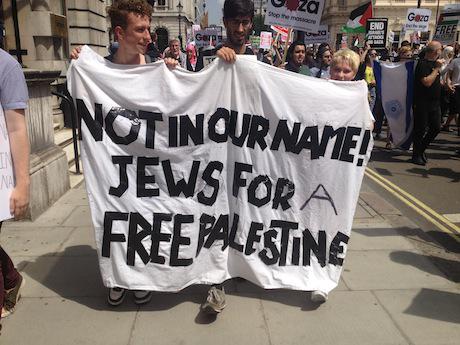
Why I am an anti-Zionist Jew: Ray Filar

RAY FILAR on openDemocracy

IMG_1810

The Israeli government deliberately invokes terrorist attacks, rockets, and scary brown men in headscarfs to stoke the population’s fear, but I am scared of the racism Zionists use to justify the occupation.

The discussions in the comments that follow are equally instructive and interesting – do scroll down and follow those as well.

Happy Independence Day India, Blessings from Kashmir: Onaiza Drabu

Guest post by ONAIZA DRABU

??????????????????????????????????????Dear India,

As you celebrate yet another year of the glorious independence; the independence that was the beginning of an era of doom for most of us here, I must inform you that I was unable to get my morning bread. Sixty Eight is a big number and I’m sure the proceedings will be aplenty and that and you have plenty of ‘ache din’. Somehow, I have my doubts but then again, I’m sure our definitions of good differ greatly. However it may be, I have one tiny request.  Please let me eat my breakfast in peace.

It is still two days to go for the Independence Day Parade in Srinagar and I am one of the privileged few who live within a two-kilometer radius of the Bakshi Stadium, the place where the annual flag hoisting ceremony is held. Excess army is deployed all around and as in all such times, our local baker wasn’t allowed to open shop this morning.

As a child, I read your textbooks in school. I read about how Pinky and Shyam would go to their school for the flag hoisting on Independence Day and of course I’d wonder where this would happen. Independence day meant a crackdown or a curfew for all us kids here. Independence day meant that the morose army guy I hated to look at would stand at my gate, staring straight ahead with a blank, yet frightening constancy. Independence day meant my dedicated doctor of a mother had to walk to work for sometimes, they’d not even allow ambulances to ply.

The independence you celebrate to commemorate freedom has forever been associated with barbed wires on streets that restricted access to locations. It is ironical how roadblocks, surprise checks and general inconvenience is what I have forever associated with this independence. General inconvenience here also includes times where each one of the dozen, army-men on every street eyes you with contempt and suspicion. I snigger if you tell me we celebrate freedom on this day. To the many things that are already restricted here this day adds more. Continue reading Happy Independence Day India, Blessings from Kashmir: Onaiza Drabu

Rape and Rakhi – Patriarchal-Communal Narratives: Kavita Krishnan

Guest Post by KAVITA KRISHNAN

Even as the communal cauldron in UP is kept on the boil, there is news that the RSS has launched a campaign to tie Rakhis to lakhs of Hindu men, asking them to pledge to protect their sisters from Muslim men and “love jehad.” The VHP has been running a helpline urging Hindus to approach them “if your daughter is being harassed by Muslim boys.” And a khap panchayat in Muzaffarnagar has imposed a ban on mobile phones and jeans for girls, claiming that these result in ‘eve-teasing’.

Woven into the above events is an old, familiar theme – that of patriarchal restrictions packaged as ‘protection’. In the wake of the anti-rape movement that followed December 16 2012, the streets of Delhi and many other parts of India had resounded with the voices of women declaring ‘Don’t take away our freedoms in the name of ‘protection’ – protect our right to fearless, fullest freedom instead’. Those women had raised their voice demanding freedom from sexual violence – and also freedom from rape culture that advices women to dress decently to avoid rape; and freedom from the khap panchayats, freedom even from the restrictions imposed by one’s own fathers and brothers.

Continue reading Rape and Rakhi – Patriarchal-Communal Narratives: Kavita Krishnan

Delhi Protests Gaza Bombing: 9 August 2014

Let it not be said that nobody cried when the news came. Let it not be remembered by the children that India “stood with” Israel through the Gaza bombings of August 2014 (God, let it not continue beyond August 2014). Let no-one assume that all 1.3 billion of us continued – as the bombs fell on fields and courtyards and washing hung up to dry in Gaza – that we in India defined our ethical positions purely within the unholy triad of family, community, nation. Let there be a tiny record of protest. A tiny record of a tiny protest, given the monstrosity of the crime. But we are in the business of remembering, since they are profiting from our forgetting. They profit from our forgetting language, since we can’t name what is going on in Gaza as war. They profit from our not being able to remember our mythologies, because this is a war in which one side is David and the other Goliath, but Goliath is winning, because the world has been told he is David. In a nation without language, without myths, without memory, without ethics, jealously holding a tattered banner, with a single word on it – ‘development’ – some Indians protested.

Global Day of Rage against Gaza, Jantar Mantar, New Delhi August 2014:

WP_20140809_001

Continue reading Delhi Protests Gaza Bombing: 9 August 2014

African Solidarity with Palestine: African scholars and scholars of Africa

We, the undersigned African scholars and scholars of Africa, hold that silence about the latest humanitarian catastrophe caused by Israel’s new military assault on the Gaza Strip—the third and most devastating in six years—constitutes complicity. Member state of NATO which mounted an air war on Libya ostensibly to protect civilians in Benghazi have been by and large quiet about the fate of civilians in Gaza. World governments and mainstream media do not hold Israel accountable for its violations of international law. We, however, as a community of scholars have a moral responsibility to do so.

Neither the violation of international law nor the destruction of Palestinian life in Gaza, however, began or will end with the current war[1]. The suffering of Palestinians is not limited to Gaza: the occupation and dispossession in East Jerusalem, the Naqab (Negev), and the West Bank; the construction of walls and fences around the Palestinian population, the curtailment of Palestinian freedom of movement and education, and the house demolitions, all have long histories that will have to be addressed. 

Continue reading African Solidarity with Palestine: African scholars and scholars of Africa