The following is a statement by WOMEN AGAINST SEXUAL VIOLENCE AND STATE REPRESSION (WSS) against the raids on and arrests of activists and intellectuals in different cities.
WSS strongly condemns the arrests of its member Advocate Sudha Bharadwaj, and activists Vernon Gonsalves, Arun Ferreira, Gautam Navlakha, Varavara Rao, and the raids at the homes of Father Stan Swamy, Dr. Anand Teltumbde, Prof. K. Satyanarayana, Pavana, Anala, Kurmanath, Kranti Tekula and others conducted by the Maharashtra police along with the state police of Telangana, Jharkhand, Goa and Delhi. These searches and arrests are a diversionary tactic to draw attention away from the spine chilling revelations about Hindu Sanatan Sanstha and Hindu Janjagruti in connection to the assassinations and bomb terror which they have been masterminding.
A couple of days back, representatives of a group that wanted a petition demanding death penalty for all the accused in the Chennai gang rape case sought an appointment with me. I had clarified that I will not be part of any process demanding death penalty and would be glad to meet them on any other discussion they might want on the case. While, I managed to convince those who met me that death penalty cannot be a deterrent against rape, I suggested that instead of the petition they should spend their efforts to energize a change in the current discourse on rape in whatever small ways possible. The meeting ended with plans of a more substantive plan of action to discuss possibilities of advocating accessible spaces for children vulnerable to physical or sexual abuses at least in the neighborhood. I have summed up some of the points that I made at the discussion and I thought it would be important to share them with a wider audience.
It is easy to see the linkages between Manu, Nietzsche, Hitler and the worldview of Hindutva supremacism
Manu and his ‘magnum opus’ Manusmriti keeps hogging headlines in the 21st century as well.
Thanks to the fascination it still holds among the Hindutva supremacists of various kinds even around seventy years after the promulgation of Constitution, which in the words of Dr Ambedkar, had “ended the rule by Manu”.
The latest to join the ‘mission glorification’ of Manusmritihappens to be another stalwart from the Hindutva brigade, called Sambhaji Bhide, the leader of Shivpratishthan Sangathan, who also happens to be an accused in the Bhima Koregaon case. Addressing his followers known as dharkaris (believers of violence) – as opposed to varkaris(who go to Pandharpur from Pune on foot), he exhorted them to disseminate Hindu religion and form Hindu Nation. He also added how ‘Manusmriti was superior to the teachings of saints Dnyaneshwar and Tukaram’.
( Read the full article here : https://newsclick.in/fascinating-manu)
The recent murder of an SFI activist, Abhimanyu, at the Maharajah’s College, Ernakulam, allegedly by activists of another student organization, the Campus Front, has once again triggered a series of intense campaigns against the Popular Front of India (PFI), which is accused of having terror links, even with the ISIS. This last claim has become commonsense almost impossible to contest.
സത്യം പറഞ്ഞാൽ അഭിമന്യു എന്ന വിദ്യാർത്ഥിയുടെ ഞെട്ടിക്കുന്ന കൊലപാതകത്തിനു ശേഷം ആ ചെറുപ്പക്കാരൻറെ മാതാവിൻറെ വിലാപം മാത്രമാണ് ഇപ്പോഴും മുഴങ്ങിക്കേൾക്കുന്നത്. ആ ശബ്ദം മനസ്സിൽ നിന്ന് മായുന്നതേയില്ല.
This dance – the Palestinian Dabka – was performed amidst firing by Israeli Zionazis on the 30th of June 2018. Remember the cowards stepped up their attack on Gaza as the holy month of Ramzan began. This video has all the ambient noises – of the firing of bullets and other war sounds and is therefore worth listening to. It has also gives you a sense of the extremely tense situation at the border.
The Office of the United Nations High Commissioner for Human Rights (OHCHR) released its first-ever ‘Report on the Situation of Human Rights in Kashmir’ on 14 June, 2018. It is unfortunate though predictable, that India rejected the report and its recommendations out of hand, after having already refused the OHCHR access to Kashmir.
Dismissed Without Reading?
The UN report is, however, a historic opportunity for India’s people to reorient and reassess the conversation around Kashmir. India’s media and columnists could have played an important role in creating a hospitable and educative space for this conversation. Instead, what we have seen is the almost panicky attempt, on part of prominent opinion-makers, to shut down the conversation and dismiss the report as too silly even to merit close scrutiny and debate. Continue reading India’s Panicky Response to UN Report on Kashmir: Kavita Krishnan→
NAPM demands Court – monitored Judicial Inquiry by Retired Apex Court Judge & action against senior political leaders, officials responsible for the massacre. Demands that Government of Tamil Nadu must ensure permanent shut down of old and proposed units of Sterlite.
National Alliance of People’s Movements (NAPM) strongly condemns the brutal gunning down of over 11 citizens including a 17 year old girl and violence on more than 60 persons by the Tamil Nadu Police, during the mass and largely peaceful protests against the Sterilite Copper Plant of Vedanta Pvt. Ltd. in Thoothukudi, Tamil Nadu. It is know that the people of Thoothukudi have been protesting against the pollution of ground water and air by the copper smelter for years. This current phase of protest started in early march when the expansion of Sterlite plant to double capacity was announced. On the 100th day of protest i.e. 22nd May, against the Sterlite copper unit Ltd, thousands of people of Thoothukudi took out a pre-announced march towards the Collectorate. The march was to reiterate their demand to shut down the existing copper smelter, causing severe pollution and health hazards. Over 10,000 people – men, women and children marched to meet the collector.Continue reading National Alliance of People’s Movements condemns killing of Anti-Sterlite protestors→
We are academics and independent scholars from India and abroad, writing to express solidarity with, and to endorse the sentiments expressed by, forty-nine retired civil servants in their open letter to you of April 16th 2018 (https://thewire.in/politics/narendra-modi-open-letter-kathua-unnao).
Along with these civil servants and countless other citizens of India and the world at large, we wish to express our deep anger and anguish over the events in Kathua and Unnao and the aftermath of these events; over the efforts, in both cases, of those administering the relevant States to protect the alleged perpetrators of these monstrous crimes; over the subsequent profoundly distasteful efforts of rationalisation, deflection and diversion that have been so much in evidence in the reactions of your party’s spokespersons in the media; and finally over your own prolonged (and by now familiar) silence that was broken only recently with wholly inadequate, platitudinous, and non-specific assurances of justice for the victims. Continue reading Open letter to the Prime Minister of India on the Kathua and Unnao Rape Cases – The Full Text→
കേന്ദ്രത്തിൽ മോഡിസർക്കാർ ഭരണത്തിൽ വന്നതിനു ശേഷം നരകത്തിൻറെ വാതായനങ്ങൾ ഒന്നൊന്നായി പിളരുകയും അവ നമ്മേ വിഴുങ്ങുകയും മഹാപാതകങ്ങൾക്ക് നിസ്സഹായരായ ദൃക് സാക്ഷികളാവുക എന്ന അപാരപരീക്ഷണത്തിനു നാം വിധേയരാവുകയും ചെയ്തിരിക്കുന്നു. നിരർബുദനരകവും അർബുദനരകവും പല വട്ടം നാം കടന്നിരിക്കുന്നു. മാട്ടിറച്ചിയുടെ പേരിലും പിറന്നു പോയ ജാതിയുടെയും മതത്തിൻറെയും പേരിൽ നിരപരാധികളായ മനുഷ്യർ ഇവിടങ്ങളിലേക്കു വലിച്ചെറിയപ്പെടുന്നത് അധികവും നിസ്സഹായരായി കണ്ടുനിൽക്കേണ്ട ദുര്യോഗം താങ്ങാവുന്നതിലും അധികമായിരിക്കുന്നു. Continue reading മഹാനരകങ്ങൾക്കെതിരെ : ഏപ്രിൽ 23ൻെറ പ്രതിഷേധക്കൂട്ടയ്മയ്ക്കു വേണ്ടി ഒരു കുറിപ്പ്→
पूरे हिंदी क्षेत्र में और विशेषकर उत्तरप्रदेश में ऐसे बडे, छोटे और मंझोले किस्म के नेताओं की बड़ी फौज पैदा हो गई है जिसकी नेतागिरी केवल सांप्रदायिक नारे लगाने और समाज में सांप्रदायिकता फैलाने पर टिकी है। सार्वजनिक जीवन पर इन संकीर्ण सोच वाले हिंदुत्व नेताओं की निरंतर मजबूत होती पकड़ ने सांप्रदायिक हिंसा को ‘न्यू नार्मल’ के रूप में मान्यता दिला दी है। हिंदू धर्म को कलंकित करने में इस नए जमाने के हिंदुत्व की क्या भूमिका है, यह अब किसी से छिपा नहीं है। एक समय था जब समाज पर समाजवादी और गांधीवादी विचारों के प्रभाव के कारण सांप्रदायिकता का सामना करना अपेक्षाकृत कम मुश्किल काम था। पर इन विचारधाराओं का प्रभाव कम हो जाने से सांप्रदायिक नेताओं-समूहों का तेजी से विस्तार हो रहा है। एबीवीपी, विहिप, हिंदू युवावाहिनी और बजरंग दल जैसे संगठन सामाजिक-राजनीतिक जीवन के पूरे परिदृश्य पर हावी हो चुके हैं।अक्सर साधारण परिवारों के युवक इन संगठनों की चपेट में इसलिए आ जाते हैं क्योंकि सांप्रदायिक संगठन समाज सेवा के मुखौटे के भीतर रहकर अपना काम करते हैं। वे दिखावे के तौर पर ब्लड डोनेशन या स्वच्छता मिशन या फिर शहीदों के सम्मान जैसी गतिविधियां करते हैं पर उनका असल मकसद समाज में सांप्रदायिकता का विचारधारा का विस्तार करना होता है। मुस्लिमों में भी सांप्रदायिकता है, पर वे उस प्रकार से संगठित सांप्रदायिकता को व्यक्त नहीं कर रहे हैं। Continue reading कासगंज हिंसा- तिरंगे को हड़प जाएगा भगवा? वैभव सिंह→
The recent reference to how the distribution of food in Malayali homes is often skewed against women by the actor Rima Kallingal in a recent talk has sparked off yet another round of attacks against feminists in Kerala. It is interesting to see how this seems to have brought together men of all political stripes and colours (may I say, from pro- and anti-Hadiya camps!). The attacks range from mild smirking to outright abuse, but are equally revealing of the fear of women’s feminist self-assertion. So even those men who supported Hadiya’s decision to choose her faith and community find it hard to swallow when women start laying bare the injustices of the ubiquitous patriarchal family, fearing that there may be an implicit choice in this criticism, to move away from the patriarchal family, and indeed, craft other non-patriarchal forms of intimate connection and commitment. After all, whatever be the community, the patriarchal family is acknowledged by patriarchal authorities everywhere as the foundation Continue reading From Nangeli to Rima Kallingal: Who are fit to claim Nangeli’s Legacy?→
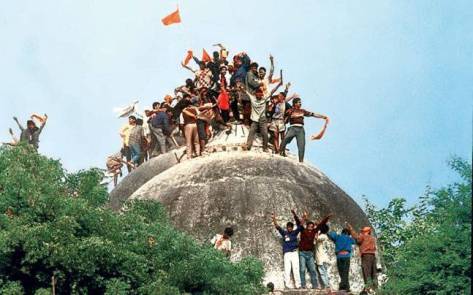
Twenty five years ago, on 6 December 1992, the structure of Babri Masjid was brought down by a mob of vandals, presided over by the top leadership of the BJP/RSS/VHP, as the Congress government led by prime minister Narasimha Rao looked on benignly. As did the Supreme Court before which a commitment was made by the Kalyan Singh (BJP) government in Uttar Pradesh – to the effect that nothing would be allowed to happen to the structure of the mosque.
Journalist Sajeda Momin, covering the demolition, recalls the scene thus,
I can still see the thousands of saffron-clad ‘kar sevaks’ clambering atop the 16th century mosque and pounding it with shovels, iron rods, pickaxes and anything they could lay their hands on. I can hear the screeching of Sadhvi Uma Bharti egging them on shouting “ek dhakka aur do, Babri Masjid tod do” through the microphones from atop the specially-built watchtower for the BJP/RSS/VHP leadership. I can visualize the three domes of the mosque collapsing inwards one by one at intervals of roughly an hour on that cold, wintery Sunday afternoon.
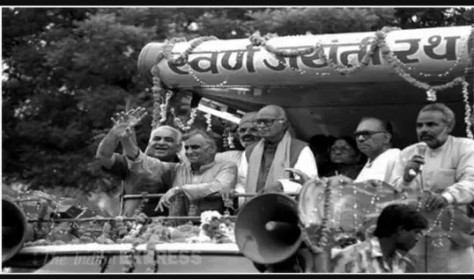
Everyone knew who were the dramatis personae at each level – and practically every bit of evidence that would ever have been required exists, captured in videos and photographs. Our present prime minister was said to be one of the key organizers of the of the Rath Yatra that led up to the demolition and can be seen holding the microphone in his hands in the photograph below.
Rath Yatra – precursor to the demolition, image courtesy Quora.com
Worse was to follow the demolition. The demolition of the structure of the mosque was over that day but the process of the demolition of the Indian Constitution that had begun with what was called the ‘Ram janmabhoomi movement’ continued. By ‘Constitution’ I do not simply mean the book that embodies the law of the land but rather the very weave that came to constitute Indian society as a result of the new contract that the document called the Constitution embodied. Constitution, therefore in a triple sense. The document called the Constitution too was not merely a book of laws; it was rather, the only existing, largely agreed upon, vision of a modern India. It was a vision which was put in place through the long process of struggles, debates and contestations over the long decades of the anticolonial movement and finally given shape in, in the Constituent Assembly. There was nothing benign or innocuous about it – every bit of it had to be achieved through a fight. And yet, in the end, that was the document that embodied the vision of modern India. The only political current that stood far away from both the anticolonial struggle and had no role in the creation of this vision is the political force that rules India today.
The RSS and its numerous offshoots were neither fighting the British nor joining in the anti-caste and anti-untouchability struggles through the period since they came into existence in the mid-1920s. No wonder leaders of the Sangh combine think the anti-colonial/ national struggle was about cow-protection. That they neither subscribed to the anti-British agenda nor to the anti-caste agenda around which struggles of that period took shape, is not just a matter of historical record but is also visible in the way its leaders and ranks conduct their politics today. Every single step taken by the Sangh leaders is a step out of sync with the vision of the future spelt out by the social contract of modern India. That the Sangh attributes this vision to the Congress is an expression of its own illiteracy about the diverse forces in struggle throughout that period.
Even though it is conducted in the name of Hindus, there is nothing ‘Hindu’ about its agenda. Sangh and Sanghism is the name of a malignant political machine that seeks to destroy the very body of society in the name of an ancient past. That is the political machine we confront today. That is the political machine that we must fight today with all our vigour.
Babri-Masjid – Before the Demolition, image courtesy Tehelka.com
The gradual erasure of the words ‘Babri Masjid’ from our everyday memory actually began in 1986, when the Hindu community was granted the exclusive right to worship there. This happened without any regard ownership disputes the and illegal conversion of this mosque into a temple in 1949.
This story of the dispute itself is disputable. It is imperative to revisit three interesting moments, which no one talks of these days.
The 1949 moment
On the night of 23 December 1949, a group of local Hindus entered the mosque and installed the idols of Lord Ram inside it. Although the police filed an FIR in which the building is clearly defined as a functional mosque, the local administration took charge of the building, and without removing the idols from the mosque space, declared it a legally “disputed site”. Read the full article here
When Hadiya Shafin shouted to the crowd that she converted voluntarily, that Shafin was her chosen husband, and that she wished to spend her life with him, some leading rationalist liberal feminists in Kerala sniggered at her: be grateful for the Indian Constitution which allows you to make a choice. This statement hid a despicable insult to her choice of Islam, slyly implying that it would not permit her any choices.
Goodness knows where these puerile, vain, indurate minds live their everyday lives. Maybe they are either still able to insulate themselves somehow from the onslaught of Hindutva violence, or find it useful to use the arms of this Hindutva hegemonised thuggish state to their narrow, shamefully narrow, ends.
Whatever, I could see no trace of the protective presence of the Indian Constitution when the Supreme Court heard Hadiya. I could see not the highest court of Justice of a vibrant democracy but I got a sense of how the Gates of Celestial Vaikuntam may look like:
Read more at : https://thewire.in/200701/hadiya-supreme-court-nia/
[This is the text of the open letter to the Chief Minister of Kerala from the celebrated Tamil poet Rajathi Salma, a leading literary and activist voice from South India whose writing has often revealed the pain and poignancy of women’s unfreedoms and the denial of a creative life of choice to them. This is about the never-ending agony that the confinement of a young woman, Hadiya, by her father, has become. Hadiya is to be heard by the Supreme Court of India on 27 November 2017, but the Kerala government refuses to take responsibility for her safe travel to Delhi, after many many pleas from civil society] Continue reading Hadiya’s Safety is the Kerala Government’s Responsibility: Rajathi Salma writes to the Chief Minister of Kerala→
First – I write this in my personal capacity. In this article I represent none of the other signatories to the statement that appealed for the crowd-sourced list of sexual offenders to be withdrawn, and for complaints to be followed through institutional mechanisms (henceforward referred to as Statement). I might still use the pronoun ‘we’ sometimes, please consider that a slippage; that collective identity is something developed over three decades in a movement, and I hope I never lose that habit. But this is my individually written post. Similarly, after the Statement, Kavita Krishnan has written on Scroll, Ayesha Kidwai on Facebook and Nandini Rao on her blog, each expanding on some aspect or the other of our brief statement.
Second – the Statement was not and is not a ‘Kafila’ statement, it was simply posted on Kafila. Just as a statement posted on Wire is not a Wire statement or a statement on Scroll a Scroll statement, unless explicitly declared to be. Kafila is a collectively run blog with about 20 members, of which I am one of the founder members. Any member of the collective can post directly on Kafila without checking back with other members of the collective. We have often had robust debates among collective members taking opposing sides on a situation, and these debates have played out on Kafila in the past. Only one Kafila member is a signatory to the Statement, myself. I posted it on Kafila because it is a site which is my first site of preference, whether I am attacking the Hindu right or writing on feminist issues. I asked the other signatories if I could post it here, since I have to ask nobody nor approach anybody to post on Kafila.
Lawrence Liang is also a member of the Kafila collective. He does not ‘run’ Kafila (as has been alleged by many), no individual does. But it seems that in this new era of ‘radical’ politics, individual control and leadership of campaigns is assumed. Further, Mahmood Farooqui too was a Kafila collective member. When a specific complaint of sexual abuse and rape was brought against him by a complainant anonymous to us, the Kafila collective suspended him immediately from Kafila publicly, pending investigation of the complaint. That was the only collective statement Kafila has issued in its ten years of functioning as a voluntary, non-funded blog.
On 13 September 2017 the Union Home Ministry, following the 2015 order of the Supreme Court, decided to grant citizenship to Chakma and Hajong refugees. Victims of religious persecution in the Chittagong Hill Tracts of Bangladesh, the predominantly Buddhist Chakmas and Hindu Hajongs began immigrating to the north eastern region of India 1960s onwards. The then central government, eventually, moved a large number of these refugees to Arunachal Pradesh; while Arunachal Pradesh is their zone of concentration, a considerable number of Chakmas and Hajongs live in Mizoram and Meghalaya too. The decision of the Home Ministry, however, did not go down well with the indigenous tribal population of Arunachal Pradesh; the All Arunachal Pradesh Students’ Union protested against the move citing threats to life and livelihood of the native inhabitants of the state. On 14 September 2017 the Union government assured the protesters that a middle-ground – between honouring the law and commitment towards protecting the rights of the people of Arunachal Pradesh – would be found.
(This is the text of the open letter from Prof. Satish Deshpande to the Chief Minister of Kerala on the Hadiya issue. Satish’s work ContemporaryIndia, translated as SamakalikaIndia, has been hugely influential in shaping the progressive understanding of Hindutva nationalism and communal hatred in Kerala.)
<!–more–>
The Honourable Chief Minister of Kerala
Shri Pinarayi Vijayan
6thOctober, 2017
Respected Sir,
Ever since I first came to Kerala in 1981 to study at the Centre for Development Studies (CDS) at Thiruvanathapuram, I have been a committed supporter of everything that the left tradition of your great state has achieved by way of democratic innovations in governance and social practice. Even today, I believe that Kerala continues to be a shining example in many spheres where the rest of India lags far behind.
I was therefore shocked to read about the Hadiya case and the tacit and explicit state support that underwrite her virtual house arrest today. I am told that the man that Hadiya has chosen to marry and the organisation with which he is associated may have a questionable past. Whatever be the truth of this matter, the fact is that an adult citizen’s personal choices in matters like marriage cannot be undone by the state no matter how ill-considered that choice may appear to others. Moreover, in the current climate, it is surely not irrelevant that the religion in question is Islam – it is highly unlikely that this case would have attracted any attention if Hadiya had chosen to convert to some other religion.
It is highly embarrassing – to the say the least – that a government led by a party that can claim to have played a major role in transforming Kerala society for the better is today seen to be siding with the reactionary forces.
I appeal to you to use the power vested in you by the people of Kerala to end this travesty of justice and ensure that Hadiya is left free to live her life as she chooses.

 KAFILA - COLLECTIVE EXPLORATIONS SINCE 2006