Indian Democracy and the Current Political Dispensation: Ram Puniyani

Guest Post by RAM PUNIYANI

Text of the Dr Asghar Ali Engineer Memorial Lecture

I begin this lecture paying tribute to my very dear friend, Dr. Asghar Ali Engineer, with whom I had the rare privilege of working with for close to two decades. Dr. Engineer was a unique scholar-activist, totally committed to the dream and vision of a humane society that honours the values of diversity and where human rights for all are the defining point.

In this regard, he may have been among the first persons who realized the dangers of divisive communal politics. It was he who set the trend seeking the causal factors behind communal violence, doing his own meticulous investigation after such riots. He contributed massively to reforms that took place in the Bohra community, on the issues of secularism and finally, in the interpretation of Islam. We need to learn a lot from him in order to strive for a society that values peace, amity and compassion.

Where are we standing today? What are the major threats to Indian democracy, today, even more menacing with the coming of the Modi Government?

The factors contributing to his victory have been several. The unstinted support given to him by India’s corporate; the fanatical zeal of the RSS and its lakhs of volunteers; the role of a corporate controlled media; the false projection of the ‘Gujarat model of development’; and the polarization of society along religious lines

The promise of Achhe Din – Good Times – has vanished into thin air. Despite the steep fall in the prices of crude oil in the world, the overall ‘cost of living’ continues to going up. The promise that all the black money stacked abroad will be brought back within six months or so and that we would be surprised to see 15 lakh deposited in our accounts, has been forgotten. The pattern of (good?) governance is only visible in the centralization of power around one person, Modi. Gradually the cabinet system of governance is giving way to one man’s autocratic ways, with secretaries of Government departments reporting directly to the PM.  Continue reading Indian Democracy and the Current Political Dispensation: Ram Puniyani

Murdering Democracy in Kerala : the Latest

Secularism and socialism can be thrown out, so says the Hindutvavadi. Among those who protested against this suggestion were, of course, the Congress. But then, increasingly, many of us who live in  Congress-ruled Kerala are unable to tell the Congress from the BJP as they have thrown out not just secularism and socialism but even minimal forms of liberalism. For our rulers seem as adamant as the BJP in forcing down our throats at least a softer version of Hindutva, reinforced with protection to shameless plunder of public resources and repressive police measures. Now young people and activists in Kerala, many of who were active in many protests including the Kiss Protests, are being pursued and hounded by the police. Apparently, a few people who participated in the latest edition of the Kiss Protests, the Lovefest, were hounded by the police for having been seen in the vicinity of a police station repeatedly! The most convenient excuse is pursuing the Maoists, a fear that is easily excited in our fattened and lazy middle classes. By the way, I am actively considering saving some money by ending my subscriptions to newspapers. In fact it is not being on FB which makes me feel out of touch with the world these days. Two leading human rights activists, Thushar Sarathy and Jaison Cooper, have been arrested and the papers are busy covering that shameful and utterly criminal waste of our common resources, the opening ceremony of the National games.

I am not surprised at all, having been an observer of local politics. In Kerala, after the Left-Right differences in politics came to an end, what we have seen is the transformation of our politics into a neofeudal space inhabited by powerful male leaders and their craven followers vying for power. Because the discourse of social development still lingers and the oppositional civil society has not yet given up, entry of predatory capital from national or global sources has not been easy. However, a whole generation of NRI — Malayali –capitalists based in the Gulf countries who essentially manage the wealth of the rulers there have been able to enter Kerala unimpeded.It is this group which is increasingly taking over our resources in overt and covert ways, legally and illegally. These capitalists themselves are interesting — their transnational belonging needs to be studied. They have apparently managed to become part of the non-democratic political systems in the Gulf countries, entering the lower levels of the court there, as juniors who help manage the rulers’ wealth. And from that position of strength, they now work to systematically undermine everything that Malayalis hold dear : our welfarist democracy, social development achievements, our rich ecology. Continue reading Murdering Democracy in Kerala : the Latest

Modi, Barack and a once sovereign nation

The sheer misery, the excruciating embarrassment, of  watching the Prime Minister of a sovereign (but not secular or socialist) nation desperately, inappropriately, capering about to show off his imagined intimacy with an American President who steadfastly kept his distance and his dignity, is now passing. Time does heal all wounds. (And hopefully, as Groucho Marx put it, Time will also wound all heels) [1]

But the burning question remains – is Modi more shameless than he is ignorant? Much has been said about Modi’s suit that exceeds the worst excesses of the late unlamented Marie Antoinette. Vrinda Gopinath points out:

While the last world leader to don such a suit (it costs around 15,000 sterling pounds or Rs 15 lakhs today) was deposed Egyptian tyrant Hosni Mubarak, it certainly out-dazzled Obama’s working dark grey suit (to cut down on non-vital decisions, the US Prez only wears grey and blue ). However, if Modi was thinking hip-hop bling and ice accessories (his fave diamond Movado watch), it certainly got Obama to make a mention at the President’s banquet when he foxily pointed out how a newspaper back home wrote, “Move aside, Michelle Obama. The world has a new fashion icon.” It must have not passed Obama’s notice that Modi had changed his attire thrice that day.

securedownload

Continue reading Modi, Barack and a once sovereign nation

Women Strike Back!

Just to share with Kafila readers two wonderful performances against misogyny by two cool young women, Rene Verma and Vasundhara Kaul, putting down sexism with a light touch that cuts very deep indeed – take a look at the string of comments that follow Vasundhara’s performance , from scared and threatened men unable to deal with it.

These are already ‘going viral’ as they say – just wanted to add Kafila’s contribution to viralizing them!

Here’s Rene Verma taking on Honey Singh. Unfortunately we cannot skip the compulsory advertisement for Modi and His Technicolour Dream Coat That Costs as Much as a Small Village Hospital.

(Oh, okay, the ad seems to have gone now, but that coat – that coat!! Ain’t going nowhere, to use the slang of the land of Modi’s new unilateral BFF).


Here’s an interview with Rene Verma on The Ladies Finger:

I’ve always been invested in performance art and its relation to policy and society. My piece was never intended to be a takedown of an individual rapper or two, it was a beleaguered response to a culture that privileges narratives of violence, restrictive norms, and ideals of beauty that are often untenable. Pop music, and pop culture at large has been perceived as a sanitized area of operation, where anything and everything goes, but songs and the discourses they promote operate in insidious ways. There is a silencing of body diversity, queer voices, dissent, and anything perceived as ‘not-the-normative’, both in overt and covert ways. I love rap, but I often find myself confounded over the lyrics packaged within these catchy, and annoyingly pervasive songs. This piece was actually part of an inter-college competition where I was given an hour to prepare a spoken word piece on the theme, “Portrait of a ‘Lady’”. And I thought it would be nice to construct a normative portrait of a ‘lady’ through a rap parody and deconstruct it through contrasting voices.

And here is Vasundhara Kaul, telling “Men With their Big Penises – rahendo beta, tum se nahin ho payega…”


Gandhi’s Assassins

“It is far too early to dismiss the possibility of a future Hindu State in India. However, the possibility does not appear a strong one. The secular state has far more than an even chance of survival in India” (India as Secular State, 1963).

It was the early sixties when American political scientist Donald Eugene Smith commented about the “possibility of a Hindu state in India”. Today, even to a layperson, the secular state in India seems to be standing on very weak foundations, and the possibility of a Hindu State is far stronger than it was half a century ago, in 1963.

Perhaps, a pertinent expression of this transformation of India is the metamorphosis we witness in the image of Nathuram Godse – the assassin of Mahatma Gandhi, as part of a conspiracy which was hatched by many bigwigs of the Hindutva Supremacist movement. The makeover in the image is for eveyone to see: from a murderer, a conspirator, terrorist to a ‘martyr’ who supposedly ‘deserves’ a temple in his name everywhere. We also learn that after the ‘successful’ run of a drama in Marathi called Me Nathuram Boltoy (I Nathuram Speak) for the last few years, plans are afoot to have a movie made on him, supposedly to communicate his ‘viewpoint’. With the changed political situation, where even the censor board of the country is populated by rightwing people, one can guess that it won’t have any difficulty in release. And with an ambience which is more prone to illiberal ideas, one can as well prophesy that it will have a good run.

Read the full text here.

Confronting Gandhi’s Ghost

” I imagine you believe that he was for the most part adored; in fact he was hated and he is still hated today. Hatred is still alive in India and he died of it. Those who were for mostly from those what is called the scheduled castes, those who belonged to the gutters with whom he had sided. Yet he did not ask anything of anyone; he simply went his own way….But the simple fact that he lived according to his own law—which was ascetic and demanding of himself was something people could not tolerate.”  French writer Helene Cixous turns to Gandhi to compare his life with the ways of writing that “may hurt, may dissatisfy and give the feeling that something is taken away.”

Continue reading Confronting Gandhi’s Ghost

@NarendraModi, or how I learned to stop worrying and love the brand: Joyojeet Pal

Guest post by Joyojeet Pal

Political Social Media had a minor event this week. The world’s two most followed elected leaders on social media, shared the media centerstage. Barack Obama, with 45 million fans on Facebook and 54 million followers on Twitter, and his Indian counterpart Modi, with 27 million on Facebook and another 9.8 million on Twitter, together command the arguably most powerful political brands on social media. In a rare moment of realpolitik bromance, Narendra Modi sent Barack Obama a smiley for quoting Shah Rukh Khan in the Lok Sabha. A day later, Narendra Modi became the first Indian politician to use Twitter’s new video feature in a carefully cut 30-second monologue.

Modi campaign’s exceptional presence on social media is not news. He is India’s most “liked” person on Facebook. While he still trails actors Amitabh Bachchan the Khan troika and the Dalai Lama from among India’s resident Tweeters, his average of adding 20,000 followers daily for much of the last year should put him safely past his competition by the end of the year.

Continue reading @NarendraModi, or how I learned to stop worrying and love the brand: Joyojeet Pal

Climate Change – Keep the Climate, Change the Economy: Sagar Dhara

Guest post by SAGAR DHARA

Contrasting outcomes of recent global warming meetings

Two recent meetings on global warming, one scientific and the other political, are of great public interest as they have a bearing on human society’s future course to become a sustainable global community. The meetings stand in sharp contrast with each other in terms of the clarity of their outcomes.

The first meeting was held by the Intergovernmental Panel on Climate Change (IPCC), a body of over 2,000 scientists. IPCC released its fifth assessment’s synthesis report in Copenhagen end-October 2014. The report states unequivocally that “Human influence on the climate system is clear.” Further, it warns that the emission of another 1,000 Giga tonnes1 (Gt) of carbon dioxide (CO2), referred to as the carbon space, is likely to raise average global surface temperatures by 2oC above pre-industrial times. This is considered dangerous to the environment and human society.

Since the industrial revolution began in the mid-18th Century, humans have used 35% of the known 1,700 Gt of conventional fossil fuel reserves, and cut a third of the then existing 60 million km2 of forests to emit 2,000 Gt CO2. The consequent 0.85oC average global temperature rise over pre-industrial times has triggered significant changes in the physical, biological and human environments. For example, rainfall variation has increased, extreme weather events are more frequent, pole-ward migration of species is noticeable and their extinction rate is higher, human health, food and water security are at greater risk, crop yield variations are higher, a 19 cm mean sea rise and a 40% reduction in Arctic’s summer ice extent have occurred over the last century, glaciers have shrunk by 275 Gt per annum in the last two decades, and social conflicts have increased. Continue reading Climate Change – Keep the Climate, Change the Economy: Sagar Dhara

Storm in a Kahwa Cup: Organizers of the Kashmiri Food Counter at the International Food Festival, JNU 2015

Guest Post by Organizers of the Kashmiri Food Counter at the International Food Festival, JNU 2015

Universities are supposed to be the centers of free inquiry, speech and expression. However, in the recent months universities and other democratic spaces have been under attack from right wing fascist elements across India. University authorities under the influence of right wing forces have increased surveillance on sections of students and have started to monitor and control campuses. As a premier institute of learning Jawaharlal Nehru University (JNU) has always has preserved its democratic culture and has resisted such attacks tooth and nail. However, in recent days even JNU is experiencing pressures from the right wing fascist forces.

Every year, JNU organizes an International Food Festival (IFF) where students from diverse cultures and nations displaying their flags come together to offer global cuisines. This year on 20thJanuary, a group of students from Kashmir booked a counter at the IFF. After completing necessary formalities and depositing security amount the festival organizers allotted space for Kashmir food counter along with the Tibet food counter. However, International students association (ISA), body that organizes the festival started receiving threats from the ABVP goons. The president and other members of the organization were harassed and intimidated. The organizers received open warnings from ABVP threatening them with disrupting the festival in case Kashmiris were allowed to open their food counter. International students who organize the festival were threatened with legal action and deportation. Just two days before the festival the booking for Kashmiri food counter was cancelled by the organization. Continue reading Storm in a Kahwa Cup: Organizers of the Kashmiri Food Counter at the International Food Festival, JNU 2015

Long Live Charlie Hebdo : Harsh Kapoor

A letter to the left leaning in wake of Charlie Hebdo shootings of January 2015

Guest Post by HARSH KAPOOR

The January 2015 terror attack on the Paris satirical weekly and its gross misinterpretation by people of Left liberal sensibilities in India and much of the world.

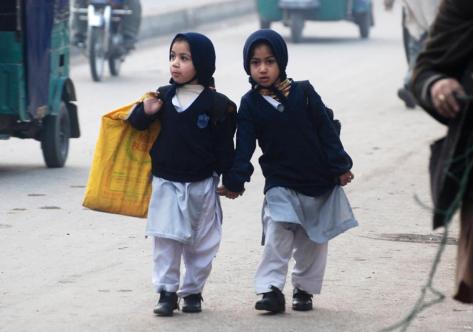
We recently witnessed a devastating terror assault by fanatics who gunned down close to 200 children in a school in Peshawar. Was this a desperate cry of the dispossessed in Pakistan? I am glad that the various tiny fractions of the left in Pakistan stood up and condemned it openly, some in India also stood up for the first time. It provoked widespread shock and disdain.

But the terrorist assassination of 12 cartoonists, journalists and workers at Charlie Hebdo in Paris on 7 January 2015 has provoked very different reactions. Geographical location of the murder seems to drive this.

I am utterly astounded and shocked at the manner in which many in the left leaning and liberal circles in India have reacted to the devastating terror attack in Paris. Has a section of left gone mad? Why do they have to deflect a straight forward issue and start providing rationalisation for terror attacks from the Muslim fundamentalists. We are being given an endless spiel on French colonisation, the war for decolonization in Algeria, the exclusion of the so-called Muslim ‘community’ in France, the blowback for France’s foolish involvement in the recent wars in Libya and Syria and so on. The role of poor and dispossessed is being invoked.

( Read the full article here : http://www.sacw.net/article10438.html)

Where Have all the Swings gone?

School kids hold up a sign given to them by activists at a demonstration at Langata Primary Road School.Photo Courtesy : Brian Inganga/AP

Who ‘stole’ our playground ?

There are occasions when simple questions raised by innocent people – even by kids – invite brutal wrath of the authorities. The kids of Langata Road Primary School in Nairobi learned it a very hard way.  Back from Christmas vacations when they found that the playground of the school – which provided them enough space to unwind themselves – has just ‘disappeared’ behind ‘iron walls’ with security people guarding it, they had raised this simple question. Sympathetic teachers had told them that a dominant politician in Nairobi, who wanted space to park cars of people visiting a neighbouring mall owned by him, has ‘taken over’ their playground.

Definitely it was not an unusual event – at least in Nairobi which happens to be one of the fastest growing real estate markets in the world – where real estate mafias are so powerful that with the connivance of political masters they are able to ‘acquire’ vacant or unmarked land plots without much difficulty. And land belonging to public schools is considered ‘under threat’ of land sharks as it is not properly delineated to them.

But nobody could have predicted that the kids in Langata School would prove to be biggest stumbling block in their ‘peaceful’ expansion and would literally ‘make history’. As rightly pointed out by an analyst these kids did what ordinary Kenyans are rarely able to do: defend disappearing public space. Continue reading Where Have all the Swings gone?

PK, satire, ramzadas: Prabhat Kumar

Guest Post by PRABHAT KUMAR

download

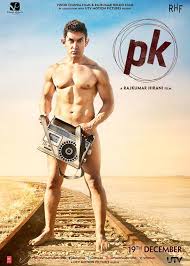
Commenting on a Hindi film released a month ago is a difficult enterprise, but this ‘delayed’ review of PK highlights what the film critics so far have ignored. Through intelligent crafting of its narrator-figure and its satirical narrative, I argue, this astoundingly successful Hindi film questions the ordinary and banal of Indian public life. The political vision behind PK’s satirical attack is old but relevant: Nehruvian.

Breaking the grammar of normalcy, Pee Ke!

Oye Pee Ke hai kya?” (Are you drunk?), is the dismissive riposte that PK, protagonist-narrator, of the film receives for questions he asks. For, the questions he asks are considered ‘abnormal’. But he is persistent with his ‘odd’ queries and prying gaze, like a drunken man, unmindful of the wrath he may invite from the sober and normal beings. He is tireless and gawking in his ‘weird’ interrogations, like a curious child, unaware of the risk of irreverence to mature beings. But, why does he ask such ‘strange’ questions? What makes his questions ‘unheard-of’ and his snooping eyes ‘clumsy’ in normal everyday life? Why is his ‘drunken-childish’ probing inadvertently insistent to confront the normalcy of mature world? The answer lies in the carefully crafted lead character and the political subtext that inform PK. Continue reading PK, satire, ramzadas: Prabhat Kumar

Resist the Shrinking of Democratic Spaces on Campus: Concerned Students of Tata Institute of Social Sciences, Mumbai

Guest post by Concerned Students of Tata Institute of Social Sciences, Mumbai

Universities are thought to be just, equal and free spaces. However the history of access to universities for certain sections of the society is not very old. Discrimination has been institutionalized and structurally carried out on the basis of caste, race, gender, religion and sexual identity even in the space of the university. However, over time there has been an increase in assertion from the marginalized groups in university spaces that has caused some disquiet among administrators. This is evident from various incidents that are taking place on a day to day basis in university spaces.

Kashmir and North East are two regions which have been frequently used by the Indian state to claim its sovereignty through grave violation of basic rights of people residing in these areas. Contrary to our beliefs, campuses and universities also reflect the larger politics of our society.

We, a group of students invited Dr Dibyesh Anand for a lecture titled “Deliberating Kashmir: Beyond AFSPA and Chutzpah” at the Tata Institute of Social Sciences, Mumbai on 3rd January 2015. Dr Dibyesh Anand is the Head of Department of Politics and International Relations at the University of Westminster, London. He is an acclaimed scholar on violence and States in South Asia and has also written and published extensively on his area of expertise. He has also been a visiting professor to the University of California Berkeley, the Australian National University, the Centre for Bhutan Studies, the Jawaharlal Nehru University and the Central University of Hyderabad. Following the procedure we had booked the room four days prior to the programme and invited students and faculty in TISS and outside to attend the talk. Continue reading Resist the Shrinking of Democratic Spaces on Campus: Concerned Students of Tata Institute of Social Sciences, Mumbai

Is economics sexist? Divya Bhagia

Guest Post by DIVYA BHAGIA

On the face of it, it is hard to believe that our beloved science of economics that has provided enough space to discuss, and at some levels promote, the idea of women’s empowerment could actually be sexist itself. Earlier, I would have offered an aggressive defence of the dscipline. So before I move on, I need to convince you with some facts, just as I had to convince myself that not everything is as it appears and there is enough reason to probe further in this direction.

Leaky Pipeline

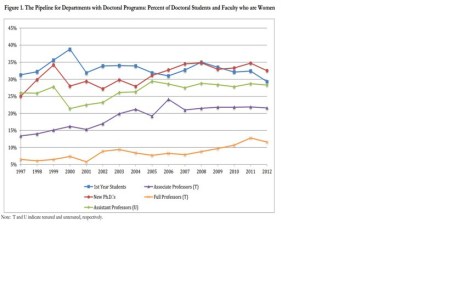
The 2012 Annual Report of the Committee on the Status of Women in the Economics Profession reported that there were only 32.5% women amongst all the people who attained a PHD degree in 2012 at 122 economic departments with doctoral programs, and there were only 28.3% women amongst assistant professors, 21.6% amongst associate professors and 11.6% amongst full professors. The fact that an already skewed women-men ratio of 3:7 in the field skews up to 1:9 ratio as we move up does ring the ‘sexist bell’. This pattern which has characterised the participation of women in economics profession for the longest time is referred to as the ‘leaky pipeline’, where we see that women are being dropped out at each step of the academic ladder.

1One reason not to dwell deeper on these numbers maybe that the percentage of women as full professors today should depend on the percentage of women as assistant professors say fifteen years back. But as the figure above shows that the numbers for each category remain more or less the same throughout the fifteen years. Also if we look at similar numbers confining ourselves to only top 10 or top 20 Economic departments in the sample, the ‘pipeline’ is even more ‘leakier’.  Continue reading Is economics sexist? Divya Bhagia

Farmers’ Suicides and Fatal Politics: Vasanthi Srinivasan

Guest Post by VASANTHI SRINIVASAN

With depressing regularity, the newspapers have been reporting farmers’ suicides in many states. Recently, P Sainath wrote on BBC that around 296,438 farmers have committed suicide since 1995. He also mentions that cash crop cultivators of cotton, sugar cane, vanilla, pepper, groundnut etc account for the bulk of those suicides. According to a PIL heard by the Supreme Court in December 2014, around 3146 farmers in Maharashtra have committed suicide this year. Of course, farmer’s suicides only account for a fraction of all suicides reported in India. Besides, farmer’s suicides are a global phenomenon. The litany of woes is also familiar to readers, namely rising indebtedness, crop failures, falling prices, natural disasters etc.

And yet the meaning of these suicides, if any, is worth reflecting upon.

Politicians, who are used to massive debts, seem to think this is an ‘extreme step’ on the part of farmers. In 2003, the then Union Minister for Agriculture hinted that indebtedness alone may not be causing the ‘extreme step’, and that ‘family problems’ may also be a reason. In Karnataka, the Veeresh committee report had earlier identified depression, alcoholism and marital discord rather than the rising debt as the relevant causes. Never one to lag behind, the hi-tech Chief Minister of Andhra Pradesh Chandrababu Naidu  announced compensations and proposed to get psychiatrists to rural areas. One scholar has pointed to the increasing isolation of cultivators and high levels of anxiety about failure suffered by some farmers [1]. These attempts at ‘personalizing’ the farmers’ problems may be necessary but not sufficient as long as other factors remain unexplored – increasing cultivation costs, crop failures, water shortages and falling product price. Citing the high figures of suicides (204) in Maharashtra for 2014 until April, followed by Telangana (69 until October), the Times of India  (dated Nov 26, 2014), reported that the present Central government admitted indebtedness as a possible factor.  There are also calls to increase monetary compensation to families affected by such suicides.   Continue reading Farmers’ Suicides and Fatal Politics: Vasanthi Srinivasan

‘Attica, Attica, You Put Them Guns Down!’ Ipsita Barik

On a day when we woke up to the seemingly incomprehensible barbarism of a woman being beheaded in Saudi Arabia, we may do well, apropos Nivedita Menon’s post on MLK, to remember the barbarism that hides in broad daylight within seemingly civilised societies. One such floodlit hideout, so bright it blinds us, is the state of our prisons. Before Guantanamo and Abu Ghraib inaugurated a new era of dehumanisation in the American “correctional system”, there was Attica, and hundreds others like it that continue in the U.S and around the world to this day. We may also remember Professor G.N Saibaba of Delhi University who, despite being 90% disabled, has been not only imprisoned but kept in solitary confinement for almost two years on mere suspicion in an Indian jail somewhere. Really, what more does it take these days?!

This is a guest post by Ipsita Barik

Attica 9

When Al Pacino’s character Sonny Wortzik yells and hollers “Attica – Attica” in the film Dog Day Afternoon, the cops and the FBI officers are left stunned & dumbfounded, but the civilian population collected at the scene, behind the police barricades began to cheer & applaud. The air is soon filled by the chants of the noun and Sonny in his soaked white shirt, flaying his arms and stomping on the ground, gestures at the cops and adds “you put them guns down; you put them down – “AATTICA aattica”. So what was happening here? Why were these people cheering and supporting a man who had come to rob a local bank and was holding hostages inside! And what was Attica all about?

Attica 5

Attica prison riots/uprisings happened at the Attica Correctional Facility, New York, United States; when the prison cells and yards were seized by the inmates, who also held hostages, on September 9th 1971, opening a series of negotiations and dialogues between the establishment and the inmates, which included civilian observers, Tom Wicker of the New York Times, Republican State Senator John Dunne, radical lawyer William Kunstler and Black Panther’s Bobby Seale, on the request of the inmates. The primary demands of the inmates were related to the inadequacies and brutalities within Attica, such as related to insufficient food and medical care, racial discrimination, physical abuse, restricted access to educational and training facilities, all a serious indictment of the prison rules and environment, as the New York State Special Commission on Attica/McKay Commission (set up by the state) subsequently went on to assert and highlight. Continue reading ‘Attica, Attica, You Put Them Guns Down!’ Ipsita Barik

The Other America: Martin Luther King

January 19th was Martin Luther King Day. To honour him, here is the recording of his famous The Other America speech at Stanford in 1967.

Too many, far too many tragic resonances with 21st Century India. 

There are literally two Americas. One America is beautiful for situation. And, in a sense, this America is overflowing with the milk of prosperity and the honey of opportunity. This America is the habitat of millions of people who have food and material necessities for their bodies; and culture and education for their minds; and freedom and human dignity for their spirits. In this America, millions of people experience every day the opportunity of having life, liberty, and the pursuit of happiness in all of their dimensions. And in this America millions of young people grow up in the sunlight of opportunity. But tragically and unfortunately, there is another America. This other America has a daily ugliness about it that constantly transforms the ebulliency of hope into the fatigue of despair. In this America millions of work-starved men walk the streets daily in search for jobs that do not exist. In this America millions of people find themselves living in rat-infested, vermin-filled slums. In this America people are poor by the millions. They find themselves perishing on a lonely island of poverty in the midst of a vast ocean of material prosperity.

The one difference being that in 21st Century India, there are lonely islands of prosperity in the midst of a vast ocean of deprivation, human misery and injustice.

Trampling on Workers’ Rights in Sriperumbudur: Ramapriya Gopalakrishnan and Bobby Kunhu

Guest post by RAMAPRIYA GOPALAKRISHNAN and BOBBY KUNHU

On January 2nd this year, management officials at the Sriperumbudur factory of NVH India Auto Parts Ltd, the Indian subsidiary of a Korean auto parts manufacturing company manhandled the company’s striking workers. The shocking visuals of the Korean managers of the company dragging workers on the floor and a manager standing over a worker holding him between his feet sparked outrage amongst civil society groups and caught the attention of the mainstream media.

Literally trampling workers!

The trigger for the strike was the suspension of 15 workers which their union alleges was without any reason. Several other issues festering for a long time also gave an impetus to the workers to go on strike. These include the lack of adequate toilet facilities. Apparently, there are only 6 toilets in a factory where more than 700 workers are employed of which only 4 are in usable condition. In a juvenile twist, the workers have to seek and secure the permission of the management officials each time they need to use the toilet. If this rule is violated in cases of emergency, warning letters are issued to workers alleging that they were found missing from their work spot. Another issue is the lack of a regular and sufficient supply of drinking water in the factory. The workers were also miffed at being under the glare of surveillance cameras all the time during their work hours. A very important issue that was a sore point was the management’s use of trainees and contract labour to perform production work of a regular nature. The workers were also upset at the attitude of the Korean management and the way they treat them.  They allege that there are instances of physical abuse where the management officials hit and slap workers and spit on their faces. Over and above all this, the permanent workers in the factory were peeved at the failure of the management to grant recognition to the union they had joined in 2013 and negotiate with the union.

Continue reading Trampling on Workers’ Rights in Sriperumbudur: Ramapriya Gopalakrishnan and Bobby Kunhu

Love in the Time of Military Courts: Fawzia Naqvi

Guest Post by FAWZIA NAQVI

[ This guest post marks one month of the 16th December massacre of school-children by Islamists in Peshawar, Pakistan ]

Fawzia 1 

Pakistan has become a euphemism for insanity.  Doing the same thing over and over again and hoping for a different outcome. There are though some incredibly brave, thoughtful, humane and patriotic Pakistani men and women who have decided enough is enough and they are determined to chart a different future for the country. Continue reading Love in the Time of Military Courts: Fawzia Naqvi

Bhopal Victims Neglect a Consequence of Disinvestment and Low Value of Life: Sagar Dhara

Guest post by SAGAR DHARA

On 2 Dec 1984, Bhopal’s unsuspecting population was hit in the stealth of the night by methyl isocyanate (MIC), a killer gas that leaked from the Union Carbide plant located on the northern edge of the city.  The official immediate death toll was 2,259, though journalists estimated it to be thrice that number.  Government of India now admits that the cumulative number of deaths is more than 20,000.

At first glance, the event looks like an engineering accident.  Wash water seeped through a closed valve, got into MIC Tank 610 and triggered a runaway reaction that ruptured it and spilt 42 tonnes of MIC.  Low wind speeds made the heavier-than-air gas cloud hug the ground at high concentrations as it drifted towards nearby slums.  The highly corrosive gas caused massive edema in the lungs.

Economics is root cause for accident

The cause for the accident can be traced to low product sales that made the company disinvest in safety and environmental systems. Prior to 1980, Carbide formulated Sevin, a carbamate group pesticide, with imported chemicals at their Mumbai plant.  Because of Sevin’s popularity, Carbide built a new plant in Bhopal to manufacture it.  By then synthetic pyrethroids, the next generation pesticide, started pushing carbamates out of the Indian market.  Consequently, the Bhopal plant never produced more than 50% of its installed capacity and its financial returns were unhappy. Continue reading Bhopal Victims Neglect a Consequence of Disinvestment and Low Value of Life: Sagar Dhara

Swachchh Bharat – Beyond Charity and Symbolism to Legal Rights and Duties: Sujith Koonan

Guest post by SUJITH KOONAN

Sanitation and cleanliness seems to have become buzzwords. Celebrities and political leaders have started talking about sanitation. The call for Swachchh Bharat by the Prime Minister of India was welcomed by many taking brooms in their hands. Several institutions have uploaded prestigiously the photographs of its employees carrying brooms. All of a sudden, the sanitation consciousness seems to have increased in the country. Indeed, it is a good sign that we have started thinking and talking about the ‘unmentionables’ – shit and dirt.

Many of these actions and responses are symbolic and rhetoric in nature. While it may be acceptable to begin with symbolism, the seriousness needs to be demonstrated through concrete long term plans and actions. One can hope that the government will take such steps. One way to show that the ongoing sanitation talk is serious, and the state is sincere about it, is to recognise the legal aspects of sanitation. There are mainly three issues where the government has been a failure in fulfilling its constitutional and legal duties and these are supposed to be at the forefront of the Swachchh Bharat Mission (SBM). Continue reading Swachchh Bharat – Beyond Charity and Symbolism to Legal Rights and Duties: Sujith Koonan

DISSENT, DEBATE, CREATE