
Salman Zalman is a young man from Kerala who has recently been arrested for an alleged act of disrespect towards the Indian National Anthem. As an observer in Kerala, I think young people like him who choose to get involved in public struggles for justice face a number of predicaments that were perhaps not so severe for my generation when we were young. For this reason, I do feel that members of my generation, those of us alive to public issues, need to be more open to the challenges that public-minded younger people face today. Continue reading If Gail Omvedt is Katherine Mayo, then Sugatha Kumari is …? Thoughts on Salman’s Predicaments
In The Virile God’s Graveyard
( I had spent a week in Gujarat in February-March,2007 and published two reports in TEHELKA. Reproducing the first part to remind myself that it was again in Gujarat where the fear of ‘Love Jihad’ was invented in its present incarnation.)
For many Gujaratis, Narendra Modi is a man who provides material and spiritual comforts to his people.Gujarat is calm. And is on the march. Every village of the state is a jyotigram. Narmada water is flowing in abundance in the canals quenching the thirst of Gujaratis. “Was not Surat flooded a few months back and did not the people of Gujarat suffer?” I ask my driver. “No, was not Narendrabhai there to take care of everything?”, he replies. How can anything go wrong when Narendrabhai is keeping watch!
Narendra Modi, you see, does not have a family and he works round the clock, we are informed. I find Modi smiling down at us benevolently from the digital billboards that dot Ahmedabad. There is no escaping his firm developmental smile. “The man has impressive qualities. Gujarat is bound to forge ahead under this workaholic chief minister. A citizen may have doubts about his secularism, but even his enemies don’t doubt his competence,” writes Gunawant Shah, a popular Gujarati columnist. Continue reading In The Virile God’s Graveyard
Reflections on Solidarity for Palestine in India: Urvashi Sarkar
Guest post by URVASHI SARKAR
Some sections of Indian civil society have reacted to Israel’s most recent brutalities in Gaza with outrage, and rightly so. In its pounding of Gaza which lasted over a month, Israel destroyed essential services and infrastructure, razed houses to debris and wiped out entire families. Over 2000 Palestinians were killed, many of them civilians, and of which over 400 were children. On the Israeli side, sixty-four soldiers and four civilians died. A shaky ceasefire between Israel and Hamas, announced in early August, did not last, with hostilities resuming almost immediately.
It is not uncommon to hear Indian voices supporting Palestine even at a time when right wing forces hold sway in the country; yet there is more to this support than meets the eye. There are internal differences on the matter of Kashmir for instance, regarding the extent to which parallels can be drawn between the Palestine and Kashmir conflicts. The actualization of both conflicts dates back to the 1940s. Both regions are heavily militarized; its people suffer routine human rights violations and both are undergoing prolonged self-determination struggles. Each year, Kashmir joins different parts of the world to observe Al-Quds day, held on the last Friday of Ramzan, to observe solidarity with the Palestinian struggle. Popular anti-India protest sites in Kashmir, such as Ramban Chowk and Maisuma, are referred to as ‘Gaza’ in local parlance. A Kashmiri teenager lost his life during firing by security forces, in an anti-Israel protest in South Kashmir in July this year. Continue reading Reflections on Solidarity for Palestine in India: Urvashi Sarkar
Strength Of A Woman? Surabhi Shukla and Anubha Singh
Guest post by SURABHI SHUKLA and ANUBHA SINGH
The Sports Authority of India recently excluded Dutee Chand from the Commonwealth Games on the basis that her androgen level exceeds the ‘normal’ range thus enhancing her performance and giving her a competitive advantage over other women athletes. This test seeks to eliminate any ‘unfair’ advantage which some women may draw from tested ‘elevated’ androgen levels and is invoked only when women perform excellently in non-traditional competitive sporting arena. Failing to accommodate the role of environmental factors and variations in ‘female’ bodies, such tests are deep rooted in the ideas of gender stereotyping and discrimination and question women’s abilities to perform beyond traditional gender defined roles. Understanding international standards and the constitutional guarantee of fundamental rights in tandem, the unconstitutionality of these tests and the various rights violations visited upon the athlete Dutee Chand begin to surface. Instead of focusing on this incident as a conspiracy or a political scheme, it is time that the matter is seen as violation of rights of Dutee Chand both on the grounds of the test failing to meet international standards and on its patent unconstitutionality.
“I am completely shattered over the development. I am an athlete and wanted to bring glory to my country. All my efforts have gone astray,”
Dutee Chand as reported to the Daily Excelisor, 19th July, 2014 Continue reading Strength Of A Woman? Surabhi Shukla and Anubha Singh
When David Became Goliath: Lee-Alison Sibley
Guest post by LEE-ALISON SIBLEY
Back in the 1960s when Hollywood was making a number of movies based on biblical stories, they came out with Orson Welles as King Saul in “David and Goliath.” I was a little kid when I saw this movie, but I remember identifying with little David who yes, played beautifully on his harp, and used his slingshot with divine accuracy. I also remember the monster Goliath – he was huge and ugly and represented the Philistines, our enemies. I cheered in my head and my heart for David to defeat the monster and he did, so that I could feel the good guys won and God was indeed on our side, the side of the Israelites.
Like any idealistic Jew, though not religious, I went to Israel to work on a kibbutz in the summer of 1971. I was in the south, near Eilat and the border with Jordan. Young and naïve, I was friendly with everyone I met — the Sabras of Israel, the Christians in Bethlehem, and Arabs in Gaza. In Gaza? Yes, I was there with a British fellow from the kibbutz who was picking up some cane furniture he had ordered. I wasn’t supposed to be there, of course, and when an Israeli army jeep spotted me, my friend was in big trouble. “Get her out of here immediately!” was the order he shouted. I guess it had something to do with my appearance and that there were no other women on the street at that time. Like I said, I was friendly with everyone – my parents did not raise me to hate, they raised me to love. The Israelis tried to make me feel guilty for not staying in Israel, but I kept saying, “I’m an American, my home is the U.S.A.” Still, I certainly supported Israel and every person I met there had lost someone, a family member or a friend in a war and I felt very sad for them and angry that they lived with the constant threat of attack. Continue reading When David Became Goliath: Lee-Alison Sibley
Why should we stand for the national anthem?
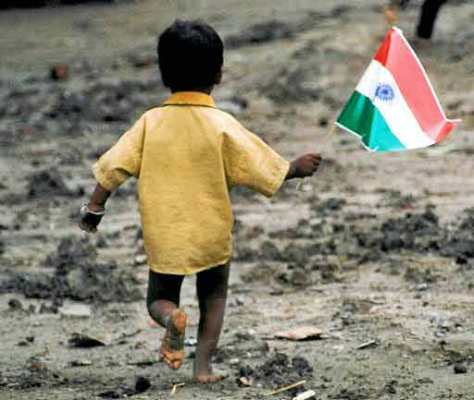
With increasing reports of people being arrested for not standing for the national anthem, it’s a good idea to remember why they stopped the practice of playing the thing in cinema halls in the first place – nationalism cannot be coercively produced in people’s breasts through such inane, superficial and empty gestures.
And the converse – just because you dont stand up for the national anthem, it doesn’t make you anti-Indian. You may just have another idea of India, or you may show your concern for “India” by some more concrete gesture, or through your politics.
As Anmol Karnik asks:
If we play the national anthem before a television show begins at home, would people stand up? I doubt it. Most people who do it, do it because it’s not socially acceptable to sit down when everyone else is standing. It’s being part of the herd, so there’s probably some part of unity embedded in it, but unity in a forceful and degrading manner.
Just as a matter of interest, this is what the Prevention of Insults to National Honour Act, 1971 says:
Whoever intentionally prevents the singing of the Jana Gana Mana or causes disturbances to any assembly engaged in such singing shall be punished with imprisonment for a term, which may extend to three years, or with fine, or with both.
There is thus, no legal obligation whatsoever to actually stand while Jana Gana Mana plays. Continue reading Why should we stand for the national anthem?
Scribbling in Dark Times
“In the dark times
Will there also be singing?
Yes, there will also be singing.
About the dark times.”-Bertolt Brecht
I.
There are moments in one’s life when one really feels perplexed.
You find yourself in a situation which you had never envisaged before.
Most of your predictions about the unfolding situation have gone awry or have not proved upto the mark.
One wants to remain calm, to contemplate things around you, take a break, but I know that for people gathered here – activists, writers committed to a cause, political workers – there is no such luxury. As rightly put by Jose Maria Sison, Filipino poet and revolutionary in one of his short poems
“The Tree Wants to be Calm
But the wind will not stop”
Arrested for sitting during the national anthem: Solidarity Statement with Salman
A youth from Peroorkada (Kerala) was arrested on Wednesday by the police on charges of showing disrespect to the national flag and the national anthem.
The police said Salman, 25, and his six friends, including two women, had showed disrespect to the national anthem while it was being played inside a movie theatre in the city on August 18. A few others who saw the group remaining seated and allegedly “making catcalls” when the anthem was being played lodged a complaint with the police.
This incident comes just days after a student was arrested in Karwar, Karnataka for similar charges. The Kumta police had arrested Jabeer Khan, a student for allegedly forwarding a message, that according to the complainant, mocked the National Anthem and India.
Statement by concerned citizens on the arrest of Salman and demanding his immediate release
On August 20th night 12 pm Salman a student and social activist from Trivandrum was picked up by the police from his home in Peroorkada. The immediate accusation against him was that he had insulted the national anthem while it was being played in a theatre, where he had gone to watch a movie. Later his comments on Facebook where he questions nationalism as a philosophical and political concept were also pointed out as a reason for his arrest. It is also being reported that there was a deliberate attempt to frame him by some right-wing hindutva groups and that they are the ones who are behind his arrest.
There is a lack of clarity regarding his arrest and the way it was conducted, late in the midnight hours of August 20th. It is clear, though, that none of the customary norms were followed during his arrest. Even after it was said that Salman was taken to the Thampanoor station, the police themselves later denied this. For a whole night and the next day even Salman’s parents had no access to him. In fact, Salman was taken from prison to prison like it is usually done with so called ‘notorious terrorists’ and the police refused to give out any information about him both to his parents and to the lawyers who had contacted them. It was onlyon August 21st evening that it was made known that there was an FIR recorded against him and that a case was registered under IPC act 124 A and 66 A charging him of sedition and of sending offensive messages through communicative service. Though there were many other students with him it is surprising that it was only Salman who was picked out and arrested. Continue reading Arrested for sitting during the national anthem: Solidarity Statement with Salman
Learning from Babasaheb: Harsh Mander
Guest post by HARSH MANDER
Among most secular progressive people in India today there is the belief – indeed an article of faith – that India has been, through most of its long history, a diverse, pluralist and tolerant civilization – the land of Buddha, Kabir and Nanak, of Ashoka, Akbar and Gandhi. It is a culture in which every major faith in the world found through the millennia the space and freedom to flourish and grow, where persecuted faiths have received refuge, where heterodox and sceptical traditions thrived alongside spiritual and mystical traditions, and where ordinary people live and instinctive respect for faith systems different from their own.
All of this is true, and this is why the rise of a narrow, monolithic and intolerant interpretations of Indian culture – what Romila Thapar describes as the right-wing Semitisation of Hinduism – in new India causes us deep disquiet. But what our analysis does not stress often or deeply enough is that all of India, both old and new, has been also built on the edifice of the monumental inequality and oppression of caste, and that this is equally the story of India, old and new. Continue reading Learning from Babasaheb: Harsh Mander
Who is guiding Modi’s economic thinking and what is their background?: Aditya Velivelli
Guest post by ADITYA VELIVELLI
The Modi government’s actions over WTO are a case of much ado about nothing. They have pointedly created a false perception over a non-issue so as to appear pro-poor. Modi said “Do we choose feeding our poor or getting good press world-wide?” Turn this statement around and one gets to see the truth of the matter. The real attempt here is “How to masquerade as pro-poor and get good press in India by using WTO?”
This demonstration of concern for the poor helps Modi’s government in implementing ultra-neoliberal economic policies in the coming months. To understand the game-plan one should only look at the people guiding Modi’s economic thinking. Continue reading Who is guiding Modi’s economic thinking and what is their background?: Aditya Velivelli
Creeping Dictatorship: Concerns from Kerala
Guest post by THUSHAR NIRMAL SARATHY
Are we living in a democratic dictatorship? ‘Democratic dictatorship’ is a much debated concept in Kerala. I am referring not to that here but to the dictatorship of the executive led by democratically-elected politicians. Recent incidents seem to indicate that this is now an ever-growing tendency in our democracy.
A few months back, a notice with the photos of well-known public figures, which identified them as Maoists, appeared in the Mananthavady police station at Wayanad. These were pictures of senior, very well-known activists who have fought battles for democracy in Kerala. Following widespread protests, the police was forced to remove the notice. On 28th July this year, Jonathan Baud, a Swiss citizen was arrested by Valappad police for attending a commemoration meeting of a Maoist leader, Sinoj, who died in an accidental explosion at the forested Kerala- Karnataka border. Mr Baud was in India on a tourist visa. His arrest was big news in the media which had happily swallowed policespeak, and so he was also projected as a Maoist. The reports claimed that he had come here with the express purpose of attending the meeting, and that he delivered a solidarity speech there. Later, when the Commemoration Committee made public its own version of events, the police sensationalism was refuted and had to be withdrawn. The charge against Mr Baud are apparently limited to violation of visa conditions and it was admitted that he had no Maoist links. Continue reading Creeping Dictatorship: Concerns from Kerala
September 5 as Teachers’ Day – The Dalit Critique: Abhay Kumar
Guest post by ABHAY KUMAR
While the schools and educational institutions of the country have been observing September 5 as Teachers’ Day since 1962, on the birth anniversary of the first Vice-President and second President of independent India Dr. Sarvepalli Radhakrishnan (1888-1975), a section of Dalits, mostly students, activists and intellectuals at public universities, are increasingly denouncing its observance. They contend that the birthday of Radhakrishnan, a Brahmin, should no longer be held as Teachers’ Day because he had made no contribution to the educational uplift of lower castes and classes. Instead they exhort people to observe National Teachers’ Day on January 3, the birth anniversary of the nineteenth century social reformer, and teacher from backward caste, Savitribai Phule (1831-1897).
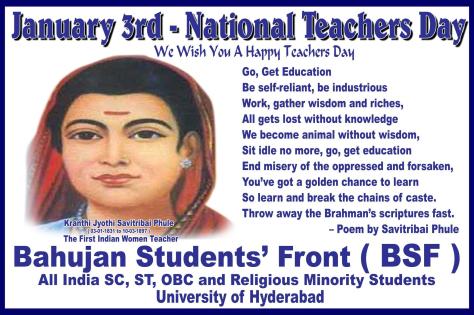
According to the biographer of Savitribai Phule, M. G. Mali (Krantijyoti Savitribai Phule, 2005), she was taught by her husband in a school run under the shade of a mango tree. Access to education enabled her to become aware about egalitarian movements at global level as she managed to read the biography of Thomas Clarkson (1760-1846), who fought for liberation of the Black. Later when she became a teacher, it was vehemently opposed by reactionary Brahmins who pelted stone and threw dung on her in order to “save” orthodox Hindu religion. When frustrated Brahmins were unable to deter the zeal of Phules about imparting education, they succeeded in reasoning with her father-in-law, Govinda Rao, to force them to leave home. She preferred eviction with her husband from home to giving up her mission on education. Despite the opposition, they continued to persuade parents to send their daughters to schools. As a result of their hard work, 18 schools were opened from 1848 to 1852. Her dedication to spread education, particularly among subalterns is self-evident from a few lines of her poem. ‘All gets lost without knowledge… We become animal without wisdom…So learn and break the chains of caste….Throw away the Brahman’s scriptures fast.’ Continue reading September 5 as Teachers’ Day – The Dalit Critique: Abhay Kumar
Why I am an anti-Zionist Jew: Ray Filar
RAY FILAR on openDemocracy
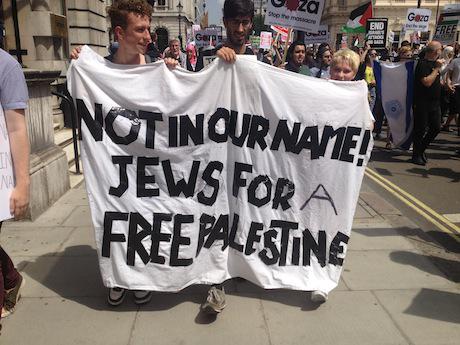
The Israeli government deliberately invokes terrorist attacks, rockets, and scary brown men in headscarfs to stoke the population’s fear, but I am scared of the racism Zionists use to justify the occupation.
The discussions in the comments that follow are equally instructive and interesting – do scroll down and follow those as well.
Don’t let the Magic Fade: Thoughts on Kudumbashree’s Sixteenth Anniversary
I do not write on Kafila as frequently as I used to because I don’t want to be writing stories of impending doom all the time. These are times in which we appear doomed, but it does not help to get obsessed with it; in fact, the obsession may actually hasten the downfall.
But these days, we also hear stories which may be told either way. For example, I can tell the story of the mining going on at Mookunnimala in Trivandrum as yet another episode in the continuing story of the destruction of our natural environment and its impending collapse. But I can also tell it another way, foregrounding the resistance that has shaped up there despite the formation of a deadly nexus of Kerala’s political parties, bureaucracy, predatory capitalists and other criminals against local people. Or, I can tell the story of the ‘development’ of the government school at Attakkulangara in the heart of Trivandrum city as another incident that proves the unrelenting march of ‘urban development’ which is nothing but shorthand for the steady takeover of prime urban space by corrupt officials and venal politicians. But it is also a David-and-Goliath tale of how a few dedicated members of the school’s old students’ association, and nature-lovers and environmental activists who go by the name Tree Walk managed to draw the attention of others, alert authorities, and arrest the steady pace of these forces. Continue reading Don’t let the Magic Fade: Thoughts on Kudumbashree’s Sixteenth Anniversary
Happy Independence Day India, Blessings from Kashmir: Onaiza Drabu
Guest post by ONAIZA DRABU
 Dear India,
As you celebrate yet another year of the glorious independence; the independence that was the beginning of an era of doom for most of us here, I must inform you that I was unable to get my morning bread. Sixty Eight is a big number and I’m sure the proceedings will be aplenty and that and you have plenty of ‘ache din’. Somehow, I have my doubts but then again, I’m sure our definitions of good differ greatly. However it may be, I have one tiny request. Please let me eat my breakfast in peace.
It is still two days to go for the Independence Day Parade in Srinagar and I am one of the privileged few who live within a two-kilometer radius of the Bakshi Stadium, the place where the annual flag hoisting ceremony is held. Excess army is deployed all around and as in all such times, our local baker wasn’t allowed to open shop this morning.
As a child, I read your textbooks in school. I read about how Pinky and Shyam would go to their school for the flag hoisting on Independence Day and of course I’d wonder where this would happen. Independence day meant a crackdown or a curfew for all us kids here. Independence day meant that the morose army guy I hated to look at would stand at my gate, staring straight ahead with a blank, yet frightening constancy. Independence day meant my dedicated doctor of a mother had to walk to work for sometimes, they’d not even allow ambulances to ply.
The independence you celebrate to commemorate freedom has forever been associated with barbed wires on streets that restricted access to locations. It is ironical how roadblocks, surprise checks and general inconvenience is what I have forever associated with this independence. General inconvenience here also includes times where each one of the dozen, army-men on every street eyes you with contempt and suspicion. I snigger if you tell me we celebrate freedom on this day. To the many things that are already restricted here this day adds more. Continue reading Happy Independence Day India, Blessings from Kashmir: Onaiza Drabu
Rape and Rakhi – Patriarchal-Communal Narratives: Kavita Krishnan
Guest Post by KAVITA KRISHNAN
Even as the communal cauldron in UP is kept on the boil, there is news that the RSS has launched a campaign to tie Rakhis to lakhs of Hindu men, asking them to pledge to protect their sisters from Muslim men and “love jehad.” The VHP has been running a helpline urging Hindus to approach them “if your daughter is being harassed by Muslim boys.” And a khap panchayat in Muzaffarnagar has imposed a ban on mobile phones and jeans for girls, claiming that these result in ‘eve-teasing’.
Woven into the above events is an old, familiar theme – that of patriarchal restrictions packaged as ‘protection’. In the wake of the anti-rape movement that followed December 16 2012, the streets of Delhi and many other parts of India had resounded with the voices of women declaring ‘Don’t take away our freedoms in the name of ‘protection’ – protect our right to fearless, fullest freedom instead’. Those women had raised their voice demanding freedom from sexual violence – and also freedom from rape culture that advices women to dress decently to avoid rape; and freedom from the khap panchayats, freedom even from the restrictions imposed by one’s own fathers and brothers.
Continue reading Rape and Rakhi – Patriarchal-Communal Narratives: Kavita Krishnan
Delhi Protests Gaza Bombing: 9 August 2014
Let it not be said that nobody cried when the news came. Let it not be remembered by the children that India “stood with” Israel through the Gaza bombings of August 2014 (God, let it not continue beyond August 2014). Let no-one assume that all 1.3 billion of us continued – as the bombs fell on fields and courtyards and washing hung up to dry in Gaza – that we in India defined our ethical positions purely within the unholy triad of family, community, nation. Let there be a tiny record of protest. A tiny record of a tiny protest, given the monstrosity of the crime. But we are in the business of remembering, since they are profiting from our forgetting. They profit from our forgetting language, since we can’t name what is going on in Gaza as war. They profit from our not being able to remember our mythologies, because this is a war in which one side is David and the other Goliath, but Goliath is winning, because the world has been told he is David. In a nation without language, without myths, without memory, without ethics, jealously holding a tattered banner, with a single word on it – ‘development’ – some Indians protested.
Global Day of Rage against Gaza, Jantar Mantar, New Delhi August 2014:

स्तब्धता और खामोशी
स्तब्धता क्या हमेशा भाषा के लोप या उसकी असमर्थता की अवस्था है? ऐसे अवसर होते हैं जब स्तब्धता अपने आप में भाषिक प्रतिकार या भर्त्सना बन जाती है.अगर चीखना एक छोर है भाषा-व्यवहार का, तो खामोश हो जाना दूसरा छोर. यह भी होता है चीख इतनी तेज़ हो और इतनी तीव्र कि साधारण श्रवण-क्षमता के बाहर हो जाए.
जिसे चुप्पी कहा जाता है, वह कुछ मौकों पर एकतरफा और कई बार दोतरफा फैसले का नतीजा होती है. खामोशी,मौन या स्तब्धता प्रायः इस बात का सूचक होती है कि भाषा के लिए जिस सामाजिक पर्यावरण की व्याप्तता को सहज माना जाता है,वह छिन्न-भिन्न हो गया है.यह नहीं कि बोलने को कुछ नहीं है, लेकिन बोलने वाला जान चुका होता है उसका बोलना व्यर्थ है क्योंकि उसे सुनने की पात्रता सामने का पक्ष खो बैठा है. Continue reading स्तब्धता और खामोशी
African Solidarity with Palestine: African scholars and scholars of Africa
We, the undersigned African scholars and scholars of Africa, hold that silence about the latest humanitarian catastrophe caused by Israel’s new military assault on the Gaza Strip—the third and most devastating in six years—constitutes complicity. Member state of NATO which mounted an air war on Libya ostensibly to protect civilians in Benghazi have been by and large quiet about the fate of civilians in Gaza. World governments and mainstream media do not hold Israel accountable for its violations of international law. We, however, as a community of scholars have a moral responsibility to do so.
Neither the violation of international law nor the destruction of Palestinian life in Gaza, however, began or will end with the current war[1]. The suffering of Palestinians is not limited to Gaza: the occupation and dispossession in East Jerusalem, the Naqab (Negev), and the West Bank; the construction of walls and fences around the Palestinian population, the curtailment of Palestinian freedom of movement and education, and the house demolitions, all have long histories that will have to be addressed.
Continue reading African Solidarity with Palestine: African scholars and scholars of Africa
The Aryan Connection: Satya Sagar
SATYA SAGAR on Countercurrents
Over two centuries after the myth of the ‘noble, superior’ Aryan Race was first postulated, the political, historical processes it set forth in motion are still with us in a variety of ways. Though thoroughly discredited by modern scholarship as well as the horrific experiences of the Second World War, the Aryan Connection is still very much alive and killing in countries like India, Sri Lanka and in a perverse, inverted way in Zionist Israel.
The Anatomy of a Massacre: The Mass Killings at Sailan, August 1998
This was sent to us by Shrimoyee Nandini Ghosh

On the night of 3-4 August 1998, 19 people including 11 children ranging in age from about 4 to 15 years old, and 5 women (including one woman in an advanced state of pregnancy) were shot at point blank range in their homes in Sailan, in the highly militarized ‘border district’ of Poonch, which is divided by the Line of Control between Pakistani and Indian Administered Kashmir. The bodies were thereafter mutilated with axes and sharp instruments. A total of thirteen female and six male members of three closely related families were killed by personnel of 9 Paratroopers, Indian army, and ‘SPOs’ (Special Police Officers) armed state back local operatives recruited to the police and affiliated to the 9 Para Army Camp. The police establishment was involved with attempting to bury the dead clandestinely, registration of a fabricated FIR, destruction of evidence, and the criminal cover up of the case. The Anatomy of a Massacre recounts the dismembered and silenced history of the Sailan Massacre through voices of family members, eye witnesses, local residents and the analysis of court, police and Right to Information documents. The legal and oral histories of Sailan illustrate how the Indian occupation of Jammu and Kashmir is made real, not just through the control of physical territory, but by deep social penetration, acts of spectacular violence and collective terrorisation, and the active collaboration of all state institutions in the illusion of legal procedures and rule of law. The Report is part of the struggle of all victims of human rights violations in Jammu and Kashmir, to articulate their demands for truth and justice in their own words, when the very language to speak of the truth has been rendered anti-national, and therefore unspeakable. It commemorates the lives lost in the massacre at Sailan, and is dedicated to them, on the anniversary of their untimely deaths.
 KAFILA - COLLECTIVE EXPLORATIONS SINCE 2006