São Paulo: The City and its Protests: Teresa Caldeira

Guest post by TERESA CALDEIRA

In June 2013, a series of large demonstrations throughout Brazil have shaken up its main cities and political landscape.  They have also perplexed politicians and analysts alike, many of whom found themselves without solid references to interpret the novelty and oscillated between silence and old discourses.  It is always risky to interpret emerging processes. Minimally, we risk following secondary paths or, even worst, framing new events with the vocabulary made available by old interpretative models, exactly the ones that the new events are trying to displace. However, in order to reveal what is emerging it is necessary to risk, search for new hints, and follow signs already available.  Several references that can guide us to interpret the June events have been around for quite a while; others are new, but we can trace their lineage and contextualize them.

SP Batata 17 june
17th June, 2013

Continue reading São Paulo: The City and its Protests: Teresa Caldeira

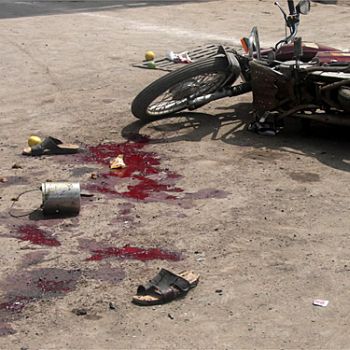
Ishrat: Laltu’s poem

Laltu‘s poem written in 2004; published in Dainik Bhaskar in 2005.

‘इशरत’
एक 

इशरत!
सुबह अँधेरे सड़क की नसों ने आग उगली
तू क्या कर रही थी पगली !
लाखों दिलों की धड़कन बनेगी तू
इतना प्यार तेरे लिए बरसेगा
प्यार की बाढ़ में डूबेगी तू
यह जान ही होगी चली!
सो जा
अब सो जा पगली. Continue reading Ishrat: Laltu’s poem

Reading Violence in the Garo Hills : Rafiul Alom Rahman

This is a guest post by RAFIUL ALOM RAHMAN

The recent mob fury over the rumour of rape of a mentally challenged Garo girl and the consequent outburst of terror on migrant workers in Tura shouldn’t be read as a simple story of Garo men’s concern for women. If it was so, not so many labourers outside Tura would have been killed in cold blood by Garo miscreants. The claim that tribal society is free from the clutch of sexism, and that it is tribal women who face sexual abuse in the hands of non-tribals does not cut ice anymore. Continue reading Reading Violence in the Garo Hills : Rafiul Alom Rahman

A letter to Chetan Bhagat from Indian Muslim Youth

Given below is the text of a letter that was initially written by a group of individuals and sent as a rejoinder to the article written by Chetan Bhagat titled,Letter from an Indian Muslim Youth published in The Times of India on 30 June 2013. The letter was sent to The Times of India The signatories include non-Muslims, because a large number of the emails read, ‘I am not a Muslim but I am equally disgusted by Chetan Bhagat’s letter’. Given below is the text of letter followed by more than 200 signatures:

A Letter to Mr. Chetan Bhagat from Indian Muslim Youth

3rd July 2013

Dear Mr. Bhagat, Continue reading A letter to Chetan Bhagat from Indian Muslim Youth

Will ACP Kisan Shengal of Mumbai ATS be prosecuted?: Yug Mohit Chaudhry

malegaon_blast_2

Guest post by YUG MOHIT CHAUDHRY: On Friday, 8th September 2006, four bomb blasts occurred in Malegaon killing thirty-one persons and injuring three hundred and twelve others. The case was originally investigated by the Maharashtra Anti-Terrorist Squad (ATS). After re-investigating the case, the National Investigation Agency (NIA) has concluded that the ATS fabricated evidence against nine persons. This unprecedented acknowledgement raises important questions about how terrorist cases are investigated, police misconduct and the rule of law in India. It remains to be seen whether the government will take action against the ATS investigating officer, Assistant Commissioner of Police (ACP) Kisan Shengal, for fabricating evidence on a capital charge. Continue reading Will ACP Kisan Shengal of Mumbai ATS be prosecuted?: Yug Mohit Chaudhry

Media manipulation on Ishrat continues: Vrinda Grover’s Protest Letter to Hindustan Times

To,
The Editor,
Hindustan Times

On the day the CBI is set to file its chargesheet in the Ishrat Jahan fake encounter case, Hindustan Times has chosen to report about it in a manner that is malicious, prejudicial and intended to manipulate public opinion. The report, “ ‘Ishrat Jahan had links with Kashmir Separatists’: CBI” by Mahesh Langa and Abhishek Sharan in the Delhi/ Ahmedabad edition of the newspaper is nothing short of defamatory. The headline attributes this ‘information’ to the CBI whereas in the text of the report, it is said that two of those killed along with Ishrat “were associated with secessionist groups in Kashmir”. Clearly, the CBI is not saying that Ishrat had any links with any group. This is a deliberate misrepresentation and a cheap trick to make connections where none exist in order to tarnish the reputation of a deceased girl who is no longer present to defend herself.  Continue reading Media manipulation on Ishrat continues: Vrinda Grover’s Protest Letter to Hindustan Times

Can The Real Shyama Prasad Mukherjee Ever Stand Up?

Image

It has been more than two years that A G Noorani’s important book ‘Article 370 : A Constitutional History of J and K’ (OUP, 2011, Pages 480) has hit the stands and has been able to clear many a confusions about the tumultuous era in post independence times pertaining to Jammu and Kashmir.

Basing himself on authentic documents, letters, memorandums, white papers, proclamations and amendments  the author, a constitutional expert himself, has not only provided new insights about the period but has also tried to bring forth an important summary of the developments then and the role played by different stakeholders. While we have been witness to a process of erosion of the article 370 today, the book underscores the politics behind its erosion, which was negotiated between Prime ministers Jawaharlal Nehru and Sheikh Abdullah and had a stamp of approval from Sardar Patel and Shyama Prasad Mukherjee.

For the  Bharatiya Janata Party (BJP), which daily invokes name of Shyama Prasad Mukherjee, founder of Bharatiya Jan Sangh – percursor to its present incarnation namely BJP – to oppose Article 370 which guarantees special status to Jammu and Kashmir – this exposure that the said Article had full approval from Mukherjee as well as then Home Minister Sardar Patel is nothing but blasphemous. Continue reading Can The Real Shyama Prasad Mukherjee Ever Stand Up?

Huge Rally of Narmada Dam Oustees in Bhopal: Jeevan Adhikar Satyagraha and Upwaas begins with Demand for Rehabilitation and Resettlement

This is a press release by the NARMADA BACHAO ANDOLAN

28th June 2013

Rally 2

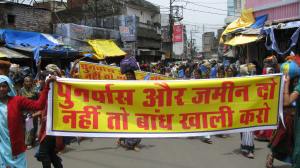
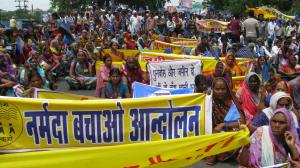
Thousands of oustees affected by the Indira Sagar, Omkareshwar, Maheshwar, Upper Beda and Man dam demonstrated in capital city Bhopal today and began their Satyagrah. Despite continuous rain in the entire Narmada valley, over 8000 men and women displaced persons have reached Bhopal to camp here for the next 5 days. The affected people demand that all the oustees of these dams should be rehabilitated and resettled with land and all other entitlements, and the injustice being wreaked on them for decades be stopped. Shri Alok Agarwal, senior activist of the Narmada Bacahao Andolan along with 4 men and women oustees have started their fast for 5 days in this “Narmada Jeevan Adhikar Satyagraha and Upwaas”.

Gyapan

Continue reading Huge Rally of Narmada Dam Oustees in Bhopal: Jeevan Adhikar Satyagraha and Upwaas begins with Demand for Rehabilitation and Resettlement

Hydro Power Projects and Northeast India: Ecology and Equity at Stake

This is a guest post by RICHARD KAMEI

Recently a two-day North East People’s Convention on water and dams was held at Bethesda Youth Welfare Centre, Dimapur (on 17th May-18th May 2013) which brought together a group of 26 organisations from North East India under the banner of the North East Dialogue Forum. This forum called for a focus into the objectives raised in this two day convention, by writing to leaders of India, China and Bangladesh over the imminent adverse impact of the issue of water, impacts of constructing big dams and mining in various regions of North-East India. The outcome of this two-day North East People’s Convention on water and dams, is the joint appeal known as ‘Dimapur Declaration’.  At the time of this declaration, prime address was made to the Prime Minister of Bangladesh, Sheikh Hasina; the Premier of China, Li Keqiang and Prime Minister of India, Dr Manmohan Singh. The main objectives of Dimapur Declaration are:  to protect the inherent rights of local people over their water, land, forest and other resources based on customary and international laws as guaranteed by the Universal Declaration of Human Rights and UN Declaration on the Rights of the Indigenous People 2007 etc., and their self-determined development of their water bodies in the region. The recommendations of the World Commission on Dams, 2000 have also been given a special mention in terms of its implementation in all decision making processes on dam constructions over Brahmaputra (Tsangpo) River. “The Thatte-Reddy Expert Committee said the present hydropower work on Subansiri contravenes the basic premise of the Brahmaputra Board Act with regard to flood control, irrigation and other benefits. The report agreed that the present planning of the project ignored the flood control aspect. Therefore, the committee agreed that the very purpose of the project and purpose of the Brahmaputra Board Act is defeated and the mandate of the board diluted by this action,” opined Akhil Gogoi, Krishak Mukti Sangram Samiti ( KMSS). Continue reading Hydro Power Projects and Northeast India: Ecology and Equity at Stake

The Greater Common Omelette

This is a guest post by NITYANAND JAYARAMAN

Governments like victims. Distressed people make for thankful recipients of public largesse. Within a week of Uttarakhand’s watery disaster of June 16 and 17, the Tamil Nadu Chief Minister announced a Rs. 5 crore relief in solidarity with the “Government and people of Uttarakhand.”

This generous gesture stands in stark contrast with the way the Chief Minister is dealing with people in her own state who are concerned about their increased vulnerability to natural disasters. Around the time that she handed out her cheque to Uttarakhand, 19 fishermen from Sulerikattukuppam, a hamlet about 40 km south of Chennai, begged their way to bail after spending a month in prison. They were arrested for demanding relocation and rehabilitation; the celebrated 100 million litres per day Nemmeli seawater desalination plant constructed by Chennai Metrowater had triggered severe sea erosion and brought the sea dangerously close to their homes. The highly toxic brine rejects were polluting their seas. Continue reading The Greater Common Omelette

The curious case of the Tamil Nadu police preventing ex-Maoists’ return to electoral path!

Guest post. A statement by Prof A. MARX and other rights activists

We, the undersigned, wish to bring to the public’s notice a curious case of doublespeak by the state. The central and state governments constantly advise Maoists to give up arms and join the mainstream. But, in Tamil Nadu, the government in collusion with the police is torturing a group of ex-Maoists who have joined the mainstream. These comrades have given up armed struggle and have come out to function in the open under a party named People’s Democratic Republic Party (PDRP). They have also accepted the electoral path to pursue their mass line. It is clear from their case that the intention of the state is not to mainstream the armed fighters but to incapacitate anyone who dares to criticize the state’s policies, without any compromise.

Background

Earlier, many PDRP members were part of CPI (Maoist). Some of them were arrested and imprisoned under POTA in 2002, on charges of undergoing arms training in Uthangarai, Tamil Nadu. They eventually came out of the prison with women getting bail in 2005 and men in 2007. Many of the comrades who came out criticized the armed struggle line of CPI (Maoist) and stressed for a mass line. The CPI (Maoist) reacted to this by dismissing them from the party towards the end of 2007. Continue reading The curious case of the Tamil Nadu police preventing ex-Maoists’ return to electoral path!

Local Leader, National Ambitions: The Curious Case of Mr Narendra Modi

Mr Prithviraj Chavan, the present incumbent to the chief minister’s seat in Maharashtra, recently received praise from an unlikely quarter. Shiv Sena president Uddhav Thakreay in the party mouthpiece “Saamana” heaped praise on Chavan for ‘adopting a broad minded approach ..for his role in the ongoing rescue operations in disaster hit Uttarakhand.’ According to him while dispatching the relief material and a large team of officials, Mr Chavan instructed them that although ‘it is meant for people from the state stranded there, other victims should not be ignored.’

It has been reported that Maharashtra has placed two helicopters at the disposal of the Uttarakhand government and extended aid of Rs. 10 crore, and it was among the first states in the country to react quickly to the disaster. It is true that many other states have also rushed forces and material to assist people who are stranded at various places and such an hour of national calamity is normally not considered a moment of exhibiting political one-upmanship. Continue reading Local Leader, National Ambitions: The Curious Case of Mr Narendra Modi

‘Documentary Evidence of Sexual Relationship’: Is companionship necessary when adults cohabit?: Rukmini Sen

This is a guest post by Rukmini Sen The Madras High Court on 17th June 2013 has delivered a judgment where it unambiguously states that ‘the main legal aspect for a valid marriage is consummation’ (pg 13). Consummation of a marriage, in many traditions and statutes of civil or religious law, is the first (or first officially credited) act of sexual intercoursebetween two people, either following their marriage to each other or after a prolonged sexual attraction. Its legal significance arises from theories of marriage as having the purpose of producing legally recognized descendants of the partners, or of providing sanction to their sexual acts together, or both (last accessed 22nd June 2013). In a country like India, where Section 377 of the Indian Penal Code still exists (although decriminalization of consensual sexual acts between two adults in private has been declared by the Delhi High Court in 2008), what constitutes the status of consummation in a gay/lesbian union or when two heterosexual adults live together, when the legal significance of consummation is connected only with giving birth to a ‘legitimate’ child? What about relationships where there are willfully no children, biological, adopted or surrogate? This is one of the many questions that this judgment raises and leaves me more bewildered about my legal identity as a cohabiting partner in a heterosexual relationship.

Continue reading ‘Documentary Evidence of Sexual Relationship’: Is companionship necessary when adults cohabit?: Rukmini Sen

For Erdoğan, you are with him or against him: Tamer Söyler

This guest post by TAMER SÖYLER is the second of a three-part series on Istanbul’s Taksim Square protests for Kafila.

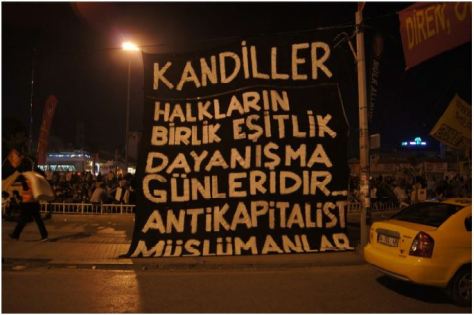
“Kandils (Islamic holy nights) are the times for equality, unity and solidarity.” Anticapitalist Muslims   Note: “Kandil” refers to the celebration of one of the five Islamic holy nights. While Erdoğan was accusing the protestors to be drinking beer and having some kind of a youth festival, anticapitalist muslims who were against the Taksim project from the very early on, wanted to give their support to the protestors. It was an interesting thing to witness. Socialists and communists were creating space for the members of the Anticapitalist Muslims to perform a public prayer in the square. This is already evidence enough that this is not secularists vs. pious.
“Kandils are the times for equality, unity and solidarity – Anti-capitalist Muslims,” this banner reads.
Kandil refers to the celebration of one of the five Islamic holy nights. While Erdoğan was accusing the protestors to be drinking beer and having some kind of a youth festival, anti-capitalist Muslims who were against the Taksim project from the very early on, wanted to give their support to the protestors. It was an interesting thing to witness. Socialists and communists were creating space for the members of the Anti-capitalist Muslims to perform a public prayer in the square. Clearly,the Taksim protests were not about secular vs. religious.

The first part of this commentary argued that as a part of his political strategy early Erdoğan had embraced a kaleidoscopic approach in governance by including various perspectives coming from citizens situated in different milieus. Erdoğan had given the impression to the citizens that his government was willing to hear the views of the citizens situated in all kinds of milieus. A simple strategy of inclusion proved to be extremely efficient for Erdoğan. Citizens who were not ideologically close to Erdoğan were quick to feel flattered by the symbolic gesture and did not hesitate to support Erdoğan. Continue reading For Erdoğan, you are with him or against him: Tamer Söyler

On Passport Divas, ‘We are Like That Only, But We Want to be Superpower’!

‘It happens only in India’ – so goes the refrain. Because we are extra special. Yes we are. In our smugness and in our conceit. In our bloated sense of Self that will stop short of nothing less than the status of the next ‘superpower’ – without anything to show for it though. Wonder where all this actually comes from? Chala Murari Hero Banane. Years ago, we were told, we had colonized Silicon Valley. Our software writers, the best in the world, had placed India in the world map of rising powers. So much had it impressed the leaders of this country that they decided that all their higher education would be geared to producing more and more such labour for the new global economy (no offense meant to the software people). However that is another story. Right now I want to tell a different one – partly out of frustration but partly because I consider it my duty to forewarn others who might be in for a similar experience as mine. Continue reading On Passport Divas, ‘We are Like That Only, But We Want to be Superpower’!

मोदी: तिलिस्म और हक़ीकत

– सुभाष गाताडे

जुल्म

तशद्दुद

झूठ

बग़ावत

आगजनी

खूं

कर्फ्यू

फायर ….

हमने इन्हें बिरसे में दिए हैं

ये बच्चे

क्या देंगे हमको ???

(कविता: बच्चे – मुसाफि़र पालनपुरी,

‘कुछ तो कहो यारों!’ सम्पादन: आयशा खान)

1

नूरा कुश्ती की समाप्ति के बाद


सियासत में आपसी सत्ता-संघर्ष अक्सर व्यक्तियों के इर्दगिर्द सिमटते दिखते हैं। Continue reading मोदी: तिलिस्म और हक़ीकत

Public Appeal by R.B. Sreekumar , Former DGP, Gujarat

Image


1. For enfeebling the validity and credibility of evidence presented by me to Judicial & Investigating bodies and to denigrate my image, the publicity managers of the Chief Minister of Gujarat State, Shri Narendra Modi and the Sangh Parivar, are widely propagating many lies about the motive and time frame of submission of evidence by me against authors of 2002 anti-minority bloodbath. A totally blatant falsehood spread about me is that I had brought out incriminating material against those responsible for 2002 carnage and subsequent subversion of the Criminal Justice System (CJS) ONLY after my super-cession in promotion to the rank of Director General of Police (DGP) in February, 2005. This contention is utterly baseless, false, malicious and misleading.

2. The real truth in this matter is given below:-
http://dilipsimeon.blogspot.in/2013/06/public-appeal-by-rb-sreekumar-former.html

Shahrukh Khan, Surrogacy and Sex-Selection: Sneha Banerjee

Guest post by SNEHA BANERJEE: It was a Monday morning that didn’t bring me blues, after many weeks of sweltering heat I could keep the door to my balcony open without fearing the skin-burning ‘loo’ and my room filled with the pleasant breeze which had the promise of bringing in rains once again.  I decided to keep my diligently prepared to-do list aside and embarked on staring at the neem tree observing the avian cohabitants of my neighbourhood with the radio on my phone tuned to a FM station.  It was then that the unnecessarily loud, over-enthusiastic voice of a radio-jockey broke the serenity of the surroundings.  His shrieky voice exhorted a promise to keep Dilliwalon up-to-date with the latest controversies in Bollywood.  Now, that was not something that I was very interested in – imagined competition among biggies, who ate what, who holidayed where and with whom and after betraying whom was going to be too depressing to handle, but before I could reach out to change the station, he took somebody’s name that still makes my heart skip a beat even after couple of leap-years have come and gone since I was sweet-sixteen.  Yes, any and every news about this ‘star’ interests me and I want to know it all, true or untrue, gossip or through ‘reliable sources’.

But what I heard then, broke my heart.  The RJ quoted a Mumbai tabloid, that Shah Rukh Khan (SRK) is having a third child through surrogacy and that he has ensured it is a son through sex-selection.  Continue reading Shahrukh Khan, Surrogacy and Sex-Selection: Sneha Banerjee

In the Belly of the Beast: Peggy Mohan

Guest post by PEGGY MOHAN: When the size and complexity of a system pass a certain threshold there is a new feature that typically and suddenly appears: self-regulation. If traffic flow through a crossing exceeds a certain amount we wake up one morning and find a traffic light. It is not there to favor any motorist: what it really signifies is that the scale of things has changed.  We are no longer in the realm of the individual but of something much, much larger: a traffic system with compulsions of its own.

It is comforting to think that there is human agency behind the bewildering transitions we are now seeing the world over towards more state surveillance and control along with less regulation of big business. Clearly there are individuals who benefit from the new order. But there is another way of looking at the direction the world is taking. It is possible to see all this as evidence of a phase change, with the emergence of the megasystem itself as a new protagonist, and with human beings relegated to the status of bacteria proliferating in (and dying in) its gut. Continue reading In the Belly of the Beast: Peggy Mohan

Can late Erdoğan learn from early Erdoğan?: Tamer Söyler

This guest post by TAMER SÖYLER is the first of a three-part series on Istanbul’s Taksim Square protests for Kafila.

taksim8
Photographs by Tamer Söyler

The 42nd President of the United States, Bill Clinton, is said to have remarked: being President is like running a cemetery; you have got a lot of people under you and nobody is listening. As is the case with any good politician, Clinton is known for his bamboo-like character. During his presidency whenever he looked the weakest, he proved to come stronger out of the chaos. Clinton’s remarkable flexibility provided him the ability to bend as much as he needed to achieve his goals without breaking. The Prime Minister of Turkey, Recep Tayyip Erdoğan, proved again that he does not have Clinton’s sense of humour, his presidency or his flexibility.

Turkey is a parliamentary representative democracy. Erdoğan has been expressing his intention to transform the country into a presidential system and become the first president of the country. The government plans to put the question of a constitutional referendum to a vote in the year 2014. The people of Turkey are suffering from a great anxiety related to a fear of finding themselves in an authoritarian, charismatic presidential system. Protestors worry that without adequate mechanisms to enforce the separation of powers in the constitution, Erdoğan can easily transform Turkey into an authoritarian regime.
Continue reading Can late Erdoğan learn from early Erdoğan?: Tamer Söyler

The Military and ‘Peripheral’ Violence in Naya Pakistan

Guest post by ZEHRA HASHMI

It has been many months now since the Hazaras in Quetta were attacked. They were targeted during the month of January in 2013 and then only 36 days later in February, both times on Alamdar road where most Hazaras live – an area that has been termed an “open air jail”. Both times the banned Sunni organization Lashkar-e-Jhangvi claimed responsibility. In recent years, as many as 2000 Hazaras have lost their lives to similar acts of targeted violence in Balochistan. As power has been handed over from one civilian government to another for the first time in Pakistan’s history, the systemic nature of this kind of violence should be central to the concerns of Pakistanis – maybe even more than electricity, dare I argue? As Pakistanis think long and hard about what democratic change could mean, I write about the Hazaras now in order to point to the seemingly peripheral minorities as central to Pakistan’s issues. These attacks speak to the complex ways in which violence embeds itself into the everyday lives of some Pakistanis. In other words, the kind of structural issues that trying to wish a ‘naya Pakistan’ into existence will not assuage. Continue reading The Military and ‘Peripheral’ Violence in Naya Pakistan

DISSENT, DEBATE, CREATE