How to start a riot out of Facebook: Yousuf Saeed

Guest post by YOUSUF SAEED

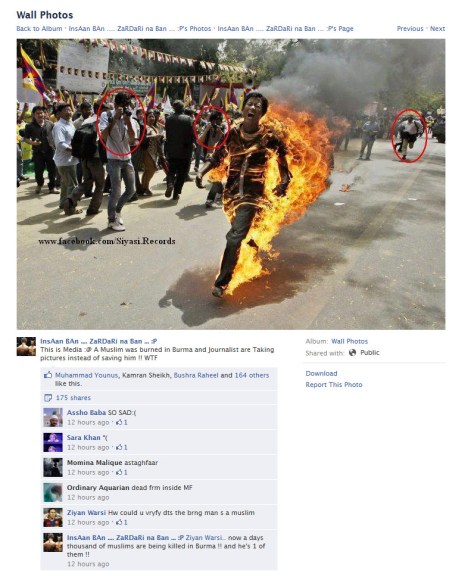
I am utterly shocked and pained to read about the violent rally that many Muslims took out at Azad Maidan in Mumbai on 11 August 2012 in protest against the recent communal carnage in Assam and Burma. More than the accidental death of two men and 50 injured in yesterday’s protest, what alarmed me was the public anger targeted on the media for “not reporting about the violence against Muslims in Assam and Myanmar”. Several vans of TV channels and their equipment were smashed or burnt besides a number of police vehicles destroyed. Of course, the authorities are still probing as to who really began the violence in an otherwise peaceful rally (and we are open to the results of such a probe). But my worst fear came true with this assertion of one of the protesters in a newspaper report: “Why is the media not covering Burma and Assam? We learnt about the incidents from videos posted on the Internet.” This seems to be a very disturbing statement on various accounts. Of course, the media can sometimes be biased, and the Muslims do feel victimised by it all the time. But are the random videos and images posted on the Internet any less biased or misleading? Continue reading How to start a riot out of Facebook: Yousuf Saeed
Gird Your Loins

A new product ’18 Again’ has hit the Indian market. A vaginal tightening gel, the advertisement left us mildly bemused.

With her newly tautened privates, the saree-clad lady seems in remarkably good cheer, given she apparently ‘feels like a virgin’ and ‘it’ (it presumably being sex), ‘feels like the very first time’. Namely awkward, painful, inexperienced fumbling? Ah well! There’s no accounting for tastes, not least the fantasies of the Indian man.

Regardless, we think this is a step in the right direction. Virgins being a scarce commodity these days, a handy at-home converter for any sacrifices you may have planned is a thoughtfully designed product indeed. (The makers of ’18 Again’ are unclear on what to do with those of us who escaped the wastelands of virginity before 18, but there you have it. You can’t please everyone, certainly not those sluts who didn’t even wait till they were legal). The makers of 18 Again are hoping for strong revenues on the back of exponential domestic demand.

As this article details, the Indian vagina now caters to a broad spectrum of consumer taste and preference. Backed by a strong commitment to product diversification, the Indian vagina is set to enter the 21st century  with applications and appliances, room fresheners and Christmas trees. Needless to say, we are delighted; our only grouse being that the products are somewhat limited in scope and vision. And so with an eye to the future we present a small list of potential uses and a plea that we all broaden, rather than tighten, our imagination. Continue reading Gird Your Loins

Mutant Modernities, Socialist Futures: Ravi Sinha

Guest post by  Ravi Sinha

Modernity and socialism can be daunting subjects. Both have had a long history and both have impacted on humanity in ways few other ideas, systems or forms of life have. In a famous incident, perhaps not entirely apocryphal, Chou En Lai, when asked about the impact of the French Revolution on the western civilization by Richard Nixon, is supposed to have answered, “It is too soon to tell.”[1] It seems to me that Chou’s riposte would hold well, and with a far greater force, if the same question were to be asked a few hundred years from now about the impact of modernity or of socialism on the entire human civilization.

One asks for trouble on other counts too when proposing to deal with these topics. They have both been explored and debated endlessly and both remain enormously controversial. In the domain of ideas and theories, they generate intense, sometimes fierce, intellectual passion. In the domain of real life, they give rise to monumental conflicts and struggles even as their influences continue to seep imperceptibly into ever deeper layers of societies and forms of life through pathways that are hard to track. One must have a good reason for raking up, as many might say, a subject where ashes of time find it difficult in any case to settle on an exasperatingly burning fire. Those too, who would like to continue stoking the fire of historical and emancipatory transformations promised by these words, would need a good reason for re-entering the subject. Whether I have one or not should best be left to be judged at the end of the hour, but one must hope to add something useful and meaningful to the debate. Continue reading Mutant Modernities, Socialist Futures: Ravi Sinha

The Nightmare of the Chaavunilam and the Illusions of Well-Meaning Scholars


Chaavunilam (“Dead Land”)is the title of one of Sarah Joseph’s well-known short-stories in Malayalam. In it she relates a myth of devastation and revival — it describes a scene of terrible devastation through the eyes of the last woman left there, the Mother — who witnesses the terrible violence between her children which leaves the earth shattered, verdure destroyed, and which ends in the death of all the combatants. This is the tale of her immense suffering — she is torn apart by birthing-pains, at the same time as she is devastated by the death of all her children. Continue reading The Nightmare of the Chaavunilam and the Illusions of Well-Meaning Scholars

MSS Pandian Responds to S K Thorat

Following the submission of the report by the Committee to Review NCERT Textbooks, we had posted the full text of the Report in Kafila, along with Prof MSS Pandian’s Note of Dissent. The controversy has since continued over the report as well as Pandian’s Note of Dissent, many questioning the very term ‘note of dissent’ on the ground that he had not participated in the proceedings of the Committee. Recently Prof Sukhdeo Thorat, head of the Committee has further put this point of view in print in The Hindu which has been followed by a response by MSS Pandian.

Since we have had a long and lively debate on the matter of the ‘Ambedkar cartoon’ in Kafila and the controversy seems to be continuing now in a different form, we reproduce here the links to the articles by Sukhdeo Thorat and MSS Pandian. In his piece, Sukhdeo Thorat defends the Committee’s work and presents his opinion on Pandian’s non-participation. Pandian responds in his piece raising serious questions about the way the work of the Committee proceeded from its early stages by excluding members. We present the links to these two pieces here so that readers can form their own judgement on the Committee’s work.

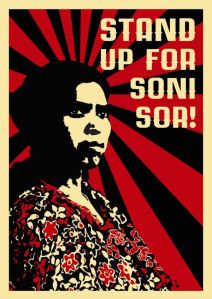
Rejoinder to story on Soni Sori in Indian Express: International Alliance for Defence of Human Rights in India

The  International Alliance for Defence of Human Rights in India (IADHRI) is based in the US and has participated in the campaigns for the release of Dr. Binayak Sen, Kopa Kunjam and now more recently Soni Sori and Lingaram Kodopi.

On August 5th, The Indian Express published a disturbing, supposedly investigative story on Soni Sori, implying both that she was guilty of the charge of being a Maoist as well as casting doubt on the activists in India and outside who support her, and who are mainly responsible for bringing into the open the fact that she was and continues to be tortured in prison.

The IADHRI has written this response to the story, rebutting it point by point.

That the media often compromises its integrity for corporate interests and the political elite is not news any more. The recent Sunday Express report titled ‘Soni’s Story’ is symptomatic of a belief that if a lie is repeated often, it becomes the accepted truth.  The report talks of Soni Sori, the Adivasi school teacher from Dantewada, Chhattisgarh, who has been arrested and accused of being a Maoist conduit. With a clever sprinkling of truth, a report can seem unbiased- the reporter appears to be the warrior fighting to find facts and settling for nothing less. It is, however, imperative that fallacies be broken down, and the casual picking and choosing of facts be exposed for what it is. Let us use the same structure that the story uses. Continue reading Rejoinder to story on Soni Sori in Indian Express: International Alliance for Defence of Human Rights in India

“It would have been better if you had given me Death Penalty” : Soni Sori

Translation of letter in Hindi written by Soni Sori from Raipur Prison on July 28, 2012.

(From kracktivist)

Letter in name of Supreme Court Judge  from Raipur Jail

Your Honour ,

Today I am alive , because of your verdict. You gave the order at the right time so that  I could be  medically treated again.  I was very happy during my treatment at AIIMS hospital in New Delhi, but  Your Honour ,  I have to pay for it now. I am being  harassed and tortured here, I request you to have mercy on me . Your Honor I am  suffering mentally .

1. I am made to sit on the Ground  ”Naked”

2. I am suffering from Hunger

Continue reading “It would have been better if you had given me Death Penalty” : Soni Sori

Of Shopfloors and Newsrooms: Faiz Ullah

Guest Post by FAIZ ULLAH

It’s that time of the year. Newsrooms of television news broadcasters are buzzing. Human Resource (HR) professionals may choose to see it as the culmination of a significant process called performance appraisal, but for young news producers and journalists – a decidedly young species – it’s time to see that overdue promotion or promised increment in remuneration. Sometime during the beginning of last financial year these young professionals must have set up their ‘specific and measurable’ KRAs, or Key Result Areas, by using formulaic proformas sent to them by the HR department. This year, a few months ago they would’ve again got a mail from the HR department asking them to revisit those excel sheets with their line supervisors and have their performances graded on the scale of 1 – 10 or some such. Every story filed, every source cultivated, every special ‘half-hour’ show done must reflect on this document. ‘Domain expertise and knowledge’, ‘integrity’, ‘self-discipline’ and ‘adaptability’ are some of the ‘competencies’ against which the supervisors are required to assess the performance of their subordinates additionally. What don’t find mention on these appraisal forms are day to day frustrations that are part and parcel of a news professional’s job and anxieties that permeate his/her larger lifeworld.

Continue reading Of Shopfloors and Newsrooms: Faiz Ullah

National contestation, not religion, responsible for the plight of Myanmar’s Rohingyas: Ayesha Siddiqa

Guest post by AYESHA SIDDIQA

This photo is a screenshot of a Facebook page that incorrectly shows the self-immolation of a Tibetan activist in Delhi as an image of Rohingya persecution in Myanmar. This is one of countless such images circulated in social media. Image credit: Express Tribune, Pakistan.

These days, the social media is abuzz with discussion on Myanmar. Interestingly, it is not even a constructive discussion but one which is meant for point scoring. The nature of the discourse has complicated the issue even more and thus calls for at least a couple of articles: one on the issue and another one meant to be an analysis of the situation of Burmese Muslims. It is important at this stage to disentangle the two dimensions to make sense of what is actually happening. Continue reading National contestation, not religion, responsible for the plight of Myanmar’s Rohingyas: Ayesha Siddiqa

“Sexism is as common as sweat at the London Olympics”

Annie-Rose Strasser draws our attention to some delicious instances of sexism at the Olympics, from  from female boxers being asked to wear skirts to differentiate them from the men, to women’s teams taking coach while men’s fly first class.

Meanwhile 18 year-old British Olympic weightlifter Zoe Smith responded sharply on her blog to Twitter-brains tweeting or chirping that she is too manly:

[We] don’t lift weights in order to look hot, especially for the likes of men like that. What makes them think that we even WANT them to find us attractive? If you do, thanks very much, we’re flattered. But if you don’t, why do you really need to voice this opinion in the first place, and what makes you think we actually give a toss that you, personally, do not find us attractive? What do you want us to do? Shall we stop weightlifting, amend our diet in order to completely get rid of our ‘manly’ muscles, and become housewives in the sheer hope that one day you will look more favourably upon us and we might actually have a shot with you?! Cause you are clearly the kindest, most attractive type of man to grace the earth with your presence.

Oh but wait, you aren’t. This may be shocking to you, but we actually would rather be attractive to people who aren’t closed-minded and ignorant. Crazy, eh?! We, as any women with an ounce of self-confidence would, prefer our men to be confident enough in themselves to not feel emasculated by the fact that we aren’t weak and feeble.

Having fun yet?

Molecular Socialism – A Possible Future for Left Politics

The end of the twentieth century saw the collapse of soviet-style state-socialism and the beginning of neo-liberalism’s triumphal march, which has ravaged the planet in a little over two decades. The destruction of the earth has proceeded with renewed vigour since, as has the dispossession of the poor. Cities have been re-made for the luxury living of the rich and the upwardly mobile middle classes. And for their luxury, for their ‘free movement’ across the city and beyond, settlements of the poor have had to make way, as shopping malls, freeways and expressways began defining the new imagination of the city.

If it took soviet-style socialism close to six-seven decades to finally face mass rejection, the neoliberal order has taken far less time. Faced with major opposition movements across the Western world, from the Occupy Wall Street movement to the Indignados in Spain and Greece and powerful new political formations in many parts of South America, the neoliberal order no longer seems as unchallengeable as it used to till just some time ago. Its advent on the horizon came as a new kind of theology that brooked no dissent. It came to us apparently telling us some elementary truths about ourselves and the world we inhabit. And it was quite amazing to see the speed with which the new religion gained converts in those early years. Continue reading Molecular Socialism – A Possible Future for Left Politics

APDP statement on Supreme Court’s suo-moto cognizance on Amarnath pilgrim deaths

This press release was issued by the ASSOCIATION OF PARENTS OF DISAPPEARED PERSONS on 31 July 2012
 
Today, 31 July 2012, Association of Parents of Disappeared Persons (APDP), held its regular monthly meeting where various issues confronting the struggle of the family members of the disappeared were discussed. Besides other issues, the recent suo-moto cognizance of the Supreme Court of India regarding the deaths of Amarnath pilgrims and its continued indifference towards the sufferings of the family members of the disappeared were raised.
On 15 July 2012, the Supreme Court took suo-moto cognizance of the deaths of 67 Amarnath pilgrims over the first 17 days of the Amarnath Yatra. Referring to a clear disregard for human life, the Supreme Court cited the constitutional rights to life [Article 21] and freedom of movement [Article 19(1) (d)] in India and issued notices to the Central Government, Government of Jammu and Kashmir and the head of the Amarnath Shrine Board. Subsequently, a high powered committee was constituted to investigate the reasons behind the deaths. Continue reading APDP statement on Supreme Court’s suo-moto cognizance on Amarnath pilgrim deaths

The Hooter Marks Time

Each morning, factory hooters call out to India’s 50 million industrial workers, many of whom stand by their stations and repeat a single set of tasks with unerring regularity until the hooter sounds again to signal the end of the first shift and the start of another.  Manufacturing provides employment to just 11 percent of India’s workforce, but the sector and its workers are seen as a bellwether for the economy as a whole.

Last week, a senior general manager in Maruti Suzuki’s Manesar plant was killed and several managers injured in a violent confrontation between workers and management, prompting national dailies to speak of the “bad old days of militant trade unionism”.   Yet, industrial unrest is at historic lows in terms of numbers of incidents and man-days lost. In 1973-74, nearly 3,00,000 strikes were called just prior to the Emergency; 2010 saw just 429 such incidents, according to data from the V.V. Giri National Labour Institute.

What accounts for this shift? Has the Indian factory become a safer, better-paid and more secure workplace?

Data suggests the opposite: Today, Indian workers are paid less in real terms than they were fifteen years ago, have less job security, and yet are less likely to strike. Workers in Haryana’s industrial belt suggest that the incident at Maruti Manesar signals the end of the all-powerful union capable of controlling the factory floor, rather than its return. Instead, industry’s reliance on casual workers has created informal leaderless networks that operate outside the framework of strikes and settlements that undergird union activity. Read more

Why the Maldivian ski team is good in short bursts (and other reflections on the Olympics): Sajan Venniyoor

Guest post by SAJAN VENNIYOOR

Now that the 2012 London Olympics has established its progressive republican credentials by recruiting former cold-war assassin, James Bond, to hurl Britain’s 86 year old Queen from a helicopter, following it up with tributes to labour unions, suffragettes, people of colour and the National Health Service (or as the Tories say, ‘leftie multicultural crap’), could we ask some fundamental questions like, what the hell is an ‘Olympic sport’ and how does a 71 year old man in a top-hat sitting on a very expensive horse exemplify the virtues of going faster, jumping higher and being stronger, unless the medal goes to the horse?

Continue reading Why the Maldivian ski team is good in short bursts (and other reflections on the Olympics): Sajan Venniyoor

Review: ‘Impeachment’ by Anjali Deshpande

Guest post by KIRAN SHAHEEN

Impeachment by Anjali Deshpande, published by Hachette India, is a well-told fictional narrative skilfully woven around the aftermath of the shameful disaster commonly known as the Bhopal Gas Tragedy.

The novel is dedicated to Dr Heeresh Chandra, a name we have seldom heard in the 28 years since the tragedy. Who is this doctor to whom the book is dedicated? The author, in a conversation says that for her, this doctor of the dead is not simply unsung but the only true hero of Bhopal.

While reading Impeachment it is difficult to decide whether it is history claiming to be fiction or fiction masquerading as history. The novel recounts actual incidents that still haunt us, intertwined with the fictional private lives of activists that are also the arena of intense gender and caste politics.

Continue reading Review: ‘Impeachment’ by Anjali Deshpande

On the ongoing ethnic violence in Assam: A Statement

The following is the text of a Statement issued in Delhi on 27 July 2012, endorsed by a number of concerned organizations and individuals

We the people from various parts of northeast residing in Delhi, along with concerned individuals, university members, various students’, teachers’, trade union, women’s, civil and human rights organisations from Delhi, strongly condemn the ongoing ethnic conflict with serious communal undertone that has erupted in four districts (Kokrajhar, Dhubri, Chirang and Bongaigaon) of Lower Assam. This has been the most widespread and alarming conflict in the recent history of Assam.

In the last one week we have witnessed the tragedy of nearly 200,000 people belonging to the Bodo and the Muslim communities, being forced to flee from their homes and villages. Currently they stand internally displaced, and are scarred and traumatized. Official figures state that around 41 people have lost their lives so far, while unofficial estimates from the grounds are much higher. More than 400 villages have been torched down until now. Continue reading On the ongoing ethnic violence in Assam: A Statement

Death and the Factory – The Casualties of Maruti Suzuki, Manesar

Factories kill people. Occasionally, those who die belong to the management. Usually, they are workers.

On the first of May, (International Labour Day) 2009, several workers at the Lakhani Shoe Factory in Faridabad, Haryana, were struck by a ball of fire, which engulfed them before they could run to save their lives. The fire, caused by willful neglect of elementary safety procedures, did not result in criminal charges being framed against the management or proprietors of the Lakhani Vardaan Group, which owns the Lakhani Shoes Factory.

A report in the Gurgaon Workers News (No.9/18) has this account of the fire –

“On 1st of May 2009 the Lakhani Shoes factory, plot 122 in Faridabad Sector 24 caught fire, the newspapers first wrote of six, then of ten, then of fifteen dead workers. Lakhani is said to be the country’s largest maker and exporter of canvas and vulcanised shoes, has two dozen units in the district. A younger worker who is employed in a neighbouring factory came to Faridabad Majdoor Library three days later. He said that it is more than likely that 50 – 100 or more workers have been killed. A boiler on the first floor exploded, the floor collapsed and buried many workers who were waiting for their over-time payment in the basement. He said that he saw at least 100 burnt bicycles outside the factory. Continue reading Death and the Factory – The Casualties of Maruti Suzuki, Manesar

Maruti workers produced in district court: Anumeha Yadav

Guest post by ANUMEHA YADAV

In Manesar 25 July court

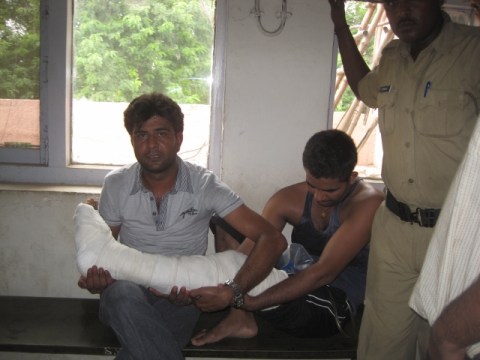
Satbir, a 28 year old worker, was among four workers from Maruti’s Manesar plant produced by Haryana police at the district court in Gurgaon on Wednesday afternoon. Satbir has multiple fractures in his left leg and was taken to the civil hospital from the court room. “I fell while trying to flee the plant. I was in the morning Shift A; we had stayed back because we heard the union leaders were meeting the management to negotiate the reinstatement of a worker,” he recounts. “The violence began after 7 pm, I don’t know why it started. Gate 1 was closed. I feared that I may get attacked in the rioting and the confusion. I and two of my colleagues tried to jump off the back wall but I fell,” he says. Continue reading Maruti workers produced in district court: Anumeha Yadav

Iranian filmmaking in Kashmiri autumn

Set in 2002, shot in 2009, Aamir Bashir’s film Harud will be in select PVR cinemas on Friday, 27 July. Harud is clearly inspired by Iranian films which manage to say a lot without saying much. Like a lot of Iranian cinema, a child is at the centre of the film. The brilliant acting by Shahnawaz Bhat, who plays the protagonist Rafiq, makes the film. In the expressions on his face there is ambiguity and wonderment as much as there is humiliation, helplessness and a desire to do something to change things around him. Here is a film about Kashmir that does not begin with beautiful landscape and does not end with a big encounter between militants and forces. This is not a film that seeks to explain the Kashmir conflict – rather, it takes you inside the lives of ordinary people and how they faced the madness of a conflict. Regardless of what your views on Kashmir are, Harud succeeds in making you empathise with Rafiq and others around him. That, for any narrative on Kashmir, is no small achievement.

Read more about the film in Time Out and ArtViewBlog. Here are some interesting interviews of the director.

The year climate change became common sense: Jacob Sebastian

Guest post by JACOB SEBASTIAN

 Is 2012 the watershed year for climate change? The year it ceases to be a ‘dodgy concept’ and transforms into painful reality?

Some facts to consider:

 *The United States – particularly the food basket that is the American Midwest, is facing its “worst drought” since the 1950s, and is expected to last all summer. US agricultural secretary Tom Vilsack told the media: “If I had a rain prayer or a rain dance I could do, I would do it.” The US is the world’s second biggest food producer, after China, but more importantly, one of the biggest exporters of food.

*Prices of the four key crops: Corn, wheat, sugar and soybean have risen 44%, 48%, 22% and 26% over the last month. The United States produces 41% of the world’s corn and 38% of the world’s soybeans. The two crops comprise two of the four largest sources of caloric energy produced and are thus critical for world food supply. Continue reading The year climate change became common sense: Jacob Sebastian

Resisting Caste Violence – Facing Brutal Repression: NTUI on Maruti-Suzuki

Statement issued by NEW TRADE UNION INITIATIVE on the incidents at Maruti-Suzuki’s Manesar Plant

Dated 19 July, 2012, New Delhi

The present spate of violence at the Manesar plant of Maruti Suzuki as a fallout of a protest by workers against a casteist comment made by a supervisor at a dalit worker reflects the continuing use of ‘caste’ as a method of subordination and oppression reflecting the persistence of deeply rooted primordial structures of society that complement capitalist exploitation. When co-workers protested, the management suspended the abused worker and refused to re-instate him and instead resorted to brutal violence, orchestrated by goons, against the workers and targeting the union leaders.

It is important to note that the Maruti Suzuki management is yet to constitute the Grievance Redressal Committee and the Welfare Committee at its Manesar plant which was agreed upon after the last dispute in October 2011. The present dispute is a well planned instigation by the management to systematically derail the ongoing negotiations on the Charter of Demands submitted by the Maruti Suzuki Workers Union in April 2012 and to discredit the sustained and united struggle of the workers at the Manesar plant. Continue reading Resisting Caste Violence – Facing Brutal Repression: NTUI on Maruti-Suzuki

DISSENT, DEBATE, CREATE