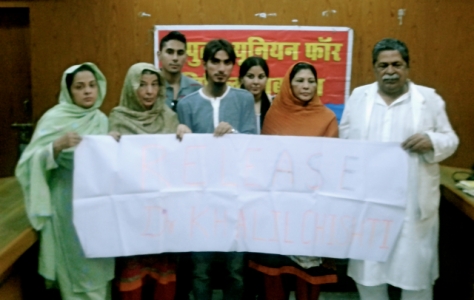
Statement by SASI on People-to-People Solidarity with Palestine and Duplicity of South Asian States

A statement by the SOUTH ASIA SOLIDARITY INITIATIVE

SASI Calls for People-to-People Solidarity with Palestine and Condemns Duplicity of South Asian States in Palestine Bid for UN Recognition

The South Asia Solidarity Initiative (SASI) recognizes the importance and urgency of the Palestinian bid for recognition by the United Nations this September. Despite the threatened U.S. veto in the Security Council, all member nations have an opportunity to weigh in on the outcome through the General Assembly. We welcome the overwhelming support shown for Palestinian membership in the UNESCO. While noting the support for recognition of Palestine by South Asian states, SASI is dismayed by the duplicity of some of these states in continuing to build economic, military, and intelligence ties with Israel. SASI supports the efforts of all peoples movements in South Asia and elsewhere towards solidarity with the people of Palestine.
Continue reading Statement by SASI on People-to-People Solidarity with Palestine and Duplicity of South Asian States

Kathmandu to Peshawar

Himal Southasian editor Kanak Mani Dixit and his wife Shanta Dixit, an educator, are driving from Kathmandu to Peshawar, via Lucknow, Delhi and Lahore, to raise money for Nepal’s only Spinal Injury Rehabiliation Centre, which he started after Kanak’s own miraculous recovery from a spinal injury. The journey was flagged off yesterday by Nepal President Ram Baran Yadav. Do join them!

Naming the Seven Billionth Child: Mitu Sengupta

Photo via The Hindu / Subir Roy

Guest post by MITU SENGUPTA

Last Monday, Nargis Yadav was declared the world’s symbolic seven billionth resident by Plan International, a child rights group. She was born to a family of farmers in a sleepy little village in Uttar Pradesh.

Nargis is surely an unwelcome child, given the grim projections that surrounded the UN Population Fund’s declaration last month, that the world’s population was about to breach seven billion.  Experts have issued sombre warnings of the devastating impact of the growing number of humans on earth. We face a bleak future of environmental distress and scarcity, they say, in which even the basics of food and water will be in short supply.

One wonders why, on October 31st – Halloween, to be precise – the UN did not name a blue-eyed baby boy from Washington, Bonn, Sydney or Toronto as our uncertain world’s symbolic seven billionth? To be sure, this would be politically incorrect, for we live in times when the well-meaning, in their bid to be representative and inclusive, scramble to push women and minorities to the forefront.  But here is an instance where keeping to pedantic liberal pieties has suppressed an honest portrayal of things as they are.

Continue reading Naming the Seven Billionth Child: Mitu Sengupta

An open letter to Tarun Tejpal: Hartman de Souza

On 27 October the Hindustan Times published an article by Hartman de Souza and on 30 October a response to it by Tarun Tejpal, editor of Tehelka newsmagazine. This guest post by HARTMAN DE SOUZA is his rejoinder

There are some of us in Goa who will know in about 20 days or so, thanks to two RTIs filed, whether Tarun Tejpal did in fact get all the necessary permissions and clearances needed to add to the lovely property he now owns in the village of Moira… or, as he more pointedly said of the village when he called me up in the Pune, “I mean, look at Moira man, it’s a dying Goan village” …emphasis on ‘dying’, and the implication being one suspects, that the Tejpals of the world can and will breathe life into it. I wonder if he remembers and can parse what I said to him in reply. Continue reading An open letter to Tarun Tejpal: Hartman de Souza

‘Who isn’t a Shabaab these days?’: Alia Allana reports from the Tunisia-Libya border

This guest post by ALIA ALLANA is part of a Kafila series of despatches from the Arab Spring

When does a boy become a shabaab?

Literally, in Arabic, shabaab means young men. Before the fever of the Arab Spring raged in the minds of the youth, back when boys used to gather in squares aimlessly, girls eyeing them would call them shabaab.

But that was then; before the political architecture of the Arab world was reconstructed.

Today the shabaab are the disenchanted youth, the angry boys of Benghazi with deathly toys devoid of opportunity, angry at their condition, aware of the world through the Internet and their mobiles, acting out their rebellion. Today the shabaab, the rebels of Libya, want what they think is theirs: the right to self-determination, a say in politics and freedom.

Continue reading ‘Who isn’t a Shabaab these days?’: Alia Allana reports from the Tunisia-Libya border

My Days with Nationalism in Assam: Ankur Tamuli Phukan

Guest post by ANKUR TAMULI PHUKAN

Many of us who have been studying the political process in Assam were surprised when we received the news in December 2009 that Chairman Arabindo Rajkhowa and some of his colleagues of United Liberation Front of Asom (ULFA) had been arrested in Bangladesh. This moment had to come some day, but we were not prepared to face it. We were familiar with the brave and somewhat legendary image they had created for themselves and needed time to believe that they could be defeated. Continue reading My Days with Nationalism in Assam: Ankur Tamuli Phukan

A temple in Peshawar reopens for the first time since 1947: Shabbir Imam

Guest post by SHABBIR IMAM from Peshawar, Pakistan. Video and photos by Shabbir Imam

[youtube:http://www.youtube.com/watch?v=qnZJClQNI_c%5D

During Sikh rule in Peshawar, the Gor Khatri area of Peshawar was declared Governor House, so the Gorakh Nath temple here was abondened and Hindu families shifted to a close by residential compound called Christian Colony. Then during the British Raj, the government provided residential quarters to a Hindu family to look after the temple. Continue reading A temple in Peshawar reopens for the first time since 1947: Shabbir Imam

What ails Pakistan?

Op-eds. Yes.

Bad things only happen so that columnists may write Op-eds about them. Before the advent of newspapers there were no terrorists, no sectarian divide, nothing was on the brink, nobody was at a crossroads; the insidious Op-ed writers have invented all these things to scare us under our beds, like parents who tell their children ghost stories because they don’t want them wandering around in the dark lest they flip the light switch at an inappropriate time. [Read the full post by Haseeb Asif]

From Kafila archives:

Kashmir’s Horcrux: Sameer Bhat

Guest post by SAMEER BHAT

Hectic parleys are on at the moment to jettison the dreaded AFSPA in the valley. By conservative estimates the army must have beaten about one in every five Kashmiris at one point or the other since this piece of horrible legislation was slapped on us. An unjust law, is no law at all, Martin Luther, the symbol of protestant reformation, verbalized the sentiment of St Augustine in the 15th century. Rings true to this day.

For more than twenty years people have been punched, thrown in the back of military trucks, knocked down by gun-butts, given kicks, pushed around as they got off a bus or simply slapped around for no apparent reason. Just for being themselves, perhaps. No you could not question the moral turpitude of a military-walla from Madras if he clubbed your aging father.  Continue reading Kashmir’s Horcrux: Sameer Bhat

Invitation to a Debate: Queer Politics and Aid Conditionalities

Breaking from usual practice, I am cross-posting a piece from Akshay Khanna writing as part of the Participation, Power and Social Change blog over at the Institute of Development Studies at the University of Sussex. Akshay is writing in response to this statement by UK Prime Minister David Cameron where, in a nutshell, he threatens cutting off aid to countries that still ban or make homosexuality illegal. Continue reading Invitation to a Debate: Queer Politics and Aid Conditionalities

25 Years of Delhi’s Lotus Temple

On a hot Sunday morning, tourists wait 30 minutes in a queue to get inside the House of Worship of the Bahá’í in Kalkaji, better known by its unofficial name, the Lotus temple. Once inside, they spend less than 30 seconds. The tourists, who include burqa-clad women and sadhus in saffron, don’t seem to be in need of a multi-faith prayer hall. The multi-faith prayer service, held thrice a day, is also sparsely attended. People are apparently disappointed there’s only a large hall inside that beautiful white Lotus building, and they can’t even take photos of this hall.   Continue reading 25 Years of Delhi’s Lotus Temple

Crime redefined in Bihar: Ibne Ali

Guest post by IBNE ALI

John Emerich Edward Dalberg Acton is said to have said in 1887, “Power tends to corrupt, and absolute power corrupts absolutely.” After 124 years it is being felt that Lord Acton could have added one more thing; Power gives you the exclusive right to define and redefine things according to your convenience. The ‘all-possible-awards-winner’ chief minister of Bihar Mr. Nitish Kumar could have prompted Lord Acton to enrich this famous quotation for a couple of reasons.

Continue reading Crime redefined in Bihar: Ibne Ali

The Synagogue and the Jihadi: Alia Allana reports from Jerba

This guest post by ALIA ALLANA is part of a Kafila series of ground reports from the Arab Spring

Inside the El Ghriba synagogue in Djerba, an island off the south coast of Tunisia

Out of all the outrageous questions I have asked in my life, this one has to be amongst the top ten:

“Are you a jihadi?” Continue reading The Synagogue and the Jihadi: Alia Allana reports from Jerba

Giving democracy in Pakistan a chance: Raza Rumi

Guest post by RAZA RUMI

Endless predictions about the fall of the PPP-led coalition government in Pakistan have been made by pundits since the very day it came to power. The recent hullabaloo about this has been in the context of the forthcoming Senate Elections, due in March 2012, which ceteris paribus will ensure a simple majority to the PPP and its allies in the upper house. Given that the Senate is an equaliser in federalist politics, this would mean that legitimate representatives of smaller provinces would be permanent stakeholders in the system beyond this government. Continue reading Giving democracy in Pakistan a chance: Raza Rumi

A prologue to memory: Arif Ayaz Parrey

Guest post by ARIF AYAZ PARREY

Over the corner shop at the busy crossing near home hangs a white board on which the words ‘Muzaffar Pan-House’ are painted in bright red. On the right side of the words, an artistic rendition of the side-view of Muzaffar’s face can be seen. His left hand is also painted in, holding a cigarette. The grey smoke emanating from the cigarette does not vanish before it touches the top of the board.
Continue reading A prologue to memory: Arif Ayaz Parrey

AFSPA in Kashmir – “Armed Forces’ Say Prevails Anyway”: Gowhar Geelani

Guest post by GOWHAR GEELANI

There is a lot of noise in the media over AFSPA. Ask any senior Indian security official, a turn-coat politician or a retired Army General what AFSPA stands for. “Armed Forces Special Powers Act,” they will say. Now pose the same query to an ordinary Kashmiri living there in the hapless Vale for the past two decades. The answer perhaps would be: “Armed Forces’ Say Prevails Anyway”. Continue reading AFSPA in Kashmir – “Armed Forces’ Say Prevails Anyway”: Gowhar Geelani

Understanding the Nepali Revolution: Baburam Bhattarai

(Nepal’s Prime Minister, Dr BABURAM BHATTARAI, visited India in his first bilateral trip since taking office, in the third week of October. Bhattarai spoke at the Jawaharlal University, Delhi, where he had earned his PhD from the Centre for Study of Regional Development, about the political evolution in Nepal, particularly after the 1990 and 2006 movements as seen through the prism of the Unified Communist Party of Nepal (Maoist).

Before beginning his substantive speech, he declared, “I am what I am because of JNU,” amidst thundering applause and cries of Lal Salaam.

The full text of the speech, provided to Kafila by his office, is being posted below for the record.)  Continue reading Understanding the Nepali Revolution: Baburam Bhattarai

Bhutan’s cautious tryst with democracy

Bhutan’s shift to plural politics remains carefully calibrated, but the emergence of a relatively free press and democratic institutions are important achievements. An account from Thimpu

Political changes in Bhutan over the past five years — the introduction of a ‘democratic constitution,’ the retreat by the fourth King and the coronation of his son, elections to Parliament which now has both a ruling and an opposition party, and governance being the prerogative of the elected government — have triggered two opposite reactions generally. One school has hailed the vision of the Bhutanese monarchy and its act of ‘renunciation,’ and has declared the ‘democracy story’ to be a success. Many others dismiss the transition as being a ‘farce,’ claiming that the King still calls the shots and that Bhutan remains a tight autocracy. Continue reading Bhutan’s cautious tryst with democracy

From Manhattan to Manesar: Naeem Moahaiemen

Greetings to the Workers of Manesar from Occupied Wall Street (Photograph by Naeem Moahaiemen)

A few days ago, in a post on the rally in solidarity with the (then) striking Maruti Suzuki, Suzuki Powertrain and Suzuki Motorcycles Factory workers in Manesar, Gugaon in Haryana, we had reported a worker saying: Continue reading From Manhattan to Manesar: Naeem Moahaiemen

‘The Quality of Mercy’: Kindness and Compassion in Higher Education: Prasanta Chakravarty

Guest post by PRASANTA CHAKRAVARTY

There is a moral compass that every freshman must inculcate, says Harvard College Dean Thomas Dingman. To that end, Dean Dingman has asked incoming Harvard students to sign the ‘Class of 2015 Pledge,’ a solemn testament that reflects a set of distinctive values: “That message serves as a kind of moral compass for the education Harvard College imparts. In the classroom, in extracurricular endeavors, and in the Yard and Houses, students are expected to act with integrity, respect, and industry, and to sustain a community characterized by inclusiveness and civility.” The document goes on to hope that entryways and yards will be places where everyone can thrive and where the “exercise of kindness holds a place on a par with intellectual attainment…we want to have an environment in which people can flourish academically.”

Continue reading ‘The Quality of Mercy’: Kindness and Compassion in Higher Education: Prasanta Chakravarty

End the culture of impunity, not just AFSPA: APDP

This is a press release from the ASSOCIATION OF PARENTS OF DISAPPEARED PERSONS

The Bund Amira Kadal, Srinagar – 190001, Jammu and Kashmir
28th October 2011

APDP feels that the recent announcement by the Chief Minister Omar Abdullah on the partial revocation of Armed Forces (Special Powers) Act (AFSPA) from some areas of Jammu and Kashmir would be insignificant for improving the human rights situation and also for providing justice to those affected by the mindless violence by armed forces.
Continue reading End the culture of impunity, not just AFSPA: APDP

DISSENT, DEBATE, CREATE