Apocalypse in Our Time: Ravikumar

Guest post by RAVIKUMAR

Waking is Another Dream: Poems on the Genocide in Eelam, a slim anthology edited by Ravikumar, will be launched by Navayana on Wednesday, 8 December 2010 at 6 p.m. at The Attic, 36 Regal Building, Connaught Place, New Delhi.

[At a time when the Eelam issue is the news again owing to Channel 4’s coverage leading to the cancellation of Mahinda Rajapaksa’s talk at Oxford, citing emerging evidence of his war crimes, Navayana presents a volume of powerful poetry translated for the first time from Tamil into English. Says poet Cheran, “The lack awareness in a city like Delhi on the fallout of the genocidal war in Sri Lanka is appalling. People here who seem concerned about Palestine or even Kashmir seem utterly indifferent to the problem in India’s own backyard.”

Continue reading Apocalypse in Our Time: Ravikumar

Of journalist citizens

With Kashmiris forcing us to take note of them on Facebook and Twitter, with the internet noise on the Radia tapes making a mockery of the media’s radio silence over them, with WikiLeaks assuring us that we’re well into the age of information anarchy, the old, dogged question rears afresh its banal head: Are citizen journalists, journalists?

I was at a Google conference in Budapest in September, called ‘Internet at Liberty 2010’, which had bloggers, activists and policywallahs from 70 countries. At one of the theme dinners, we were asked how many of us identified ourselves as citizen journalists. No hand went up, even as we were all conscious that any one of us could be the first one to see a plane crashing and be the first to report it on Twitter. Continue reading Of journalist citizens

On sedition: Sarim Naved

In this guest post, SARIM NAVED gives a chronological account of sedition in Indian law, and discusses the procedural aspects laid down for a magistrate to take cognisance of sedition

After the 1857 revolt, the Press Act of 1857 which prohibited all publications, without licensing, was passed. This Act known as Lord Canning’s Act  applied to all kinds of publication, including books in all languages and other printed papers in all languages. 1860 saw the enactment of the Indian Penal Code, which remains in force today in a relatively unchanged manner. The Indian Penal Code, while not directly dealing with the press, does incorporate provisions that impinge upon and regulate the activities of the press. The code dealt with issues ranging from offences against a person’s body or property to criminal breach of trust to offences like defamation and obscenity that directly concerned editors.  In the words of Rajeev Dhavan, “It was a comprehensive code. Not all these provisions were directed against free speech but virtually all could be used against it.” Amendments were later introduced to bring in the offence of sedition in 1870, the offence of promoting enmity between classes in 1898, the offence of outraging religious feelings in 1928 and imputations or assertions prejudicial to national integration, which were added by the government of independent India in 1972. Continue reading On sedition: Sarim Naved

City in Terror: Dilip D’Souza

Guest post by DILIP D’SOUZA

Starting today eighteen years ago, for much of December and January (and then March 12), Indian killed Indian on the streets of my city. Terror at its most elemental: I felt it then. I saw it then. Others told me about it then.

Some memories of those weeks, in no particular order but they all still make my hair stand on end.

Clamping down on the dissenting voice

Part 3 of a 3 part series by SIDDHARTH NARRAIN. First published on The Hoot.
 

While the Supreme Court’s decision lay to rest the debate on the scope and constitutional validity of the sedition law, the life of the sedition law is entangled with that of political dissent in the country. A brief search for reported High Court and Supreme Court cases on sedition gives us an indication of the kinds of situations where the sedition law is commonly used.

For instance, in 1967, the government prosecuted Ghulam Rasood Choari, the editor of an Agra based Urdu weekly called Ehsas for exhorting the Muslims of the country, especially the Muslims of Kashmir to violence against the government and bringing the readers of the paper into ‘hatred’ and contempt and dissatisfaction with the government (Ghulam Rasool Choari v. The State 1968 CriLJ 884).

Continue reading Clamping down on the dissenting voice

How Sedition crept into the constitution: Siddharth Narrain

Part 2 of a 3 part series by SIDDHARTH NARRAIN. First published on The Hoot

While in their Draft Constitution, the Constitutional Framers included ‘sedition’ and the term ‘public order’ as a basis on which laws could be framed limiting the fundamental right to speech (Article 13), in the final draft of the Constitution though, both ‘public order’ and sedition were eliminated from the exceptions to the right to freedom of speech and expression (Article 19 (2)).Commenting on this omission many years later, Justice Fazl Ali said: 

The framers of the Constitution must have therefore found themselves face to face with the dilemma as to whether the word “sedition” should be used in article 19(2) and if it was to be used in what sense it was to be used. On the one hand, they must have had before their mind the very widely accepted view supported by numerous authorities that sedition was essentially an offence against public tranquillity and was connected in some way or other with public disorder; and, on the other hand, there was the pronouncement of the Judicial Committee that sedition as defined in the Indian Penal Code did not necessarily imply any intention or tendency to incite disorder.

Continue reading How Sedition crept into the constitution: Siddharth Narrain

We are all seditious now, but when did this start?

I am afraid that unlike in Sholay, where the reply to Gabbar’s question and in our time, the reply to Nivedita’s question would have to be more than ‘Do sarkar’. But regardless of the rather large numbers, given the extreme nervousness which prompts a law like sedition, hopefully, they will still return to the sarkar, khaali haath.

As a part of the We Are All Seditious series, I am posting three guest posts written by SIDDHARTH NARRAIN which provides us with an overview of the history and the politics of sedition law in India.

These posts have been hosted by The Hoot, a highly recommended site for keeping track of the media in India. The first in the series looks at three major trials,  Gandhi’s trial and those of Tilak and Shiekh Abdullah. Continue reading We are all seditious now, but when did this start?

Xonzoi Barbora interviews Kyaw Zwa Moe on the elections in Burma

Many thanks to XONZOI BARBORA for contributing to Kafila our first podcast. This podcast is an interview of Burmese journalist KYAW ZWA MOE. The interview was originally conducted for Panos Radio South Asia on 6 November 2010. Please allow a moment for the audio player to load on your screen.

Burma’s elections, like its new flag, constitution and capital, is part of an inventory of an elaborate make-over for the military junta that runs the country. This make-over has the tacit support of Burma’s powerful neighbours — China, India and Thailand — who cast covetous eyes on the oil, gas and mineral resources of the country. The elections that took place on November 7, 2010 was one designed to entrench the military in civic life and also provide a reasonable ground for big donor agencies to intervene in administration. Even as the National League for Democracy (NLD) boycotted the elections, other democratic forces were rendered powerless by the junta’s stranglehold over the electoral process. It reserved seats for itself; circumvented the electoral process in places where it thought it would lose and simply made it too expensive for its opponents to contest. Continue reading Xonzoi Barbora interviews Kyaw Zwa Moe on the elections in Burma

Kitne aadmi the? We are all seditious now

Here is a very short, utterly incomplete, hastily compiled list of people charged under Section 124 A in the last two years alone.

Our very own Shuddhabrata Sengupta figures  in this roll of honour.

(Incidentally, KK Shahina, who has guest posted with us, faces charges from the Karnataka Police under IPC 506 for intimidating witnesses. Her expose in Tehelka showed how the police case against Abdul Nasar Madani, head of the People’s Democratic Front (PDP), accused in 2008 Bengaluru blasts, was fragile and based on non-existent and false testimonies.)

There would be hundreds more, not named here, charged with sedition for “criticizing” the government, for exposing corruption and police nexus with mafias, or for expressing views that run counter to official wisdom on the “integrity” of India.

As if “integrity” is something pre-existing and eternal rather than something that has to be produced at every point. The existence of a nation is a daily plebiscite, said even historian Ernst Renan, a staunch supporter of the nation form. Not so Rabindranath Tagore, who was highly suspicious of the “fetish of nationalism”. He called the Nation nothing but the “the organization of politics and commerce” and warned that when this Nation “becomes all-powerful at the cost of the harmony of the higher social life, then it is an evil day for humanity.” (In his lectures on nationalism, published by Rupa and Co. 1994) Continue reading Kitne aadmi the? We are all seditious now

Why is WikiLeaks doing what it’s doing?

The answer may lie in this poster they’ve put out:


Julian Assange explains The WikiLeaks Manifesto, and reveals more about WikiLeaks here.

Public statement condemning the recent incidents of sexual assault on women from North East India

The endorsements are still coming in. Protest demonstration at Jantar Mantar, Delhi at 5 pm tomorrow, December 1, 2010. Please send endorsements to:

nirantar.mail@gmail.com

As women’s groups, child rights groups, sexual rights groups, Lesbian, Gay, Bisexual, Transgender and Queer rights groups and other progressive groups, academicians and concerned individuals, we are shocked by the repeated incidents of sexual assault on women from the North East in the capital of India in recent months. The incident of rape of a 30-year-old woman in Dhaula Kuan on 23rdNovember has again pointed to the failure of the Delhi government to ensure safety of women and especially of women from the North East. Continue reading Public statement condemning the recent incidents of sexual assault on women from North East India

Will the Insecure Male at the News Desk Please Stand Up?

K.K. Shahina, of the Tehelka, some feel, may be a terrorist. No prizes for guessing who. After all, Shahina has been working, despite pressures of all sorts, to unravel the impossible web of lies that the police, the media, and political parties have been weaving around the figure of Abdul Nasar Madani, who was arrested again as an accused in the 2008 Bangalore blast case and denied bail. Madani, as is well-known, had already suffered enormous injustice at the hands of the Indian state but to the chagrin of the Hindutva ‘nationalists’, he re-entered the political arena. Whether one agrees with him on Islam or other matters, or about his choice of alliances, is a different matter. Choosing to demand space in the political public, he exercised his right as a citizen, and thereby indicated a preliminary implicit willingness to place his views before a critical public. Continue reading Will the Insecure Male at the News Desk Please Stand Up?

The Media Barons and the Radia Tapes: Monobina Gupta

Guest post by MONOBINA GUPTA

The first formal discussion on the Radia-Media nexus by a section of top media professionals this Friday revealed the media’s general reluctance to put themselves through the same wringer of criticality that they so love to put others through. Barring Manu Joseph, editor of  Open Magazine, which put out in the public domain the tapes which had been lying  for days in the ‘safe’ custody of most media organizations, majority of the speakers argued that the controversy was not about Vir Sanghvi and Barkha Dutt; that there was no proof whether Sanghvi had actually written his ‘most read’ column as he had assured Nira Radia; that we do not know if Barkha Dutt had kept her word to Radia and passed on the message of the DMK’s internal dissensions to the Congress; that pressured by the minute-by-minute  demands of 24/7 TV channels, journalists have to make random promises (which they do not intend to honour!); that they have to play along with their sources to extract news etc. The list of extenuating circumstances offered by the media, now getting a taste of its own treatment, was quite revolting.

Continue reading The Media Barons and the Radia Tapes: Monobina Gupta

‘Editors as Powerbrokers’?: Vinitha Mokkil

Guest post by VINITHA MOKKIL

The good news first. On the morning of November 26, the Foundation for Media Professionals (an independent, not-for-profit organization) decided it was time to break the polite silence and hold a panel discussion on the topic, ‘Editors as Powerbrokers’ at the India International Centre (IIC), Delhi. The Nira Radia tapes, whose transcripts were first published by Open magazine a week ago, was the trigger for the discussion. The panelists included editors from prominent print and electronic media houses.

The auditorium was packed. Clearly, the nexus between the media, politicians and PR honchos, as revealed by the transcripts, had shocked people enough to bring them out of the comfort of their homes to the venue.

Continue reading ‘Editors as Powerbrokers’?: Vinitha Mokkil

Don’t miss the Nigah Queer Fest in Delhi

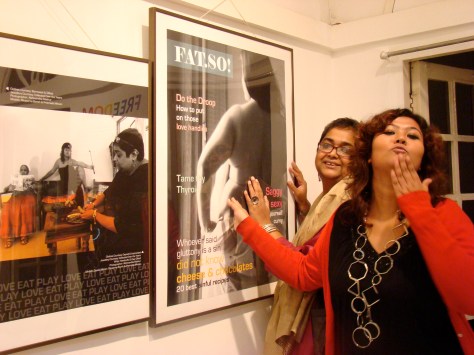
Artists: Neelima and Abhinandita

Models: (to put my nepotistic interests up-front) – my sister Pramada, my mother Devaki and friend Rituparna

This is just one panel of a visual arts exhibition at Max Mueller Bhavan, Delhi, and there are films and performances too. It’s on from 26th November to 5th December, 2010.

Check out the programme at http://www.thequeerfest.com/

Asrar-ul-Haq MAJAAZ -1911-2011

Asrar-ul-Haq Majaaz was born in Radauli on the 19 October in 1911 or 1910 and died at 44 on 5 December 1955. After his initial education at Agra and Lucknow he came to Aligarh and completed his graduation in 1936. This was the year when Ali Sardar Jafri was expelled from AMU for indulging in political activities and also the year when the Progressive Writers Association (PWA), formed a little earlier in London, held its first conference under the chairmanship of Munshi Prem Chand at Lucknow, the city that Majaaz called his home. Continue reading Asrar-ul-Haq MAJAAZ -1911-2011

Audacity of hypocrisy: Sameer Bhat

Guest post by SAMEER BHAT, written on 26 November in response to Kashmiri Pandits heckling the Mirwaiz in Chandigarh.

Aesop, the Hellenistic slave, narrated a profound tale in the winter of 6th century BC. The story is simple but the message remains relevant 2700 winters later. A Bee, queen of the hive, buzzed her way to Mt Olympus to present Jupiter some fresh honey. Jupiter, delighted with the offering, promised to give her whatever she wanted in return. The Bee thought for a while and then said, “Please give me a stinger, so that I can hurt whoever might come to take my honey.”  Continue reading Audacity of hypocrisy: Sameer Bhat

25,000 Maheshwar dam oustees march in Madleshwar: Narmada Bachao Andolan

Thousands demand revoking of clearance and scrapping of dam

Press note from NBA

The Mandleshwar town resounded with the voices of 20,000 to 25,000 people (over 50% of them women) affected by the Maheshwar dam who marched through the town today, in defence of their rights despite the heavy rain, asking for rehabilitation and land, or scrapping of the dam. After marching through the main roads of Mandleshwar town, the oustees reached the Narmada River and after affirming and renewing their resolve to struggle against all odds, the people congregated in a huge public meeting at the local “Krishi Upaj mandi” in Mandleshwar. Continue reading 25,000 Maheshwar dam oustees march in Madleshwar: Narmada Bachao Andolan

On the November Massacres in Assam: Aruni Kashyap

This is a guest post by ARUNI KASHYAP

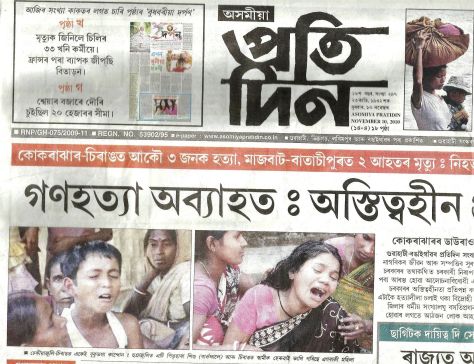
The front page of Asomiya Pratidin on 10 November

In the beginning of this month, the anti-talks faction of NDFB carried out a state-wide massacre of non-Bodos, mostly Hindi speaking settlers in Assam in a revenge-killing spree after Mahesh Basumatary, who allegedly was a cadre of NDFB, was killed by the Indian security forces in Assam’s Sonitpur district. The Bodo militant organisation claimed that the person was an innocent civilian and wasn’t linked to their organisation in any way while the security forces claimed otherwise. A recent report aired in a local television news channel DY365 records the victim’s family and his resident village’s viewpoint that matches with the claims of the NDFB. Continue reading On the November Massacres in Assam: Aruni Kashyap

Volunteers needed to transcribe all 104 Radia tapes

See Reading Radia

As you know, Open and Outlook magazines have put out legally taped telephone conversations of several people with lobbyist Niira Radia. Open put out only a few audios, and transcribed them all, where as Outlook put out a somewhat different set. However, Outlook was kind enough to put out all the audios they had on their website. There’s a lot of muck in there, and it’s not just about Barkha Dutt and Vir Sanghvi, it’s not just about the 2G scam. It’s very crucial that we transcribe ALL these tapes so that the words are on Google, se we can access the content of all tapes more easily. The media should have done this by now but the media is silent to save the skin of their own. So we need to become the media, you and I. Just 15 minutes of your time needed. To volunteer, please leave a comment on any post which says a volunteer is required to transcribe this one.

Thanks!


Memories of another time: Dilip D’Souza

Guest post by DILIP D’SOUZA

The anniversary began, for me, with a phone call. Someone I haven’t heard from in some years, mother of a soldier who died fighting for India in Kashmir. Her voice faltered several times during our conversation, and I could hear her tears. “Look at the tamasha,” she said, “over remembering the people who died on November 26 2008. Yet do we remember my son? Do we remember so many others” — and here she named several soldiers — “who died facing bullets on our border? Really do we remember people who died for no reason?”

“If we have a remembrance for one,” she said, “I want it for all. I want it for everyone who dies like this. Otherwise we wonder, what did our sons die for?” Continue reading Memories of another time: Dilip D’Souza

DISSENT, DEBATE, CREATE