Bovine Intervention

This article on Kashmir by HILAL MIR was written in 2008, when a land transfer dispute became a catalyst for azadi protests of a scale not seen since 1991. Two years later, it remains relevant.

Moo! Moo! Oh ye white men in blue camouflage uniforms and caps, hearken to my bootless cries. Continue reading Bovine Intervention

Opening Pandora’s box

Source: NDTV.com

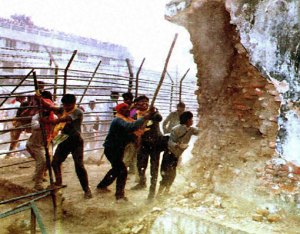
The Ayodhya judgement is out; Pandora’s box has been opened and I suppose the hope fairy is fluttering amidst us all. That there haven’t been riots is being seen as a sign that “the country has moved on”.  My personal sense is that the absence of riots simply proves that riots are rarely spontaneous: adequate security has ensured an uneasy calm.

It’s still too early (at least for me) to make sense of this verdict, so I thought we could kick off the debate on Kafila by posting a list of links and resources and perhaps take the conversation forward as more and more information comes in.

To start off, the Judgements can be accessed at http://rjbm.nic.in/ . The top half of the page contains the gist of the judgments while your can find the entire judgement below the fold.

Continue reading Opening Pandora’s box

Repeal AFSPA: Committee for the Release of Dr Binayak Sen Mumbai


Irom Sharmila has been on a fast unto death for the repeal of the Armed Forces (Special Powers) Act (AFSPA) after troops of the Assam Rifles gunned down 10 civilians at Malom near Imphal airport on November 2, 2000. She is periodically arrested and force-fed by the Indian state.

Dear Prime Minister, Home Minister and Sonia Gandhi,

We have noticed a striking anomaly in the way the armed forces and the state treats the people of Kashmir and the Northeast. When contemplating the use of the armed forces in the forest belt, the armed forces and the state concluded (quite correctly, in our opinion) that they should not be used against the people of this region, including the Maoists, since ‘they are our people’. Yet the very same armed forces have no compunction about being deployed against the people of Kashmir and the Northeast, and the state agrees! Worse still, the armed forces insist that they cannot carry out their duties without AFSPA, which allows them to rape, torture and kill with impunity.

So what is happening here? Are the people of Kashmir and the Northeast not ‘our people’? This is indeed the message that comes across. And if these people feel that they are not regarded or treated as ‘our people’ by the state and armed forces of India, is it surprising that many of them do not want to belong to India?

In fact, AFSPA allows the armed forces to commit atrocities that would be considered war crimes even if they were directed at a foreign enemy. There is no justification for keeping it on the statute books, because it is incompatible with international humanitarian law. Its enforcement in these states has been one of the main reasons why there has been no resolution of the conflicts in them for decades. Consulting the armed forces about the repeal of a law that allows them unlimited power is worse than useless: why would they ever agree? Surely you ought instead to be consulting people like Irom Sharmila, who has been waging a heroic and totally non-violent struggle against AFSPA for ten years!

Shouldn’t the government be asking her why she is ready to sacrifice her life to get this law repealed? And taking her answer deadly seriously before she dies?

FROM
COMMITTEE FOR THE RELEASE OF DR BINAYAK SEN MUMBAI

Apni Dilli Unke Khel

Written, performed and directed by  ASUR (Narendra,  Rakesh, Archna  and Ravi)

‘Shastra Pujas’ – What’s Religious About Worshipping Weapons ?

I.

Schools are meant for play and studies where kids slowly blossom into adolescents. Schools are meant for books, laboratories and other cultural activities which cater to the all round development of its students. Schools are meant for opening up of minds, inculcating inquisitiveness and curiosity, explain the wonder that is the world and lead the students towards further enquiries and promoting inclusiveness cutting across different ascriptive categories with which all of us are born with.

Of course, in emergency situations, schools even metamorphose into shelter homes for the victims of a natural calamity or a social catastrophe.

But certainly, no sane person can imagine that school premises can ever be used for worshipping deadly weapons – loaded pistols and illegal rifles. But it appears that on this count RSS – the all hindu male organisation – thinks differently. It is not for nothing that schools which run under the aegis of its affiliated organisation are freely handed over for such programmes under the specious reason that it is a religious programme. Any close watcher of the ground level situation can vouch that worshipping of weapons on Dusshera has nothing to with religion rather it is part of social tradition. Despite this reality organising of ‘shastra pujas’ has of late become a national phenomenon and hindutva organisations are known to play an important role in it. It serves a double purpose for them : consolidate their constituency by using religion as the legitimising force, terrorising the ‘others’ simply by taking out ‘religious processions’ brandishing weapons.

Continue reading ‘Shastra Pujas’ – What’s Religious About Worshipping Weapons ?

Kashmir: A Time for Freedom

Guest post by ANGANA CHATTERJI
First published on 25 September 2010 in Greater Kashmir

“Freedom” represents many things across rural and urban spaces in India-ruled Kashmir. These divergent meanings are steadfastly united in that freedom always signifies an end to India’s authoritarian governance.

In the administration of brutality, India, the postcolony, has proven itself coequal to its former colonial masters. Kashmir is not about “Kashmir.” Governing Kashmir is about India’s coming of age as a power, its ability to disburse violence, to manipulate and dominate. Kashmir is about nostalgia, about resources, and buffer zones. The possession of Kashmir by India renders an imaginary past real, emblematic of India’s triumphant unification as a nation-state. Controlling Kashmir requires that Kashmiri demands for justice be depicted as threatening to India’s integrity. India’s contrived enemy in Kashmir is a plausible one – the Muslim “Other,” India’s historically manufactured nemesis. Continue reading Kashmir: A Time for Freedom

The Many Lives of Caste in Modern India

[Following my previous post, ‘We are Proud Hindus’, there has been an expected barrage of comments – all along very predictable lines. Most of them, characteristically, turn every critique of reprehensible caste practices of Hindu society into an expression of ‘casteism’ and immediately displace the criticism to their favourite enemy, Islam. For the benefit of readers who might be interested in a more reasoned debate, I post here an essay,  which was written some years ago and a version of which published in South Asian Journal. This is  just by way of making my own position clear. – AN ]

Politics in contemporary India is marked by the ‘resurgence’ of ‘caste politics’. In a sense, this is true. The past two decades have seen a dramatic collapse of the old political formations and parties, which had dominated the politics of the Nehruvian era.[1] Even the movements of that period, right up to the mid-1970s, were largely movements on economic issues and questions of corruption, black-marketing, hoarding and food shortages. Through the decade of the 1980s, there was a gradual erosion of the Nehruvian secular-nationalist imagination, and one of the factors responsible for it was the ‘re-emergence’ of caste in public discourse.

The watershed in this respect of course, was the famous ‘Mandal Commission’ agitation – which has become something of a metaphor in contemporary Indian politics. The Commission, which was instituted in 1978, during the Janata Party government, under the stewardship of B.P. Mandal, a socialist leader from a ‘backward caste’, was given the task of looking into the question of ‘backwardness’ of certain castes and suggest remedies for its redressal. For about a decade after it submitted its recommendations in 1980, it lay in cold storage after the Congress under the leadership of Mrs Indira Gandhi (subsequently taken charge of by her son Rajiv) returned to power. It was implemented under extremely contentious circumstances in 1990 under the Prime Ministership of V.P. Singh. As is well-known, its main recommendations included 27 percent reservations in public employment for these castes (known in India as the ‘Other Backward Classes’ or OBCs).

Continue reading The Many Lives of Caste in Modern India

Provincial Councils and the 13th Amendment: Interview with Lal Wijenayake

I interviewed attorney at law, veteran Left politician and former Provincial Councillor for fifteen years, Lal Wijenayake in July 2010.  His experience is all the more important given the recent discussions and debates on the 13th Amendment and the Provincial Council system in Sri Lanka.  While this interview from two months back is very much focused on his experience as a Provincial Councillor, in recent weeks, Lal Wijenayake was also a petitioner against the anti-democratic 18th Amendment to the Constitution before the Supreme Court.  This was in contrast to the shameful manner in which all five Members of Parliament of the Socialist Alliance voted for the 18th Amendment. Continue reading Provincial Councils and the 13th Amendment: Interview with Lal Wijenayake

To Delhi

I had used Baudelaire for the post pasted below because on the day  I sat to write about the CWG, nothing I wrote made any sense or captured my frustration other than the poem. Yet, as an email I got this morning reminded me, I have partially substituted one injustice with another. Since good critiques are so wonderfully rare and this one voiced so well, I cite the email below (with permission) as an amendment to my own post since my agreement with its charges are complete:

“Dear Gautam,
I was disappointed to read your post on Kafila , the one where you posted an extract from Baudelaire [http://kafila.org/2010/09/25/to-delhi/]. It is very tiring to read of woman / the feminine as characterized by caprice and associated with luxury + cruelty.
Even if it is Delhi , the city, that one is supposed to read as the woman, unfeeling, capricious, this still ties up with the discourse around women as the consumers of luxury goods, thus responsible for the exploitation resulting from the production / trade of these goods. [Off the top of my head – look at Pope’s Rape of the Lock , Gray’s goldfish-enamoured cat, and the sequel to Love Story – Oliver’s Story with the woman who works for the sweatshop-patronising firm]. I don’t see how the sexism in this piece can be excused or explained away. And to quote it without atleast pointing out the problems in it?

Also, isn’t caprice a problem in itself? Aren’t you disappointed in the reporting that characterizes the Commonweath expenditure as resulting from the caprice of a few in power? Without exploring the systems, structures of thinking/ideology that make such expenditure possible in the first place? Without connecting this, the commonwealth-exploitation, to the histories of similar exploitation?

Yes, it is possible to see that you were highlighting injustice and class – but –
the piece ends up valourizing a man who feels what – pity? guilt? A little shame. Shame is so comfortable – he can occupy moral high ground, diss the woman, use the services of the cafe, and do nothing after that.

I hope your work goes okay.
Best wishes,
Akshi.”

The original post:

“Oh!  You want to know why I hate you today.

Continue reading To Delhi

Commonwealth Postcards

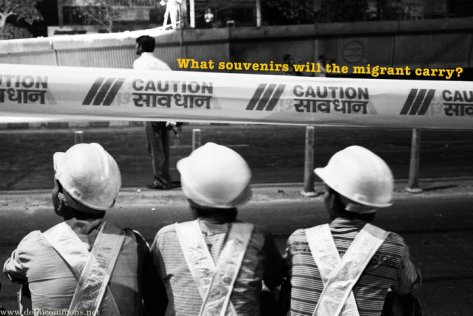
This and other postcards, expressing what many Delhi residents feel about the Commonwealth Games, have been put out by Delhi Commons (Facebook). They are available at Sarai CSDS (North Delhi), People Tree (Central Delhi) and Yodakin Bookstore, Hauz Khaz Village (South Delhi).

The Banality of Shame

BANAL: everyday, ordinary, commonplace

SHAME: the  painful  feeling  arising  from  the  consciousness  of  something  dishonourable done  by  oneself  or another


Jana gana mana adhinayaka jaya he

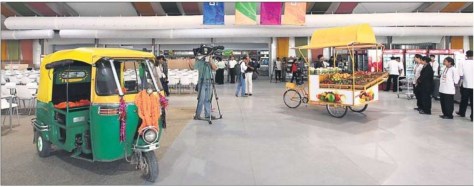
An auto-rickshaw and a street hawker’s pushcart as showpieces in the Commonwealth Games Village dining hall

* MCD to raze dhabas on Games route: It doesn’t matter if you are running your business legally or illegally. If your shops fall on the route of a Games event, chances are that you will have to shut shop. A shop and taxi stand in front of Bal Bhawan — which have been running for 20 years — were demolished by MCD on Saturday and the civic agency is planning to raze all dhabas  functioning along the stretch in the coming days even as the dhaba owners claim that they have been paying rent to MCD.

Continue reading The Banality of Shame

We Are Proud Hindus!

The Times of India carried a story today that we are reproducing here in full. It is the story of a Rajput-owned dog who became outcaste because it was fed a chapati by a dalit woman.  Not only was the dog turned ‘out’  to live in the dalit basti, worse, the woman Sunita was fined Rs 15, 000/-  by the panchayat for the crime. But hold on, there is more: when Sunita and her brother went to lodge a complaint at the police station, the police officer asked her why she fed the dog? So, this is not really a matter of one mad, ‘illiterate’ individual (as if literates are by definition better): This incident reveals an entire structure of thought and belief that extends through from the panchayat to the police itself (which despite the Supreme Court’s directive has not yet filed an FIR). Here is the full report:

BHOPAL: A dog’s life couldn’t get worse. A mongrel brought up in an upper caste home in Morena was kicked out after the Rajput family members discovered that their Sheru had eaten a roti from a dalit woman and was now an “untouchable”. Next, Sheru was tied to a pole in the village’s dalit locality. His controversial case is now pending with the district collector, the state police and the Scheduled Caste Atrocities police station in Morena district of north MP.

The black cur, of no particular pedigree, was accustomed to the creature comforts in the home of its influential Rajput owners in Manikpur village in Morena. Its master, identified by the police as Rampal Singh, is a rich farmer with local political connections.

Continue reading We Are Proud Hindus!

Rayana R Khazi and The Specter of Religious Fundamentalism in the Kerala Public Sphere: Jenny Rowena & K Ashraf

This is a guest post by JENNY ROWENA and K ASHRAF
Rayana R Khazi is a young student from Cherkalam in Kasargode. Recently she has been in the news after she came out to speak to the media about the threatening letters and phone calls that she was receiving, all of which demanded her to wear the Purdah. After Rayana’s revelations, media, human rights and feminist activists have rushed to her aid, starting off yet another round of anxieties about the growth of Islamic fundamentalism.  Even as we fully support Rayana’s need for a more livable life, it is also important that, at this juncture, we look at the numerous issues that this incident brings forth into the public sphere of Kerala.
Control of Women’s Bodies
In this controversy, one of the most important issues being raised is about the control of women’s bodies by male, religious fundamentalists in the Muslim community.  Such responses, be it from a reactionary, anti-Islamophobic perspective or from a more progressive view- point, which is aware of the rampant Islamophobia of our times, carries out a similar function in Kerala. Continue reading Rayana R Khazi and The Specter of Religious Fundamentalism in the Kerala Public Sphere: Jenny Rowena & K Ashraf

Scorched by Blind-spots – Prabhat Babu and the CPI(M): Andaleeb Mondal

Guest post by ANDALEEB MONDAL

[Recently Prabhat Patnaik published an article “Dial M for modernity” in The Telegraph, about what is right about the CPI(M). This piece is a response to that article. There are some very elliptical Bengal-specific references in the piece that have been retained as they add to the flavour. AN]

The CPI(M) regime is alive in West Bengal and Kerala. As the numbers go, it could hardly be more alive in Bengal, its throbbing vitality being underscored by a now-famous comparison of assembly seats between the CPI(M) led Left Front and the principal opposition – “Amra 235, ora 35” ( We are 235, they are 35).This famous phrase was uttered by a self-proclaimed progressive writer with supreme empathy for toiling masses, who incidentally is the nephew of another writer-poet whose progressive credentials and dedication to people’s causes resonated in Bengal and beyond, without having the honour of being propped up by state sponsorship. Of course I am being snide and I do not intend to embark on a comparative literary analysis. To look for evidence of continuity among them is absurd – the filial accident being least of the reasons. However, conjuring up continuities do serve some purpose, occasionally.

Times shape people vice versa and such mutual shaping has always happened – sometimes imperceptibly, sometimes vigorously. They do bear the imprint of past times and ethos and hence in the absence of observable points of radical change, one may fall into the trap of assuming a kind of “historical” continuity. This idea of continuity can obfuscate continuous drifts in time. In the life of political organizations and ideologies , such feigned continuities primarily have a three-pronged way of self-maintainance. Let me call them – rituals, manifestos and lastly, for lack of a better epithet, kula-devatas ( clan deities). This permeates most political formations in the Indian landscape – the present discussion is about the CPI(M). However, a semblance of similarity in these Three Great cliches can be kept up.

Continue reading Scorched by Blind-spots – Prabhat Babu and the CPI(M): Andaleeb Mondal

We are all Kashmiris! Or at least should be!: Dibyesh Anand

Guest post by DIBYESH ANAND

Dibyesh Anand is Associate Professor at Westminster University and writes on majority-minority relations in China and India

Democracy is as much an idea, as it is a political system. An idea for which millions have given life and even more have been killed. When non-democratic or quasi-democratic states suppress people, it is a shame, but when established democracies kill their own citizens for exercising their legitimate right to protest, it is a bigger tragedy. Bigger because it is not only men and women who die, but also the hope that democracy offers a humane and representative form of government at least for its own people.

This is the hope that is dying in the world’s largest democracy as the security forces continue to kill unarmed protestors every day for the last two months in Indian controlled Kashmi. Till date, more than a hundred, mostly young men and children, have been killed by those who are supposed to be the protectors. Evidence of torture, gratuitous killings, and sheer brutal dehumanisation of ordinary people are in abundance and yet the Indian state responds by threatening action against those who reveal the evidence and against forums (such as facebook, youtube) that allow these to be made public. There is no sense of humility, regret or introspection. No promise of impartial inquiry and strict punishment for the law-enforcers who kill and maim with impunity. Not even A of an apology.

Continue reading We are all Kashmiris! Or at least should be!: Dibyesh Anand

Loneliness Alert! Rounding up the Unusual Suspects

Guest post by AKHIL KATYAL

Fire alarms at my postgraduate student house in London are always a ready excuse to hang out. Every time the highly annoying siren sounds off, I see students acknowledge it with a very odd mix of frustration and amusement. We clamber down the stairs making the familiar shrugs and smiles to each other, making it clear that we all really hate this. But something very peculiar happens after the first half-a-minute of the ritual rant against the housing management. People break out into conversations about what they were doing, or more usually, what they were just about to do if the alarm had not gone off. Some bring their mugs of coffee down with them and do the sip and chatter. Those in the bath-robes look awkwardly about as if they can’t find the right address. The front yard begins to look like a party, and like any other party I’ve been to in London in the last two years, it breaks into some very loud, talkative groups and some folks standing by themselves in the corners.

The alarms, 99% of the times, mean nothing serious. Someone has just smoked in their kitchens, someone has made pan-fried noodles and the smoke alarm has caught the whiff, things like these generally. So the siren by itself is a non-event, a formality. Except that it becomes something else all together. What is formally a situation of potential crisis becomes a pretext for running into others, for a bit of casual nattering. So much so that when the alarm ceases, some people look half resigned to end the banter. Some continue the conversations, some hurriedly get back to their rooms, and others seem half-reluctant.

Continue reading Loneliness Alert! Rounding up the Unusual Suspects

Godmen and Conmen

Why the Criticism of Religion Should Now Come On The Agenda

The foundation of irreligious criticism is: Man makes religion, religion does not make man.

Religion is, indeed, the self-consciousness and self-esteem of man who has either not yet won through to himself, or has already lost himself again. But, man is no abstract being squatting outside the world. Man is the world of man – state, society. This state and this society produce religion, which is an inverted consciousness of the world, because they are an inverted world. Religion is the general theory of this world, its encyclopaedic compendium, its logic in popular form, its spiritual point d’honneur, its enthusiasm, its moral sanction, its solemn complement, and its universal basis of consolation and justification. It is the fantastic realization of the human essence since the human essence has not acquired any true reality. The struggle against religion is, therefore, indirectly the struggle against that world whose spiritual aroma is religion.

– Karl Marx, Introduction to A Contribution to the Critique of Hegel’s Philosophy ofRight

I.

Sheltering fugitives from the law, laundering money, ‘arranging’ for government contracts, solving your financial woes or even bumbing off a pesky blackmailer – tasks which are normally associated with D company or their local level clones are today not their sole preserve. Spiritual gurus of the day who are a dime a dozen in this country have emerged as powerful challengers to their monopoly. And not only the newly emergent Sadhus, who are recent entrants in the sprawling spiritual bazaar, but even the old ones also seem deeply emersed in this morass of crime and corruption.

One can easily notice that hardly had the discussion around Icchadhari baba alias Shivmurat Dwivedi, who ran a prostitution racket which spanned many states, with his clientele reaching powerful bureaucrats and politicians, has died down, a sting operation by a leading channel has brought forth the different skills developed by the leading lights of this profession.

Continue reading Godmen and Conmen

Lucas Tete, Maoist violence and K Balagopal: Biswajit Roy

Guest post by BISWAJIT ROY

It’s a welcome development that Arundhati Roy, G N Saibaba, Mahasweta Devi, Sujato Bhadra and others have condemned the killing of Maoists’ POW and Bihar policeman Lucas Tete as reported by Bengal Post. The civil society personalities sympathetic to the Maoist cause and human rights groups in general are sometimes criticized correctly for being silent on brutalities by Maoists and other insurgents while opposing the atrocities by the security forces and private armed squads, in case of West Bengal, CPM’s armed cadres. The Maoist leadership’s response to the intellectuals’ criticism is still not known. But the condemnations seemed to have played a role in their decision to free the rest three policemen. In an earlier occasion in Bengal, senior Maoist leader Kisenji had succeeded in extracting a huge media mileage by using the captive officer-in-charge of Sankrail police station as a pawn to bargain with the state government.

It is another matter that the Maoists could not extract much from the government except bail for some tribal and non-tribal women undertrials who had been languishing in jails as Maoist sympathizers. But the high-profile drama over Kisenji’s on-camera vitriol against the Centre and state in full camera glare and the eventual release of the ‘POW’ police officer through the good office of media persons had definitely made Kisenji a household name in Bengal and allowed him to occupy the political center-stage.

Continue reading Lucas Tete, Maoist violence and K Balagopal: Biswajit Roy

Kashmir, September 2010. The Reichstag Fire (dispersed) Redux ?

(Apologies for cross posting on the Reader List)

As if by magic, those who had hidden themselves for the past few months in Kashmir are leading mobs and setting schools and public buildings on fire. And many more people have died tragic and unnecessary deaths. This time, unlike in the past, the blame must be squarely shared between those who fired the bullets, and some of those who led the incendiary crowds. Perhaps Kashmir has just entered a new and darker phase, brandishing a burning torch. This situation, in order not to be irreversible, needs the urgent and sane attention of Kashmiris themselves, and of all those who wish Kashmir and its people well.

We could do well by way of beginning by turning our attention to a surprising detail hidden within the reports of the recent events of arson. National Conference apparatchiks, who did not even dare appear in public till recently for fear of being attacked for their role in sustaining the occupation of Kashmir by India’s armed might, are now allegedly seen openly goading mobs of zealots to burn down a school in the name of the defence of religion. If this is true, the what we are witnessing is the realization by them of a wonderful opportunity to wear new costumes and speak new lines in the unfolding theatre of the moment.

Continue reading Kashmir, September 2010. The Reichstag Fire (dispersed) Redux ?

Ramzan in Jamia Nagar

It is Ramzan time in Jamia Nagar – municipal workers clean the streets and line it with chuna lime, bakeries are piled high with sewain, and halwais have begun preparing the special iftar food. The police are busy too, but residents can comfort themselves with the thought that it is only to regulate traffic in the congested lanes. As the clock ticks towards iftar, the road from the Jamia Milia Islamia University towards Batla House is made one-way: the way in, to help the rushing crowd reach home in time, picking up fruit and pakwan (snacks) on the way.

The residents’ relationship with the police here is notoriously complicated. Until 2007, Jamia Nagar only had a police post, but during Ramzan that year a policeman was accused of desecrating the Quran, and the dispute led to the police post turning into a full-fledged police station. In 2008, it was during Ramzan that the police engaged alleged bomb-plotters in a firefight, an “encounter” that’s widely regarded to have been fake. A few weeks later, a jeepful of Noida policemen in plainclothes attempted to kidnap a local man, but residents poured out and chased them away. Continue reading Ramzan in Jamia Nagar

On Torture and Testimonies

I was going to write out a reply to the comments on Shuddha’s post, Kashmir’s Abu Gharaiab, but thought I would expand it into a larger post.

I’d like to make clear that I have been to Kashmir only once – and that too for a few hours in the aftermath of the earthquake, so if anyone writes back saying, “I should see the ground reality in Kashmir”; I concede that point straight off the bat.  I should see the ground reality in Kashmir; we all should.

However, over the last eight months, I have had the opportunity to interact very closely with central paramilitary forces like the BSF and CRPF in the course  of their deployment in Chhattisgarh, where I work. Many of the men conducting anti-Maoist operations in Chhattisgarh have served in Kashmir and the North-East theatres.

Over the last three days, I and a reporter from the Times of India have been working on a story in which a group of adivasis from two villages in Chhattisgarh’s Kanker district have accused the BSF of torturing a number of young men and women from their respective villages by beating them and also administering electric shocks.

Continue reading On Torture and Testimonies

DISSENT, DEBATE, CREATE