
The recent move by the Ministry of Social Justice to go for important amendments in the Scheduled Castes & Scheduled Tribes (Prevention of Atrocities) Act (POA) 1989 supposedly to simplify the process of hearings and strengthen investigation mechanisms has largely gone unnoticed.
Continue reading Demand Justice: Get (Amended) Laws
‘Dhule was burnt after 40 years, despite its glorious tradition of communal harmony’
![Aurangabad Times]](https://kafila.online/wp-content/uploads/2008/10/dhule.png?w=474 "dhule")
[This report about the recent riots in Dhule comes from from PRATIBHA SHINDE and AMBARISH RAI.] Continue reading ‘Dhule was burnt after 40 years, despite its glorious tradition of communal harmony’
‘The Best Form of Saying is Doing’ – Ravikumar on Che

[This is a guest post by well-known Tamil writer RAVIKUMAR on the occasion of Che Guevara’s 40th death anniversary on 9 October. The article was written on the 9th. ]
Ernesto Guevara de la Serna popularly known as ‘ Che’ was born on June 14, 1928 in Argentina. A doctor by profession he involved himself in revolutionary activities from his student days. He was with the political activists of Guatemala when the elected government of Jacob Arbenz was overthrown by a CIA backed coup in 1954. He escaped to Mexico where he met the exiled Cuban revolutionaries led by Fidel Castro. He joined with them in their struggle to liberate Cuba from the Batista regime.
Che was the name his Cuban companeros gave him. It is a popular form of address in Argentina. He sailed with the Cuban revolutionaries in the famous yacht ‘Granma’ as a doctor. Later he was promoted as commander. Che played an important role in the success of the Cuban revolution. He led a guerilla column in the final battle. Finally, Batista fled the country on January 1, 1959.
Continue reading ‘The Best Form of Saying is Doing’ – Ravikumar on Che
Of “Killer” Buses and Car Lobbies: The Coincidental Death of the BRT
The sustained campaign by the elite press to jettison Delhi’s first mas transit bus system has been remarked upon and documented on Kafila. Today morning’s newspapers carries news of an accident in which 32-year old Poonam Sharma was killed as she tried crossing the road and was hit by an oncoming bus. Delhi’s record when it comes to road safety is abysmal and this is yet another instance of the the terrible and tragic fate that befalls many pedestrians every year on Delhi’s roads. What is interesting though is the way in which accidents on the BRT are reported compared to the reportage of other road fatalities. Here are some headlines from the recent past:
BRT Corridor Claims One More Life
BRT Delhi: Death Toll Continues, Pedestrians Blamed
BRT Claims another Life: Woman run over by Bus
Continue reading Of “Killer” Buses and Car Lobbies: The Coincidental Death of the BRT
Converting lions to elephants
As the most hideous kinds of violence are unleashed on Christians in Orissa and Karnataka by proud Hindu terrorists, one issue that the liberal Hindu mind-set stumbles over is that of conversions. Of course, violence is bad, it bleats, nothing justifies killings, but mass conversions, you know…
Conversions. Images of Muslim hordes waving their fierce banners, sweeping across the North Indian plains; images of sly Christian missionaries swindling innocent tribals and dalits with food and education and social status, into accepting an alien god. The liberal Hindu, who would never dream of converting anybody to Hinduism, shrinks at these images.
Aditya has drawn our attention to Ambedkar’s clear-eyed insight into why Hinduism is not a proselytizing religion. Can you convert a non-Hindu into a Brahmin? Nope.
Freedom of Conscience and Attacks on Christians
The idea that fundamental rights are enjoyed by all, without any distinction of race, sex, language, ethnic origin, nationality and religion, is a basic principle of democracy and international human rights law. Violent attacks on the Christian minorities in different parts of the country are an assault on the very notion of democracy and universal human rights. Despite the country’s obligation to respect and protect the right to freedom of conscience and religion, the wave of killings, beatings, sexual assaults, looting, destruction of property, and displacement have created a climate of fear and insecurity, particularly among the Christians. Representatives of Christians and minorities are exposed to the grave risk of communally motivated verbal abuse and physical attacks.
Worst, the governments of Orissa and Karnataka continued to deny the extent of violence prevalent, and failed to face up to their minimum responsibility of securing the life of their people. If India has to live up to any human rights standards, it must show a clear political will to combat attacks on Christians: speaking out strongly, and at all levels of governance; publicly acknowledging the seriousness of the issue; and the need to take concerted action. This is not ‘hooliganism’ or ‘anti-social’ activity, motivated by some hooligans and anti-social elements. It is a violent, and apparently a communal attack, carried out by organized groups. Crimes which are communally motivated must be effectively and thoroughly investigated and prosecuted as such. Treating communally induced violence and brutality on an equal footing with cases that have no communal overtones would be to turn a blind eye to the specific nature of the acts that are particularly destructive of fundamental rights.
Continue reading Freedom of Conscience and Attacks on Christians
“India’s Anti-Christian Violence Unparalleled Among World Democracies”

As Maoists confirm that they were behind the murder of Laxmananda Saraswati and give their reasons, two notes below from Madhu Chandra of the All India Christian Council.
Hi Friends,
Hindutva forces – Vishwa Hindu Parishad, Rashtriya Swayamsevak Sangh and Bajrang Dal knew very well that the Maoists have killed their Swami Lakshmanananda on August 23 but intentionally denied it and alleged Christians so that they could do what they have done to Dalit Christians of Orissa.
Orissa Government who runs on mercy of BJP and Hindutva forces believes the allegation and allowed the religious ethnic cleansing of Christians in Kandhamal district of Orissa. Continue reading “India’s Anti-Christian Violence Unparalleled Among World Democracies”
“Gentle persuasion” in Kashmir
Some intelligence agencies have also warned of a low-poll percentage. But a senior police official said: “One cannot wait for the perfect situation in Kashmir.” According to him “gentle persuasion” in rural and border areas will help improve turnout. “After all, it is not a crime to ask people to vote. In several countries, voting is mandatory,” he argues. [George Joseph, Sakaal Times]
What an admission, what a giveaway! Indian democracy never went beyond Lakhanpur anyway. Nationalists and the weak hearted, please be ready to shut your eyes and ears for the next two months. The Indian state is planning to show its ugliest face in the Valley. Get ready, get ready.
Your Dera Ghazi Khan, and mine

In Mehrauli, the Khattars insisted that after noting down the damage, in lakhs, that the blasts caused to their shops, the second most important detail was that they were from Dera Ghazi Khan.
Dera Ghazi Khan? Oh, in Multan you know, we are all from there, 300 families. Yes, yes, after Partition, in the Sarai area of Mehrauli, we’ve always lived here, forever…
And then I see the subject line of a thread on a Sindhi mailing list: “Capital be shifted from Islamabad to Deira Ghazi Khan/ Bahawalpur/ Raheemyar Khan.” Continue reading Your Dera Ghazi Khan, and mine
Subscribe to Kafila

You can subscribe to Kafila‘s RSS feed and even our comments feed. You can do so by pasting those links into an RSS reader like Google Reader or Bloglines.
For the uninitaiated, this RSS has nothing to do with the Rashtriya Swayamsewak Sangh. Here is a good guide to what feed readers are about.
If you are obsessed with us, you can even get mobile alerts about our posts! You may also want to read our About and Disclaimer pages.
Atta Boys, Delhi Police, Again
As the comments on the Jamia encounter pieces have flooded in, what has been amazing of course is how the defence of the police establishment comes often from the very same discourse which can’t stop crying itself hoarse about the corruption of the government. I am pretty sure many of those who have jumped to make us doubters and naysayers feel guilty about failing to support our boys in khaki would be wringing their hands at India’s sliding down the scale on Transparency International’s rating. What is required? What are we doing wrong? Does everybody in this country who can read and write need a Poli.Sci 101 course on what the Indian State is, and how it includes the elected and the non-elected arms, and how the ‘corrupt politicians’ are part of one large material and ideological whole that includes bureaucrats and internal security establishment? Continue reading Atta Boys, Delhi Police, Again
Shiver… down the spine: My tryst with the e-messengers of terror
Guest post by SHAHINA K K
[This is the fuller version of an article published today in the Hindustan Times. This longer version is crossposted from the e-discussion group, Greenyouth. The specific article referred to – ‘Bombs Defused in Newsrooms’ was crossposted in Kafila ]
Since 14th September 2008, writing has become a laborious exercise for me. It was all of a sudden that words turned heavy, staring at my own convictions, political thinking and journalistic vigor. It was on a gloomy Sunday (the day after the bloody Saturday on which the life of twenty odd people had been taken away by some body called Indian Mujahideen)that things turned upside down. It’s difficult to describe my terrible sense of shock when it came to my notice that a part of the email sent by perpetrators of the Delhi blasts laying claim to the deadly bombs on the day, had been written by me! It was lifted verbatim from a piece of mine (‘Bombs defused in News rooms’) which appeared in the media watchdog portal, The Hoot. Newspapers had given extensive quotes wondering at the ‘journalistic character’ and ‘impeccable English’ of those who prepared the mail. Even when everybody calls it plagiarism I was not spared because my name carries the identity of a community which is put in the dock for all that happens dreadfully around us. I wrote about what the media does, how it deals with the unending episodes of terror strikes juxtaposing with the violence by Hindu extremists and how flagrantly they fail in the ‘balancing’ act! Continue reading Shiver… down the spine: My tryst with the e-messengers of terror
Malegaon to Modasa Blasts: The H Factor ?
Saba Parveen still repents the fact that she sent her younger sister Farheen to Bhikku Chowk to buy some Pakoras. Little she could have the premonition that she would never get to see her 10 year old sister a class V student alive.
The blast at Malegaon’s Bhikku Chowk, has literally shattered the family of Shaikh Liaquat Wahiuddin, Farheen’s father who lives around 100 feet away from the Chowk near the Kasbapada masjid. A father of three daughters and two sons and a wife has seen all the hell broke lose soon after the bomb blast. Continue reading Malegaon to Modasa Blasts: The H Factor ?
The Greatest VP debate since – like ever!!!
Good morning, Good evening, to people across the globe. In our attempt to cater to our world wide audience at Kafila; we have decided – in collaboration with several heavily funded political lobbyists – to bring you a semi-realtime commentary on the first and only vice presidential debate in what promises to be the USA’s most interesting election since – like ever.
Much has been written about Sarah Palin – especially since her somewhat surprising comments on a whole variety issues – most recently her interviews with Katie Couric of CBS news. You can access two parts here and here. Much was also made of her famous “We can see Russia from Alaska” comment.
Continue reading The Greatest VP debate since – like ever!!!
“Gandhi would be in your jail”: Protests against CSPSA at Berkeley
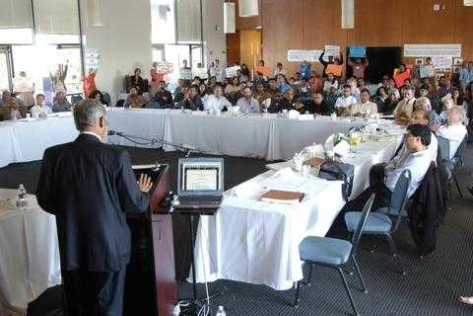
The Center for South Asia, University of California Berkeley and Foundation for Democratic Reforms in India jointly organized a seminar (September 27, 2008) on Indian Democracy where the Director General of Police of Chhattisgarh was a speaker. Continue reading “Gandhi would be in your jail”: Protests against CSPSA at Berkeley
Eid, Kashmir

“Eid-ul-fitr celebrated with fervour in Jammu and Kashmir,” says PTI.
“Eid in Srinagar lack fervour,” says NDTV’s Nazir Masoodi.
Eid mubarak?
Bye Bye Reliance: Pen Tehsil Says No SEZ!
In our continuing concern with the strange times that seem to have befallen our cities, lets not lose sight of the historic battle underway in the countryside. In the first instance of its kind, the referendum on the Maha-Mumbai Special Economic Zone being set up by Reliance has unambiguously returned the verdict of the farmers of Raigad- no SEZ in Pen! As Sanhati notes, the Tata’s 1500 crore investment in Singur sounds like loose change when compared to the one lakh crore that Reliance is planning to sink into 10,000 hectares. 22 villages in the Pen Tehsil voted against the acquisition of their lands at the paltry sum of 10 lakhs per acre. Unsurprisingly, Reliance Industries Limited has said the referendum is “not genuine”:
Prachanda in New York: Ahilan Kadirgamar
Guest post by AHILAN KADIRGAMAR
Maoist leader and the first Prime Minster of Republican Nepal, Pushpa Kamal Dahal, more commonly known as Prachanda, was in New York these last few days. I heard him speak at the Asia Society and at the New School for Social Research, where he fielded questions from the audience. The webcast of Prachanda’s address to the UN is here.
Prachanda opened his speech at the Asia Society, by saying it is like a sweet dream to be in New York. Continue reading Prachanda in New York: Ahilan Kadirgamar
OB vans in Mehrauli
I was in Mehrauli today for a few good hours. I don’t have the patience to write a long post. Just a few things. Continue reading OB vans in Mehrauli
On Being Muslim: Shahrukh Alam
Guest post by SHAHRUKH ALAM
This afternoon, I saw on TV, the ticker advertising a Special Feature. The programme was going to be aired later in the day and was called “Young, Educated Killers”. And for the next few seconds, I wondered who the title might be referring to: not the ‘encounter specialists’, surely? The economists who frame policies for the new, resurgent India, perhaps? People on the National Disaster Management Commission, possibly? Or since it was of topical interest, The Board of Directors for Lehman Brothers? Or even Patent attorneys for multinational Pharmaceutical companies? But then the visuals came on and I have to admit I was most embarrassed at having thought such dark thoughts about the aforementioned good people. Continue reading On Being Muslim: Shahrukh Alam
“Shame is a revolutionary sentiment”: Sadanand Menon

A few days ago in a comment on Shuddha’s little forensic exercise, I had drawn attention to the pernicious communal stereotyping evident in the widely circulated pictures of the three arrested terrorists Continue reading “Shame is a revolutionary sentiment”: Sadanand Menon
 KAFILA - COLLECTIVE EXPLORATIONS SINCE 2006