
ST. PAUL, MN—Democracy Now! host Amy Goodman was unlawfully arrested in downtown St. Paul, Minnesota at approximately 5 p.m. local time. Police violently manhandled Goodman, yanking her arm, as they arrested her. Video of her arrest can be seen here: http://www.youtube.com/watch?v=oYjyvkR0bGQ Continue reading Amy Goodman Arrested:Democracy Now
A New ‘Kerala Model’
The latest news from Chengara is alarming. As if in retaliation to the rally taken out by dalit and human rights activists on 30 August, the very next day, a group of people who were travelling to the struggle site were attacked by the goons who continue the blockade. The whole group — eight men and thirteen women, including Omana, six months pregnant,were beaten heavily, and Omana’s two-year-child was snatched and thrown down. The injured are in hospital and activists are trying to get a case registered with the police.Intimidating posters have appeared all over Pathanamthitta town, declaring that the estate will be ‘cleared’on 3 September by the unions. All this, while the police watches, and a spineless admininstration looks the other way. Apparently, the administration now takes its orders from the CPM district committee.Meanwhile, the leadership continues to talk of the package, which will apparently come only after the protestors have been thoroughly intimidated, physically and emotionally,and reduced to cowering, nervous wrecks.
The million mutinee question – Anant Maringanti
Guest post by ANANT MARINGANTI
How far is Nandigram from Chengara ? If we take media coverage and internet buzz as indicators, they are on two different planets. The heat generated by Singur and Nandigram was enough to run a chain of mini power plants. All that the families in the Chengara holdout have managed to evoke is a few approving nods from here and there. Here is a partial inventory of reasons why this might be so.
1) Singur and Nandigram are protests against disposession. The bad guys in the two instances are high profile harbingers of neoliberal globalization. No less. Chengara is about staking a claim to a welfare provision that nobody takes seriously anymore. There are no easily identifiable bad guys here.
Continue reading The million mutinee question – Anant Maringanti
A cartoon in ‘Greater Kashmir’

Meanwhile, some links to the sort of news from Kashmir that the Delhi media won’t give you:
Even expecting mother not spared during curfew
CRPF administers ‘patriotic’ dose to 56-yr old
Crippling curfew devastates fruit industry
Sikh Youth thrashed by Samiti supporters
‘Dangerous conspiracy to give communal color to movement’
While we were gagged
8 Killed, Hundreds Injured In 7 Days, Massive Clampdown On Valley
Where are pro-freedom leaders?
Geelani’s Son-In-Law Seeks Red Cross’ Intervention
Curfew relaxed, not beating
‘It is terrorism in uniform’
Yeh BBC London Ki Urdu Service Hai
News starved Kashmiris tune into popular radio program of 90’s in curfew
Curfew revives water transport on Jhelum
AMK condemns demand for ban on Kashir channel
Hindu chauvinist derails Mumbai citizens’ sit-in
Azaadi echo in Delhi
Civil right activists favour Kashmir independence
Holy Cows and Scapegoats
….It is difficult to say what will happen next !
Whether the police and security forces would understand their folly and would release Tariq Ahmad Batloo unconditionally or whether Delhi police who have branded two of their earlier contacts Irshad Ali and Mohammad Marouf Qamar as ‘Al Badr Terrorists’ would make amends to their steps ? Whether media would engage in a deep soul-searching about its complicity to join the powers that be in making ‘terrorists’ out of innocent people ? Neither it is possible to predict when would the process of ‘terrorisation’ and ‘stigmatisation’ of particular communities would end nor it is possible to predict when would the division of peoples in Holy Cowsand Scapegoats would end.
It would not be an exaggeration to say that the future of India as a republic is at stake here.] Continue reading Holy Cows and Scapegoats
Indians against Indian repression in Kashmir
Be there or elsewhere:
Janahastakshep, PUCL and PUDR are holding a dharna on August 30 at jantar mantar from 11am to 1pm in protest against the crackdown on non violent people demanding ‘azadi’. Continue reading Indians against Indian repression in Kashmir
Yeh To Bada Toing Hai!
It seems the I & B ministry doesn’t like chocolate. Specifically it doesn’t like women nibbling the posterior of a chocolate covered man. The new ‘Dark Temptations’ Axe deodorant ad has been recently banned by the ministry for being indecent, vulgar and suggestive and thus violating Rule 7 (8) of the Advertising Code prescribed under the Cable Television Act, which says, ” Indecent, vulgar, suggestive, repulsive or offensive themes or treatment shall be avoided in all advertisements.”
Personally I can take chocolate or leave it….
“Indecent”, “vulgar”, “repulsive” and “offensive” I understand as ideas, at least notionally. It’s the “suggestive” I don’t get.
Update from Kerala: Blockade continues at Chengara
Despite the talks held by Ministers with the leaders of the Chengara land struggle, the situation continues to be tense,and the blockade continues for all practical purposes. The workers’ unions are hell-bent on not allowing anyone with a ‘partisan attitude’ about the issue to visit the site of the struggle.On 26 August, P.V. Rajagopal, Member of the National Land Reforms Committee, was prevented from proceeding to Chengara by workers. Just the other day, K.R.Meera, one of Kerala’s leading fiction writers, was stopped from visiting the protest.
Continue reading Update from Kerala: Blockade continues at Chengara
Red and Black
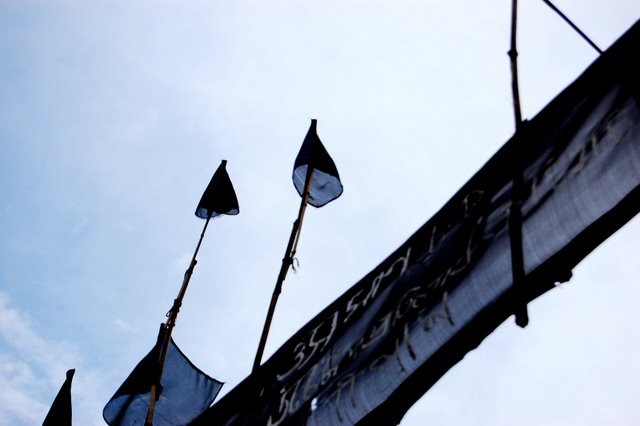
Red Flags of ‘Consent’/ Black Flags of Freedom and We, the Civil Society
guest post by TRINA NILEENA BANERJEE
(Written in Feb 2008)
The way towards Nandigram in November 2007 was fraught with a spectacle of flags.
I use the word ‘fraught’ deliberately – because as the journey progressed that autumn morning1, this proliferation of flags left me with a sense of mounting fear and apprehension. Continue reading Red and Black
The Continuing Violence Against Christians in Orissa
From John Dayal and Madhu Chandra of the All India Christian Council, an update on the continuing violence against Christians in Orissa. Continue reading The Continuing Violence Against Christians in Orissa
Statement on Censorship in Kashmir by Reporters without Borders
Censorship and violence against press in Kashmir
Reporters WIthout Borders, 25th August, 2008
Reporters Without Borders calls on the Indian authorities to put an immediate stop to the censorship and violence against the media in Kashmir that has been prompted by a wave of protests against Indian rule. At least 13 journalists were beaten by police yesterday in Srinagar, local TV stations are being censored and a curfew is making it hard for newspapers to bring out their issues.
“This latest crisis in Indian Kashmir must not be used as a pretext for subjecting the press to more violence and obstruction,” Reporters Without Borders said. “Journalists must have all the guarantees they need, including permanent passes, to be able to work freely despite the curfew. We also call on the police authorities to investigate the violence by certain elements that have led to injuries in the ranks of the press. If no sanctions are adopted, the door will be left open for more abuses. Finally, we call for an end to the censorship of local TV stations, which is a clear violation of the right of Kashmiris to be informed.”
Continue reading Statement on Censorship in Kashmir by Reporters without Borders
Bomb Makers of Hindutva
Two bajarangdal leaders were killed while 2 others injured on 24 August when they were making bombs in Kanpur in the Indian state of Uttar Pradesh (UP) as reported by Urdu daily Rashtriya Sahara in its front page. According to Sahara, the blast was so strong that the wall of the room in which the blast occurred collapsed. In other rooms, the walls were damaged. Pieces of glass were strewn everywhere.
The bomb blasted in a house in Rajeev Nagar area on Sunday afternoon. According to the report, the police recovered 3 kg lead oxide, 500 g red lead, 1 kg potassium nitrate, 11 country made grenades, several bomb pins, seven timers and batteries from the spot. According to the IG, “The recovery shows that a massive explosion was on the cards.
The deceased have been identified as Rajeev Mishra and Bhupinder Singh. While Rajeev is the son of S S Mishra, the landlord of the house, Bhupinder was a resident of Shastri Nagar. Continue reading Bomb Makers of Hindutva
“I See Kashmir from New Delhi at Midnight”
(Adapted from a posting made earlier today on the Reader-List, Apologies for Cross Posting)
Even as the Indian state seems to be on the threshold of losing its grip both on hearts and minds in Kashmir and on its own wisdom, we have our own bunch of proud patriots making a heroic effort to convert the column inches of newspapers and the floor space of television studios into their own, special, battleground. Perhaps they might be consoling themselves with the hope that the turf battle of perception management in the media may yet be won, even if Kashmir is lost. Somehow, I am not so sure that this is going to be the case.
Unfortunately for them, to win in arguments, both – the state in Kashmir, and the Indian nationalist hard liners in the media and on other public fora, need some ideas, some attempt at reason, some amount of vision. I am afraid, that so far, neither the state, nor its hyper-loyal editorialists, sound-byte commandos and cyber-footsoldiers, have been able to display any. Instead, we have had bullets in Kashmir, and as I write this, news of midnight raids, arrests and the putting in place of the machinery of a major crackdown tomorrow, on those planning to assemble to protest peacefully on Lal Chowk in Srinagar, and restrictions on the freedom of expression. It is possible that a lot will happen tomorrow and in the next few days that will not filter through on television and the newspapers. It is possible that internet connections will be momentarily ‘down’ and that phone contact with the valley may be suspended. If it is not, then it is imperative that those who are in the valley, especially journalists of major international newspapers witness and report what might happen. If the worst does not come to pass, then, everyone will be relieved, and I really hope that is the case. We must remember, that in 1989-90, major massacres took place in Srinagar and in the rest of India, nobody really knew what was going on before it was too late. It is not as easy today for the Indian state to replicate the news blackout that accompanied the crackdown that took place in 1989, but certainly, the signs are that there might just be an attempt to do precisely that underway.
The PTI report quoted in a story just uploaded on the Indian Express website an hour before midnight, yesterday, 24th August, makes for chilling reading, especially if we read between the lines. It deserves being quoted in its entirety.
Continue reading “I See Kashmir from New Delhi at Midnight”
Freedom from each other

Arundhati Roy on the freedom struggle in Kashmir:
To expect matters to end there was of course absurd. Hadn’t anybody noticed that in Kashmir even minor protests about civic issues like water and electricity inevitably turned into demands for azadi? To threaten them with mass starvation amounted to committing political suicide.
Not surprisingly, the voice that the Government of India has tried so hard to silence in Kashmir has massed into a deafening roar. Hundreds of thousands of unarmed people have come out to reclaim their cities, their streets and mohallas. They have simply overwhelmed the heavily armed security forces by their sheer numbers, and with a remarkable display of raw courage.
Raised in a playground of army camps, checkposts and bunkers, with screams from torture chambers for a soundtrack, the young generation has suddenly discovered the power of mass protest, and above all, the dignity of being able to straighten their shoulders and speak for themselves, represent themselves. For them it is nothing short of an epiphany. They’re in full flow, not even the fear of death seems to hold them back.
And once that fear has gone, of what use is the largest or second-largest army in the world? What threat does it hold? Who should know that better than the people of India who won their independence in the way that they did? [Outlook]
Will the Left’s’Negative Hallucination’End in Kerala?
Today, perhaps for the first time after early August, the Chengara land struggle attained some front-page space in the newspapers. It was front-page news in the Thiruvananthapuram edition of The Hindu, which reported the ongoing efforts for negotiated settlement. The Revenue Minister, K.P.Rajendran, and the Minister for the Welfare of the Scheduled Castes and Scheduled Tribes, A.K. Balan, held talks with Laha Gopalan, and other solidarity council members, and “promised them that the government would do everything within its power to meet their demand for provision of land to the landless among the Scheduled Castes and other similarly placed sections and assured them that there was no question of the government resorting to repressive measures against the agitators”. However, the Ministers revealed that” the government could promise to give them only land that is already with it or that which could be taken over without the possibility of further litigations.”
So far so good, and obviously we are in here for a long haul. The leaders of the agitation apparently made it cleared that they were not demanding the immediate assignment of the estate land but a more comprehensive package. The government has also announced that medical camps will be conducted in the struggle point and that the road bloackade will end. Relief, indeed, after so many tense days.It is clear that the real hard work begins now. Pressure will have to be kept up until the package is announced; it will have to debated, and adequate monitoring of its implementation will have to be assured through, perhaps, a national monitoring committee.
But as a historian, I’d say that that this is indeed an opportunity to attain greater clarity on the political relevance of political decentralisation and local planning. In the mid-1990s, it was projected as a panacea to all possible ills — from Kerala’s fiscal crisis, to non-sovereign forms of power. The People’s Planning Campaign shifted the focus to local-level development, promising to transform welfare recipients into small producers. In itself this was an interesting proposition in some ways: one that focused on small capitalism rather than neoliberal extractive growth, and promised to make poor citizens independent of state welfare. Continue reading Will the Left’s’Negative Hallucination’End in Kerala?
On Tyranny and the Strauss-Kojeve Correspondences – Prasanta Chakravarty
On June 7, 2007 the opinion page of The New York Times carried a piece by Jenny Strauss Clay, daughter of Leo Strauss. With a candid fervor, she sought to distance her father’s legacy from the masterminds of the neo-conservative ideologues of the American foreign policy. She tells us that Leo Strauss believed in the intrinsic dignity of the political. He believed in and defended liberal democracy; although he was not blind to its flaws. He was an enemy of any regime that aspired to global domination. He despised unworked utopianism—in our time, Nazism and Communism—which is predicated on the denial of a fundamental and even noble feature of human nature: love of one’s own deepest concerns. And yes, Jenny Strauss reminds us that his greatest passions were to raise rabbits (Flemish Giants) and read Plato with his students.
The nephew of Wassily Kandinsky, Alexandre Kojeve/ Kozhevnikov’s seminars on Hegel from 1933-1939 at the Ecole Pratique des Hautes Etudes, as is well known, fundamentally influenced much of modern French thought, including that of Merleau-Ponty and Lacan, Bataille and Althusser, Breton and Queneau—all his students at some point. Kojeve’s thought also philosophically encouraged a different breed of social and political thinkers: Raymond Aron in France, Alan Bloom and Francis Fukuyama in the US, to name a select few. Kojeve himself spent the final 25 years of his life as a trade negotiator and civil servant under de Gaulle and helped establish the European Economic Community (now EU) as a model for his universal and homogenous state.
Continue reading On Tyranny and the Strauss-Kojeve Correspondences – Prasanta Chakravarty
Binayak Sen and the Right to a Fair Trial
The right to a fair trial is a cornerstone of democratic societies. How a person is treated, when accused of a crime, provides a concrete demonstration of how far a State respects human rights. Detention is ‘arbitrary’, where there are often grave violations of the right to a fair trial. Detention and imprisonment, which may be lawful under national standards, are considered ‘unlawful’ under international standards. A fair trial is indispensable for the protection of other rights, such as the right to freedom from torture, the right to life, and the right to freedom of expression. This right should never be compromised. However, throughout the country, people are being detained and imprisoned without a fair trial. In these circumstances, many face torture and other forms of ill-treatment. The continued detention of Dr. Binayak Sen, Vice-President of India’s leading human rights organization, the People’s Union for Civil Liberties (PUCL), should trigger a debate, not only in Chhattisgarh, but also around the country, about whether and to what extent the right to a fair trial may be compromised in the name of security.
Leftist Babel in Kerala
There is still the eerie silence here about the land struggle at Chengara, but we are nearly deaf from listening to talk, talk, and more talk about the redistribution of surplus land to landless dalit people. Everyone, from Karat to Pinarayi Vijayan to VS, to even that undaunted champion of liberal ‘minimum entitlements’ welfarism, T.M. Thomas Isaac, is talking of redistributing surplus land to landless dalits (adivasis, according to some,or landless ‘poor’ according to others, ‘poor’ according to yet others…).
That seems rather odd.Talking with some minor CPM intellectual-bhikshaamdehis the other day (who are of course still patiently waiting for ‘more and accurate information’) I could see a sense of wounded innocence. “Don’t forget,” one of them told me,”it is the CPM that campaigned for redistribution of surplus land.” What they do not want to acknowledge — in the very specific present, of course — was that this promise was never fulfilled. Indeed, the so-called ‘class agenda’of the dominant left was more or less treated as over in the early 1970s;the left’s achievements after this did not touch upon redistribution of productive resources to the agricultural working classes. Indeed, we have seen the expansion of mass welfare — mass housing, fixing minimum wages, making available welfare pensions through welfare funds for unorganised sector workers, and so on.We have also seen the welfare system’s indirect acknowledgement of the rise of the consumer-citizen in Kerala — for instance, in the state-run Maveli stores.
Chengara: Letter to National Commission for Women by Delhi groups
The Chairperson
National Commission for Women
4, Deen Dayal Upadhyaya Marg,
New Delhi
Subject: Torture and Rape of Women and Other Incidents in the Land Struggle at Chengara, Kerala
Dear Chairperson,
We urge your attention to the following incidents in Chengara, Kerala as they require your urgent intervention.
In the ongoing struggle for land in Chengara, there is escalating violence against the peaceful and democratic protest of the people. Here women are the most affected as they are the targets of brutal attacks by the workers of trade unions affiliated to leading political parties and also other hired henchmen of Harrison Malayalam Ltd. Many women have testified that the attacks happened right in the presence of the police. All these events seem to indicate a total breakdown of the state’s administrative machinery to redress the situation, which makes the intervention of external bodies like yours crucial.
Continue reading Chengara: Letter to National Commission for Women by Delhi groups
Horses That Walk Backwards – Samkutty Pattomkary

Mr. Prakash Karat, how far behind are you and your crew walking?!
asks theatre director SAMKUTTY PATTOMKARY
[As the Chengara struggle reached a new phase, the CPI-M in Kerala organized a Dalit convention in Kochi – 51 years too late says the author. J Devika has posted updates on the struggle in recent days, as also a translation of Sunny Kapicadu’s speech at the historic night-vigil on 7 March 2008, in Kafila earlier.]
In more than 80 years of communist history in Kerala, for the first time, a communist chief minister has declared today (16-8-2008) that the caste system is strongly alive in Kerala! It took 51 years, starting from EMS in 1957, for the communist rulers to understand the caste system in Kerala. Anyway, on this ‘auspicious’ occasion of such a revelation for the Kerala CPM people, let them be reminded of some more facts.
Continue reading Horses That Walk Backwards – Samkutty Pattomkary
 KAFILA - COLLECTIVE EXPLORATIONS SINCE 2006