The Kerala police has once more revealed how utterly unreconstructed it is since colonial times, in their brutal attack on transgender people in the city of Kochi. Stuck in 19th century Victorian morality on the one hand, and in the unabashed sense of power that only colonial authority can bequeath, these policemen thought it perfectly alright to use violence to correct what they perceive as a ‘moral problem’, sex work and that too, by transgendered persons. Continue reading Moral Police-Police!→
Never Be Deceived That the Rich Will Permit You To Vote Away Their Wealth
– Lucy Parsons
..लोग सोच रहे हैं कि आखिर जनतंत्र हर ओर दक्षिणपंथी हवाओें के लिए रास्ता सुगम कैसे कर रहा है, अगर वह ‘युनाईटेड किंगडम इंडिपेण्डस पार्टी’ के नाम से ब्रिटन में मौजूद है तो मरीन ला पेन के तौर पर फ्रांस में अस्तित्व में है तो नोर्बर्ट होफेर और फ्रीडम पार्टी के नाम से आस्टिया में सक्रिय है तो अमेरिका में उसे डोनाल्ड ट्रम्प के नाम से पहचाना जा रहा है। वैसे इन दिनों सबसे अधिक सूर्खियों में ब्रिटेन है, जिसने पश्चिमी जनतंत्र के संकट को उजागर किया है।
ब्रिटेन को यूरोपीयन यूनियन का हिस्सा बने रहना चाहिए या नहीं इसे लेकर जो जनमतसंग्रह हुआ, जिसमें सभी यही कयास लगा रहे थे कि ब्रिटेन को ‘अलग हो जाना चाहिए’ ऐसा माननेवालों को शिकस्त मिलेगी, मगर उसमें उलटफेर दिखाई दिया है; वही लोग जीत गए हैं। और इस बात को नहीं भुला जा सकता कि जो कुछ हो हुआ है उसमें प्रक्रिया के तौर पर गैरजनतांत्रिक कुछ भी नहीं है। दक्षिणपंथ के झण्डाबरदारों ने ऐसे चुनावों में लोगों को अपने पक्ष में वोट डालने के लिए प्रेरित किया है, जो पारदर्शी थे, जिनके संचालन पर कोई सवाल नहीं उठे हैं।
सी पी एम या भारतीय कम्युनिस्ट पार्टी (मार्क्सवादी) पिछले दिनों अपनी एक सदस्य की वजह से खबर में रही. अनुशासनहीनता के कारण जगमती सांगवान को पार्टी से निकालने का निर्णय किया गया,ऐसी सूचना उसके वक्तव्य में दी गई है. जगमती पार्टी की केन्द्रीय समिति की सदस्य थीं.
जगमती सांगवान को पार्टी से निकाला बाद में गया, केन्द्रीय समिति की बैठक के दौरान ही पहले वे बाहर निकल आई थीं और प्रेसवालों के सामने पार्टी छोड़ने का ऐलान कर दिया था.लेकिन कम्युनिस्ट पार्टी में ही नहीं,किसी भी पार्टी में शायद ही किसी सदस्य को खुद पार्टी से अलग होने का गौरव लेने दिया जाता रहा हो! यह फैसला पार्टी ही कर सकती है कि सदस्य का रिश्ता पार्टी से कैसा और कितना लंबा होगा.इसलिए कम से कम इस आधार पर सी पी एम की आलोचना करने के पहले पार्टियों के तंत्र की आलोचना करने की आवश्यकता होगी. Continue reading सी पी एम के भीतर जनतांत्रिक विरोध के अधिकार का प्रश्न – जगमती सांगवान के बहाने→
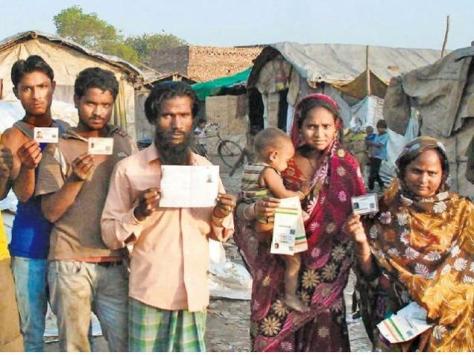
Once cut off from the electoral list, getting re-enrolled is a painful exercise for these migrants who work outside Assam. Fear of being struck off voters’ lists and branded Bangladeshis haunts them.
This time around (2016 Elections) BJP has managed to come to power in Assam, though as a coalition with its allies. Its vote share this time came down to 29.5% from the earlier 36.5% (2014); still because of the strategically stitched alliances it beat the Congress in the number of seats won. BJP election appeal was centered on the divisive issue of Bangaldeshi immigrants. It took care to regard 3% native Muslims on the ground of ‘Native Assamese identity’ while the Bengali Muslims (32%) were singled out as immigrants; outsiders. The Bengali immigrant Hindus were projected as refugees. BJP’s propaganda was on the lines of Hindus versus Muslims. Cleverly it was presented as natives versus outsiders.
Elections 2016
Taking recourse to communal historiography the election was presented as the second battle of Saraighat, where Lachit Burfukan had defeated the Mughal army in 1671. As such the many commanders and soldiers of Lachit were Muslims also like Bagh Hazarika. Mughal army had many Hindu generals and soldiers. By spinning the tale directed against Mughals projected in the form of Badruddin Ajmal, who was the main target as he was presented as a symbol of Bengali Muslims. At electoral level the Muslims votes got split between Congress and Ajmal’s party. Now the new Government is planning to identify the Bangaldeshi immigrants and throw them out. As such Assam has been witnessing the harassment of Muslims and many of them have been denied voting right putting them in D Votercategory (D for doubtful). Continue reading Assam Election Results 2016 – Challenges to Pluralist Ethos: Ram Puniyani→
In an online documentary archive called Delhi Digest, Saleem Shakeel, founder of an e-waste recycling company in the city, speaks to the camera about e-waste. The setting is familiar. Mr Shakeel sits on the single chair in what looks like a small, partially built room of exposed red brick. There are piles of objects which, like the room itself, appear used or discarded. If you conjured up an image of “informal” and “waste,” this is pretty much what you think of. Ashish Nandy would perhaps describe an outsider’s view of it it as he once did for the way we see the “slum”: all that stubbornly refuses to bow out of modernity’s way. It’s hard to imagine technology here, let along big data or smart solutions.
Yet as Mr Shakeel speaks, it is precisely technology and data that flood your mind. He describes how e-waste circulates through circuits and geographies in the city that we rarely see. Sophisticated flows of work and labour are ready when the computer comes, each finely skilled and discerning. Different workers take the different parts – CPU goes one way, the keyboard another. They break further: mother boards, drives, power supply, wires, the iron, the gold chip. Every last bit is used, and its use is determined by the current market’s daily prices. No two days, says Mr Shakeel, are the same; you have to know, and you have to be ready to adjust. Information – that less glamourous cousin of “data” – flows quickly, endlessly, in many modes and forms. The circuits are opaque, but they work.
The recent “Toppers” scam in Bihar has served as a breeding ground to denigrate Biharis for their alleged corruption and backwardness. This is not the first time that Bihari bashing has surfaced as a favourite pastime of the self-indulgent elites of India. In fact, it is a continuous process with its periodic shifts. Ironically, the people who abuse people for the belief that India has gone intolerant and the people who denigrate Bihar constitute largely the same set of people reflecting the illusory, self-satisfying belief of Indian superiority and the unsuitability, other-worldliness of Bihar to suit that image of India.
Most of the trending stereotypes about Bihar, thanks to social media, seek to gain its legitimacy under the cloak of backwardness in Bihar. What is missing in the entire brouhaha and the mockery of Biharis is an attempt to delve into the processes that operate beneath the backward nature of Bihar.
One of the stark reasons, which the article would focus upon, for the alleged backwardness is that Biharis have failed to forge a concrete sub-national identity which can infuse a sense of provincial ownership over the region. It is no surprise then that elites of Bihar often hate to be termed as Biharis and, in fact, actively take part in Bihar bashing. They even go to the extent of denying their roots and to vindicate that they come up with different kind of explanations and excuses to distance themselves from the ignominy of being a Bihari. They cower down to the societal pressures of conformity so that they can live a relatively comfortable though pride-less personal life. They use English or for that matter, Hindi – both hegemonic languages – to show their progressive nature. It is an index of the lack of sub-national identity that neither of the official languages of the state, Hindi or Urdu, is the mother-tongue of a single major population group. This is despite the fact that there were languages like Maithili, which had their own literary heritage – and this leads to isolation and disillusionment to the people who do not share the language of Hindi. Continue reading Bihari Bashing and ‘Backwardness’ – A Case for Bihari Sub-Nationalism: Mayank Labh→
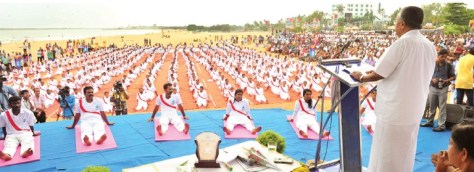
There are many ways in which ‘saffronization’ is being carried out at various levels. It takes the form of virulent battles at one extreme and persistent soft-campaigns at the other. It really does not require deep skills in socio-political analysis to see this entire spectrum of insidious divisive politics – all of that are in the clearly visible band. Surprisingly, the CPI(M) seems to have taken the attitude of a friendly match when it comes to certain variants of soft-saffronization, pretending not to see what is going on behind often innocuous-sounding things like Yoga – the latest weapon being deployed in the saffronization campaign. Instead of questioning the premises of this misplaced ‘national celebration’ and its belligerent imposition that defines the Modi government move, the party has chosen to play a friendly match by wholeheartedly joining the soft-saffronization race.
Pinarayi Vijayan at CPI-MK’s Yoga event
The CPI(M, Kerala syndicate) has, in many ways, outperformed the RSS in Kerala so much so that the hyper-active media in Kerala had very little to report on how BJP and RSS celebrated yoga day in God’s Own Country. It seemed the Sanghis were pleasantly surprised at the saffronization of the CPI(M) itself! May be, the CPI(M) is gloating over how it out-smarted the Sanghis at their own game but that is not how it works in the world of everyday politics. For their part, the Sanghis could find nothing to object to in the way the new government in Kerala celebrated yoga. It seemed the Gods came to the CPI(M) party headquarters to pay obeisance to the newly enthroned in their glorious new clothes, new language, new style, new gait, new approach, and, of course, some inklings of a new, disquieting politics.
Recently, I received the opportunity of a lifetime when I was invited to attend Indian Prime Minister (PM) Modi’s address to the joint session of US Congress on June 8th, 2016. When I got the call from Congressman Nolan’s office, I was surprised to say the least. I am not involved in politics, I did not know Rep. Nolan personally, and have not made any significant monetary contributions to politics in either country. My first reaction was to say no, because PM Modi and I could not be further apart on the political spectrum. But soon the significance of what had happened dawned on me. I, an Indian American, an academic, had just received an invitation from a US Congressman who knew about my work and had picked me to be his guest. As a minority in both countries, a Christian minority in India and an ethnic/ racial minority in the US, I was invited to a place of power which typically would be inaccessible to a person like me. Ironically, as an Indian-American I had more access to a transnational political arena than as an Indian living in India. I arrived in DC with eager anticipation not knowing what would unfold.
Attending PM Modi’s address has provided me with unique insight into transnational politics and my own identity as an Indian-American and one who is “not a Hindu”. As I was sitting in the gallery with other Indian Americans, I realized that in a post-liberalization world where political contributions flow easily across borders, Indian Americans play a huge role in the political economy of India and the message of Hindutva has become the single most powerful way to unite this group.
The term Hindutva refers to a nearly hundred year socio-political project promoted by right wing Hindu nationalist groups, which redefines people living in India as “Hindu” based on geographic, racial, and cultural identity. The Hindutva project is centered on the “invention of archaic Vedic Hinduism” and Vedic Aryanism and the belief that “…it was in India that Aryans had either originated or achieved the pinnacle of their culture and civilization which they had then bestowed on the world”. While Hinduism has been known for being a diverse religion, Hindutva’s project is to construct a homogeneous Hindu community through universalizing upper caste practices and values to all castes and classes. [1]Continue reading Hindutva Lands on Foreign Shores – A View from the Gallery: Rebecca de Souza→
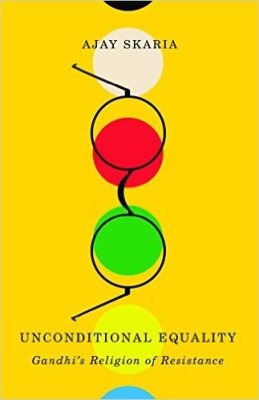
[The following is the ‘Preface’ to AJAY SKARIA’s recent book, Unconditional Equality: Gandhi’s Religion of Resistance by Ajay Skaria. The preface raises interesting questions not only about Gandhi’s politics but also about the idea/s of secularism and religion in what we might call a postsecular world – a world that is, where the naive and uninterrogated binary between the two terms is constantly put into question.Also of interest to readers might be the attempt made by the author to read Gandhi’s writings as a long and ongoing struggle to articulate or ‘understand’ his own politics – a politics that Skaria claims is as much premised on equality among humans as it is on the equality of all being/s.]
Unconditional Equality by Ajay Skaria
Somewhere in the early 2000s, while preparing to teach Mohandas Karamchand Gandhi’s English translation of Hind Swaraj to my undergraduate class, a passage about history in the text intrigued me. Since I happened to have the Gujarati version of that text at hand, I consulted it. The divergence is striking. The Gujarati text criticizes “history” (the English word occurs in the Gujarati text) and contrasts it to itihaas [usually translated as “history”]. The English text criticizes “history,” but in it there is no equivalent for itihaas; the contrast between history and itihaas is thus obscured. The gap between the Gujarati and English texts, I have since come to realize, is symptomatic of Gandhi’s struggles to think his politics. What this politics involves is by no means clear to him; perhaps he writes so prolifically and indefatigably (his collected works run to ninety-eight volumes in English) precisely in order to try and understand his own politics. This politics becomes even more intriguing when we attend not only to Gandhi as an author or “intending subject,” but to his writing.[1] By dwelling in and on the gaps (between Gujarati and English and also within each of these languages) in his writing, this book tries to draw out his politics.
For me, writing this book has been difficult also because of another gap—that between Gandhi’s insistence that there can be “no politics without religion” and the secular inheritance that I have, as far as I know, no desire to abandon. Gandhi repeatedly describes satyagraha (his most famous neologism, which he coins initially as a translation of “passive resistance”) as his “dharma” or “religion,” even as the religion that stays in all religions.[2] Symptomatic of my difficulty with this religious politics was my inability for long to even recognize it. When Vinay Lal first asked me in 2007 to write an essay on Gandhi’s religion for a volume he was planning on political Hinduism, I protested that I was not interested in this aspect of Gandhi. But with his characteristic persistence, Vinay did not accept my protests, and I ended up writing that essay, which became a precursor of this book.
In the process, my own understanding of dharma and religion as “concepts” has been transformed.[3]
The violent police crackdown on teachers’ union protests recently have spurred widespread condemnation of the government’s privatization drive, backed by repression. The following is extracted from two reports by Lauren McCauley, staff writer, Common Dreams (commondreams.org)
Oaxaca protests- teachers block highway, Mexico, (Photo: Luis Alberto Hernandez/ AP)
An initial report in Common Dreams, on 20 June 2016 reported: ‘A Mexican teacher protest against neoliberal education policies turned deadly on Sunday, with nine people killed, after police unleashed gunfire on the demonstrators’ road blockade.
According to TeleSUR, teachers from the dissident union, Coordinadora Nacional de Trabajadores de la Educación (CNTE), “had set up the blockade as part of protests over an education reform implemented by President Enrique Peña Nieto and the arrest of several of the unions’ leaders over the past week,” which they said, were politically motivated.
The attack on Raghuram Rajan spearheaded by Sangh Parivar trouble-maker Subramanian Swamy has disturbed even those who otherwise support Prime Minister Modi’s government. The attack has received even more attention because it preceded Rajan’s surprise announcement of his departure from the Reserve Bank of India (RBI), prior to the government’s decision on whether he should be given a second term. It is clear from his letter to the RBI’s staff announcing his decision to keep out of the race for the job as central bank chief, that Rajan would have liked to serve a second term. But sensing that he was not going to be offered the extension and could even rejected if he applied for it, Rajan chose to step down.
It would be giving Swamy too much credit to hold that his letters to the Prime Minister claiming that Raghuram Rajan was wrecking the economy, was not “nationalist” enough because of his American green card, and was a stooge of the Congress, were responsible for the latter’s decision to exit. Swamy is widely seen as a maverick, and Rajan is too smart not to know that if anything, it is the BJP MP’s credibility that has been affected. What must have irked him more is the failure of the government and the PM to stand up for him. That silence possibly explains the arrogant shift of Swamy’s target of attack to the Chief Economic Advisor, Arvind Subramanian, who is more vulnerable because of his advice in the past to the US government, calling for stronger action against India on intellectual property issues. Continue reading Of experts and politicians – The Raghuram Rajan Drama: C. P. Chandrasekhar→
31 May passed like any day in present-day Kerala – filled with the cacophony of mediocrities and expressions of greed, envy, and hate which have become the new normal. No wonder, then, that most people did not remember that this was the poet Kamala Das/Madhavikkutty/ Kamala Surayya’s death anniversary. I cannot help recollecting that I had predicted that this would happen: that people here would celebrate her death, display sickening sentimentality, and then quickly forget. In life and in death, Surayya never received the critical attention that she deserved as a thinker, nor did those interested in progressive left politics take her forays into politics seriously. In these times of despair, one must, however, turn to her …
The police investigation about the bomb blast at the Kollam Collectorate on 15 June 2016 has now turned against us. Neither the organization nor its activists have any involvement in this incident. The accusation against us is just a ploy to use draconian laws such as the UAPA to destroy dalit-adivasi resistance.
The demeaning and enslaving social norms in Kerala have, since centuries, denied dalit people the most basic human rights such as the right to education, the right to decently clothe one’s body, the right to travel on public roads, and express one’s views. But India became a democracy that aimed for social democratisation, and Dr B R Ambedkar raised the possibility of social equality and reservations for the underprivileged groups through the Indian Constitution. Yet, sixty-five years later, the classes fundamental to this society have made no social, economic, or cultural progress and they continue to endure caste slavery and and exploitation in all areas of public life. The mainstream political parties who surfaced as the protectors of these classes have never offered them complete protection at any time. Though they have been faithful followers and workers of these parties, members of the disadvantaged groups have had little economic security; they have lacked social education; they have had to cry out for tiny parcels of land. Continue reading Stop Trying to Portray Us as Extremists: Dalit Human Rights Movement→
“Woh kam-jaat ladka hai. Phir kaise uske saath bhag gayi? Sochna tha na pehle?” (He is a low-caste boy, why did she elope with him then? Shouldn’t she have thought of this?”)
Vimala’s judgment was unequivocal. She was talking about Hansa, her neighbour and my former ‘help.’ Hansa is a young girl , perhaps seventeen, and she recently eloped with a boy. I stopped myself from saying anything facile, as yet.
“Ab pyaar poochhke to hota nahin, “ I said to her. Love seeks no permission.
“To bhugatna bhi padta phir.” Then be ready to suffer, Vimala quipped.
She went on to tell me about an incident she had witnessed in her village, about 30 kilometers away from the big town of Dungarpur in Rajasthan. A Rajput girl and Sewak boy eloped. They settled down in some city, and ten years went by. Meanwhile the girl had a child and was carrying her second baby. Her family had managed to track her whereabouts and convinced that she would be welcome home. The couple returned to the village for a visit. One night the girl’s brother put out lights in the entire village. The young couple was killed.
“Poore gaanv ki bijli band kar di, aur maar dala dono ko. Humne dekha apni aankhon se,” Vimala said.
I stood transfixed. What was more accurate here, fiction or life? I had just returned from watching the Marathi film, Sairat.
Javadekar’s defence is that his orders are premised on complaints his Ministry has received from multiple State governments claiming that the animals are damaging farm-lands.
Construing the actions of an individual, irrespective of their arbitrariness, risks confusing the symptom for the disease. Today, Mr. Javadekar’s actions are based on an ill-informed interpretation of the Wildlife Protection Act of 1972. The Act stipulates the protection of all wild species, barring vermin. By definition, vermin include common crows, fruit bats, mice and rats. A notable exception is made when there is a direct threat to human life by wild animals, and it requires immediate intervention. Apart from these, arguably, justified reasons, the Ministry is disallowed from ordering culling of any other animal. Unfortunately, Mr. Javadekar has bypassed the existing framework, by opting to declare an entire species as vermin – the convenient route out of planned and strategized animal management.
In the second instance of what I hope will become a regular feature on Kafila, I caught up with fellow journalist and Kafila contributor Prashant Jha on the We Are Sorry Campaign for Social Reform in Madhes , where upper-caste Nepali Hindus acknowledge they have benefited from the centuries long oppression of pretty much everyone else.
In our conversation Prashant addresses the substantive and well-founded criticism of the pledge [another example of upper-castes setting the terms of debate and discourse, largely symbolic] as well as broader questions of Nepali politics and nation-hood.
He will respond to comments on this site. Let me know if there are any particular themes you would like us to explore in our new audio work. All audio files in this series are freely downloadable, and shareable – so you can download them to your phone and listen on your commute to where ever.
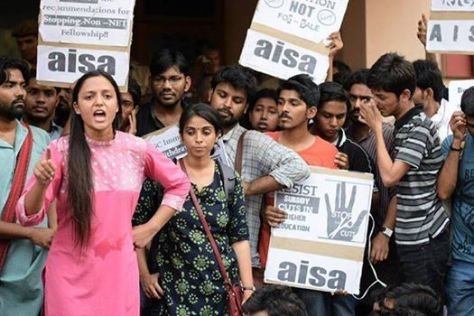
When politics decides your future, decide what your politics should be !
Shehla Rashid (AISA), Vice President JNUSU, speaks at a student protest, during the ‘Occupy UGC’ Movement
The recent government constituted panel‘s (headed by former cabinet secretary T.S.R. Subramaniam) report on student politics is unconstitutional, highly regressive and politically motivated, and signals the upcoming onslaught of total commercialisation of education and imposition of Hindutva ideology in universities. The TSR Subramaniam Panel’s report is the logical follow up to the Birla Ambani report (which was submitted in 2000), following which student unions across the country were banned. The Birla Ambani report had lamented that student unions are not allowing commercialisation of education: we accept the charge and take pride in it! We believe that education should be a right of everyone, not a privilege of a handful of people.
After three years at the Delhi University, I have been disillusioned with a lot of things. But one thing which never ceases to surprise me is the tireless effort put in by a lot of you to create something better. It is often against the system, against the apathy of the students, against the examinations which reduce texts to regressive questions. This is for you.
This is for the teachers who hated the FYUP programme, but still tried hard to create meaningful project topics for the foundational courses out of the juvenile textbooks we had, not caring about the extra correction this created for themselves. This is for the teachers who went out of their way to conduct thought-provoking discussions on “Integrating Mind, Body and Heart”, a course which had no marking. Continue reading An Open Letter to the DU Teachers from a DU Student – I Stand with You: Fatma M. Khan→
We, the undersigned, are in solidarity with Dr. Homa Hoodfar, a Canadian anthropologist of Iranian origin who has been imprisoned by the Iranian authorities on June 6, 2016. Dr. Hoodfar is a respected academic scholar and researcher on women and family in the Middle East and the Muslim world. She travelled to Iran in March 2016 to visit family and for research on women’s participation in public life.
Prior to her arrest, the Iranian Revolutionary Guard interrogated Ms. Hoodfar repeatedly without the presence of a lawyer, searched and seized her belongings including passport, phone and laptop. Ms. Hoodfar fully cooperated with the process and has been very respectful of the domestic Iranian judicial system. Since her arrest however, her family, colleagues and supporters in Iran were left with no choice but to go public with the news of the arrest.
Iranian authorities have given no reason for the arrest and the charges under which she has been held. She has not been granted access to her family or legal counsel. Dr. Hoodfar, aged 65, is not in good health and has already suffered from a mild stroke in 2015. Her family is concerned about her health and fears she may not have access to the specialized care that she requires. Continue reading Indian Feminists In Solidarity with Dr. Homa Hoodfar→
स्मशान में कवि सम्मेलन और वह भी अमावस की पूरी रात।
पिछले साल के अन्त में पुणे से आयी इस ख़बर की तरफ बहुत कम लोगों का ध्यान गया था। ( देखें इंडियन एक्स्प्रेस 14 नवम्बर 2015) उधर शहर में लोग दीपावली मना रहे थे और वहां सैकड़ों की तादाद मंे एकत्रित लोगों के बीच कविताएं पढ़ी जा रही थीं, एक कविता संग्रह का विमोचन भी हो रहा था, कुछ सांस्कृतिक समूह भी बीच बीच में अपनी प्रस्तुतियां दे रहे थे। पुणे के उपनगर बोपोडी की स्मशानभूमि का परिसर उस अलग ढंग के कार्यक्रम का गवाह बना था।
‘अमावस्या की पवित्र रात में स्मशान में कवि सम्मेलन’ शीर्षक से आयोजित इस कार्यक्रम के मुख्य आयोजक थे , महाराष्ट्र अंधश्रद्धा निर्मूलन समिति – जिसके निर्माण में शहीद विचारक डा नरेन्द्र दाभोलकर ने पहल ली थी – तथा सिद्धार्थ संघ और सिद्धार्थ महिला संघ। समिति के सदस्यों द्वारा गाया एक गीत काफी चर्चित हुआ, जिसके बोल थे ‘बो रहे हैं हम प्रकाश बीज’। भूतों-प्रेतों के ‘अस्तित्व’ या उनके ‘विचरण’ को लेकर समाज में व्याप्त भ्रांत धारणाओं को चुनौती देने के लिए अंधश्रद्धा निर्मूलन समिति के बैनर तले आयोजित इस कार्यक्रम ने बरबस कुछ समय पहले कर्नाटक के बेलागावी सिटी कार्पोरेशन के अन्तर्गत आते वैंकुंठ धाम स्मशान में हुए एक अन्य आयोजन की याद ताजा कर दी थी, जहां कर्नाटक के उत्पादनशुल्क/एक्साईज मंत्राी जनाब सतीश जरकीहोली ने सैकड़ों लोगों के साथ वहीं रात बीतायी थी अंौर वहां भोजन भी किया था। याद रहे कि महाराष्ट्र की तर्ज पर कर्नाटक विधानसभा में अंधश्रद्धा विरोधी बिल लाने में अत्यधिक सक्रिय रहे मंत्राीमहोदय दरअसल लोगों के मन में व्याप्त इस मिथक को दूर करना चाहते थे कि ऐसे स्थानों पर ‘भूत निवास’ करते हैं। Continue reading रौशनी के बीज बोने का माददा – ‘अंधविश्वास उन्मूलन’ पुस्तकत्रयी के बहाने चन्द बातें →




 KAFILA - COLLECTIVE EXPLORATIONS SINCE 2006