An ‘Anti National’ Response from JNU to the ‘Nationalist’ RSS: Pratim, Gargi and Lenin

Guest Post by Pratim, Gargi and Lenin.

As writers, historians, scientists, film makers, poets, actors and others return their awards in protest against the rising intolerance and anti-rational climate in this country, we in JNU keep stocking up accolades of a different kind. These accolades are ones which are very generously gifted to us from the RSS and its affiliates. These accolades come in more than fifty shades, only highlighting the deep seated trouble that these folks have in seeing this University up to them, despite their attempts to tarnish it. A few days back the ever-so-absurd/islamophobic/irrational Subramaniam Swamy endowed JNU students with the honours of being ‘Jehadis’, ‘Naxal’ and ‘Anti-National’.

Continue reading An ‘Anti National’ Response from JNU to the ‘Nationalist’ RSS: Pratim, Gargi and Lenin

Matters of the Mind and the Agrarian Political Economy in Eastern Maharashtra: Pronoy Rai

Guest post by PRONOY RAI

I interviewed Santosh Daune (name changed), a landless agricultural laborer in the interior drylands of Yavatmal district in Maharashtra last week for my dissertation research. Santosh’s village is about 15 kilometers away from the main road in Yavatmal, 25 kilometers from the nearest Public Health Center, and the nearest railway station is about 90 kilometers away (or two and a half hours by bus). I met with Santosh, who is around 50 years old, at his home – a one room and one kitchen set – built right next to his father’s two-room house in the dalit basti in his village. I wanted to understand Santosh’s views on changes in the village resulting from increased labor migration over the last couple of decades. A lean man with a head full of grey hair, Santosh spoke some Hindi and fluent Vidarbha Marathi. Santosh was unsure about his response to my questions. He wasn’t shaking but he seemed nervous, in a basti where dalit villagers didn’t mind pulling me in to their homes in a hope that I would let the state government know about poverty in the village. I would perhaps be more convincing than the villagers to implore the state government to address extreme poverty in the village.

Continue reading Matters of the Mind and the Agrarian Political Economy in Eastern Maharashtra: Pronoy Rai

Statement by Academics Against Intolerance

In light of the recent spate of killings of noted writers and intellectuals M M Kalburgi, Govind Pansare, and Narendra Dabholkar, and the Dadri lynching incident followed by forced nation-wide attempts at cultural policing, we feel that the current political dispensation headed by the Prime Minister is mandating an atmosphere of violence and fear. Continue reading Statement by Academics Against Intolerance

जो पहले नहीं हुआ: किशोर कुमार

Guest Post by KISHORE KUMAR

लगभग चालीस लेखकों के पुरुस्कार लौटाने के बाद अब फिल्म निर्देशकों ने भी पुरुस्कार लौटने शुरू कर दिए. यह पुरुस्कार बढती असहनशीलता और अभिव्यक्ति की स्वंत्रता के दमन के विरोध में लौटाए जा रहे हैं.

बी.जे.पी की राय में यह राजनीति से प्रेरित कदम है और यह सब बी.जे.पी के खिलाफ हो रही साजिश का हिस्सा है. बी.जे.पी के अनुसार आज कुछ ऐसा नया नहीं हुआ जो पहले ना हुआ हो और इन लोगों ने उस समय यह पुरूस्कार वापस क्यों नहीं लौटाए? बी.जे.पी. के अनुसार पुरुस्कार लौटना छदम धर्मनिरपेक्ष लोगों का नाटक है और  असहनशीलता इतनी नहीं बढ़ी और माहौल इतना ख़राब नहीं हुआ कि इतना शोर मचाया जाए. Continue reading जो पहले नहीं हुआ: किशोर कुमार

A Dalit Employee’s Death and Its Aftermath – in a Central University: Solidarity for Amar Singh

The following is a guest post by SOLIDARITY FOR AMAR SINGH

We are writing this quite late. On 27 July 2015, a Monday, a young person named Amar Singh passed away in Lucknow. We came to know it very late, only on the other day, since we no longer reside in the city and, to confess, do not remain in regular touch with the happenings there. A leading Hindi daily’s Lucknow edition had reported this death two days later in a small column which we have just recovered. The report provided information about his father as well as about his native place, Faizabad. Though the daily did not state his caste in its description of what could be discerned like an accident, it made a note of his name, his age, his father’s name, and the job he was doing. But we knew Amar’s background. Amar was a dalit. He was Hela by caste and hailed from a poor family. His death could well be an accident, though what exactly happened remains mysterious. People who know a little about the incident are however emphatic that it was not suicide. But what appeared very intricate is how his death was reported and how the whole incident was handled since then, in the well-known public spheres—not only of Lucknow but also of other places.

The daily, Dainik Jagran, indeed reported it on 29 July 2015, stating that on Monday night at Nishatganj, a young man passed away under mysterious circumstances, and that he was a sanitation worker at the Moti Mahal lawns. It also informs that his relatives had asked for an investigation by the police. The report reads further like this: “Originally from Faizabad, the son of Ram Ratan, Amar Singh (23) had gone to his employer’s house at Nishatganj on Monday. Soon after leaving the premise there, he was found on the road in a state of unconsciousness. The passersby took him to a private hospital where he passed away.” The report ends there. It had appeared as an insignificant column at the left bottom of page 9 of the daily, with one of the most common headings one can come across, “a young man dies under suspicious circumstances”. But who was this employer here? Who were the passersby? Continue reading A Dalit Employee’s Death and Its Aftermath – in a Central University: Solidarity for Amar Singh

What Communal Attacks And Our Own Blindness have Cost Us: Thoughts for Malayalees on the Eve of Panchayat Elections

On the eve of the panchayat elections in Kerala, I can’t help noticing how different it has been this time. Every time, the build-up to voting day includes heated debates about the state of the local bodies and discussions on the promises made by political parties. Not that it was completely absent this time, but somehow it appeared that such questions were hardly on people’s minds. The coming of decentralized governance in the mid-1990s divided the political field in Kerala into two:  ‘local governance’ and ‘high politics’ involved very different conceptions of power, authority, and agency. Welfarism, now also reimagined in terms of self-help, was moved into the former, while the latter remained the more decisive arena of political activity and authority. However, given that the space on local governance was crucial to the poor in that welfare entitlements flowed through it, it remained a key area of public concern. Over the years, from Plachimada to Vilappilsala, the local bodies even seemed to form sites around which resistance to top-down destructive ‘development’ could take shape. Each election was an opportunity to take stock of this large network of institutions which despite all the flaws remained quite decisively important to the lives of the poor in Kerala. In fact, it is worth noting that the elections were the occasions in which the better-off sections paid relatively more attention to local bodies and even set aside their cynicism and reluctance to engage. Not so, this time, I can’t help feeling. Continue reading What Communal Attacks And Our Own Blindness have Cost Us: Thoughts for Malayalees on the Eve of Panchayat Elections

My name is Ajmal: Ajmal Khan A.T.

Guest Post by AJMAL KHAN A.T.

What is your name?

Ajmal,

Ohh…Ajmal Kasab?

No, I smile.

This is a familiar exchange for me, not to mention my friends often  calling out to me,  hey, Kasab!

I noticed this started  in Mumbai post 26/11, of course.

But there are other instances.  Once, while I was traveling by train from Mumbai to Kerala, a man who was in his mid 50s with whom I was sharing a seat, asked while I was about to get down at the Calicut railway station, ‘boy what is your name?’ I replied – my name is Ajmal. A cute little boy, around 9 years old, who was traveling with him, responded with  Ajmal Kasab?

I somehow managed to smile and say, no my dear. I got down at my station. Continue reading My name is Ajmal: Ajmal Khan A.T.

Can accessibility alone create an inclusive society for persons with disability? Tony Kurian

Guest Post by TONY KURIAN

Amidst the noisy campaigns of “Make In India and Digital India”, a campaign called “Accessible India” was launched by the Central Government recently and unsurprisingly this did not catch much media attention. Department of Persons with Disabilities, Ministry of Social Justice & Empowerment has launched the Accessible India Campaign (Sugamya Bharat Abhiyan), as a nation-wide flagship campaign for achieving universal accessibility for Persons with Disabilities.

The campaign is an extremely welcome initiative in a country like India which is home to more than 2.1 million officiallyrecognized disabled and a lot more who are not counted by the decadal exercise of census. While the campaign disserves much appreciation, it offers an appropriate opportunity for us to rethink some of our common sense, or at least that of majority about disability and disabled. Continue reading Can accessibility alone create an inclusive society for persons with disability? Tony Kurian

Sursuri: Swaang

SWAANG is a Mumbai based cultural group, whose members include actors, writers, directors, singers and composers primarily working with the Hindi Film Industry in Mumbai. The members come from different parts of India and have been associated with progressive arts in the past.

Sursuri, their melodious new song, its melody in stark contrast to the bitterness of the lyrics, reflects on the indifference to growing injustice and intolerance in our country. It asks – What do you do when freedom, pluralism and rationalism are under relentless attack? Relax, don’t speak up, slurp up that hot tingling tea…and fall asleep.

Why the Ban on Cow Slaughter is not Just Anti-Farmer but Anti-Cow as Well: Sagari R Ramdas

SAGARI R. RAMDAS writes in The Wire:

The recent killings of Mohammad Akhlaq, Noman and Zahid Ahmad Bhatt on the claim that they were slaughtering cows is not only an attack on the right to life, livelihood and diverse food cultures but an assault on the entire agrarian economy.

The cynical fetishisation of cows by Hindutva politicians is not only profoundly anti-farmer but, paradoxically, also anti-cow.

What these bigots fail to realise is that the cow will survive only if there are pro-active measures to support multiple-produce based cattle production systems, where animals have economic roles. The system must produce a combination of milk, beef, draught work, manure and hide, as has been the case in the rain-fed food farming agriculture systems of the sub-continent over the centuries.

In meat production systems – whether meat from cattle, buffaloes, sheep, goat, pigs or poultry – it is the female which is reared carefully in large numbers to reproduce future generations, and the male that goes to slaughter. It is only the sick, old, infertile and non-lactating female that is sold for slaughter. In every society where beef consumption is not politicised, farmers known that eating the female bovine as a primary source of meat will compromise future production, and hence they are rarely consumed.

Read the rest of this article here.

The Polariser is peddling a lie that could lead to a civil war. And yet we’re silent.

(First published by Catchnews on 29 October,2015)

The man has spoken yet again. If the liberals keep complaining even after this about his silence, they should go and get their ears checked.

He speaks again and again, but they do not hear him. Is it just their old ‘secular’ embarrassment that prevents them from accepting what he has been saying all along in his own voice?

This time, the mobiliser, or polariser, tried to give an anti-Muslim spin to the reservation debate. He told his audience that there was a conspiracy being hatched by Lalu Prasad and Nitish Kumar to snatch away the quota of the Extremely Backward Classes and Scheduled Castes, and give it to a particular community. He left the community unnamed. Continue reading The Polariser is peddling a lie that could lead to a civil war. And yet we’re silent.

The meaning of the sports bicycle: Sanjay Srivastava

Guest post by SANJAY SRIVASTAVA

Our public life is full of vacuous gestures that seek to define public good. The rise of the elite-class bicycle as a symbol of mass welfare is the latest in the addled and self-serving history of ‘ordinariness’ in the republic.

car

TOI photo: Sanjay Sekhri

Over the past few years, the sports bicycle with bells and whistles and its rider whose riding gear might cost more than a month’s salary paid to a professional car driver have become icons of an urban renewal movement. We so perfectly walk in the footsteps of meanings borrowed from elsewhere that we erase our own imprints. Does the fancy bicycle – the kind sported by Arvind Kejriwal in his Dussehra Car Free Day  ride in Delhi —  hold the key to a improved urban environment characterised by reduced pollution levels and, more importantly, ease of access for the city’s most disadvantaged populations? Far from it. For, even our gimmicks are of the cruellest kind.

Continue reading The meaning of the sports bicycle: Sanjay Srivastava

Knowledge and Innovation for a Better Society : Ravi Sinha

An Address to the Students of Gokhale Institute of Politics and Economics, Pune, India

Guest Post by Ravi Sinha

It should be a matter of no small comfort if, in today’s world and in today’s India, any discussion takes place anywhere about the relationship between knowledge and innovation on the one hand and the prospects for a good society on the other. It is greatly more satisfying and reassuring if this topic interests talented young minds such as present here, who, I hope, also nurse hopes for a better future, not only for themselves but also for the entire society and civilization. Yours is an esteemed institution with such a long history of cultivating and disseminating knowledge about society – about politics, economics and other related disciplines. I am sure this issue has been a core concern right from the inception of this institute, and I doubt if I will be able to bring in anything of added value. But, as I said, this is always a welcome topic for discussion. I am very happy for this opportunity to share some of my thoughts with you.

Today if one mentions these two words – knowledge and innovation – together, it is very likely that the image of a Mark Zuckerberg or Steve Jobs or Bill Gates will come to mind, even if such an association is not obvious to everyone. I, for one, often need to tell myself that I should not complain. After all, these gentlemen are symbols of one of the greatest technological revolutions humanity has experienced and we are living through. It has changed the way humanity works, communicates and lives, and it is not over yet. Unrealized potentials far outweigh the realized ones and far greater changes are in the pipeline. Physicists have recently discovered that the Universe now expands at an accelerated rate, but when it comes to accelerated expansion into the unknown, the Universe appears to be no match for technology.

For many the technological explosion is a cause for unadulterated excitement and a source of unbounded hope. For many others it is a cause for grave concern. There are yet others for whom it presents a mixed picture. In times of rapid and radical transformations, it is not unusual for many to have a sense of unease. Humanity has always innovated and created new ways and forms of life, and it has always found it difficult to adjust to its own innovations and creations. But the capacity to adjust improves with time. If the sense of unease or consternation appears widespread despite a greatly improved capacity for adjusting to the new, part of the reason lies in the break-neck speed of the current change. Continue reading Knowledge and Innovation for a Better Society : Ravi Sinha

Protest the communally motivated murder of Yakub Shaikh in Mumbai!

A CALL FOR PROTEST on 29th October 2015 outside Toyota Shinrai, Cotton Green, Mumbai.

On 29th September at 2:30 pm,  a day after Dadri lynching in Uttar Pradesh, Yakub Shaikh, a worker at the Toyota Shinrai workshop cum showroom at Cotton Green, Mumbai, was brutally murdered at his workplace. The murder took place as a result of some of his co-workers forcefully inserting an air pipe at 140 PSI pressure into his rectum. His organs burst open leading to what must have been a painful but instant death. The gruesome `lynching’ was sought to be suppressed by the management and co-employees at the showroom.

His family was misinformed throughout, the various versions of the death being told  to them as “heart attack”, food poisoning, medicine overdose and finally “a prank”, by the company and police. The two CCTV cameras covering the spot of murder were reported by the Toyota Shinrai management to police as having been out of service for months, whereas a close inspection shows that they have been tampered with and damaged very recently. Clearly there seems to be an unholy nexus between the police and the Toyota company.

The police have recorded the statement of an 18-year old temporary worker as the complainant and registered an FIR in his name. Why wasn’t the  management made the complainant? In a large workplace where 40-50 people work, why were the statements of co workers not recorded? The single witness / complainant is likely to  turn hostile at any moment. Why have the police refused to accept the version from the victim’s family? Why has the management given different versions of the death to the family? Why the management wanted to give a false story of heart attack, and why the police ACP was trying to do a negotiation for 3 lakhs? Why was there a delay in doing post mortem? The management’ s false heart attack story and the delay in deciding on post mortem itself warranted demand for charging/implicating the management in covering-up/destroying evidence, if not conspiracy with the murderers.  Does not a single arrest to such a gruesome murder point to a conspiracy and a deliberate attempt by the police to shield the Toyota Company and the other accomplices to the murder? Throughout, the police have taken every possible step to silence the victim’s family.

A fact-finding team of lawyers and activists from various organizations have submitted a report after their own investigation that a minimum of 5-6 people were involved in pinning down Yakub Shaikh and inserting the air pipe into his rectum. It is clearly a case of pre-planned murder. The murder also happened a day after the Dadri lynching soon after Eid and Yakub Shaikh had been threatened for having eaten `meat’.

A month after the murder of Yakub Shaikh, the police and management are singing in chorus that Yakub was killed because of a prank that misfired. We concerned citizens strongly condemn the murder and demand that the officials of Toyota Shinrai showroom along with the employees responsible for the murder be booked and justice be given to the family of Yakub Shaikh.

We appeal  to all democratic citizens, trade unionists and secular activists to gather in large numbers at 5 pm on Thursday, 29th October . We will gather at Lal Maidan and from there we will proceed to Toyota Shinrai as a sign of protest against the gruesome murder of Yakub Shaikh to demand justice for the victim and his family.

CPDR, BBA, JKA and concerned citizens.

Girl, Get Back your Dignity NOW: Indulekha Writes to Sumathikkuttyamma

Dear great-great granddaughter Sumathikutty

I am sure you never expected this missive. Yes, you may even think it impossible. But here am I, writing to you, from the other side of J Devika’s computer screen at which she is staring now, mouth open and goggle-eyed, right now. I don’t have to introduce myself – most Malayalees know me as Chandu Menon’s Soul-Daughter, and the Grand (Old) Lady of Modern Kerala (alas, some of the youngest know of Indulekha hair oil only!). Continue reading Girl, Get Back your Dignity NOW: Indulekha Writes to Sumathikkuttyamma

Delhi Police Tells Lies about Attacks on Protesting Students – #OccupyUGC

[ Video Footage, courtesy Akhil Kumar, taken from his Facebook Page ]

The ongoing movement to #OccupyUGC by students from all the universities in Delhi has so far seen two instances of vicious attack by the Delhi Police. Students were manhandled, abused and badly beaten with sticks and batons. Several had to be hospitalized and some are severely injured. However, police officers have been lying about their actions.

The Indian Express reported the lathi charge and also quoted a senior police officer – DCP (Central), Paramaditya as saying, “Around 45-50 protesters were detained. No one was lathicharged. Policemen did not have lathis… the protesters attacked and injured policewomen.”


Post on Akhil Kumar's Facebook Wall
Post on Akhil Kumar’s Facebook Wall

Here is a series of videos shot by Akhil Kumar, a young independent photo-journalist (who was himself severely beaten after this). This footage clearly shows up DCP (Central) Paramaditya as a liar.

Meanwhile, #OccupyUGC continues.

Remove ban on food items like beef and meat

Sign the petition posted at Change.org by SANKET CHHABRA

I am a Jain vegetarian person, but moreover I am a supporter of free will! It started with the ban of beef in Maharashtra, but now it’s spreading, I know the government means respect for the Jain community, but if they are banning meat during our festival, should’t it also force us to eat meat during the celebration of Id, all I am asking for is for everyone to choose what they want to eat and whenever they want it! I call for support for this petition as I do not want the people of a DEMOCRATIC country to be forced into doing something they don’t believe in! Thank You to all the Governments for the respect you have given this small community of ours, but please don’t force the people with different beliefs to do the same!

SIGN THE PETITION HERE

Statement of outrage against police crackdown on students at #Occupy UGC: Faculty Feminist Collective, JNU

The Faculty Feminist Collective of JNU stands in solidarity with the students protesting the revocation/review of the UGC non-NET fellowship. We are outraged at the brutal police action against students gathered in a protest demonstration since yesterday, without a single convincing response from the UGC or the MHRD that could allay the anxieties of thousands of students across India that the non-NET fellowship will not be discontinued. Prevarication on this basic demand by press releases announcing the setting up of a review committee has only indicated a malafide intent.

We are deeply dismayed to hear of the reports of significant injuries to unarmed protestors and the detention of a number of students by the police until late last night.

The MHRD Minister and the UGC Chairperson should understand that the situation can only be defused by their unequivocal assurance to the academic community that there shall be no rollback or any other amendment of the eligibility of students for the UGC Non-NET Fellowship scheme for the universities that are already in receipt of these fellowships in this or future academic years.

Furthermore, it should take positive and visible steps to meet students’ demands for an enhancement of fellowship remuneration and undertake to extend this fellowship scheme to state universities as well.

Education is a right, not a privilege, and as members of the academic community, we will resist all moves to subvert this basic understanding.

We fully endorse the JNUSU’s call for a strike, and in protest at state action and in solidarity with students, we will not be taking classes today.

The students have returned to UGC. Let us assemble there to show that we stand with them.

Statement by Artists, Curators and Critics Against Rising Intolerance in India

Text of a Statement by Artists, Curators and Critics in India against a Climate of Rising Intolerance in India

(Followed by Names of the 300 + Signatories, in Alphabetical Order)

The artist community of India stands in firm solidarity with the actions of our writers who have relinquished awards and positions, and spoken up in protest against the alarming rise of intolerance in the country. We condemn and mourn the murders of MM Kalburgi, Narendra Dabholkar and Govind Pansare, rationalists and free thinkers whose voices have been silenced by rightwing dogmatists but whose ‘presence’ must ignite our resistance to the conditions of hate being generated around us.

We will never forget the battle we fought for our pre-eminent artist M.F. Husain who was hounded out of the country and died in exile. We remember the rightwing invasion and dismantling of freedoms in one of the country’s best known art schools in Baroda. We witness the present government’s appointment of grossly unqualified persons to the FTII Society and its disregard of the ongoing strike by the students of this leading Institute. We see a writer like Perumal Murugan being intimidated into declaring his death as a writer, a matter of dire shame in any society.

While the Prime Minister of the country has been conspicuously reticent in his response to the recent events, the reactions of BJP ministers in his government reveal their ignorance and prejudice. Mahesh Sharma, Minister of State for Culture, has made abhorrent comments about mob lynching and murder. His remarks suggesting that writers should stop writing to prove their point are alarming – empowered as he is to take policy decisions in the domain of culture. Arun Jaitley, Minister of Finance, Information & Broadcasting, has mocked the actions of our respected writers as a manufactured ‘paper rebellion’. He asks for scrutiny of the political and ideological affiliations of those who are protesting.

To these and other such provocations there is a clear answer: while the actual affiliations of the protesting writers and artists, scholars and journalists may be many and varied, their individual and collective voices are gaining cumulative strength. It is this that the ruling party will have to reckon with: the protestors’ declared disaffiliation from a government that encourages marauding outfits to enforce a series of regressive commands in this culturally diverse country.

The scale of social violence and fatal assaults on ordinary citizens (as in Dadri, Uttar Pradesh; Udhampur, Jammu and Kashmir; Faridabad, Harayana) is escalating. The contemptuous comments about the religious minorities and Dalits made by those within the government confirm that there is little difference between the RSS-BJP mainstream and supposed ‘fringe’ elements. The perfunctory warnings and regrets issued by ruling party ideologues – to defend the agendas of ‘development’ and ‘governance’ advanced by Mr Narendra Modi – are merely expedient. The Sangh Parivar and its Hindutva forces operating through their goon brigades form the support base of this government; they are all complicit in the attempts to impose conformity of thought, belief and practice. Continue reading Statement by Artists, Curators and Critics Against Rising Intolerance in India

BRUTAL CRACKDOWN ON THE STUDENTS IN Day 7 of THE #‎OccupyUGC MOVEMENT in Delhi: Kanhaiya Kumar, President JNUSU

Guest Post by Kanhaiya Kumar, President, Jawaharlal Nehru Students Union (JNUSU)

BRUTAL CRACKDOWN ON THE STUDENTS IN THE #‎OccupyUGC MOVEMENT: DAY7

Students at the Police Barricades - #OccupyUGC
Students at the Police Barricades – #OccupyUGC

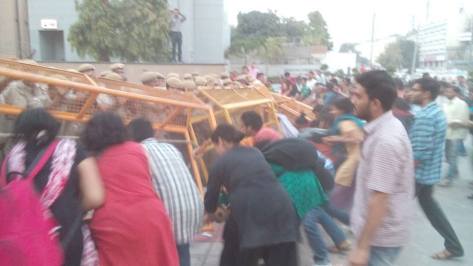
Students from JNU, AUD, DU and Jamia Milia Islamia University who were protesting in front of the UGC building, were brutally lathicharged on 27th October and 33 students have been detained. This is the second time that students have been lathicharged and detained since October 21, 2015. Students across universities in and beyond Delhi initiated the #OccupyUGC movement protesting against UGC’s decision to discontinue non-NET fellowships, refuse any enhancement and introduce ‘merit’ and ‘income’ criteria in allocating fellowships to research scholars. In today’s lathicharge, one student was hospitalized in critical condition, female protestors were mishandled by male police, they were abused verbally and many have been seriously injured.

This slideshow requires JavaScript.

JNUSU condemns the brutal lathicharge/crackdown against the protesting students by the Delhi Police and appeals to common citizens to support the cause of the ongoing #OccupyUGC movement.

Kanhaiya Kumar is President, JNUSU

The Move to Professionalise Research: Aswathy Senan

This is a guest post by ASWATHY SENAN

Researchers all over the country are protesting the move by the UGC to scrap the non-NET fellowship and students have gathered in hundreds to resume their agitation at the UGC office through OccupyUGC. it appears that one should be clear about what the student reaction means: it is much more than as a demand for monetary benefits. The student mobilization happened after the committee that met at the UGC office in Delhi to discuss and increase the non-NET fellowship, decided to scrap it. Following the protests that lasted through the nights from 21 October, the Minister of Human Resources Development tweeted that the fellowship shall be continued leaving out one crucial detail: its availability to new students. This decision to end all financial support of researchers doing their MPhil and PhD until they qualify NET or JRF is a huge threat for the research community in India as this is a clear move to professionalise research and make it a mere add on to teaching career. Continue reading The Move to Professionalise Research: Aswathy Senan

DISSENT, DEBATE, CREATE