Muzaffarnagar Baaqi Hai – Critical Readings Online and Offline: Akash Bhattacharya and Arif Hayat Nairang

These are guest posts by Akash Bhattacharya and Arif Hayat Nairang

The film Muzaffarnagar Baaqi Hai has been in the news recently, and not always for the right reasons, having attracted disruptive and abusive protest at some screenings. Following a day of counter-protest in which the film was screened all over the country, a friend teaching in a Delhi University college suggested screening it in her college, only to be told by the student representative that it would “cause trouble” (“bawwal mach jayega ma’am!!”). She asked what that meant and if he had seen the film, and he simply said, “nahin, bhaiyya logon ne kaha hai ki woh film bahut buri hai” (No, but our elder brothers have said it’s a bad film). 

In an atmosphere where political self-censoring comes as easily to the current generation of students as scouring the net for “blocked content” we present below two readings of the reception of the film, the first ruminating on whether the film addresses the complexities of communal mobilisation adequately; and the second inquiring in the context of social media and particularly Facebook, what constitutes the ‘liking’ of an image or idea. The idea of posting these comments is as much to give space to these arguments as it is to make a larger point that the ‘sickular left’ voices that are presumably behind the film love discussion, critique and disagreement. That to my mind is the way forward, not pre-empting the always-already hurt sentiments of the bhaiyya log whosoever they may be.

Continue reading Muzaffarnagar Baaqi Hai – Critical Readings Online and Offline: Akash Bhattacharya and Arif Hayat Nairang

‘Cities of Sleep’: Anirban Gupta-Nigam

Guest post by ANIRBAN GUPTA-NIGAM – A Preview of SHAUNAK SEN’S film ‘Cities of Sleep

A few days ago, on its Facebook page, Business Insider India shared a series of images of Bollywood stars who had gone—plainly speaking—from “zeroes to heroes”[1]. The yardstick for what constitutes success is another matter (Mithun Chakraborty, for example, is celebrated because he progressed from being a ‘Naxalite’ to ‘India’s highest tax payer’), but accompanying the post were the following words: ‘Every great dream begins with a dreamer. Always remember, you have within you the strength, the patience, and the passion to reach for the stars to change the world’. In another words, dare to dream and you shall become all you want to be.

This simple, inspiring message is possibly more complex than it first appears to be. It contains within it a contradiction that might well be worth attending to. Specifically, the images implicitly demand that we ask who (or what) is a ‘dreamer’ today.

The famous comedian George Carlin once said that ‘they call it the American dream because you have to be asleep to believe it’. A problem of a similar order is posed by the images in question here. Taken at face value, the mantra ‘every great dream begins with a dreamer’ not only propagates an all too familiar narrative of entrepreneurial success. It also comes with a qualifier—every great dream begins with a dreamer. Which is to say, not all dreams qualify for this honor. Continue reading ‘Cities of Sleep’: Anirban Gupta-Nigam

Hindutva: A Political Theory of Nationhood?: Aman Verma

Guest post by Aman Verma

It is disheartening to see amongst supporters of Hindutva these days a silent acquiescence and at times even active support for extra-constitutional techniques being adopted by organizations like the RSS and its offshoots towards attaining the goal of Ram Rajya. An assessment is necessary of what would ultimately entail on the social, political and economic fronts if such a policy that envisages a supposedly ‘Hindu’ cultural and linguistic hegemony over cultures and languages represented by minority communities becomes reality. However, being a student of law what disturbs me more is the absence of any socio-political entity or civil society movement rooted in values of democracy that can effectively counter the impact of Hindutva organizations on the Indian social fabric. While the BJP has its RSS, every other political party claiming to be the upholder of secularism lacks its equivalent, or at the very least an effective social protégé.

Further, my personal interactions with supporters of BJP reveals that there is some deep sense of hurt and helplessness, part valid for the sake of argument, but for the most part carefully manufactured by Hindutva propaganda, which manifests itself in questions a friend recently put to me, “What are the other ways in which the Hindus can also claim their rights and send out a message that they have been too tolerant for too long?” and another which sounded like “How else to keep our dignity and identity alive in our land?”. These questions, based upon presumptions like those of “Hindu tolerance” of acts perpetrated by other communities supposedly only against Hindus and, protection of a completely vague concept of “Hindu identity” are clearly an outcome of a campaign strategy that relies upon upping the antics on the romantic-nationalist front.

Continue reading Hindutva: A Political Theory of Nationhood?: Aman Verma

Comrade Chintamani: Faridabad Mazdoor Samachar

This is a guest post from Faridabad Mazdoor Samachar (FMS), a monthly workers’ newspaper published from Majdoor Library

This appeared in Hindi in August 2015, New Series 326 and has been translated into English  by Pratik Ali and Sheena Jain.

In the early hours of 31st July, Comrade Chintamani passed away.

Saathi Chintamani was born in the village Mustafabad Saraiyya of Kadipur tehsil, Sultanpur district in eastern Uttar Pradesh. He studied till class 12th. Rejected tempting offers for converting to another religion, he joined as an impounding official in the Department of Agriculture, Uttar Pradesh government. While he was on duty once, realizing dues, he thrashed some people for insulting him over his caste. To avoid upper-caste backlash, he left his permanent job and moved to some relatives at Faridabad. After working for a month or two each at Bata, Goodyear, Dabur, Escorts, etc., he became a permanent worker in Gedore Tools. Together with the job, he was active in politics of caste of the Ambedkarite current. Long conversations with Com. Vijay Shankar of neighboring Babripur village strengthened his grip upon the new reality of having become, and of being, a wage-worker.

In 1977 wage-worker stirrings intensified greatly in Faridabad, and Saathi Chintamani was very active in them. He lent special support to the militant workers of Usha Spinning and Weaving Mill and the Bharatiya Electric Steel Factories. He was among those who left eighty unions to form Majdoor Sangharsh Samiti (Workers’ Struggle Committee). In 1979, many workers were killed in police firing in Faridabad. After internal emergency was lifted in 1977, Com. Vijay Shankar was dismissed from his job for his role in the Delhi Faridabad Textile (DFT) strikes. Wage-workers from Bata, Gedore, Poritts & Spencer, Electricity Board, Handa Steel, East India Cotton Mills, Orient Steel, Leatherite, etc. got together with Com. Vijay Shankar at Azad Nagar jhuggi (shanties) and Mujesar for collective study of Karl Marx’s book, ‘Capital’. Saathi Chintamani was among them.

Continue reading Comrade Chintamani: Faridabad Mazdoor Samachar

Cheralam to Keralam to Ketta-idam – A Report on ‘Development’ from Trivandrum, Kerala: Sriranjini R

This is a guest post by Sriranjini R.

Cheralam Sriranjani

ISIS in Syria, Al Qaeda in Afghanistan, Taliban in Pakistan, Boko Haram in Nigeria, ecological problems, climate change … the list of the world’s ‘security’ problems seems endless. India has its own share of course – the India-Pakistan conflict, India-China problems, Maoism and so on. In Kerala, police have been desperate to find ‘security threats’ of their own. They first tried hunting down a ‘druglord’ whose picture was found on T-shirts of young people suspected of drug use. His name is Bob Marley. Please give the man up if you find him anywhere. Then they tried looking for Maoists. Every state has some, how come we have so few, was their complaint. After going after thin, dark-skinned, bearded fellows, Kiss of Love activists, and sundry others, hoping that one of these will be a Maoist, finally they caught one. And he didn’t look like any threat to most Malayalis.

Continue reading Cheralam to Keralam to Ketta-idam – A Report on ‘Development’ from Trivandrum, Kerala: Sriranjini R

Allahabad High Court Order on Government Schools in U.P: Devanik Saha

This is a guest post by Devanik Saha

The judiciary in India can be highly unpredictable. Either it is accused of not doing enough to provide justice to victims or it is hailed for giving landmark judgments. In a recent controversial decision, the Allahabad High Court ordered that all children of government servants and elected representatives in Uttar Pradesh should mandatorily send their wards to government schools. It noted that “Only then would they be serious enough to look into the requirements of these schools and ensure that they are run in good condition”.

While the decision has evoked sharp reactions from UP legislators, it has been fiercely debated in the media fraternity, with mixed responses. The wretched condition of government schools (in every state) in India isn’t a hidden fact. While India has achieved impressive rates of school enrolment – the quality of education and learning outcomes – have been extremely dismal.

An analysis by data journalism portal IndiaSpend revealed that Rs 5,86,085 crore has been spent on primary education in the past 10 years and 80% of the expenditure on education is spent on teachers, but the state of affairs continue to be dreary, which has led to the mushrooming of low income private schools. The number of students enrolled in private schools in UP has risen from 32.2% in 2006 to 52.8% in 2014, according to the Annual Survey Education Report (ASER) by Pratham, an education NGO.

Continue reading Allahabad High Court Order on Government Schools in U.P: Devanik Saha

Lions, Liars and Masters of the Universe: Shrinivas Dharmadhikari

Guest Post by SHRINIVAS DHARMADHIKARI

Last month’s killing of Cecil, the 13-year-old, rare black-maned lion by American dentist Walter Palmer, was met with global outrage and condemnation. However, this foolish bravado cannot just be treated as another sign of American (or white) exceptionalism (read sickness)  because behind this is a much larger and thriving Trophy Industry.

A few facts will make the size and destructive power of this industry clear. Americans traveling to Africa make up more than 60 per cent of the foreign-participated lion trophy hunts carried out each year. This is according to John Jackson, president of the lobbying group Conservation Force. According to another scientist, Eric Jensen, a University of Warwick professor  who studies public engagement in wildlife issues, the Trophy industry caters to the human need for dominance and control of nature and provides in addition a sense of masculinity having hunted a large animal. Continue reading Lions, Liars and Masters of the Universe: Shrinivas Dharmadhikari

P.A.D.S. Statement on the killing of Prof MM Kalburgi – a sane voice against communalism and superstition

People’s Alliance for Democracy and Secularism (PADS)

Murder of another rational voice against communalism and superstition

The respected and loved Kannada scholar and writer MM Kalburgi was murdered by two unidentified men on August 30 at his home in Dharwad. The seventy seven year scholar was actively researching Vachanas literature of early Kannada and literature produced during the Adil Shahi period in Northern Karnataka. He was a source of wisdom for many students and scholars, and his killers gained access posing as students. He was also a vocal critic of religious superstitions and had been targeted by fundamentalists within his own Lingayat community and by Hindutva organisations. He had received many threats and his house had been attacked with stones and bottles. He was given police protection, which was withdrawn only days before his murder.

Professor Kalburgi’s cold-blooded murder has caused widespread shock and dismay in the literary and intellectual circles of Karnataka. Many protests involving ordinary citizens have been held in Bangalore and Dharwad. At least one Hindutva Bajrang dal activist has publicly welcomed the assassination, warned another rationalist of Karnataka, Prof KS Bhagwan of the same fate.

Prof Kalburgi’s killing comes after the murders of two other prominent critics of religious superstitions. Dr Narender Dabholkar was killed in 2013 in Pune. Trade Unionist and Communist Govind Pansare was killed in Kolhapur in February this year. There are uncanny similarities in the modus operandi of all three cases. It is likely that as in the earlier cases, the police will fail to solve Prof Kalburgi’s murder. Continue reading P.A.D.S. Statement on the killing of Prof MM Kalburgi – a sane voice against communalism and superstition

A Consummate Hanging Bares Gaping Holes in Nation State’s Democratic Facade : Sanjay Kumar

Guest Post by Sanjay Kumar

At 7AM on 30 July, 2015, the Republic of India hanged a man named Yakub Memon. By all means, though without anyone’s planning, the hanging turned out to be the endpoint of a consummate exercise. Three judges of the highest court of the land sat through the night, right up to two hours before the execution to decide on the last petition of the condemned convict. The highest law official of the central government came to put forth arguments against the petition at two thirty in the morning, while some of the most respected and best legal minds of the country argued for it. Even before this post mid night hearing, the case of Mr Memon had been through more than one round of curative and review petitions in the Supreme Court, and mercy petitions with the President of the Republic. Much earlier, in fact more than twenty years ago, the Mumbai police had carried out perhaps the most painstaking, and detailed investigation of independent India into the 12 March, 1993 blasts; cracking the case within two days and filing a 10,000 page charge sheet within eight months. The trial involving 123 accused, 684 witnesses and voluminous material evidence ran for ten years. After Mr Memon’s guilt and conviction were established by the trial court, his appeals had gone on in the Supreme Court for nearly a decade. Two years ago the then Government of India had hanged Afzal Guru, a Kashmiri convicted in the Parliament attack case, without informing his family, and refused to hand his dead body to them. Nothing of that shameful behaviour was repeated this time. What more could the criminal justice system of the country have done in the case of Mr Memon! Yet, his execution has left behind more questions on the institutional biases, and ideological underpinnings of the Indian state, than perhaps any other execution. Continue reading A Consummate Hanging Bares Gaping Holes in Nation State’s Democratic Facade : Sanjay Kumar

On keeping Open the Door that was Opened by Dr. Malleshappa Kalburgi

On Sunday morning, seventy seven year old scholar Dr. Malleshappa Kalburgi opened his door in Dharwad town in Karnataka to some people who asked for ‘sir’. They pumped bullets into ‘sir’ when he appeared in front of them. Throughout his life, Dr. Kalburgi had the habit of opening doors. His scholarship into Kannada literature opened many doors. Those who killed Kalburgi abused not just his hospitality, and his willingness to open his doors to strangers (he had asked that his security be ‘lifted’ despite threats to his life), they abused all the traditions in the world that promise kindness to strangers, and keep doors open.

Continue reading On keeping Open the Door that was Opened by Dr. Malleshappa Kalburgi

India Census 2011 – Where are the Atheists?

The consternation witnessed around release of religious figures in Census 2011 has rather overshadowed an interesting fact which has emerged through this mammoth exercise. It tells us that India has 2.87 million people who have no faith in any religion, which is around 0.24 per cent of our population. Definitely it includes not only atheists, rationalists but all those people who do not believe in any faith but some ‘unknown’ force.

Definitely it is a welcome development that the state has finally acknowledged their existence and what Dravid Kazhagam leader K Veeramani said ‘recorded their voice for the first time in the census’. but a cursory glance at earlier surveys and studies makes it amply clear that the figures are on the lower end. Continue reading India Census 2011 – Where are the Atheists?

Saving ‘Development’ From Dangerous Women Activists: Kamal Nayan Choubey

Guest Post by  KAMAL NAYAN CHOUBEY

The inclination of the Indian State to suppress any movement related to the just demands of marginalized sections has increased immensely in recent times. There is no question of dialogue. Coercive methods are generally employed to contain these movements. This is what has happened with the movement of tribal people are struggling against the Kanhar Dam in the Sonbhadra district of Uttar Pradesh. In this movement, women activists play a crucial role, and in order to contain it, the UP Police arrested two key women activists Roma and Sukalo, and six other women activists from the Robertsganj office of All India Union for Forest Working People (AIUFWP) on 30th June 2015.

DSC00028

Roma is the General Secretary of the AIUFWP.

The UP police has registered cases of inciting rioting against the women activists and it has also reopened old cases against them, particularly against Roma. Apart from them, another tribal woman activist Rajkumari was arrested on 21st April.

DSC00115

Sukalo

Continue reading Saving ‘Development’ From Dangerous Women Activists: Kamal Nayan Choubey

The Murky Fourth Estate: Asifa Zunaidha

This is a guest post by ASIFA ZUNAIDHA.

[Some time ago, I wrote on Kafila about my experience of attending a televised interaction with HRD Minister Smriti Irani. The audience, packed with supporters of the particular party Irani belongs to, was set up in that debate as the neutral ‘public’, thereby killing two birds with one stone – boosting the popularity of the Minister on news media, and legitimising the news channel as a site of punchy political debate. We have below a similar case of manipulation of the powerful medium of electronic news media, this time by another channel.] 

What is the role of the news media in a society if not to disseminate information and opinions as an impartial media(tor)? ‘Half truth is no truth’ is a popular aphorism, but ‘selective’ truth is also a lie and certainly does not befit the content of a news channel. It seems that in an age of corporate media, one would be foolish to expect impartial truths, let alone ‘undiluted or uncensored’ opinion of diverse groups. A recent episode inside the JNU campus shows how ‘news’ presented by News Channels can be easily manipulated and the opinion of a ‘select few’ is showcased as the ‘unanimous opinion’ emerging from the premier higher educational institute of the country.

Continue reading The Murky Fourth Estate: Asifa Zunaidha

जनगणना में अल्पसंख्यक : नकली डर पैदा करने की कोशिश

‘ लोकप्रिय स्तर पर लोगों के लिए इस हकीकत पर गौर करना या उसे जज्ब़ करना मुश्किल जान पड़ता है जब उन्हें बताया जाता है कि बहुसंख्यक मुस्लिम आबादी वाले इंडोनेशिया की प्रजननक्षमता (कुल प्रजनन क्षमता दर 2.6) की दर बहुसंख्यक हिन्दू आबादी वाले भारत की तुलना में (कुल प्रजनन क्षमता दर 3.2) कम है। दरअसल इंडोनेशिया में प्रजनन क्षमता में कमी को परिवार नियोजन पर कारगर अमल, जो मुल्क की स्वास्थ्यसेवाओं के साथ अभिन्न रूप से जुड़ी हैं, से जोड़ा जा सकता है। हाल के समयों में बांगलादेश में भी परिवार नियोजन के बढ़ते स्तर ने वहां की प्रजनन क्षमता को में काफी तेजी से कमी दिखाई दी।’’
/फेक्ट एण्ड फिक्शन आन हिन्दुत्व क्लेम्स, आर बी भगत, सितम्बर 25, 2004, इकोनोमिक एण्ड पोलिटिकल वीकली )

1.
जनगणना के आंकड़े एक गतिशील समाज के तेजी से बदलते परिद्रश्य को उदघाटित करते रहते हैं। आंकड़ों का यह समुच्चय नीतिनिर्धारकों को ही नहीं समाजविज्ञानियों, राजनीतिक विश्लेषकों या सामाजिक-राजनीतिक कार्यकर्ताओं के लिए एक खजाने के तौर पर उपस्थित होता है, जिसका विश्लेषण करके वह अपनी समझदारी तय करते हैं या अपने हस्तक्षेप की रूपरेखा बनाते हैं। एक सौ बीस करोड़ से अधिक आबादी का भारतीय समाज – जहां दुनिया के लगभग सभी धर्मों के अनुयायी मिलते हैं – और जो अपने उपमहाद्वीपीय आकार के चलते ; भाषाई, सांस्क्रतिक तथा अन्य विविधताओं के चलते दुनिया भर के जनसंख्याविशारदों के लिए कुतूहल एवं अध्ययन का विषय बनता है, ऐसा ही नज़ारा उपस्थित करता है।

यह अलग बात है आज जबकि दक्षिण एशिया के इस हिस्से में बहुसंख्यकवाद अर्थात मेजोरिटेरियानिजम का बोलबाला बढ़ा है और भारत के इस हिस्से के धर्मनिरपेक्ष एवं समावेशी जनतंत्र के क्षरण की कोशिशें तेज हो चली हैं हम पा रहे हैं कि जनगणना के आंकड़ों के माध्यम से अपनी संकीर्ण राजनीति को ही हवा देने की कोशिशें तेज हो रही है, और उसके व्यापक निहितार्थों पर परदा डाले रखने के प्रयास चल रहे हैैं। यह महज इत्तेफाक नहीं कि बिहार विधानसभा चुनावों के ऐन मौकों पर जनगणना के धार्मिक आंकड़ों को जारी किया गया है ताकि उसके आंशिक निष्कर्षों को सामने लाकर अल्पसंख्यकों की ‘बढ़ती आबादी’ के नाम पर बहुसंख्यकों का ध्रुवीकरण किया जा सके और चूंकि 2001-2011 के दरमियान हिन्दुओं की आबादी की तुलना में मुसलमानों की आबादी अधिक बढ़ने के आंकड़े सामने आए हैं, लिहाजा उसी को लेकर एक नए ध्रुवीकरण के फिराक में वह दिखती है। विडम्बना है कि जनगणना के जाति सम्बन्धी आंकड़ों पर अभी भी चुप्पी है, जिसकी लम्बे समय से मांग हो रही है। Continue reading जनगणना में अल्पसंख्यक : नकली डर पैदा करने की कोशिश

For a Better FB: WomeninCampaign’s Press Release

August 26, 2015

Digital rights advocates demand a revision of Facebook’s policies that perpetuate violence against women in non-English speaking communities.

On July 28th a social activist, Preetha G, was brutally slut-shamed, harassed and abused in Facebook through a page which was in a native Indian language, Malayalam. The hate pages instigated a huge degree of violence, hurled abuses at her dignity and womanhood. It contained her morphed pictures with sexually explicit abuses, targetting even her autistic son. Preetha hailing from the state of Kerala in India, has around 22K followers on Facebook and uses the platform to to express her political opinions, her ideas on gender and other minority rights.

Many users including Preetha reported the hate pages (a total of 5 pages in a span of 3 weeks) to Facebook and also to the cyber crime wing of Kerala Police. Facebook replied with a generic message stating “The post doesn’t violate community standards”. The hate pages continued to update its content with threats and abuses to the women who publicly supported Preetha. Amidst all this, profiles of several supporters, especially women were suspended by Facebook. All these, including that of Preetha was blocked stating “violation of Real Name Policy” possibly due to reporting by those cyber-criminals who started the hate pages.

As the story of violence aided by Facebook policies spread, stories emerged from other countries as well. A recent incident occurred in Peshwar, Pakistan where a similar hate campaign was unleashed towards several young women through Facebook. When this was reported by users, Facebook responded in a similar fashion with the generic message that “no community standards were violated”. These young women’s lives were put to extreme risk and their own families did not protect them.

The women in countries like India and Pakistan do not get family support and Facebook refuses to understand the cultural complexities. With respect to this context, different individuals and organizations had several conversations with Facebook, but Facebook failed to take any measures until now to rectify these.

From the generic response that Facebook provides while hate pages in non-English language is reported, it is evident that the language experts that Facebook claims to have in place, is a myth. The actions or rather the lack of actions from Facebook, make it easier for several majoritarian forces to unleash violence against women and other marginalized sections. Facebook’s flimsy community policies are putting women’s lives in danger and this platform is used as a tool to silence women and bring forth more oppression.

It is high time we collectively inform Facebook about renegotiating its policies what adhere to majoritarian forces, and initiate a global mass campaign against those policies.

We, Women In Campaign, demand the following to Facebook:

a) Right to Privacy: To get rid of the real name policy and its associated proceedings.

b) Right for protection against hate crimes: A systemized responsive system or a set of language experts for assessing hate pages in non-English languages and a timely response and follow up in such situations.

c) Right to cultural diversity: Facebook needs to understand the complexity of non-English cultures and cannot impose its American corporate colonization into other societies. It urgently needs to appoint linguistic experts who can verify hate pages and understand regional languages and it nuances.

On Tuesday Aug 18th 2015, an online meeting was held with representatives from Facebook (India and US), Maya Leela and Inji Pennu (Women In Campaign) and members of a few other organisations who stand for Facebook policy revisions. We are waiting for a post-meeting response from Facebook. Depending on their response, we will disclose our future strategies.

We stand in solidarity against the invasion of Facebook into our right to privacy and political choices.

A Facebook page is started for the campaign: https://www.facebook.com/womenincampaign

hashtag for solidarity: #forabetterfb 

 Sincerely,

Women In Campaign, India

[Aswathy Senan, Inji Pennu, Jaseela Cheriyavalappil, Jina Dcruz, Kunjila Mascillamani, Maya Leela, Najma Jose, Preetha GP]

Digital Rights Foundation, Pakistan – Nighat Dad

Internet Democracy Project, India

Point of View, Bishakha – India

Phone Contact:Inji Pennu : (USA) +1-3212502484

Jaseela CV: (India) +91-9497550324

Email : forabetterfb@gmail.com 
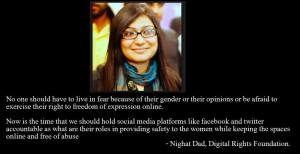
Nighat

Kavita

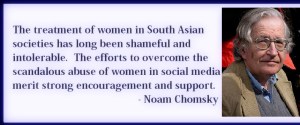
chomsky

Askmebazar.com – Dystopian Hyper-Consumerism and Pushy Advertising : Adnan R. Amin

This is a guest post by ADNAN R AMIN

It was an entertaining skit.

It opens with an animated evangelist (played by a dashing Bollywood leading man) talking about the dangers of stress and how it drains us. To the applause of an enthralled, glazed-eyed audience, he presents a man quivering uncontrollably – tap-dancing even – from extreme work-related stress. With the uproarious consent of the crowd, the evangelist introduces the poor specimen to Askmebazar.com. Miraculously, the man stops shaking and starts browsing through shopping items. He is instantly relieved of his stress and bathed in a halo-like glow. As the plot winds up, he is seen drowning in a deluge of delivery crates and boxes.

“One Click Therapy.”

This is the comical, over-the-top television commercial from Askmebazar.com, an online marketplace. While undeniably funny, the positioning idea is discomforting, if not problematic. Once we get past the comedy and the antics, the message of the commercial is darkly dystopian. It seems to say: if earning gives you stress, spending will relieve that stress. Meanwhile, here’s an app just for that. Continue reading Askmebazar.com – Dystopian Hyper-Consumerism and Pushy Advertising : Adnan R. Amin

The Anthem of ‘Black Lives Matter’

MEERA NANDA has sent us this moving and militant anthem of the Black Lives Matter campaign.

janelle-getty_wide-40db75d71631e05766c321b52a99a3cee3eb15a5-s800-c85

R&B singer Janelle Monáe released a blistering 6 1/2-minute protest song on Friday called “Hell You Talmbout.” [African-American slang for “what the hell are you talking about.”] The song’s premise is simple, and that simplicity is the source of its power. The lyrics are the chanted names of black Americans killed by police and vigilantes, followed by the phrase “say his name” or “say her name.” The chorus is an anthemic, gospel-leaning repetition of the song’s title. Monáe is joined on the track by a drum line and the members of her Wondaland Arts Society collective: Jidenna, Roman GianArthur, Deep Cotton, St. Beauty and George 2.0. All of the vocals are raw, several to the point of breaking. None of the names are sung.

At the moment, Hell You Talmabout is available as a stream only. Here is the link.

And here are the lyrics. Note that some of the names are hyperlinked to tell you about the person being named.

Continue reading The Anthem of ‘Black Lives Matter’

An Open Letter to Mr Adani on the Occasion of Onam

Dear Mr Adani

Writing to you from Thiruvananthapuram, where you recently signed an agreement with the Kerala government, undertaking the construction of the international container terminal at Vizhinjam off the Thiruvananthapuram coast.

The Malayali press went wild in their delight ; the politicians beamed in triumph (well, most of them. Some of them –guess who — could not, having discovered that they had shot themselves in the foot); the contractors and sundry middlemen in the construction sector rubbed their hands in glee. This is Onam season in Kerala, and Onam, you may know, is our national festival. You are very much in the talk here. To the contractors and our miserably corrupt and craven political class, you are Maveli reborn in flesh and blood. To the poor fisher people on what is arguably Kerala’s poorest coastal stretch, you are a newer version of evil Vamanan himself, threatening to banish them to the nether-world. There was a time when the political left in Kerala reinterpreted the Maveli myth as a vindication of the Welfare State. But since the welfare state has been almost as good as dead in the minds of Kerala’s mainstream political classes, the throne has also been conveniently empty.The mainstream press has set you up on it indirectly but definitely, and that’s pretty much evident. But Malayalees who love this land and are not blinded by hollow –false– national sentiment can see that not only are you the very opposite of Maveli, but also that this Emperor-figure has no clothes at all.

Continue reading An Open Letter to Mr Adani on the Occasion of Onam

A Different kind of India-Pakistan Dialogue

As NSA talks between India and Pakistan were suspended, another kind of cross border conversation was taking place.

The vocalist of Indian Ocean band, Rahul Ram along with Varun Grover and stand up comedian Sanjay Rajoura produced a song to the tune of Kishore Kumar’s ‘Mere Samnewali Khidki mein’ (from Padosan). Their song ‘Mere Samnewali Sarhad Pe’ is a delightful and gentle parody of the mirror image pathologies in both our countries.
In response,  Muhammad Hassan Miraj, who identifies himself as a Major in the Pakistan Army, wrote an equally disarming reply,  sung by Mujtaba Ali, with Ali and Kamran on guitar while Gul Durrani directed the video.
Here’s to cross border solidarities!

Of Hanuman, Pakistan and Bhaijaan: Prabhat Kumar

Guest post by PRABHAT KUMAR

Hanuman in the Enemy Land

What did our Ram-bhakt Hanuman do in Lanka, the land of his master’s enemy when he went there in the golden past? Everybody knows. What will Hanuman do, if today he is sent to Pakistan? Lankan voyage of Hanuman then, and cinematic expedition of his modern counterparts now (Sunny Deols of Border, The Hero, Ghadar, etc.), leave no room for imagination. Pakistan – the enemy land of India’s nationalist imagination – must be taught a lesson, as Rashtra-bhakt TV news anchors keep shouting from behind fire and embers on the screen.

We have seen on almost daily basis the bhakts, posing variously as Rashtra-bhakt or Ram-bhakt or lately as NaMo-bhakt. Bhakts, who persistently wish to annihilate the enemy land in TV studios, social media, or movie theatres. However, what a latest Hindi film Bajrangi Bhaijan shows is an unusual, or should I say, an abnormal bhakt. A bhakt, who does not want to destroy Pakistan! Lo and behold, he is a Hanuman-bhakt! He is called Bajrangi-Bhaijaan (Salman Khan). For, the word Bajrangi is a synonym of Hanuman, the ubiquitous monkey-god. He is bhaijaan because he is unable to lose his affection for a cute little girl even after knowing that she is a Muslim and, more than that, a Pakistani! Continue reading Of Hanuman, Pakistan and Bhaijaan: Prabhat Kumar

Open Letter to Odisha CM Re False Charges Against GASS Activist Debaranjan

 WITHDRAW FALSE CHARGES AGAINST DEBARANJAN OF GASS, ODISHA

To:

Mr Naveen Patnaik
Chief Minister,
Government of Odisha

22 August 2015

 We, the undersigned, unequivocally condemn the foisting of a false case on Debaranjan, member of the Ganatantrik Adhikar Surakhya Sangathan (GASS) in Odisha.

Debaranjan has for several years now been deeply involved with people’s struggles in Odisha, first as a full-time activist in Kashipur, Rayagada district, then as film-maker, and most recently also as a member of the democratic rights group GASS. His has been among the consistent voices in Odisha for over twenty years against state repression on people’s struggles, atrocities faced by adivasis, dalits and other underprivileged communities, and against communalization of the polity and in society. This is the political context in which he is being targeted.

Last week, Debaranjan was sought to be interrogated by the Special Branch of the Intelligence Department while he was engaged in work on a documentary film in Malkangari district. Subsequently, a number of false charges were filed against him by the Malkangiri Police, including charges pertaining to molestation under Section 354 (b) of the IPC, and under sections 354 and 323. We believe these charges to be patently false and absurd, and constitute nothing other than harassment and part of the continued persecution of democratic voices in this country. Continue reading Open Letter to Odisha CM Re False Charges Against GASS Activist Debaranjan

DISSENT, DEBATE, CREATE