Tag Archives: caste

Caste and Exploitation in Indian History: Bharat Patankar

Guest post by BHARAT PATANKAR translated by GAIL OMVEDT

Introduction: The Process of Exploitation

Exploitation arising from the caste hierarchy is a particular feature of the South Asian subcontinent. There was no such exploitative system in other continents or in countries outside of South Asia. But since caste exploitation has been a reality for 1500-2000 years this shakes the belief that only class can be the basis of exploitation. And because of this we have to transcend the attempt to find a way only pragmatically and deal with the issue on a philosophical and theoretical level. Class has been theorized extensively in terms of exploitation; to some extent gender also, but not caste. Exploitation as women in various forms has also been a reality for thousands of years; this also is not through “class”. This reality from throughout the world gives a blow to the idea that exploitation can only be class exploitation. This can also be said of exploitation arising on the basis of racial and communal factors. Continue reading Caste and Exploitation in Indian History: Bharat Patankar

Desecrating Memory – The Paramakudi Police Shootings: V Geetha

Guest Post by V. GEETHA

Readers of Kafila might have heard of the horrific shootings that took place at Paramakudi and Madurai on September 11. Officially seven people died when police opened fire on dalits who had gathered to pay their respects to Immanuel Sekaran, a dalit leader who was brutally killed in 1957 in circumstances that pointed to the complicity of dominant caste thevars in carrying out this murder.  (The thevars are an important constituent of the ‘Mukkulathor’ complex of castes that includes the kallars and the maravars.) Subsequently, U Muthuramalinga Thevar, Forward Bloc leader was arrested in connection with Sekaran’s death – he stood trail and was released two years later, because the case against him was not established and proved. (Thevar was proud of his anti-communism and his Hinduism; to him he claimed that patriotism and theistic belief constituted his very vision, they were the ‘eyes’ through which he saw the world.) Continue reading Desecrating Memory – The Paramakudi Police Shootings: V Geetha

Gautam Book Centre

AK Gautam

It is the sort of place you will not find unless you are looking for it. Even if you find the address in Hardevpuri near Shahdara, you will not know where to knock. There is no signboard that will tell you this is Gautam Book Center. “A signboard will attract the attention of those who don’t like our books,” explains AK Gautam.

These are not books of pornography or an underground militia. These are books on caste.
Continue reading Gautam Book Centre

In Allahpur, a Moment of Truth

(First published in Untold Stories)

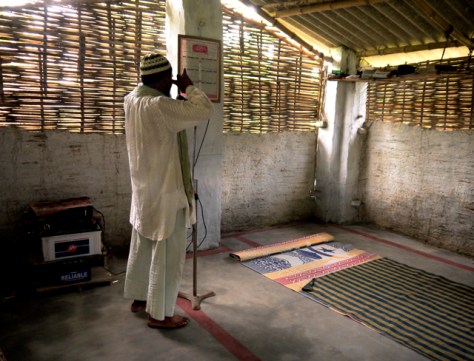
Imam Shamsuddin calls for prayer. Photo credit: Shivam Vij

Like nearly every village in South Asia, Allahpur, in the east Indian state of Bihar, is geographically divided on the lines of caste. On one side of a dirt track live the upper-caste Muslims (Syeds, Sheikhs and Pathans) and on the other side live the lower-caste Muslims (Ansaris, Dhunias and Raains). There are only four Hindu families in Allahpur, and they are all lower castes, their houses amid the low-caste Muslim houses.

For five years now, the low caste Muslims have been praying at a ramshackle mosque they built, boycotting the mosque in the upper-caste Muslim area, a stone’s throw away.

Continue reading In Allahpur, a Moment of Truth

‘Muslim Quota’: Keep it Simple, Silly! – Khalid Anis Ansari

Guest post by KHALID ANIS ANSARI

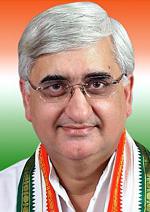
In an interview last month, Mr. Salman Khursheed was posed the query: ‘There are reports that you are considering Muslim reservations within the OBC quota?’ He responded affirmatively: ‘Absolutely. Sachar described them as SEBC, socially and educationally backward classes. This is a special segment within OBC.’

Nowhere in the Sachar report are Muslims categorized as SEBC (Socially and Educational Backward Classes). They are categorised merely as one of many SRCs (Socio-Religious Communities). Moreover, the Sachar Report has acknowledged caste-based stratification within Muslims and has suggested quite unequivocally: ‘Thus, one can discern three groups among Muslims: (1) those without any social disabilities, the ashrafs; (2) those equivalent to Hindu OBCs, the ajlafs, and (3) those equivalent to Hindu SCs, the arzals. Those who are referred to as Muslim OBCs combine (2) and (3) [p. 193 (emphasis added)]’.

So, according to the Sachar Report all Muslims cannot be conceived as a socially and educationally backward class (OBC) because the forward Muslims (ashrafs) are ‘without any social disabilities’. Well, one may ask if the minister who exhorted everyone to read the Sachar Report critically and not as gospel truth, has failed to practice what he himself preached. The honorable minister seems to have read the report incorrectly.

Strange are the ways politics affects one’s judgment! Continue reading ‘Muslim Quota’: Keep it Simple, Silly! – Khalid Anis Ansari

The Lokpal debate from a Dalit-Bahujan perspective

The video above shows a protest in Delhi demanding a Bahujan Lokpal Bill, and protesting against Anna Hazare. This was hardly given any coverage in the media. The video was made and uploaded by KHALID ANIS ANSARI, who writes at the Round Table India:

A supra-parliamentary Jan Lokpal and a very interventionist and unaccountable judiciary are a horror for the dalit-bahujan masses. All said and done the legislature is most respectful of social diversity as far as the three organs of government are concerned. The executive is bad and the judiciary is the worst in this regard. So I am presently in favor of taking the ‘political’ route than the civil society one which is in any way a club of the chattering classes. [Read the full post]

Given below is a note expressing a Dalit-Bahujan perspective on the Lokpal debate. The note has been put out by DINESH MAURYA: Continue reading The Lokpal debate from a Dalit-Bahujan perspective

Why Jai Karan supports Anna Hazare

Jai Karan in The Times of India

My own feelings about the Anna Hazare movement are mixed, or you could say confused. I like the way the movement is bringing an arrogant government to its knees, and though I don’t know if their version of the Lokpal Bill is the best way to fight corruption, I appreciate how they have exposed the UPA’s farce of a bill. I get the point that fellow-travellers Nivedita Menon and Aditya Nigam are making about democracy and political movements, but as one unit of ‘the people’, I don’t see why I should support a movement just because it is popular. Perhaps it is my elitism and naivete and cynicism. Or perhaps I’m just confused by now. The taste of the pudding is in the eating, and I’d like to see where this takes us.

While I sort out my confusion, I see a message on Facebook, attributed to Anu Ramdas, that says:

Continue reading Why Jai Karan supports Anna Hazare

What caste do you think the Financial Times is?

See update below.

So… I get a phone call yesterday. It’s a reporter from the Financial Times who wants to know what I feel about the recent ban on the movie Aarakshan in certain states, and also what do I feel about caste-based reservations in general, whether caste is still relevant in the India of today, the theory that quotas just increase inequality etc.. I tell her I haven’t seen the movie, and if she still wants to know what I feel about caste-based reservations we could talk for a bit. She says she absolutely wants to know. So I say fine, and we have a 45-minute conversation. Allow me to reproduce a very simplified version of that conversation (in Q&A forrmat):

1. Q: Do you believe movies like Aarakshan can be provocative or controversial; as in, are certain groups justified in taking offence and asking for a ban? Continue reading What caste do you think the Financial Times is?

The Unending Struggle of Dalit Christians and Dalit Muslims for Equality: S. Japhet and Y. Moses

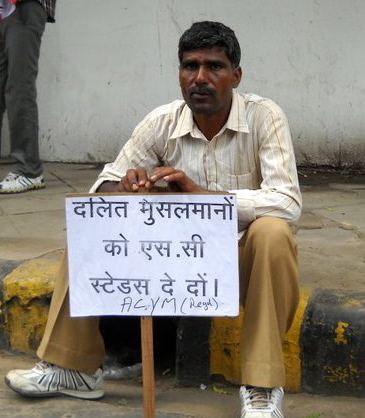
On the sidelines of a protest at Delhi's Jantar Mantar today

Guest post by S. JAPHET and Y. MOSES

Religious minorities, both Christians and Muslims from different parts of the country have converged in Delhi to demand reservations for Dalit Christians and Dalit Muslims. This is part of a long standing struggle demanding the Government to introduce a bill to amend the constitution to include Dalit Christians and Dalit Muslims in the scheduled Castes list. The Christian community has been agitating since the promulgation of the Presidential Order Government of India 1950 that effectively prevents those professing religions other than Hinduism from being considered as Scheduled Castes. It has been argued that the 1950 Order violates Article 15 that prohibits discrimination on grounds of religion, race or caste and Article 25 that gives the right to all citizens to profess and practise any religion according to his or her choice. The demand is that affirmative action or positive discrimination of dalits, providing reservations in government jobs, educational institutions and representation in Parliament and state legislatures should be extended to all dalits irrespective of whatever religion they may profess and practise. Continue reading The Unending Struggle of Dalit Christians and Dalit Muslims for Equality: S. Japhet and Y. Moses

‘Can someone be a Brahmin and not be acting as a Brahmin?’

Over at the excellent India Site, Rahul Pandita asks a thought-provoking question:

As a Brahmin, does it make me less sensitive to the plight of the poor or the marginalised? Why is it such a big deal that I can wear my Janeu, recite my Hanuman Chalisa, and yet go to Bant Singh’s house in Bhurj Jabbar, thirstily gulp down a few glasses of water, and tell his story? Where is the contradiction? [‘A Brahmin Heart’]

And the ever-sharp Kufr has the best answers there can be to that question:

when rahul pandita says he’s a brahmin, he’s making a claim on a lot of indian history. when bant singh rebels against his present, he is also rejecting pandita’s history, his claim on privilege. if pandita doesn’t see that, he shouldn’t have undertaken the trip to bant singh’s home. [why bant singh can’t go to rahul pandita]

‘Locking up gods within caste’

This note comes via Malarvizhi Jayanth. Those in support can leave a comment saying so, and add their designations to their names, if they wish.

We call for all those who support democracy and free speech to express solidarity with Thirumavalavan, Meena Kandasamy and Samya.Kathavarayan and Madurai Veeran are among the gods who are acknowledged to be Dalit and are worshipped by many castes. Clearly, in the oral history of the people, the gods have castes and these castes are not determined by who worships them. The twin brothers Ponnar Shankar inhabit the realm between hero and deity. They have been fictionalised, recreated for the silver screen, and are worshipped across communities. Their origin myth remains contested territory – it is variously read as symbolic of the conflict between agriculturists/warriors and hunters, as part of founding tale of the land-owning agriculturist Kongu Vellala Gounder sub-caste and, in a textbook example of how Hindutva functions, have recently been claimed as reincarnations of the Pandavas. Like other deities of the people, they are firmly located in a historical imagination among a society of human beings, and not in a mythos of gods.

In a footnote in Uproot Hindutva: The Fiery Voice of the Liberation Panthers by Thirmavalavan, MeenaKandasamy describes Ponnar Shankar as dalit. M Loganathan, an advocate from Nanje Goundanpudur and Students Wing Convenor of the Kongu Nadu Munnetra Kazhagam (KMK), has been quoted in news reports as saying that there is evidence proving that Ponnar and Shankar are Kongu Vellala Gounders and claiming that depicting them as Dalits will lead to caste tension. Continue reading ‘Locking up gods within caste’

Caste in Urdu Prose Literature: Ajmal Kamal

Cover of "The Adventures of Amir Hamza (M...
A cover of 'The Adventures of Amir Hamza'

Guest post by AJMAL KAMAL

The historical division of society in South Asia on caste lines is now an acknowledged sociological, political and economic fact. However, caste as a literary or social discourse does not, for several reasons, form a part of the predominantly Muslim culture of Urdu. Nor has there been much academic exploration of the role caste plays in the life of South Asian Muslim communities as against others. As far as the Urdu literary writing is concerned, it has traditionally focused exclusively on the lives and concerns of conquerors, their cohorts and their descendants, who typically prided themselves on their real or perceived foreign origins. Even after modern, socially committed writing began in Urdu around the 1930s, caste as a variable for social exploration was largely ignored in favour of economic class. Continue reading Caste in Urdu Prose Literature: Ajmal Kamal

Corruption, the New Caste: Thomas Crowley

Guest post by THOMAS CROWLEY

In the mainstream coverage of the Ramdev hullabaloo, there has been, unsurprisingly, little substantive discussion about corruption itself: its fundamental causes; its widespread effects; the viability of different plans to combat it. Who would want a dry, intellectual discussion of the root causes of corruption when we can stare uneasily at pictures of Baba Ramdev holding a sword and wait with bated breath for his holy army to congregate?

But let’s – for the moment – take seriously Ramdev’s proposal that the death sentence be meted out to India’s corrupt. If the press is to be believed – especially the foreign press – this may just mean killing every Indian. For, implicit in many media reports is the assertion that corruption is part of the Indian psyche, an essential component of what it means to be Indian. In this sense, corruption serves the same conceptual role as caste: it essentializes an ever-changing historical phenomenon, freezing it in time and obscuring its economic and political roots. Much as the British taught Indians and foreigners alike to understand India predominantly in terms of caste, modern commentators are encouraging both desis and firangis to conceptualize India as the land of unending corruption. (Of course corruption has not replaced caste as a mode of understanding India; the fascination with caste still runs deep.)

Continue reading Corruption, the New Caste: Thomas Crowley

The Death of Merit: A short film series by the Insight Foundation

From here.

This documentary is first in the series of our efforts to document caste-based discrimination prevalent in Indian higher education system resulting in large number of suicides of Dalit students in Indian campuses.

It is based on the testimonies of parents and family members. In next few days, we are coming up with few more documentaries to expose the kind of caste-based hostility and harassment Dalit and Adivasi students have to suffer from the faculties, fellow students and administration in some of the country’s premier educational institutions. These documentaries are part of our efforts to make Indian educational system inclusive in real sense and free from caste-discrimination.

Here’s more on The Death of Merit.

Brilliant Tutorials: Trisha Gupta reviews Siddharth Chowdhury’s “Day Scholar”

Guest post by TRISHA GUPTA

On the face of it, Siddharth Chowdhury’s Day Scholar, is a coming of age novel. The book’s own inside cover actually describes it as a “crazed and profane coming of age tale”, whose plot is ostensibly about how Patna boy Hriday Thakur (“who hopes to be a writer some day”) is first “trapped… by a series of misjudgements” and later “saved from a terrible end”. But much like Chowdhury’s previous offering, Patna Roughcut (also billed as “a story of love, idealism and sexual awakening” that takes us to “the heart of an aching, throbbing youth”), Day Scholar – despite a self-referential moment when its protagonist is asked by his father about how his Bildugsroman is coming along – is not a book that seems containable within the neat boundaries of the coming-of-age genre. Continue reading Brilliant Tutorials: Trisha Gupta reviews Siddharth Chowdhury’s “Day Scholar”

Do I look painDoo?

This post is dedicated to Nadeem F. Paracha.

Photo by 'Life Church Burnley' Flickr: "shoorkot road toba tek sing love this palce.but need much improvement"

[Photo by ‘Life Church Burnley’ on Flickr: “shoorkot road toba tek singh love this place but need much improvement”]

So on Facebook I saw a fellow Punjabi who lives in vilayat has listed his hometown as Toba Tek Singh, Pakistan, which I thought was very cool. Why didn’t I get this idea? Never mind, I thought, like all good ideas this must be stolen. My hometown on Facebook now is also Toba Tek Singh, Pakistan. It was only much after going mad over Manto’s story did I discover that Toba Tek Singh was a real place in west Punjab. Always wondered what its people thought about the story. Continue reading Do I look painDoo?

The Making of Anna Hazare

[This piece is based on my extensive field work on Anna Hazare and his movement in Ralegan Sidhi over some years and is also a part of my forthcoming book Green and Saffron: Hindu Nationalism and Indian Environmental Politics. MS]

The anti-corruption movement, spearheaded by Anna Hazare, and the passage of the Lokpal Bill have generated unprecedented interest amongst a wide spectrum of society about the ideas, politics and organisations of civil society in general, and Anna Hazare in particular. Hazare’s anti-corruption crusade merits attention not only for its importance in ensuring a corruption-free society, but also due to its multifaceted nature. Hazare’s politics however has to be seen in a larger framework and in a wider historical context. Howsoever laudable the goals of anti-corruption movement in India today, the movement is not beyond the categories of gender, caste, authority, democracy, nationalism and ultra-nationalism. Far from transcending them, the movement is transforming and being transformed by the implicit deployment of such categories. I wish to place Hazare in the larger context of his environmental journeys, where the elusive but crucial element is one of authority that is exercised due to a large degree of consent and conservatism. Yet, almost all accounts on him, largely celebratory in nature, do not examine the ideology and politics of his works. These are crucial not only to critically assess the present and the future of our anti-corruption movements, but also to interrogate certain brands of civil society activisms and environmentalisms. Continue reading The Making of Anna Hazare

Corruption has its Caste in the Judiciary: All India Confederation of SC/ST Organisations

This press release come from the ALL INDIA CONFEDERATION OF SC/ST ORGANISATIONS

New Delhi, April 4, 2011.

Dr. Udit Raj, National Chairman of All India Confederation of SC/ST Organisations, said that corruption has its caste. The way the former Chief Justice of India, K. G. Balakrishnan and former Chief Justice of Karnataka, P.D. Dinakaran, are being treated, there is no doubt that corruption knows the caste. Here argument is not to absolve these people but to expose hypocrisy and double speak. The Supreme Court hastened to admit petition against K.G. Balakrishnan but why not in other cases? Continue reading Corruption has its Caste in the Judiciary: All India Confederation of SC/ST Organisations

Emboldening Khap Panchayats?

Teaching Harmony, Practicing Disharmony

This was presented as a paper at a symposium on Peace Education organised as part of National Conference on Indian Psychology, on 6 February 2011 at the India International Centre.

This piece seeks to underscore the cleavages that exist in our society, explore the foundations upon which the edifice of intolerance has risen and to look at the tools, like education for peace and harmony, with which we try to dismantle this citadel of intolerance.

Peace education, you would agree, cannot be confined merely to teaching the message of Love and brotherhood, our text books have been teaching this message for as long as I remember and my memories of our text books go back, at least to my senior school days in the mid sixties, almost 45 years ago.

If telling students in their classes that we should all love each other because we are all Indians and that we are all equal was enough then we would not have many of the problems that we are confronting today. Continue reading Teaching Harmony, Practicing Disharmony

Why is it so difficult to free India of manual scavenging?

Guest post by BEZWADA WILSON

Safai karamcharis from across India declared their liberation at a function in Delhi on 20 December

Over the years, there have been many changes in the Safai Karamchari Andolan movement. The biggest change we have seen has been in the safai karamchari community’s outlook. There was a time when safai karamcharis were ashamed to admit they did manual scavenging. It was not uncommon for even family members to be unaware that someone was involved in the practice of manual scavenging.

Continue reading Why is it so difficult to free India of manual scavenging?