Tag Archives: Congress

The Sin and the Error : Ravi Sinha

Guest Post by RAVI SINHA

…it takes an error to father a sin. ─ J. Robert Oppenheimer[1]

Future historians of India may well describe the past year as a year of political sin. This was the year in which the man who had earlier presided over the Gujarat Carnage was awarded the ultimate prize. The year saw an election that touched a new low marked by shallowness, vulgarities and lies – in no small measure by the labors of the man himself. Equally appalling have been the exertions of a large class of literati and glitterati to portray philistinism and inanities spouted by the most powerful mouth as wisdom of a visionary leader.

An entire country seems to have gone blind – unable to see that the emperor has no clothes. In this age of incessant television it should be obvious to anyone that the supreme leader does not carry conviction even when enunciating relatively higher banalities. He is at his natural best only when he mocks someone as a shehzada or slanders and vilifies an entire community through phrases such as ame paanch, amara pachees. It is an irony of history that the republic which had Nehru as its first prime minister has one now for whom even common mythology is too cerebral. He must vulgarize Pushpak Viman and Ganesha and reduce them to quackeries of aviation and surgery.

Misfortune of the nation goes beyond the man. Forces of the diabolic housed in the hydra-headed Parivaar can now accomplish the impossible. They can now occupy the political center stage without leaving off the lunatic fringe. They can adopt Gandhi without renouncing Godse; erect world’s tallest statue of a leader who had punished their forefathers for assassinating Gandhi; even co-opt Bhagat Singh without batting an eyelid about what he stood for and what he had to say about ideologies like theirs. They can further refine the art of doublespeak. Their “statesmen” can pave the way for corporate plunder and call it sab ka vikas (development for all). Their “ideologues” can advocate sab ka saath (inclusion of all) by exhorting Hindu women to give birth to a minimum of four children each, lest Hindus are reduced to a minority “in their own country”. Continue reading The Sin and the Error : Ravi Sinha

While “Exposing 300 days of Modi’s Rule”, Let us not fall into the Trappings of Old Congress Style Politics: Nayan Jyoti

Guest Post by Nayan Jyoti

SOME QUESTIONS IN THE CONTEXT OF MASS ORGANISATIONS OF CPI(ML)LIBERATION, CPI, CPI(M) & OTHERS INVITING CONGRESS, RJD, JD(U) TO DEFEND ‘SECULARISM, INDIAN CONSTITUTION, INDIAN NATIONALISM’

Janta Dal (United) leader Ali Anwar, in an ‘united’ program in Jantar Mantar on 19th March had a frank admission to make in the first 15 minutes of his speech: “Elections ki hi baat se shuru kare, to haan, hum sab milkar Modi ko harayenge” (“If we begin with the question of elections, yes, we will unite to defeat Modi together”). He was indicating a plain and simple ‘unity’ of convenience for elections, of a converging pole in Indian politics. He indicated: “Bihar assembly elections are waiting to happen.” He of course, remembered the theme of ‘secularism’ for the event and said, “now I will say a few ideological things” and did utter a few lines against the BJP-RSS.

Delhi’s Jantar Mantar on 19th March thus saw a (not very?) strange unity. Various “civil society and secular political parties, victims, artists, intellectuals” came together to organize an Exposing 300 days of Modi’s Rule program. Many of the organizers included mass organisations of the Left like AISA, AICCTU, AIPWA connected with CPI(ML)Liberation, and SFI, AIDWA, CITU, DYFI, AILU connected with CPI(M), and AITUC, NFIW, PWA related to CPI, among others. In these dark times of achhe din, where unity and collaboration of various left, democratic and progressive forces has come up with renewed necessity to fight the present regime, it becomes important for us to interrogate such attempts without any sectarianism. An important question that requires asking here is the basis of these ‘Unities’ and Forums being variously attempted. ‘Unity’ is definitely required in these times of combined attack of brutal neoliberal and communal attack, but standing on what ground, and in what direction? Continue reading While “Exposing 300 days of Modi’s Rule”, Let us not fall into the Trappings of Old Congress Style Politics: Nayan Jyoti

Footsoldiers in Search of an Icon

“The epitaph for the RSS volunteer will be that he was born, he joined the RSS and died without accomplishing anything.”-V. D. Savarkar

(D.V.Kelkar, “The R.S.S.” Economic Weekly ( 4 Feb 1950: 132) Page 36, The Brotherhood in Saffron,The RSS and The Hindu Revivalism, Andersen and Damle,Vistaar, 1986, Delhi)


Veer Savarkar was a Veer Purush who was not scared of death. He was a Shastra Upasak and Shaasrta Upasak: Shri Narendra Modi

May 29, 2013 Author: admin (http://www.narendramodi.in/)

I

Celebrations at the central hall of Parliament are a marker of the political ambience in the country.

The change of guard at the centre was very much visible at the place recently where the entire top brass of BJP including PM Narendra Modi were present to celebrate the birth anniversary of Savarkar. Modi described Savarkar as a prolific writer, poet and social reformer. “Tributes to Veer Savarkar on his birth anniversary. We remember and salute his tireless efforts towards the regeneration of our motherland.” Continue reading Footsoldiers in Search of an Icon

Statement on the Loksabha Elections, 2014: P.A.D.S.

Guest Post : P.A.D.S. (Peoples’s Alliance for Democracy and Secularism) Statement on Elections

The Loksabha election results of 2014 surprised everyone. They are beyond the wildest dreams of even the most ardent BJP and Modi supporters, and worse than the worst scenarios imagined by  BJP’s political opponents. Even though these elections results are singularly stunning, phenomena like these have diverse reasons. A comprehensive understanding and meaningful response require that all these reasons be dispassionately explored and evaluated.

First, the votes behind these results. BJP polled 31% of votes. Never before has a party with so few votes won a mjority in national elections. Clearly, the first past the post system has benefited it disproportionately, more than any other ruling party in the past. This electoral system has amplified the BJP victory and made it look so impressive.  However, BJP’s electoral achievements in other domains must not be discounted. For the first time it managed to dislodge the Congress as the main party to represent Assam in the Lok Sabha. Fighting alone, it garnered 17% of votes in West Bengal and made determined bids in Tamil Nadu and Kerala. In all states where it fought a straight battle with the Congress, its vote share was above or close to fity percent. It ran the most expensive and well organised campaign. Among all contestants, only it appeared determined to win and left no stone unturned to achieve its objective. It played the communal card astutely in UP and Bihar, with full paraphernalia of communal riots, started more than a year ago, and unabashed use of Hindu religious symbols. At other places it was the ‘development’.  The BJP victory is actually Mr Modi’s victory. For the first time since Mrs Indira Gandhi after  the 1971 and 1980 elections, a single person has come to acquire such a mandate at the national level.  These results show a significant shift of electoral politics to the right and marginalisation of non-communal forces. Continue reading Statement on the Loksabha Elections, 2014: P.A.D.S.

AK versus NaMo

Neelanjan Mukhopadhyay, author of a much discussed book on Modi, made few interesting observations about AAP’s (Aam Aadmi Party ) foray into the electoral politics of Gujarat. Underlining the fact that Kejriwal’s entry into the state – wherein he tried to put the government on the mat for its acts of omission and commission – did raise expectations, he maintains that the momentum did peter away slowly.

What is more important to note that when the electoral battle started the party did not field a single candidate from the minority community despite the fact that population of Muslims in Gujarat is more than nine percent. According to the state leadership of the party it did not ‘find any suitable candidate from the community’ to contest elections. Questioning this explanation Neelanjan says that it thus did not challenge the prevalent norm that ‘Muslims are not to be given tickets’ by the mainstream parties. (Modi ki Raah Chale Kejriwal, Deshbandhu, 30 April 2014).

Any neutral observer of the whole situation – who is familiar with the fact that there are places where AAP did field ‘outsiders’ to fight elections – would also be of the opinion that this explanation seems insufficient and perhaps there are deeper reasons involved in this decision. If at the political level it could bracket BJP as well as Congress at the same level by portraying their alleged proximity to the Adanis’ and Ambanis’ why did not it try to make another strong political point by giving ticket(s) to candidate(s) belonging to the minority community. (To put it on record, the BJP did not field a single Muslim candidate and Congress could muster courage to do it in only one constituency). Continue reading AK versus NaMo

Pogrom Politics from 1984 to 2002: Sanjay Kumar

Guest post by SANJAY KUMAR

Delhi 1984 and Gujarat 2002 are among the darkest spots in India’s post independence history. Like all other communal killings in the country, they too were similar in the mechanics of their violence. Connivance of the top state authorities, active role of elected politicians, police and bureaucratic indifference, a cornered and hapless minority, and participation of ordinary folks in violence and looting, all elements of the process of communal killings almost reached the  point of perfection in these two pogroms. So much so, that they indeed were not contained, but played themselves out fully, till the time killers and looters got tired, or when nobody was left to be killed, and nothing remained to be burnt and looted. All those who talk, think, write or make claims about civilisation in India, should take a few moments off to come to terms with these two events. Victims of these pogroms too, like of other communal killings in the country, continue to wait for justice. Collusion of investigative agencies, protective shadow of state power and judicial lethargy has meant that prime movers behind these killings have remained beyond the arm of justice. In fact, particularly in these two cases, the political fortunes of parties involved in killings witnessed an unprecedented boom. Congress party under Rajiv Gandhi in 1984 returned with the largest ever national mandate to Lok Sabha; and the BJP under Narendra Modi has successfully decimated all political opposition in Gujarat, and is now eyeing central power under his leadership. Continue reading Pogrom Politics from 1984 to 2002: Sanjay Kumar

लोकतंत्र का अंतिम क्षण

कैमरा बार बार जा कर उसी क्षण पर टिकता था.मेरी बेटी ने विचलित होकर कहा, “चैनल बदल दो, अच्छा नहीं लग रहा.” लेकिन चैनल उस थप्पड़ की आवाज़ न सुना पाने की लाचारी की भरपाई उस दृश्य को दुहरा-दुहरा कर कर रहे थे. उन्हें सोलह साल की मेरी नवयुवती बेटी की तड़प क्योंकर सुनाई दे? चैनल बदलते अधीर दर्शक इस दृश्य से वंचित न रह जायें, इस चिंता के मारे उसे हथौड़े की तरह बार-बार बजाया गया.

यह हमला था. लेकिन हिंदी में हमला कहने पर हिंसा का बोध अधिक होता है,सो अखबारों ने ‘केजरी को थप्पड़’,‘पहले माला फिर थप्पड़’, ‘केजरीवाल को फिर थप्पड़’ जैसे शीर्षक लगाए. भाषा का अध्ययन करने वाले जानते हैं कि शब्दों के चयन के पीछे की मंशा उनका अर्थ तय करती है. ‘थप्पड़’ कहने से हिंसा की गंभीरता कम होती है और हिंसा के शिकार की कमजोरी ज़्यादा उजागर होती है. थप्पड़ से किसी की जान नहीं जाती, उसकी निष्कवचता अधिक प्रकट होती है. उसमें किसी योजना की जगह एक प्रकार की स्वतःस्फूर्तता का तत्व होता है. कहा जा सकता है कि थप्पड़ मारने वाले की मंशा सिर्फ नाराजगी का इजहार था.अंग्रेज़ी में भी ‘स्लैप’ शब्द का ही इस्तेमाल किया गया, यह भी लिखा गया, “केजरीवाल स्लैप्ड अगेन”. इसमें हमला करने वाले से ज़्यादा हमले के शिकार की ही गलती नज़र आती है, मानो उसे मार खाने की आदत सी पड़ गई हो. आदतन मार खाने वाला सहानुभूति की जगह हास्य का पात्र बन जाता है. Continue reading लोकतंत्र का अंतिम क्षण

Muslims Will Consider Supporting AAP, if it Offers Concrete Programme for Them: Jamaat-e-Islami

An Interview with the Jamaat-e-Islami Hind Amir (National President) MAULANA JALALUDDIN OMARI conducted by MISHAB  IRIKKUR, MOHAMMAD RAGHIB and ABHAY KUMAR

Amid the talk of communal forces emerging stronger, India is going to polls. The fear of BJP’s prime ministerial candidate Narendra Modi is perhaps more felt by the Muslim minority than anyone else. The “secular” Congress—charged with corruption and misrule—does not seem much energetic and confident at this moment. At this crucial juncture what strategy should the largest religious minority community of the country adopt in the upcoming General and assembly elections? What are the options available for them? To learn about this and more, Mishab Irikkur, Mohammad Raghib and Abhay Kumar interacted with Maulana Jalaluddin Omari, the Amir (national president) of Jamaat-e-Islami Hind (JIH) last week at its New Delhi headquarter. The seventy-nine year old Amir–who is an Islamic scholar and author of dozens of books–spoke on a host of issues such as elections, politics, the social and economic problems of Muslims, reservation, framing of innocent Muslim youth on terror charges etc. The JIH—which came into existence soon after the Jamaat-e-Islami had split into two separate organisations at Partition–is one of the most influential Islamic organizations among Muslims that mainly does “intellectual” work and carries out welfare activities as well. The excerpts are as follows.

Amir_JIH_Omari
Amir_JIH_Omari

What are the major concerns of Muslims ahead of the upcoming elections?

Omari: Our Constitution does not discriminate any citizen on the basis of caste, colour, religion, region, sex etc. It has also given minorities some special rights related to their personal laws and culture. Muslims, therefore, should vote to power those forces, which are committed to upholding democracy, secularism and the principles of Indian Constitution. At the same time we should defeat the parties which are opposed to diversity. The very language of cultural assimilation is a threat to the spirit of our Constitution and interests of people. Continue reading Muslims Will Consider Supporting AAP, if it Offers Concrete Programme for Them: Jamaat-e-Islami

AAP and the Ideology Warriors

If ideology-warriors had their way, they would rather have Narendra Modi as the next prime minister than have their ideological purity compromised. Soon after AAP’s victory, many secularists rushed to declare, on Facebook and elsewhere, that they do not and will not partake of the AAP euphoria. ‘What is their stand on communalism?’, they asked indignantly. Some other friends insisted that Muslims need an assurance about AAP’s position on communalism and it should clarify its stand if it wanted the Muslim vote.

So what do the ideology warriors want? Just when the political agenda for the elections has decisively changed, throwing the BJP into a complete quandary, upsetting its strategic plans, they want the old familiar, secular/ communal divide back in place, opening up the political field once more to the same Hindu-Muslim polarization that we are so used to. The secular/ communal divide has been the millstone around our neck, preventing any other issue from being brought into public debate at election time and effectively preventing the emergence of any new force or formation. And let there be no mistake that in a communal polarization of Hindus and Muslims, secular forces will always, in the on-going drama of secular masochism, have to deposit themselves tied hand and foot, into the Congress party’s dungeon. The Amit Shahs will have a field day, creating one Muzaffarnagar after another, and erstwhile secular mascots like Mulayam Singh Yadav will vie with them in further entrenching the Hindu-Muslim divide. In all of this, the Congress will present itself as the saviour of Muslims.

The Congress, the BJP, the imaginary ‘third front’ – all have been able players and winners in this game. Continue reading AAP and the Ideology Warriors

The Year That Was and the Challenge of 2014

This is a slightly modified version of the article ‘Winds of Change’, published in Economic and Political Weekly (28 December, 2013). As the year ends and we brace up for the big battle that lies ahead in the coming year, here are some reflections on matters that may have a bearing on that battle. Politics is undergoing a transformation, in India as elsewhere. But perhaps, more importantly, it is also what we have so far understood as politics, that is on the point of transformation. For over a century, social science disciplines have maintained a neat distinction between the political and the economic, between state and capital and so on. Marxism ostensibly challenged this false division – but only to assert that the real thing was ‘economics’; that politics was mere epi-phenomenon. But the story of capital was never an economic story alone. In diverse ways, movements in different parts of the world are about this forced division, and the destruction of politics that followed in actual life as economics became a domain of so-called iron laws and economic models began to determine the ways we were taught to see and understand politics.  In the neoliberal 1990s and part of the 2000s, economic laws and the ‘needs’ of capital became sacrosanct – all politics was made to sing and dance to its tune. Only rank outsiders to this world could ask the emperor’s new clothes kind of questions. That is what seems to be happening. Till now, even those who saw that the emperor was naked, went on a maun vrata (vow of silence), fearing ridicule.

The dying old Kulin Brahmin in Goutam Ghose’s Bengali film Antarjali Jatra suddenly sprang to life on seeing his new attractive wife who had been married to him for the sole purpose of accompanying him in his life beyond as sati. Much like that character, the decrepit and ramshackle BJP seems to have suddenly sprung to life at the fantasy of power, having been out in the cold for almost a decade. And just as the young bride in the film was provided by another old impoverished Brahmin (his unmarried daughter), so an utterly impoverished Congress has provided the BJP with the most tantalizing possibility of what it might get in its life beyond.

How else do we explain the fact that the BJP after 2004, already in shambles with all its old leaders gone and its organization ridden with internal bickering and loss of direction, suddenly seems to have made such a comeback in the recent elections in five states? The ‘return of the BJP’ seems to be the overt message of the results of these elections. For there is certainly no doubt that in the past one year so, ever since the orchestrated rise of Narendra Modi in all-India level politics, the BJP’s fortunes too seem to have started turning. This development, however, was greatly facilitated by the Congress in more ways than one. The Congress seemed determined to hand over the game to Modi and the Hindu Right. Continue reading The Year That Was and the Challenge of 2014

AAP’s Rise and Congress Rout – Some Obvious but Unconventional Questions: Sanjay Kumar

Guest post by SANJAY KUMAR

A Congress rout and the AAP success are the most obvious results of recent polls. Both are spectacular, in their own ways. Even BJP’s landslide victory in Rajasthan and Madhya Pradesh pales in comparison, for these two open up new possibilities.

Why a party whose legacy of anti-colonial struggle had lost sheen generations ago, whose top leadership is in the grip of a seemingly disinterested and incompetent dynasty, that lacks any organised cadre, coherent ideology, social base, and whose average leader appears more of a wheeler-dealer, and scamster, should continue to get close to thirty percent of votes from Indians even in worst of times, is a genuine mystery. That the Indian social analyses, barring a few exceptions, have tried little to unravel this mystery, is not only an indication of their intellectual limitations, but also of their ideological biases. The enduring success of Congress indicates seamier side of liberal democracy in general, which bourgeois social sciences try more to paper over than explore.

From voters’ perspective elections under liberal democracy are an exercise in choice, but not in freedom. When people vote, they are not acting as citizens shaping their social world, but as little men and women facing pre-existing structures of social power. The magic of elections under liberal democracy is precisely this. They offer a choice, the choice is not fake, its collective outcome is uncertain, yet the choice is already pre-determined in ways that by and large reproduce pre-existing power structures. That is why, exercising franchise is not necessarily a marker of democratic exercise, and leaders of fascist persuasion are often the loudest votaries of compulsory voting.  But that is not all. If elections were mere gears in a machine that simply revolved on and on, they would be quickly become a ritual, like those under state socialism in which the Party and leaders always got more than 95% approvals. Elections under liberal democracy in contrast provide flexible adjustment of state political functionaries to changing social conditions. They allow reflection of changes in public opinion, demography, gender politics, caste equations and balance of class forces, whose origins lie somewhere else, onto state politics. Punctuated adjustment with a time lag produces a sense of drama. Personae on stage appear as victors and losers, for voters there is enough stage space to allow their hope, vengeance or gratitude to play their part. For a time, and only for a time, the impersonal structure of state power becomes humanly palpable. Continue reading AAP’s Rise and Congress Rout – Some Obvious but Unconventional Questions: Sanjay Kumar

1984 and the Spectre of Narendra Modi: Ravinder Kaur

Guest Post by Ravinder Kaur 

As India begins the countdown to the 2014 general elections, a new discourse has started taking shape around its minority populations. It is called the ‘what about 1984’ argument. The supporters of Narendra Modi in a bid to deflect attention from his role in 2002 pogrom usually throw 1984 at his critics. The critics have lately begun responding by placing 1984 pogrom in  a less grave category in comparison to 2002. The difference we are told is the political ideology – Congress is inherently secular and 1984 an aberration whereas BJP is communal and 2002 symptomatic. This unfortunate comparison means that the ‘what about 1984’ argument has unintentionally turned 1984 pogrom into an exclusive Congress problem even when it sets out to call out Modi’s anti-minority stance. The role of Hindutava ideology has been airbrushed out of the history that led to 1984 pogrom as a consequence.

Continue reading 1984 and the Spectre of Narendra Modi: Ravinder Kaur

India needs a third imagination

In a brilliant column in the The Indian Express, Pratap Bhanu Mehta (with whom I have much to disagree about reservations) calls the bluff of the “national” parties who want Indian voters to be wary of the ‘instability’ and impossibility of a third front coalition government. This argument, strangely posing itself in a nationalist tone, is unfortunately also bought by too many left-liberal intellectuals and activists who don’t want us to get out the non-choice of the BJP-Congress binary. Mehta writes:

Sometimes an ordered instability can be more productive than a comatose stability. It is said that a third front leadership is unlikely to have a national perspective. But the cringingly desperate way in which the leadership of the national parties have put their own survival above any principle makes you wonder what the charge of not having a national perspective is all about. The third front will make foreign policy hostage to regional interests. In a way, it already is. But the source of the problem is deeper. Even a supposedly national party like the BJP cannot get its act together on the enclaves agreement with Bangladesh. Why blame regional parties? The third front will be fiscally irresponsible. It is a risk, but no more than a risk with any political party. The Congress squandered the best of economic opportunities in a fiscally irresponsible way. It is something of an irony that the only Chidambaram budget described as a “dream budget” came under Deve Gowda. And many states have shown innovation in a kind of pro-business entrepreneurial capitalism and in social sector schemes. Many of the regional leaders who would make up the third front are autocrats. Indeed, many of them are. But that autocracy is more visible because the national parties can use the state structure in a very sophisticated way to further their ends. But they are articulate and engage with their constituents. In short, the constituents of the third front are as much India and Indian interests as anyone else. [Full article]

India needs a third imagination, and by constantly being told that it is not possible we are told not to imagine it. This is the argument of, as Mehta puts it, the ‘entrenched elites’, to save their privileges. The fear of the third front, of the ‘regional’, needs to be fought and defeated. We see this poverty of imagination thrown at us whether we’re talking of Nitish Kumar or Arvind Kejriwal or Mayawati by people who will do not think it necessary to subject the Congress and the BJP to similar scrutiny. This bias against the “regional” is remarkably shared amongst a lot of people across the ideological spectrum. Their bluff needs to be called.

The Great Right-Wing Convergence – Towards 2014: Ruchi Gupta

Guest post by RUCHI GUPTA

For those of us, whom the well organized Right on the internet describes as “sickular”, the prospect of Modi as Prime Minister is unthinkable. Congress is then a reflexive default – not a party of choice. Its secular credentials too are tarnished with 1984, but its communal capitulations are opportunistic (and thus contained) unlike the BJP with its official Hindutva party plank. Moreover with all its corruption and contradictions, the Congress has always had a strong left-liberal strand, providing some space for engagement to further progressive agenda, enacting for instance the landmark Right to Information Act, NREGA and FRA. However faced with a Rahul Gandhi versus Modi contest – the former a reluctant prince leading a dithering party, the latter the decisive machismo king of no-nonsense governance – it appears that Congress has decided to move so far to the Right that 2014 looks set to become a Modi versus ‘sickular’ Modi contest.

Continue reading The Great Right-Wing Convergence – Towards 2014: Ruchi Gupta

Why Rahul Gandhi’s Congress flopped in Uttar Pradesh

In 2008 if you had said the Congress could revive in Uttar Pradesh you would have been laughed at. No party structure or caste base, you would have been told. In 2009, Rahul Gandhi earned perhaps the first laurel of his political career by proving critics wrong. He beat conventional wisdom by saying no to allying with the Samajwadi Party and the Congress won just 22 of 406 seats. Since then, Congress revival in UP has been taken for granted in many corners. Some pundits were predicting as many as 100 seats for the Congress this election. This speculation had a good basis: Rahul Gandhi always left crowds happy. And he flew on a helicopter addressing as many as 4 rallies a day. If you spoke to the people who attended his rallies, you’d be surprised by the amount of goodwill he created for himself. The rise in vote share despite the poor seat performance is proof for the rising appreciation of the Congress’ efforts to regain relevance in state politics. But then, what went wrong? Continue reading Why Rahul Gandhi’s Congress flopped in Uttar Pradesh

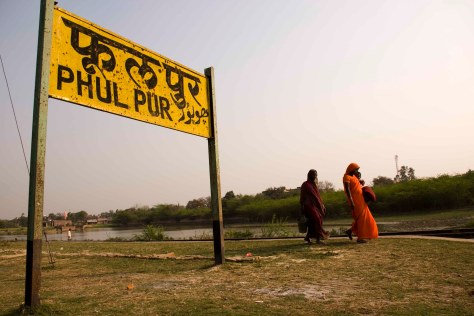
Seeing UP from Phulpur

Photograph by Akif Ahmad for Fountain Ink magazine

In which I go to Phulpur, once famous as Nehru’s seat, and do walk-the-talk with village-level workers of the four main political parties in Uttar Pradesh. Here. Continue reading Seeing UP from Phulpur

Welcome to Kerala’s Haven of Ease and Vice — Chengara

Make no mistake — this is not my assessment. I’ve just borrowed it from our Chief Minister, the redoubtable V.S. Achuthananadan, the foremost of (official) revolutionaries in Kerala, whose memories of struggle stretch back right up to the workers’ uprising of the 1940s in south Kerala, the Punnapra-Vayalar, celebrated in communist myth and legend.  In September this year it appeared as if the CPM was ready to negotiate with the protestors, but nothing has really moved. The latter have hung firm in their resolve, it requires a rather strange imagination to read that as evidence for ‘peace and prosperity’ at Chengara. The Congress has now emerged, after much slumber, with support for the struggle, and V.M. Sudheeran, one of the most popular and respected leaders of the Congress, has sharply condemned the CM’s statement (below).

Continue reading Welcome to Kerala’s Haven of Ease and Vice — Chengara