The cast in this short film: Sharma- Rajesh, Mishra- Nishant, Choudhury- Roshan, Dalit- Dinamani
Camera- Babita, Script and Direction- Dinamani (dina_bhim@yahoo.co.in). Special thanks to Anoop for making the office available for the shoot.

The cast in this short film: Sharma- Rajesh, Mishra- Nishant, Choudhury- Roshan, Dalit- Dinamani
Camera- Babita, Script and Direction- Dinamani (dina_bhim@yahoo.co.in). Special thanks to Anoop for making the office available for the shoot.
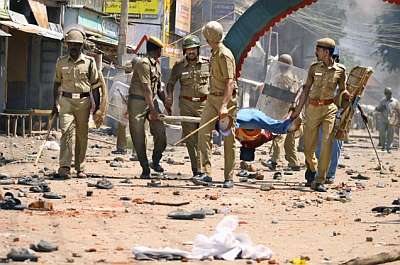
In September last year, the Tamil Nadu police killed six Dalits in a firing incident in Paramakudi town of Ramanathapuram district. This guest post by RAVIKUMAR is a set of six poems on the Paramakudi killings. The English translation by RAVISHANKER is followed by the Tamil original. For more on the incident, see articles in Kafila archives by V. Geetha and Bobby Kunhu and over at Atrocity News, a fact finding report (.pdf).

It is the sort of place you will not find unless you are looking for it. Even if you find the address in Hardevpuri near Shahdara, you will not know where to knock. There is no signboard that will tell you this is Gautam Book Center. “A signboard will attract the attention of those who don’t like our books,” explains AK Gautam.
These are not books of pornography or an underground militia. These are books on caste.
Continue reading Gautam Book Centre
The video above shows a protest in Delhi demanding a Bahujan Lokpal Bill, and protesting against Anna Hazare. This was hardly given any coverage in the media. The video was made and uploaded by KHALID ANIS ANSARI, who writes at the Round Table India:
A supra-parliamentary Jan Lokpal and a very interventionist and unaccountable judiciary are a horror for the dalit-bahujan masses. All said and done the legislature is most respectful of social diversity as far as the three organs of government are concerned. The executive is bad and the judiciary is the worst in this regard. So I am presently in favor of taking the ‘political’ route than the civil society one which is in any way a club of the chattering classes. [Read the full post]
Given below is a note expressing a Dalit-Bahujan perspective on the Lokpal debate. The note has been put out by DINESH MAURYA: Continue reading The Lokpal debate from a Dalit-Bahujan perspective
My own feelings about the Anna Hazare movement are mixed, or you could say confused. I like the way the movement is bringing an arrogant government to its knees, and though I don’t know if their version of the Lokpal Bill is the best way to fight corruption, I appreciate how they have exposed the UPA’s farce of a bill. I get the point that fellow-travellers Nivedita Menon and Aditya Nigam are making about democracy and political movements, but as one unit of ‘the people’, I don’t see why I should support a movement just because it is popular. Perhaps it is my elitism and naivete and cynicism. Or perhaps I’m just confused by now. The taste of the pudding is in the eating, and I’d like to see where this takes us.
While I sort out my confusion, I see a message on Facebook, attributed to Anu Ramdas, that says:

See update below.
So… I get a phone call yesterday. It’s a reporter from the Financial Times who wants to know what I feel about the recent ban on the movie Aarakshan in certain states, and also what do I feel about caste-based reservations in general, whether caste is still relevant in the India of today, the theory that quotas just increase inequality etc.. I tell her I haven’t seen the movie, and if she still wants to know what I feel about caste-based reservations we could talk for a bit. She says she absolutely wants to know. So I say fine, and we have a 45-minute conversation. Allow me to reproduce a very simplified version of that conversation (in Q&A forrmat):
1. Q: Do you believe movies like Aarakshan can be provocative or controversial; as in, are certain groups justified in taking offence and asking for a ban? Continue reading What caste do you think the Financial Times is?
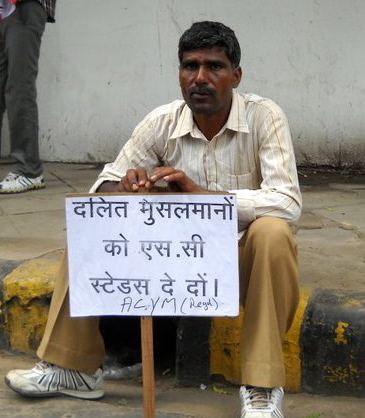
Guest post by S. JAPHET and Y. MOSES
Religious minorities, both Christians and Muslims from different parts of the country have converged in Delhi to demand reservations for Dalit Christians and Dalit Muslims. This is part of a long standing struggle demanding the Government to introduce a bill to amend the constitution to include Dalit Christians and Dalit Muslims in the scheduled Castes list. The Christian community has been agitating since the promulgation of the Presidential Order Government of India 1950 that effectively prevents those professing religions other than Hinduism from being considered as Scheduled Castes. It has been argued that the 1950 Order violates Article 15 that prohibits discrimination on grounds of religion, race or caste and Article 25 that gives the right to all citizens to profess and practise any religion according to his or her choice. The demand is that affirmative action or positive discrimination of dalits, providing reservations in government jobs, educational institutions and representation in Parliament and state legislatures should be extended to all dalits irrespective of whatever religion they may profess and practise. Continue reading The Unending Struggle of Dalit Christians and Dalit Muslims for Equality: S. Japhet and Y. Moses
This note comes via Malarvizhi Jayanth. Those in support can leave a comment saying so, and add their designations to their names, if they wish.
In a footnote in Uproot Hindutva: The Fiery Voice of the Liberation Panthers by Thirmavalavan, MeenaKandasamy describes Ponnar Shankar as dalit. M Loganathan, an advocate from Nanje Goundanpudur and Students Wing Convenor of the Kongu Nadu Munnetra Kazhagam (KMK), has been quoted in news reports as saying that there is evidence proving that Ponnar and Shankar are Kongu Vellala Gounders and claiming that depicting them as Dalits will lead to caste tension. Continue reading ‘Locking up gods within caste’
From here.
This documentary is first in the series of our efforts to document caste-based discrimination prevalent in Indian higher education system resulting in large number of suicides of Dalit students in Indian campuses.
It is based on the testimonies of parents and family members. In next few days, we are coming up with few more documentaries to expose the kind of caste-based hostility and harassment Dalit and Adivasi students have to suffer from the faculties, fellow students and administration in some of the country’s premier educational institutions. These documentaries are part of our efforts to make Indian educational system inclusive in real sense and free from caste-discrimination.
Here’s more on The Death of Merit.
(I am posting a much longer version of my previous article that will also respond to some of the queries and comments. This article is based on my research, field work and interviews in Ralegan Sidhi since 1991.)
This article is focussed mainly on understanding how exactly the rural environmental works in the journey of Anna Hazare and Ralegan Sidhi are articulated within a coherent ideological framework, to acquire their legitimacy and authority, which are fed by, and fed into, some dominant political cultures of the state. Any political theory and practice, built on this framework, can open the possibilities of a strengthening of the conservative and nationalist forces. Certainly, the ideology of a rural organisation or a movement and its appeal is not based on a single plank. In the case of Anna Hazare and his programme, though the developmental and the environmental works form the core of its ideological structures, it includes other issues as well. At times it provides a different scale of activities to its audience, but eventually reinforces its principal ideological framework. Some understanding of the ideological DNA of the green villagers and the fellow environmental travellers also gives us an idea as to what elements of this endeavour and ideology motivate villagers and environmentalists.
The Historical Context of Maharashtra
Anna Hazare and Ralegan Siddhi are not a new addition to the social history of the Maharashtra state. Indeed, the movement has borrowed many features from the historical evolution of the region, and the political culture of the state, with which it negotiates at different levels. There are many factors at play, though three are of prime importance in the context of this paper: (i) nativism and regionalism in Maharashtrian culture and politics (ii) structure and nature of caste and class and (iii) agrarian economy and local environmentalism.
Continue reading The Making of an Authority: Anna Hazare in Ralegan Siddhi
This press release come from the ALL INDIA CONFEDERATION OF SC/ST ORGANISATIONS
New Delhi, April 4, 2011.
Dr. Udit Raj, National Chairman of All India Confederation of SC/ST Organisations, said that corruption has its caste. The way the former Chief Justice of India, K. G. Balakrishnan and former Chief Justice of Karnataka, P.D. Dinakaran, are being treated, there is no doubt that corruption knows the caste. Here argument is not to absolve these people but to expose hypocrisy and double speak. The Supreme Court hastened to admit petition against K.G. Balakrishnan but why not in other cases? Continue reading Corruption has its Caste in the Judiciary: All India Confederation of SC/ST Organisations
Guest post by PAUL DIVAKAR
This was written yesterday, 24 March 2011: Today we witnessed most humiliating, fascist nature of pulverising already vulnerable communities – most of whom are Dalits and backward castes in Gayatri colony near Faridpur of Baljit Nagar. Continue reading Hundreds of lives reduced to rubble in Delhi: Paul Divakar
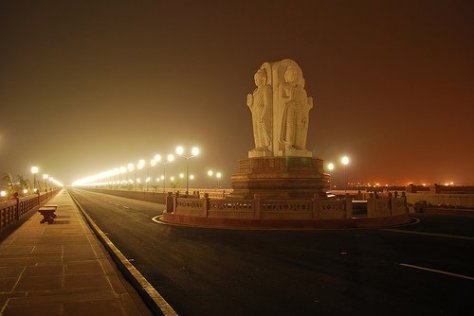
A prominent Dalit academic once told me that when a Dalit entered the seminar room, the rest of them should feel uncomfortable. Given the monumental oppression Dalits face, this should be the least consequence of Dalits getting a voice.
I am reminded of this when I think of Mayawati’s gigantic Dalit memorials that have changed Lucknow’s landscape.
Guest post by BEZWADA WILSON

Over the years, there have been many changes in the Safai Karamchari Andolan movement. The biggest change we have seen has been in the safai karamchari community’s outlook. There was a time when safai karamcharis were ashamed to admit they did manual scavenging. It was not uncommon for even family members to be unaware that someone was involved in the practice of manual scavenging.
Continue reading Why is it so difficult to free India of manual scavenging?
Bhagwan Das (23 April 1927–18 November 2010) legendary Ambedkarite and historian of the dalit movement passed away on 18 November 2010 at the age of 83. Continue reading Bhagwan Das (1927-2010)
Guest post by SUNIL
[Sunil is the national vice-president of Samajwadi Jan Parishad. This article was written for a special issue of Janata weekly. The essay is an important statement from one of the leading activist-theorists of the socialist movement (i.e. non-Marxist socialism) which does not simply disavow the marxist legacy but engages with that experience as an essential component of socialist practice. AN]
The tussle between capitalism and socialism as alternative visions of human society is not yet over. It is like the old fable of the race between a hare and a tortoise. At times one seems to be the winner. At other times the other seems to be leading. Capitalism is like the hare of the story. It looks fast, impressive and dynamic but after some time it is tired and resting with its own contradictions. In the end, we know it is the tortoise of socialism which will prevail. But that end is yet to be arrived at.
Capitalism looked supreme and unchallengeable in the later decades of the past century. With the disintegration of USSR, reverting of China, Vietnam and many other communist countries to the path of capitalism, and downfall of social democracy in Europe, there was no challenge to capitalism. Thus ‘end of history’ was arrogantly announced. Market fundamentalism of Reagan and Thatcher varieties started ruling over the world. But soon many crises arrived. Ecological crisis with the dangers of climate change and global warming on the one hand, and the global financial crisis with the worst recession since the thirties on the other, shook the faith in the supremacy and immortality of capitalist civilization. Added to these were the growing crises of hunger, malnutrition, homelessness, violence and war. The number of hungry people in the world kept growing and crossed the figure of 100 cores in the first decade of the twenty first century i.e. every sixth person on the earth today remains underfed and starved. This is perhaps the biggest and the most glaring failure of capitalism. Even after more than two centuries of the industrial revolution and miraculous progress of science and technology, it is unable to fulfill even the most basic need of the humankind.
A fact-finding report released today by PUCL Uttar Pradesh
Fact Finding Report on the murder of MNREGA and labour activist Shri Hari Lal, Village Lehna, Block Manjhanpur, District Kaushambhi on 15.08.2010
A fact finding committee to investigate the incident was formed with the following: members
The committee visited the site of incident in village Lehna on 21.08.10 .The fact finding committee met the family members of the late Hari Lal, other residents of the village, and workers and officials of Voice of People’s (VOP). The committee also met the district magistrate and spoke to the superintendent of police. The following facts about the incidents came to light through this enquiry:
Background to the Incident
The main issue behind this incident was of MNREGA and payment of labour wages. According to the available evidence, a pond was dug in the village by 250 labourers from the panchayat quota of MNREGA in April, May and June 2007. However, the gram pradhan, Tirath (Dhobi), did not pay the labourers full wages. The gram pradhan is a mere puppet in the hands of a former gram pradhan, Bassan, and his son Fateh and a criminal named Nakkan. Continue reading Godhra, arson, terrorism, stone-pelting, Dalits and Muslims, and other such issues in village Lehna
The Myth of the ‘Misuse’ of Laws Meant for the Protection of Dalits and Tribals
Are the laws meant for the protection of Dalits and tribals are put to misuse?
It is a theme which recurs regularly in the discussions engaged in by the chattering classes of the country. While nobody can deny that frivolous cases are not filed under this act the manner in which the issue gets raised creates an impression that the only ‘use’ of this law is its ‘misuse.’ Neither the polity nor the articulate sections of our society seem ready to go for a reality check. In fact, as a marker of these classes’ ‘sensitivities’ towards this delicate issue, even Ms Mayawati in her earlier incarnations as Chief Minister of UP had cautioned the police about its ‘misuse’. She is also reported to have issued G.Os (government orders) to use this law only in cases of rapes and murders of the Dalits.
Continue reading In Search of Brahmeshwar Singh, ‘the Absconder’
This article by me has appeared (.pdf) in the Economic and Political Weekly.
On 14 April this year party general secretary Rahul Gandhi launched the Congress’ biggest campaign to revive itself since 1989. The date was carefully chosen, Ambedkar Jayanti, because he is trying to win over dalit votes in Uttar Pradesh (UP). In 1989 the Congress’ support base in UP was made up of a rainbow coalition of brahmins, Muslims and dalits. The Congress has to woo these communities again to regain power in UP.
The brahmin community took to the now ruling Bahujan Samaj Party (BSP) in small numbers in the 2007 Vidhan Sabha election primarily because there was no strong brahmin leader after Bharatiya Janata Party (BJP) leader Atal Behari Vajpayee became politically inactive. Brahmins see in Rahul Gandhi a potential “brahmin” leader. The UP Congress president, legislative leader and Youth Congress president in the state are all from the brahmin community.
Muslim support is no longer enchained to the Samajwadi Party (SP) because their bete noire, the BJP, is powerless these days in both the centre and the state. As a result the Muslim vote is being fought for, as a three-way contest between BSP, SP and Congress. BSP head and Chief Minister Mayawati’s stratagem is to therefore change her party’s core support base constructed out of the “brahmin-dalit” alliance into a Muslim-dalit alliance.
The dalits, wooed away en masse by the Kanshi Ram-Mayawati duo of the BSP for years, would be the hardest to win back for the Congress. In fact, a year ago the very idea would have sounded ludicrous. But today, Mayawati’s angry reaction to the Congress’ bid to woo dalits is indication that the Congress may be winning over dalits. How is this happening? Continue reading Rahul Gandhi and the Dalit votebank in Uttar Pradesh

The Congress Party will use the occassion of Ambedkar Jayanti tommorow to reach out to UP’s Dalits. Commenting on this, NDTV says, “Mayawati, who knows a thing or two about appropriating the Dalit legacy, is going on the offensive as well.”
Appropriating? Hello! You mean to say Rahul Gandhi is a Dalit and Mayawati a half-Italian, one-fourths Parsi and one-fourth Kashmiri Pandit, trying to pass off as an Allahbad Brahmin and collecting Dalit votes on the side?
Of course there will be other memorable celebrations, but they won’t be as ‘news-worthy’.
(A Fact Finding Report issued by Nagrik Adhikar Manch and Yuva Samvad.)
(The situation in the Gadarwara Sub Division of District.Narsinghpur (MP) has been in a state of constant flux since last 3-4 months. The Dalits living in the villages adjoining Gadarwara have been condemned to a life of fear and intimidation.Their human rights and dignity are being at stake.
Obviously there is a concrete reason behind this sudden spurt in violence against them.They have refused to remain subservient to the interests of the upper/dominant castes and have decided to speak up.
Instead of taking concrete steps to guarantee the human rights of dalits granted to them under constituion, the administration has preferred to remain silent or at best supportive of the interests of the dominant castes only. One can easily see why Madhya Pradesh happens to be the state which tops the list of atrocities on tribals and stands second when it comes to cases of atrocities against dalits.)
Dist: Narsinghpur(Madhya Pradesh)
Tehsil: Gadarwara
Affected Area: Dalits (Ahirwar community) in Gadarwara and adjoining villages
Villages visited by the Fact Finding Team: Nander, Madgula, Devri and Tekapar
Date: 7th and 9th November 2009
Members of Fact Finding Team
Jai Bhim, Moolchand Ahirwar, Javed, Skand Shukla, Manoj, Satyam, Shivkumar, Nishant Kaushik
Brief Introduction to Narsinghpur District. Continue reading Social Boycott of Dalits in MP: Uncivil Society, apathetic administration
 KAFILA - COLLECTIVE EXPLORATIONS SINCE 2006