Tag Archives: Democracy

Democracy For The Few ?

Is Bihar being turned into a test case of disenfranchising people?

Representational Image. Image Courtesy: Flickr

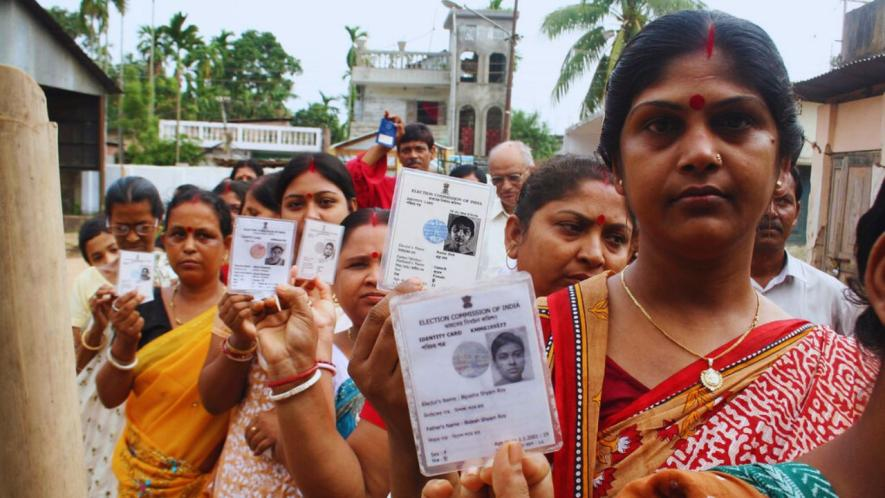
India pledged to usher in a democracy with universal adult franchise.

It was the late 1940s, when India, a newly independent nation, whose less than 10% population was then literate, embarked on this unique experiment, unheard of in those times.

The architects of Independence rejected all the Western prescriptions that openly said that .’.. India had no democratic future‘ (Winston Churchill) or ”monarchial arrangement best suited the Asian people‘ (British Prime Minister Clement Attlee to Nehru, 1949), and (to quote a student of history) ‘met the imperial argument on direct terms, firmly believing in the possibility of creating democratic citizens through democratic politics.’ (India’s Founding Moment: The Constitution of a Most Surprising Democracy by Madhav Khosla)

What is worth emphasising is that all those great leaders who shaped a forward-looking Constitution were on the same page when it came to granting the right to vote. For example, B.R Ambedkar, who was chairman of the Drafting Committee of the Constitution, firmly believed that ‘To limit the franchise, was to misunderstand the meaning of democracy ... ‘

None of them dithered over this provision despite knowing well that even the Western countries had not fully adopted universal adult franchise. Remember, Switzerland granted the right to vote to women only in 1971.

Much water has flown down the Ganges, the Jhelum, the Brahmaputra, the Godavari or the Kaveri.

A good 75 years after the adoption of the Constitution (1950), today we are faced with a challenge that at first looks unbelievable, the present ruling dispensation seems to have embarked on a journey in an exactly reverse direction. [Read the full article here : https://www.newsclick.in/democracy-few]

Anti-Colonial Constitutionalism and the Defence of India’s Democracy

Democracy Dialogues Series 37

Organised by New Socialist Initiative
Theme : Anti-Colonial Constitutionalism and the Defence of India’s Democracy

Speaker : Prof Sugata Bose

Gardiner Professor of Oceanic History and Affairs, Harvard University, ex Member of Parliament

Continue reading Anti-Colonial Constitutionalism and the Defence of India’s Democracy

Democracy and the Logic of Capitalism: The recent Indian Experience – Professor Jayati Ghosh

Democracy Dialogues Lecture 34 :

Speaker: 

Professor Jayati Ghosh

Professor of Economics at the University of Massachusetts Amherst

Time and Date

Sunday, 17 th November 2024l, at 6 PM (IST)

Topic : ‘Democracy and the logic of capitalism: The recent Indian experience

Abstract :

Many analyses of the recent erosion of democracy in India have dwelt on political and social forces. I will examine the role of economic forces unleashed by a particular form of capitalist development, and how they may have contributed to this process in recent decades.

About the Speaker

Professor Jayati Ghosh, Professor of Economics at the University of Massachusetts Amherst,  a member of the Club of Rome’s Transformational Economics Commission and Co-Chair of the Independent Commission for the Reform of International Corporate Taxation, Formerly a Professor with the Centre for Economic Studies and Planning, JNU, Delhi, has also worked as a Consultant with the Planning Commission of India. Recipient of many awards including UNDP Award for Excellence in Analysis 2005, she has authored- co edited  around twenty books on Economics.

Here is a list of a few of her recent books :

-Women, Gender and Work (Volume 2): Social choices and inequalities, (volume coedited with Mark Lansky, Dominique Meda and Uma Rani, 2016, Geneva: International Labour Office.

-Interpreting the World to Change It: Essays for Prabhat Patnaik (volume co-edited with C. P. Chandrasekhar), New Delhi: Tulika books, 2017.

– Demonetisation Decoded (with Prabhat Patnaik and C. P. Chandrasekhar) New Delhi: Routledge Taylor and Francis India, 2017.

– Indian Banking: Current challenges and alternatives for the future, AIBOC, Chennai, 2018.

– Informal Women Workers in the Global South: Policies and Practices for the Formalisation of Women’s Employment in Developing Economies, (edited volume) Routledge, 2020

– The making of a catastrophe: The Covid-19 pandemic and the Indian economy, New Delhi: Aleph Book Publishing, Forthcoming 2021.

– Development: A collection of articles from the International Labour Review, ILO Centenary Volumes, Geneva: ILO, forthcoming 2021 (co-edited with Uma Rani)

Stop ‘Pooja Archana’, Bow Before Preamble in Court Premises

Towards 75 years of adopting the Constitution, it is time for a new beginning.

‘Secularism is the religion of humanity …. It is a protest against theological oppression, against ecclesiastical tyranny, against being the serf, the subject or slave of any phantom, or of the priest of any phantom. “

– Robert Green Ingersoll

Simple ideas are perhaps the most difficult to implement.

For a country of around 1.4 billion, which has witnessed internecine violence on religious lines at the time of Independence, and which has turned a new leaf by adopting a Constitution based on secularism, which abhorred even mentioning the word God, why it is still difficult to avoid religious rituals in public domain, at least in the precincts of the courts?

Continue reading Stop ‘Pooja Archana’, Bow Before Preamble in Court Premises

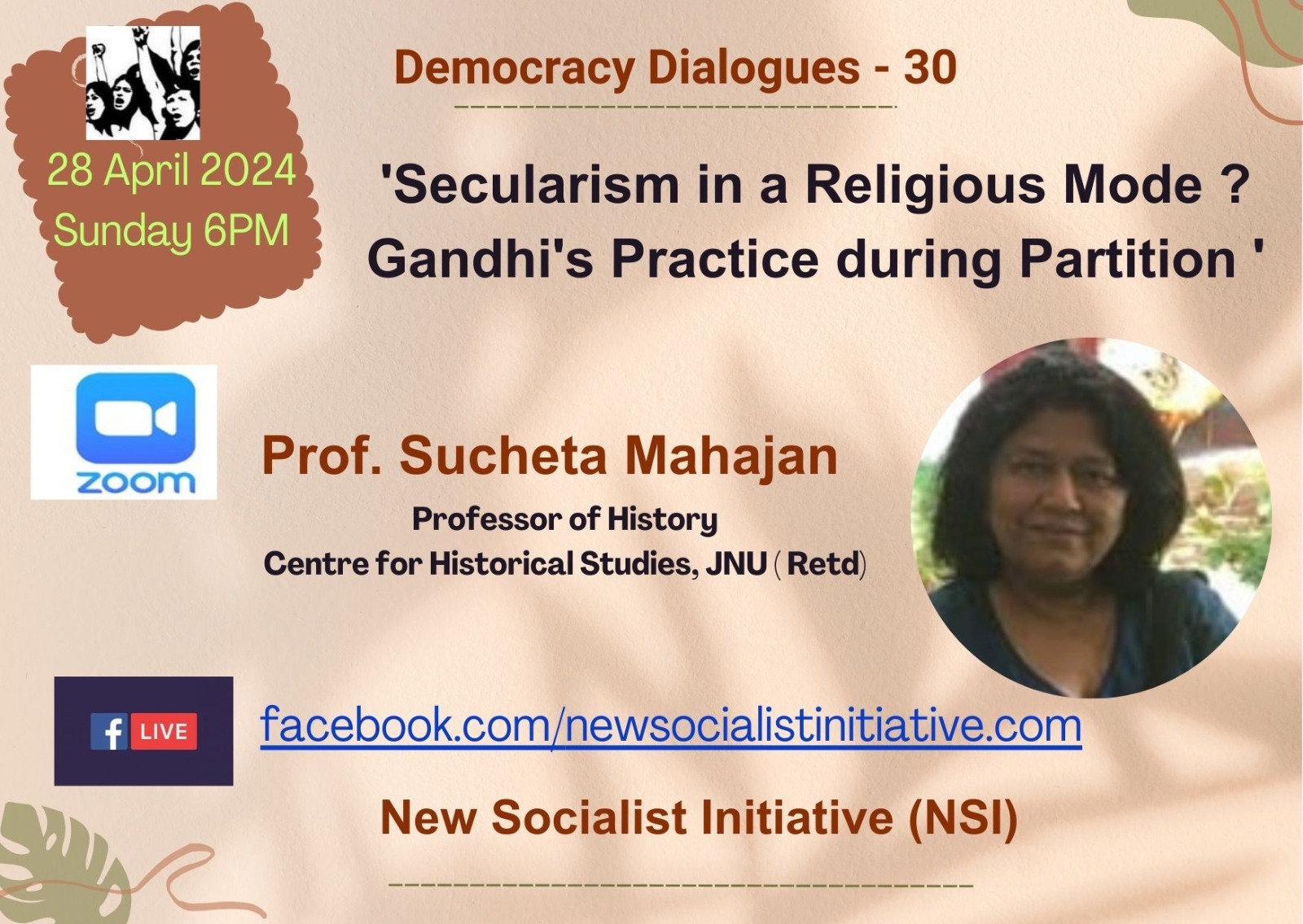
Secularism in a Religious Mode ?-  Gandhi’s Practice during Partition : Prof Sucheta Mahajan

Democracy Dialogues Lecture 30 :

Speaker: 

Professor Sucheta Mahajan

Centre for Historical Studies, JNU ( retd)

Date: Sunday, 28 th April, at 6 PM (IST)

Theme :

‘Secularism in a Religious Mode ?-  Gandhi’s Practice during Partition ‘

Join Zoom Meeting
https://us02web.zoom.us/j/81056829791?pwd=VnRpK2xtWDA3elArZGR5WnN0MGNDdz09

Meeting ID: 810 5682 9791
Passcode: 433470

The lecture will be live on facebook.com/newsocialistinitiative.nsi

Abstract :

The talk looks at the practice of Gandhi in his struggle against communalism in the years leading up to Partition. 

This is a hugely controversial subject with polarised positions taken by his followers and critics. 

The perspective of the talk emerges from Gandhi’s oft quoted but not heeded statement, My Life is My Message. The talk is a reading of a life text in this sense: Gandhi’s mission in Noakhali to mend the social fabric torn by communal riots and spread of communal ideology.

Gandhi’s search for a way out may offer some insights to those sharing his concern for a secular, plural society and polity today.

About the Speaker :

Professor at the Centre for Historical Studies, Jawaharlal Nehru University, till the end of February 2023, Professor Mahajan has been visiting professor and Fellow at different International and National  Institutions.

She was member of the prestigious international research projects such as SPECTRESS and CHCI-MELLON Crises of Democracy, Global Humanities Institute. She has authored and edited many books on India’s Independence Struggle, Partition, Challenge of Communalism, Composite Culture etc

Publications :

Towards Freedom: Documents on the Movement for Independence in India, 1947, Parts One
and Two, (edited and with an Introduction) OUP, 2013 and 2015.
Education for Social Change: MVF and Child Labour, National Book Trust, New Delhi, 2008.
RSS, School Texts and the Murder of Mahatma Gandhi- The Hindu Communal Project (with
Aditya and Mridula Mukherjee) Sage Publications, 2008.
Composite Culture in a Multi-Cultural Society (Co-edited with Bipan Chandra), Pearson India & National Book Trust, New Delhi, 2006. 
Rites of Passage, A Civil Servant Remembers: H.M. Patel, (ed.), Rupa & Co., New Delhi,2005.
Independence and Partition: The Erosion of Colonial Power in India, Sage Publications, New Delhi, 2000. 


How India Wants to Whitewash Its Democracy Image

It was the early part of last year when the chorus of India as ‘mother of democracy’ gathered pace.

The summit for Democracy held in March, witnessed PM Modi in his virtual address sharing his pearls of wisdom as India being “indeed the mother of Democracy” citing reference to Vedas and Mahabharata

Delegates who arrived for the G 20 summit in Delhi were similarly greeted with the slogan Welcome to the ‘Mother of Democracy’ ( -do-)

Rightwing think tanks were not behind to project India’s past experience in its very own Indic Democracy despite proofs to the contrary.

Continue reading How India Wants to Whitewash Its Democracy Image

Democracy and Religion in Modern India: Critical and Self-critical Reflections – Prof Rajeev Bhargava

Professor Rajeev Bhargava, noted political theorist will be delivering the 29th Democracy Dialogues Lecture on Sunday, March 31, 2024 at 6 PM ( IST)

Please reserve the time and date for the lecture. Details are given below

Democracy Dialogues Lecture 29:

Speaker: Professor Rajeev Bhargava

Date: Sunday, March 31, 2024, at 6 PM IST

Theme: 

Democracy and Religion in Modern India: Critical and Self-critical Reflections – Prof Rajeev Bhargava

– New Socialist Initiative

Abstract:

“It is widely accepted that ‘secular’ is an alien category in India. This is too simplistic a view. But even if we agree with it, how come no one has asked if ‘religion’ is alien to India? My claim is that it is or at least it is as foreign to India as secular is. What are the implications of this thesis? What have been the consequences of religionization on Indian society and polity? How has it shaped Indian democracy?  In my presentation, I shall expand these views and show why India  needs secularism and in what form.”

About the speaker :

Renowned political theorist and former director of  Centre for the Study of Developing Societies ( CSDS), Delhi Prof Rajeev Bhargava is currently an honorary fellow at the Centre and the director of its Parekh Institute of Indian Thought. He has taught at the University of Delhi and Jawaharlal Nehru University (Delhi) and has lectured, taught and held visiting professorships at several international universities. 

Prof Bhargava’s work on individualism and secularism is internationally acclaimed. His publications include Individualism in Social Science (1992), What Is Political Theory and Why Do We Need It? (2010) and The Promise of India’s Secular Democracy (2010). His edited works include Secularism and Its Critics (1998), Politics and Ethics of the Indian Constitution (2008) and Politics, Ethics and the Self: Re-reading Hind Swaraj (2022), Bridging Two Worlds : Comparing Classical Political Thought and Statecraft in India and China (2023) 

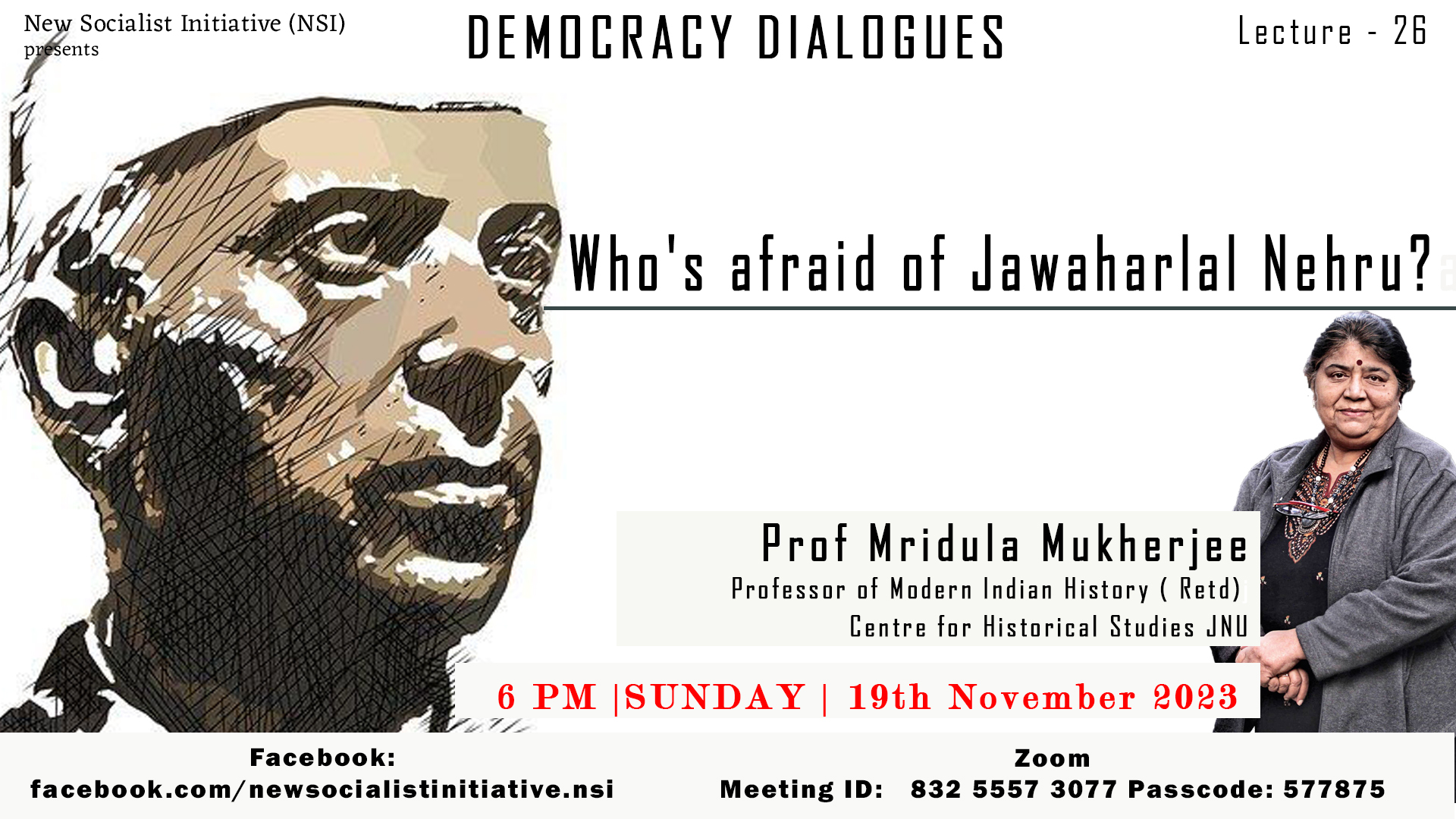
‘Who’s Afraid of Jawaharlal Nehru?’ Mridula Mukherjee – Lecture notice

Professor Mridula Mukherjee, Professor of Modern Indian History ( Retd), Centre for Historical Studies, JNU, will be delivering the 26 th Democracy Dialogues Series lecture on Sunday, 19 th November 2023 at 6 PM (IST).

Theme :
Who’s Afraid of Jawaharlal Nehru?
Time: Nov 19, 2023 06:00 PM India

Join Zoom Meeting
https://us02web.zoom.us/j/83255573077?pwd=RXdiblVjcWZaeDdqVmJaSjI3aW9Qdz09

Meeting ID: 832 5557 3077
Passcode: 577875

Also live streamed at: facebook.com/newsocialistinitiative.com
——————
Theme : 
‘Who’s Afraid of Jawaharlal Nehru?’

Summary :
In his lifetime, Jawaharlal Nehru was recognized the world over as a statesman and an Indian leader second only to Gandhiji. A foremost leader of the freedom struggle, who gave it a decided socialist orientation, he remained unrivaled as Prime Minister after independence and built the solid foundations of a sovereign, secular, democratic, and egalitarian republic. He evolved the concept of non-alignment which enabled many ex-colonial countries to avoid becoming a part of the two power blocs engaged in the Cold War.

However, he is today the favourite whipping boy of the establishment.  We are told he was responsible for the partition, for the mess in Kashmir, for the death of Subhash Bose, for delaying the integration of Hyderabad, and of Goa, for the defeat at the hands of China in 1962, for neglecting agriculture, and primary education, and much else. The reason for the defamation is of course that he stood for the exact opposite of what is valued today. His life and work present a continuous question mark to the regressive trends in fashion.

This will become evident as we focus in the talk especially on two areas of great relevance today in which we are facing a grave crisis: Democracy and Civil liberties, and Communalism/Secularism. We will also focus attention on Nehru’s evolving understanding of  Mahatma Gandhi’s vision and method of non-violent struggle, of which he became the most ardent advocate after his death.

Speaker :

Author of many books, Prof Mukherjee has been a visiting Scholar at Duke University, USA, and at the Institute of Oriental Culture, University of Tokyo and was also Director of Nehru Memorial Museum and Library, ( NMML), New Delhi.
She has published widely in the areas of agrarian history, peasant movements, social movements and the Indian national movement.

Here is a list of a few of her publications :
Colonializing Agriculture, The Myth of Punjab Exceptionalism Sage (2005) ;  Peasants in India’s Non Violent Revolution : Practice and Theory (Sage 2004).

This list also includes India’s Struggle for Independence (1999) and India After Independence 1947–2000 (2000), RSS, School Texts and the Murder of Mahatma Gandhi The Hindu Communal Project (2008) co-authored with Prof Bipan Chandra and others.

When Does Democracy Undermines Itself : Dr Ravi Sinha

Dear Friends

New Socialist Initiative ( NSI) South, recently organised two lectures by one of its senior Comrades Dr Ravi Sinha in Hyderabad. 

First lecture was on ‘Fascism and Democratic Polity : How Did India Land in This Crisis ?‘ and the second lecture was on ‘When Does Democracy Undermines Itself ?

Here is a YouTube Link of the second lecture. We had already shared YouTube link of the first lecture earlier

We will appreciate it very much if you are able to share your views / comments with us

Topic – When Does Democracy Undermines Itself

Speaker – Dr Ravi Sinha

Date : 19 th February 2023

Venue: Sundarayya Vignana Kemdram

Hyderabad

Organised by : New Socialist Initiative (South)

Fascism and Democratic Polity : How Did India Land in This Crisis ? – Dr Ravi Sinha

New Socialist Initiative ( NSI) South, recently organised two lectures by one of its senior Comrades Dr Ravi Sinha in Hyderabad. 

First lecture was on ‘Fascism and Democratic Polity : How Did India Land in This Crisis ?‘ and the second lecture was on ‘How Does Democracy Undermines Itself ?

Here is a YouTube Link of the first lecture.

Topic – Fascism and Democratic Polity : How Did India Land in This Crisis

Speaker : Dr Ravi Sinha

Date : 17 th February 2023

Place : Tarnaka, Hyderabad

Organised by : New Socialist Initiative ( South)

Challenges to India’s Democracy : Prof Zoya Hasan

Prof Zoya Hasan, Professor Emerita, Jawaharlal Nehru University and Distinguished Faculty, Council for Social Development, New Delhi, will be delivering the 16 th lecture  in the Democracy Dialogues Series, organised by New Socialist Initiative, at 6 PM, (IST) Sunday, 27 th March, 2022.

She will be speaking on ‘Challenges to India’s Democracy

Prof Zoya Hasan has written and edited many books on state, political parties, ethnicity, gender and minorities in India and society in north India and has been a visiting Professor to the Universities of Zurich, Edinburgh and Maison des Sciences de L’Homme, Paris.

Her most recent publications include Forging Identities : Gender, Communities And The State In India ( edited) ,  Agitation to Legislation – Negotiating Equity and Justice in India ,   Congress after Indira: Policy, Power and Political Change (1984–2009), Politics of Inclusion: Castes, Minorities and Affirmative Action, (2009) and a collection of essays titled Democracy and the Crisis of Inequality

Abstract

Challenges to India’s Democracy

The 75th anniversary of Indian Independence is a landmark event in the history of our democracy. It is for this reason a significant moment to assess the state of India’s democracy. As the largest democracy in the non-western world, India is a success story. Its success, however, has primarily been recognized as an electoral democracy, with regular free and fair elections registering high voter participation, and also peaceful transfer of power. Elections certainly are a climactic moment of the democratic process but by no means the only important one. Politics between elections is central for understanding the challenges facing Indian democracy, and it is important, therefore, to contextualize democracy.

Three years since the Bhartiya Janata Party government was re-elected has seen the consolidation of the process begun in 2014 – the establishment of a Hindu state. This process has been facilitated by the combination of majoritarianism and authoritarianism which has resulted in democracy becoming thinner, not accidentally, but deliberately. This does raise certain questions about the relationship between Hindu nationalism and democracy which seems to weaken the idea of democracy moderated by institutions. 

This paper tries to make sense of these shifts through a thematic exploration of the trajectory of Indian democracy since 2014 focusing on three overlapping developments -the consolidation of a majoritarian brand of politics, the decline of independent institutions and the shrinking space for political dissent and protests -which has undermined democracy. Each of these issues distinct and significant in its own right when taken together constitutes a major risk to Indian democracy. However, public protests in the last few years have emerged as a major bulwark against authoritarian rule and the erosion of democratic dissent. For the Opposition it’s a moment of reckoning but there are signs of churning among the Opposition as well.

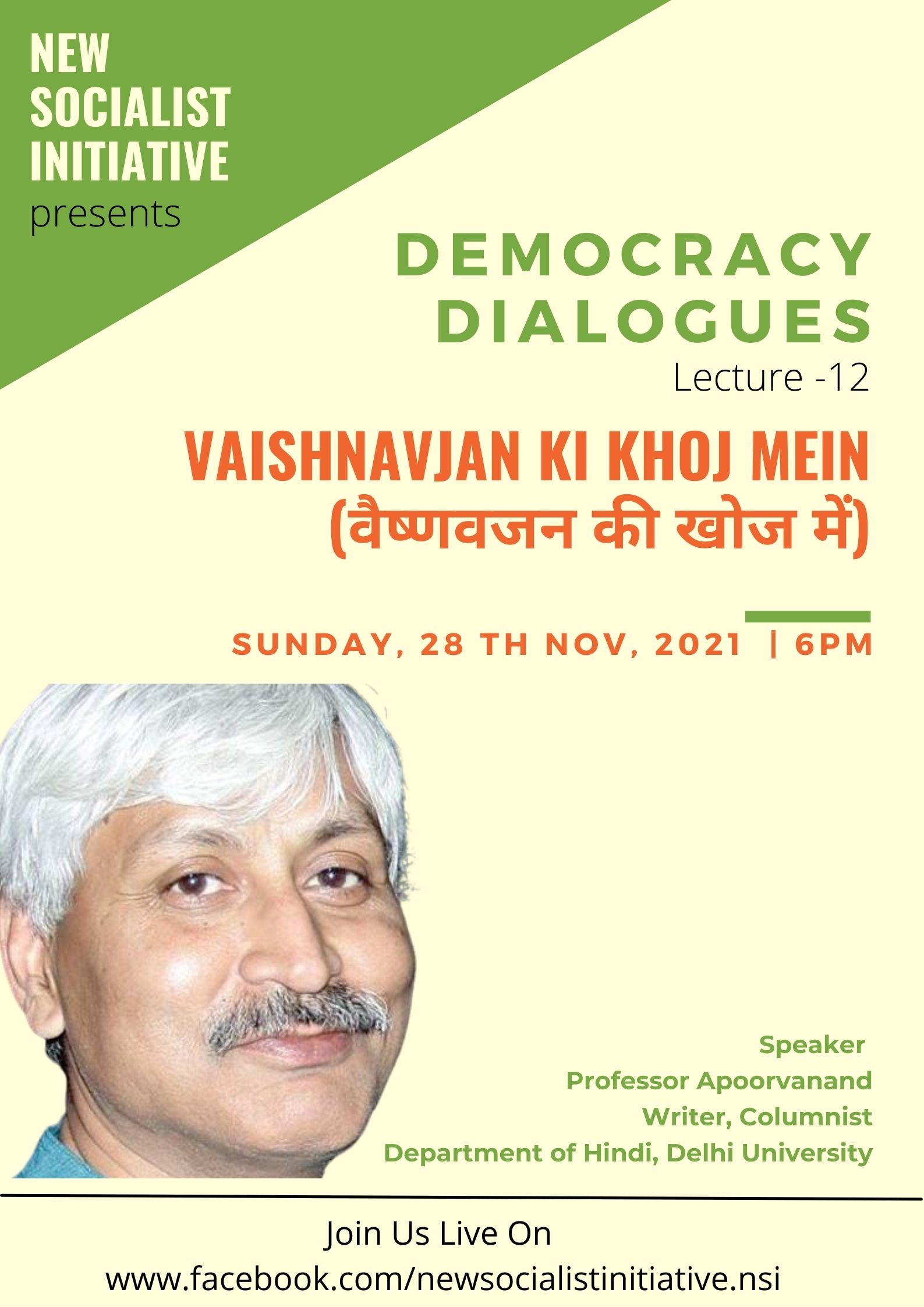
वैष्णवजन की खोज में : अपूर्वानंद

न्यू सोशलिस्ट इनिशिएटिव की तरफ से आयोजित ‘डेमोक्रेसी डायलॉग्स सीरीज ‘  का 12 वां व्याख्यान अग्रणी लेखक, स्तम्भकार, दिल्ली विश्वविद्यालय में हिंदी विभाग से सम्बद्ध  प्रोफेसर अपूर्वानंद 6 बजे शाम, रविवार, 28 नवम्बर 2021 को प्रस्तुत करेंगे। 

विषय : ‘वैष्णवजन की खोज में’ 


वैष्णवजन  की  कल्पना को राजनीतिक और सामाजिक पटल पर स्थापित करने का श्रेय गाँधी को है। इस बात पर  ध्यान जाना चाहिए  कि उपनिवेशवाद विरोधी आंदोलन में या राष्ट्र की स्वतंत्रता  के संघर्ष में गाँधी ने  वैष्णवजन को संभवतः इस आंदोलन के लिए  आदर्श आंदोलनकारी के रूप में पेश किया। वह कैसा जन है? पीर और पराई , इन दोनों से उसका रिश्ता क्या होगा? और क्यों  एक सच्चा जनतांत्रिक जन वैष्णवजन ही हो सकता है? हमारे संविधान की प्रस्तावना में हम भारत के लोग जिस यात्रा पर निकले हैं क्या वह इस  वैष्णवजनत्व की तलाश की यात्रा है?”

हिंदी तथा अंग्रेजी  अख़बारों तथा अन्य प्रकाशनों में  तथा  टीवी की चर्चाओं में अपनी निरंतर सशक्त उपस्थिति दर्ज करते रहने वाले प्रोफेसर अपूर्वानंद सार्वजनिक जीवन में न्याय, समता  और तार्किकता के पक्ष में अपने सक्रिय हस्तक्षेप के लिए जाने जाते हैं .

आप ने कई किताबें भी लिखी  हैं, जिनमें से कुछ के शीर्षक इस प्रकार हैं : ‘सुंदर का स्वप्न ‘ ( वाणी प्रकाशन, 2001 ) , ‘साहित्य का एकांत’ ( वाणी प्रकाशन , 2008 ), The Idea of University ( Context, 2018 ) , Education at the Crossroads ( Niyogi Books, 2018 )

व्याख्यान फेसबुक पर live होगा  : facebook.com/newsocialistinitiative.nsi

अगर आप zoom पर जुड़ना चाहते हैं तो हमें democracydialogues@gmail.com पर लिखें 

If Comment is Free, Why are Dissenters Being Locked Up?

THE STATE LOOKS THE OTHER WAY ONLY WHEN RIGHT-WING FOOTSOLDIERS TARGET INNOCENT PEOPLE AND PROVOKE VIOLENCE.

If Comment is Free, Why are Dissenters Being Locked Up?

A foreigner, returning from a trip to the Third Reich,

When asked who ruled there, answered:

Fear…

The Regime, Bertolt Brecht.

Those occasions on which judicial verdicts bring cheer are getting rarer. As everyone who supports gender justice rejoices over the victory of senior journalist Priya Ramani in the defamation case filed against her by ex-minister MJ Akbar, it is also time to get excited over another judgement passed in another court.

In an ambience in which dissent is increasingly criminalised, this judgement by a Delhi court, which grants bail to two people accused of posting “fake” videos related to the ongoing farmer movement, is also a breath of fresh air.

The prosecution argued that these videos—which seemed to express discontent among police officers against the government—could create disaffection against the government. Instead of agreeing, the judge hearing the case handed out a tutorial to the government as to when the law on spreading disaffection is actually to be applied.

The law, the prosecution was told, can be invoked only when there is a “call to violence”. The judge underlined that the law to punish sedition is an important instrument to maintain peace and order, and it cannot be invoked to quieten disquiet while pretending to muzzle miscreants.

Any student of law knows that the judge’s declarations resonate with two historic judgements delivered by the highest court of the country, namely the Kedarnath Singh vs State of Bihar ruling from 1962 and the Balwant Singh and Bhupinder Singh vs State of Punjab government case from 1995, which specifically emphasise that the charge of sedition can be used only when violence is invoked or where there are attempts to create disorder.

( Read the full text here)

दाव पर केवल कुछ किसान या किसानी ही नहीं, पूरी अर्थव्यवस्था और लोकतंत्र हैं : राजेन्द्र चौधरी

Guest post by RAJINDER CHAUDHARY

कई लोगों को यह गलतफहमी है कि नए कृषि कानूनों से केवल किसान और वो भी केवल पंजाब के किसान परेशान हैं. दिल्ली की सिंघु सीमा से आन्दोलन स्थल के फोटो जिनमें सिक्ख किसानों की भरमार होती है, को देख कर यह गलतफहमी किसी भी अनजान व्यक्ति को हो सकती. यह भी सही है कि सड़कों पर जिस तादाद में पंजाब/हरियाणा/उत्तर प्रदेश के किसान आये हैं उस पैमाने पर शेष भारत से किसान इन कानूनों के खिलाफ होने के बावजूद सड़कों पर नहीं आये हैं. ऐसा दो कारणों से हुआ है. एक तो ये कानून केवल अंग्रेजी में उपलब्ध हैं. इस लिए देश के ज़्यादातर किसान स्वयं तो इन को पढ़ ही नहीं पाए. दूसरा मीडिया में केवल एमएसपी या न्यूनतम समर्थन पर खतरे का मुद्दा ही छाया रहा, जिस के चलते ऐसा प्रतीत हुआ कि केवल यही खतरा मुख्य है. अब जिन किसानों को वैसे भी आमतौर पर न्यूनतम समर्थन मूल्य से कम पर फसल बेचनी ही पड़ती है, उन को यह लगना स्वाभाविक ही है कि इन कानूनों से उन्हें कोई विशेष नुकसान नहीं होने वाला.

परन्तु इन कानूनों को पढ़ सकने वाला कोई भी व्यक्ति जान सकता है कि दाव पर केवल एमएसपी नहीं है. और खतरा न केवल करार कानून के तहत हुए समझौतों से कम्पनियों के मुकर जाने का है. करार खेती कानून धारा 2 (डी), धारा 2 (जी) (ii), धारा 8 (ख) और सरकार द्वारा सदन में रखे गए बिल के पृष्ट 11 पर दिए गई कृषि मंत्री के ‘कानून के उदेश्यों एवं कारणों’ पर प्रकाश डालते हुए वक्तव्य से यह शीशे की तरह स्पष्ट है, भले ही मीडिया में यह मुद्दा पूरे जोरशोर से नहीं आया, कि अब कम्पनियां न केवल खेती को अप्रत्यक्ष रूप से नियंत्रित करेंगी अपितु सीधे सीधे स्वयं खेती भी कर सकेंगी. एमएसपी पर संकट से भी बड़ा संकट यह है कि इस कानून के लागू होने के बाद ज़मीन भले ही किसान की रहेगी पर खेती कम्पनियां करने लगेंगी.

Continue reading दाव पर केवल कुछ किसान या किसानी ही नहीं, पूरी अर्थव्यवस्था और लोकतंत्र हैं : राजेन्द्र चौधरी

Mass Politics and ‘Populism’ in the World of Indian Languages

Image courtesy Netherlands Institute for Multiparty Democracy

The label ‘populism’ has acquired unprecedented currency lately and is used to indiscriminately describe such a wide range of poliical figures and political tendencies that it seems to have lost all conceptual meaning. In the best of times, it was always a slippery concept that has been linked to democracy at one end and fascism at the other. On the one hand, it is seen as the democratic ‘excess’ that escapes the attempt of liberal-representative institutions to rein it in; on the other, it is seen as being of a piece with the fascist resort to antipolitical demagoguery and the rhetoric of the (national) ‘underdog’ oppressed by an elite (usually with international links).
The way the term is used these days to describe everyone from a Donald Trump, a Recep Erdogan or a Narendra Modi on the one hand, to the late Hugo Chavez, Evo Morales, Rafael Correa or even Bernie Sanders or Podemos and Syriza, on the other, defies all logic. What possible common denominator can one find between such diverse figures and political formations? That common denominator is simply ‘the people’ or the ‘underdog’ that they invoke – even if in completely different ways.

Continue reading Mass Politics and ‘Populism’ in the World of Indian Languages

करोना से ग़लत सबक़ लेना घातक हो सकता है : राजेन्द्र चौधरी

Guest post by RAJINDER CHAUDHARY

पिछले दिनों हम ने ‘करोना के कुछ ज़रूरी सबक़’ पर चर्चा की थी. पर बड़ी संभावना यह है कि करोना के आधे अधूरे या गलत सबक निकाले जाएँ.  इस के लिए भी हमें तैयार रहना चाहिए.

बिलकुल गलत सबकों पर आने से पहले, कुछ संभावित आधे अधूरे सबकों की चर्चा कर लें. निश्चित तौर पर करोना के बाद की दुनिया में वैश्वीकरण ढलान पर होगा; अब आर्थिक वैश्वीकरण बढ़ने के स्थान पर घटेगा. विशेष तौर पर दवाइयों और स्वास्थ्य सेवाओं से जुड़ी वस्तुओं के मामले में राष्ट्र आत्मनिर्भर होने की कोशिश करेंगे; करनी भी चाहिए पर यह अधूरा निष्कर्ष होगा. केवल स्वास्थ्य सम्बन्धी मामलों में ही नहीं, बल्कि जहाँ तक संभव हो हर मामले में आत्मनिर्भर होने की कोशिश होनी चाहिए. इस से भी आगे बढ़ कर यह आत्मनिर्भरता केवल राष्ट्रीय स्तर पर न हो कर स्थानीय स्तर पर भी होनी चाहिए.

Continue reading करोना से ग़लत सबक़ लेना घातक हो सकता है : राजेन्द्र चौधरी

Desirable Deaths, Malignant Neglect

Coronavirus reveals that in the capitalist world there is still no such thing as society.

Coronavirus

Bella Ciao! Bella Ciao! A song which traces its origins to the struggles of working women (rice-weeders) in 19th-century Northern Italy, and which later became an anthem of anti-fascist struggles there, recently made a comeback on the streets of Rome.

Well, there was no mass gathering, obviously, but you could hear people’s voices sing not only Bella Ciao from windows and balconies but many other patriotic numbers, some newly-composed.

With the world’s eighth-largest economy under lockdown, people restricted to their homes and fatalities due to novel coronavirus already over 1,400, this collective singing was the Italian people’s way of finding a moment of joy in this time of anxiety. It “lifted their spirits” and became a unique way for them to declare solidarity with each other.

( Read the full story here : https://www.newsclick.in/Coronavirus-Crisis-Capitalist-Society-Public-Funded-Health-System)

Lessons from Ambedkar and Gandhi to take forward

They represented two foundational but antagonistic visions of “what we as a society, what we as a state should embody”

( Review of ‘Radical Equality: Ambedkar, Gandhi, and The Risk of Democracy’ By Aishwary Kumar Navayana, Rs 599)

The book, Radical Equality: Ambedkar, Gandhi, and the Risk of Democracy by Aishwary Kumar, takes forward the conversation around the two “most formidable non-Western thinkers of the twentieth century, whose visions of moral and political life have left the deepest imprints”.

In the early 1990s D.R. Nagaraj published The Flaming Feet, a compilation of his essays in which he admired both Gandhi and Ambedkar. Coming close on the heels of the phenomenon of Dalit assertion, it argued that “there is a compelling necessity to achieve a synthesis of the two”. But that has not been the only attempt to examine how the ideas of these two leaders interacted, challenged each other, and how they extended or revisited the meanings of different concepts.

The book, Radical Equality: Ambedkar, Gandhi, and the Risk of Democracy by Aishwary Kumar, takes forward the conversation around the two “most formidable non-Western thinkers of the twentieth century, whose visions of moral and political life have left the deepest imprints”. For the author they “exemplified two incommensurable ways of forging a relationship between sovereignty and justice, force and disobedience”, or represented two foundational but antagonistic visions of “what we as a society, what we as a state should embody”.

Focusing mainly on Hind Swaraj — a monograph written by Gandhi on a ship to South Africa from London (1909) — and Annihilation of Caste, which happens to be the undelivered speech by Dr Ambedkar when he was invited by the Jat Pat Todak Mandal, Lahore (1936) — the organization rescinded the invite when it came across the ‘radical’ proposals he had put forward in the draft — this around 400-page book discerns “an insurrectionary element at the limit of politics” in the works of these two stalwarts. It is “an insurrection that sought to extract the political itself — and the social question — from the doctrinal prescriptions and certitude of its European past”

( Read the full text here : https://www.telegraphindia.com/culture/books/lessons-from-ambedkar-and-gandhi-to-take-forward/cid/1747042?ref=books_culture-books-page)

Democracy as Majoritarianism

Extract from the Preface of  ‘Hindutva’s Second Coming’

Preface

Democracy as Majoritarianism

We can never forget that everything that Hitler did in Germany was ‘legal,’ and everything the Hungarian freedom fighters did was ‘illegal.’ It was ‘illegal’ to aid and comfort a Jew in Hitler’s Germany, but I am sure that if I lived in Germany during that time I would have comforted my Jewish brothers even though it was illegal… we who engage in nonviolent direct action are not creators of tension. We merely bring to the surface the hidden tension that is already alive.
— Martin Luther King, Jr

What is the signature of democracy?

It is the understanding that minority voices will be allowed to flourish and they will not be bulldozed.
At the apparent level majoritarianism – rule by majority – sounds very similar to democracy but it essentially stands democracy on its head. For real democracy to thrive, it is essential that ideas and principles of secularism are at its core. The idea that there will be a clear separation between state and religion and there won’t be any discrimination on the basis of religion has to be its guiding principle.
Majoritarianism clearly defeats democracy in idea as well as practice.
While democracy’s metamorphosis into majoritarianism is a real danger, under rule of capital – especially its present phase of neoliberalism – another lurking danger is its evolution into what can be called as plutocracy – government by the rich.
As India enters the race for elections to the 17 th Lok Sabha, these are the two broad questions which are staring in everyone’s mind, whether the same dynamic – which has made the last five years as unique in Independent India’s history – will continue or we will witness a rupture.
It is a disturbing scenario when the biggest democracy in the world seems to have taken a ‘[Q]uantum Jump In Wrong Direction Since 2014’ (Amartya Sen) – prompting even the normally reticient community of scientists to ask people to reject the politics which ‘.[d]ivides us, creates fears, and marginalises a large fraction of our society’ and remind them that “[D]iversity is our democracy’s greatest strength; discrimination and non-inclusivity strike at its very foundation.’
Whether there would be further normalisation of majoritianism or ordinary people’s desire to live a more inclusive, egalitarian life and in a less toxic world would ultimately triumph the designs of the hatemongers and secondly, whether free run being given to the crony capitalists and moneybags would be over and ideas of redistribution would make a comeback with vengeance.
What has added a new dimension to this dynamic is the existence of a ‘self proclaimed cultural organisation’ called RSS – whose principles, ideology and activities contravene the very basis of Constitution – which is de facto ruling the country. It is an organisation whose principles “[d]epicting Indian nationalism in terms of the faith of the religious majority – have serious negative social and political implications for sections of the citizen-body and are in violation of the Constitution.” ( http://caravandaily.com/rss-principles-are-in-violation-of-constitution-detrimental-to-india-hamid-ansari/)
It was exactly 42 years back that Indian people defeated the attempts to throttle the democratic experiment by their united struggle, whether they would be we able to have an encore when more secretive, sinister and communal forces are on ascent who are also popular among a significant section of people.
0 0
The central concern of the collection of essays (some of them published earlier and revised for this collection) presented here is this normalisation of majoritarianism which is taking place here. A situation where representation of the biggest religious minority in the outgoing Parliament had been at its lowest since independence and where it is being slowly invisiblised even from public discourse.
Section I tries to situate these developments in India in South Asian context and search for any commonality in the experiences of people and also looks at the societal roots for this fascination of hate filled ideologies and leaders.
Section II deals with the ‘pioneers of the Hindutva Supremacist movement and the new icons they want to present for a ‘New India’ which is supposedly taking shape under their wings. Section III tries to offer tentative suggestions to fight the menace which is trying to overwhelm the Indian republic.
….0 0
The book is dedicated to the memory of the legendary Indonesian author Pramoedya Ananta Tur (February 20, 1925 – April 30, 2006) who survived persecution, imprisonment and censorship, whose writings have inspired generations of Indonesian People,
What was remarkable that Pramoedya, a leftist, was jailed not only during the anti-colonial struggle but had to undergo a long phase of detention which started in mid-sixties when Indonesia witnessed a CIA sponsored military coup – which witnessed killings of lakhs of people. He was released from imprisonment in 1979, but remained under house arrest in Jakarta until 1992.
His tetralogy of novels – for which he is best known – ‘Buru Quartet’ was written during the tormenting period of detention only. “Is it possible,” Pramoedya asked later, “to take from a man his right to speak to himself?”


Glory to his memory !

—————————————————————

—————————————————————-

Contents

Dedication
Preface
Section I
1. India: The Road Less Travelled by
2. Time to Militarise Hindus, Hinduise the Nation
3. South Asia: Forward March of Majoritarianism
4. Dear Hitler
Section II
5. Veer of a different Kind
6. Can the Real Shyamaprasad Mukherjee Ever Stand Up?
7. Godse: In Love with the Assasin
8. Deendayal Upadhyay: BJP’s “Gandhi”
9. Many Silences of Mr Mohan Bhagwat
Section III
10. Hindutva’s Second Coming
Appendix IV
Nehru, Ambedkar and Challenge of Majoritarianism

Index
—–
About the author
Subhash Gatade ( born 1957) is a left activist, writer and translator.
He has done M Tech ( Mech Engg 1981) from BHU-IT, Varanasi.
He has authored few books including  Modinama : On Caste, Cows and the Manusmriti ( Leftword, in press), Charvak ke Vaaris ( Authors Pride, Hindi, 2018), Ambedkar ani Rashtriya Swayamsevak Sangh ( Sugava, Marathi, 2016), Beesavi Sadi Mein Ambedkar ka Sawal ( Dakhal, Hindi, 2014), Godse ki Aulad ( Pharos, Urdu, 2013) , Godse’s Children – Hindutva Terror in India (Pharos,  2011), The Saffron Condition ( Three Essays, 2011)
He also occasionally writes for children. Pahad Se Uncha Aadmi ( NCERT, Hindi, 2010)



A Statement against Suppression of Dissent by IACLALS

We are publishing below a statement sent to us by the Indian Association of Commonwealth Literature and Language Studies against the suppression and criminalizing of dissent in India

The Indian Association of Commonwealth Literature and Language Studies (IACLALS) expresses its deep dismay over the continuing assault on civic freedoms and constitutional rights of writers, teachers, students, human rights activists and public intellectuals in the country. The current political climate of fear and intimidation – fuelled and vindicated by the state and the ruling party – has simultaneously targetted entire communities through a range of religious-ethnic violence, as much as it has sought to silence conscientious voices that have spoken up against such onslaughts. Vacuous rhetorical constructions like “anti-national” and “urban naxal” – with no basis in fact or in principles of democratic governance – have been repeatedly manufactured as the grounds for punitive-legal action and media trials, through the invoking of outdated colonial codes like the sedition laws. The latest of these forms of orchestrated witch-hunt has seen the attempted arrest or chargesheeting of Hiren Gohain, Anand Teltumbde and of several JNU students – in the cause of raking up an electoral consensus against the spirit of scientific inquiry and free-thinking.

The IACLALS’ academic investments have engaged with and gained from the works and ideas of these scholars, who now face the ire of the state. As a scholarly association, we believe in the need and power of a critical public sphere, as the only promise of a living democracy. We stand in firm solidarity with them, and strongly condemn every attempt being made at gagging forms of dissent and enforcing regimes of censorship.

Pondicherry University, Feb. 8, 2019.

GJV Prasad (Chariperson), Subhendu Mund and M. Asaduddin (Vice Chairpersons), Rina Ramdev (Secretary), Angelie Multani (Treasurer)


Defend Constitutional Values, Save Hinduism from Hindtuva: For Civil Servants and Armed Forces Veterans

On 30 January 2018, retired civil servants and veterans of the armed forces jointly organised a conclave on ‘Hinduism and Hindutva’ at the Indian Social Institute, New Delhi. The conclave attended by over hundred participants, emphasized the need to rescue both Hinduism and the Indian Constitution from the clutches of the political project that calls itself Hindutva, and which has nothing to do with religion as such. The participants at the conclave sought to make a plea for saving Hinduism without making any concessions to the monstrosity of caste oppression, which in the spirit of many earlier reformers, they rejected.

This conclave followed an earlier one on ‘A Fractured Polity: The
Relevance of Gandhi Today’ organised on 10 October 2017, which had been
addressed by Justice A P Shah, Mrinal Pande and Ramachandra Guha. The
speeches are available on YouTube (Justice A.P. Shah, Mrinal Pande,
Ramachandra Guha). These civil servants and veterans have also raised severe
concerns about the present situation in a series of open letters over the last few
months: on vigilantism and hyper-nationalism; the suspicious death of Justice
Loya; and violence and discrimination against minorities in India. (See: Retired
Civil Servants open letter – 10 June 2017, Armed Forces Veterans open letter –
30 July 2017, Retired Civil Servants Letter 02 December 2017 – Enquiry into
Judge Loya’s death, Armed Forces Veterans letter to Supreme Court & Bombay
High Court on Judge Loya’s death, Retired Civil Servants open letter – 28 January
2018).
Continue reading Defend Constitutional Values, Save Hinduism from Hindtuva: For Civil Servants and Armed Forces Veterans