Tag Archives: Gujarat

Madhu Mausi, Namo Mamu and the Ghost of Uncle Pepper

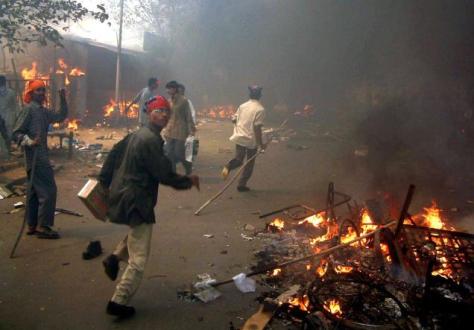
I’ve been thinking a lot about magic lately. The kind of magic that gets pulled at fairgrounds and birthday parties, or on stage, where the impossible is made to appear possible, where material objects dematerialize and specters appear, tantalizing us into suspending our disbelief. Some magicians, including those I would like to think of as friends, do what they can with consummate skill, so that we attain a state of wonder while they effect transformations using ordinary things for extraordinary purposes. They make us inhabit parallel universes on a table top. There is a kind of poetry and grace in that kind of magic. That is the kind of magic that makes men out of god-men, and re-affirms even a non-patriot’s faith in the ‘waters of India’.

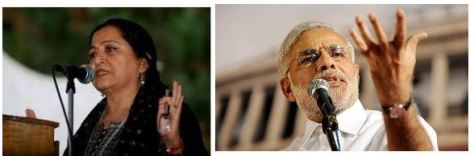
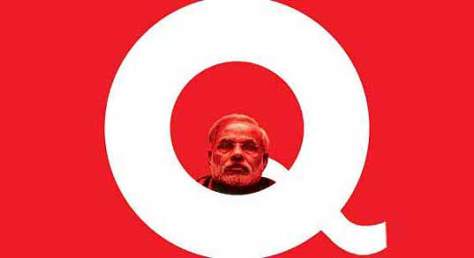
There is another kind of magic, a bag of tricks that relies on the cheapening of our impulses, on our addictions to false premises, on our giving in to our basest instincts. And because sometimes old cliches are useful, we could call this kind black magic. The greatest practitioner of this art, at this moment, seems to me to  be none other than the man who is setting himself up as the caudillo of the future, the chief minister of Gujarat, our prime-minister in waiting, Narendrabhai Damodardas Modi. We,a stunned would be electorate, are the rabbit he is aiming to pull out of his hat.
Continue reading Madhu Mausi, Namo Mamu and the Ghost of Uncle Pepper
Three questions for Madhu Kishwar: Dilip D’Souza

Guest post by DILIP D’SOUZA

Dear Madhu,

20+ years ago, I picked you up at the airport in Austin and you stayed at my home there for a few days. You had come there to deliver a lecture, as I’m sure you remember. We developed a friendship based on a degree of mutual respect and liking. I think you’ll agree? Several years after that I remember a stimulating afternoon sitting with you in Panchgani, catching up on many things and discussing various issues threadbare.

We haven’t met in some years now, but I’m going to call on the privilege of our 20+ years of friendship as I write these lines.

I have no problem at all with your desire to learn about Gujarat and Narendra Modi for yourself. Nor with your desire to see beyond what you’ve called the “targeting” of Modi. Nor with your speaking in support of Modi: if there are people who criticize Modi, I understand and accept that there are those who support him — it’s a democracy we live in after all. Nor with your speaking your mind: you have always done so and it’s the least I expect from you. (In turn, it’s the least you should expect from me). Continue reading Three questions for Madhu Kishwar: Dilip D’Souza

Same Difference? The Politics of Development in Rajapakse’s Sri Lanka and Modi’s Gujarat: Anonymous

This is a  guest post by ANONYMOUS

President Mahinda Rajapakse in Sri Lanka and Gujarat’s Chief Minister Narendra Modi in India have positioned themselves as champions of development and good governance. Hardly a day passes without a media comment in the two countries on their respective development achievements. By and large, claims and counter-claims regarding development in Gujarat and Sri Lanka have tended to focus on mobilising data and ‘facts’ pertaining to a range of vital indicators—economic growth, levels of foreign investment, per capita income, employment, industrial or agricultural output, housing, rural infrastructure, roads, electrification, social welfare allocations, etc.

While working with development data is useful and necessary, an approach that relies too heavily on them tells us little about why development matters to the two regimes and how and to what ends it is actually deployed and leveraged by them at this point in time—the focus of this commentary. The question is not just what Modi and Rajapakse are doing for development but also what development is doing for them. Notwithstanding the significant differences between Gujarat and Sri Lanka, as argued herein, there are many striking similarities with respect to how and why Modi and Rajapakse are constructing, invoking and championing the cause of development. Continue reading Same Difference? The Politics of Development in Rajapakse’s Sri Lanka and Modi’s Gujarat: Anonymous

On the social fabric in Narendra Modi’s Gujarat: Nilanjan Mukhopadhyay

This is an excerpt from the chapter, ‘The Enemy Within’ in NIIANJAN MUKHOPADHYAY’s book, Narendra Modi: The Man, The Times.

20130420-121828.jpg
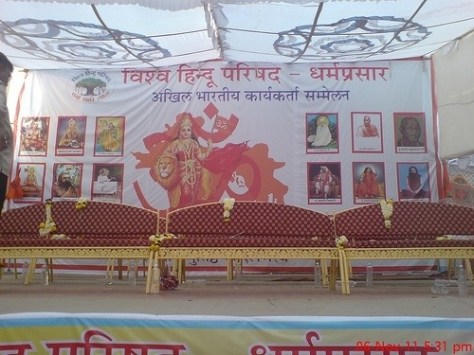
Stage set for a Vishwa Hindu Parishad function next to the Pirana shrine in Ahmedabad, 2011. Photo via twocircles.net

From the label of “Master Divider” in India Today in January 2003 to the tag of “The Great Polariser” in the Outlook in July 2012 — Narendra Modi’s image remained static: self-declared champion of one community of people. But the strain Gujarat faced in the course of his tenure has increased manifold. Wherever I travelled in Gujarat, there was a clear distinction between “us” and “them”. This difference was articulated by several Hindus every time the conversation veered in this direction. In contrast, counterparts among Muslims denied this. The disagreement with the hypothesis stemmed not from a belief and perception that they faced no discrimination but because of a “fear” that accepting such a viewpoint could be interpreted as levelling an allegation that they were being targeted — a risk no Muslim is willing to take after the post-Godhra violence.

Continue reading On the social fabric in Narendra Modi’s Gujarat: Nilanjan Mukhopadhyay

Spin Doctors, Propagandists and the Modi Make-over

Elsewhere on Kafila, we have published a 7000 word long response by Madhu Kishwar to Zahir Janmohamad’s open letter to her which appeared on 15 January, followed by Zahir Janmohamad’s response. Perhaps a few things need to be stated here clearly with respect to her ‘response’. It seems to me to violate every tenet of reasoned debate and argument and is replete with name calling and stereo-typing of not just the secularist ‘other’ [who is her real other, not the Muslim] but even of the adversary she is arguing with. So if Zahir is a  Muslim, he has to be X, Y, Z and has to be believing in A, B, C. Everything starts and ends in bad faith. But then that is what distinguishes Madhu Kishwar from others. She is in her element especially in relation to those whom she disagrees with. With her there can be no disagreement – you have to be sneered and jeered at, irrespective of whether you are a Medha Patkar or an Aruna Roy. I suppose these are matters of personal style and I shall not dwell on them further.

Let me rather, turn to some of the more substantive issues raised in Madhu’s response. Zahir has answered most of them but it seems to me that a couple of vital questions still remain. Even here, though, a caveat is necessary. I have great admiration for Madhu Kishwar’s battle in defense of the rikshaw pullers in Delhi and have often said so openly to her as well as others. However, I do know that it is possible to talk to her when only we agree, which is very rare. On matters that we disagree about, I have decided that I do not want to enter into any kind of an argument with her. In any case, large parts of her ‘response’ are like Modi’s PR handouts, served to us without any sense of critical examination. Therefore, what follows below is not my reply to her but my reactions to a set of allegations she has raised about whosoever is opposed to Narendra Modi – all lumped together in a breathtaking move of reductio ad absurdum, first as secularists , who are reduced to Leftists/ NGO activists and finally to Congress-supporters (because, she says in her Modinama1, the Congress has been equally responsible for all the riots till date). I therefore, lay my cards on the table at the outset: I am an inveterate Modi-hater (and a Congress-hater as well, if that makes sense to anyone in her dichotomized universe) and Kafila is a forum with a certain, if very broad, politics that, at the minimum rules out being pro-Modi. Continue reading Spin Doctors, Propagandists and the Modi Make-over

The urban-rural divide in Modi’s Gujarat

Christophe Jaffrelot gives us perspective on why Gujarat’s development numbers don’t look as impressive as Gujarat’s economic growth – it’s about Modi’s neglect of the rural:

Modi’s policy, over the last 10 years, has benefited the urban middle class more than anybody else. If Gujarat ranks only 11th out of 23 states in terms of the human development index, it’s because groups in rural Gujarat continue to lag behind. Indeed, Gujarat is a case of social polarisation with the new rich in the cities and most of the groups that are at the receiving end concentrated in the villages. There, the number of families below the poverty line has jumped from 23.39 lakh in 2000 to 30.49 lakh in July 2012, according to the rural development commissioner. Unsurprisingly, 9 lakh of the 11 lakh houses without electricity, according to the Gujarat 2011 census, are in rural areas. In terms of education, the excellent report of the NGO, Pratham, shows that rural Gujarat was lagging behind states like Haryana.

Dalits and Adivasis (11.3 and 16.5 per cent of the state population, respectively) are particularly affected. For instance, the percentage of tribal underweight children (0-5 years old) is much higher in Gujarat than the tribal average at the national level (64.5 per cent compared to 54.5 per cent). The under-five mortality rate of tribal children is also much higher. Similarly, the percentage of Dalit participation in the NREGA programme is three times less in Gujarat (7.83 per cent) than in India at large (22.67 per cent). In fact, development has meant socio-economic polarisation, because Gujarat is a typical case of growth without development for all. The Gujarat chapter of the India Human Development Report of 2011 concluded that “the high growth rate achieved by the state over the years has not percolated to the marginalised sections of society, particularly STs and SCs, to help improve their human development outcomes”. [Full article here]

More on Gujarat from Kafila archives: Continue reading The urban-rural divide in Modi’s Gujarat

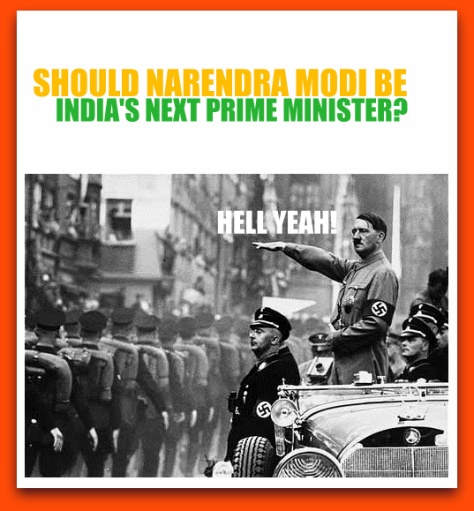
Should Narendra Modi be India’s next Prime Minister?

MODI-HITLER

Sheela Bhatt writes: Continue reading Should Narendra Modi be India’s next Prime Minister?

Modi’s Social Engineering

The system of untouchability has been a goldmine for the Hindus. This system affords 60 millions of untouchables to do the dirty work of scavenging and sweeping to the 240 million Hindus who are debarred by their religion to do such dirty work. But the work must be done for the Hindus and who else than the untouchables?

– Dr. B. R. Ambedkar

 Whether Shit Collection or cleaning of gutters – which has condemned lakhs of people to a life of indignity since ages – could be considered a ‘Spiritual Experience.’ Definitely not. Everybody would yell. Well, Mr Narendra Modi, chief minister of Gujarat, has a different take on this, which he mentions in the book ‘Karmayog’ (Publication year 2007). Continue reading Modi’s Social Engineering

तार्किकता, भावुकता और फासिज्म

 28 फरवरी को याद करने पर अब कहा जाने लगा है कि यह नकारात्मक स्मृति है और इंसानी फितरत के मुताबिक़ हमें आगे बढ़ना  चाहिए. हिन्दुओं को, खासकर गुजराती हिन्दुओं, यह नागवार गुजरता है कि उन्हें  बार-बार 28 फरवरी , 2002 की याद दिलाई जाए. आखिर गुजरात में 2002 के बाद पूरा अमन है और वह विकास के मार्ग पर एक दृढसंकल्प मुख्यमंत्री के नेतृत्व में संकल्पपूर्वक बढ़ा जा रहा है और वहां के मुसलमान भी अब कुछ और बात करना चाहते हैं.

दरअसल भुलाने और आगे बढ़ जाने की शुरुआत 2002 में ही हो गई थी. 28 फ़रवरी से राज्य-संरक्षण में शुरू हुए मुसलमानों के कत्लेआम ने भारत के उद्योगपतियों के एक हिस्से को भी झकझोर दिया था. लेकिन कुछ समय बाद ही पूंजीवाद के तर्क ने मानवीयता की कमजोरी पर विजय पा ली और उन्होने नाराज़ मुख्यमंत्री से क्षमायाचना करके गुजरात की प्रगति में उन्हें हिस्सा लेने की इजाजत माँग ली  थी. सार्वजनिक रूप से उन्हें गांधी और पटेल से तुलनीय बताया जाना अब अटपटा भी नहीं लगता, बल्कि उलट कर कहा जा सकता है कि गांधी और पटेल में  ऐसे कई गुण नहीं थे जो गुजरात के ह्रदय-सम्राट में पाए जाते हैं , इसलिए यह तुलना वस्तुतः इन दोनों के प्रति पक्षपात है. पूंजीवाद के मूल अंतर्राष्ट्रीय चरित्र ने अंततः युरोपियन यूनियन को अपनी मानवीय हिचक को किनारे करके गुजराती यथार्थ को कबूल करते हुए कारोबारी नज़रिया अपनाने को प्रेरित किया. यह संभव नहीं था कि आर्थिक निवेश के ठोस आकर्षक आमंत्रण को   न्याय के अमूर्त आग्रह  के चलते ठुकरा दिया जाए. Continue reading तार्किकता, भावुकता और फासिज्म

Prof VK Tripathi and the fight for Schools in Juhapura: Zahir Janmohamed

Guest post by ZAHIR JANMOHAMED

A school in Juhapura. Photo credit: Atish Patel

On Tuesday, February 19, the Ahmedabad Municipal Corporation ratified its budget and elected to build the first municipal school in Juhapura, the largest ghetto of Muslims in Ahmedabad. Juhapura was incorporated into the Ahmedabad Municipal Corporation five years ago and many residents wondered why the AMC took so long to build a school to serve Juhapura’s 350,000 residents. At the forefront of this struggle is IIT Delhi physics professor VK Tripathi. It was during a chance meeting with a sandwich shop owner in Washington DC that Professor Tripathi first learned about Juhapura. Continue reading Prof VK Tripathi and the fight for Schools in Juhapura: Zahir Janmohamed

An open letter to Madhu Purnima Kishwar: Zahir Janmohamed

Dear Madhu ji,

I was very excited when I learned you were coming to Ahmedabad and I was honoured that you expressed interest in possibly meeting with me.

I was sitting with a journalist friend when I read your Tweet about visiting Ahmedabad and he told me you are a “pioneering feminist who did ground breaking work.” He also told me that in 2005 you signed a very strong petition calling for Gujarat Chief Minister Narendra Modi’s dismissal because of Modi’s role in the 2002 Gujarat riots. He also added that you have been very vocal on behalf of Kashmiri Pandits. After I witnessed the Gujarat riots in 2002, I returned to the United States—where I was born and raised—and I gave lectures for six months about the violence I saw. In each lecture, an audience member would inevitably shout at me that I have ignored the plight of the Kashmiri Pandits. It is true. I know very little about Kashmir, and for that matter Kashmiri Pandits, and I would have enjoyed and benefited from listening to your views on the conflict there.

I understand from your Twitter feed that you have left Ahmedabad. I know your days in Ahmedabad were limited and I fully understand that you were not able to meet. Therefore in this letter I will try to convey some of the things I had hoped to tell you in person, in particular about your Tweets. Continue reading An open letter to Madhu Purnima Kishwar: Zahir Janmohamed

Gujarat vs. Himachal Pradesh: Rahul Verma

Guest post by RAHUL VERMA

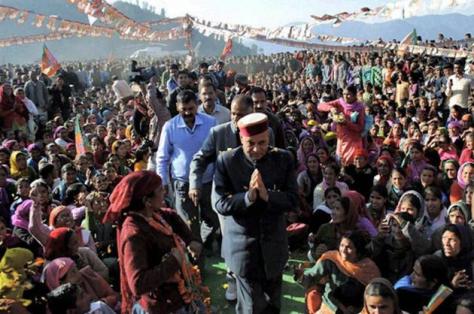
Himachal Pradesh Chief Minister Prem Kumar Dhumal at an election rally in Mandi. PTI photo

Even though Hiamchal Pradesh voted on November 4, Gujarat has been hogging all the limelight. The election in Gujarat is only in the third week of December. Gujarat captures our political imagination as a ‘role model state’ whereas Hiamchal Pradesh is just in our tourism agenda as a top holiday destination. It is hard for anyone to notice Himachal as a political entity among the big brothers like Uttar Pradesh, West Bengal, Bihar, Andhra Pradesh, Tamil Nadu, and Maharashtra. The irony is that some smaller states like Manipur and Nagaland still manage to get  some attention because of violent manifestations of political choices in these states. Himachal Pradesh is absent from our discourses as the state is just ‘small’ and ‘beautiful’. However, the great turn around in Himachal over last two decades demands that India at least recognizes the “Himachal Pradesh model of development”. Continue reading Gujarat vs. Himachal Pradesh: Rahul Verma

The intruders were not found in possession of any objectionable material apart from a large cache of fish

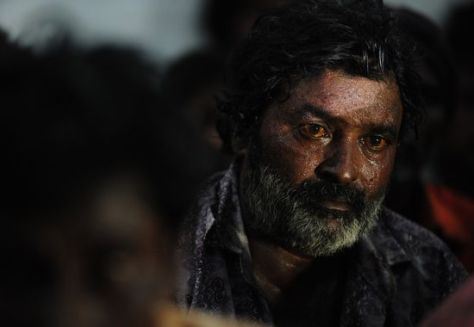
An arrested Indian fisherman sits at a police station in Pakistan’s port city of Karachi on October 1, 2012. Pakistan maritime security agency arrested 33 Indian fishermen and seized five boats for allegedly fishing illegally in Pakistan’s territorial waters. By Asif Hassan/AFP/Getty Images.

The insensitive governments of India and Pakistan are not moved even when one of their citizens dies in the other country, especially if the citizen was a poor fisherman arrested for the crime of inadvertently crossing a maritime boundary.

After 23 days of lying in the morgue of Ahmedabad’s Civil Hospital, the body of 32 year old Nawaz Ali Jat will finally reach Karachi on Monday by a Pakistan International Airlines flight. His family waited 14 years for his return, but they didn’t even get to know when he died of kidney failure on September 8. Continue reading The intruders were not found in possession of any objectionable material apart from a large cache of fish

Dalits in Hindurashtra – Time for another sadbhavna fast Modiji!

…27 of the 30 complaints that were addressed to the commission spoke of indifference of police officials towards dalits.These issues were raised immediately after NHRC chairman KG Balakrishnan praised status of scheduled castes (SC) in Gujarat. He said the state’s schemes for development of the marginalised are working well and penetration of education among scheduled caste and scheduled tribes has reached 70%.Almost all dalits and their leaders present in the audience were not in agreement with this statement. [DNA]

 I

Justice Balakrishnan, retired Chief Justice of the Supreme Court of India, and at present Chairman of the National Human Rights Commission (NHRC), – who has remained in news since his retirement altogether for wrong reasons – provided further ammunition to his critics with his recent visit to Gujarat. The manner in which he lauded the state government for its ‘innovative schemes for the upliftment of dalits’ and claims that ‘..[f]uture of the SC community seems to be fairly good in Gujarat as compared to many other states’ is being seen as an attempt to clean chit and whitewash acts of ommission and commission.of a government which is still mired in the controversies surrounding the carnage in 2002

The said two day visit (14-15 th March) was part of the plan envisaged by the Commission to hold “open hearing” sessions on issues related to dalit atrocities in different parts of the country. According to media inputs, this was one of the important recommendattion by the K.B. Saxena committee which had done a painstaking job and brought out a report on dalit atrocities in the country few years back.for the commission itself. Not some time ago the commission had held its first such hearing in the state of Orissa.

Continue reading Dalits in Hindurashtra – Time for another sadbhavna fast Modiji!

Of Shared Spaces and Experiences in Gujarat: Ayesha Khan

This is a guest post by Ayesha Khan

The other day, my brother dug out an old DD animation film on unity in diversity – Ek Titli, Anek Titli… We replayed it umpteen times in a fit of summer nostalgia, until we got all the lines correct. We  ignored the political subtext.  But only until it rebounded starkly on us, with the wails of  a baby that had newly come in to the family. The little one foisted on us the first ponderous responsibility – finding him a name.

The family brief for me, aunt to a six day old nephew, and equally to childhood pal Vandana, who is soon-to-be aunt to a niece in US,  was to think up  names resonating a core Indian-ness, the Muslimness, the TamBram-ness (in Vandana’s case), with a universal appeal and encapsulating  everything that is pious, lucky and great.

Continue reading Of Shared Spaces and Experiences in Gujarat: Ayesha Khan

On the low morale of Gujarat Police: RB Sreekumar

This guest post by former Gujarat DGP RB SREEKUMAR is a letter to the Union Minister of Home Affairs.

Dear Shri P. Chidambaram,

I belonged to Gujarat cadre of Indian Police service (IPS)-1971 batch-and retired from service on 27.2.2007 in the rank of Director General of Police (DGP), Gujarat state.

2. As a senior citizen (age-65 years) staying in Gujarat since 1970s, I am constrained to write the following for your kind consideration and urgent remedial action.

3. The morale, self esteem and image of the Gujarat Police in general and of IPS officers giving leadership to police force in the state in particular, have been in steady decline since 2002 anti-minority genocide. The media, reputed human rights activists and national bodies like the National Human Rights Commission, the National Commission for Minorities and the National Commission for Women have thrown light on serious intentional acts of commission and omission by Gujarat government functionaries (except in cities like Surat, Bhavnagar and a few districts in South Gujarat and Saurashtra), that facilitated extensive and gruesome mass violence against minorities.

Continue reading On the low morale of Gujarat Police: RB Sreekumar

We, the People of Gujarat: Urvish Kothari

This guest post by URVISH KOTHARI was originally written in Gujarati and has been translated by VISTASP HODIWALA

Associated Press

Some facts are so simple and self-evident that they elude you completely at the time they happen. Digesting them takes time – 2, 3,7, maybe even 10 years. By that time, the passion and the anger has abated a bit and there is a sense of composure that pervades our beings.

Like the fact about the communal violence that gripped the State of Gujarat in 2002.

Of course, a mere mention of this is enough to get the chief minister’s fanboys roll up their sleeves, even as their opponents ready themselves to launch a counter onslaught. But with the passage of ten long years, the first question should not be about whether the Chief Minister was complicit in the crime or not. No, it cannot be.

Continue reading We, the People of Gujarat: Urvish Kothari

Three Stories of Resilience from Gujarat: Ayesha Khan

Guest post by AYESHA KHAN, Baroda-based journalist

Bilkis Bano. Photo via a grab from a recent NDTV report

To mine the detritus of the Gujarat pogrom for positive stories may seem like sacrilege. But when memories are dredged up to mark a decade of the horrors of 2002, a little blasphemy could help balance the account books.

Mostly what we recount of Gujarat 2002 is deaths. Yet, more than the murder and mayhem, the pogrom stood out for an unprecedented scale of sexual violence that Muslim women were subjected to. George Fernandese in his capacity as the Union defence minister had explained to the Parliament after a quick tour of Gujarat that women raped or molested during riots was not surprising or exceptional. I will not go here into the polemics of why violating women’s sexuality is considered a means of dishonouring a community,

There’s an untold story about how the community handled sexual violence. If the dominant community legitimised rape driven by its insecurities and politics that stemmed from history and identity issues, it was perhaps for the first time that the persecuted community reacted to rape in a progressive way.

Rape is double-edged sword, first leading to physical violation and second to social ostracisation in most societies. Which is common to mask the identity of rape victims for fear of social stigma. Strangely, during the 2002 riots, Muslim women, some of them burqa clad and most of them from tightly-knit rural communities never betrayed the kind of shame or guilt that rape victims are expected to show. What was their fault? Why should the victim feel shame and guilt? And so it was that many of them did not cloak their identities, and instead chose to come out publicly to demand justice. Continue reading Three Stories of Resilience from Gujarat: Ayesha Khan

Defending Narendra Modi: An Exercise in Obfuscation

In Outlook magazine last week, its web editor Sundeep Dougal asked 25 questions of Narendra Modi about the 2002 Gujarat pogrom and the subversion of justice since then. Predictably, the army of Narendra Modi Defenders began to spill outrage at such blatant compilation of true charges against Mr Modi. Doing the rounds of the internet is a point by point rebuttal to Dougal’s questions by a blogger, Shashi Shekhar, who goes by the name Offstumped, and is a known online Modi defender. Offstumped’s answers have been responded to by Dougal, and yet Offstumped’s rejoinder is being circulated all over the internet by Modi defenders in the hope of persuading public opinion that Mr Modi is a spotlessly clean man whose actions and inactions did not result in any loss of life, property or dignity of anyone in 2002 and later. The rather large army of Narendra Modi Fans on the internet hopes that by repeating their standard lies again and again, they will one day become accepted truth. Continue reading Defending Narendra Modi: An Exercise in Obfuscation

The Gulberg Memorial

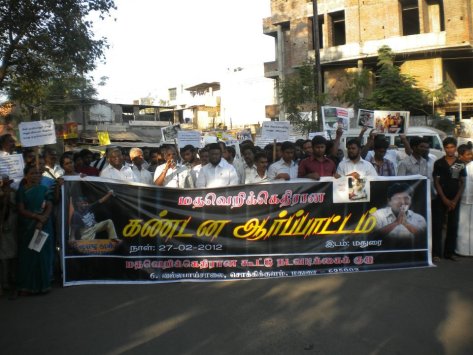
The photograph above is that of a small protest by People’s Watch yesterday, in Madurai, for justice and reparations in Gujarat. Such demonstrations were held across India. Nothing irks the Narendra Modi Fan Brigade than remembering. Move on, they say, move on, forget it. It happened. The struggle of man against power, said Milan Kundera, is the struggle of memory against forgetting.

The short film below, about making a memorial at Gulberg Society in Ahemdabad, was put out by the Teesta Setalvad-led Sabrang Trust in 2008. Yesterday, tenth anniversary of the day Gujarat began to burn for a few weeks in 2002, Sabrang Trust held a meeting at what is now the Gulberge Memorial. Given below the film is the text read out by Justice Hosbet Suresh read out at the Memorial meeting, which was webcast live by Sabrang Trust.

Continue reading The Gulberg Memorial

Gujarat genocide – the state, law and subversion: R B Sreekumar

Guest post by R B SREEKUMAR, former Director General of Police, Gujarat, who deposed before the Nanavati Commission.

Gujarat riot victims prevented from protesting against Narendra Modi during his sadbhavna fast in September 2011.

The Gujarat genocide in 2002, resulting in killing of nearly 1,500 innocent citizens, mostly from India’s major minority community and subsequent pervasive subversion of governmental machinery to sabotage justice delivery to riot victims, has to be understood as a man-made disaster. A disaster broughtabout by lack of professionalism and lack of integrity and commitment to the letter, spirit and ethos of the Constitution of India, on the part of all officials of the state, from the Chief Minister Narendra Modi to the police constables.

An analysis of the sequence of events from the time of the gruesome killing of 59 Hindu passengers in the train burning incident on 27 February, 2002 to this day, will bring up many unambiguous facts and data on deliberate acts of omission and commission by political leaders, bureaucrats and policemen, aiming at the actualization of the anti-Muslim carnage in Gujarat in 2002, and since then, the lopsided justice delivery to riot victims.

Continue reading Gujarat genocide – the state, law and subversion: R B Sreekumar