Tag Archives: India-Pakistan

Can we solve Siachen without solving the Jammu and Kashmir dispute?

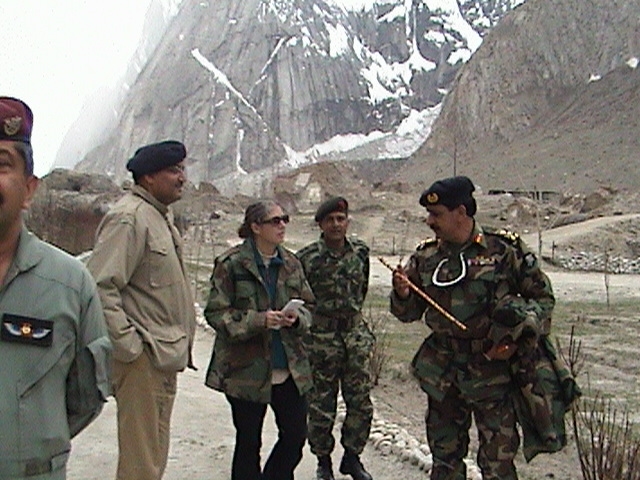
Myra MacDonald with Pakistani Army officers in the Gyari sector in 2004

Myra MacDonald is a London-based journalist with Reuters and a long-time observer of South Asia. She tracks the turning points in Pakistan politics at the Pakistan: Now or Never. MacDonald is best known for her book on the Siachen conflict, Heights of Madness: One Woman’s Journey in Pursuit of a Secret War. Published in 2007, the research for the book took her to both sides of the conflict, on helicopter and on ground. She was bureau chief of Reuters in India in 2000-2003. She then took leave-of-absence to research the Siachen conflict, becoming one of the very few people to visit the war zone on both the Indian and Pakistani sides. She has given presentations on Siachen to the Royal Military Academy Sandhurst and to the International Institute for Strategic Studies in London. Amidst alarmist rumours that track-two parleys between India and Pakistan are urging India to ‘give up Siachen’, MacDonald tells Shivam Vij in an e-mail interview why resolving Siachen without resolving the Jammu and Kashmir dispute may not be easy.

Q1) The idea of demilitarising Siachen is being seen by some in India as a demand to hand Siachen over to Pakistan, or at the very least, to ‘lose’ the territory for which Indian soldiers have made great sacrifices. Do you agree with such an interpretation of demilitarising the glacier? Do you think India has real strategic advantage with its occupation of the glacier? Continue reading Can we solve Siachen without solving the Jammu and Kashmir dispute?
Why Manmohan Singh should not visit Pakistan

Dr Manmohan Singh is the longest serving Indian prime minister since Jawaharlal Nehru, but history will perhaps note more pertinently that he was the most discredited and unpopular prime minister since Chandra Shekhar Singh, who was in office for a mere eight months. So spectacularly disastrous has his second term in power been that the speed of political crises he battles is now more than one a week. Few will be able to count a single achievement of UPA-2.

And yet there is one achievement, and that is his handling of Pakistan.

The Indian home secretary was returning from a very positive visit to Pakistan when 26/11 happened. The 2008 terrorist attacks in Mumbai shocked not just India but the world. They were not like the bomb blasts we have become accustomed to; their impact was much more than 166 lives. They held India’s commercial capital hostage. They were an act of war and few even in Pakistan pretend that those attacks did not originate from Pakistani soil, across the Arabian Sea. Few in India buy the theory that state actors in Pakistan were not involved. Continue reading Why Manmohan Singh should not visit Pakistan

An appeal to release three Pakistani fishermen imprisoned in India since 1999: Jatin Desai

Given below is the text of a letter sent yesterday by JATIN DESAI to the Indian foreign secretary

Shri Ranjan Mathai,
Foreign Secretary,
Ministry for External Affairs,
Government of India,
New Delhi -110001

Shri Ranjan Mathai ji,

Greetings from Pakistan-India Peoples’ Forum for Peace & Democracy (PIPFPD).

This is in regarding three Pakistani fishermen arrested in 1999 when their boat was destroyed in a cyclone and they strayed into Indian water. The Indian Coast Guard arrested few Pakistani fishermen including Nawaz Ali Jat, Usman Sachu son of Haji Ibrahim Jat, Zaman Jat son of Haji Jat and Usman Jat son of Ali Mohammad Jat.

Nawaz Ali passed away on September 8 2012 in Civil Hospital, Ahmedabad and his body was sent to Karachi, Pakistan on October 1 2012 by PIA’s Mumbai-Karachi flight. We believe, remaining 3 arrested Pakistani fishermen are in some prison of Gujarat and most probably in Rajkot as Nawaz was taken to Civil Hospital, Ahmedabad from Rajkot Prison. Continue reading An appeal to release three Pakistani fishermen imprisoned in India since 1999: Jatin Desai

Shabbo Kumari patrols the border

Photo by Poulomi Basu

The Lens blog at NYTimes.com has a photo essay by Poulomi Basu about women guards of the Indian Border Security Force.

Most of the recruits were from impoverished rural areas. If she could observe them not only in training but with their families as well, she would be able to tell the story of their transformation from villagers into soldiers.

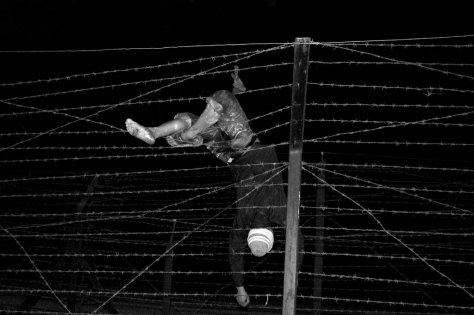
The most haunting image Basu has  is the one above.

One of the most riveting photographs shows a dead man hanging upside down, his legs caught in the high barbed wire fence that India has constructed to demarcate the border. Guards had shot the man as he and others tried to enter Pakistan near Attari, in Punjab State, Ms. Basu said. Continue reading Shabbo Kumari patrols the border

The intruders were not found in possession of any objectionable material apart from a large cache of fish

An arrested Indian fisherman sits at a police station in Pakistan’s port city of Karachi on October 1, 2012. Pakistan maritime security agency arrested 33 Indian fishermen and seized five boats for allegedly fishing illegally in Pakistan’s territorial waters. By Asif Hassan/AFP/Getty Images.

The insensitive governments of India and Pakistan are not moved even when one of their citizens dies in the other country, especially if the citizen was a poor fisherman arrested for the crime of inadvertently crossing a maritime boundary.

After 23 days of lying in the morgue of Ahmedabad’s Civil Hospital, the body of 32 year old Nawaz Ali Jat will finally reach Karachi on Monday by a Pakistan International Airlines flight. His family waited 14 years for his return, but they didn’t even get to know when he died of kidney failure on September 8. Continue reading The intruders were not found in possession of any objectionable material apart from a large cache of fish

Our search for Charasi Kababs: Saba Dewan

Guest post by SABA DEWAN

Qissa Khwani bazaar, Peshawar

I was last in Pakistan in 2006 during Ramzan. Rahul had some work in Islamabad, Peshawar and Lahore and I had used that as an excuse to visit my mother’s place of birth. While I had visited my mother’s beloved Lahore a few times earlier this was to be my first trip to Islamabad and Peshawar.

To cut a long story short, on our first evening in Peshawar, post iftaar, we found ourselves in the fabled Qissa Khwani bazaar, the Bazaar of Story tellers. It was here that in 1930 British troops had fired upon an anti-colonial demonstration of non violent, unarmed nationalist Khudai Khidmatgars leaving more than 400 amongst them dead. History has come a long way since then marking contemporary Peshawar as one of the more violence prone cities of Pakistan. Continue reading Our search for Charasi Kababs: Saba Dewan

अपुन का मंटो: पाकदिल, सियाहक़लम, अपूर्व, अप्रतिम, अखंड


मंटो ने रचनात्मक अभिव्यक्ति के लिए कला की कोई भी दिशा चुनी हो, हंगामा किसी न किसी तरह अवश्य हुआ।
– बलराज मेनरा व शरद दत्त


कोई सत्तावन साल पहले महज़ बयालीस की उम्र में तक़सीम-ए-हिन्द और शराबनोशी के मिले-जुले असर से अकालकालकवलित मंटो आज सौ का होने पर भी उतना ही हरदिलअज़ीज़ है, जितना हैरतअंगेज़, उतना ही लुत्फ़अंदोज़ है, जितना तीरेनीमेकश। शा यद आज भी उतना ही मानीख़ेज़। बल्कि यूँ मालूम होता है कि वक़्त के साथ उसके अनपढ़ आलोचकों की तादाद कम होती गई है और पिछले दो-तीन दशकों में मुख़्तलिफ़ विधाओं में पसरे उसके लघु-कथाओं व बड़े अफ़सानों, मज़ामीन, रेडियो नाटकों, मंज़रनामों, ख़तों, फ़िल्मी संस्मरणों और अनुवादों के बारीकतरीन पाठों का सिलसिला थमने की जगह ज़ोर पकड़ने लगा है। और पाठ-पुनर्पाठ की ये धारा सिर्फ़ उर्दू या हिन्दी में ही नहीं, बल्कि अंग्रेज़ी में भी मुसलसल बह निकली है। जिसके बूते दक्षिण एशिया का यह अप्रतिम कहानीकार अब समस्त दुनिया की एक नायाब धरोहर बन गया है। यह वाजिब भी है क्योंकि मंटो के अदब व फ़लसफ़े में पश्चिम व पूर्व का अद्भुत संगम हुआ। मोपासाँ, चेखव व गोर्की वग़ैरह से उसने अगर तुला हुआ, मुख़्तसर अंदाज़े-बयान सीखा तो एशियाई माहिरों से रस बरसाने वाली दास्तानगोई का चमत्कार, और तफ़्सीलात का इज़हार।

Continue reading अपुन का मंटो: पाकदिल, सियाहक़लम, अपूर्व, अप्रतिम, अखंड

The Peaceniks prevail over the Realists: India and Pakistan sign new visa pact

While the new visa pact between India and Pakistan is a landmark achievement, it still leaves a lot to be desired to make easier travel possible for the citizens of the two countries. Some suggestions are given in the Aman ki Asha petition, which you may want to sign here. While the full text of the pact does not seem to be online at this time, the most detailed story about the pact has been put out by the ASSOCIATED PRESS OF PAKISTAN, reproduced below. It is not clear when the new regulations come into force.

ISLAMABAD: Pakistan and India on Saturday signed new liberalised visa regime giving more concessions and simplifying the procedure to grant visa with a view to promote people-to-people contacts and enhance trade and business activities between two neighbours.     Continue reading The Peaceniks prevail over the Realists: India and Pakistan sign new visa pact

A Visa for Mahiwaal: Maheep Singh

Guest post by MAHEEP SINGH

Sufi dervishes join a Sikh Nagar Kirtan parade at the Nankana Saheb shrine near Lahore. Photo credit: S Khalsa

As a child I gave my mother a tough time with all sorts of questions about the world; she would often not have answers. I would ask, for instance, why we couldn’t just go to Nankana Saheb as and when we wanted. Nankana Saheb is the birthplace of Guru Nanak, founder of the Sikh faith. It is in Pakistan, on the outskirts of Lahore.

Sikhism must be the only religion in the world whose official prayers include a plea for visa relaxation. Believe it or not, millions of Sikhs all over the world do that as part of their daily prayer, the Ardas, in which we pray to almighty to grant us free access (“khulle darshan deedaar”) to the birth place of Guru Nanak and other places in present-day Pakistan, considered holy by Sikhs. Continue reading A Visa for Mahiwaal: Maheep Singh

India and Pakistan: Let people meet

This online petition has been put out by AMAN KI ASHA

The people of Pakistan and India, people of Indian and Pakistani origin around the world, and friends of India and Pakistan, are fed up of the visa restrictions that prevent them from visiting families in the other country. There isn’t even a tourist visa protocol between these two biggest neighbours of South Asia. People in the region want the right to travel and to trade, to walk along coastlines and roads that represent their collective past, to seek and spread harmony across a subcontinent not divided by politics and propaganda. In this modern age of interdependence, it is a tragedy that the citizens of India and Pakistan are left peering over a border made indomitable and intimidating. There is little space for the hand of friendship to be extended across this border. This must change.

The governments of India and Pakistan must:  Continue reading India and Pakistan: Let people meet

Coke Studio Pakistan – At a crossroads: Nandini Krishnan

Guest post by NANDINI KRISHNAN

Rohail Hyatt, producer of Coke Studio Pakistan

Khabaram raseedah…imshab
Khabaram raseedah imshab kih nigaar khaahi aamad

The words are beautiful; the voices that sing them mellifluous. And yet, I find that instead of being overwhelmed as I usually am by the qawwali of Fareed Ayaz and Abu Muhammad, enraptured by the transcendental waves of their music, parts of my consciousness are held down, niggled. Perhaps it’s the constant drumming and strumming, perhaps it’s the psychedelic sound waves zipping across giant screens, perhaps it’s the acoustics that throw back bits of the singers’ strains at them. But the Coke Studio version of Khabaram Raseedah doesn’t affect me the way even scratchy recordings of live, open-air concerts do. Continue reading Coke Studio Pakistan – At a crossroads: Nandini Krishnan

Borderline madness: Sajan Venniyoor


Guest post by SAJAN VENNIYOOR

Now that government agencies in India — some half a dozen of them working with the exceptional coordination we have come to expect from government agencies — have blocked Facebook accounts, Twitter feeds and YouTube videos supposedly originating in Pakistan, perhaps we could contemplate other trans-border electronic transgressions committed by our neighbours.

In August 2011, The Times of India reported that Punjab border farmers still tune into Pak FM radio stations. According to villagers on the fringes of Ferozepur, the limited range of India’s “national radio” broadcasts and the absence of any local FM station have made radio services from Pakistan the most popular source of entertainment in border areas.

About the same time last year, the Indian government had become alarmed by the popularity of Nepal’s FM radio channels in Bihar along the Indo-Nepal border. According to various sources, some half a dozen Nepal FM radio stations are broadcasting programmes – “anti-India advertisements and vulgar songs”, according to one outraged newspaper report – into Bihar, especially Madhepura, Supaul, Madhubani, Kishanganj, Araria, Sheohar, Saharsa, Muzaffarpur, and East and West Champaran districts.  Continue reading Borderline madness: Sajan Venniyoor

Of Nationalism and Love in South Asia

The predominant emotion with which jingoistic Indians and Pakistanis view each others’ misfortunes is schadenfreude. They count each other’s conflicts and rebellions to keep score. The Indian will talk about sectarian violence in Pakistan, and the Pakistani will ask about the treatment of Dalits in India. The Pakistani will complain against Indian atrocities in Kashmir  and the Indian will point fingers at Balochistan.

When I see such Indo-Pakistani interactions online, I am reminded of these words: Continue reading Of Nationalism and Love in South Asia

Dr Khalil Chishty is back home – three cheers for candle-light peaceniks

The 80 year old Pakistani virologist Dr Khalil Chishty just reached Pakistan. His son Tariq called me from Islamabad. “Sorry we couldn’t meet, it was all so rushed.” Tariq Chishty was worrying about getting a PIA ticket – President Zardari sent his special PAF plane to get them! Contrast this with the rank indifference with which the Indian government treats the issue of Indian prisoners in Pakistan.

Just a few days ago, Tariq Chishty was convinced his father is not going to be freed in the hearing on Thursday and was ready to return to Pakistan alone. But the Supreme Court of India, in an unprecedented judgement, allowed him to go home, on the condition that he must return by 1 November for the next hearing. Some months ago when his grandson had met him in jail, Dr Chishty had bid him goodbye as though it was the last time. This is not the end yet – the Supreme Court may uphold his conviction and god knows if he’ll again have to spend time in jail. 20 years in India have been jail-like for him even when he’s not been in jail. For details of his case, whether and why he should be granted mercy and so on, please see this article by me. Continue reading Dr Khalil Chishty is back home – three cheers for candle-light peaceniks

Family chronicles

Jamal Kidwai tells the (continuing) story of the Partition through family memories:

As children we would invariably be divided into Pakistani and Hindustani groups. We would have long arguments about who would win the next war, whether Imran Khan was a better all-round cricketer than Kapil Dev; we would even divide ourselves into Indian and Pakistani teams when it came to playing cards, scrabble, cricket or antakshari. These competitions and arguments brought small but interesting victories. Like once when in the course of an argument, a Pakistani cousin pulled out a tube of Colgate toothpaste, a far slicker plastic tube than our usual Indian toothpaste which came in tin tubes and was easily rusted. He was taunting us about the quality of the toothpaste tube which, of course, proved how backward India was compared to Pakistan. At this point one of us from the Indian team noticed that ‘their’ tube had a mark ‘Made in India’. Nothing gave us more joy than that and the Pakistani team was not only defeated but was left embarrassed for the rest of the holidays. (Material wealth and consumer goods was one area where Pakistan, with its imported goods from the US, was far more ‘developed’ than India and it gave us great pleasure to puncture that aspiration.) [Read the full article.]

A meeting with Deepak Perwani

At the Lifestyle Pakistan trade exhibition that concluded in Delhi on Sunday, one stall stands out from a distance for just its name – Deepak Perwani, one of Pakistan’s most famous fashion designers. This was the first of its kind exposure for Perwani outside the Indian fashion circuit, of which he has long been a friend and fellow traveller. The humble Perwani, though, has long been used to facing Indian surprise. “People keep asking me, ‘Oh you guys didn’t migrate?’, ‘How are you treated there?’ and so on. The questions show a lack of awareness.” Pakistani Hindus do not exist in the Indian imagination, but Perwani is part of Karachi’s flourishing Hindu community, which is small but visible and influential even today. One lakh of Karachi’s 1.3 crore population is Hindu.

Continue reading A meeting with Deepak Perwani

India must reciprocate Pakistan by sending back Dr. Chishty and Pakistani fishermen

This is a statement put out by some of us; names of signatories is given at the end

We, the undersigned, welcome the decision of Pakistan government to release 26 Indian fishermen on humanitarian grounds. They were in Pakistani prison for more than two years for allegedly violating territorial border. The Pakistani gesture came in the background of a meeting, which took place in New Delhi, between the Indian Prime Minister Manmohan Singh & the Pakistani President Asif Ali Zardari on last Sunday. The poor Indian and Pakistani fishermen find it extremely difficult to recognize other country’s territorial border in the mid-sea.

We appeal to the Government of India to reciprocate Pakistani gesture by sending Dr. Khaleel Chishty and Pakistani fishermen back home. This will be a major confidence building measure. It will help in creating a conducive atmosphere in taking forward peace process. Continue reading India must reciprocate Pakistan by sending back Dr. Chishty and Pakistani fishermen

On the Supreme Court granting bail to Dr Khaleel Chishty: PUCL statement

Given below is the statement of the PEOPLE’S UNION FOR CIVIL LIBERTIES on the Supreme Court’s decision yesterday to grant bail to Dr Khaleel Chishty. Given below the statement is the full text of the court order
The PUCL is extremely relieved that the SC decided to set free from the Prison 80 year old Dr. Khalil Chishty serving a life sentence in Ajmer Central Jail for a murder case. This is an extremely significant step but not sufficient as bail for Dr. Chishty as seen earlier when the trial was underway for 19 years, was like house arrest. he had to report regularly to the police and could not step out of his house and area. We hope that the next step of sending Dr. Chishty back home happens soon as it would be better for all that we send him back alive, when he can be with those who care for him and love. The PUCL appreciates the wisdom of the Supreme Court for this judgement.
While Judicial remedy would be pursued in the Supreme Court, we would like to remind all that the executive remedy as provided in the Indian Constitution of President and the Governot of a State granting Mercy to an individual at any stage of the judicial process, was stalled by the Governor of Rajasthan, who despite being recommended twice by the Chief Minister of Rajasthan that Dr. Chishty be pardoned, the Governor only let the file gather dust. Continue reading On the Supreme Court granting bail to Dr Khaleel Chishty: PUCL statement

Who are the real stakeholders of Indo-Pak peace?: Ayesha Siddiqa

This guest post by AYESHA SIDDIQA is the text of a speech delivered by her at a recent civil society review of the India-Pakistan peace process, organised by the Centre for Policy Analysis in Delhi.

This time it seems better then last time! I suppose this is what we said the last time as well. India–Pakistan relations have a cycle of ups and down: a crest followed by a trough and then a crest again. Although there is increased frustration on both sides for not being able to solve the ‘relationship’ mystery, the leadership and people in general remain eager to have peace rather than war. However, we also remain elusive regarding our threshold of peace, or what would be the cut-off point in settling for peace with each other. This cyclic peace of war and peace has remained primarily due to the peace process being elitist and confined to the strategic/security community. Therefore, I would like to argue three points: Continue reading Who are the real stakeholders of Indo-Pak peace?: Ayesha Siddiqa

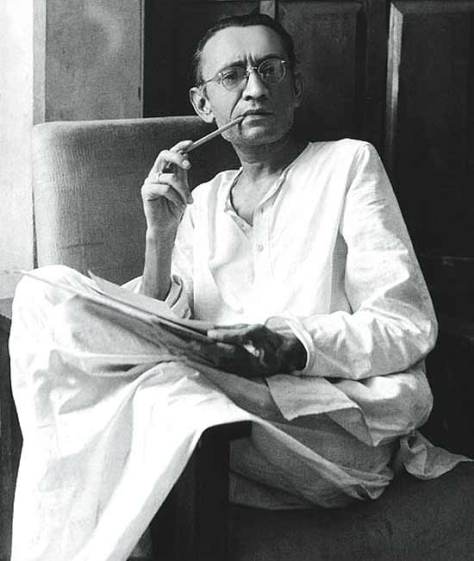
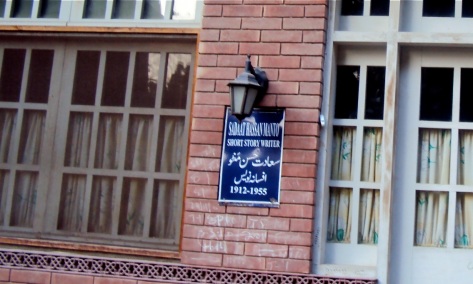
A Hundred Years of Manto

31, Laxmi Mansions, Hall Road, Lahore

“Here lies buried Saadat Hasan Manto in whose bosom are enshrined all the secrets and art of short story writing. Buried under mounds of earth, even now he is contemplating whether he is a greater short story writer or God.”

May 2012 will mark the hundredth birth anniversary of the man who wrote that epitaph for himself, Saadat Hasan Manto (1912-1955). One cannot help but compare Manto’s centennial to Faiz Ahmed Faiz’s last year, preparations for which had begun much in advance. There seems to be an odd silence about Manto. Continue reading A Hundred Years of Manto

On Josh Malihabadi’s death anniversary

On Josh Malihabadi’s 30th death anniversary, doing the rounds is this recently uploaded interview of the Urdu poet, amongst a rich archive uploaded on YouTube by Radio Pakistan.

Josh migrated to Pakistan only in 1958. About the loss of Lucknow, he says it was like losing the world. He says in this interview about a visit to Lucknow, where he asked a taxi driver, how is it going with all these Sikhs and Punjabis who have come to Lucknow. The taxi driver replies, we have taught them (Lakhnavi) etiquette!