Tag Archives: Kanhaiya Kumar

Bangalore Research Network’s Letter of Solidarity with JNU


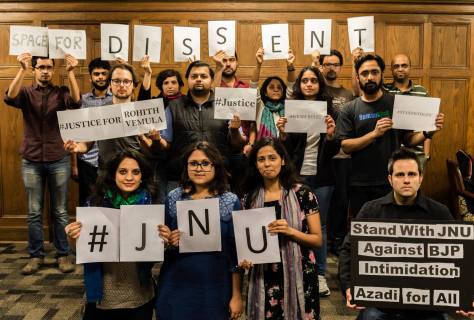
We, the undersigned members of the Bangalore Research Network and a consortium of academics and researchers from Bangalore, declare our solidarity with the students and faculty of the Jawaharlal Nehru University, New Delhi protesting the illegal police arrest of JNUSU president Kanhaiya Kumar on charges of sedition. We unequivocally stand by them in affirming that universities are autonomous spaces for the free expression of a plurality of beliefs and cannot become military spaces of thought control that go against the very grain of a democratic society.  With them, we condemn the blatantly authoritarian attempt by the police and the central government to witch hunt students on the basis of their political beliefs. We also condemn the unethical media trial of JNU students such as Kanhaiya Kumar and Umar Khalid. Continue reading Bangalore Research Network’s Letter of Solidarity with JNU

The Limits of Efficient Suasion : Rina Ramdev

This is a guest post by RINA RAMDEV

The Prime Minister’s monogrammed suit and the HRD Minister’s fake degree in the early days of the BJP’s 2014 electoral win were embarrassments dotting the uneasy calm that prevailed over the new digital, development avatar of the nation; even as a sense of the slouching beast waiting to break through the controlled, contained quietism was always there in deferred menace. And thus, when majoritarian sentiment fuelled the ‘Ghar waapsi’ campaign and the ban on cow slaughter found a mainstreaming in minority witch hunting, there was an eerie expectedness to these turns. The Swachh Bharat Abhiyan’s minatory address, carrying the subtext of a communal cleansing in sinister remand, visibilized itself in the horrific lynching of Mohammed Akhlaq in Dadri. Mostly civil voices of protest raged against this as well as against the organised killings of questioning rationalists like Pansare and Kalburgi. Sections of the thinking polity mobilised signature campaigns, petitions and an entire event like the‘Award waapsi’ drew attention to this vitiated political climate. Continue reading The Limits of Efficient Suasion : Rina Ramdev

The India I Came Back To: Namrata Sharma

This is a guest post by NAMRATA SHARMA


I will start this piece with a painful but short flashback tirade about myself. I moved back to New Delhi in 2014, after six long years in New York and Singapore. My decision to move back to the motherland was predominantly attributed to issues that a twenty-something grapples with when he or she is away from home and family. However, familial ties and emotional reasons aside, there was one factor which deeply resonated with me and was the driving force behind my decision to move back. This factor was – the liberty to express my thoughts and views on a topic, any topic, in an indulgent and lenient space, which, by virtue of being an Indian citizen, was guaranteed to me in India and not in other places. In India, this liberty transcended predictable spaces like classrooms, newsrooms and sophisticated editorial pages of the morning newspaper and was very organically present in the form of arm-chair political banter amongst friends and political conversations with family over dinner. Continue reading The India I Came Back To: Namrata Sharma

Solidarity Statement of Students from Northeast India, TISS, Mumbai 20th February 2016


We, the undersigned, students and research students from various states of northeastern region of India studying in Tata Institute of Social Sciences, Mumbai would like to highlight on the unprecedented shrinkage of academic spaces across various universities in India. We condemn the politically motivated interferences of the state in Jawaharlal Nehru University and in Hyderabad Central University (HCU), and other universities. We also condemn the mob justice perpetrated by lawyers against students, journalist, activists etc in the Patiala House Courts, New Delhi, and media trial led by prominent journalists from New Delhi. Continue reading Solidarity Statement of Students from Northeast India, TISS, Mumbai 20th February 2016

An Appeal to the Academic Community of Delhi for February 23 Rohith Vemula March, “Chalo Dilli” by University of Hyderabad Alumni

Dear friends,
We, the alumni of the University of Hyderabad, are writing to the fellow teachers, researchers and students of Delhi to request all to participate in the Chalo Dilli March, “Delhi for Rohith Vemula”, organised for the ideals of social justice and constitutional rights on 23 February 2016 from Ambedkar Bhawan to Jantar Mantar.

Continue reading An Appeal to the Academic Community of Delhi for February 23 Rohith Vemula March, “Chalo Dilli” by University of Hyderabad Alumni

Manipur Solidarity Statement for JNU

Guest Post by a group of Concerned Individuals from Manipur

We, the undersigned, are appalled by the conduct of the present regime against Jawaharlal Nehru University where students are being hunted down for debating on an issue which is also close to the heart of Manipur.

There is critical need for deepening dialogue on the very idea of India so that many nations and nationalities have space for their expressions rather than stifling them within a very narrow definition of India. There are very few institutions in India where such a debate can take place, and a healthy debate will allow India to be critical of itself ensuring a more vibrant multicultural and multi-national India.

We strongly believe that universities must be non-militarized spaces where students and teachers are able to freely engage on topics such as the one that took place in JNU. They must not be suppressed ideologically and militarily in the name of national security. Back here, there is military occupation in the heart of Manipur University. Yes, in the name of security. And it is time the military completely withdraws away from the sites of learning and knowledge.

Continue reading Manipur Solidarity Statement for JNU

From Concerned Citizens of Gujarat to the President of India on JNU Incidents

Guest Post by Concerned Citizens of Gujarat

MEMORANDUM  To  Shri Pranab Mukherji, The President of India,New Delhi, India

 Sir,

We the citizens of Gujarat would like to share our deep concern about the series of happenings from 9th of February to 18th of February.

While dissociating ourselves from anti India pro Pakistan slogans in JNU campus, we are horrified to watch the unprecedented authoritarian arm twisting punitive measures like witch hunt in the campus and slapping Sedition Charge on President of JNU Students Union, Mr. Kanhaiya Kumar by the BJP led NDA Govt at Centre as per the direction of Home Minister Mr. Rajnath Singh and Human resources Minister Smt. Smriti Irani.

The police interference in JNU Campus, slapping the Sedition Charge on the President of JNU students Union Mr. Kanhaiya is condemnable.

The chain of incidents of hooliganism, like repeated attack on Kanhaiya Kumar in Patiala house court, attack on teachers and students, journalists, hooting the Supreme Court appointed five members panel as anti-National by the forces in the presence of police appeared to be backed by the ruling party BJP and its’ outfits expose the absence of safety of the citizens even in the court premises. This open terrorizing tactics has been prompted by the Govt. in power, police and hoodlums to send a loud message to scuttle the freedom of expression endanger democracy and democratic institutions in our country.

Defying the Supreme Court’s order tantamounting to contempt, the repeated attacks on Kanhaiya Kumar and journalists is nothing but the fascist onslaught to muzzle the voices of dissent.   Casting anyone anti- BJP and anti-Govt as anti- national and any one pro BJP as patriots is to say the least, quite ridiculous.

The attackers like BJP MLA O.P Sharma, numbers of so- called black coat worn advocates like Mr.Vikram Chauhan are moving freely and side by side the lies are fabricated to mislead the people in the name of Nationalism and patriotism.

There are worldwide condemnation including in our country against of arrests, sedition charge, attacks on journalists, academician but all these have no effect on the attitude of the Govt. and the authority.

We the citizens endorse the voices raised by concerned citizens across the country and world.

Under this circumstances we would like to reiterate that Universities are the space for open debates and polemics and we request your intervention to save the democracy, autonomy of the universities, safeguard the freedom of expression and provide security to all citizens.

 We demand

  • Release of Kanhaiya Kumar
  • Repeal of sedition charge
  • Stop police interference in universities
  • The security of all citizens, media persons be ensured
  • Arrest the BJP MLA and  lawyers like Vikram Chauhan and other identified persons responsible for attacks
  • Institute impartial inquiry into the whole affair.

Continue reading From Concerned Citizens of Gujarat to the President of India on JNU Incidents

Wanted Students Surface in JNU: JNUSU Vice President Shehla Rashid Shora and Umar Khalid Speaking to Students

[ In a dramatic new development, four students, Umar Khalid (ex-DSU), Anirban (ex-DSU), Rama Naga and Asutosh (AISA),  from amongst the list of  ‘students wanted by the police’ resurfaced on the night of Sunday, 21 February, and stayed with their fellow students till the early hours of Monday, February 22 on the JNU campus. Reportedly, they are still on campus, with their fellow students. One of them, Umar Khalid, spoke at a large gathering in front of the administration block, where all protesting students have been meeting. The gathering was also addressed by the Jawahar Lal Nehru Students’ Union (JNUSU) vice-president and All India Students Association (AISA) activist, Shehla Rashid Shora (against whom there are no charges made out by the police at the moment). The police, did not enter the campus at that time, given the very large number of students who had gathered in solidarity with their ‘wanted’ friends. The statements of the JNUSU vice president, Shehla Rashid Shora, and of Umar Khalid (who is one of students ‘wanted’ by the police), were recorded by a correspondent of the online portal, Catchnews.com during the early hours of Monday, 22nd February, as they addressed the gathered students. We are sharing those recordings, with thanks to Catchnews.com, with our transcript/translation of what was said by both Shehla and Umar. As is clear from both statements, the students are not in hiding, they are offering peaceful resistance, and the charges of sedition against them are utterly without foundation. Listen, and read, for yourselves.]

Continue reading Wanted Students Surface in JNU: JNUSU Vice President Shehla Rashid Shora and Umar Khalid Speaking to Students

Oxford University Members and Alumni in Solidarity with JNU: Oxford Students, Faculty and Alumni

Guest Post by students, faculty and alumni of Oxford University, UK

We, the undersigned members and alumni of the University of Oxford, stand firmly in solidarity with fellow students, teachers and scholars at the Jawaharlal Nehru University (JNU). We condemn the ongoing persecution of the student community in JNU, in particular the arrest of JNU Students Union (JNUSU) president Kanhaiya Kumar under sedition charges. We protest the use of institutional and state machinery to stifle dissent on campuses, and the attempt to persecute those whose views do not conform to the narrow narratives of ‘nationalism’, ‘nationhood’ and ‘Indian culture’ promoted and endorsed by the ruling party. We view the crackdown in JNU in a continuum with the use of state machinery to clamp down on dissenting views and ideologies on campuses, most prominently at the FTII, Jadavpur University, IIT-Madras and the University of Hyderabad (UoH). We would like to point out that it was a similar witchhunt, backed by state authority, that led to the suicide of Dalit scholar and student leader of the Ambedkar Students’ Association, Rohith Vemula. We also stand in solidarity with the ongoing rally hunger strike at UoH and the struggles of the Joint Action Committee for Social Justice, demanding justice for Rohith Vemula.

Continue reading Oxford University Members and Alumni in Solidarity with JNU: Oxford Students, Faculty and Alumni

#AssamwithJNU – Thousands take to the Streets in Assam: Bonojit Hussain

This slideshow requires JavaScript.

Last two days had seen several #AssamWithJNU #JusticeForRohith protests and rallies demanding justice for Rohith Vemula and against the assault on JNU, police crackdown and arrest of JNUSU President Kanhaiya Kumar under the charges of sedition, media trial of Umar Khalid, and the undeclared emergency in the country.

Continue reading #AssamwithJNU – Thousands take to the Streets in Assam: Bonojit Hussain

Undeclared Emergency? State Repression from JNU students to HONDA workers: Nayan Jyoti

Guest Post by Nayan Jyoti

[ Even as the repression on students in universities, continues, the BJP regimes in Rajasthan and Haryana have attacked peaceful assemblies of young workers in the National Capital Region (NCR). This calls for widening and deepening the resistance against the Modi regime, whose fascist character is now nakedly visible. When the state starts hunting down workers and students at the same time, it is time for workers and students (and their friends) to stand united together and resist the repression by all means necessary and possible. We are posting below an account by Nayan Jyoti, a young activist, of the violence unleashed by the BJP governments in Rajasthan and Haryana, in collusion with factory managements, using the brute force of armed police and hired thugs in the last few days, with the hope that it will add crucially to our understanding of what exactly is going on in India.The Modi regime is in a deep crisis, and the only way the BJP (both at the centre and at the provincial levels) knows how to respond is through violence. Modi is the best student of Indira Gandhi in Indian politics, and he is following totally in her footsteps, invoking exactly the same ‘Anti-National’ tag, especially in terms of the way she led up to the declaration of the emergency in 1975. Things are different now, but also very similar. This is the beginning, as the author of this post says, of an undeclared emergency. The difference between a declared and an undeclared emergency appears at the moment to be only a formality. It is time we saw through the veil of this formality.]

We #standwithJNU and raised our united voices against State repression and witch-hunt of students for #righttodissent since 9th February. On 18th February, more than 15,000 people said so clearly in Delhi and pointed out that this has directly followed in a coordinated manner more recently from the institutional murder of Rohith Vemula in HCU by the anti-Dalit administrations under influence of the BJP, and right-wing attack on FTII students to completely control freedom of thought and expression earlier and the murder of progressive intellectuals by right-wing groups in recent times.

As this terrorizing and silencing of progressive voices, students and intellectuals goes on by both the BJP government and its police-administration from the top and the RSS vigilante groups on the streets, another much more brutal crackdown on thousands of workers has just happened and continues in the Haryana-Rajasthan border.

Continue reading Undeclared Emergency? State Repression from JNU students to HONDA workers: Nayan Jyoti

#StandwithJNU: Solidarity Statement from the Institute for Gender, Race, Sexuality and Social Justice at the University of British Columbia

We, graduate students and faculty at the Institute for Gender, Race, Sexuality and Social Justice and the broader University of British Columbia community stand in absolute and resounding support of the students, faculty, staff and allies at Jawaharlal Nehru University (JNU). We condemn the political and legal clout being exercised by the Indian government in Kanhaiya Kumar’s arrest and subsequent reaction to protests. Not only is Kanhaiya’s arrest erroneous and suspect to begin with, the consequent unraveling of systematic hatred towards these “anti-national” scholars creates an environment where anyone perceived to be against ‘Hindu’-hence-Indian culture is at risk of personal harm meted out by the State.

It is deeply disturbing to note public debate around this on mainstream Indian media and TV news channels. The contention is that universities should not be spaces of political engagement, but of quiet scholarly repose.  As students and researchers committed to the principles of transnational social justice, it is distressing to note this attempt to depoliticize the university space by dismissing students as undeserving of their spot for being actively engaged in the future of their country.

To term universities and institutions that foster alternative spaces of being and thinking ‘anti-national’ is commandeering an invective that is untrue and wholly vicious.  Moreover, the violence meted out to Kanhaiya as well as journalists at Patiala Court is horrifying, especially noting Delhi police’s inaction and complicity in this, despite tight presence. It is precisely this sort of unprovoked violence by the State apparatus that is undemocratic. It is baffling to note the Delhi police’s apparent inability to track down the people who attacked Kanhaiya, while at the same time it launches a now country-wide witch hunt for another JNU student leader Umar Khalid (who allegedly organized the protest in question), based on completely false Islamophobic allegations.

We believe that universities are sites of active engagement, and using an old colonial remnant that is the sedition charge betrays intent to suppress the voice of a democracy. To hold debates and discussions is not anti-national, even more so when there is overwhelming testimony that Kanhaiya Kumar was not involved in the particular sloganeering for which he was arrested. An active and thriving student body presence is what makes JNU one of Asia’s premiere institutions. It is deeply disappointing to note the efforts by the current government to clamp down on this. It is with rising alarm that we register the chain of events that connect other established institutions like the Film and Television Institute of India (FTII) and the University of Hyderabad (UoH).

Continue reading #StandwithJNU: Solidarity Statement from the Institute for Gender, Race, Sexuality and Social Justice at the University of British Columbia

UNIVERSITY OF ILLINOIS STANDS WITH JNU

Students and Faculty, University of Illinois Urbana Champaign in Solidarity with JNU

We, the undersigned students, faculty, staff, and other members of the University of Illinois community are in solidarity with students, faculty and staff at Jawaharlal Nehru University (JNU), India, against the ongoing anti-democratic actions by the Indian state. We demand an immediate end to the police action against students on campus, and withdrawal of all charges against Kanhaiya Kumar, President of the JNU Students’ Union. We unequivocally condemn the witch hunting of students, using archaic laws of sedition, who organized the cultural event questioning capital punishment and the deliberate vandalism and violence unleashed by those affiliated with Hindu Nationalist groups. We are also dismayed at the violence used by lawyers aligned with the government in their acts of vigilantism which are aimed at using the garb of patriotism to impose their ideology through violence.

We strongly believe that the charge of sedition against Kanhaiya Kumar, Umar Khalid and the other 6 students are based on spurious evidence. This arrest is an excuse for the state to root out dissenting voices on JNU campus, a move towards converting educational institutions like JNU into an arm of the authoritarian state. Attempts of a similar nature have been witnessed recently at other Indian educational institutions such as Film and Television Institute of India (FTII) and Hyderabad University. The growing threat to academic freedom and the practice of fundamental thinking and critique, posed by the current political climate is transnational, and extends beyond India to other parts of the world–it is a threat we face here in the United States, too.

Continue reading UNIVERSITY OF ILLINOIS STANDS WITH JNU

Mea Culpa, Mea Culpa! : To A Student from CDS

Dear Student from CDS who pasted the posters criticising  our collective effort to stand with JNU

I write in response to the views that you expressed on those posters. First of all, let me tell you how much I’d have appreciated if you expressed those views openly right from the beginning, so that we could have had a proper debate. I do wish we stopped scribbling comments on each others’ posters – this is an open campus, and surely, we don’t practice the Sangh Parivar’s intolerance of a contrary opinion. No one, I assure you, will harm you in any way, and I am sure all my fellow teachers, students, and non-teaching staff will join me in assuring you thus.

Continue reading Mea Culpa, Mea Culpa! : To A Student from CDS

Modi Govt. Stifles Dissent and Democratic Values – The real aim of the politics of ‘Desh-droh’ and ‘Gaddaar’ : NSI

Guest Post by New Socialist Initiative (NSI)

There is poison in the air. Loud abuses of ‘deshdrohi’, ‘gaddar’, ‘maaro maaro’ are rending the air. Angry men shouting these words have beaten up teachers and students of one of the best known universities in the country in the Patiala House Court of Delhi, barely three kilometers away from the seat of the national government. An elected MLA of the ruling party was part of the team of attackers. Women teachers of the university have publicly said that they were physically harassed by the mob, while the police looked the other way. This happened on 15th February. We can turn a day back.
The Home Minister of the country announced to the world that a protest by a handful of students at the Jawaharlal Nehru University was the handiwork of India’s ‘enemy number one’, Hafez Saeed of Lashkar-E-Taiba. The basis of his claim proved to be a fake tweet within hours. Three days before that, the elected president of JNU students union Mr Kanhaiya Kumar was arrested by Delhi police on charges of sedition, under the same clause of IPC which was used by the colonial rulers against Indian freedom fighters.

Continue reading Modi Govt. Stifles Dissent and Democratic Values – The real aim of the politics of ‘Desh-droh’ and ‘Gaddaar’ : NSI

JNU Teachers Statement

After the arrest of JNUSU President Kanhaiya Kumar on 12 February and the entry of the police into JNU Campus, the situation has worsened for our students over the last few days. Sections of the mainstream and social media have carried unsubstantiated rumours targeting students, and organised groups have been making threats against them and indulging in hate speech in order to intimidate. The viciousness of this section of the media and amounts to a public trial and the frightening abuses being hurled at them make us feel deeply concerned for their personal safety and possibilities of their obtaining justice.

We strongly condemn these acts that create an environment of extreme prejudice and potential violence. We demand that the campus be allowed to return to normalcy at the soonest, so that students can return to their regular academic life in an atmosphere of trust and safety. The slander campaign against the University based on unsubstantiated claims not only tarnishes JNU’s image as one of best regarded institutions of higher education in the country, it also destroys JNU’s peaceful academic life. We are deeply concerned about the students’ future, which is being affected by this malicious campaign against JNU.

We the teachers of JNU wish that the Indian people should see through this orchestrated design to transform JNU into a space which will be unable to encourage or sustain critical thinking, so vital to the functioning of our democracy and our nation. It will also endanger the futures of thousands of students who are uncertain about the consequences that such a sustained campaign will have on their futures. We call upon the broadest possible sections of the Indian people to preserve the character of this much cherished national institution.

 C.P. Chandrasekhar

G. Arunima

Ayesha Kidwai

Udaya Kumar

Pratiksha Baxi

Chirashree Dasgupta

Saradindu Bhaduri

Rajat Datta

Vinay Kumar Ambedkar

Ranjani Mazumdar

Jayati Ghosh

Navaneetha Mokkil

Rohith Azad

Ameet Parameswaran

Joy Pachuau

Yashadatta Alone

Rajarshi Dasgupta

Mohan Rao

Vikas Bajpai

Sujatha V

Parul Mukherjee

Ramila Bisht

Surinder Jodhka

Happymon Jacob

Supriya Varma

Mallarika Sinha Roy

Parnal Chirmuley

Nivedita Menon

Hemant Adlakha

Lata Singh

Urmimala Sarkar

Rajib Dasgupta

Rama Baru

Prachin Ghodajkar

Vikas Rawal

Partho Datta

Papia Sengupta

Ira Bhaskar

Sandesha Rayipa-Garbiyal

Veena Hariharan

Pradipta Bandyopadhyay

Biswajit Dhar

Neera Kongari

Geetha Nambissan

Brahma Prakash

Brinda Bose

Maitrayee Chaudhuri

Rashmi Barua


Letter of solidarity from members of the faculty of IIT Bombay

[This statement is issued in our individual capacities, and does not represent the institution’s opinion]


We, the undersigned, members of the faculty at IIT Bombay, are deeply concerned with the recent events that have undermined the autonomy of institutions of higher education in this country. We believe that these institutions are spaces of critical thinking and expression. Matters of contention that might arise in the conduct of intellectual and social engagements need to be addressed democratically and rationally. These methods in turn should be within the purview of institutional procedures that are responsible and accountable.

The state cannot dictate on the many meanings of what it is to be ‘Indian’ or mandate the meaning of ‘nationalism’. Rather, the state should be the one that makes sure that multiple ways of imagining one’s relationship with the nation are allowed to flourish especially when it might contradict dominant ways of thinking. In this context, we condemn the overreach of the state in the recent incidents in a number of institutions and the attempts of the Hindu Right to stifle dissent and suppress differences.

Signatories:


Abhijit Majumder, Assistant Professor, Department of Chemical Engineering, IIT Bombay

Aftab Alam, Professor, Department of Physics, IIT Bombay

S. Akshay, Assistant Professor, Department of Computer Science and Engineering, IIT Bombay

Alka Hingorani, Associate Professor, Industrial Design Centre, IIT Bombay

Aliasgar Q. Contractor, Professor (retired), Department of Chemistry, IIT Bombay

Amitabh Bhattacharya, Assistant Professor, Department of Mechanical Engineering, IIT Bombay

Amitabha Nandi, Assistant Professor, Department of Physics, IIT Bombay

A. Sanyal, Professor, Department of Computer Science and Engineering, IIT Bombay.

UK Anandavardhanan, Associate Professor, Department of Mathematics, IIT Bombay

Anil Kottantharayil, Professor, Department of Electrical Engineering, IIT Bombay

Azizuddin Khan, Associate Professor, Department of Humanities and Social Sciences, IIT Bombay

A. Chatterjee, Professor, Department of Aerospace Engineering, IIT Bombay

Dayadeep Monder, Assistant Professor, Department of Energy Science and Engineering, IIT Bombay

Dibyendu Das, Professor, Department of Physics, IIT Bombay

Dipankar, TREELabs, IIT-Bombay

Douglas Allen, Professor of Philosophy, University of Maine, USA, and Visiting Chair Professor in Gandhian Philosophy, IIT Bombay

Kushal Deb, Professor, Department of Humanities and Social Sciences, IIT Bombay

Madhu N. Belur, Professor, Department of Electrical Engineering, IIT Bombay

Mukta Tripathy, Assistant Professor, Department of Chemical Engineering, IIT Bombay

Mithun Kumar Mitra, Assistant Professor, Department of Physics, IIT Bombay

N.C. Narayanan, Professor, CTARA, IIT Bombay

Om Damani, Associate Professor, Department of Computer Science and Engineering, IIT Bombay

D. Parthasarathy, Professor, Department of Humanities and Social Sciences, IIT Bombay

Paulomi Chakraborty, Assistant Professor, Department of Humanities and Social Sciences, IIT Bombay

Pradeepkumar P. I., Associate Professor, Department of Chemistry, IIT Bombay

Purushottam Kulkarni, Department of Computer Science and Engineering, IIT Bombay

Raghunath Chelakkot, Assistant Professor, Department of Physics, IIT Bombay

M S Raghunathan, Distinguished Guest Professor, Department of Mathematics, IIT Bombay

Priya Jadhav, Assistant Professor, Centre for Technology Alternatives for Rural Areas, IIT Bombay

Raja Mohanty, Professor, Industrial Design Centre, IIT Bombay

Ramesh Bairy T. S., Associate Professor, Department of Humanities and Social Sciences, IIT Bombay

Ratheesh Radhakrishnan, Associate Professor, Department of Humanities and Social Sciences, IIT Bombay

Ravi N. Banavar, Professor, Systems and Control Engineering, IIT Bombay

C. D. Sebastian, Associate Professor, Department of Humanities and Social Sciences, IIT Bombay

Sharmila Sreekumar, Associate Professor, Department of Humanities and Social Sciences, IIT Bombay

Shishir Kumar Jha, Shailesh J. Mehta School of Management, IIT Bombay

Shrikrishna G. Dani, Distinguished Guest Professor, Department of Mathematics, IIT Bombay

Siby K. George, Associate Professor, Department of Humanities and Social Sciences, IIT Bombay

Siddhartha Chaudhuri, Assistant Professor, Department of Computer Science and Engineering, IIT Bombay

Sriram Srinivasan, Adjunct Professor, Department of Computer Science and Engineering, IIT Bombay

Supratik Chakraborty, Professor, Department of Computer Science and Engineering, IIT Bombay

V. S. Borkar, Professor, Department of Electrical Engineering, IIT Bombay

Sudhir R. Ghorpade, Institute Chair Professor, Department of Mathematics, IIT Bombay

Harish K Pillai, Professor, Department of Electrical Engineering, IIT Bombay

V. Sarma, Department of Humanities and Social Sciences, IIT Bombay

Anurag Mehra, Professor, Department of Chemical Engineering, IIT Bombay

Ravi Raghunathan, Department of Mathematics, IIT Bombay

P Sunthar, Chemical Engineering, IIT Bombay

Siddhartha Ghosh, Department of Civil Engineering, IIT Bombay

Kishore Chatterjee, Department of Electrical Engineering, IIT Bombay

Naresh K. Chandiramani, Department of Civil Engineering, IIT Bombay

R. Chakrabarti, Assistant Professor, Department of Chemistry, IIT Bombay

Sushil K Mishra, Assistant Professor, Department of Mechanical Engineering, IIT Bombay

Anindya Datta, Professor, Department of Chemistry, Indian Institute of Technology Bombay

Arup Ranjan Bhattacharyya, Professor, Department of Metallurgical Engineering and Materials Science, IIT Bombay

Indradev S Samajdar, Professor Department of Metallurgical Engineering and Materials Science, IIT Bombay

Mrinmoyi Kulkarni, Department of Humanities and Social Sciences, IIT Bombay

Sachin C. Patwardhan, Professor, Department of Chemical Engineering, IIT Bombay

Stand With JNU – SUNY College, Colgate and Syracuse Universities for Academic Freedom in India

Guest Post by Students and Teachers of Syracuse University, Colgate University and SUNY College of Environmental Science and Forestry

We, the undersigned at Syracuse University, Colgate University, and SUNY College of Environmental Science and Forestry, are in solidarity with our comrades at Jawaharlal Nehru University (JNU), India against the ongoing anti-democratic actions by the Indian state. We demand an immediate end to the police action against students on campus, and withdrawal of all charges against Kanhaiya Kumar, President of the JNU Students’ Union. We further demand that the Central Government put an immediate end to its prejudiced persecution of student activists on campuses across the country.

We strongly believe that the charge of sedition against Kanhaiya Kumar follows spurious claims. This arrest is an excuse for the state to root out dissenting voices on JNU campus, a move towards converting educational institutions like JNU into an arm of the authoritarian state. Attempts of a similar nature have been witnessed recently at other Indian educational institutions such as Film and Television Institute of India (FTII) and Hyderabad University. The growing threat to academic freedom posed by the current political climate is transnational, and extends beyond India to other parts of the world–it is a threat we face here in the United States, too.

For any word or action to qualify as being “seditious” under Indian law, it has to directly issue a call to violence. This was not the nature of the protest held by a group of JNU students against the judiciary’s decision regarding Afzal Guru, who was convicted of an attack on the Indian parliament. The peaceful protest held on February 9 on campus was not unlike other protests convened at the university over the last several decades. Dissent is an essential part of a healthy democracy. We therefore strongly condemn the Indian government’s response to the students’ protests and demand that the state refrain from authoritarian behaviour. In this spirit, we urge the Vice Chancellor of JNU to protect members of the university community and safeguard their democratic rights. Continue reading Stand With JNU – SUNY College, Colgate and Syracuse Universities for Academic Freedom in India

Statement on behalf of the students, alumni and faculty of law schools against clamping down of university spaces

This is a statement signed by over 450 lawyers, law teachers and law students expressing their solidarity with JNU and Kanhaiya Kumar


We, the undersigned, as current students, alumni and professors of law universities, stand in strong opposition to the recent events which have unfolded at JNU, especially those involving the arrest of the JNUSU President, among other disproportionate measures. We strongly disapprove of the free reign given to the police to question, detain and arrest any student or faculty member for voicing their opinions.

We believe that university spaces are forums to discuss, question and debate fundamental political issues from different perspectives. University campuses are, and should be, spaces where people can peacefully voice their opinions, raise questions and disagree with each other on issues which concern us all as a part of the polity. The only way to uphold the ethics and values of safe spaces on university campuses, is to counter through dialogue and debate, not state backed violence. What a university campus cannot be is a site for stifling dissent and opinions with the threat of violence and a state backed misuse of the Indian Penal Code especially that of provisions such as sedition which were earlier used against many of our freedom fighters, those we eulogize as defenders of our “national” identity.

Continue reading Statement on behalf of the students, alumni and faculty of law schools against clamping down of university spaces

Statement of Solidarity with Student Protests in India : Students of the University of Chicago

We, the undersigned, strongly condemn the arbitrary, unconstitutional, and anti-democratic actions of the BJP/RSS/ABVP/Delhi Police continuum at the Jawaharlal Nehru University (JNU) campus. We demand an immediate end to all police action on campus, a withdrawal of all frivolous charges against the President of JNU Students’ Union, Kanhaiya Kumar, and other students, as well as an end to the campaign of harassment and intimidation against students at the university. Continue reading Statement of Solidarity with Student Protests in India : Students of the University of Chicago

Some thoughts on love in times of hate – from a JNU student : Pallavi Paul

Guest Post by Pallavi Paul

As I comb through the deluge of responses and opinions  that have been circulating on television, social media, newspapers and conversations  over the arrest of JNUSU president Kanhaiya Kumar, there is one particular fear that sticks out repeatedly. The fear  of JNU being a ‘transformative’ space. Where young and innocent minds are changed. The question that follows then is- changed into what? Even as we see ABVP students vociferously defending police action on all media platforms, the Sanskrit department continuing with classes in spite of the call for strike in support of Kanhaiya and faculty members like Hari Ram Mishra (CSS) issuing media statements against the student agitation currently underway- the simple formula that JNU transforms its students into ‘anti-national’ elements (going by the current interpretation of the term) begins to appear erroneous. In addition to having a culture of critical thinking, debate, questioning and radical left politics – JNU has also had an equally dynamic history of Hindutva and Brahaminical politics. For every protest on Afsal Guru there is a Guru Dakhshina Karyakram, for every Sitaram Yechury addressing students there is an Ashok Singhal (who visited the campus in 2002 even amidst intense protests). This fear then, if seen clearly begins to appear more and more abstract. It bases itself on a ‘sense’ of the campus- rather than its actual political fiber. Infact if one hears carefully it is the larger fear of things changing, things changing irreversibly.

Continue reading Some thoughts on love in times of hate – from a JNU student : Pallavi Paul