
Althea supports DrAsha Achy Joseph’s efforts to oppose the shielding of powerful men so that they may get away with the most egregious sexual violence and harassment.
However, we are wary of the implications of ‘zero tolerance’, given its ambiguous global history. Zero tolerance is not the same as “ending gender-based violence.” It can very quickly devolve into a superficial checkbox for institutions that sounds good on paper and in theory.
Tag Archives: Kerala
Letter to the Kerala CM from a Concerned Citizen about the ASHA Workers’ Strike: ARCHANA RAVI
Dear Chief Minister,
In the democracy of our dreams, you, I and Asha workers are equal. But in this world, a (yet to be identified) person shouted at Asha workers from the first floor of the health minister’s official residence and they had to return without meeting the minister. A huge reason why the health department was praised by the world was the labour of these women. The minister’s demeanour towards them makes me wonder if she has forgotten this.
Continue reading Letter to the Kerala CM from a Concerned Citizen about the ASHA Workers’ Strike: ARCHANA RAVICare work is work: in solidarity with the striking ASHA workers in Kerala: Sustainable Kerala Menstruation Collective
ASHA workers, the backbone of community healthcare, are neither privileged nor part of the ruling class. They receive honorariums, not wages, for their essential services. This constitutes a clear instance of labor exploitation and informalisation, a practice ironically reminiscent of the current government’s own historical roots in worker strikes dating back to the 1920s. Today, Dalit, Bahujan, and Adivasi women are leading the charge in this strike, demanding recognition as workers entitled to dignified working conditions and a basic living wage.
Continue reading Care work is work: in solidarity with the striking ASHA workers in Kerala: Sustainable Kerala Menstruation CollectiveKulastree Kills? Thoughts on A Recent Honour Killing in Kerala
In the past weeks, the Malayalam press has been abuzz with a case of gruesome murder — by a young, highly-educated woman named Greeshma who plotted murder to end a relationship that she did not wish to continue. In 2022, she poisoned her boyfriend who was apparently reluctant to end the relationship. He died a slow and painful death. It was subsequently found that the murder was a family conspiracy — and that the woman’s mother and maternal uncle were accomplices. The police investigation revealed that Greeshma had committed premeditated murder; the Neyyatinkara Sessions Court awarded the 24-year-old the death sentence, calling the murder “brutal, gruesome, diabolical, and revolting.”
Continue reading Kulastree Kills? Thoughts on A Recent Honour Killing in KeralaReflections on the Kafila Journey: Seventeen Years of ‘Beyonding’
[This is the third of the “Reflection on the Kafila Journey” series. The first post in this series by Subhash Gatade can be read here and the second by Aditya Nigam can be read here.]
I started writing on Kafila in 2007. I met Nivedita at a conference in Delhi where she listened to my research on sexuality and development in Kerala; she took me by the arm gently, persuaded me to start writing in a non-academic but rigorous style, and showed me the possibilities of the new medium.
Continue reading Reflections on the Kafila Journey: Seventeen Years of ‘Beyonding’Feminist Solidarity in the Times of the Hema Committee Report
The Hema Committee Report has led to a welcome flurry of feminist activism in Kerala, both among the mainstream feminists as well as others. All political viewpoints within Malayali feminism have stood strongly with the WCC and sought to further their fight, with the implicit agreement that the WCC should not perceived as responsible for all further work.
Continue reading Feminist Solidarity in the Times of the Hema Committee ReportEmpowered to Death? Tales of Empowerment and Death from Kerala
Last month, on the 21st of January 2024, a young woman, an assistant public prosecutor at a lower court in the district of Kollam in Kerala, took her own life, after sending out one last desperate plea — calling for justice after her death at least. She revealed through audio clips that fighting for justice at her workplace had worn her out completely. Her words brought out the rot infecting the institution of public prosecution (the stench of it is very much in the air, actually, unbearable it has become, though our political leaders and social justice motormouths seem to largely ignore it).
Continue reading Empowered to Death? Tales of Empowerment and Death from KeralaSurviving the Suresh Gopis and their Gender-Insults
At a media interaction on 26 October, the Malayali actor-turned-politician tried to turn his reel-life into real life. Once known mainly for his cine-avatar as the perpetually-angry, elite-justice hungry, thoroughly-misogynist ‘hero’ characters (yes, despite some better roles), Mr Gopi behaved with unbelievable condescension towards a woman journalist who asked him a question. Instead of answering her in a meaningful and civil manner, he turned into one of his obnoxious on-screen avatars. He put his hand on her shoulder and addressed her as ‘mole’ (daughter, literally, but also a condescending reference used by male lovers/husbands to refer to their loves/wives). She was clearly unhappy with the gesture, and backed away. Probably because the man has now become actually indistinguishable from the rotten, stinking masculinity he represents on-screen — knowingly or otherwise — he put his hand right back on her shoulder.
Continue reading Surviving the Suresh Gopis and their Gender-InsultsSame Sex Marriage, Welfarism and the Indian Supreme Court: Thoughts from Kerala
When I read the Supreme Court Bench’s disappointing judgment on same-sex marriage, it was a line from Lalithambika Antharjanam’s autobiography that came to my mind. Remembering her youthful struggles against the barbaric oppression of women in the traditional Malayala brahmin caste, she wrote: “Never had my heart trembled so hard than when I placed my hand on that forbidding door”. She was referring to the terrifying, dehumanising, violent structure of restrictions under which Malayala brahmin women lived. Over centuries, she says, innumerable women had battered it with their heads. Until one day it collapsed at a small push, soaked with their blood and tears.
Continue reading Same Sex Marriage, Welfarism and the Indian Supreme Court: Thoughts from KeralaTurning a Blind Eye: Power and the Intellectual in Kerala Today
Today someone who is an absolute darling of the post-socialist oligarchy in Kerala and their army of hanger-ons told me, without a tinge of irony, with the most endearing innocence, that they were not celebrated at all in Kerala. That they were excluded from circles that praised and glorified the work of many other authors. It was most intriguing, to say the least. I think it reveals a lot about how the present dispensation manages intellectuals and minimises critical thinking.
You can be a rebel without any serious losses in present-day Kerala if you desist from any serious criticism of the establishment and its acolytes. You can spout feminism, dalit politics, espousals of the solidarity economy, liberal Muslim thought, queer thinking, soft Hindutva– literally anything except Islamism if you keep your mouth shut about the establishment and the post-socialist oligarchy, or at least limit yourself to weak, occasional noises. You can also present yourself in combinations of the above laced with hints of your slant towards the establishment and reap much success in classrooms and academic fora, and much applause on the social media. If you have connections with the Nair deep state and ‘deep intellectual elite’, you can pornify, sell, any kind of abuse of women.
Continue reading Turning a Blind Eye: Power and the Intellectual in Kerala TodayCarceral Feminism and the Punitive State: Why I am not with the Mob — 3
In the light of the above history it seems no surprise at all that mainstream feminists in Kerala do not seem to need a critique of the punitive state at all. Nor are they really troubled by the withdrawal of the welfare state or its perversion, even in matters that crucially affect women and children. Being moored in it, even the withdrawal of the welfare state from even support services to child-victims of sexual violence (citing ‘convenience’ which turned to be ‘convenience’ for the government alone), and the stuffing of crucial committees dealing with the welfare of and justice to women and children with dubious candidates with nepotistic connections – has rarely excited significant united protest from Kerala’s mainstream feminists.
Indeed, in a recent case of baby-abduction in which the infant born to Anupama Chandran, the daughter of a local CPM leader, in her relationship with Ajith, a dalit man, was trafficked with the active connivance of child welfare officials, this feminist mainstream was mostly silent; many prominent voices in it were rallied against the aggrieved mother; some of them even participated in the unspeakable cyber-lynching of the couple, spreading rumours and making unfounded accusations. Though the large numbers of young sexual violence victims belong to the oppressed castes, and though the Anupama-Ajith case was plainly one of caste hostility and violence, these features did not trigger animated responses from the feminist mainstream. These tepid or hostile responses are in sharp contrast to the manner in which sexual harassment campaigns are conducted. Continue reading Carceral Feminism and the Punitive State: Why I am not with the Mob — 3
Carceral Feminism and the Punitive State: Why I am not with the Mob — 1
I have never been a carceral feminist anytime in my life. Right now, there is a massive tide of abuse and misrepresentation of non-carceral feminism in Kerala, so much so that any suggestion of solutions to the problem of sexual harassment outside the framework of the state is immediately dubbed anti-woman and anti-feminist. Carceral feminists are so warped, they seem to be totally unseeing of the fact that the debate has always been about the significance of the state and its instruments in the generally agreed-upon goal of gender justice, and not really about who is the true, or truer feminist. Indeed, this is strongly reminiscent of the mass attack on the sex worker activist Nalini Jameela years back and the anti-carceral feminists who were prepared to hear her out and stand with her. I remain a non-carceral feminist, rejecting the binary between carceral and anti-carceral feminism. I refuse the insistence that proportional punishment is irrelevant in dealing with sexual misconduct. I refuse to see ‘Men’ — I will not buy the idea that all male bodies share the same privilege and power and hence must be dealt with in the same way. I write the following in this spirit. If I am banished from the feminist mainstream for this, so be it.
Continue reading Carceral Feminism and the Punitive State: Why I am not with the Mob — 1Gouri the Deathless
My tribute to Kerala’s irreplaceable K R Gouri Amma. The brightest bolt of lightning that illuminated the dark skies of twentieth century Kerala.
triumphalist torturers: or, life in kerala is no breeze
[Buffeted by many kinds of emotions, unable to think straight, eyes and mind clouded again and again with tears and the most tenebrous, threatening emotional clouds — this state of mind has been constant in me since many months. I have not been able to compose myself enough to write political commentary in these tumultuous times on Kafila, as I have always done. Not just because of the disease. I increasingly feel as if I am on my last journey, a forbidding one on a narrow, winding, rough, path up a hill, walking without being able to look left or right, unable to turn or help companions falling on the way behind me. Like Yudhishtira, maybe, but without knowing what lies beyond this mountain path up there.
Continue reading triumphalist torturers: or, life in kerala is no breezePost-Election Musings -Federalism to the Fore: Nakul Singh Sawhney
Guest post by NAKUL SINGH SAWHNEY
Some observations and takeaways from State Assembly elections in Kerala, Tamil Nadu, West Bengal, and Assam in May 2021 – from an original Facebook post. The observations are in the form of informal reflections but they point towards certain developments that might open up new, anticipated spaces for the struggle for a democratic India.
Federalism: The Election verdicts of May 2, 2021, from Tamil Nadu, West Bengal, and Kerala scream ‘federalism’. The election results are so vastly different in the State Assemblies and Lok Sabha. The election outcomes of Delhi, Maharashtra, Haryana, West Bengal, Kerala are important examples of this phenomenon.
India is a country that naturally lends itself to federalism and greater state autonomy. While the Congress, by and large, didn’t allow for it, the BJP is hell-bent on a deeply centralized structure and crushing any aspiration for regional autonomy. If progressive forces don’t take up the question of federalism and state autonomy, then it runs the risk of slipping into the hands of crude chauvinists and xenophobes like Shiv Sena of yesteryears or secessionists like Khalistanis.
Continue reading Post-Election Musings -Federalism to the Fore: Nakul Singh Sawhney
The gender between men’s legs and other learnings from a college in kerala
Over the past one year, I have been trying to make a college in Kerala – in a women’s college in Kerala– take some action against one of their faculty members who rained abuse on me publicly, including a public assertion about his possession of a penis, at a seminar in which I was an invited guest. This happened in November 2019.
Continue reading The gender between men’s legs and other learnings from a college in keralaBreak the Chain, Break the (Unconventional) Family?
My earlier posts on the Kerala Left’s inability to forge an adequate and democratizing response to the ‘societal emergencies’ that have challenged Malayali society in the 21st century, and on the completely-unjustified attack on the body artist Rehana Fathima seem to have irritated, even angered, many supporters of the CPM on Facebook.
These people are not youngsters, a detail that is really important. Indeed, they largely belong to the upper-middle-class professional elite, indeed, perhaps among the best-off sections of Malayali society, which include medical professionals, male and female. Their responses reveal very interesting details about how the pandemic shapes our understanding of ‘useful expertise’: at this moment, we are told, just listen to medical professionals, and not just their views on issues pertaining to health, but also to ‘social health’. Many of these professionals believe that the brazen violence unleashed against Rehana Fathima’s family — her mother-in-law has been denied free dialysis simply because she is Rehana Fathima’s mother-in-law, and BSNL has ordered the eviction of the family on completely ridiculous grounds – is a minor diversion, an irritating, trivial one, compared to the task of controlling the pandemic on the ground, which of course, brings the medical professional (even when he/she works in Kerala’s private hospitals, which are surely not the epitome of altruism) to the centre of public discourse as the ‘hero’ that everyone should be eternally grateful to. And if such heroes tell you that Rehana Fathima is just a child-abusing publicity-seeker, then you have to just say yes. And, as as the artist Radha Gomathy put it, participate in the Break-the-Chain-and-Break-the-Family campaign — or punish Rehana’s supportive family for not being freakishly conservative, like good Malayali families.
Bolstering their claim to be the only ‘real experts’ to talk about Malayali society at the moment is their implicit understanding that medical professionals are somehow more ‘scientific’ than others. Yet I was amazed — indeed, alarmed — by the carelessness with which they dealt with empirical information and their easy abandonment of logic. The tendency to equate technical training with scientific is very strong in these Facebook debates, as also the idea that social science and history are some airy-fairy romance that lacks scientific basis.
I am mentioning these features not to put these people down — and I am also aware of, and grateful to, many other medical professionals who expressed unease at these acts of hubris. I wish only to flag what seems to me an emerging axis of power in post-pandemic Kerala. A form in which the state’s apparatus of biopower is projected insistently as the sole benevolent source of human sustenance that must engage us constantly; it is not that critical discourse should be abolished, but it must focus, and gently, on this pre-given object. In it, the biological body is the object on which the state builds its new protectionism; the only kind of body it is bound to protect. The ‘new expert’ wields power on it, and their technical interventions will henceforth be recognized as ‘scientific’ — and the significance of the gap between the two will be ignored. The suspension of neoliberal logic during the pandemic has indeed allowed the Left to behave, even think, like the left — this emerging protectionism seems to be actually riding on it.
It is not surprising at all then that for some of these experts, those of us who contested the purportedly ‘scientific claim’ that Rehana’s children will be necessarily harmed psychologically by the sight of their mother’s exposed torso, or the equally-shaky idea that they necessarily lack the psychological strength the resist the taunts of society, seem dangerous to society. Rehana’s use of the body is aimed at the long-term; it signals the possibility of seeing the body as the site of aesthetic play and creativity; its androgynous appearance and breaking of stereotypes about the maternal body make it defy gendered classification (so necessary for the state). Her husband deserves punishment because he had abandoned the role of Reformer-Husband so central to the twentieth-century reformist discourse. Our experts’ ‘scientific temperaments’ do not allow them to perceive the fact that the Reformer-Husband carried the burden of ushering his wife into (a gendered) modernity, while in twenty-first century Kerala, women no longer need such ushering — there is data that shows that more women than men complete their education and enter higher education; that they outperform men in most examinations and have entered most modern professions; that in marriages, the bride is now likely to be more educated than the groom. The family needs to be punished as a whole for allowing such explorations of the body.
I still repose faith in the democratizing possibilities that this window of time gives us, but that does not make me blind to this wilful shutting out of the long-term and the agency of citizens. It is as if future society may be imagined by citizens only with or after the state. The state sees a vague and uncertain future, and therefore all citizens should, therefore, limit themselves to the immediate and present. Nothing should be allowed to disrupt the Left’s hegemony-building through pandemic-control exercises. Even if that requires that we turn a blind eye to the fact that the refurbishing of this hegemony may not be antithetical to the further entrenchment of biopower and the reign of these new experts.
Truth Behind India’s Hierarchies of Pain
Perhaps celebrities know that talking about the plight of an animal—who died in a state not ruled by the ruling dispensation at the Centre—is a safe bet
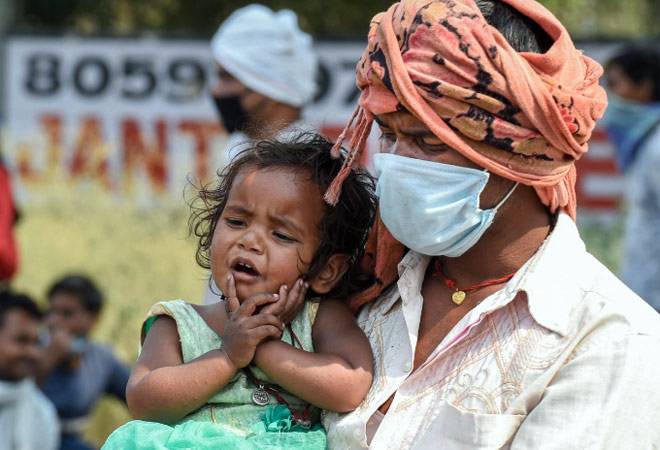
Migrants wait for a means of transport to travel to their native places during the fourth phase of the ongoing COVID-19 nationwide lockdown, at Kundali Industrial Area in Sonipat. (Photo: PTI)
The killing of a pregnant elephant has caused national outrage. The elephant had strayed into a village in Palakkad, Kerala, and is said to have been fed a fruit stuffed with firecrackers, which exploded in its mouth. It is impossible to comprehend the tremendous suffering of the elephant, who died a painful death. It is also learnt that people in the region have in the past used incendiary materials to protect their crop from animals, particularly wild boar.
One person was arrested after the matter came to light and few others have been identified. Kerala Chief Minister Pinarayi Vijayan has promised “justice will prevail”, but one does not know if that includes legal action against the hatemongers—including a former cabinet minister who gave the incident a communal colour by claiming, incorrectly, that the incident occurred in Muslim-majority Malappuram. A sitting cabinet minister also retweeted this fake news, which further vitiated the atmosphere.
In a complaint to the Malappuram Police, a lawyer has urged the police chief to file an FIR against the former minister and others for a “derogatory” campaign against the district.
Now, many Indian celebrities, for example Indian cricket team captain Virat Kohli, have said that they are “appalled” by the incident. The chairman of India’s biggest corporate giant, Ratan Tata, has compared the “criminal act” with “meditated murder”. The celebrities, the anchors of 24/7 news channels and many other prominent figures are undeniably upset by the plight of the elephant. But do they also feel the same kind of outrage and disquiet over the communal overtones being imparted to it?
( Read the full article here)
Against Aachaaram: A Dossier from Malayalam – Announcement
This is to announce a new series of postings I will be doing, relating to aachaaram in Kerala.
Aachaaram is loosely translated as ‘customary practices’ or ‘customary rituals’, but in 19th century Malayali society, it referred to a massive, inter-connected, all-pervading web of practices, rituals, and ideas which bolstered the domination of the upper-castes — in Kerala’s context, this meant the Brahmin-sudra nexus — over the lower castes. It touched the most intimate and personal aspects of a person’s life; through it, the allegiances and the labour of lower caste communities were extracted to benefit the upper castes. The lower-caste assertions of the late 19th and early 20th centuries here, through which modern democracy became a possibility at all, were directed against this web. Aachaaram, however, survived this phase through shrinking its spatial presence to savarna homes and temples; later, after the re-consolidation of brahmin-sudra power, towards the end of the 20th century, the rise of spiritual capitalism had led to aacharam’s resurrection as the vehicle of gendered savarna power — and as the provider of opening gambits for the Hindu fundamentalists — in Kerala .
In this series, I will post translations of selections/excerpts from the writings of the critics of aachaaram from early 20th century Kerala, with short reflections on each for the present. The many different readings of Hinduism that arose in that period when the Brahmin-sudra nexus was thrown into confusion, as well as the many different dreams of social liberation from different parts of the world that entered Malayali society then — from C Krishnan’s Buddhism to Marxism — produced powerful critical exposures that revealed aachaaram to be nothing but a vehicle and instrument of the power of certain groups over others. The effort made by these voices to point to the danger that it posed to a dream of a just society was largely ignored by the mainstream, especially the mainstream left.
The first of these is an excerpt from a conversation between the well-known social revolutionary, the avarna-born seer, spiritual leader, and philosopher, Srinarayana Guru and his disciples in which the annual pilgrimage to Sivagiri was planned, which I will post separately.
Hindutva Terror and Left Hegemony: After Women’s Entry into Sabarimala
Hours after the two women entered Sabarimala, the Hindu terrorists began their handiwork. Mad mobs, including women, began to roam the streets and attack by-passers, in their desperation to foment violence and provoke riots. In Karunagappally, Muslim establishments and shops were singled out for vandalism. The Sangh-backed Sabarimala Action Council called for a hartal today and they have spared no effort to make sure that people are terrorized. Continue reading Hindutva Terror and Left Hegemony: After Women’s Entry into Sabarimala
The Festering Sore of the Caste-Wall at Vadayambady: T T Sreekumar
T T Sreekumar, an important commentator on contemporary politics in Kerala — a public intellectual who now qualifies to be an irritant in the eyes of the Kerala police, now that he has openly declared his allegiance to the dalit people fighting injustice and Vadayambady and inaugurated a protest-event there — writes about the issue and its historical origins:
When I visited Vadayambady the other day to express my solidarity with the cause of the agitation, what I witnessed there was an atmosphere of utmost fear and police terror. A big task force of police was stationed at the location. The team that included the special branch officers, had created a situation of terror at the peaceful site. Activists mentioned that a particular police officer continuously hurled abuses, including caste abuses, at the protesters that included Dalit women and children. When the protest began to draw national attention, the ruling dispensation of CPIM that had hitherto remained unconcerned has started to take up some damage control measures. However, when they finally arrived at the site of the agitation almost after a year since the agitation began, the CPIM leaders allegedly refused to address the caste question involved. Dalit activists, including women activists, surrounded them and raised several objections to this attitude pointing to their sheer hypocrisy and lack of integrity.
Read more at:
 KAFILA - COLLECTIVE EXPLORATIONS SINCE 2006