
All posts by Aarti Sethi

I am an M.Phil student at the School of Arts and Aesthetics, JNU, New Delhi. This blog is meant to be a space for conversation with friends on my ongoing work on cinema and the city. And since all of you know me there not much else to say ;)

Report on Violence Against Workers in Ludhiana: JTSA

[Here on Kafila we have written before about the new contours of class struggle and unrest in industrial zones. As the demands of capital become ever more rapacious, and worker’s bodies more dispensable, the last few years have witnessed increasing incidents of violent conflict in urban industrial areas across the country. In each case workers’ demands fall on the deaf ears of an increasingly unresponsive management backed by the weapons of the state. When the simmering violence finally comes to a head, it is workers who are demonized. We carry below a report by the Jamia Teacher’s Solidarity Association on the recent outbreaks of violence in Ludhiana’s industrial zone.]

A fact-finding team of university teachers from Delhi visited Ludhiana on Sunday (20.12.2009) to ascertain the facts of the incidents of violence that have gripped the industrial part of the city involving migrant workers. The team visited Dhandari kalan and Sherpur and spoke to a large number of migrant workers and visited their homes. The team found that despite a large number of the migrant workforce (around 12 lakhs) living in Ludhiana for over 15 years, sometimes even much longer, a majority of them had no voting rights or ration cards. Even when they applied for voters I cards, their applications were rejected on spurious grounds. It is not surprising that no political party, not even the local Member of Parliament, Mr. Manish Tiwari, has bothered to visit them. This attitude percolates down to the bureaucracy and police force, who treat the migrant workers as virtually second class citizens. Continue reading Report on Violence Against Workers in Ludhiana: JTSA

Media Induced Morbidity Syndrome: Anant Maringanti

Or, when suicide threat becomes political strategy

Guest post by ANANT MARINGANTI

I am witnessing a bizarre phenomenon in Andhra Pradesh which I can at the moment only call Media Induced Morbidity Syndrome. That this is pathological, and that this has to do with the media I am certain. But it is difficult to pin down what the pathogen is.

First, in the days and weeks following the then chief minister Y S Rajasekhar Reddy’s (YSR) death on September 2nd, 2009; over 450 people were reported to have died either of heart attacks or suicides. Newspapers kept a daily tally and the numbers kept mounting. Being in Singapore at the time, several thousands of miles away from Hyderabad during those weeks, I had no first hand experience of the mood in Hyderabad. I dismissed the reportage as a silly political gimmick. It was easy to surmise that vested interests had simply been collecting daily death reports from various government hospitals in different towns and attributing them to grief over YSR’s death. The largest number of these deaths – 227 occurred on the day of the funeral and the following day. Continue reading Media Induced Morbidity Syndrome: Anant Maringanti

Reflections on Biometric Attendance: Kriti Budhiraja

This is a guest post by Kriti Budhiraja

The latest in the list of efforts to “meet international standards” is the proposal to introduce biometric attendance for teachers across Delhi University. According to Vice Chancellor Deepak Pental, this new system is in keeping with the “spirit of transparency inculcated by the Right to Information Act.” But this commitment to a “spirit of transparency” becomes immediately questionable when one reflects on the undemocratic ways in which proposals such as these are being pushed through. Much like the semester system which is going to be implemented despite widespread dissent, it is rightfully feared that Deepak Pental may go ahead with this proposal while paying scant regard to teachers’ hostility towards it. Continue reading Reflections on Biometric Attendance: Kriti Budhiraja

IWIJ Report on Shopian

After months of uncertainty in which the entire political and state machinery has been galvanized to ensure that the perpetrators of the horrific rape and murder of two young women in Shopian go scot free, the Central Bureau of Investigation has produced a report that gives a clean chit to the indicted policemen and claims that the two women drowned in a stream. Below we carry a report by the Independent Women’s Initiative for Justice. Do circulate as widely as possible.

The IWIJ comprising of Uma Chakravarti, Usha Ramanathan, Vrinda Grover, Anuradha Bhasin Jamwal, Seema Misra and Dr. Ajita – are conducting a case watch on the Shopian rape and murder of 2 women in May 2009. The first case watch report was released by IWIJ on 10 December 2009, at New Delhi.


Water…

In a tangential continuation of my last rant, a news report in the Hindu today caught my eye, because it made clear what we all know: the poor pay much much more for essential services than the rich do and therefore price of living indices as they are currently defined/calculated do not capture in any way the everyday realities of millions of Indians.

Continue reading Water…

Let Them Eat Gobi

It seems the Planning Commission exists on a planet which is so far removed from anything we might call the real world, that one begins to wonder whether its staff have not been born, bred and spent the entirety of their lives within the corridors of Yojana Bhavan, with tubes up their noses for nutrition. How else does one make sense of new figures released by the Tendulkar Committee according to which an income of 560 rupees per month in urban India and 368 rupees per month in rural India is enough to fulfill a person’s daily nutritional needs (2,100 calories urban; 2,400 calories rural). This can only mean one of two things: either the Planning Commission has invented a time machine whereby everyone can access food at 1980 prices, or they have simply gone insane. Continue reading Let Them Eat Gobi

Minarett-Verbot

This is a guest post by Naeem, an artist friend. The post is a cull from a conversation regarding the recent ban in Switzerland imposed on building minarets.

In a vote that displayed a widespread anxiety about Islam and undermined the country’s reputation for religious tolerance, the Swiss on Sunday overwhelmingly imposed a national ban on the construction of minarets, the prayer towers of mosques, in a referendum drawn up by the far right and opposed by the government. The referendum passed with 57.5 percent of the vote and in 22 of Switzerland’s 26 cantons.

Continue reading Minarett-Verbot

Why I Feel For B.P. Singhal

In the aftermath of the Delhi High Court judgement reading down Section 377, the initial euphoria and celebration is now being increasingly met with an equally strong backlash. Some of this has of course come from the religious right of all denominations (Hindu,Muslim, Sikh, Isayi Apas mein sab bhai bhai), the army, politicians, conservative commentators in the press. Underlying much of the oppositions seems to be a sense that somehow the decriminalization of homosexuality is going to turn everyone gay, a sentiment that sounds bizarre to us.

But now that I have been thinking about this I think I am beginning to understand the fear that is articulated in this “homosexuality-as-contagious-virus” position. Because in one sense they are right. In his post Lawrence speaks of the radical politics of impossibility – the change in the law suddenly makes possible a new set of imaginary possibilities that we could not dream of hitherto. And so BP Singhal and Dominic Emmanuel and everyone else who is saying that the presence of the law performs a stellar function against the rise of a virtual army of gay people and must remain on the books, even if, and indeed especially because, it is never used against actual real gay people, have a point. Continue reading Why I Feel For B.P. Singhal

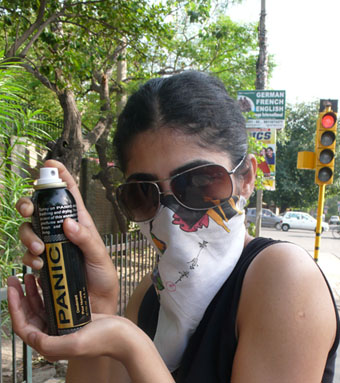
An Ounce of Panic is Worth a Quintal of Surveillance!

Panic

Did you know terrorists are running amok in Delhi University??

Continue reading An Ounce of Panic is Worth a Quintal of Surveillance!

Is Desh Ka Kuch Nahin Ho Sakta

Of the many excitements on offer at election time are the pious ads by luminaries of the film fraternity exhorting the peoples of India to vote. This one is my favourite…

“Parties come and parties go”, smiles Isha Koppikar,

“But the rubbish on the roads,” says a glum Ritesh,

“Is still there,” notes Farhan astutely.

“Why?”

“Why?”

“Why?” ask Shahid, Priyanka, and Sonam in anguished tones. The answer my friend, as the bard and Kareena said is, “Kyonke Kuch Nahin Ho Sakta Is Desh Ka”. Bhaiiyon aur behenon! Ungli uthao aur button dabao! Ah! TV! But the disastrous acting and terrible scripting aside, there are few things more hilarious than watching Abhishek Bacchan, who distinguished himself by declaring himself a farmer and stealing land from farmers in Barabanki, waxing eleoquent on criminalization of politics. Truly, after watching this ad, I am forced to concur: Is Desh Ka Kuch Nahin Ho Sakta…

Dignifying Jade Goody, or, What Jade Goody actually connotes: D. Parthasarthy

guest post by D. PARTHASARTHY

When newspaper columnists become self-righteous, it is usually because they see a good way of capturing reader interest by moralizing about an issue. After all, tabloids around the world regularly make fortunes by generating a false sense of moral outrage and indignation through stories of the indiscretions and ineptitudes, sufferings and misfortunes of celebrities and of not so famous people. It is a sign of irony as well as an indication of the way in which neo-liberal capitalist media works, that the consequences of alienation engendered by an individualist ideology is fodder for sensationalist reporting, but also a tool for mobilizing collective conscience against alienated individuals, and for preventing communities from understanding the real reasons for alienation.

Continue reading Dignifying Jade Goody, or, What Jade Goody actually connotes: D. Parthasarthy

Cultural Policing in Dakshina Kannada: Vigilante Attacks on Women and Minorities

[This summary comes to us from ARVIND NARRAIN (ALF) of a report brought out by the People’s Union for Civil Liberties, Karnataka (PUCL-K) in the wake of the attacks on women in Mangalore by cadres of the Hindu right-wing Sri Ram Sene.]

It was only after the continuous telecast of the images of the women who were subjected to an horrific assault by cadres of the Sri Ram Sene in a pub in Mangalore on January 24, 2009, that public attention gravitated towards what was happening in Mangalore. Self styled vigilante groups in Dakshina Kannada have begun to police social interactions between members of different religious communities such as boys and girls drinking juice together or sitting together on a bus merely because they come from different religious communities. Cultural policing also targets women in particular and lays down norms with respect to public spaces they can occupy and the clothes which they can wear. Cultural policing has as its primary target, young people. From Shefantunde (16) who was attacked for talking to a Hindu girl to a college student Shruti and Shabeeb for talking on a bus to Anishwita (23), Akeel Mohammmad (24) and Pramilla(22) for drinking a juice together, its the young which has come under vicious attack. Perhaps we also need to think of the young not just as victims but indeed as agents of social transformation who through their everyday acts of fraternal living are fulfilling the promise of the Indian Constitution and thereby imperiling the ideological agenda of those who see India differently. Cultural policing aims to punish all those who try to live out the meaning of the Preamble’s promise of ‘fraternity’ and is a fundamental attack on the very Constitutional order. The promise of fraternity held out in the Preamble is what is contested at its very roots by cultural policing. What cultural policing wants to produce are monolithic self-enclosed communities with no form of social interaction between them. It is antithetical to the idea of ‘We, the people of India’ and insists that India is no more one nation, but rather a collection of separate peoples. This Report documents how sixty years after independence, the vision of the framers of the Constitution is sought to be so completely repudiated by organizations which are bent on ripping out the heart of Indian Constitutionalism.

The full report is available on the Alternative Law Forum website and can be accessed here.

The Caste of a Scam: A Thousand Satyams in the Making

Guest post by D.PARTHASARATHY

Industry leaders, CEOs, and Corporate big-wigs have been falling over each other to portray the Satyam scam as an isolated case, as a simple failure of corporate governance. On the other hand critics from the left once again have had a field day with their “I told you so” condemnation of capitalist free market economies. There is also a moralistic middle class which blames it on greed pure and simple. The fact that the Indian private sector is largely dominated by family owned and controlled businesses of sundry sizes, that caste, community, gender, and social networks play a significant role in who gets nominated to top positions within the companies, and how businesses are run, that these have significant implications for corporate governance as well as corporate loot – these are issues that are too dangerous and embarrassing at the same time, and so are conveniently ignored.

Continue reading The Caste of a Scam: A Thousand Satyams in the Making

Your Rights End Where My Terror Begins

A phone in poll today on CNN-IBN’s Face the Nation:

Should human rights take a back-seat in favour of tougher terror laws?

65% say Yes!

Thus speaketh the great Indian middle-class- Enough is enough!

Continue reading Your Rights End Where My Terror Begins

Mera Joota Hai Iraqi!

With utmost seriousness, the news clip replays the incident twelve times for our viewing pleasure, while the ‘LIVE’ on the top right-hand of the screen glints promisingly. Ah yes gentle reader, if wishes were horses…  The Guardian helpfully accompanies the clip with cultural commentary for its readers, just in case we were in any doubt as to the symbolic significance of the action:

In the Arab world, throwing shoes at somebody is considered a serious insult, as is even showing them the soles of one’s footwear, as demonstrated by jubilant Iraqis towards the statue of Saddam Hussein as it was toppled in Baghdad during the 2003 invasion.

Always good to be up on native customs in the global village.

Continue reading Mera Joota Hai Iraqi!

Witnessing Madness 24/7

What is happening? The Taj is burning, gunmen are shooting, the police is storming, the Oberoi is burning, the army is descending, people are running; bleeding; dying. Barkha Dutt is talking, Rajdeep Sardesai is talking, Srinivasan Jain is talking, Vilas Rao Deshmukh is talking, L.K Advani is talking, Manmohan Singh is talking, Vikram Chandra is talking, an eye-witness is talking, the army chief is talking, the naval chief is talking, an ex-hostage is talking, the terrorist is talking, Javed Jaffery is talking, Arnab Goswami is talking, is anyone even listening, is everyone listening—But what is happening?

Continue reading Witnessing Madness 24/7

Collateral Damage in our ‘War on Terror’

The Express Story today on the detention and torture of 6 Muslim men/boys in the wake of the Hyderabad blasts makes for chilling, terrifying reading. Amongst over 70 Muslim men who were arrested by the Hyderabad police, they detail custodial abuse and torture which ranges from stripping, to severe beatings on the hands and soles of their feet, to electrical shocks administered to genitalia. With characteristic insouciance and perversity the government has announced a ‘healing touch’ compensation of Rs 30,000 to each victim of the police’s tactile ministrations.

Continue reading Collateral Damage in our ‘War on Terror’

Whitey On The Moon

guest post by S. ANAND

We Back on the Ground (WeBOG) would like to congratulate the Indian state for sending up a rocket towards the moon. Continue reading Whitey On The Moon

Of “Killer” Buses and Car Lobbies: The Coincidental Death of the BRT

The sustained campaign by the elite press to jettison Delhi’s first mas transit bus system has been remarked upon and documented on Kafila. Today morning’s newspapers carries news of an accident in which 32-year old Poonam Sharma was killed as she tried crossing the road and was hit by an oncoming bus. Delhi’s record when it comes to road safety is abysmal and this is yet another instance of the the terrible and tragic fate that befalls many pedestrians every year on Delhi’s roads. What is interesting though is the way in which accidents on the BRT are reported compared to the reportage of other road fatalities. Here are some headlines from the recent past:

BRT Corridor Claims One More Life

BRT Delhi: Death Toll Continues, Pedestrians Blamed

Delhi BRT has it 10th Victim

BRT Claims another Life: Woman run over by Bus

Continue reading Of “Killer” Buses and Car Lobbies: The Coincidental Death of the BRT

Bye Bye Reliance: Pen Tehsil Says No SEZ!

In our continuing concern with the strange times that seem to have befallen our cities, lets not lose sight of the historic battle underway in the countryside. In the first instance of its kind, the referendum on the Maha-Mumbai Special Economic Zone being set up by Reliance has unambiguously returned the verdict of the farmers of Raigad- no SEZ in Pen! As Sanhati notes, the Tata’s 1500 crore investment in Singur sounds like loose change when compared to the one lakh crore that Reliance is planning to sink into 10,000 hectares. 22 villages in the Pen Tehsil voted against the acquisition of their lands at the paltry sum of 10 lakhs per acre. Unsurprisingly, Reliance Industries Limited has said the referendum is “not genuine”:

Continue reading Bye Bye Reliance: Pen Tehsil Says No SEZ!

Some Questions About the Delhi Encounter

By Shabnam Hashmi, Satya Sivaraman, Manisha Sethi, Tanweer Fazal, Arshad Alam, Pallavi Deka

First published on Countercurrents.

A team comprising activists, academicians and journalists visited the site of the police operation against alleged terrorists staying in an apartment in Jamia Nagar in the afternoon of 20.09.2008 (Saturday). Two alleged terrorists Atif and Sajid, along with Mohan Chand Sharma, an inspector of the Delhi Police’s Special Cell died in the operation while a third alleged terrorist was arrested. Continue reading Some Questions About the Delhi Encounter