All posts by Aditya Nigam

डिजिटल दुनिया के देशभक्त सैनिक और औसत आदमी : मनीष राज

Guest post by MANISH RAJ

चारों तरफ देशभक्ति का खुमार चढ़ा देख मैं सोच में पड़ गया. क्या मैं भी देखभक्त कहलाने लायक हूँ? क्या मेरे अन्दर भी देशभक्ति के वे सभी गुण मौजूद हैं जो एक भारतवासी में होने चाहिएं? इस सवाल का जवाब जानने के लिए पहले मुझे देशभक्ति के मायने समझने होंगे. आखिर देशभक्ति किसे कहते हैं?

सबसे पहले मैंने इस शब्द के शाब्दिक अर्थ पर गौर किया. देशभक्ति यानि देश की भक्ति. लेकिन भक्ति तो भगवान् की होती है न जी, जिसका गुणगान करना मोक्ष का मार्ग माना जाता है. या फिर उन बाबाओं की, जिनके एक आशीर्वाद, एक अंगूठी या एक ताबीज़ से आपका धंधा चल निकलता है, आपके बच्चों की शादियाँ हो जाती है और सारी बीमारियाँ ठीक हो जाती है. वैसे आजकल भक्ति शब्द अलग-अलग नामों से बहुत फैशन में है. एक समूह दुसरे समूह को किसी व्यक्ति विशेष का भक्त बता रहा है, तो वहीँ दूसरा समूह पहले समूह को पुरानी धारणाओं से ग्रसित और किसी दूसरे व्यक्ति का चमचा बता रहा है. सूचना के लिए बता दूं कि मैं अपनी गिनती इन दोनों समूहों में नहीं करता. इन दोनों में खचाखच भीड़ है, और भीड़ में मेरा दम घुटने लगता है.

शब्दों में उलझ गया तो फिर सोचा कि व्यस्तता से भरे आधुनिक जीवन में शब्दों की तितलियों के पीछे दौड़ने का क्या लाभ. इसलिए व्यावहारिक होते हुए मैंने देशभक्ति के प्रमाणिक सबूत तलाशना शुरू किया. देशभक्त किन्हें माना जाता है और उनमें क्या गुण होते हैं? Continue reading डिजिटल दुनिया के देशभक्त सैनिक और औसत आदमी : मनीष राज

बड़े नोटों का रद्दीकरण – छिपकली की पूंछ पकड़ने के लिए विशाल पिंजरा – राजिंदर चौधरी

Guest post by RAJINDER CHUDHARY


1946 और 1978 में भी प्रचलित बड़े नोटों को रद्ध किया गया था। इस लिए 8 नवंबर 2016 को मोदी सरकार द्वारा 500 और 1000 रुपये के प्रचलित नोटों को रद्ध करने का निर्णय आधुनिक काल में तीसरी बार उठाया गया कदम है। तीनों बार मुख्य लक्ष्य कालेधन को खत्म करना रहा है। लेकिन मोदी सरकार ने अपने निर्णय के पीछे एक नया कारण भी जोड़ा हैं। यह है नकली नोटों का बढ़ता चलन और इन के माध्यम से आतंकवाद का फलना-फूलना। रिज़र्व बैंक के नवीनतम आंकड़ों के अनुसार 2015-16 के दौरान 1000 रुपये के नोटों में नकली नोटों का अनुपात 0.002262% था यानी 1000 के एक लाख नोटों में सवा दो नोट नकली पाये गए (इन में पुलिस एवं अन्य द्वारा पकड़े गए नकली नोट शामिल नहीं हैं)। 500 रुपये के नोटों में यह अनुपात 0.00167% था यानी 500 रुपये के 1 लाख नोटों में नकली नोटों की संख्या 2 से कम थी। जाहिर है ये सारे के सारे नकली नोट आंतकवादियों द्वारा जारी नहीं किए गए होंगे। विशुद्ध आर्थिक अपराधियों का भी इस में योगदान होगा। लेकिन अगर यह भी मान लें कि ये सारे के सारे नकली नोट आतंकवादियों द्वारा चलाये गए थे तो भी 2015-16 में रिज़र्व बैंक के आंकड़ों के अनुसार 500 और 1000 के नकली नोटों की कुल कीमत 27.39 करोड़ रुपये बनती है (इन के अलावा 2015 में बीएसएफ़ ने 2.6 करोड़ रुपये के नकली नोट पकड़े थे)। इस से स्पष्ट है कि नकली नोट आतंकवाद की बुनियाद नहीं हो सकते। वैसे भी, इन नकली नोटों पर रोक लगाने के लिए इन नोटों को एकायक रद्ध करना न आवश्यक है और न पर्याप्त। अगर नोटों की छपाई को अधिक सुरक्षित नहीं बनाया गया, तो ‘आतंकवाद के समर्थक’ ताकतों, जो सामान्य अपराधी तो हैं नहीं, द्वारा नए नकली नोट छापना मुश्किल नहीं होगा। इस लिए अधिक सुरक्षित नोट छापना बेहद आवश्यक है।  नए, अधिक सुरक्षित नोट जारी करने के साथ, पुराने ‘असुरक्षित’ नोटों को बदलवाने के लिए एक समय सीमा रखी जा सकती थी। जैसा पहले भी किया गया है। 2005 से पहले के छपे नोटों को, जिन पर छपने का वर्ष अंकित नहीं होता था, उन्हें मई 2013 से पर्याप्त समय दे कर, बैंकों में जमा करा लिया गया है। यही प्रक्रिया दूसरे ‘असुरक्षित’ नोटों के साथ भी दोहराई जा सकती है। इस लिए नकली नोटों पर रोक लगाने के लिए सारे नोटों को रद्ध करना आवश्यक नहीं था। Continue reading बड़े नोटों का रद्दीकरण – छिपकली की पूंछ पकड़ने के लिए विशाल पिंजरा – राजिंदर चौधरी

‘Degrees’ of Democracy – Field Notes from a Central University in Bihar: Debaditya Bhattacharya

Guest post by DEBADITYA BHATTACHARYA

This piece has long been in the coming. Soon after the summer of student protests in India exposed the terror-apparatuses of the state and unleashed a new vocabulary of progressive political resistance, the students of a certain Central University of South Bihar (in Gaya) went on strike against the university administration in the early days of August. They however were not fighting to protect constitutional rights, because their daily encounters with the university had already come to rest on a structural suspension of many such rights. Like those of speech, of rational thought and scientific inquiry, of gender-equality, and of resisting what Vemula called the event of being reduced to one’s “immediate identity”. These students merely decided to fight for their right to a degree.

They had come together to demand statutory recognition for courses that they were enrolled in since 2013, but most sections of the national media at that time deemed the issue ‘sub-national’ enough to be granted space or audience. Reporters from the local print-media were – in what seems like accepted practice across public institutions in the country – barred entry into the university campus, and hearsay reports constituted the stuff of low-key news-briefs with little context or compassion. Those who attempted to organise public opinion by writing on social and alternative media spaces, were – in a classic division of interests that administrative bureaucracies are deft at provoking – urged by students themselves to withdraw. The reason was simple: each social media post or conversation around the issue was declaredly spied on by the university administration in order to ‘detect’ subterranean alliances and “outside support” (as if it were a terrorist conspiracy!), and students were individually targeted and intimidated for passing on internal ‘secrets’ to ‘outsiders’. I know of specific Facebook posts which had been taken print-outs of and convened surreptitious meetings over, where administrative heads and proctorial board members put their heads together to crush the germ of student dissent and ‘outsider’-mobilizations. The agitated students continued in their own ways, despite open threats of disciplinary action and reminders of exam-time tactics of penalisation. The Vice-Chancellor marched off to Delhi to strike bargains for an interim settlement-package with officials in the ministry, and returned to meet the striking protestors with as much of an assurance as threats of expulsion. Continue reading ‘Degrees’ of Democracy – Field Notes from a Central University in Bihar: Debaditya Bhattacharya

Demonetization, ‘Financial Inclusion’ and the Great ‘Unbanked’

A Prologue

There is a lot of talk these days about ‘exclusion’ – which is almost unquestioningly assumed to be a bad thing. The corollary to this understanding of exclusion is that all inclusion is necessarily good. One hears a lot about ‘financial inclusion’ these days,  which truth be told, makes me shudder. There is thus a lot of angst expressed these days, especially by the rich and powerful, over the ‘financial exclusion’ of the masses. Here is the basic argument (read the full article, disowned by the edit department, here):

Inclusive growth would mean that all sections of society benefit from economic prosperity. A key metric for inclusion is ‘financial inclusion’ i.e. the access to banking services and affordable financial products such as bank accounts, loans, and deposits for all individuals and businesses. When the poorest of the poor have access to credit and savings facilities, this translates to their financial security. They can grow larger businesses, manage consumption and household expenses better and plan for shocks. The standard of living improves and poverty falls, allowing people to contribute more to the economy as well.

Remember, however, before we proceed:

(i) That in 1997, the Asian financial crisis that wiped out the hard earned life-savings of millions of people, in one fell swoop, was an instance of financial inclusion.

(ii) That it was the banks that were fully responsible for the crises across the USA and Europe, 2008 onward. That the Occupy Wall Street movement was basically a movement against the  robbery of ordinary people’s money saved in banks by the banks, who on top of everything wanted to be bailed out with tax payers’ money.

(iii) That very recently Iceland has had to jail 26 bankers responsible for the 2008 financial crisis, “for crimes ranging from insider trading to fraud, money laundering, misleading markets, breach of duties and lying to the authorities”.

(iv) That one of the major reasons India escaped the worst effects of that crisis was because effectively 70 percent of its population still lies outside the banking and financial sector. Of course, the other important difference with the Western capitalist economies was that India’s banks were still largely in the public sector. In other words, banks do not only do what they and the economists say they do. Banks play with the hard-earned savings of the relatively poor, often simply handing handing them over to predator corporations and then writing off!

The Demonetization Gamble

A lot has already been said by now on the Modi government’s decision to demonetize Rs 500 and Rs 1000 notes. Economists and economic analysts from the Left-wing Prabhat Patnaik to others like  World Bank Chief Economist and former advisor to the Indian government, Kaushik Basu and journalist Swaminathan Aiyar have expressed serious doubts about both the rationale and feasibility of the move.  The point has been effectively made by them and others like Arvind Kejriwal (who have been centrally concerned with the issue of corruption and ‘black money’ for a long time now), that this measure does not touch the real big players in the game of black and unaccounted money. Big corporate sharks don’t need to go the ‘black money’ route because government policy itself is written by them and everything they do is made ‘legal’ either in advance, or retrospectively, because the government is in their pockets. Of course illegal activities even at those high levels often go on nevertheless, because the power-corporate elite has become so used to the idea that nothing really matters in this country – that everything they want is theirs. And in any case, the real big money lies deposited in Swiss banks or in circulation elsewhere, in other forms. Continue reading Demonetization, ‘Financial Inclusion’ and the Great ‘Unbanked’

Modi’s Demonetization, Black Money and Surveillance: Baidurya Chakrabarti

Guest post by BAIDURYA CHAKRABARTI

  • The demonetization drive of Modi is neither new in content nor in form. In India, it has been done earlier by Morarji Desai; the initial conversion to Euro in the European Union happened within a month’s span. Currency is routinely taken out of circulation. What is significant about Modi’s demonetization is the amount of sensation he has generated out of an otherwise insignificant move. What is routinely done through phasing out denominations is being done in an extremely abrupt manner. He is dressing up a withdrawal and issuing of currency notes as a revolutionary move, and it is being executed in the manner more suited to currency change. What we need to thus ask ourselves is this: why is a routine monetary policy being enacted in this—which I shall later call ‘terroristic’—manner? Clearly, the answer is not economic; even the government does not pretend it to be a strictly economic issue (when they harp on the ‘terror’ factor).

(But before we move on, an aside. This demonetization exposes how the nostalgia for socialist development has fuelled the rise of Modi. Disenchantment with neoliberalism has produced an obscene amount of nostalgia for the pre-liberalization days among the Indian middle class, especially among the left-leaning ones. However, now that a gesture right out of those hoary days have returned to our world, it turns out to be a nightmare.)

  • Let us state the obvious things first: demonetization will do next to nothing to the so-called ‘black money’, which are routinely converted into fixed assets or foreign currency. This move dis-incentivizes hoarding of cash, but not speculation, all sorts of accounting practices that can produce the so-called ‘black money’ while bypassing the level of cash transaction altogether. Demonetization is simply an old-school, brute-force monetary policy to curb hyperinflation. The Head of European Central Bank in Europe and Larry Summers, US treasury secretary, has proposed demonetization of their high-currency notes this year. But none of them dream of doing it within a notice of 4 hours!

Continue reading Modi’s Demonetization, Black Money and Surveillance: Baidurya Chakrabarti

Anguish and Insurrection – Travelling with Shubha’s Poem: Prasanta Chakravarty

Guest post by PRASANTA CHAKRAVARTY

अतिमानवीय दुख

शुभा
________________

इतना दुख आंसुओं से नहीं उठाया जाता
वे हार गए कब के
चीख़ इसे और वीभत्स बनाती है
गुस्सा तो सिर्फ राख पैदा करता है

कुछ देर इसे ख़ामोशी ने उठाया
कभी उठाया कविता ने
विचार ने उठाया इसे
इसे उठाया दोस्तों ने
मिलकर गीत गाते हुए

कम्युनिस्ट पार्टियां बिखरीं
कितनी बार इसे उठाते हुए

इसे उठाने के लिए
कुछ और चाहिये
इन सबके साथ
उठाने का कोई नया ढब
इतिहास ने इसे उठाया कभी-कभी

अब इसकी चिन्दियां बिखरी हैं
इन्हें बच्चे उठा रहे हैं
यह पहुंच रहा है प्रकृति तक
तूफान और कन्दराएं
उठायेंगी इसका बोझ

अगर धरती इसे न उठा सकी
अन्तरिक्ष में नाचेंगी इसकी चिन्दियां

1.

SUPERHUMAN GRIEF

Shubha

Tears cannot bear such a burden of grief
They gave up a while ago
A scream makes it even more horrid
And anger gives birth only to ash

For a while silence bore it
Occasionally it was borne by poetry
Thought bore it
It was borne by friends
As they sang songs together

Communist parties scattered
so many times as they bore it

To be able to bear it
Something more is needed
along with all of these
a new way to bear it
History bore it on occasion

Now its scraps are scattered
Children are gathering them
It is now reaching nature
Storms and ravines
Will bear its weight
If the earth cannot bear it
Its scraps will dance in the cosmos

(Tr. Suvir Kaul)

* * *

2.

GRIEF WAY BEYOND HUMAN

Shubha

A grief that is way beyond human
Is too hard for tears to hold
Defeated, they dry up before long
Howling makes it only worse, more horrendous
Anger yields nothing but ash

Silence shouldered this grief for sometime
As did poetry
As did ideas now and then
As did comrades singing in unison
History has carried it too

Communist parties fell apart so often
Carrying this burden

Surely we need something different now
To carry it any farther

Grief is everywhere now
Little children are carrying its shredded pieces
It has overcome nature
Caves and storms will bear it

If the planet too fails to contain this grief
Its shreds will swirl and spread
Into empty space beyond

(Tr. Bhupinder Brar)

* * *

3.

SUPERHUMAN SORROW

Shubha

So much sorrow cannot be borne by tears
They gave up a while ago
A shriek makes it more grisly
And anger only births ash

For a while silence bore it
And sometimes poetry did
Thought carried it
And friends too
Singing along together

Communist parties disintegrated
so often while carrying it

Something more is needed
Some new bearing
with the rest to carry it
Now and then history lifted it

Now its bits lie scattered
Children are picking them up
Now it’s reaching into nature
Storms and caves will
bear its burden

If the earth is unable to bear it
The bits will dance in the cosmos

(Tr. Aishwarya Iyer)

* * *

4.

SUPERHUMAN GRIEF

Shubha

Tears can’t bear this much grief
They had been defeated long ago
A scream makes it more grotesque
Anger can only turn to ashes

For a time silence carried the burden
sometimes poetry tried it
Ideas bore it for a bit
And then the friends
singing together

Communist parties disintegrated
trying to carry it ahead

To bear it
one needs something else
A new way
Beyond the known ones
Occasionally history too tried its hand

Now it lies scattered
And children pick up the pieces

It now enters the nature itself
Storms & Caves
Shall lift its burden
If the earth can not bear it
Universe shall see the pieces dance

(Tr. Tarun Bharatiya )

5.

SUPERHUMAN GRIEF

Shubha

Tears cannot bear this burden
They have dried up long ago
A scream makes it bizarre
And anger can only produce so much ash

Silence bore it for some time
Sometimes poetry
Thought carried it
As did friends
singing in unison

Communist parties disintegrated
Umpteen times under its weight

Something else is needed
To lift it
A new way
Along with the familiar ones
History lifted it occasionally

It is scattered into tiny strips now
Kids are picking and carrying them
It is now reaching the nature itself
Storms and caves and ravines
Will bear it

If the earth couldn’t carry its weight
The strips will dance in outer space.

(Tr. Asad Zaidi)

––––

Five translations of a single poem, by five leading poets, activists, artists and/or literary scholars. A rare occasion in contemporary translation on the subcontinent. A special poem it is indeed. Every single one of these attentive readers seems to have been scorched by the primitive, enunciatory power of its pure voice. Every single translation extends the afterlife of the original and shows how Shubha has been able to successfully communicate the force of a guttural shriek into something coherent and universally felt. Continue reading Anguish and Insurrection – Travelling with Shubha’s Poem: Prasanta Chakravarty

Beyond pop nationalism – How neoliberalism affects the jawan: Ujithra Ponniah

Guest post by UJITHRA PONNIAH

‘7th Pay Commission: Modi government’s Diwali bonanza to armed forces! Indian soldiers to get 10% arrears’, on October 13, 2016 Zee News the current government’s pet broadcaster, tried to quell the rising disquiet within sections of the armed forces with the 7th pay commission recommendations[i]. The recommendations of the 7th pay commission headed by a retired Supreme Court judge, Justice Ashok Kumar Mathur came into effect from the January 1st, 2016. The three military chiefs in an uncharacteristic move since then have written repeated letters to the government, expressing their rising unhappiness within the ranks only to be swiftly turned down. The last on the matter from the defence minister Manohar Parrikar is a promise of referring the anomalies to a higher panel, a black hole where many concerns in the past have also been lost. Along with the current serving military chiefs, 10 ex-chiefs have also written to the Prime Minister, only to be met with the selective silence that many in the country are well familiar with[ii]. So what are the military’s concerns with the current pay commission?[iii] They can be swiftly summarized around three points though the issues run deeper: an increasing disparity between the military and the civilian central government employees both in terms of pay and hike (for example a hardship allowance for an IAS officer posted in the north east is more than a soldier in Siachen); a downsizing of the disability pension in the military; and the clubbing of the military service pay (MSP) of junior commissioned officers (who rise from within the ranks of the jawans) and the jawans[iv].

Continue reading Beyond pop nationalism – How neoliberalism affects the jawan: Ujithra Ponniah

An Appeal by JNU Teachers on the Disappearance of Najeeb Ahmed

We, the undersigned teachers of JNU, are deeply concerned about the continued absence of Najeeb Ahmad, a student of M.Sc. Biotechnology, who was last reported as seen  on JNU campus on 15 October 2016. We express our deepest sympathy and solidarity with Najeeb’s mother, sisters and extended family, and share in their anxiety and despair at the fact that even after ten days of Najeeb’s disappearance, neither the police not the JNU authorities have been able to provide any credible leads to his whereabouts; indeed, both have failed to even keep the JNU community informed of the progress of the search operations.

The JNUTA has repeatedly requested the VC to issue a personal appeal assuring Najeeb complete security and due process and to immediately set up a channel for the dissemination of this information, but to our dismay, the JNU administration has taken no concrete steps in this direction.The very least the JNU administration can do at this juncture is to issue a press release detailing all the steps it has taken thus far in facilitating the search for Najeeb, including its own efforts as well as its communications to the police and other authorities, and thereafter issue daily bulletins on the developments in the search. This willingness to share information with the JNU community and particularly Najeeb’s distraught and anxious mother and family, is absolutely imperative, both as a measure of enforcing accountability as well as to prevent the circulation of unfounded rumours. Continue reading An Appeal by JNU Teachers on the Disappearance of Najeeb Ahmed

Academics’ Letter to the VC, Central University of Haryana Regarding the ‘Draupadi’ Affair

Following is the text of a letter to the Vice Chancellor, Central University of Haryana, sent by some academics protesting the attacks on Dr Snehsata Manav and Dr Manoj Kumar regarding the students’ production of the play ‘Draupadi’:
To the Vice Chancellor,
Central University of Haryana
Dear Vice Chancellor:
We write in support of Dr. Snehsata Manav and Dr. Manoj Kumar of the Department of English and Foreign Languages who have recently come under attack for their sponsorship of a student production on your campus of the play “Draupadi” based on a story by Mahasweta Devi who, as you know, is universally recognized as a towering figure in contemporary Indian literature. Her writings, translated into most Indian languages, have highlighted the struggles of oppressed and marginalized women and men. Her story “Draupadi”, whose dramatized version has been highly acclaimed and performed all over India, deals with the sensitive but enormously important question of the ethics of deploying the armed forces in dealing with civil disturbances within the country. This question, along with specific instances of rapes committed by army personnel in different parts of India, continues to be debated in the Indian public media and has engaged the attention of political leaders as well as the courts.
We strongly believe that it is both unjust and unwise to accuse intellectually responsible teachers of hurting the sentiments of some sections of opinion. The recent demise of Mahasweta Devi was a perfect occasion to engage university students in a serious discussion on why some of the greatest writers and artists of India have been concerned about the excesses of state violence carried out at the behest of those in power, no matter what their party or ideology.
We hope you will convey our views to those who have accused Dr. Manav and Dr. Kumar of being hurtful and unpatriotic. The university campus needs to be fostered as a place where difficult questions can be debated in a spirit of intellectual openness and without fear of censure.
Sincerely,
Gayatri Chakravorty Spivak, University Professor in the Humanities, Columbia University, New York
Akeel Bilgrami, Stanley Morgenbesser Professor of Philosophy, Columbia University, New York
Gauri Viswanathan, Professor of English and Comparative Literature, Columbia University, New York
Partha Chatterjee, Professor of anthropology, Columbia University, New York
Romila Thapar, Professor Emeritus in History, Jawaharlal Nehru University, New Delhi
Ramachandra Guha, author, Bengaluru

Continue reading Academics’ Letter to the VC, Central University of Haryana Regarding the ‘Draupadi’ Affair

Killings in Kaziranga, Dantewada Hazaribagh – ‘National Interest’, ‘Internal Security’ and ‘Development’: Kamal Nayan Choubey

Guest post by KAMAL NAYAN CHOUBEY

In the last few weeks there were at least three gruesome incidents of killing of tribals or forest dwelling persons in different parts of the country. In the first incident two persons from Muslim community were killed in police firing near Kaziranga National Park (KNP) of Assam on 19 September 2016. These people were peacefully protesting against their eviction drive carried out by local administration, which was implementing the judgment of Gauhati High Court related to evictions. In the second incident two young boys were killed by police in the Bastar area of the Chhattisgarh, and following the long tradition of all such killings, the police claimed that they were Maoists. The third incident occurred on the 1st October in the Hazaribagh, Jharkhand where the police used its brutal power and killed four persons in an open firing. These people were peacefully protesting against land acquisition for a Thermal Power Plant, which would cause their displacement. It is should be asked that why the State used its brutal power against one of the most marginalized sections of the society? Was firing on these unarmed and, at least in two cases, peacefully protesting tribal and forest dwelling people necessary? Could it be claimed by the State authorities that they fulfilled all constitutional obligations in the context of the demands of these people, in other words, could it be claimed by authorities that their demands were absurd and unconstitutional? Or would it be more correct to underline that tribals represent the marginal voices of the Indian nation-state, and mainstream notions of ‘national interest’, ‘internal security’ and ‘development’ have meager or no space for their claims or rights?

Continue reading Killings in Kaziranga, Dantewada Hazaribagh – ‘National Interest’, ‘Internal Security’ and ‘Development’: Kamal Nayan Choubey

Press Club of India Elections 2016 – Prescription for a better soup: The Dissenters

[As the Press Club of India, Delhi, goes for its election today, with two left panels on offer, here is a note from THE DISSENTERS. We publish this as we think it raises some very important issues of larger importance.]

How to vote amidst false claims from Left, Right and Others

Journalism means expressing dissent and speaking truth to power. Alas! The Press Club Of India has lost this very essence. In the lust for power, all ethics and morality, even professional wisdom is being negotiated with in the current elections for PCI, New Delhi.

The recent move by one brave journalist to dissociate himself from his panel at the last moment exposes grave corruption embedded in the the moral sphere of scribes who have formed convenient rainbow coalitions, convenienty called panels, to grab the small power centre that operates from 1, Raisina Road, New Delhi. This election however was a farce from the very beginning. Let us take some time to read this before we go to vote on October 1st, 2016.

The outgoing panel was supposed to go out of office after completion of its one-year term and remain as a caretaker till the current elections. This never happened. There are many arguments for and against this immoral act but what has conspired in the meantime needs to be recalled.

The defining moment for this panel, named Nadeem panel after PCI outgoing Secretary-General, came in the Ali Javed episode. Let’s not forget that Ali Javed only booked the PCI hall  in his capacity as a member where the Kashmir-centric program was held and allegedly “anti-national” slogans were raised. Despite, this management committee involved Delhi Police instead of initiating a preliminary internal inquiry. A complaint was lodged in the midnight by PCI against Javed and others that led to prolonged harassment of this senior member who teaches in DU and is himself the General Secretary of Progressive Writers Association, the oldest organisation of writers in this country associated with the Communist Party of India (CPI).

A signature campaign was initiated against PCI’s move the very next day in favour of Javed that immediately tested the waters. The “official” panel (Gautam-Vinay panel) supported by outgoing GS Nadeem Kazmi is backed by so-called CPI-CPM affiliated journalists. These scribes not only refused to sign the petition rather disapproved of running any such campaign because “right-wing will benefit” from it. Later Javed was reinstated but when he arrived one fine evening in the club, he was forced to leave and even abused as “Pakistani agent” by some management committee members as well as others.  Continue reading Press Club of India Elections 2016 – Prescription for a better soup: The Dissenters

Aam Aadmi Mohalla Clinics Set to Shut Thanks to L-G and BJP Controlled Municipal Bodies: Jyoti Punwani

[The Superintendent of Tihar Jail, went a joke recently circulating on WhatsApp, had staked his claim for the Chief Ministership of Delhi, because he had the requisite number of MLAs! The mainstream (Big) media has had a field day, reporting with great ‘earnestness’, what even the ordinary person on the street can see is an orchestrated move to harass and discredit the AAP. A leading paper even did a status report on all the cases against AAP MLAs a couple of days ago, as if it was simply ‘reporting’ (with a straight face). Some day, hopefully we will be able to come out with a more detailed analysis of the ways in which sections of the big media have – even in the person/s of their most benign representatives and columnists – played footsie with the regime at the Centre. This dispensation and its utterly unprincipled and unethical ways are truly unprecedented and this phase of our history has emerged as the dirtiest chapter of parliamentary democracy in India. In the meantime, online news forums have kept the tradition of actual reportage and fairness alive. Here are some extracts from a report by JYOTI PUNWANI, courtesy The Hoot (linked below), on the mohalla clinics and the strange politics of the media that surrounds reportage around such measures undertaken by the Delhi government.]

The AAP’s mohalla clinic experiment drew the attention of The Washington Post. Its article (`What New Delhi’s free clinics can teach America’, March 11, 2016) was also carried by the Chicago Tribune. A University of Southern California delegation came to study mohalla clinics  in July.

But our print media didn’t think this important experiment was anything special. Not all covered it; of those that did, some didn’t carry the report in all their editions….

The Indian Express carried a long report in April, after the second batch of clinics opened, in its Delhi edition (“In rented rooms across Delhi, part 2 of ‘mohalla’ clinic project takes off’’).  Livemint hada detailed report last month, after more than 100 clinics had opened (`Mohalla clinic: AAP offers affordable healthcare model at doorstep’); and earlier this week, The Hindu evaluated their performance in its Delhi edition (`A thousand promises of prompt health care’).

Among news websites, Newslaundry did a lively report immediately after the first clinic opened (`Mohalla clinics come to town’). In January, Catch News did a report  (`#MohallaClinics: AAP has diagnosed Delhi’s health problem. Can it cure it?’), and a follow-up in April after the second batch opened (`AAP Mohalla clinics: rented homes turn clinics, private docs appointed’).

A two-part article appeared in Scroll.in in May (`The clinic at your doorstep: How the Delhi government is rethinking primary healthcare…) Indeed, news websites, rather than newspapers, seem to have given the new experiment the space it deserves.

Going through the reports on mohalla clinics, it became clear that the possible removal of some of them was only the latest move against them. A few days before the NDMC issued this order, the Lieutenant General (LG) of Delhi had got into the act. Consider the sequence of events:

On August 5, the Delhi High Court ruled that the LG was the administrative head of the capital. After the judgment, Deputy CM Manish Sisodia specially requested Najeeb Jung not to transfer the Health and Education secretaries as these two bureaucrats were essential for the AAP’s new initiatives in these sectors. Continue reading Aam Aadmi Mohalla Clinics Set to Shut Thanks to L-G and BJP Controlled Municipal Bodies: Jyoti Punwani

The Left Non-debate on Fascism or How Not to Fight the Hindu Right

History never repeats itself. Neither as tragedy, nor as farce. Every historical situation is a singularity, a product of its conjuncture and the opening out of different possibilities – thus irreducible to any other. What becomes farcical is the attempt of historical actors to borrow their slogans, icons and ideas from specific pasts and their attempt to reenact them in conjunctures that are radically different. Indian communists, of course, have long had a penchant for re-enacting (or believing they are re-enacting) other histories and other revolutions. And yet, more often than not, they have simply operated on the margins, engaging in violent and heated debates, as if the course of history depended on how these debates were resolved – while other historical actors took centre-stage, actually steering the course of history.

For decades Indian communists debated the ‘class character of the Indian state’ and even though their descriptions of its effects often differed little (except for an emphasis here or an emphasis there), they themselves split many times over in trying to name the beast. They became one another’s bitterest enemies, throwing about labels like “revisionist”, “neo-revisionist”, “sectarian”, “adventurist” and so on. Ask the CPI, CPI(M) or CPI(ML) Liberation, who fought the 2015 Bihar elections together and are trying to come together on issues of common concern today, how invested they are in those characterizations and how relevant they find them for their joint activity today? The really honest answer would have to be that it is of no relevance, whatsoever,  whether the state is described as that of the national bourgeoisie, the bourgeois-landlord alliance or as a semi-feudal and semi-colonial one – especially where it concerns joint or common struggles. Indeed, many communists might cringe today if reminded of these characterizations over which not just barrels of ink but precious blood has been spilt in the past. And so it happened, that while communists occupied themselves with all this bloodletting, history passed them by. Not once or twice but repeatedly.

There is a sense of deja vu therefore, when the official Left (at least the CPI(M) and CPI) and many left intellectuals suddenly seem bent upon tearing each other to bits in simply trying to name the Modi/RSS/BJP phenomenon (hereafter referred to as Sanghism – a term I have explained elsewhere). It seems it is necessary to first “correctly” characterize the phenomenon before any fight can even be conceived – even though, I suspect, there will be little difference in the way the different protagonists actually describe it.

Kick-starting this great non-debate, former CPI(M) general secretary Prakash Karat wrote in The Indian Express, a piece so befuddling that it left many people gasping: The Sanghist/ Modi dispensation, according to him, is “right -wing authoritarian” but not “fascist” and hence there is no need for broader resistance against it (my paraphrase of what is in fact a simple question of whether or not to have an electoral alliance with the Congress!) What was worse, he referred to what he called the “classic definition” (yes, definition!) of fascism, in order to make his point. What was simply a formulation made by Georgi Dimitrov and the Comintern in a specific context, is turned into a definition. Here is Karat’s “definition”: Fascism in power is “the open terrorist dictatorship of the most reactionary, most chauvinistic and most imperialist elements of finance capital.” From this definition, he then proceeds to make his deductions about present day India:

In India today, neither has fascism been established, nor are the conditions present — in political, economic and class terms — for a fascist regime to be established. There is no crisis that threatens a collapse of the capitalist system; the ruling classes of India face no threat to their class rule.

Every bit of this statement is an instance of formulaic thinking. As Jairus Banaji pointed out in a sharp riposte, calling Dimitrov’s formulation a “classic definition” is merely a way of suggesting that it was a code graven in stone, and therefore, not open to any critical scrutiny or examination. After all, how can you debate a definition? Banaji, in fact, made an important point in his response: fascism is not merely a conspiracy of finance capital but as later Marxists like Arthur Rosenberg and Wilhelm Reich repeatedly insisted, it was, above all, a mass movement. If one seriously ponders the implications of this claim, fascism’s relationship to capital – finance or otherwise – can hardly be seen as simple and straightforward any more. We will return to this point later. Continue reading The Left Non-debate on Fascism or How Not to Fight the Hindu Right

Kafila was hacked – but we’re back!

For the second time in two years, we were the target of  a malicious cyber attack.

We must be doing something right!

For ten years, since October 2006, Kafila has served as a forum or debate and dissent, and with the support of our readers, contributors and commentators, we hope to keep going.

Thank you to the group of superb experts (in the games people play in the cyber-universe), who were so prompt and generous with their time, enabling us to get back up and running.

Our new domain name is kafila (dot) online.

As Faiz said:

mata-e-lauh-o-qalam chhin gayi to kya gham hai

ki khoon-e-dil men dabo lee hain ungliyan maine

(So what if my slate and pencil have been snatched,

I have dipped my fingers in the blood of my heart)


The Singur Judgement, End of Neoliberalism and the CPI(M) Comedy Show

The Supreme Court verdict on Singur land acquisition that eventually signaled the beginning of the end of CPI(M)-led Left Front’s 34 year long rule in West Bengal, has come as a breath of fresh air. It is especially so, because the advent of the Modi government at the Centre had succeeded in reinstating the logic of corporate development, brushing aside all concerns regarding environmental clearances to land acquisition, despite its attempts to undo the provisions of the Land Acquisition Act 2013 (LARR 2013), being effectively rebuffed. The implications of the Singur judgement go far beyond West Bengal, for the argument made by Justices V. Gopala Gowda and Arun Mishra underlines one thing starkly: the “brunt of development” should not be borne by the “weakest sections of the society, more so, poor agricultural workers who have no means of raising a voice against the action of the mighty State government.” While the 204 page still waits to be read more closely, it is clear that the break that the Singur-Nandigram moment had already initiated in the neoliberal consensus among the political and state elite in 2006-7, continues to acquire legitimacy. Even the 2013 Act was a consequence of that break. The SC verdict recognizes that ‘growth’ and industrialization’ do not come without costs and who pays for those costs remains a key question at the end of the day.

Continue reading The Singur Judgement, End of Neoliberalism and the CPI(M) Comedy Show

आज़ादी की एक लड़ाई चम्बल की घाटी में : अंकित झा

Guest post by ANKIT JHA

आज़ादी किसे पसंद नहीं है? सभी मनुष्यों कीआत्मा में निहित एक अधिकार आज़ादी. सभी बंधनों से मुक्ति, ना कोई शासक ना कोई शासन. स्वयं का स्वयं पर अधिकार. एक आज़ादी की लड़ाई चम्बल से.जाति संघर्ष के परे,वर्ग संघर्ष के परे. परन्तु सब को समाहित किये एक अनोखा संघर्ष. मध्य प्रदेश के चम्बल संभाग में स्थित जिला श्योपुर.और सतत चला आ रहा ज़मीन संघर्ष.  इस देश में किसी गरीब व वंचित वर्ग के लिए ज़मीन का अधिकार पाना कभी आसान नहीं रहा.हालाँकि समय-समय पर सरकार, समाजसेवी संगठन तथा कुछ आन्दोलनों द्वारा इसका भरसक प्रयास किया गया है कि समाज में सभी के पास सामान रूप से ज़मीन हो. लेकिन हर बार यह प्रयास किसी न किसी कारण से असफल रहा.इन असफलताओं का कारण अधिकाँश समय उच्च वर्ग का अपनी ज़मीन से मोह तथा वंचित वर्ग का निरंतर शोषण रहा है.सरकार हो या अधिकांश समाजसेवी संस्थाएं, इसी ख़ास वर्ग की नुमाइंदगी करते रहे हैं. ना ही संघर्ष को सफलता मिली और ना ही कोई रास्ता. अब जिस व्यक्ति को अपनी जीविका हेतु संघर्ष करना पड़ता हो, उसके अन्दर ऐसी संघर्ष की चाह पैदा करना पाना मुश्किल कार्य है. फिर यदि शोषित वर्ग वनों में रहने वाले आदिवासी वर्ग हो तो कार्य नामुमकिन सा प्रतीत होता है.यह नामुमकिन ही है, जबतक इच्छा शक्ति एकता परिषद सी ना हो.

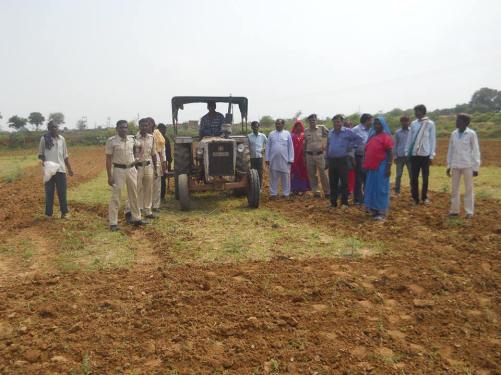
Ekta parishad leaders & administration demarcating formerly land for giving possession to the Sahariya tribal people

विगत 10 वर्षों से भी अधिक से श्योपुर में ज़मीन माफियाओं ने जबरन आदिवासियों की ज़मीन पर कब्ज़ा कर रखा था और कईयों ने तो इन ज़मीनों को हरियाणा, पंजाब तथा उत्तरी राजस्थान से आये बड़े किसानों को बेच दिया था. इन बाहरी किसानों ने आदिवासियों को उनकी ही ज़मीन पर मजदूर की नौकरी प्रदत्त करवा के उनपे शोषण का नया तरीका अपनाया.यह कतई किवदंती नहीं है कि खेत में कार्य कर रहा मजदूर उन बड़े किसानों के गुलाम से भी बदहाल स्थिति में कार्य करते हैं. ये दिहाड़ी मजदूर किसी संघर्ष की लालसा में अपने एक दिन के आय को नहीं खो सकते. ऐसे समय में एकता परिषद् ने संघर्ष को नया नाम दिया.उन्होंने इसे आज़ादी के लिए किये जाने वाला संघर्ष कहा. अपनी ज़मीन वापस पाने की आज़ादी. अपना अधिकार वापस लेने की आज़ादी.एकता परिषद् एक गांधीवादी संस्था है जो वंचित वर्ग के जल, जंगल व ज़मीन के लिए संघर्ष करती है. विगत 2 दशकों से भी अधिक समय से शोषित व वंचित वर्ग की सेवा तथा उनके सशक्तिकरण के लिए संस्था कार्यरत है.संस्था ने सबसे पहले ज़मीनी हकीकत पता किया तथा सभी जानकारी लेने के पश्चात सभी आदिवासी जिनकी ज़मीन पर कब्ज़ा था उन्हें आगे आने के लिए प्रेरित किया. जब आदिवासी तैयार हुए तो उन्होंने जिला कलेक्टर को तुरंत कार्रवाई तथा अपने स्वामित्व को पुनः प्राप्त करने हेतु ज्ञापन सौंपा. इस ज्ञापन का असर यह हुआ कि प्रशासन तुरंत हरकत में आया.

Continue reading आज़ादी की एक लड़ाई चम्बल की घाटी में : अंकित झा

Whose Terror, Whose Powerlessness? Milind Wani


Guest post by MILIND WANI

On January 7 a car bomb at a Libyan police camp in the town of Zilten killed 60 people and wounded 200 more.  On January 11, bombs in three cities in Iraq, including Baghdad, killed over 130 people. On January 16, ISIS forces attacked the Syrian town of Deir ez-Zor, killing Syrian army members as well as women and children. Death toll estimates range between 130 and 300 people.  On February 1, a suicide bomber detonated a vest outside Afghanistan’s national police headquarters in Kabul, killing 20 and injuring 29. On February 8, ISIS executed approximately 300 activists, police, and military personnel in Mosul, Iraq. On February 21, ISIS detonated car bombs in two Syrian towns heavily populated with Shi’ite Muslims, killing between 140 and 270 people, and wounding over 300 more. In March this year, a car bomb detonated in a busy public square killed at least 37 people in the Turkish capital of Ankara. The same month, on a street filled with shops and cafes in Istanbul, Turkey’s largest city, a suicide bomber killed five people. On March 27, seventy-two people, including 29 children, were killed in a suicide bombing at the largest public park in Lahore, Pakistan. In May Baghdad attacks, at least 69 to 90 were killed in suicide attacks and car bombings in Iraq capital. On June 28, a trio of suicide bombings at an airport in Istanbul killed 45 and injured 200 more. On 3rd July 2016, coordinated bomb attacks were carried out in Baghdad, resulting in mass civilian casualties. A few minutes after midnight local time, a suicide truck bombing in the district of Karrada killed more than 300 people and injured hundreds more. This list is not exhaustive.

In the above backdrop of terror attacks in middle east by the ISIS or groups associated with it, that Pratap Bhanu Mehta should be impelled to write a passionate piece only after the horrendous truck rampage which left 84 dead in Nice says much about how even the most sympathetic of commentators have become party to selective amnesia. But if that was his only sin, one could just put it down to the times we live in where even the most informed ones are not free of ideological biases. However there is much that can be considered as problematic, either in terms of his analysis or the solutions he proposes or the stand he takes and would want us to take. Continue reading Whose Terror, Whose Powerlessness? Milind Wani

Cow-Gangs of Akhand Bharat and the Dalit Revolt – Hindutva Unravels

As the cow-gangs of Hindutva go on a rampage and the the prime minister, Narendra Modi, adopts a posture of strategic silence, the country is rapidly being pushed to the brink of a civil war. This might sound a trifle far-fetched but classically, when large numbers of people begin to believe that there is no government for them, the time is not far when they will start making preparations for defending themselves. It started with the attacks on Muslims but soon enveloped the Dalits as it was bound to. The Una incident, which sparked off a veritable revolt, was followed up by subsequent attacks in Lucknow. The Progressive Dairy Farmers’ Association in Punjab, involving large number of Sikh farmers, has also been fighting continuing harassment and violence by cow-gangs of Hindutva in Punjab for some time now. The PDFA president has also stated that they might be forced to act in self-defense. The president Daljit Singh Gill, in fact, reportedly told mediapersons that “(I)f someone attacks the farmers, we will stop them now,” and “(I)f something goes wrong, it is the government’s responsibility.”

Even as the cow-gangs continue with their vigilantism unrestrained and unchecked, a large demonstration yesterday at Jantar Mantar by Samta Sainik Dal, actually sent out yet another signal. It spokespersons said in so many words that they were now prepared to take on the cow-gangs physically, if and where necessary.

Tracing SSD’s lineage back to Dr Ambedkar’s initiative in the 1924, the President of the organization openly blamed the ‘Manuvadi’ forces, in cahoots with the police and bureaucracy, backed by the government. He was candid that it is not the Sikhs or Muslims or Christians who are attacking the Dalits today but the Hindus who are doing it in the name of nationalism and that people were now in a mood to fight back unitedly together.

Not only is Modi’s deafening silence now coming to be seen as a sign of encouragement and complicity, with BJP leaders like Hyderabad MLA Raja Singh openly justifying the Una attack, and no action being taken against him by the party yet, it is clear that this vigilantism is endorsed by the highest quarters in the party. For those who may have missed seeing Raja Singh’s video, this is what he said:

“Jo Dalit gaye ke maas ko le ja raha tha, jo uski pitai hui hai, woh bohut hi achhi hui hai (Those Dalits who were taking the cow, the cow meat, those who were beaten, it was a very good thing to happen).

Continue reading Cow-Gangs of Akhand Bharat and the Dalit Revolt – Hindutva Unravels

An Example of the Liberal Media Defending Powerful Neoliberal Elites: Aditya Velivelli

Guest post by ADITYA VELIVELLI

A wife’s career taking a backseat due to her husband’s work is no trivial issue. However, Outlook magazine used this issue to defend a powerful couple who had giant conflicts of interest among them.

In the recent cabinet reshuffle, Minister of State for Finance, Jayant Sinha, was shifted out of the finance ministry. A few news articles came out speculating that Sinha’s transfer was due to his wife Punita Sinha’s conflicts of interest and because a Tea party organised by Jayant Sinha involved schmoozing between Corporates and bank officers. Jayant Sinha was in the process of organising a bailout fund for the bad corporate loans at that time. This bailout fund would be paid for by the tax payers.  Continue reading An Example of the Liberal Media Defending Powerful Neoliberal Elites: Aditya Velivelli

Eminent Citizens of Gujarat Demand Judicial Inquiry into Attacks on Dalits in Una

The following is a Memorandum to the Governor of Gujarat, initiated by statement issued by the Movement for Secular Democracy and signed by many eminent personalities in the state, demanding a judicial inquiry into the attacks on Dalits in Una by cow-vigilantes. The memorandum was sent on 16 July 2016.

(079) 26404418

MOVEMENT FOR SECULAR DEMOCRACY (M.S.D.)

C/o. Narmad Meghani Library, Opp. Natraj Railway Crossing, Meethakhali, Ahmedabad- 380 006.

Date: 14-7-2016

To,

The Honourable Governor,

Gujarat,

Gandhinagar.

Sub: Appointing a Judicial Commission for the Investigation in the Matter of Atrocities on Dalits in Una of Gir Somnath District

Dear Sir,

It is a matter of pain that when the entire nation is celebrating 125th Birth anniversary of Dr. Babasaheb Ambedkar, the Gujarat has created a precedent of atrocities on Dalits! Continue reading Eminent Citizens of Gujarat Demand Judicial Inquiry into Attacks on Dalits in Una

A Non-Obituary – Life and Times of an Insaan: Bobby Kunhu

Guest post by BOBBY KUNHU

“To be mortal is the most basic human experience, and yet man has never been able to accept it, grasp it, and behave accordingly. Man doesn’t know how to be mortal. And when he dies, he doesn’t even know how to be dead.” – Milan Kundera, Immortality
Insaan was a person who deliberately and desperately sought to mortalise himself in a world obsessed with immortality. He was very clear that he did not want to leave any footprints of his life when he died, no children, no money, no property, no awards, no monuments, no records, no pictures – except for those inevitable because of State restrictions that could trouble people who handled his death – like death certificate. He was working hard since his retirement towards his death fighting his way through the bureaucracy for anonymity in death! Then why am I writing about him disregarding his long cherished wish? Firstly his life was too important not to be chronicled; secondly whenever we joked that we would make a saint of him after he died he responded that he did not believe in an afterlife and what people did after he died was not his concern and finally, this is my way of grieving the loss of someone who was dear to me and whose relationship with me is not at all definable!
Insaan was not new to obituaries. In fact it was an obituary that brought him into my life. The story dates back to 1982, when Advocate P. M. Padhmanaban was visiting his relatives in Bombay. My grandfather, M. Rasheed had asked him to look up Insaan, his political co-traveler and fellow trade unionist from whom he had not heard in a while. On enquiries Padhmanabhan was informed that Insaan had succumbed to a long bout of jaundice and was no more. Dutifully he passed on the information to my grandfather, who wrote a long obituary in the Sunday edition of the Malayalam newspaper Mathrubhumi. The following Sunday as my grandfather was sitting with his cup of tea and perusing his morning newspapers at the Verandah of his Calicut house, Insaan walked in with a copy of the newspaper that carried his obituary!

Continue reading A Non-Obituary – Life and Times of an Insaan: Bobby Kunhu