All posts by Aditya Nigam

Dadri Beef Rumour and Lynching – A Report from Bisara village

The following is a report on the Dadri beef rumour and lynching, prepared by a fact finding team from NEW SOCIALIST INITIATIVE, PEOPLE’S ALLIANCE for DEMOCRACY and SECULARISM, SAHELI and DELHI SOLIDARITY GROUP, released in New Delhi on 05/10/2015

 The investigation team with the following members visited the village on 3 October 2015: Bonojit Hussain (New Socialist Initiative), Deepti Sharma (Saheli), Kiran Shaheen (writer and activist), Naveen Chander (New Socialist Initiative), Sanjay Kumar (People’s Alliance for Democracy and Secularism and New Socialist Initiative) and Sanjeev Kumar (Delhi Solidarity Group)

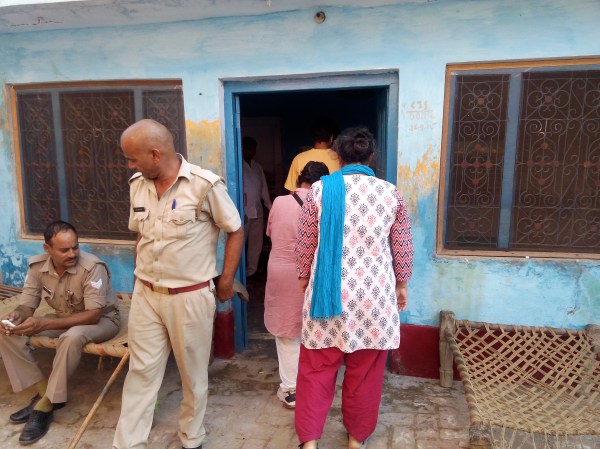
Akhlaq's house
Akhlaq’s house

On the night of 28 September, in a heinous instance of hate crime Mohammad Akhlaq a resident of Bisara village of Dadri in western Uttar Pradesh was lynched to death and his son Danish brutally assaulted by a mob of villagers over a rumour that Mr. Akhlaq and his family had slaughtered a calf and consumed its meat. Just before the lynching, an announcement was made from the local temple to spread the rumour, and within moments a mob constituted itself and attacked Mr. Akhlaq resulting in his lynching. Mr. Akhlaq’s son Danish has been in hospital since that night and despite undergoing two brain surgeries his condition is still said to be critical. Continue reading Dadri Beef Rumour and Lynching – A Report from Bisara village

Volkswagen, Deutsche Bank and Ordoliberalism: Shrinivas Dharma

Guest post by SHRINIVAS DHARMA

News of Volkswagen’s systematic cheating in emission tests by making its cars appear far less polluting than they are, has proved to be a bolt from the blue for the Global Automobile industry, financial markets, European politicians and German society at large. VW is more than just another car company. For German society, it is a heritage brand with iconic status. In a reputed poll last month, two-thirds of Germans named Volkswagen as the country’s number one national symbol, putting it before Merkel, the national football team and Goethe. No wonder, this news destroyed 10% of market value of the VW brand in a single trading day.

VW’s so-called “defeat device”  a piece of software in the car’s computer is already there on 11 million cars on the road which are emitting up to an extra 1m ton of a toxic gas responsible for killing tens of thousands people in various countries. With this insidious deception, VW has not only let down Germans but the entire Global Society by showing sheer contempt typical of a Big Business towards the continuing environmental degradation. No wonder, the news wiped out billions of dollars off the market value of entire car industry providing credence to the suspicion that emissions test rigging may be more widely practiced art, than what has come to light so far. Continue reading Volkswagen, Deutsche Bank and Ordoliberalism: Shrinivas Dharma

NBA Welcomes SC Dismissal of MP Govt Application Denying Right to Land to Sardar Sarovar Oustees

We are publishing below the text of a statement issued by the NARMADA BACHAO ANDOLAN in New Delhi today following a significant Supreme Court order on the rehabilitation of Sardar Sarovar oustees

In a significant Order, the Social Justice Bench of the Supreme Court comprising Jst. Madan Lokur and Jst. Uday Umesh Lalit today dismissed an Application filed by the Government of Madhya Pradesh (GoMP) / Narmada Valley Development Authority (NVDA) seeking a ‘modification / clarification’ of the Apex Court’s previous judgements of 2000 and 2005, thereby denying right to land of a few thousand adult sons of the Sardar Sarovar Project (SSP) affected farmers.

The Hon’ble Court held among other things that the Application by State of MP suffers from gross delay / laches having being filed many years after the judgements were issued (upholding the right to land of the SSP adult sons) and the rights / entitlements already accrued to the oustees in principle cannot be taken away. The Bench also had to take note of the fact that while the entitlement of most of the adult sons have already been recognized many many years ago, one set of oustees have been offered land / Special Rehabilitation Package (5.5. lakhs for 5 acres) since the judgement of 15/3/2005 of the Apex Court and another set of oustees are being denied the same; this would result in a clear violation of Article 14 of the Constitution which guarantees a fundamental right to equality. Terming this “not to be good governance”, the Court summarily dismissed the Application.   Continue reading NBA Welcomes SC Dismissal of MP Govt Application Denying Right to Land to Sardar Sarovar Oustees

A Statement Protesting Approval to Introduce Injectable Contraceptives in the National Family Planning Programme

The following is the text of a letter written by activists and scholars working in the field of medicine, public health and women’s rights, to the Union Minister for Health and Family Welfare:

To

Shri Jagat Prakash Nadda,

Union Minister for Health and Family Welfare,
Ministry of Health and Family Welfare,
Nirman Bhavan, Maulana Azad Road,
New Delhi 110 011

22nd September 2015

Statement Protesting the Approval to Introduce Injectable Contraceptives in the National Family Planning Programme

We, the following health groups, women’s organisations, peoples’ networks and individuals are extremely disturbed by the news report published in the Times of India (dated 16th September 2015) that the Union Health Ministry has approved Depo Medroxy Progesterone Acetate (DMPA) for use in the National Family Planning Programme (FPP).

It may be re-called that following a Supreme Court case filed in 1986 by women’s groups regarding serious problems with injectable contraceptives like Depo and Net-En, the Court directed the government to monitor safety issues in use of injectable contraceptives but did not ban its use. While they are available in the private medical sector, the Drugs Technical Advisory Board (DTAB), the highest decision-making body on technical matters in the Ministry of Health &Family Welfare, in 1995 held that Depo-Provera is not recommended for inclusion in the FPP. Continue reading A Statement Protesting Approval to Introduce Injectable Contraceptives in the National Family Planning Programme

Bihar Needs a Corbyn Moment: Sushil Chandra

Guest post by SUSHIL CHANDRA

If the media discourse on Bihar elections has any semblance of truth, this election is a choice between Pepsi and Coke. Whatever you choose, you get a cola of casteism, corruption and gangsters. On one hand we have winning combination of intermediate castes, the assured Muslim vote, the great legacy of fodder scam and kidnapping rings with added glitter of so called good governance and on the other hand the return of feudal dominance, the guaranteed promise of a theocracy and another band of gangsters. It is difficult to fathom from the media coverage that there is a third alternative available in shape of left which is free from all these attractions and offering a principled platform. You can see on television Upendra Kushwahas and Pappu Yadavs holding forth on their great vision for Bihar, the daily tantrums of Majhi and Paswan for their tug-of-war on seats but talk of the left and even Ravish Kumar forgets to mention them on his daily shouting matches on Bihar election. Is it because of our corporate media is not willing to invest in those not willing to invest on caste and religion? Continue reading Bihar Needs a Corbyn Moment: Sushil Chandra

Cow Slaughter – Can a Directive Principle Trump Fundamental Rights of the Most Marginalized? Mariya Salim

Guest post by MARIYA SALIM

The debates and demands around the issue of the prohibition of cow slaughter in India are a highly volatile, political and contentious subject, with the cow being revered as sacred by most Hindus in the country. Although almost all the proponents calling for a national legislation for a total ban on slaughter of cow and other cattle today look to the directive principles of state policy and use an economic and agrarian argument to defend their demand, it is interesting to note that the constituent assembly debates around this directive principle clearly indicate that it was as much a religious issue, reasoned on science and agriculture instead however, for some of those who wanted it to be an integral part of the Indian Constitution.

After much debate and deliberation in the Constituent Assembly and a demand from a few members of the assembly, to include a total ban on the slaughter of cows as part of fundamental rights in the Indian Constitution, a compromise was reached and the protection of the revered bovine found place in the Directive Principles of state policy, which incorporates this Hindu sentiment in a somewhat guarded and hesitant form[1]. Most notable among the members raising the issue were Pandit Thakur Dass Bhargava and Seth Govind Das[2]. Syed Muhammad Sa’adulla, another member argued that he would rather have the insertion on the protection of cow slaughter as a religious ground, as, the argument on economic grounds will ‘create a suspicion in the minds of many that the ingrained Hindu feeling against cow slaughter is being satisfied by the backdoor’ and he went on to give facts and figures on how cow slaughter is not as bad ‘as it is being made out to be’ from the economic point of view. [3]  Continue reading Cow Slaughter – Can a Directive Principle Trump Fundamental Rights of the Most Marginalized? Mariya Salim

Scramble for Muslim Votes as Owaisi Jumps into Bihar Polls: Abhay Kumar

Guest post by ABHAY KUMAR

Ever since Asaduddin Owaisi, president of the All India Majlis-e-Ittehadul Muslimeen (henceforth MIM), addressed a well-attended public meeting in Kishanganj  on August 17, speculation about his party contesting election in Bihar has been rife. Three weeks after the rally, Owaisi, eventually, decided that he would field candidates in Muslim-dominated Seemanchal region of Kishanganj, Araria, Purnia and Katihar. “MIM will put up candidates in Bihar’s Seemanchal region, which is not only backward but also has a lot of problems. There has to be over all development,” Owaisi told media, giving the leaders of anti-Hindutva Grand Alliance jitters.

Contrary to Owaisi’s latest move, some political observers had held the view that given the weak organisational structure of the MIM in Bihar and late entry in the state, Owaisi was unlikely to jump into assembly election. For example, senior journalist and political commentator, Khurshid Hashmi said that if Owaisi had been serious about Bihar election, he would have launched his campaign much earlier as he did in UP. Continue reading Scramble for Muslim Votes as Owaisi Jumps into Bihar Polls: Abhay Kumar

An Attempt to Make Sense of Culture in Islam: Raoof Mir

Guest post by RAOOF MIR

Purity and corruption has remained one of the recurrent themes in the entire history of Islam. The arrival of Islam in Arabia did not mean a radical departure from the past. Wael B. Hallaq, a noted scholar on Islamic law and Islamic intellectual history establishes through his commendable work that “much of Arabian law continued to occupy a place in the Shari’ah, but not without modification.” Prophet Mohammed, who founded this new faith by introducing new nomos, also let several old customs and institutions to remain unchallenged. Despite his critical attitude toward the local social and moral environment, Prophet Muhammad was very much part of this environment and was deeply rooted in the traditions of Arabia.

Though the new converts to Islam entered into a new cosmological order, they at the same time, continued to adhere to the practices of old pagan culture. Since the arrival of Islam many individual reformists or reform movements have intended to reform Islam and decontaminate it from its ‘accretional’ aspects. These reformative endeavours envisaged a Muslim community that is not only socially distinct but also repudiates the pre-existing cosmological order. However, so far, there has been no end to this conflict. This conflict between the formal ideology of reformists (Textual Islam) and functional behaviour of the majority of the Muslims (Lived Islam) continues till today. Continue reading An Attempt to Make Sense of Culture in Islam: Raoof Mir

Statement Against Prof. Kalburgi’s Murder: Academics for Democracy, Chennai

The following statement against the murder of Professor Kalburgi was issued by Academics for Democracy, a forum of academics based in Chennai.

As a group of academics and scientists who are involved in various ways towards promotion of democratic values, we wish to condemn the murder of Prof. M. M. Kalburgi, who was shot dead by unidentified gunmen on August 30th , in strongest possible terms.

Prof. Maleshappa Madivalappa is a well known writer in Kannada and a former Vice Chancellor of Hampi university, who  raised his voice against religious malpractices and superstitious ideas on several different occasions. He is an authority on vachana sahitya, whose collection of research articles titled Marga were academically acclaimed. He was awarded the Karnataka Sahitya Academy Award in 2006 for Marga. Continue reading Statement Against Prof. Kalburgi’s Murder: Academics for Democracy, Chennai

Open Letter to Odisha CM Re False Charges Against GASS Activist Debaranjan

 WITHDRAW FALSE CHARGES AGAINST DEBARANJAN OF GASS, ODISHA

To:

Mr Naveen Patnaik
Chief Minister,
Government of Odisha

22 August 2015

 We, the undersigned, unequivocally condemn the foisting of a false case on Debaranjan, member of the Ganatantrik Adhikar Surakhya Sangathan (GASS) in Odisha.

Debaranjan has for several years now been deeply involved with people’s struggles in Odisha, first as a full-time activist in Kashipur, Rayagada district, then as film-maker, and most recently also as a member of the democratic rights group GASS. His has been among the consistent voices in Odisha for over twenty years against state repression on people’s struggles, atrocities faced by adivasis, dalits and other underprivileged communities, and against communalization of the polity and in society. This is the political context in which he is being targeted.

Last week, Debaranjan was sought to be interrogated by the Special Branch of the Intelligence Department while he was engaged in work on a documentary film in Malkangari district. Subsequently, a number of false charges were filed against him by the Malkangiri Police, including charges pertaining to molestation under Section 354 (b) of the IPC, and under sections 354 and 323. We believe these charges to be patently false and absurd, and constitute nothing other than harassment and part of the continued persecution of democratic voices in this country. Continue reading Open Letter to Odisha CM Re False Charges Against GASS Activist Debaranjan

A Demand to Restore the Stature and Reputation of FTII: Statement by Media Scholars and Teachers

PUBLIC STATEMENT BY MEDIA SCHOLARS AND TEACHERS ON FTII

As teachers, scholars and researchers of the media we are deeply disturbed by the obduracy and high-handedness shown by the authorities to the legitimate issues and questions raised by the students of FTII who have been on strike since June 12, 2015.

It has now been established that Gajendra Chauhan, an official member of the BJP since 2004, was chosen to be the Chairman of the Governing Council and consequently, President of the FTII Society for his loyalty to the party and not because he has any credentials to occupy these posts. A `star campaigner” for the BJP during the Lok Sabha elections, Chauhan’s only claim to visibility has been his role as Yudhisthir in the TV series Mahabharata and his role in the current controversy. He does not possess any professional or academic qualification that makes him remotely eligible for the job.  It is a an absolute travesty that Chauhan should be handed a chair that has in the past been occupied by nationally and internationally recognized personalities like UR Ananthamurthy, Girish Karnad, Shyam Benegal, Saeed Akhtar Mirza, Adoor Gopalakrishnan, Mahesh Bhatt and Mrinal Sen. Continue reading A Demand to Restore the Stature and Reputation of FTII: Statement by Media Scholars and Teachers

Of Housing, Jobs and Everyday Communalism: Saidalavi P.C.

Guest post by SAIDALAVI P.C.

“True generosity consists precisely in fighting to destroy the causes which nourish false charity”

Paulo Freire, Pedagogy of the Oppressed

On the evening of 21 February, 2015 I and my friend walked through the narrow lines of Vasant Kunj, New Delhi looking for an accommodation for him. On both sides of narrow roads, three-storied buildings blocked sun rays reaching the ground. Here and there scrapheap assaulted our nostrils and a flock of bees and mosquitoes hovered around the area keeping watch. Our eyes waded through the gates of the buildings looking for a signboard announcing vacancies. We pushed a gate open and entered the building looking for the owner. A middle-aged man announced his presence pushing his belly in front of him. We asked, room koi khali hai, bhayya (Is there any room vacant, brother?) He scrutinised us for a moment. May be nonplussed by seeing no marks of our identity (we are clean shaven, well-dressed, normative secular self with supposedly a neutral identity in public) he was bit confused and his lips contorted a bit towards the left. Impassively, he nodded us to follow him since the room was on the second floor. My friend was visibly satisfied by the room, it was well-furnished, with a bathroom, kitchen and a balcony. He said he would take it. Listening to it, the owner’s face had taken a bit more serious expression, and at last he asked what our names are. It seemed our neutral identity was the bomb he wanted to diffuse. The moment we uttered our names, his facial expression changed into one who is caught by colic, he was startled and flushed, and his ears instantly became red. We were unable to make sense of what he was thinking. Then, he spoke hoarsely and told us to leave immediately. He said that if he had known earlier that we were Muslims, he wouldn’t have invited us to see the rooms. He never let rooms to Muslims. We tried to reason with him by asking why he is not renting it to Muslims.

Continue reading Of Housing, Jobs and Everyday Communalism: Saidalavi P.C.

Teesta, Yakub and Hijab – The Triple Tests of Nationalism: Saif Mahmood

Guest post by SAIF MAHMOOD

If you are Indian but not a supporter of the present Government, on social media your loyalty to your country will be tested on the following touchstones :

  1. Have you said anything against the CBI’s palpably malicious agenda against Teesta Setalvad or even hinted that, even if the CBI’s allegations are taken on their face value, she is entitled to anticipatory bail ?
  2. Do you think that the decision to hang Yakub Memon deserves one last re-look ?
  3. Have you criticised the manner in which female Muslim and Christian PMT aspirants were told to take off their hijabs and scarfs if they wished to take the test and / or the intemperate language in which the Supreme Court refused to interfere in the matter?

If the answer to any of the above questions is in the affirmative, you have just failed the loyalty test; and failed you have, irrespective of the reasons that you may have for your answers. Continue reading Teesta, Yakub and Hijab – The Triple Tests of Nationalism: Saif Mahmood

Gujarat State Crime Branch Claims and the Reality Behind the Charges Against Teesta Setalvad

[In the light of a concerted campaign against Teesta Setalvad and Javed Anand and their organizations Citizens for Justice and Peace and Sabrang Trust, launched by the Gujarat government and parroted by the media at large, we are reproducing a note prepared by Teesta and Javed, along with the details regarding their statement on finances (which were prepared over four months ago in February 2015 and which are also submitted before the Supreme Court). There seems a veritable media trial on with the versions of CJP and Sabrang Trust virtually blacked out, except for a few honourable exceptions. ]

A NOTE ON CITIZENS FOR JUSTICE AND PEACE; SABRANG TRUST

Concerning the allegations of embezzlement of funds by Teesta Setalvad and Javed Anand by the Gujarat police, presented below are some facts:

CITIZENS FOR JUSTICE AND PEACE:

Primary Activity: Legal Aid to victims of mass crimes (communalism, terrorism)

  • Citizens for Justice and Peace (CJP) was formed in April 2002 by 11 prominent, law-abiding Mumbaikars, each one of whom had been individually and collectively engaged in building peace and seeking justice in the aftermath of the 1992-93 communal violence in Mumbai. Noted playwright, late Vijay Tendulkar was the founding President of CJP and remained at that post till his sad demise in May 2008.
  • Bearing in mind that the victims of the 1984 communal carnages in Delhi and in Mumbai in 1992-93 had been denied justice, the founding members of CJP resolved to focus their efforts in legal intervention in the courts to ensure Rule of Law and impartial policing.
  • The very first activity of CJP was to set-up a Citizens Tribunal headed by the late Justice VR Krishna Iyer, former justice of the Supreme Court of India. Other members of the Tribunal included former judge of the Supreme Court of India, Justice P. B. Sawant and former judge of the Bombay High Court, Justice Hosbet Suresh.

Continue reading Gujarat State Crime Branch Claims and the Reality Behind the Charges Against Teesta Setalvad

CBI Mis-reporting on Search: Teesta Setalvad

We reproduce below the full statement (partially reported in the newspapers) from Teesta Setalvad on the CBI search at her office premises regarding the continuous misreporting that was going on during the search: 

As I write this, the search is still not concluded. It is shocking that while over a dozen members of the CBI are still in our premises conducting the search, Delhi spokesperson is misleading the public and our vast supporters by a series of misinformations and official tweets.

In our view, and we repeat no laws have been broken by us. This is a continuation of the persecution and witchhunt first launched by the Gujarat police in 2014 then under the dispensation that rules Delhi. The CBI has taken the same documents that we had voluntarily on inspection given the MHA (FCRA dept). Over 25,000 pages of documentary evidence has been given to the Gujarat Police. When they could not succeed with the bizarre and desperate attempts to gain custody (February 2015), it was the Gujarat Government Home Department that wrote to the MHA and the current round of the persecutions began.

Its is shameful political vendetta. The Zakia Jafri case begins its final hearings on July 27 2015. The Naroda Patiya appeals (Kodnani and Bajrangi) are being heard in the Gujarat High Court tomorrow. This is nothing but a bid to subvert the cause of public justice and ensure that no justice happens in these cases. Continue reading CBI Mis-reporting on Search: Teesta Setalvad

IMA, NCERT and Existing Inequalities – Issues Around Availability and Accessibility of Health Care: Sarojini N. B. and Deepa V.

Guest post by SAROJINI N.B. and DEEPA V

[A story appeared on 11 July 2015 in some newspapers about the Indian Medial Association demanding deletions from a class VII NCERT textbook. An immediate response appeared in Kafila to some of the issues raised by IMA.

This post, whose authors Sarojini and Deepa were centrally involved in the writing of the textbook in question, here put certain things in perspective. They present this as an initial clarificatory response to the news report. ]

We are writing regarding an article “Docs oppose ‘negative’ portrayal by NCERT” that appeared in the front page of The Hindu on 11 JUly 2015, Delhi edition by Bindu Shajan Perappadan. The article refers to the chapter “Role of the Government in Health” in the NCERT’s social science textbook on Social and Political Life-II for Class VII students. The article reports that the IMA has written to President Pranab Mukherjee, Prime Minister Narendra Modi and the Ministries of Health and Education, pointing to the “objectionable description” of private healthcare services. The IMA has also demanded “immediate remedial action” stating in their letter that the “matter should be taken seriously and the NCERT should be directed to delete or re-write this chapter”.

In 2007, several NCERT text books were developed, including the textbook in question Social and Political Life-II for Class VII, through a consultative and contributory process in which many of us were involved. The process led by NCERT was a progressive attempt at reviewing and developing content on a range of subject areas and issues in the country, in order to generate knowledge that is as contemporary and comprehensive as possible, and encourages critical and analytical thinking on the part of students.  While the issues were complex, authors / contributors as a group attempted to develop chapters that would reflect an understanding that is rooted in social, economic and political realities, while making them interesting and comprehensible for class VII students. The chapters foreground existing inequalities and discuss the issues around availability and accessibility of health care – including some key characteristics of the private and public health sector. Continue reading IMA, NCERT and Existing Inequalities – Issues Around Availability and Accessibility of Health Care: Sarojini N. B. and Deepa V.

Who cares about the environment? Some notes on the ecological crisis in India: Shashank Kela

Guest post by SHASHANK KELA

The past few months have been exceptional, in one respect at least, for the Indian press: a serious structural problem has actually been given the attention it deserves. The Economic Times continues to play a prominent part in discussing air pollution in Delhi – there is no other city in the world where it is so bad. Nor is this all: including Delhi, India now boasts thirteen out of twenty cities with the worst air. More recently, the uproar over supposedly high levels of lead in a brand of junk food led to a (very) few articles on groundwater contamination: after all, the reason why lead and other poisons get into food is because they are present in the soil in which crops grow. Another piece, in the Guardian this time, speculated that the recent Sahelian heat wave in the Deccan might be a symptom of climate change (an “extreme” climate event of the kind likely to become all too common).[1]

These stories are only a tiny fraction of those that could be reported, for we are already in the throes of an unprecedented environmental crisis. Large swathes of our agricultural soils are contaminated or saline. Pesticide residues and heavy metals form part of our food. The air of our major cities is unfit to breathe. Freshwater availability is declining; most rivers, especially in the south, do not flow at all, or only seasonally, since their runoff is impounded in dams and used for irrigation (with very high rates of seepage and evaporation loss). Groundwater tables are falling as a consequence of over extraction and the disappearance of vegetative cover enabling percolation. The pattern of weather is being reset with gaps and lags – the available evidence indicates that the onset of the monsoon is changing and precipitation becoming more uneven. Our offshore seas are denuded of marine life thanks to trawler fishing at ever greater distances. Himalayan glaciers are shrinking with obvious long-term consequences for the hydrology of river systems dependent upon snow-melt. Sudden, destructive floods, exacerbated by embankments and dams, the building over of river valleys and floodplains, have become a regular occurrence. Continue reading Who cares about the environment? Some notes on the ecological crisis in India: Shashank Kela

IMA’s Promotion of Healthcare Privatization Through Insidious Attack on NCERT Textbook

Manali Shah (name changed on request), a 33-year-old software engineer working in the private  sector, lost her savings of eight years in a day when her father, 65, underwent a liver transplant in a private hospital. “Not only did my savings go, I also had to borrow money from the family to foot the bill. The procedure and hospitalisation cost almost Rs 30 lakh, and we have to continue spending Rs 10,000 each month for medicines, follow-up consultations and diagnostics,” she says

Each round of chemotherapy and radiation costs her almost Rs 1 lakh, but she didn’t consider AIIMS because the radiotherapy machine there is booked for the next seven months. [The cost of one round of chemotherapy in AIIMS was just Rs 750/- at that time, hence the overbooking]. From a report in Hindustan Times, 20 October 2013

Doctor, heal thyself, was my initial reaction when I read the front page report in The Hindu that ‘Docs’ were opposing ‘negative’ portrayal by NCERT. The objection raised by them is that the class VII textbook, Social and Political Life II, contained “objectionable description ” of the medical profession. Or so you believe till you realize, by the time you are into the third paragraph of the report, that the issue is not at all about the negative portrayal of the medical profession as such but of its elite practitioners who are making a killing in elite private medical institutions and hospitals at the expense of the ordinary people.

So it is not doctors in general – those who work in trying conditions in government hospitals – who are raising the objection but the Indian Medical Association that professes to be “the only representative, national voluntary organisation of Doctors of Modern Scientific System of Medicine, which looks after the interest of doctors as well as the well being of the community at large”.  The IMA says the news report, has written to the President Pranab Mukherjee and Prime Minister Narendra Modi “demanding immediate remedial action”. Continue reading IMA’s Promotion of Healthcare Privatization Through Insidious Attack on NCERT Textbook

Women’s Mosque of America – Women Carving Out Spaces of Prayer: Azza Basarudin and Khanum Shaikh

Guest post by AZZA BASARUDIN and KHANUM SHAIKH

In the past decade, the efforts of women in communities of Muslims to claim leadership roles within their communities of worship have animated heated debates around the role and place that Islam ascribes to women. Questions of whether women are allowed to call congregants to prayer (adhaan), deliver sermons (khutba), lead prayers, and participate in mixed-gender prayer with women and men standing side-by-side are religiously permissible acts have been thrown up into the air, gaining support from some Muslims, and intense resistance from others. Within the United States, these contemporary debates can be traced back to a mixed-gender Friday prayer service led by Dr. Amina Wadud at Synod House of the Cathedral of St. John the Divine in New York in 2005.[1] Numerous women-led prayer sessions have since taken place in cities across the United States, and in various global locations such as Toronto and Barcelona.[2] Widespread condemnation, heresy charges, and death threats swiftly followed some of these acts of defiance by Muslim women who are tired of being excluded from and/or given marginal spaces/roles within mosques for prayer, i.e. usually behind men or in less than ideal spaces where it is difficult to see/hear the sermon (khutba). Nonetheless, voices of support and acceptance are also prevalent—not that the women trailblazing this mode of leadership in ritual practices need anyone’s approval. It is into one such space—a newly created women-only Friday prayer organized by the Women’s Mosque of America—that we made our way on May 22, 2015 in Los Angeles. Continue reading Women’s Mosque of America – Women Carving Out Spaces of Prayer: Azza Basarudin and Khanum Shaikh

बाक़ी चीज़ों की तरह इनका योग भी फ्रॉड है…

Dilip C Mandal's photo.
Dilip C Mandal के फेसबुक पोस्ट से साभार (तस्वीर और नीचे की टिप्पणी दोनों)

जो लोग कभी नहीं करते और फ़ोटो खिंचवाने के लिए नाटक करते हैं, वे सबसे आसान आसन- पद्मासन भी गलत करते हैं।

मोदी जी के पैरों की मुद्रा देखिए। सही पद्मासन में पीछे वाली लड़की बैठी है। देखिए, दोनों पैर ऊपर हैं। जो कभी नहीं करते हैं, वे नाटक के लिए भी नहीं कर सकते।

जब पद्मासन में बैठने को कहा गया है और सभी लोग वही कर रहे हैं, तो रेगुलर योग करने का दावा करने वाले को पद्मासन ही करना चाहिए। अर्ध नहीं पूर्ण।

56 इंच का सीना नहीं, 56 इंच का पेट है। रामसनेही को अब पूरा यकीन है कि सुनने में धोखा हुआ था।

बच्चों को इनसे शिक्षा नहीं लेनी चाहिए।

Stop the Coercive Imposition of Yoga to Enforce Cultural Homogeneity – A Petition

Yoga petition

We write as concerned scholars, many of whom have long been indebted to yoga and pranayama for their therapeutic effects, about the many plans that are being made to declare June 21 as a successful start of International Yoga Day. While mindful of yoga as a most desirable option for health care, we are concerned by the central compulsion driving the directives issued by the present Government, namely  about entering the Guinness Book of Records through a show of numerical strength. We are even more alarmed about the government order addressed to university teachers and staff and school students to perform yoga on 21st June in public, and construe this as a compulsion that amounts to misuse of state authority.

Continue reading Stop the Coercive Imposition of Yoga to Enforce Cultural Homogeneity – A Petition