All posts by Shuddhabrata Sengupta

As a religious minority, I empathize with sexual minorities: M Reyaz

This is a guest post by M. REYAZ

The Apex Court judgment of December 11, putting aside the Delhi High Court order on decriminalisation of homosexuality, pertaining to Section 377 of the IPC has clearly divided into two ‘queer’ camps, where on one side besides LGBTS are those liberals extending their support to the LGBT cause, and on the other side, there are religious leaders and groups, who otherwise would not even see eye to eye with each other (what is ‘queer’ about this second camp is not so much its sexual orientation, as the strangeness of its banding together against queer people despite their antagonism toward each other).

Continue reading As a religious minority, I empathize with sexual minorities: M Reyaz

JTSA extends support to the LGBT community, calls for committed judicial activism: JTSA

Guest Post by JAMIA TEACHERS’ SOLIDARITY ASSOCIATION

On 11 December, 2013 a two judge bench of the Supreme Court of India (SC) ruled that section 377 of the Indian Penal Code (IPC), which considers homosexuality a criminal offence, does not ‘suffer from the vice of unconstitutionality’ and hence, legally valid.  By this highly regrettable ruling the apex court astounded and disappointed not only the LGBT community but the wider public at large.

Continue reading JTSA extends support to the LGBT community, calls for committed judicial activism: JTSA

The Anti-Rape Movement -The Political Vision of ‘Naari Mukti/Sabki Mukti’: Kavita Krishnan

Guest Post by KAVITA KRISHNAN

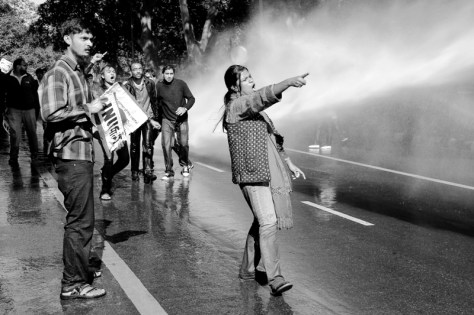
Anti Rape Protest at CM Shiela Dixit's House, Photo by Vijay Kumar
Anti Rape Protest at CM Shiela Dixit’s House, Photo by Vijay Kumar

A year ago, a massive movement erupted on the streets of Delhi and the country – against the brutal gangrape of a young woman on a bus, leading to her death. Looking back at that movement a year later, it is clear that the questions, concerns and above all the tensions and debates embedded in that movement are with us still – and are quite crucial to the political discourse around us.

Continue reading The Anti-Rape Movement -The Political Vision of ‘Naari Mukti/Sabki Mukti’: Kavita Krishnan

A hunt, the aftermath, angry Indian men and a tragedy: Rahul Roy

Guest Post by RAHUL ROY

Nivedita Menon ends her commentary on the unfolding Tehelka sexual assault case in Kafila by asserting – “the time has come. It is now”. It should be, but is it? Are we witnessing the end game of an old Indian patriarchal sport called sexual assault? The sport is akin to another old game called the royal hunt that was an important part of elite political culture of South Asia. The rules of the sport were then as now heavily loaded in favour of the royal huntsman – weapons, support teams, timing, everything required for the thrill of a kill were with powerful men out to conquer. The expeditions however were not just about the kill. The sport was also a means of asserting authority over tracts of the wild and those that lived there and were by some misfortune not aware of prevailing authority structures. The royal hunt was an event to showcase to subjects the might, prowess and authority of the elite rulers. It was the stamping of power over human as well as animal kingdom. The royal huntsman could not but win. He could not but kill.
Continue reading A hunt, the aftermath, angry Indian men and a tragedy: Rahul Roy

Protect the Privacy of the Tehelka Journalist: Report Responsibly

GUEST POST BY ‘REPORT RESPONSIBLY’
To all editors, journalists, bloggers, users of social media, and the public:

Some websites and blogs are posting the Tehelka journalist’s complaint to the magazine’s management or reproducing parts of it, perhaps with intent to expose a grave act of sexual assault by a man occupying a powerful position. However, in doing so, they are violating basic ethical and legal injunctions on the way cases of sexual assault must be reported.

The journalist’s complaint to her company is a private document and not a public one. While private documents can be leaked in the ‘public interest’, this principle is applicable to the emails of Tarun Tejpal and Shoma Chaudhury sent to Tehelka staffers, not to the journalist’s emailed complaint. In cases of sexual assault, it is a well established principle that the media can name the perpetrator, but not the victim. The identity and privacy of a victim must be protected at all costs.We are distressed that many people are circulating the journalist’s emails, and other journalists, bloggers and users of social media are publishing it in parts or whole.

Continue reading Protect the Privacy of the Tehelka Journalist: Report Responsibly

1984 and the Spectre of Narendra Modi: Ravinder Kaur

Guest Post by Ravinder Kaur 

As India begins the countdown to the 2014 general elections, a new discourse has started taking shape around its minority populations. It is called the ‘what about 1984’ argument. The supporters of Narendra Modi in a bid to deflect attention from his role in 2002 pogrom usually throw 1984 at his critics. The critics have lately begun responding by placing 1984 pogrom in  a less grave category in comparison to 2002. The difference we are told is the political ideology – Congress is inherently secular and 1984 an aberration whereas BJP is communal and 2002 symptomatic. This unfortunate comparison means that the ‘what about 1984’ argument has unintentionally turned 1984 pogrom into an exclusive Congress problem even when it sets out to call out Modi’s anti-minority stance. The role of Hindutava ideology has been airbrushed out of the history that led to 1984 pogrom as a consequence.

Continue reading 1984 and the Spectre of Narendra Modi: Ravinder Kaur

Nobody Killed the 58 People Who Died in Laxmanpur Bathe on 1 December 1997: Dipankar Bhattacharya

Guest Post by Dipankar Bhattacharya

Predictably enough, the Patna High Court has acquitted all the 26 persons convicted by the trial court in the Laxmanpur-Bathe massacre case. This is the fourth successive instance of wholesale acquittal of convicts by the Patna High Court in cases of massacre of the oppressed rural poor in Bihar. Once again eye witness accounts have been dismissed as being not fully credible and convicts granted acquittal on ‘benefit of doubt’. The judges could not however disprove the fact that 58 people had been killed and post-mortems done, and hence they asked the trial court to calculate the compensation payable to the nearest kin of the victims as per relevant provisions the Motor Vehicles Act on the basis of the minimum wage prevalent in the area at the time of the massacre. They of course did not forget to add that any ex gratia paid after the massacre should be deducted from the amount of compensation!

Continue reading Nobody Killed the 58 People Who Died in Laxmanpur Bathe on 1 December 1997: Dipankar Bhattacharya

A tale of two passports, the year 1979, and walking to India: Fawzia Naqvi

Guest Post by Fawzia Naqvi

For the first time Pakistan’s elected President has completed his full five-year term and has willingly stepped down to transfer power to another elected President, a herculean achievement for a country with chronic dictatoritus.  The people of Pakistan must be congratulated for ensuring that democracy becomes an enduring grace and not just a good idea in some unforeseeable future.  So while there is earsplitting cacophony of debate and disagreement on virtually all issues, there is near unanimous political consensus that the army should remain in the barracks and that there should be peace with India. The time is now. And Pakistanis have accomplished this in an era when Pakistan is suffering its worst hellish nightmare of daily bombings and killings by terrorists, and a loss of over 40,000 of its own citizens in the last decade or so.  Pakistan teeters on the precipice of a very dark abyss, and has been inching ever closer to this dangerous edge for the last 34 years if not more. The first disturbing sign which I can remember was when the state institutionalized bigotry by officially declaring the Ahmadi community non-Muslim in 1974, opening up a hornets nest of discrimination, violence and unequal citizenship.  A tragic disaster, and fatal capitulation to right wing elements, by Prime Minister Zulfikar Ali Bhutto. No one is really safe in today’s Pakistan but clearly those less safe, those hunted and killed are the Shias, the Christians, the Ahmadis and the Hindus. Those doing the killings have given insidiousness to the meaning of “the land of the pure.”

Continue reading A tale of two passports, the year 1979, and walking to India: Fawzia Naqvi

The Nation did not want to know about Laxmanpur Bathe and that is why Sachin Tendulkar is ‘God’

Searching for Laxmanpur Bathe in Times Now
‘No Results Found’ on Searching for Laxmanpur Bathe in Times Now on the night of Oct 12-13, 2013

In a country where the bloodthirsty rhetoric of ‘hang them, shoot them’, an ‘eye for an eye’ and ‘their heads for our heads’ is heard so regularly, and so loudly on prime time television, we were greeted by an odd and chilling silence in the course of this week. It wasn’t for a lack of noise, vendetta laced sound-bytes, storms in tea-cups, or of talking heads.

Continue reading The Nation did not want to know about Laxmanpur Bathe and that is why Sachin Tendulkar is ‘God’

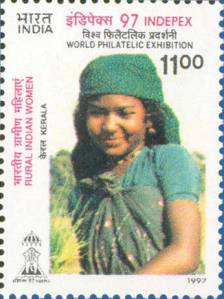
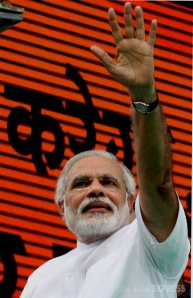
Can Narendra Modi Apologize to Four Hundred and Five Million Rural Women in India?

1744_Rural_Women_Keral 1742_Rural_Women_Gujar B_Id_424710_Narendra_Modi_

Rural Indian Women (Courtesy India Post) and An Urban Indian Man (Narendra Modi)

I watched the television broadcast of BJP’s Prime Ministerial candidate Narendra Modi’s speech at the Japanese Park in Rohini in Delhi on Sunday morning with breathless anticipation and some trepidation. With the restless anxiety that he would spin at least half a new idea, that could induce some naive fence-sitters in Delhi, my city, to sign up behind his juggernaut along with the rest of his zombie horde.

Would his spin doctors have worked hard and tirelessly overnight to give their client a new teflon coating? Would his savvy advisers have given him a sharp new statistic to play with, an incontrovertible fact, a compelling argument that would persuade my fellow citizens? Continue reading Can Narendra Modi Apologize to Four Hundred and Five Million Rural Women in India?

How Would You Like your Death Penalty Steak, Rare, Well Done, or Medium Rare?: Arguments Against the Death Penalty

The anger that I felt when a young woman was brutally raped and killed by a group of men on the night of December 16 last year is not something that will ever go away. It marked not just me, but millions of people in Delhi, and elsewhere. That anger has no closure. Nor do I seek the convenience of such a closure. I do not seek the convenience of closure for the rape and murder of dalit women in Haryana, or of women in Kunan-Poshpora and elsewhere in Jammu & Kashmir or in Manipur who were raped and killed by the soldiers of the Indian army and who are still unpunished. I would like such men to be punished, but I will never demand the penalty of death for them. Not because I have any affection for rapists, but because I have a greater regard and respect for human life, which I do not think that we should allow the state to take away, in cold pre-meditation, whatever the circumstances.

Continue reading How Would You Like your Death Penalty Steak, Rare, Well Done, or Medium Rare?: Arguments Against the Death Penalty

Why is Sachin Pilot in My Dreams? Or, Three Visas, and No More, to India: Fawzia Naqvi

Guest Post by Fawzia Naqvi

Sachin Pilot was in my dreams last night, with all due apologies to his wife, because I swear, I am not secretly fantasizing at all about India’s youngest cabinet minister. He just showed up. I think it was in Srinagar, though I’ve never been there, I swear. And why Srinagar? Well that’s another matter, requiring numerous sessions of therapy. But the good Minister made a cameo appearance and told me quite categorically that I had already been granted three visas to India and should expect no more. Don’t get me wrong. I like Minister Pilot. I admired the way he handled corporate America when he visited New York to deal with all the whining and complaining about Indian reforms and that pesky CSR Bill. But why is he in my dreams? An Indian friend tells me it’s because I’m constantly nervous about going to India. And herein lies the truth. I observe, analyze, obsess about, pontificate upon, call, email and travel to India more than most Pakistanis, without actually being a spy. Yes. Really. And I resent how easy the spooks have it. I’m guessing they aren’t dreaming about a finger wagging minister, ok Sachin Pilot, telling them they can’t get a visa! But such are the incessant covert and overt anxieties of Pakistanis like me who have careers involving India. And if Sachin Pilot, he of the new generation of Indian leaders is also telling me (in my dreams of course) that I can’t get a visa, then surely the news for Indo-Pak and hence my career, is not good. The twain of course is twinned.
Continue reading Why is Sachin Pilot in My Dreams? Or, Three Visas, and No More, to India: Fawzia Naqvi

Why Do ‘They’ Love Narendra Modi ?: Shankar Gopalakrishnan

Guest Post by Shankar Gopalakrishnan

On August 14th, Narendra Modi declared that his Independence Day speech would attract as much attention as that of the Prime Minister. He appears to have been right. The fact that this is hardly unexpected should not obscure the deeper puzzle that it hides. It is a rare occurrence for a state level leader to suddenly get so much prominence in the media, and that too for such a long period. Why, then, have powerful forces in our society – including most of the media – chosen to endorse Modi? Why the sudden promotion of this particular leader at this particular time? What is it that he and his regime are offering?

Continue reading Why Do ‘They’ Love Narendra Modi ?: Shankar Gopalakrishnan

The Public Secret of Savita Bhabhi: Jyoti Singh

This is a  guest post by JYOTI SINGH

In May 2013, makers of the erotic comic strip came out with the Savita Bhabhi movie, where apart from Savita Bhabhi doing what she is best at, she also helps the two nerds, who mistakenly teleport her into their Orwellian India of 2070, take their revenge upon the notorious I&B Minister who bans all online porn but engages in all offline porn. With this, Savita Bhabhi was back in our ever-so-fickle public memory after 4 years of ban, but yet not quite. Her resurfacing was not as resounding as her going away. One could ascribe this to the spoken language of the movie being Hindi instead of English, which is the original language of the strip and also the official language of all modern day revolutions of the middle class on social media. Perhaps they misjudged the ‘maximum reach’ bit, which rendered her an orphan. Nevertheless, that aside, why isn’t Savita Bhabhi missed enough anyway?

Continue reading The Public Secret of Savita Bhabhi: Jyoti Singh

Deceit at the Hospital of Truth: Surendra Panchal

Guest Post by Surendra Panchal

Sanitation Hospital Workers Strike at a Delhi Hospital over Non-Payment of Minimum Wages

Sanitation workers of the Satyavadi Raja Harishchandra Hospital (The Truthful King Harishchandra Hospital), Narela in Outer Delhi have started an indefinite dharna today, to protest their unjust dismissal when they asked to be paid the statutory minimum wage for unskilled work declared by the Delhi Government, Rs 7254 per month.

Continue reading Deceit at the Hospital of Truth: Surendra Panchal

Good Muslim, Bad Muslim – A Response to Ashish Khetan on the ‘IM’: Warisha Farasat

Guest Post by Warisha Farasat

The recent opinion piece by Ashish Khetan in the Hindu has yet again reiterated the false and malicious stereotype: that Muslims somehow have something or the other to do with terror, either when they are directly involved or when they are silent about others of the community being involved. It is disappointing that the debate is framed in the stereotypical, “good Muslim”, “bad Muslim” tenor rather than a real engagement with issues of shoddy investigation and communal bias that marks terror investigations in the country. Perhaps the greatest disservice that has been done to idea of justice has been linking an entire community to terrorism.

Continue reading Good Muslim, Bad Muslim – A Response to Ashish Khetan on the ‘IM’: Warisha Farasat

Can Happiness and Resistance Go Together? Gowhar Fazili

Guest Post by Gowhar Fazili

Does resistance necessarily have a direct relationship with suffering and inverse relationship with pleasure and happiness? This is a question that is particularly significant for long drawn resistance movements facing a formidable enemy insensitive to and largely unruffled by the exertions of resistance.  The engagement with occupation often involves violent and non-violent struggle.  Both demand sacrifices that warrant shunning of such mundane pleasures and opportunities taken for granted by the populations reconciled with power.  If the struggle extends over multiple decades, it is bound to generate fatigue and disillusionment especially among those who have not voluntarily committed themselves to the life of endless self abnegation even while they may desire freedom from occupation.   While all people want to be free from the indignity of living under occupation and dominance, human nature puts limits on how far individuals and populations may be willing to stretch themselves in their denial of bodily desires and material pleasures that life has to offer.

Continue reading Can Happiness and Resistance Go Together? Gowhar Fazili

Terror and the Indian Mujahideen – A Response to Ashish Khetan: Sharib Ali

Guest Post by Sharib Ali

There is something disquieting in what Ashish Khetan has written and said recently on terror in India (in The Hindu and on Tehelka.tv), and centrally within it, the Indian Mujahideen. More so, because it comes from one of the most credible journalist’s today, who has done some commendable work over the years. A journalist I personally respect. But there are several reasons which compel this response. And yet, this is not just a response, but also an attempt to elucidate the many complex processes within which ‘terror’ is located today, and the way the discourse has transformed, and has implications for a people’s negotiated relationship with their state.

Continue reading Terror and the Indian Mujahideen – A Response to Ashish Khetan: Sharib Ali

Gendered Violence and the Hall of Mirrors: Parnal Chirmuley

Guest Post by Parnal Chirmuley

A very young man, who should have been cheerfully devouring the world of ideas over samosas and tea from the canteen, tries instead to hack an equally young woman, his classmate, to death. With an axe, some say. Tries to shoot her too, but the pistol is too stubborn, they say. Then turns the blade and the poison on himself. There he sees success. Succumbs to both.

This leaves behind rivers of blood in the classroom and gashes in the minds of those who witnessed this, bravely intervened, or ran away from it. It leaves everybody entangled in a sea of Gordian knots that are just questions.

Continue reading Gendered Violence and the Hall of Mirrors: Parnal Chirmuley

The Affective Claims of Violence – Reflections on the JNU Campus Tragedy: Pratiksha Baxi

Guest Post by Pratiksha Baxi

Many competing frameworks have given expression to shock, disbelief, rage, grief, guilt and fear after the violence witnessed as the new semester kicked in, with a monumental tragedy, on the JNU campus. Everyone is stunned by the tragic turn of events that has resulted in a young woman battling for her life in a neuro–ICU in Safadarjung hospital. Confusion gripped the campus as the classroom became a scene of crime, a classmate became a bloodied body and the familiar transformed into the incomprehensible. It was devastating that the assailant, who succeeded in extinguishing his own life, aimed to unite in death the object of his obsession through a planned and highly performative act of violence in the routine setting of a classroom.

Continue reading The Affective Claims of Violence – Reflections on the JNU Campus Tragedy: Pratiksha Baxi

People’s Victory Against Chutka (Madhya Pradesh) Nuclear Power Plant: Lokesh Malti Prakash

Guest Post by Lokesh Malti Prakash

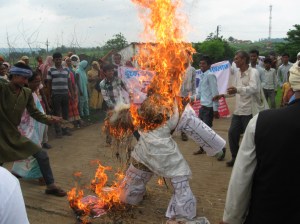
The People of Chutka and adjoining villages in Mandla district of Madhya Pradesh won another victory against the Chutka (Madhya Pradesh) Nuclear Power Plant (being imposed on them by Congress-led Central government in active collusion with BJP-led state government) as the government was forced for the second time to postpone its farcical public-hearing on the project that was scheduled on 31st July. After a sustained protest by people of the region that was actively supported by almost every section of left-democratic forces in the state and beyond, the district administration called off the public-hearing on 29th July.

Burning the Effigy of Nuclear Power at Chutka

Continue reading People’s Victory Against Chutka (Madhya Pradesh) Nuclear Power Plant: Lokesh Malti Prakash