All posts by Shuddhabrata Sengupta

Unrequited love or simply ‘self love’? – Reflections in the wake of a Campus Tragedy at JNU: Shivani Nag

Guest Post by Shivani Nag

In the days following the brutal rape and murder of a young woman in December last year, I remember waking up each day and being out on the streets raising slogans on women’s freedom and liberation. For months after that, there were a series of mobilizations, vigils, parades and protests, and my strongest recollection of those events is the resounding reverberation of ‘mahilaayein maangi azaadi… khaap se bhi azaadi aur baap se bhi azaadi, shaadi karne ki azaadi aur na karne ki azaadi…’. It WAS about justice for that one woman, but it wasn’t ONLY about that… it was also about many other such women – some forgotten, some not, some dead and some still around… it was also about all women, demanding not just justice but their right to life as equal citizens. We did not come out on the streets to be told how to be safe, but to convey it loud and clear that we cannot spend our entire lives trying to be safe without actually getting to live it. We came out to demand and defend our right to choice!! Continue reading Unrequited love or simply ‘self love’? – Reflections in the wake of a Campus Tragedy at JNU: Shivani Nag

Beyond Reasonable Doubt? The Conviction of Shahzad Ahmad: JTSA

Guest Post by Jamia Teachers’ Solidarity Association ( JTSA ), Delhi.

Beyond Reasonable Doubt? The Conviction of Shahzad Ahmad is a detailed analysis and critique by the Jamia Teachers’ Solidarity Association of the judgment awarded on the 25th of July by the 2nd Additional Session Judge, Delhi-South East (Saket) Court in the ‘State vs. Shahzad Ahmad@Pappu’ case, also known as the ‘Batla House Encounter’ case. Yesterday, on the 30th of July, the judge confirmed his verdict of ‘guilty’ and awarded Shahzad Ahmad the punishment of imprisonment for life and a fine of Rs. 95,000/-. The JTSA, which has been following the Batla House Encounter since 2008 presents its findings on the trial in this booklet, and disputes the guilty verdict awarded to Shahzad Ahmad. Kafila is carrying this publication (as part of a series of posts on the Batla House Encounter) as a downloadable pdf format file.

The Batla House Judgement and the Impossibility of Closure

The word ‘closure’ has a reassuring, comforting resonance, particularly when it comes to matters of death. One achieves closure. It is granted.  Those who are fortunate receive it as recompense for the necessary tasks of grief and mourning. We move on.

On the 25th of July, last week, after Rajender Kumar Shastri, 2nd Addiitional Sessions Judge of the South East (Saket) Court in New Delhi announced in open court that a young man named Shahzad Ahmad of Khalispur village in Uttar Pradesh’s Azamgarh Disttrict was guilty of causing the death of Inspector Mohan Chand Sharma of the Special Cell of the Delhi Police in Flat No. 108, L-18, Batla House, in South Delhi’s Jamia Nagar on the 19th of September, 2008, the word ‘closure’ began to ring out on prime time television.  We were given to believe that the infamous ‘Batla House Encounter’ case had finally achieved closure. That the ‘martyrdom’ and sacrifice of Inspector Mohan Chand Sharma had now been vindicated. That all unseemly controversy could now be put to rest. We were told that it was time to move on.

Continue reading The Batla House Judgement and the Impossibility of Closure

Ishrat Jahan, Narendra Modi and the IB: How Not to be Non-Non Terrorist

The CBI charge-sheet in the Ishrat Jahan encounter case and its aftermath has led the BJP and supporters of Narendra Modi (within and without the Intelligence Bureau) to discover the joys of time travel. Apparently, David Coleman Headley’s testimony in 2010 (which says that Ishrat Jahan was an LeT operative) has given the Gujarat police officials a means to tell us why they killed Ishrat Jahan in 2004. Or, following on from Shivam Vij’s recent tweets, we could say: “The IB says that Headley says that Ishrat Jahan was a non-non terrorist…”

We will discuss more about this heady Headley testimony and ‘non-non terrorism’ later, but for now, let us admit that the secret of how a statement in the future can influence the unfolding an event six years in the past is known only to those who are partisan to Mr. Modi and his party. It is not for nothing that they call him a Yug Purush (‘The Man of Time’)- all times, past, present and future, can do his bidding, or so thinks the BJP. Continue reading Ishrat Jahan, Narendra Modi and the IB: How Not to be Non-Non Terrorist

Madhu Mausi, Namo Mamu and the Ghost of Uncle Pepper

I’ve been thinking a lot about magic lately. The kind of magic that gets pulled at fairgrounds and birthday parties, or on stage, where the impossible is made to appear possible, where material objects dematerialize and specters appear, tantalizing us into suspending our disbelief. Some magicians, including those I would like to think of as friends, do what they can with consummate skill, so that we attain a state of wonder while they effect transformations using ordinary things for extraordinary purposes. They make us inhabit parallel universes on a table top. There is a kind of poetry and grace in that kind of magic. That is the kind of magic that makes men out of god-men, and re-affirms even a non-patriot’s faith in the ‘waters of India’.

There is another kind of magic, a bag of tricks that relies on the cheapening of our impulses, on our addictions to false premises, on our giving in to our basest instincts. And because sometimes old cliches are useful, we could call this kind black magic. The greatest practitioner of this art, at this moment, seems to me to  be none other than the man who is setting himself up as the caudillo of the future, the chief minister of Gujarat, our prime-minister in waiting, Narendrabhai Damodardas Modi. We,a stunned would be electorate, are the rabbit he is aiming to pull out of his hat.
Continue reading Madhu Mausi, Namo Mamu and the Ghost of Uncle Pepper

Another rape, still more incompetence: Time to teach Delhi Police a Lesson?

A five year old girl is now in a critical condition in a Delhi hospital after being brutalized and raped by a neighbour. The Delhi police, which has dealt with the situation with its characteristic incompetence, first refused to file an FIR when her parents went to the police station, and then, tried to bribe the girls parents with two thousand rupees so as to ‘hush them up’. Subsequently,a young woman who tried to protest against the behaviour of the police at the Dayanand Hospital were the girl was initially taken for treatment was slapped by a policeman, an Assistant Commissioner of Police, in full public view. His actions have been recorded on video. It is believed that the policemen who tried to bribe the victim’s parents and the policeman who slapped the young woman have been suspended.

But can the suspension of a few individuals address what is obviously a deep rooted culture of misogyny and class prejudice (what else is it but class prejudice – would a policeman in a thana, say in an affluent South Delhi colony be able to offer two thousand rupees as ‘hush money’ to parents of an assaulted child with the same ease with which they could in Gandhi Nagar in East Delhi) within the Delhi Police? Is more severe and strict action that goes right to the top and to the source, not necessary in order to send a signal that this kind of behaviour within the police force cannot be tolerated? Must Delhi’s police commissioner not be compelled to resign, for his abysmal failure in terms of dealing with sexism and for failing to address the contempt for citizens who are not affluent that is now clearly endemic to the Delhi Police’s work culture?

Continue reading Another rape, still more incompetence: Time to teach Delhi Police a Lesson?

Haryana Police and Administration Repress Ongoing Maruti Workers’ Struggle: MSWU

Guest Post by Maruti Suzuki Workers Union, Provisional Working Committee

Third Day of our Fast Unto Death – Police and Administration Gearing up for Further Repression of Our Struggle!

Friends,

Today is the third day of our fast unto death that began on 28th March. However it seems that the state is adamant on responding to our peaceful movement with increased violence and use of brute force. Today, when the local people of nearby villages and our family members came to lend their support to us at the site of the hunger strike, they were greeted by an increased number of policemen. When we tried to meet Haryana Industrial Minister Randeep Surjewala – we have been sitting outside whose residence for the last 6 days braving rains and the cold – he flatly refused to meet us. When the family members surrounded him demanding our rights then a large number of police men appeared at the site and the minister left the place using the police to disperse the people. Now there are 2 police vans stationed here and the small shopkeepers and tea stall owners in the area are being threatened by the administration to withdraw their support from our movement. When the administration realized that we are not going to abandon our struggle because of their threats then they put pressure on the owner of the plot where we are sitting and tried to use him force to us out.
Continue reading Haryana Police and Administration Repress Ongoing Maruti Workers’ Struggle: MSWU

Letter from Jail: Maruti Suzuki Workers Union

Guest Post by MARUTI SUZUKI WORKERS UNION
(Reg. No. 1923, IMT Manesar)

Appeal from Jail
Stand in Solidarity with us for Justice

We are workers of Maruti Suzuki, who are behind bars since 18.07.2012 as part of a conspiracy, and without any just investigation. 147 of us are inside Gurgaon Central Jail. Since July, 2500 permanent and contract workers have been terminated from our jobs. In these past more than 8 months, we have sent our appeal to almost all administrative officials and elected representatives, including Chief Minister Haryana and the Prime Minister of India. But neither have our appeals been heard nor have we been granted bail.

Continue reading Letter from Jail: Maruti Suzuki Workers Union

Aadhar/UID is Against Equality and Democracy: Moiz Tundawala

Guest Post by Moiz Tundawala

After the suppression of the 1857 Mutiny and the British take over of Delhi, Mirza Ghalib was once asked by a military official whether he were Muslim or not. Ghalib is said to have quipped: “Only half Muslim; I drink wine but refrain from swine.” For me, this ripost evinces a flippant disdain for modern forms of rule which essentialize persons and groups purely based on certain attributes which are deemed definitive and prioritized over others. As far as Ghalib’s case was concerned, the idea may have been to find out based on his religious identity if at all he could pose problems for the newly established colonial regime. In later years, this policy, which African intellectual Mahmood Mamdani has recently termed ‘define and rule’, gradually became integral to governmental practices in most parts of the modern world; today, populations are ever so readily classified and enumerated based on empirically observable characteristics in order to make them amenable to effective government. The Aadhaar project of the Unique Identification Authority of India clearly falls within the gamut of such practices, marking a transition to modernity in a radical break from the past. So my reservations with it are just the same as those with any other modernity inspired programme wherein personal and collective identities are reduced to a somewhat arbitrarily determined bare essence which may have no real connection with lived experiences of fuzzy and contextually constructed identities.

Continue reading Aadhar/UID is Against Equality and Democracy: Moiz Tundawala

A Political Hanging: Nirmalangshu Mukherji

Guest Post by Nirmalangshu Mukherji

Since the secret hanging and burial of Afzal Guru in Tihar jail, many writers have justly condemned the manner in which the government conducted the execution . However, once the state decides to hang a person, the issue of whether the killing took place in a ‘transparent’ and ‘dignified’ manner is a largely aesthetic one. The process that initiated the killing continues to be of primary epistemic concern.

No doubt the manner and timing of the hanging clearly indicates that the government had ulterior political motives in mind. Yet, these motives are better understood in terms of the political considerations that guided the case of Afzal Guru from his arrest to the rejection of his mercy petition. His hanging within a few days of the presidential rejection was just the inevitable culmination of this political process.

Continue reading A Political Hanging: Nirmalangshu Mukherji

A Tale of Two Panels: Vrinda Marwah

Guest Post by Vrinda Marwah

On 6th March, in the run up to International Women’s Day, I was involved in two panel discussions on women’s rights, both adrenalin-raising but for entirely different reasons. As someone who has been working in feminist organisations, and who, like so many others, is trying to be active and simultaneously make sense of the agitations and conversations following the Delhi gang rape, I decided to write about this experience because it was so revealing about how power operates.

The second panel, which I will talk about first, was in the United Nations Information Center, from 7:00 PM to 9:00 PM approx., organized by the New Delhi hub of the Global Shapers Community of the World Economic Forum, on issues of women’s safety in Delhi and practical measures that can be taken to address these. I don’t know much about this rather fancy sounding group (in their correspondence with me they describe themselves thus: The Global Shapers Community is a network of hubs developed and led by young people who are exceptional in their potential, achievements and drive to make a contribution to their communities). Continue reading A Tale of Two Panels: Vrinda Marwah

Kindly Deliver My Letter to the PM of India: Mahum Shabir

Guest Post by Mahum Shabir

Dear Mr. Prime Minister,

Maybe it is silly to think that the Prime Minister of the world’s largest democracy will listen to the sorrows of a young Kashmiri woman-you have a billion more people to worry about. Maybe your interest in this letter would be piqued if I began by telling you that we have something in common-an education from two of the world’s best universities, yours from Oxford, mine from Harvard. Maybe it shouldn’t take a reference to where one went to school to get attention on a serious ethical issue at the center of democratic governance in India but nothing else has worked so far. I hope jaan pehchaan will work its wonders this once too. Continue reading Kindly Deliver My Letter to the PM of India: Mahum Shabir

A Modest Proposal from EFLU Students, Hyderabad: Anonymous

Anonymous Guest Post

[This is a response to the recent political developments in the English and Foreign Languages University, Hyderabad. On 1nd March, 2013, Mudasir Kamran, a Kashmiri Muslim PhD scholar of the university was taken to the police station by the Proctor and some other professors of the university in pretext of a personal enmity between Mudasir and his erstwhile room-mate, where he was detained throughout the night without any written complaint being filed. Mudasir came back broken, asking why he was treated like a thief and a criminal. On 2nd March, he committed suicide. A section of the students since then has been demanding for the suspension of the Proctor, an apology from the university, and compensation to the family. The university administration dealt with this in a fiercely draconian manner. They refused to meet the students, they enforced police protection, they threatened a null semester, even a total shut-down of the university. They did not issue a single apology, they appeared in front of media and produced false versions of the events hand in glove with the police (that was subsequently refuted by the alleged eye-witnesses), they constituted a faculty-only Fact-Finding Committee without removing the accused from his administrative position. Rumours have been floated about the alleged homosexuality and the mental instability, thus inciting the cultural stereotype of social aberration and criminality. One unofficially Leftist section alleged that the students are spreading rumours and contacting their “Kashmiri friends” to ignite the fire of unrest in Kashmir (although there has been and still is no connection between student’s demand and what is happening in Kashmir). On 8th March, they finally succeeded in coercing the students enough to make them ask for a resumption of normalcy on the campus. The Vice-Chancellor has threatened that any political activity on the campus will result in a null semester. She has ensured that classes will commence under heavy ‘police protection’ on Monday. A section of the teachers who has refused to accept the responsibility for Mudasir’s unfortunate death has demanded for criminal cases to be filed against the protesting students. Since the protesting side has been majorly comprised of dalits, OBCs, minorities, this is an attempt from their side to allegorically (and satirically, in the tradition of Jonathan Swift who once wrote his ‘modest proposal’ that the British landed aristocracy simply eat Irish children as a way to end the problem of poverty in Ireland) express some of the horrors they have to go through to even stage a basic minimum democratic protest in a so-called elite university.]

[This text has been slightly edited and modified, mainly to allow for easier reading, and to correct a few syntactical slips, but the general tone and style, including capitalization and some archaisms have been maintained so that it is clear that this is a legitimate work of satire, written in the public interest. Kafila]

​​A MODEST PROPOSAL FOR PREVENTING THE DALITS, MINORITIES, AND IN GENERAL THE POOR AND THE MARGINALIZED FROM BEING A BURDEN ON THE GLORY OF THE ENGLISH AND FOREIGN LANGUAGES UNIVERSITY, HYDERABAD AND FOR MAKING THEM BENEFICIAL TO THE UNIVERSITY.

Continue reading A Modest Proposal from EFLU Students, Hyderabad: Anonymous

Gender Safety Audit of Delhi University: Parivartan

Guest post by PARIVARTAN – The Gender Forum of Kirori Mal College, Delhi University

In the lead up to March 8th, International Womens’ Day, I would like to share with Kafila readers, especially those in Delhi University, research done by students of Kirori Mal College on how women students perceive questions of safety and security on campus. The research is richly illustrated with graphs and figures and is especially illuminating for the way in which it reveals attitudes amongst women students about why they they do not trust an increased police presence on campus as a guarantee of their safety and security.

Mayhem in March: Sameer Bhat

Guest post by SAMEER BHAT: The completeness of night’s silence is absolute in Kashmir. Earlier today another boy was put six feet under. Killed in cold blood in Baramulla by the Indian army. Apparently a small crowd was protesting against the hanging of Afzal Guru and driven by pure emotion, pelted a passing army truck with stones. Since Kashmiri blood costs next to nothing, the armymen quickly got down, cocked their machine guns and sprayed the protesting kids with bullets, instantly killing a kid – Tahir — in his 20s. Nothing much. His friends, too shocked to react, smeared his blood on their faces. Grown-ups wept. The army later issued a statement that they didn’t shoot the boy. Period. Continue reading Mayhem in March: Sameer Bhat

People’s Watch Over Parliament: Bekhauf Azadi Campaign

20130220-235633.jpg

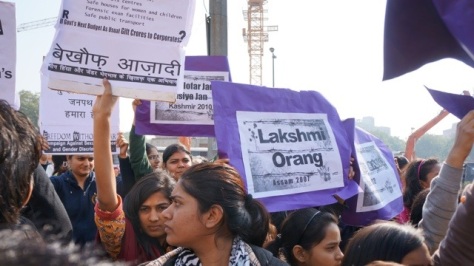
  • Protestors at the ‘Freedom Parade’ Rally of the Bekhauf Azadi Campaign, New Delhi, 26 January, 2013

Guest Post by Bekhauf Azadi (Freedom Without Fear) Campaign.

People’s Watch Over Parliament: February 21, 1st Day of the Budget Session, Jantar Mantar
Gather in large numbers – 12 PM onwards at Jantar Mantar, New Delhi.
Are Our Lawmakers Ready to Listen to the Voice of the Movement Against Sexual Violence?

Continue reading People’s Watch Over Parliament: Bekhauf Azadi Campaign

What Afzal Deserves: Chandan Gomes

20130212-185109.jpg

Guest post by CHANDAN GOMES

Ever since the news of Afzal Guru’s execution broke out on the 9th, I have witnessed my personal space descend into a state of chaos. I woke up that morning to a number of emails/facebook messages by friends requesting me to join them at Jantar Mantar to protest against Guru’s execution. Many called that particular protest farcical, some even going to the extent of labelling these young men and women as traitors. Battle lines were drawn and a country stood divided. The more I thought about the execution, the more it saddened me. I could see myself and people like me (the ordinary citizens of this great nation) as pawns in a game of ugly power play, waiting to be sacrificed at the altar of ‘opportune moment’. Continue reading What Afzal Deserves: Chandan Gomes

The Day Afzal Died: Nirmalangshu Mukherji

Guest post by NIRMALANGSHU MUKHERJI

There are days in which streaks of hope shine through dark clouds of misery. The 9th of February, 2013, was such a day.

The day broke with the news that the noose of the Indian state had finally seized the throat of Mohammad Afzal Guru after years of careful conspiracy. With ill-concealed admiration, the television screens reported the military swiftness, the secrecy, and the perfection with which a nuclear-powered state with one of the largest armies in the world escorted an unarmed, hapless Kashmiri to the gallows, performed its rituals, and pulled the bolt. As the murder was officially videographed with full legal sanction, the body was kept dangling for thirty minutes before it was pulled down and immediately buried in an ‘unmarked’ grave, protected by layers and layers of impenetrable walls. The case of Afzal Guru was thus brought to a ‘closure’. So hoped the state. Continue reading The Day Afzal Died: Nirmalangshu Mukherji

Do we have the right to a peaceful protest?: Warisha Farasat

Guest post by WARISHA FARASAT, who was present at the peaceful Jantar Mantar protest against the execution of Afzal Guru

We have been finally denied even the basic right to a peaceful protest. Two incidents over the last week have proven that only the right wing Hindutva groups have the right to protest in this country; the unbridled right to disrupt all other peaceful protests; and to ensure that the civil liberties groups are pushed even further against the wall. Two days ago, a peaceful student protest against Narendra Modi’s speech at Delhi University was met with brutal response, which has been reported extensively. Today, as Shuddhabrata Sengupta has poignantly pointed in his earlier post there were peaceful silent protests against the secretive hanging of Afzal Guru, and also for the abolition of the death penalty from the criminal statute books at Jantar Mantar. But what unraveled thereafter was shameful. The police watched and participated while young and brave University students, several of them Kashmiri, were beaten up. I saw young women with scarves, which were seen as a marker of their identity being targeted, groped, beaten, humiliated, abused, and finally arrested. Other respected civil liberties activists, lawyers, and even journalists were abused, kicked, beaten, and their faces blackened. Continue reading Do we have the right to a peaceful protest?: Warisha Farasat

Peaceful Protest Against Afzal Guru’s Execution at Jantar Mantar Broken Up by Right Wing Goons and Delhi Police

This slideshow requires JavaScript.

A small group of citizens, mainly young people from different universities in Delhi, and people associated with civil rights groups and initiatives, had gathered at Jantar Mantar in New Delhi this afternoon at 1:00 pm to express their protest against the execution by hanging of Afzal Guru at 8:00 am this morning in Tihar Prison.

The protest was dignified and entirely peaceful. It was interrupted suddenly when a large mob gathered and began heckling the protestors. I was present there, and I clearly heard this mob of young men hurl, unprintable abuses at the men and women who were peacefully protesting against the execution of Afzal Guru. Some of them wore saffron scarves that clearly identified them as being the storm troopers of the far right. They repeatedly chanted violent and incendiary slogans which included the following – “shoot them all”, “kill the traitors”. These alternated with patriotic chants. I have never seen a more nakedly bloodthirsty exhibition of the far right wing version of Indian nationalism on the streets of Delhi. The mob made threatening gestures and advanced towards the line of protestors. Continue reading Peaceful Protest Against Afzal Guru’s Execution at Jantar Mantar Broken Up by Right Wing Goons and Delhi Police

Bhag Modi Bhag: Three eyewitness accounts from a protest in Delhi University

Guest posts by CHANDAN GOMES, AKHIL KUMAR and an ANONYMOUS student; photographs by CHANDAN GOMES, SHAFAQ KHAN and MUKUL DUBE

Photo credit: Chandan Gomes

No Space for Dissent

by CHANDAN GOMES

On 6th January, 2013 the usually quaint Delhi University transformed into a battle ground of ideologies. The road leading to Sri Ram College of Commerce (SRCC) where Narendra Modi was invited to speak at the Sri Ram Memorial Oration stands witness to all that went wrong day before yesterday. Continue reading Bhag Modi Bhag: Three eyewitness accounts from a protest in Delhi University