All posts by Shuddhabrata Sengupta

All India Protest Day in Support of Maruti Suzuki Workers: MSWU

Guest post by MARUTI SUZUKI WORKERS UNION (Provisonal Working Committee)

[This is a statement issued by the MSWU – Provisional Working Committee on the All India Protest Day held on the 5th of February in many cities and industrial areas in Solidarity with the workers of the Maruti Suzuki Factory in Manesar, Gurgaon, Haryana. Predictably this important statement and report was not carried by the mainstream media.]

MSWU, Registration No. 1923, IMT Manesar, Gurgaon, Date: 5 February 2013

Today, 5th February 2013, the great response to our appeal to all trade unions, workers, democratic organizations and progressive forces to hold an ALL-INDIA PROTEST DAY in solidarity with our struggle, against the continued exploitation, repression and injustice by the Maruti Suzuki company and Haryana Government, has further strengthened our resolve. 147 of our fellow workers are arrested and have not got bail for last 7 months, 66 more have non-bailable arrest warrants against them, 546 permanent and 1800 contract workers terminated from our jobs have not been reinstated, and we continue to face continued police repression, anti-worker administration and a state which has nakedly sided with the company-management. Even thus we are determined to carry forward our struggle to release all jailed workers, reinstate all terminated workers, impartial probe into the 18 July incident, implementation of labour laws and abolition of contract worker system.

Continue reading All India Protest Day in Support of Maruti Suzuki Workers: MSWU
Azaadi (Freedom) for ‘Pragaash’, an All Female Band from Kashmir

20130206-113749.jpg

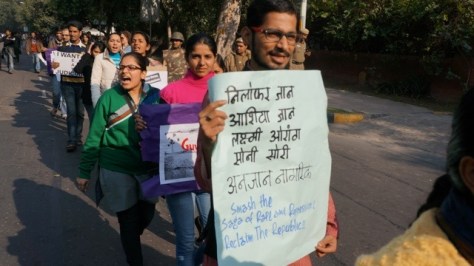
In the last month the streets of Delhi have echoed with a slogan familiar to many in Kashmir – ‘Hum Kya Chahtey ? – Azaadi !’ (‘What do we want ? – Freedom !’). Thousands of young women and men have chanted this slogan in Delhi while protesting against rape and sexual violence, and while doing so, they have also spoken out, with great courage and integrity, and carried explicit banners and signs about the fact that women in Kashmir have had to face rape and sexual assault by the AFSPA protected armed forces (the army, police, irregular counter-insurgents and paramilitary forces) of the Indian state. And no, the young people carrying these signs, and chanting these slogans, that talk about Nilofar and Aasiya Jaan, that name the atrocities and rapes that took place in Shopian and Kunan Poshpora have not been all Kashmiris. Some of them are Kashmiri students studying in Delhi University, JNU and Jamia Millia Islamia. But along with them, several of the young people who have been weaving the reality of Kashmir into the fabric of the protests in Delhi are not from Kashmir. Each time that they have walked with these signs and chanted these slogans – (and I have seen them in every gathering and every demonstration – their numbers are growing – as more young people in Delhi use the protests as sites of learning about the many complex realities of power and oppression) – they risk being branded as ‘traitors’ by the mainstream of Indian nationalist opinion, which can never question the Indian state’s conduct in Kashmir. They have tempered their sense of justice and deepened it with the substance of solidarity. Continue reading Azaadi (Freedom) for ‘Pragaash’, an All Female Band from Kashmir

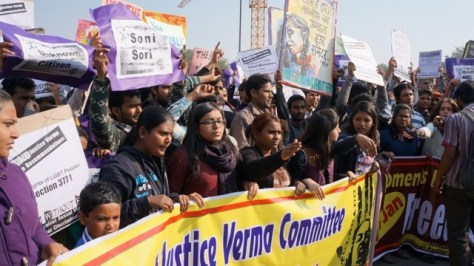
Why the Govt’s Ordnance is Fraud & Mockery of the Justice Verma Committe Recommendations: Bekhauf Azaadi Campaign

Guest post by BEKHAUF AZAADI CAMPAIGN

The UPA Govt, in a Cabinet meeting held on 1 February, has introduced an ordinance that it claims will address the most urgent concerns on sexual violence. In fact, the Government has been completely reluctant to acknowledge and implement the Justice Verma Committee recommendations: the PM refused to accept it from Justuce Verma, the Ministry of Home Affairs removed it from their website, the Govt never adopted any transparent process of discussion to decide the way forward on implementing the recommendations, rather they said Justice Verma ‘exceeded his brief’. Now, they claim that their ordinance has ‘implemented’ the Justice Verma recommendations. Is this true?

The fact is that the Government’s ordinance is a mockery of the letter and spirit of the Justice Verma recommendations. Why? Let us take a closer look.

Continue reading Why the Govt’s Ordnance is Fraud & Mockery of the Justice Verma Committe Recommendations: Bekhauf Azaadi Campaign

Water Cannons, Tear Gas, Ordinance: How the State Responds to Protests Against Rape and the Justice Verma Committee

20130203-075541.jpg

  • [ Protestors from the Bekhauf Azaadi/Freedom Without Fear Campaign Demanding Complete Implementation of the Justice Verma Committee Recommendations during the Freedom Parade to Reclaim the Republic on Republic Day, 26 January, 2012 in New Delhi. ]

So, first they come with water cannons and tear gas, and then they come with an ordnance.

Yesterday, the Union Cabinet decided to rush drafting an ordinance in response to the massive protests against rape and sexual violence that have been occurring ever since the 16th of December, 2012. According to preliminary reports, the ordnance, which will be signed into law by the President of India before Parliament even meets, flies in the face of the detailed and exhaustive list of recommendations made by the Justice Verma Committee (JVC) which had been hailed by the protesting young people and a large number of women’s organisations. In other words, the government feels no need to discuss the JVC in parliament. It feels no need to even give time and an opportunity for its recommendations to sink in, for there to be more thinking, more ideas, more awareness of the issues and questions at stake. No wonder, the government had so hastily pulled down the JVC report from its own websites after it had been released. Continue reading Water Cannons, Tear Gas, Ordinance: How the State Responds to Protests Against Rape and the Justice Verma Committee

Ashis Nandy’s Predicament and Ours

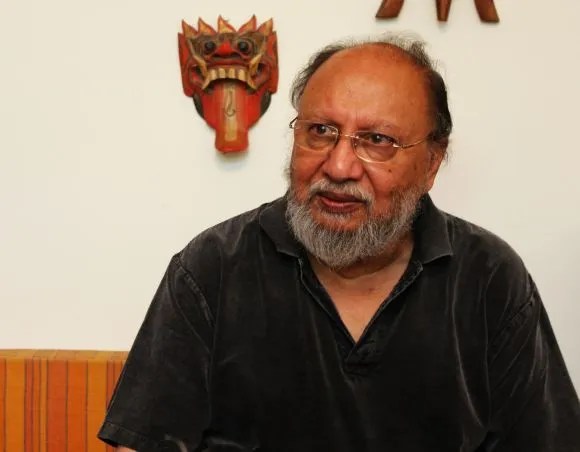
For the past few days I have been preoccupied in one part of my mind in dealing with two reasons for anguish. The first reason has to do with the profound sense of disappointment and anger with which I heard Prof. Ashis Nandy, a man I consider to be a great teacher, friend and in possession of one of the finest minds of our time, commit himself in public to a flippant and vulgar position when speaking of the relationship between caste and corruption at the Jaipur Literary Festival.

I was saddened because Prof. Nandy’s statements do a great disservice to the suppleness and ethical integrity of his thinking, and represent one of those sadly paradoxical situations where an intellectual can become their own worst adversary. I am unambiguously critical of the Nandy who chooses to be pompously opinionated and misinformed at a forum like the Jaipur Literary Festival or while riding the hot-air currents of television especially because I remain a partisan of the Nandy who can be (when he chooses to be) one of the most thoughtful and insightful witnesses to our time in his writing. Continue reading Ashis Nandy’s Predicament and Ours

Reclaiming the Republic from the Alleged Perpetrators of Violence

As I sit writing this, on the 26th of January, 2013, in various parts of the territory of the Republic of India, soldiers either already have, or are about to begin marching in formation. In New Delhi, the capital of India, their parade is accompanied by tanks, heavy artillery and replicas of nuclear warheads. In the part of the province of Jammu & Kashmir administered by the Indian Union, in several provinces of the north-east, and other areas where the writ of the state runs entirely on the basis of its armed might, Republic Day, as this date is called, is an occasion for search and cordon operations, ‘crackdowns’ and the creation of a Potemkin village like ambience in the zones (usually heavily guarded stadia) where the republic insulates itself from the public. In New Delhi, the naked, obscene exhibitionism on the axial avenue of Rajpath of a nuclear weapons power that maintains the second largest armed forces in the world, even as millions of its subjects subsist at sub-Saharan levels, is an annual ritual. Apparently, this ritual is conducted to commemorate the founding of the Indian republic through the coming into force of its constitution in 1950.

Continue reading Reclaiming the Republic from the Alleged Perpetrators of Violence

Patriarchy, Women’s Freedom and Capitalism: Kavita Krishnan

Guest post by KAVITA KRISHNAN

(This article began as a rejoinder to Hindi columnist Raj Kishor [Vaam se dakshin tak ek hi tark, (‘The same argument from Left to Right’), Rashtriya Sahara, January 13 2013], but it has also provided an occasion to address some common misconceptions about women’s freedom and capitalism.)

When women demand ‘freedom,’ why does it immediately raise the spectre of ‘licentiousness’?
Why, in other words, is women’s freedom automatically taken by many as equivalent with ‘licence,’ whereas the similar freedom on the part of men is never branded as ‘licence’?

This question arose in my mind after reading a piece by Hindi columnist Raj Kishor. Raj Kishor’s argument is that those – from Left leaders like I, to those whom he sees as representatives of the market – who are calling for women’s freedom are ‘consigning women into the fire of capitalism.’ When he hears me use the word ‘azaadi’ (freedom) he calls such freedom ‘utshrnkhalta’ (literally ‘unbridled-ness’, or licentiousness). He says and I, and the capitalist market alike, are calling for women to be free to ‘break all bounds of licentiousness’ if they so choose. Of course, Raj Kishor anticipates my criticism of his use of the word ‘utshrnkhalta’, since he says that is a word that ‘has feminists up in arms, demanding with red (infuriated) eyes the definition of ‘utshrnkhalta’.

Continue reading Patriarchy, Women’s Freedom and Capitalism: Kavita Krishnan

Implement Justice Verma Committee Recommendations Immediately: Freedom Without Fear Campaign

Guest Post from BEKHAUF AZAADI / Freedom Without Fear Campaign

UPA Government: Implement Justice Verma Committee Recommendations Without Delay!

The Report submitted by the Justice Verma committee marks an important measure of victory for the ongoing people’s movement against sexual violence, as well as for the decades of the women’s movement and democratic movement in India.

Continue reading Implement Justice Verma Committee Recommendations Immediately: Freedom Without Fear Campaign

Condemn Police Repression on Maruti Suzuki Workers’ Protest Rally: MSWU

Guest post from Provisional Working Committee (MSWU)

We from the Maruti Suzuki Workers Union (MSWU) and our families continue to face not only an exploitative company management but also continous state repression since we started our agitation demanding justice and legitimate rights of workers.

This morning, Imaan Khan, one of the members of the Provisional Working Committee, MSWU, was picked up by the Haryana police while a Press Conference was underway, from outside the union office of Sarva Karmachari Sangh in Civil Lines, Gurgaon near Puspanjali Hospital.

Continue reading Condemn Police Repression on Maruti Suzuki Workers’ Protest Rally: MSWU

Dear Barkha Dutt: The Buck Stops Where?

On the of latest edition, (telecast a few hours ago, on the evening of the 15th of January, 2013) of ‘The Buck Stops Here’, (a flagship news show on NDTV anchored by Barkha Dutt) – ‘India-Pakistan:Another Tipping Point‘, Admiral (Retd.) Ramdas, former chief of the Indian Navy said he knew that Indian forces have beheaded Pakistani soldiers in the past. Gen. (Retd.) V.P. Malik, former chief of the Indian Army contradicted him, and said this had never happened. Barkha Dutt was silent on this matter.

Below is a summary of some highlights of the discussion. Continue reading Dear Barkha Dutt: The Buck Stops Where?

Letting Go of Fear: Tenzing Choesang

Guest post by TENZING CHOESANG

Nine years ago, on a hot summer day, I was sitting in the New Delhi railway station waiting for a train to Dharamsala where I had planned to do my summer internship in a human rights organisation. There, I met a person who used to live in the same locality as I did when I was a child. He asked me where I was headed and I excitedly told him about the summer internship I was going for. He gave me a sympathetic look and said in Nepali “God, what all, daughters have to do these days”. I was taken aback by his statement but I knew where it was coming from. I come from Sikkim, a beautiful state in the foothills of the Himalayas. Students from Sikkim generally come to Delhi for graduation and after completing their higher studies most of them return back. After their return, they either start their own businesses or get into comfortable government jobs and live with their parents. This is how things work there. So, I think he felt bad for me since he thought that I was being made to “face the big bad world” when I could have gone back home happily. I didn’t agree to his logic then and have not till date. Continue reading Letting Go of Fear: Tenzing Choesang

From Delhi to Djakarta, Protests Against Sexual Violence Across Borders: Bonojit Husain

Guest post by BONOJIT HUSAIN

20130115-211244.jpg

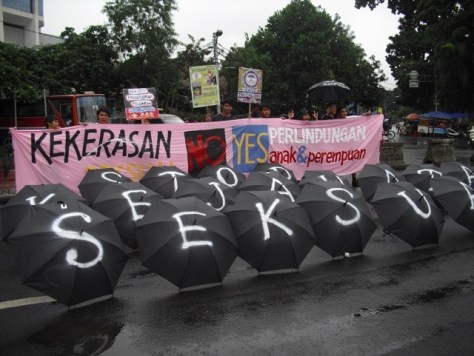
(Photographs courtesy: Pipit Apriani who is a Jakarta based activist and a blogger)

Protests against sexual violence are spreading across Asia. Last week demonstrations against rape and sexual violence were held in Nepal, Bangladesh, Pakistan and Sri Lanka.

Inspired by the protests held in Delhi for last three weeks, hundreds of university students and activists march on the streets of Jakarta few hundred meters away from the Presidential Palace for a world free of sexual violence. The call for the protest march was given by a coalition of University Students’ Unions and civil society organizations in response to the death of RI, a 11-year-old girl, who died last week after suffering severe vaginal and rectal injuries due to repeated sexual assaults. Continue reading From Delhi to Djakarta, Protests Against Sexual Violence Across Borders: Bonojit Husain

Stalking, Delhi Police and Memory – Another Encounter: Kavita Krishnan

Guest Post by Kavita Krishnan

I have been wanting to post about an experience with Delhi police since yesterday, but haven’t found the time yet… Here goes.

Some days ago, (early this month if I recall rightly), I got a call from a woman worker living in Usmanpur near Seelampur. She got my number through the son of one of our Trade Union comrades, who is a friend of her brother’s. She said she was being stalked by a man who made calls to her thretening an acid attack. She has 3 children and was concerned for their safety too. She told me she was scared to complain to the police, and asked for advice. I was reluctant to advice a police complaint without her being fully ready, knowing that it might not yield satisfactory results. So I suggested we meet and talk things over before deciding.

But soon after, she called again: feeling buoyed by a sense of hope arising from the ongoing movement, she had gone to the police station – alone – and written out a complaint, giving the stalker’s mobile number, the number of his bike, and offering to share recordings she had made on her phone of the threat calls. She said, though, that the police had not given her any proof of having received or recorded her complaint (in spite of her asking).

Continue reading Stalking, Delhi Police and Memory – Another Encounter: Kavita Krishnan

Breaking the Collective – Notes from Jantar Mantar & Koodankulam: Vivek Vellanki

Guest Post by Vivek Vellanki

The death of the young girl brought incommensurable grief for the ‘Indian’ people. A national angst ensued with divergent voices seeking divergent ends: justice, death penalty, fast track courts, end to patriarchy, chemical castration, and a long list that cannot be spelt out here. There was a glimmer of hope that the discursiveness would ensue a quintessentially democratic process of debate, discussion, and deliberation amongst the people. The Indian state with its long-standing reputation wouldn’t allow for that to happen. It had to continue on its pet peeve of Breaking the Collective! The people’s movement in Koodankulam, the anti-corruption movement, the movement for seperate Telangana are some of the many instances that remind us of this pet avocation of the Indian state being pursued in recent times, almost, vocationally. However cynical it may sound, amidst the entire candle lighting and sloganeering, we failed to realise that the protest in Delhi was happening on the terrain that the government decided, in a manner that it wished for it to play out, and was party to the people it wanted to see there. I wish to argue that the closing down of the metro stations has a relation to the nature of the protests at Jantar Mantar. Furthermore it concurs with the tactics of chocking people’s movements logistically and stifling the collective by pathologizing the everyday life of masses. The tragedy of this lies in the fact that such actions of the state have become so recurrent that they have entered our common sense and they present themselves as normal and logical responses. Albeit they have been rationalized by invoking a specious reference to law, order, and safety, there is a need to unpack such a rationalization. My attempt is to extract these actions from that location of common sense and present them for public scrutiny. Through this essay, I would like to draw the connections between the democratic protests happening in locations across the country and state action in dealing with them. In doing so, I hope to bring to notice how the Indian state uses its machinery to purge protests of their democratic tenor and eventually, at least, attempts to break the collective. Continue reading Breaking the Collective – Notes from Jantar Mantar & Koodankulam: Vivek Vellanki

The Country With A ‘Balancing Office’: Suvaid Yaseen

Guest Post by Suvaid Yaseen

Of late there has been a rising trend of Kashmiris – professionals, artists, writers, musicians et al presenting their works on Kashmir on a much wider level than before. The larger impression that comes out of it all is that the narrative has been taken up by the people for themselves. A welcome contrast to outsiders flying in and telling us what we want, how we think, and what is actually good for us.

So, every time a Kashmiri artist is presenting his/her work on Kashmir, the expectations among Kashmiris tend to go up. People start feeling that finally their narrative, of how they saw the things, what they went through, would be told to the world, bereft of the lenses of security paradigm through which Kashmir has been usually viewed  –  a strategic territory, with not-so-strategic, dispensable people.

This can be fortunate as well as unfortunate. On one hand there is a ready audience to appreciate and applaud your work. On the other hand there are expectations to ‘perform’. For the artists themselves, there are additional pressures of ‘balancing’ and having a ‘non-biased’ view from the other side.

Continue reading The Country With A ‘Balancing Office’: Suvaid Yaseen

Some thoughts on rape, sexual violence and protest – responding to responses: Devika Narayan

Guest Post by Devika Narayan

Rarely does a city experience the sort of upheaval that Delhi is witnessing.  Everyone is talking about it. Everyone has an opinion. It is impossible to walk down the street without overhearing snatches of conversation. Issues that usually find brief mention in some obscure corner of the newspaper are now being subject to analysis by every passer-by. A rickshaw driver refuses to take any money when he realises I am on my way to a protest. I remember the old man at a photocopy shop who had looked up and asked no one in particular: do you think she will die? The receptionist at the doctor’s clinic is distraught, providing waiting patients her explanation for the recent events. Men huddled around tiny fires littered across the foggy city carp on about the state of politics, the police and the government. Everyone is invested in this moment of reckoning.

An opportunity, in the most brutal manner, has been thrust upon us to challenge, critique and reconstruct unjust social relations. This is an opportunity to pledge our commitment to a vision of a gender just society. Unless we assert in powerful ways that women are autonomous beings and equal citizens it will not end. Continue reading Some thoughts on rape, sexual violence and protest – responding to responses: Devika Narayan

January 6, 1993 – A Town Torched: Remembering the Sopore Massacre Twenty Years After: Sameer Bhat

Guest post by SAMEER BHAT

In Memory of the Massacre in Sopore, Kashmir, by the 94th Battalion of the Border Security Force on January 6, 1993.

[YouTube Video – Compiled from various sources – including a report by Savyasachi Jain, now with NDTV, for Eyewitness – a VHS delivered video news magazine active in the early 1990s.]

There was sound of a huge bang that morning, like someone blowing up a cartful of dynamite. Just before the cockcrow. Most of the townspeople were asleep. The dawn prayers had thin attendance, mostly because it gets very cold in January. By nine o’clock a military patrol was out, doing rounds of the main marketplace. Suddenly gunmen emerged from a narrow alley and shot random bullets at the party before quickly disappearing in the maze that old Sopore is. Taken rather off guard, the security detail ran back to their barracks only to emerge again as Frankenstein’s monsters, spitting hell fire. In the next fifty odd minutes, they murdered fifty five people in cold blood. And burnt the town down. Continue reading January 6, 1993 – A Town Torched: Remembering the Sopore Massacre Twenty Years After: Sameer Bhat

Come Frolic with Me in the Streets of Delhi: Amrapali Basumatary

Guest post by AMRAPALI ‘TARA’ BASUMATARY

Another Report on the Gathering of the Night of 31st of December 2012/Ist January 2013 against Patriarchy in Delhi

It was 31st December 2012, city-Delhi, the same Delhi which has gained the infamy of being the Rape-Capital of a country called India, a nation whose ‘dignity’ has been maligned by the increasing cases of sexual assault on women. Around three hours before the clock struck the decisive moment of New Year, many of us gathered at the PVR Anupam complex in Saket to “take back the night”, back from the shackles of misogyny, sexual assault, patriarchy and above all from the banal and real fear of being subjected to crimes meted out by multifarious forms of male-supremacy and power. It was a night when ‘dented and painted’ females as well as males were showing that ‘denting and painting’ are not reasons that ‘invite’ rape or sexual assault and those ‘hormone driven gazes’. Continue reading Come Frolic with Me in the Streets of Delhi: Amrapali Basumatary

The Bitter Truth Regarding Delhi Police’s Womens’ Help-Line: Kavita

Guest post by KAVITA, an activist with the Stree Mukti League

Translated from Hindi by Shuddhabrata Sengupta

It would be natural to expect that in the wake of the barbaric Delhi gang-rape of December 16 and subsequent popular upsurge of anger the police and the state machinery would betray a modicum of sensitivity and alertness. The reality is just the opposite of what you expect. We have heard this from many women in the past few days, and a few evenings ago, came face to face with this sad fact ourselves.

For the last few days, we (activists of the Stree Mukti League) have been going to different places in Delhi to hold meetings, demonstrations and to distribute leaflets against sexual violence. The leaflet has a contact phone number for the Stree Mukti League. Since the evening of the 1st of January this year a perverted male individual has been continuously ringing that number, abusing us, threatening us, using obscene and unprintable language. He even said ‘I know all you girls, and you cannot escape me. What I will do to you will terrify people…’, and several other things which cannot be repeated. Continue reading The Bitter Truth Regarding Delhi Police’s Womens’ Help-Line: Kavita

Akbaruddin Owaisi – You are an Enemy of Muslims (and Hindus)

Guest post by IRSHADUL HAQUE
Translated from Hindi by Shuddhabrata Sengupta

Akbaruddin Owaisi, you are an enemy of Muslims. You are the kind of adversary who lurks like a snake in the grass, ready to strike at the person who cares for that patch. Your desire to provoke a confrontation between India’s 25 crore Muslims and 100 crore Hindus reminds us of Muhammad Ali Jinnah. This is why Javed Akhtar has gone to the extent of calling you ‘the greatest enemy of Muslims’. I know that I am not alone when I find myself agreeing with this view. Many other Indian Muslims will be in agreement with me. Continue reading Akbaruddin Owaisi – You are an Enemy of Muslims (and Hindus)

RSS Supremo Mohan Bhagwat’s Thoughts on Rape

The RSS supremo Mohan Bhagwat (or to call him out in the way he is referred to in the Sangh – Sarsanghchalak Param Pujya Shri Mohan-ji Bhagwat-ji) has now joined the pavilion of eminent Bharatiya moustachioed misogynists. In a breathtakingly revealing statement, he has told us that rapes happen in India, not in Bharat. What he means is that rape only occurs in urban areas where the influence of Paschatya Sanskriti (western culture) leads women astray into being raped by men unable to help or control themselves in the face of the assault of women, out and about, by day and night, defying Mohan Bhageat’s Sangh-mandated Lakshman Rekha.

When an upper-caste landlord in a village claims his ‘droit de seigneur’ (land-owner’s claim) with a Dalit woman, it is not rape, it is a yagya, a time honoured shastric ritual. When husbands persuade minor wives on their ‘suhaag raat’ with a few disciplinary measures that leave them with black eyes and sore limbs, it is not rape, it is the carrying out of an Upanishadic injunction. When swamijis, babajis, acharyas and prachaks have their way with ignorant and nabalik shishyas, it is not rape, it is the partaking of the naivedyam of a woman’s body. It is the realisation of a ‘pushp ki abhilasha’, even if the pushp gets pushed around a little bit in the process. Continue reading RSS Supremo Mohan Bhagwat’s Thoughts on Rape