All posts by Shivam Vij

Shivam Vij is a writer and journalist based in New Delhi.

Clean Chit to Law-Breaker Lavasa, a Blot on India’s Democracy and Environmentalism: NAPM

This press release was put out by the NATIONAL ALLIANCE FOR PEOPLE’S MOVEMENTS on 14 November 2011

Post-facto Green signal to Phase-I of Lavasa by the Union Ministry of Environment and Forests (MoEF) given on the November 9th is a blot on the democratic process and a shockingly dangerous precedent in the history of environmental action in India. MoEF’s improper action has infact sent shock-waves to eco-activists within the country and also across the world. Although it is not the first time in the long history of Indian Environmental clearance regime that political highhandedness has been used to subvert rule of law and the ends of justice, this case is unique since the clearance has disregarded well established evidence based on facts collected by no other than the MoEF itself. It is surprising that the Ministry’s decision has come in the wake of the case filed by the Maharashtra government against 15 persons including promoters of Lavasa Corporation for alleged violations of the Environment Protection Act (EPA), while the Maharashtra Chief Minister on the other hand has recommended that Lavasa be considered for environmental clearance, exposes the double standards of the state government.  Continue reading Clean Chit to Law-Breaker Lavasa, a Blot on India’s Democracy and Environmentalism: NAPM
Bring Justice to ANM Bhanwri Devi: Women’s organisations protest in Jaipur

This press release was put out by KAVITA SRIVASTAVA on behalf of various women’s organisations in Rajasthan, on 11 November 2011. For a background to the case, see “A CD and a missing health worker“.

  • RAJASTHAN CONGRESS, STOP MISUSING AND EXPLOITING WOMEN IN POLITICS!
  • ARREST MAHILPAL MADERNA AND OTHER POLITICIANS INVOLVED IN THE DISAPPEARANCE BHANWARI DEVI!
  • ASHOK GEHLOT, PRODUCE BHANWRI DEVI DEAD OR ALIVE, OR ELSE RESIGN!
  • BJP WHERE ARE YOUR TEARS FOR BHANWRI DEVI!! STOP PLAYING THE CASTE CARD!
  • MAMTA SHARMA, NCW Chairperson, WHY THE SILENCE ON BHANWRI DEVI!

Raising the above slogans, Women, Dalit and Human Rights Organisation under the leadership of Dr. Pawan Surana ex-chairperson of the state women’s commission, protested today 11 November, 2011 condemning the Ashok Gehlot Government for the disappearance of one the workers of his Government ANM Bhanwri Devi and an aspirant of the Congress party.  Continue reading Bring Justice to ANM Bhanwri Devi: Women’s organisations protest in Jaipur

‘A Call for Rejecting 2011 Land Acquisition Bill’

This joint statement, signed and endorsed by various organisations and individuals from across India, named at the end, was put out on 12 November 2011. 

The 2011 Land Acquisition, Resettlement and Rehabilitation Bill is a dangerous exercise in doublespeak that will worsen the injustice and devastation caused by the present law. Below is a joint statement on this legislation from a number of organisations and individuals, calling for the rejection of the new Bill and raising the basic issues that need to be addressed by any legal framework.

The statement points out that:

Continue reading ‘A Call for Rejecting 2011 Land Acquisition Bill’

Govt must do more to protect minorities: Human Rights Commission of Pakistan

This press release was put out by the HUMAN RIGHTS COMMISSION OF PAKISTAN, Lahore, on 9 November 2011

The brazen murder of three brothers from the Hindu community in Shikarpur district on Eid day demonstrates that the perpetrators believe they can get away with murder simply because the victims are non-Muslim, the Human Rights Commission of Pakistan (HRCP) has said.

In a statement issued on Wednesday the Commission said: “HRCP is shocked at the brazen murder of the three Hindu citizens in Shikarpur and shares the sense of outrage of the Hindu community, not least because of the utter failure of the police to prevent the killings or arrest the killers even though threats of violence had been brought to their notice. Continue reading Govt must do more to protect minorities: Human Rights Commission of Pakistan

Rain, Eid and Geelani: Sameer Bhat

Guest post by SAMEER BHAT

A fine rain was falling as I disembarked the aircraft. Srinagar was shivering at 7 degrees centigrade. Rams and ewes, all set for slaughter on Eid, looked forlorn. Meat-market persons in untidy pherans haggled with locals for rates. Half the male population, I noticed, had not seen a shaving blade for weeks, a very Kashmiri trait most noticeable in winters. While it continued to drizzle, queues outside ATM machines got fretful. At least three people entered the cashpoint at one time to witness your transaction. The invasion of financial privacy has a very harmless ring to it, which is very indigenous. Continue reading Rain, Eid and Geelani: Sameer Bhat

Mistaken Identity: Arif Ayaz Parrey

Guest post by ARIF AYAZ PARREY

The Indian army in Kashmir must be reading a lot of Manto these days. Or Borges. Or Kundera. Or –and this is most likely, given the approaching winter season and their ‘hearts and minds’ programme– Kashmiri folklore.

Not three months have passed since they made a highly publicized acknowledgement of “mistaken identity” after they had killed a mentally “challenged” “Hindu” youth in Poonch and declared that he was a “fierce” “Pakistani terrorist Abu-Usman killed after a 12-hour long gunbattle” (such valour exhibited by the Indian security forces is the stuff of legends in Kashmir) that they have followed it with another announcement of a (dis)similar “mistaken indentity”.

This time, like always, the culprits are the Kashmiri people (whose synonym in the Indian army’s dictionary is “miscreants”) Apparently, people beat to pulp a “member of a covert team of the army and J&K police” who were “sent to Sopore Town on getting info of presence of terrorists in the public rally addressed  by SA Geelani”. The person was carrying a camcorder and his service pistol. The people thought he was the terrorist.

Democracy? History? Or “mishtake”? Choose your option.

Kundera writes, “When the institutions of a state no longer feel the need to make sense or to give plausible explanations, the state can only survive as long as people allow it to lie shamelessly.”

See also:

Previously in Kafila by Arif Ayaz Parrey:

A Rickshaw Ride in Kolkata: Waled Aadnan

Guest post by WALED AADNAN

“Amar naam Chatterjee!” My name is Chatterjee! sounds like a proclamation from a fiery leader of the masses at a public rally, but it came from a rickshaw wallah plying his trade in the dusty bylanes of North Calcutta and addressed to no one in particular.

As I sat on his rickshaw, the frail old man launched into an indignant tirade against the ruling political party, whom he branded as a group of turncoats, insisting vehemently and repeatedly to nothing but the evening breeze that he had always been a Congressman.

Yes, he defended, petrol prices have been rising, but surely the bosses in Delhi would admit to that! What is the point of protesting about that in an insignificant meeting of rickshaw wallahs’ union? His tone of uncompromising understanding of world affairs drew me to listen to him, rather than plug in my earphones and switch off the world. Continue reading A Rickshaw Ride in Kolkata: Waled Aadnan

Adib Shishakly – The Rebel in the Hotel Room: Alia Allana

This guest post by ALIA ALLANA, a despatch from Istanbul, is the seventh in Kafila series of ground reports from the Arab Spring. Photos by Alia Allana unless otherwise mentioned

Adib Shishakly’s rebellion starts with a small pin on his blue blazer.

Embellishing the the blue of his jacket, clipped on to the left collar is a flag of Syria not seen since the days following the French mandate. Today the flag flies in the besieged areas of Homs, Hama and Dera’a where the protestors have posed Bashar al Assad’s regime with it’s biggest challenge to date. It’s this very flag, with its three golden stars that was outlawed by the Ba’ath Party, by strong man Hafez al Assad.

Continue reading Adib Shishakly – The Rebel in the Hotel Room: Alia Allana

Kathmandu to Peshawar

Himal Southasian editor Kanak Mani Dixit and his wife Shanta Dixit, an educator, are driving from Kathmandu to Peshawar, via Lucknow, Delhi and Lahore, to raise money for Nepal’s only Spinal Injury Rehabiliation Centre, which he started after Kanak’s own miraculous recovery from a spinal injury. The journey was flagged off yesterday by Nepal President Ram Baran Yadav. Do join them!

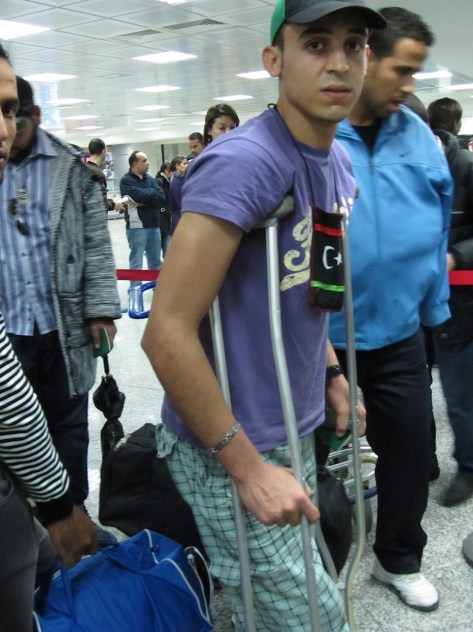
‘Who isn’t a Shabaab these days?’: Alia Allana reports from the Tunisia-Libya border

This guest post by ALIA ALLANA is part of a Kafila series of despatches from the Arab Spring

When does a boy become a shabaab?

Literally, in Arabic, shabaab means young men. Before the fever of the Arab Spring raged in the minds of the youth, back when boys used to gather in squares aimlessly, girls eyeing them would call them shabaab.

But that was then; before the political architecture of the Arab world was reconstructed.

Today the shabaab are the disenchanted youth, the angry boys of Benghazi with deathly toys devoid of opportunity, angry at their condition, aware of the world through the Internet and their mobiles, acting out their rebellion. Today the shabaab, the rebels of Libya, want what they think is theirs: the right to self-determination, a say in politics and freedom.

Continue reading ‘Who isn’t a Shabaab these days?’: Alia Allana reports from the Tunisia-Libya border

My Days with Nationalism in Assam: Ankur Tamuli Phukan

Guest post by ANKUR TAMULI PHUKAN

Many of us who have been studying the political process in Assam were surprised when we received the news in December 2009 that Chairman Arabindo Rajkhowa and some of his colleagues of United Liberation Front of Asom (ULFA) had been arrested in Bangladesh. This moment had to come some day, but we were not prepared to face it. We were familiar with the brave and somewhat legendary image they had created for themselves and needed time to believe that they could be defeated. Continue reading My Days with Nationalism in Assam: Ankur Tamuli Phukan

A temple in Peshawar reopens for the first time since 1947: Shabbir Imam

Guest post by SHABBIR IMAM from Peshawar, Pakistan. Video and photos by Shabbir Imam

[youtube:http://www.youtube.com/watch?v=qnZJClQNI_c%5D

During Sikh rule in Peshawar, the Gor Khatri area of Peshawar was declared Governor House, so the Gorakh Nath temple here was abondened and Hindu families shifted to a close by residential compound called Christian Colony. Then during the British Raj, the government provided residential quarters to a Hindu family to look after the temple. Continue reading A temple in Peshawar reopens for the first time since 1947: Shabbir Imam

What ails Pakistan?

Op-eds. Yes.

Bad things only happen so that columnists may write Op-eds about them. Before the advent of newspapers there were no terrorists, no sectarian divide, nothing was on the brink, nobody was at a crossroads; the insidious Op-ed writers have invented all these things to scare us under our beds, like parents who tell their children ghost stories because they don’t want them wandering around in the dark lest they flip the light switch at an inappropriate time. [Read the full post by Haseeb Asif]

From Kafila archives:

Kashmir’s Horcrux: Sameer Bhat

Guest post by SAMEER BHAT

Hectic parleys are on at the moment to jettison the dreaded AFSPA in the valley. By conservative estimates the army must have beaten about one in every five Kashmiris at one point or the other since this piece of horrible legislation was slapped on us. An unjust law, is no law at all, Martin Luther, the symbol of protestant reformation, verbalized the sentiment of St Augustine in the 15th century. Rings true to this day.

For more than twenty years people have been punched, thrown in the back of military trucks, knocked down by gun-butts, given kicks, pushed around as they got off a bus or simply slapped around for no apparent reason. Just for being themselves, perhaps. No you could not question the moral turpitude of a military-walla from Madras if he clubbed your aging father.  Continue reading Kashmir’s Horcrux: Sameer Bhat

25 Years of Delhi’s Lotus Temple

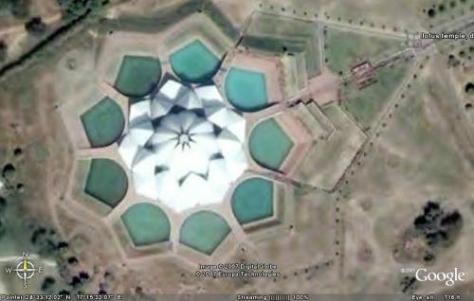
On a hot Sunday morning, tourists wait 30 minutes in a queue to get inside the House of Worship of the Bahá’í in Kalkaji, better known by its unofficial name, the Lotus temple. Once inside, they spend less than 30 seconds. The tourists, who include burqa-clad women and sadhus in saffron, don’t seem to be in need of a multi-faith prayer hall. The multi-faith prayer service, held thrice a day, is also sparsely attended. People are apparently disappointed there’s only a large hall inside that beautiful white Lotus building, and they can’t even take photos of this hall.   Continue reading 25 Years of Delhi’s Lotus Temple

The Synagogue and the Jihadi: Alia Allana reports from Jerba

This guest post by ALIA ALLANA is part of a Kafila series of ground reports from the Arab Spring

Inside the El Ghriba synagogue in Djerba, an island off the south coast of Tunisia

Out of all the outrageous questions I have asked in my life, this one has to be amongst the top ten:

“Are you a jihadi?” Continue reading The Synagogue and the Jihadi: Alia Allana reports from Jerba

Giving democracy in Pakistan a chance: Raza Rumi

Guest post by RAZA RUMI

Endless predictions about the fall of the PPP-led coalition government in Pakistan have been made by pundits since the very day it came to power. The recent hullabaloo about this has been in the context of the forthcoming Senate Elections, due in March 2012, which ceteris paribus will ensure a simple majority to the PPP and its allies in the upper house. Given that the Senate is an equaliser in federalist politics, this would mean that legitimate representatives of smaller provinces would be permanent stakeholders in the system beyond this government. Continue reading Giving democracy in Pakistan a chance: Raza Rumi

A prologue to memory: Arif Ayaz Parrey

Guest post by ARIF AYAZ PARREY

Over the corner shop at the busy crossing near home hangs a white board on which the words ‘Muzaffar Pan-House’ are painted in bright red. On the right side of the words, an artistic rendition of the side-view of Muzaffar’s face can be seen. His left hand is also painted in, holding a cigarette. The grey smoke emanating from the cigarette does not vanish before it touches the top of the board.
Continue reading A prologue to memory: Arif Ayaz Parrey

AFSPA in Kashmir – “Armed Forces’ Say Prevails Anyway”: Gowhar Geelani

Guest post by GOWHAR GEELANI

There is a lot of noise in the media over AFSPA. Ask any senior Indian security official, a turn-coat politician or a retired Army General what AFSPA stands for. “Armed Forces Special Powers Act,” they will say. Now pose the same query to an ordinary Kashmiri living there in the hapless Vale for the past two decades. The answer perhaps would be: “Armed Forces’ Say Prevails Anyway”. Continue reading AFSPA in Kashmir – “Armed Forces’ Say Prevails Anyway”: Gowhar Geelani

End the culture of impunity, not just AFSPA: APDP

This is a press release from the ASSOCIATION OF PARENTS OF DISAPPEARED PERSONS

The Bund Amira Kadal, Srinagar – 190001, Jammu and Kashmir
28th October 2011

APDP feels that the recent announcement by the Chief Minister Omar Abdullah on the partial revocation of Armed Forces (Special Powers) Act (AFSPA) from some areas of Jammu and Kashmir would be insignificant for improving the human rights situation and also for providing justice to those affected by the mindless violence by armed forces.
Continue reading End the culture of impunity, not just AFSPA: APDP

‘This is like a editorial kind of things no, I can’t mention on the paper you know’

Goa-based journalist MAYABHUSHAN NAGVENKAR posed as a politician planning to contest the Goa assembly elections 2012, and called up a marketing executive of the Goa newspaper, Herald, asking for an interview to be published in the newspaper, for a price, as editorial content rather than advertisement. He has posted online four conversations he had with the executive, one of which you can hear below.

See the full story: Goa’s Paid Piper – Paid political interview in Goa’s Herald newspaper for Rs 86,400

And the newspaper’s response.